
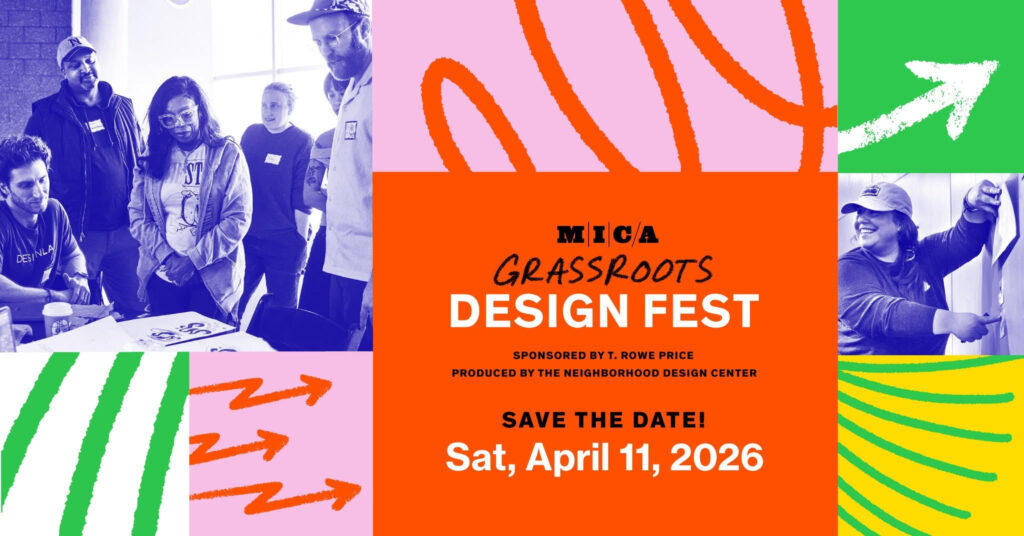
The Neighborhood Design Center (NDC), in partnership with the T. Rowe Price Foundation and Maryland Institute College of Art (MICA), today announced the return of Grassroots DesignFest, a daylong, in-person design event that pairs volunteer design teams with Baltimore-based nonprofits for high-impact, pro bono design support, on Saturday, April 11, 2026.
Inspired by the hackathon model and conceived by the T. Rowe Price Foundation, Grassroots DesignFest demonstrates the role creative problem-solving can play in strengthening Baltimore’s social-change ecosystem. Hosted by MICA, Grassroots DesignFest has become a signature civic design initiative, helping small nonprofits strengthen their visual identities, communication tools, and public presence. Post-event surveys consistently show high satisfaction across nonprofit partners, design teams, and coaches, with nonprofits citing the quality of design results and access to expertise they could not otherwise afford.
This year’s cohort includes more than 100 professional and volunteer designers who will be paired with 15 nonprofits representing arts and culture, youth development, human services, neighborhood revitalization, and environmental work. Projects were selected through a competitive application process to ensure strong alignment between organizational needs and achievable design outcomes. Volunteer design teams—supported by expert coaches and NDC facilitators—will work directly with nonprofit leaders throughout the day to develop actionable concepts tailored to each organization’s priorities, which range from logo and website development to wayfinding signage, digital marketing, placemaking, and collateral needs.
“As we mark our Bicentennial, MICA is proud to once again host Grassroots DesignFest and welcome designers and community partners into a dynamic space energized by creativity and connection to Baltimore,” said Elizabeth Homan, MICA VP of Marketing and Communications. “This event speaks directly to MICA’s deep commitment to creative entrepreneurship and to bringing students and professionals together to learn, collaborate, and use their craft for public good. It reflects the power of community-centered design—and its potential to help shape a more equitable Baltimore.”