Walking into the theater for Iron Crow’s new production, The View Upstairs, is more akin to entering a bar than a black box. Or, if you’re, say, two negronis deep after just visiting the nearby Owl Bar, you’re practically on a pub crawl. That’s because glasses are clinking as audience members get to order from the bar before the show and take shots with the cast. This prelude is remarkably warm and inviting and is thematically consistent for the piece of musical theater that is about to commence: a eulogistic celebration of the Upstairs Lounge, a real-life New Orleans gay bar whose inclusivity in the 1970s became, ultimately, the stuff of legends.
Since there’s a piano present, it makes sense that one of the actors sets down his whiskey and starts to play. It’s Buddy (Xander Conte), belting out what sounds at first like an impromptu rendition of a lost Billy Joel track. When the chorus hits, the other actors join in, because that’s what’s fun at a bar where everyone’s friends. Seamlessly and practically mid-verse, the singalong morphs into a full ensemble piece, and the effect is that of transitioning from reality to fantasy.
Up until the opening number’s end, there’s little clue that View is a ghost story, but this will soon be learned by Wes (Joey Schuman). He’s a present-day Gen-Z entrepreneur who’s flown down from Brooklyn to evaluate the now-decrepit drinkery as the locus for his next influencer project, whatever that means. Wes, like the audience, is oblivious to the fact that nearly fifty years prior, one night in 1973, the former Upstairs Lounge space was the target of hate-fueled arson attack that destroyed the building and killed all 32 of its occupants.
It’s a grim backdrop, but to the credit of Max Vernon’s 2017 script, the play is much more of a party than a sobriety-check. How? Well, Wes falls through some kind of temporal rift when visiting the bar and is teleported backward in time to enjoy one fateful and glamorous evening in its heyday, joining the same patrons and staff who’d greeted the audience not long ago. For some, random occurrences of time travel might prove terrifying, but for Wes, it’s just another trip. “Gee,” he exclaims five minutes into the ordeal, wearing a grin bigger than a rainbow. “I’ve got to call my dealer because these drugs are fucking great!”
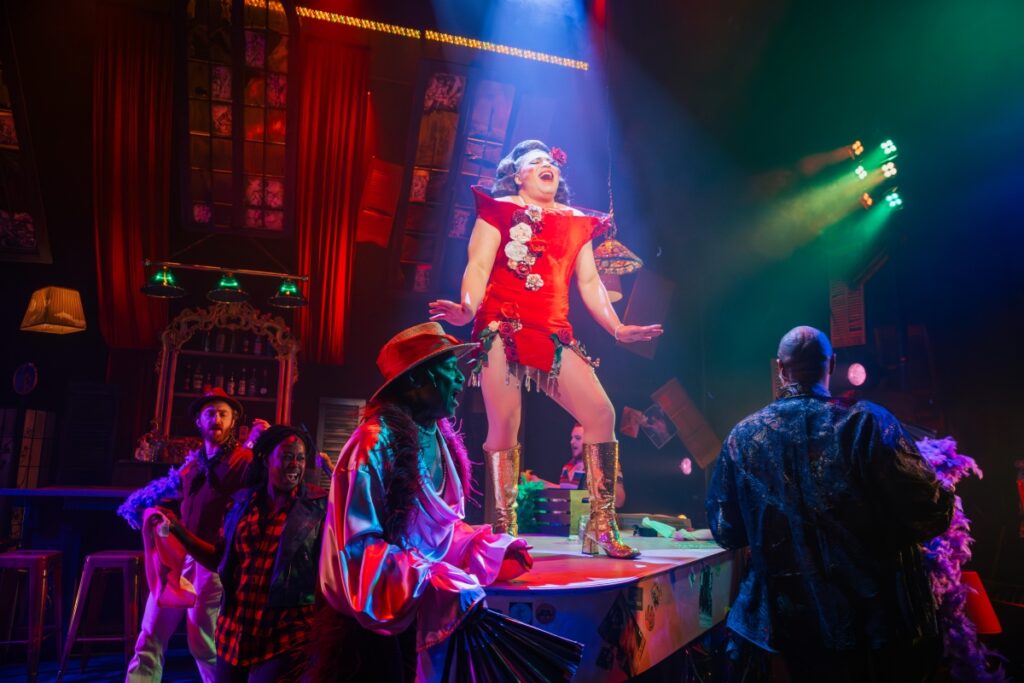
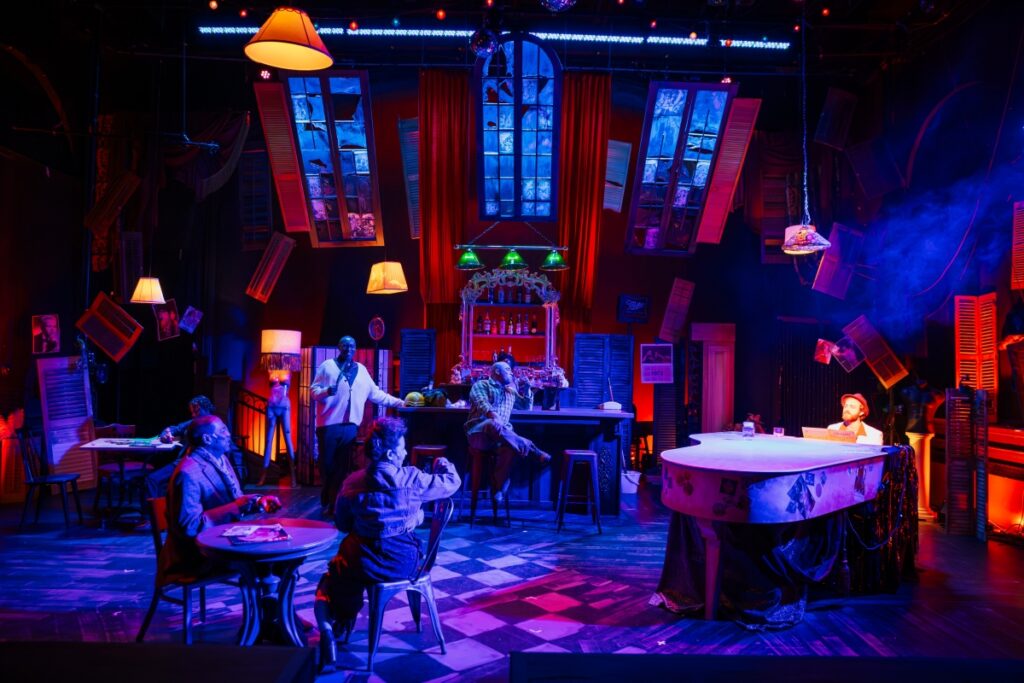
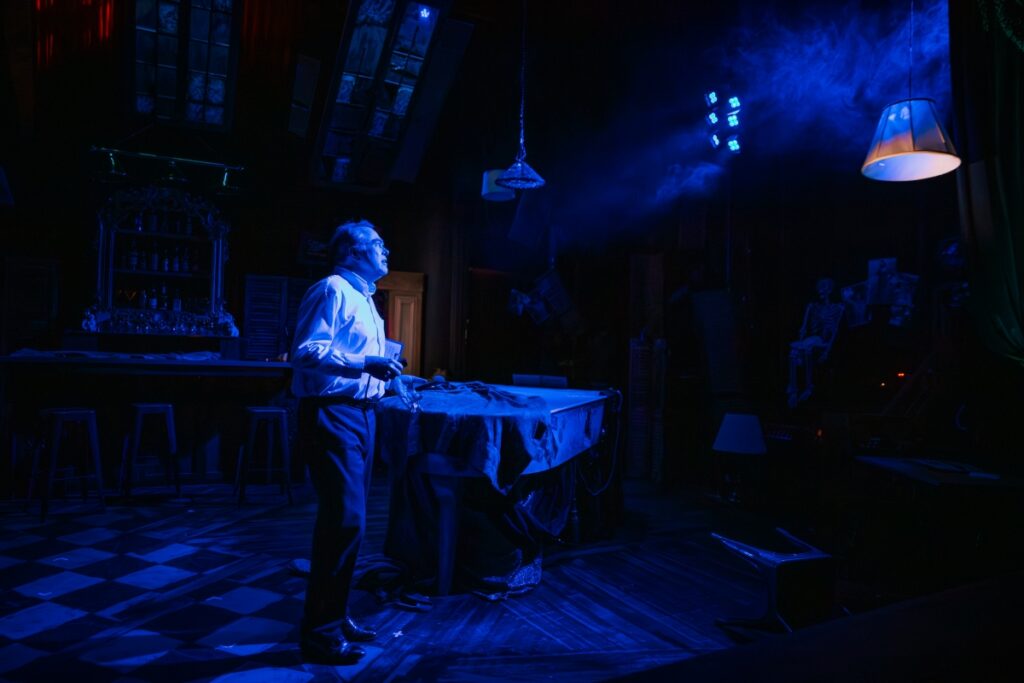
Will future-Wes keep the Upstairs Lounge’s décor the same? Probably not. James V. Raymond’s stage design is a love letter to the kind of oddball dives once numerous in Baltimore neighborhoods like Mount Vernon or Fell’s Point, that is: musty, eccentric watering holes so packed with decorations that the spaces could conceivably double as antique stores after some dusting and brighter lighting. Burnt window fixtures with melty panes hang suspended over the stage, and they overshadow the whole affair in a way that’s lightly surreal. Their off-kilter arrangement suggests that in this narrative, the laws of reality only haphazardly apply.
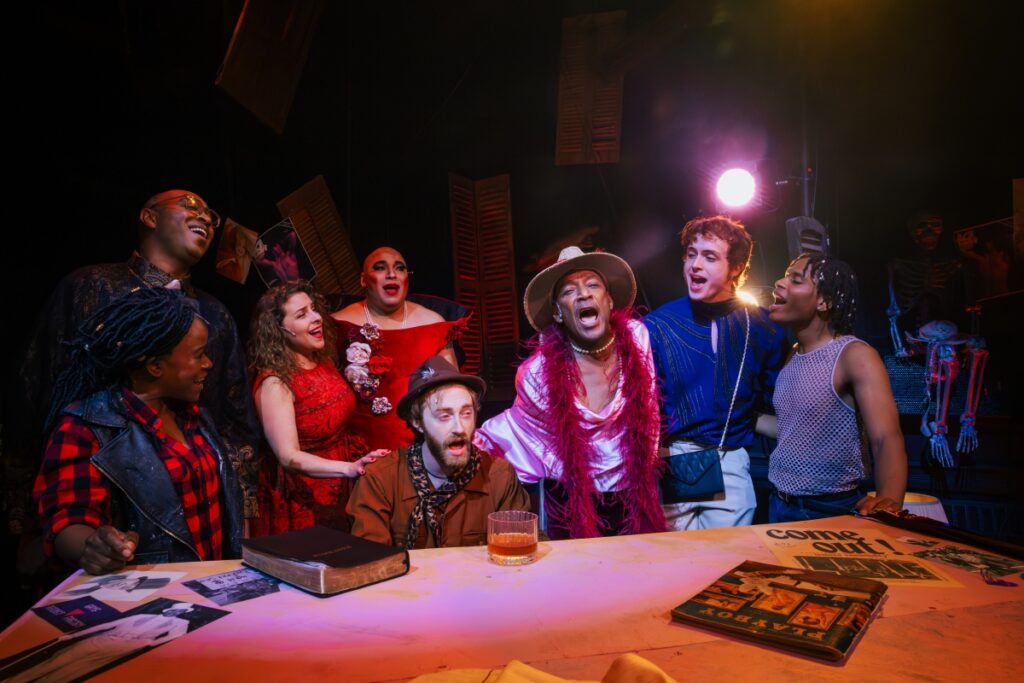
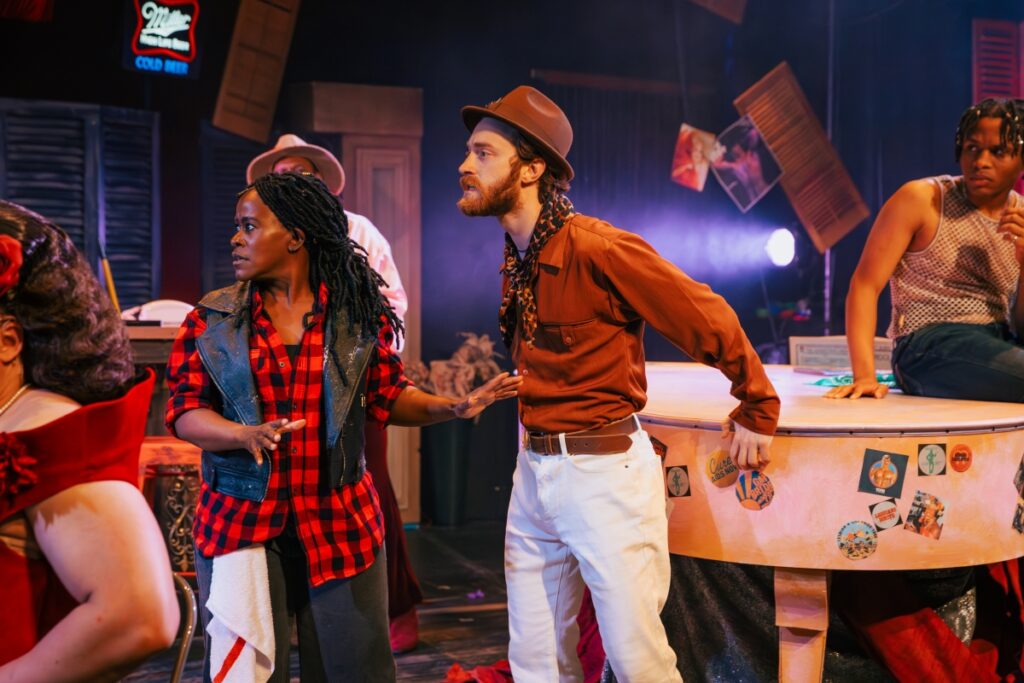
At the Upstairs Lounge, Wes finds allies aplenty. Since this is an ensemble piece, space is made to focus on the bars’ denizens: each shares a backstory and a soulful song with which to be witnessed, and in this way, the motley crew comes to feel like old friends from real life who we’ve somehow never met. We meet Freddy (Christopher Alexey Diaz), a Latino drag queen who learned makeup from his bighearted Mom, Inez (Santina Maiolatesi). There’s Richard (Nicholas Miles), a gay pastor who preaches a universal gospel of love. Fronting the group is bar owner Henri, (Iron Crow resident Asia-Ligé Arnold), who needs to be practical because her customers are known to gank drinks, and who probably carries a switchblade, too, even though she’s a big ‘ol softy inside. Then, watching from the sidelines, is self-described “old queen” Wille (fellow resident Timoth David Copney), who waxes and wanes over the good old days—just don’t ask him how long ago they were.
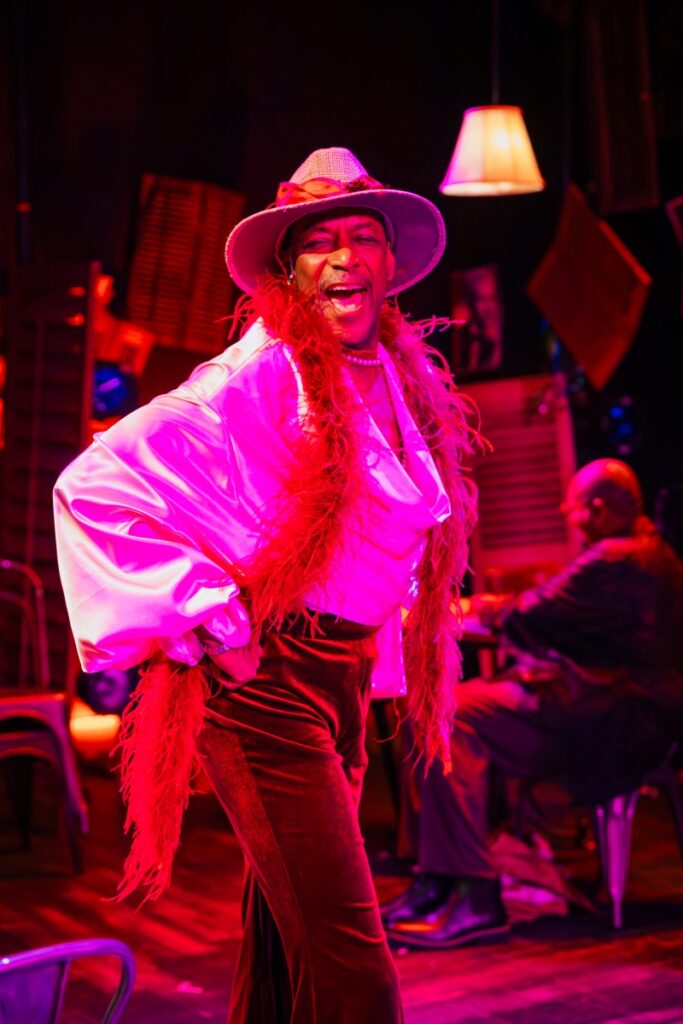
But not all is rosy for the patrons of the Upstairs Lounge. Dale (Geraden Ward) suffers from shaky emotional health and struggles with substance abuse after living as an outcast on the margins. And Buddy is supposedly everybody’s best friend in the world, but when a dangerous outsider (David Forrer) invades the bar midway through the play, he’s the first to deepen his voice and don the mask of straightness. “I have a wife and kids at home!” he pleads when push comes to shove. “I’m not one of these queers; I just play here to make a few extra bucks!”
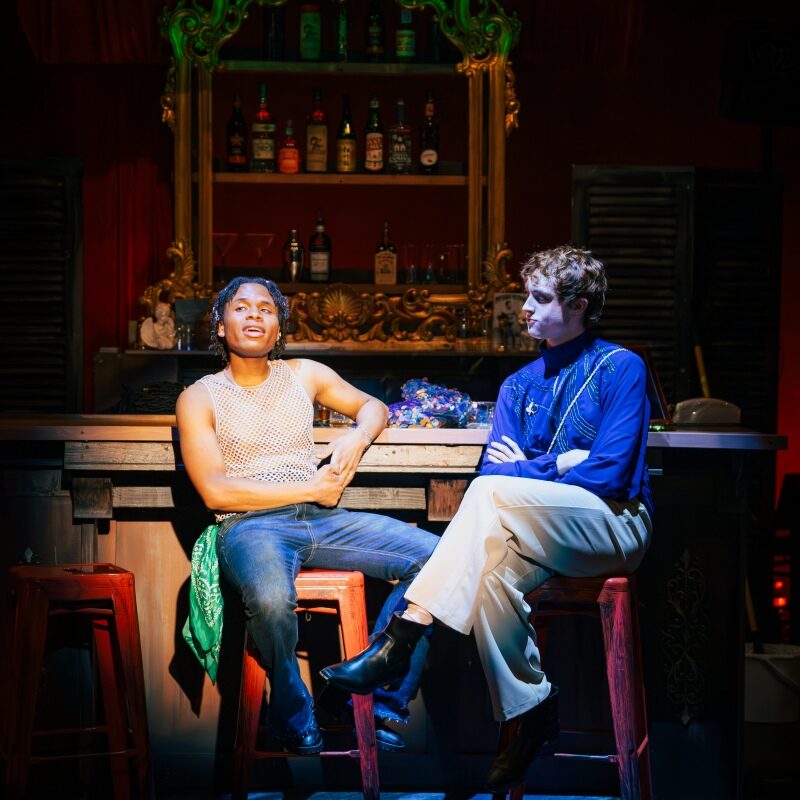
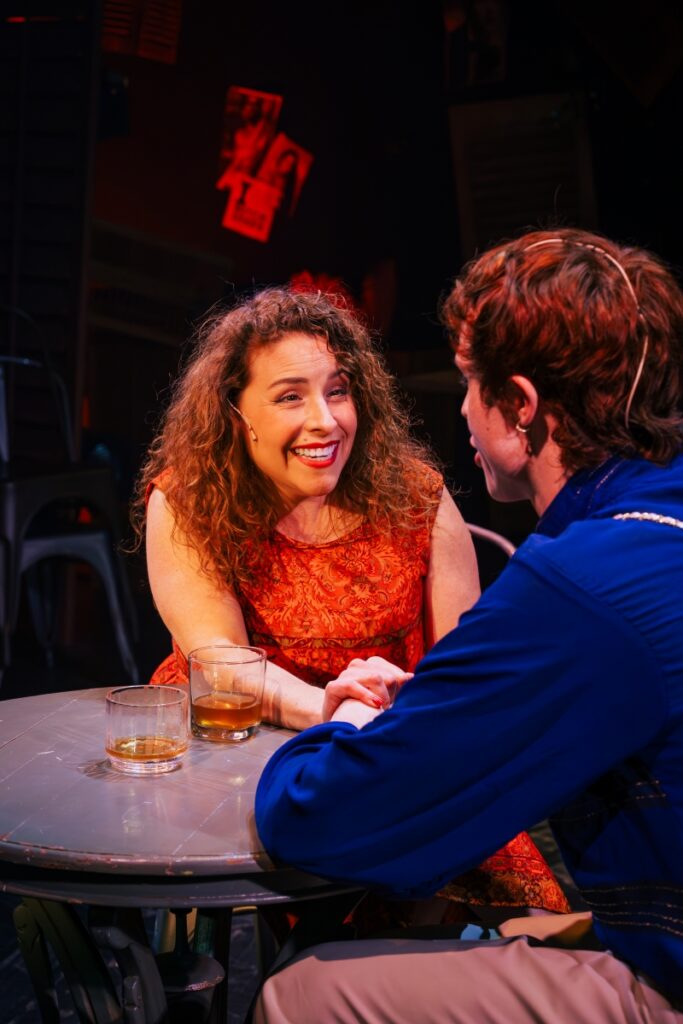
Wes’ attention is captured most by fellow romantic, Patrick (Kobe Morrison). The burgeoning love and lust between the two young men—one of whom is living while the other, sadly, is not—provides the View Upstairs’ emotional and intellectual hooks. They circle one another in an elaborate routine of flirting and bickering.
To Patrick, gay men in the 1970s are less self-absorbed and more tapped into present reality than Wes is. The lack of a cell phone in his pocket becomes his superpower. Wes, meanwhile, envies Patrick’s carefree attitude toward casual sex, but pities it all the same. It’s 1973 after all, and AIDS doesn’t yet exist.
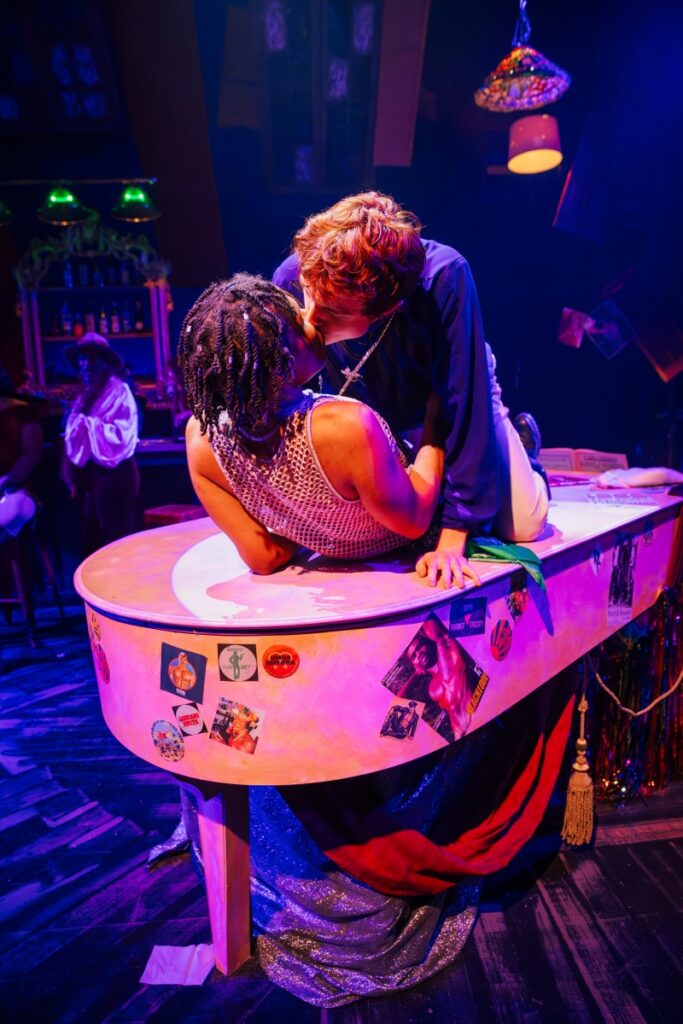
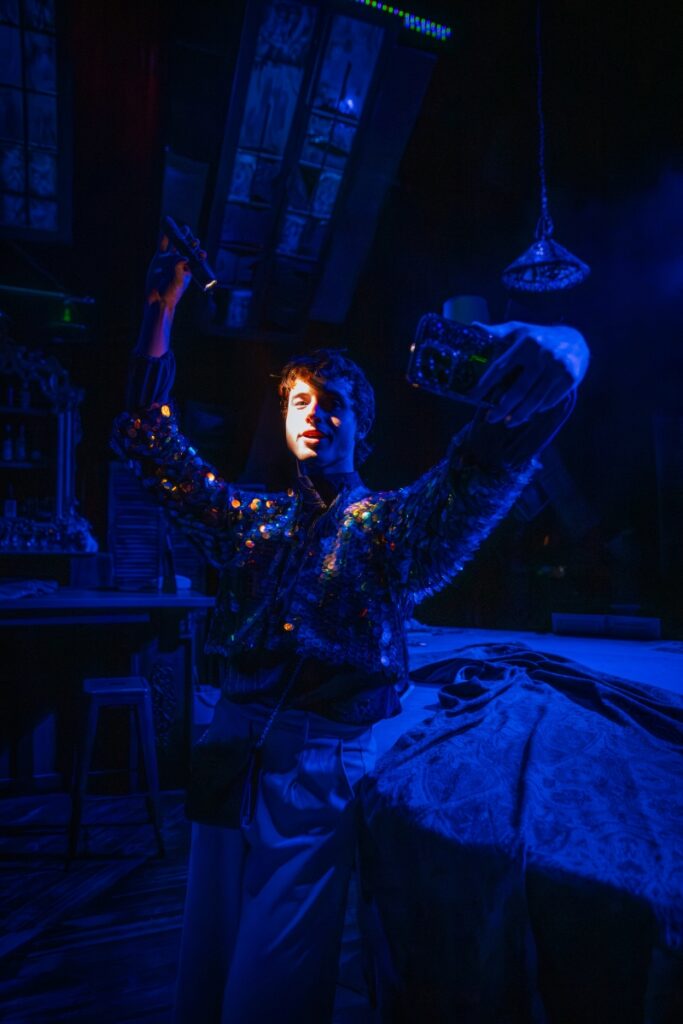
Joey Schuman and Kobe Morrison are both young, Iron Crow newbies, and they ably lead the show. The character of Wes is arguably one-dimensional as the generic centennial/zoomer kid, but Schuman makes the most of the script and then some, landing jokes and heartfelt moments alike with irresistible sincerity. The pop-punk bounce he brings to the early song “#householdname” amped up the energy and had the audience bopping in their seats.
Since Schuman’s is the kind of performance that strives for audience approval, Morrison provides the perfect counterbalance. His Patrick is falsely modest and somewhat coy, even if it’s all part of an elaborate effort to charm Wes’ pants off. When it comes time for him to sing, it’s musical theater magic. A good song and dance routine always delights, but by combining considerable technical chops with his effortless affect, Morrison wows as he jumps from barstool to countertop, nailing his notes and tossing empty glasses to castmates like it’s just another night on the town.
For the audience, the joy these two come to experience is bittersweet. According to the note written by Iron Crow’s Artistic Director, Sean Elias (who also directed this show), the firebombing of the Upstairs Lounge was the deadliest act of mass violence directed at the queer community until the 2016 Pulse Nightclub shooting, and the ordeal was underplayed by local news and largely forgotten in time until recent years. When the chilling tragedy finally arrives, the script handles it without flinching from the gruesome details but does so with artful compassion that does not serve to negate the play’s optimistic spirit.
Other scripts may have delved deeper into the attack itself or played up its ignorant, bigoted perpetrators, but this one keeps the villains and their motivations on the sidelines, ensuring that the imagined history spotlights the characters’ lives, not their deaths.
And while it all takes place in The Big Easy, it could just as easily be set in Baltimore. In our city, residents are also confronted daily with the question of how to balance honoring the history of physical spaces with the march of forward progress. Like Wes, Baltimoreans must decide if knocking down buildings and building modern ones in their place is better than the dream of reviving the glory of days past.
The View Upstairs hits particularly hard in a neighborhood that, within recent-ish memory, featured at least twice as many prominent gay bars. As Wes explains to his new best friends, in the future, hookup culture transpires within smartphones, not community spaces. Individuals don’t chat or banter or catfight in flirtatious rituals much anymore, they just swap nudes and select one another from a list, same as ordering a DoorDash or an Uber.
In the present day, Wes is openly queer and understands that his ability to be so was hard won by his predecessors, but in the end, it’s ambiguous whether he is more or less free than his 70’s compatriots, or any more alive.
The View Upstairs runs May 29th through June 14th at the Theater Project, 45 W Preston St, Baltimore, MD 21201. Tickets can be purchased at https://www.ironcrowtheatre.org/. Pro-tip: show up early.