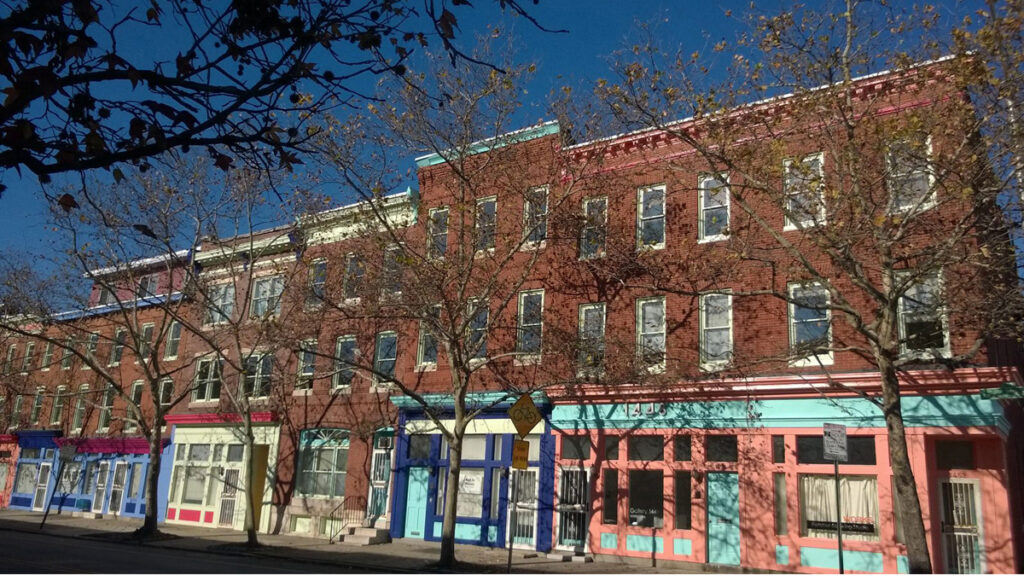
Along an unassuming block of East Baltimore Street, a row of classic Baltimore storefront houses features woodwork painted salmon pink, turquoise, and pistachio. Their plate glass windows reveal handmade ceramic dishes, a statue with a goat skull head wearing a spiky jacket, and a gallery advertising an erotic art show. This stretch between Washington Hill and Jonestown embodies a radical experiment in urban arts development that has quietly endured for nearly forty years: Artists Housing Inc. (AHI), Baltimore’s first and oldest residential art cooperative.
The block had been long abandoned when the city acquired the ten rowhouses on the 1400 block between 1984-1985. Betty Hyatt, Director of the Citizens for Washington Hill —who had already piloted a “shopsteading” project that brought craftspeople and businesses to the 1600 block of East Baltimore Street—partnered with Jody Albright at the Mayor’s Advisory Committee on Art and Culture under Mayor William Donald Schaefer’s administration to reimagine what the block could become. Their vision, as the Evening Sun described it in August 1986, was “an artists’ utopia.” The transformation of ten rowhouses into 32 units cost $1.25 million, combining a $500,000 Community Development Block Grant with a $750,000 low-interest HUD loan. Schaefer presided over the groundbreaking that autumn.
Bill Leizman, a sculptor who served as an adviser to city officials on the project, articulated the animating logic: “Artists don’t need a spiffy place, they just need somewhere to work.” He knew many artists were already paying two rents: one for a studio, one for residence. AHI, he believed, would let them consolidate.
“I hadn’t realized Baltimore had an artist co-op, especially one established in 1986,” says Hoesy Corona, one of AHI’s newer members, who stumbled across a social media post about a unit for sale while finishing a residency at Creative Alliance nearly four decades later. He recognized it immediately for what it was—something born of “a perfect set of circumstances that made the impossible possible.”
Walter Schamu & Associates (now SM+P Architects) tackled the challenge of revising the structures, along with project manager Peter Doo, and contractor Buzz Cusack (who also renovated the historic Charles and Senator Theatres). The team made a bold decision: they demolished the backs of five mid-block buildings to create expansive 12-foot ceilings throughout. This allowed for fewer floors overall but created space for lofts and mezzanines for storage and sleeping in many of the units, making them better suited for live/work.
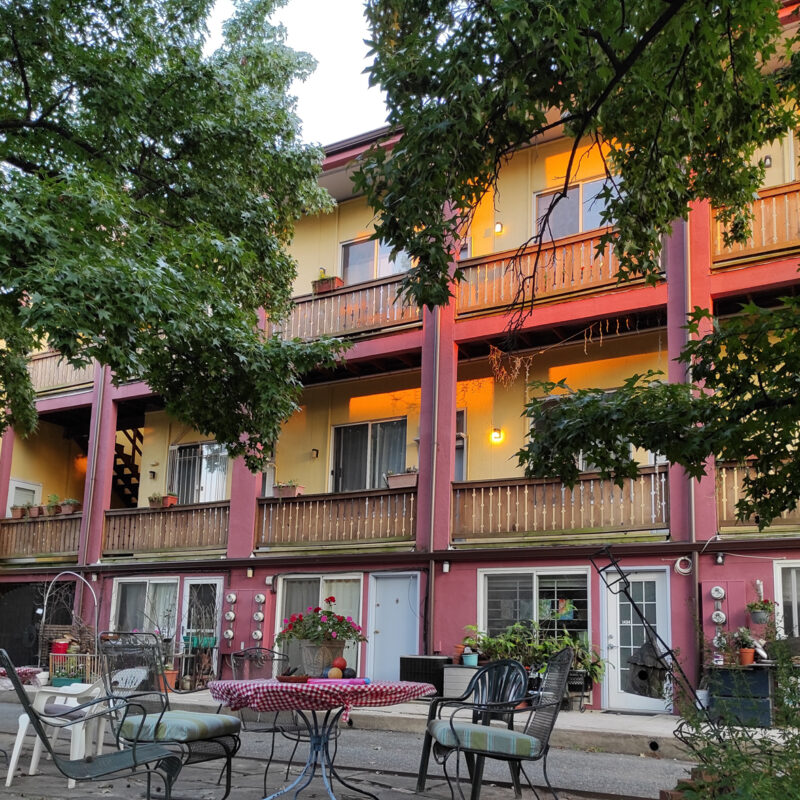
Large sliding glass doors installed along the rear façades allow artists to move substantial artworks in and out of the ground floor with ease. The historic Baltimore Street frontages remain largely intact—though now painted in vibrant colors. The rear of the buildings feature bright yellow stucco, open mezzanine walkways, and large windows maximizing natural light.
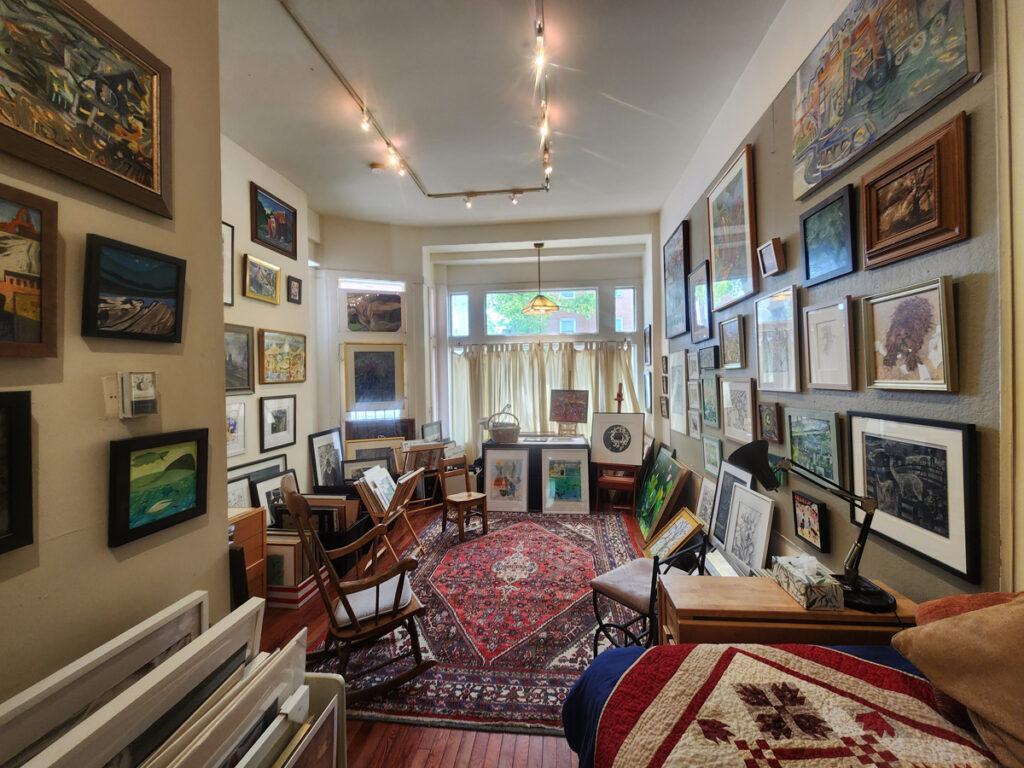
Long-time residents Leslie Schwing and Greg Fletcher have used AHI’s unique architectural qualities in a way many artists (and likely many other married couples) would envy. They each have a private studio unit in which to work, and share a street-level unit they describe as their hangout space for living, dining, and entertaining—as well as a showroom for their varied artistic output, which covers all walls. “We have a three-story townhouse, except it’s spread all over the co-op,” Schwing explains.
The cooperative’s 32 units—one of which is occupied by the shared gallery—were carved from what were once ten rowhouses and range in size from 609 to 1,055 square feet. Each contains a studio space, bedroom, and bathroom. The kitchens, along with many other elements, are DIYed; how artists configure these elements varies dramatically.
Michelle Lamb’s unit houses her soft sculpture studio, where she creates posable animal figures using found fabrics. The double-height entry room is decorated with Moroccan carved wood screens and huge flourishing plants. Her workspace features a large cutting table positioned to capture optimal natural light.
Before her recent passing, Beverly Eisenberg had transformed her downstairs unit using cherry wood cabinetry salvaged from the Loading Dock, and created a loft sleeping space uniquely fitted to her 4’10” frame.
What distinguishes AHI from most artist housing initiatives is its ownership structure. It is a not-for-profit housing cooperative—legally distinct from a 501(c)3—designed for member benefit rather than public charity.
In 1986, artists paid a $50 non-refundable application fee to join the coop; then a $1,000 membership fee with monthly carrying charges ranging from $290 to $315. To be considered, applicants had to demonstrate annual income below $17,550 (or $20,100 for two-person households). They were then vetted on credit and artistic merit. Selections were made by a committee spanning performing, visual, and literary arts. When a member left, the corporation returned their original membership fee plus their accumulated monthly carrying charges—the mechanism that made it, in structure, a genuine limited-equity arrangement. From the start, this utopia required abundant amounts of paperwork.
Fast forward to the present, where units now sell for between $35,000 and $80,000; depending on size and location. Monthly carrying charges run between $300 to $400, recently adjusted by $50 in response to rising property taxes, utilities, and insurance. These fees cover exterior maintenance, grounds, parking, the water bill, appliance replacements, and the property manager’s salary. The gardens and gallery are run on volunteer labor.
AHI operated as a formal limited equity cooperative for its first twenty years, while paying down the HUD loan. After the loan was retired, the co-op dropped that structure—but two mechanisms keep it on mission: a land disposition agreement that dedicates the property to artists’ housing in perpetuity and seldom-amended bylaws. “I think our survival is due to the bylaws that were created at our inception,” Schwing says. “We are self-governed by a board of five elected members and a paid property manager. As long as we abide by those bylaws, which keeps us artist-occupied, we have managed to stay self-regulated.”
The co-op has deliberately avoided conventional lenders—AHI looked into cooperative banking structures and found the terms would have driven up unit costs. The obstacle is structural: a unit is a share in a corporation, not real estate, which gives banks nothing to foreclose on in the conventional sense. Members typically piece together their own financing for buy-in. In some cases, a departing owner will finance a buyer partially or entirely—a risk the seller takes on individually. “A true co-op requires a mission-driven lender to make it work,” Corona says.
The original income cap applied only to the initial round of owners and has since been dropped. New member selection reflects a different orientation. “Artistic qualification is based more on commitment to the arts rather than merit,” Schwing explains—a definition broad enough to include musicians, dancers, poets, jewelers, writers, architects, teachers, filmmakers, photographers, a chef, and arts administrators alongside painters and sculptors. Applications require a portfolio reviewed by five current resident artists, a letter of intent, a resume, a credit check, and a personal interview. When a member leaves, they are typically responsible for recruiting their own replacement candidates. “We generally have a few on the waitlist,” Schwing says. Some members have purchased second units. Turnover is minimal.
As Greg Fletcher emphasizes, “We’re one of only two artist owned and occupied co-ops in the city. And this is a model that has not been repeated. It should be repeated. It’s affordable housing for artists, and the emphasis is on housing and affordability.”
Schwing was one of AHI’s original residents in 1987. Fletcher grew up in the neighborhood. They met, as he tells it, through her practice. “I saw her work, and it just blew me away. And a year later, somebody set us up on a blind date, and that was that—29 years ago.”
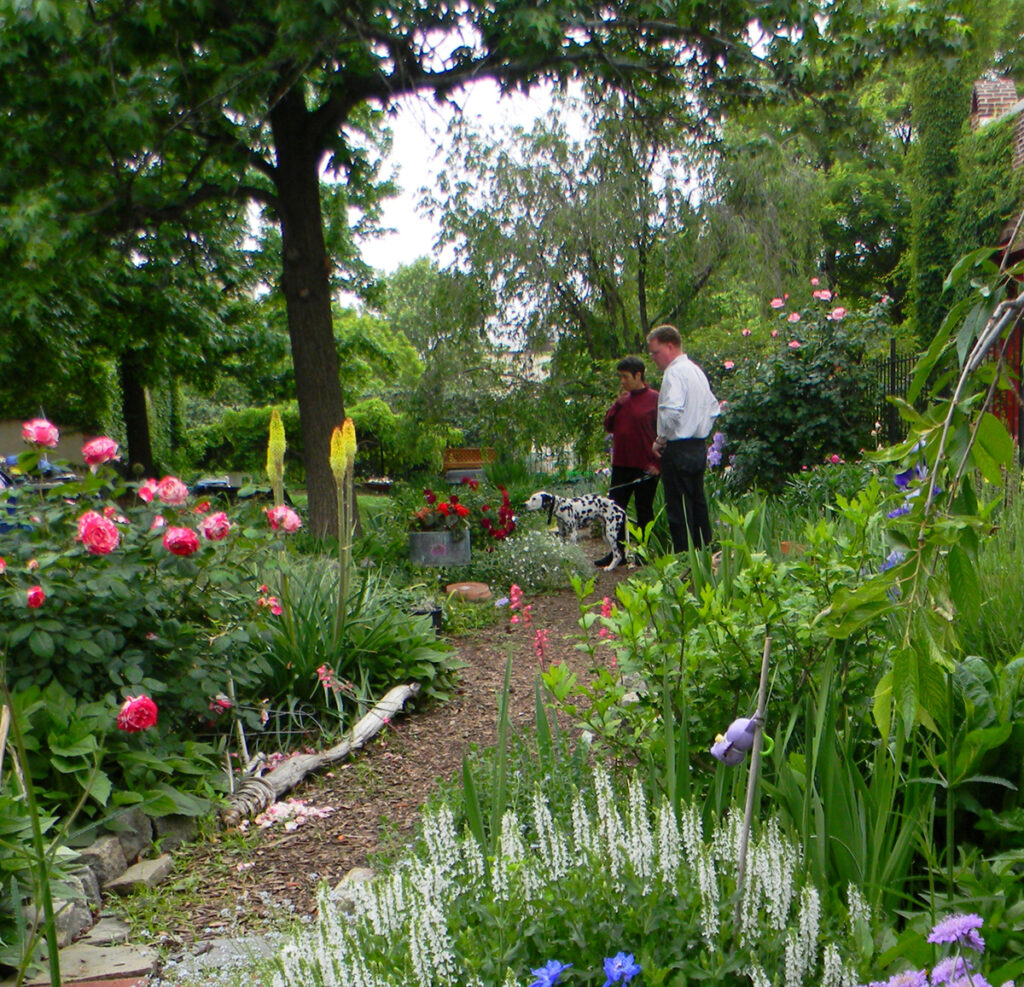
Member participation is organized around five committees—Board, Gallery, Social, Garden, and Long-Term Planning. Originally a dirt lot, the garden was developed entirely by volunteers over four decades. “Artists know other artists!” Schwing says, of how the community has replenished itself by word of mouth. LuAnn Zuback—who creates figurative collages, prints, and paintings—describes a figure-drawing club that periodically transforms the gallery into a shared studio. Residents and non-resident artists pool money to pay a model, producing drawings that sometimes later appear on the gallery walls.
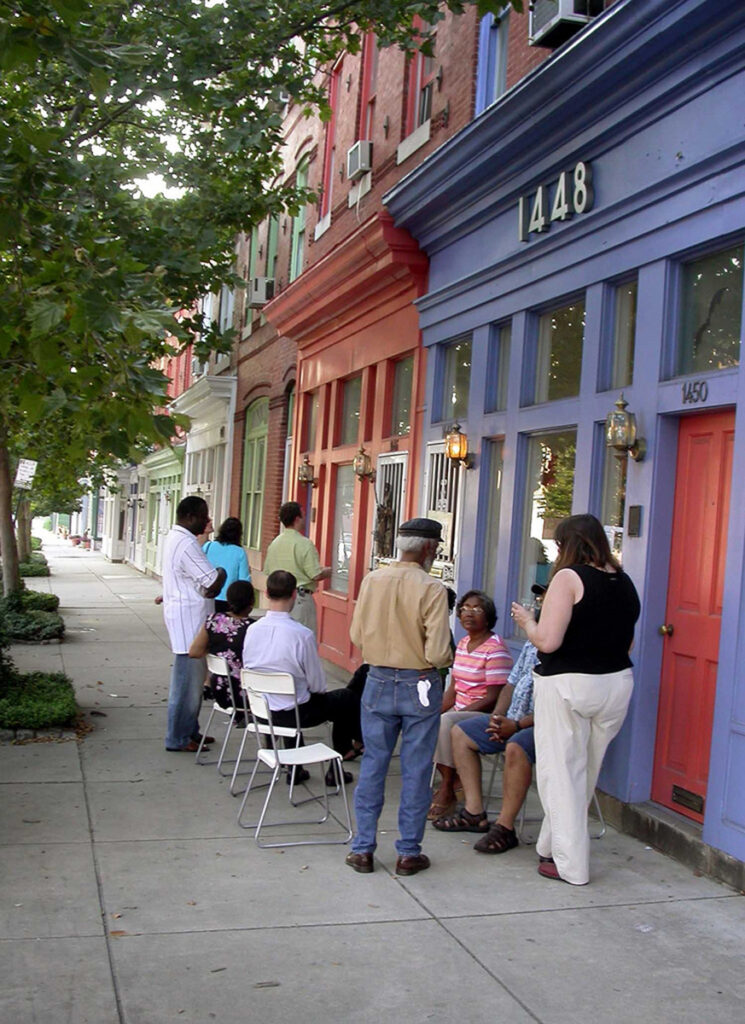
In 2001, the co-op bought back a member’s storefront unit to create Gallery 1448, which runs on membership contributions and sales commissions. It hosts regular exhibitions—including the annual erotica show that was up during my visit—as well as music and poetry events, yoga classes, and community meetings for several local organizations. “We are a central place where people can come and interact and have meetings, which we do, and we don’t charge any money,” Schwing notes. AHI is exploring formalizing the gallery as a nonprofit—a move that could open new funding streams—and newer members may be the ones to take it on.
AHI’s most immediate threat is property taxes. Located outside Baltimore’s designated Arts and Entertainment Districts, the co-op has been ineligible for many of the incentives available to newer artist housing developments, as surrounding redevelopment drives assessments up. “We are not large-scale developers,” Corona says. “We are a dedicated grassroots group of artists providing culture, permanence, and community to our neighborhood and the city as a whole.”
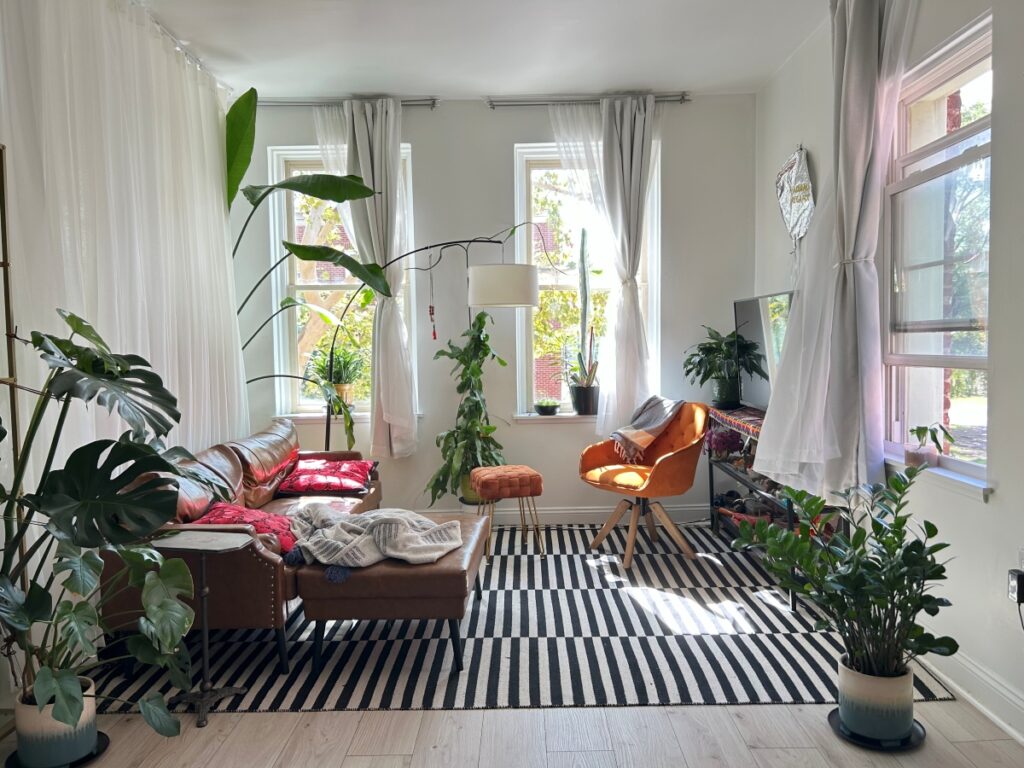
Corona, now living among several younger residents who have moved in recently, found AHI while already under contract on a Mt. Vernon rental. He toured the space, researched co-op structures, and ran the numbers. “I calculated the rent in Mt. Vernon would have equaled the cost of buying into the co-op in about four years,” he says. “It was a no-brainer.”
The more consequential shift was harder to anticipate. After years on the residency circuit—Wisconsin, Pittsburgh, DC, Tulsa, Columbia, Indiana—while maintaining a studio in Baltimore, he finally had a permanent base. “I hadn’t realized the ‘unseen weight’ of being nomadic until it finally lifted.” He went to the doctor for the first time in eight years.
“I am profoundly thankful to the founders and members who had the foresight, kindness, and guts to make a daring investment in themselves—and in every artist who follows,” says Corona.
AHI has managed to balance collective infrastructure and governance with individual autonomy. But the conditions that produced AHI in 1986—HUD financing, block grant funding, a mayor personally invested in arts-based renewal, organized community advocacy—came together once and have not reassembled. Banks remain wary of blanket mortgages to artist collectives, preferring condominiums where individual units are easier to foreclose. Modern building codes require expensive professionals at every stage.
On the broader political conditions, Schwing is flat: “This particular year? Unlikely. Maybe in a different administration it will become possible again.”
Nearly four decades after its founding, Artists Housing, Inc. stands as both a pioneer and a survivor in Baltimore’s cultural landscape. The utopia turned out to require less in the way of visionary circumstances than it did consistent, unglamorous maintenance of a set of bylaws. “A safe live/work home, once a distant dream, was built with the perpetual plight of the artist in mind,” Corona says.
“Maybe that simple humble mission,” Schwing adds, “is the reason we are still thriving.”