
11am-2pm
“Demolition by Neglect: Research and Residues” by Marian April Glebes | Closing Reception + Artist Talk
Current Space
421 North Howard Street
Baltimore, MD 21201
Current Space is proud to present
Demolition by Neglect: Research and Residues
A Solo Exhibition By Marian April Glebes
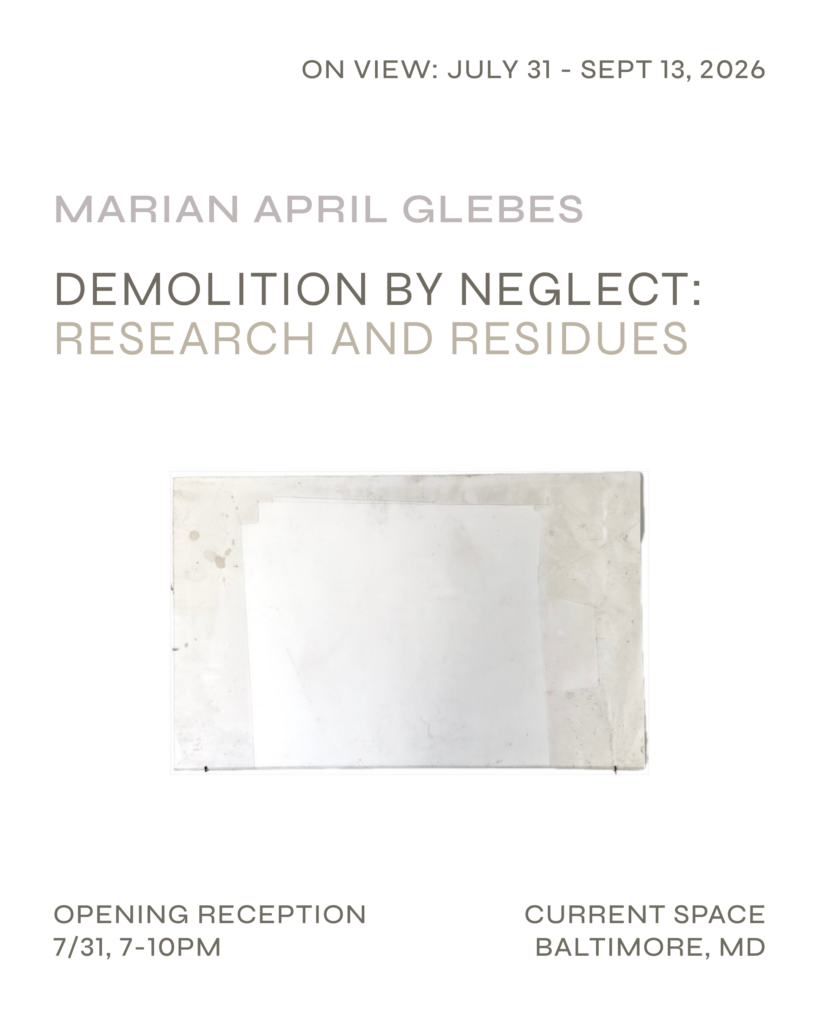
Working in drywall, joint compound, dust, and graphite and oil on paper salvaged from her own domestic spaces, Baltimore-based artist and preservation planner Marian April Glebes examines what it means to maintain–or fail to maintain–the places that house/shelter us.
Exhibition Duration: July 31 – Sept 13, 2026
Opening Reception: Friday, July 31 from 7-10pm
Closing Reception & Artist Talk: Sunday, Sept 13
Gallery Hours: Saturdays from 1-5pm, during public events, or by appointment
In historic preservation, “demolition by neglect” names a particular kind of violence: not the wrecking ball, but the slow withdrawal of care. A roof left unpatched. A gutter left to overflow. A structure allowed, deliberately or otherwise, to fail under its own weight until failure becomes the justification for its removal. It is a term invented to describe what happens to buildings, but it names something I recognize at a smaller, more intimate scale — the scale of a single household, a single room, a single relationship to the walls that shelter us. What happens when neglect is not an accident of policy or absentee ownership, but a private, ongoing choice? What does it mean to live inside a structure that is not being maintained, and to know that the not-maintaining is itself a message?
Demolition by Neglect: Research and Residues takes up this question through the material vocabulary of the Baltimore home: drywall, dust, joint compound, graphite and oil on paper, and other salvaged fragments drawn from my own domestic spaces and places. These are not metaphors I have imported from elsewhere. They are the literal substance of walls — the skin of a house, and the material most often called upon to disguise a wound rather than to address what caused it. Joint compound smooths a crack; it does not ask why the crack appeared. This exhibition asks that question instead, using the tools of documentation, cultural landscape analysis, and conceptual art practice to slow down and look closely at what usually goes unexamined: the accumulated evidence of care given, care withheld, and the long residue left behind by both.
I come to this research as both an artist and a preservation planner, trained to read landscapes and buildings as palimpsests — surfaces layered with the visible and invisible traces of use, change, and abandonment over time. Cultural landscape theory teaches that practicing this kind of looking is itself a discipline, a way of seeing what remains and what has been erased, and of understanding a place as something made continuously by the people who inhabit it, even as it makes them in return. I bring that same discipline home. What are the character-defining features of a domestic life under duress? What integrity is lost, and what integrity survives, in a space that has been allowed — or forced — to deteriorate?
Rebecca Falkoff’s Possessed: A Cultural History of Hoarding offers a companion framework, one built on the premise that hoarding is not primarily an excess of things but a conflict of value: the hoarder and everyone else disagree about what an object is worth, and that disagreement becomes visible in the accumulation itself. I am interested in the inverse problem — not what is kept beyond reason, but what is discarded, patched over, or left permanently unfinished, and what that refusal communicates. Many of us now find ourselves sorting through the households of parents and grandparents, confronting decades of collected objects that the next generation does not want and cannot use. That sorting is its own kind of research: an inventory of what a life accumulated, and a reckoning with how little of it can be carried forward. My studio practice performs a parallel inventory, cataloguing the residues of a domestic interior — dust, drywall dust, scraped compound, the graphite outlines of things once positioned and later removed — as a record of occupancy rather than a memorial to it.
This project also owes a debt to the conceptual artists of the 1960s and 70s who first proposed that the record of an act could stand in for the act itself, and that the discarded, the demolished, and the overlooked deserved the same attention as the finished object. Lucy Lippard’s account of the “dematerialization of the art object” describes a moment when documentation — a photograph, a drawing, a description — became inseparable from, and sometimes more durable than, the work it recorded. Gordon Matta-Clark’s building cuts sliced into condemned houses to expose their structural interiors, turning demolition into a form of disclosure. Rachel Whiteread cast the negative space of a soon-to-be-demolished London house, making a monument out of absence itself. Alan Kaprow dissolved the boundary between art and daily life, insisting that sweeping a floor could be an artwork if performed with sufficient attention. The artists of Arte Povera turned to humble, unglamorous materials — plaster, ash, rags, dust — to insist that value need not depend on permanence or preciousness. Each of these practices refuses the idea that only the finished, maintained, and intact deserves to be seen. Demolition by Neglect extends that refusal to the household: a place where unfinished walls and unresolved conditions are not failures to photograph after the fact, but the primary evidence.
The nationwide reckoning with Confederate monuments offers one more useful lens. When a monument is removed, what remains — an empty pedestal, a patch of bare grass, a wall never repainted — can itself become a counter-monument, a site that holds memory more honestly than the object it replaced ever did. I ask the same of a room. What does it mean to leave a wall unmended, to let the failing plaster show, to keep the dust rather than sweep it away? What does housekeeping mean, understood not as maintenance but as a conceptual practice — a daily, ongoing negotiation over what gets tended, what gets ignored, and who decides? This exhibition does not resolve that negotiation. It documents it, materially and literally, as research: an accounting of what a home holds onto, what it lets go of, and what it cannot help but keep.