Two of the area’s most venerated educational institutions have embarked on a historic and precedent-setting collaboration. Morgan State University’s Opera Department (known as Opera at Morgan) and Johns Hopkins Peabody Opera Theater joined forces in a production of Kurt Weill’s Street Scene. With a three performance run, November 14-16, 2025, at Morgan State University’s Murphy Fine Arts Center, the venture not only exhibited an extraordinary level of achievement but also elevated each to new heights of artistic excellence.

Now, before I get into the gem that lit up the stage, a little background…
Kurt Weill, the German-born composer, had already written several successful pieces when he went ahead with plans to adapt Street Scene, a play written by American playwright Elmer Rice. He saw the play as a perfect example of the kind of Americana slice-of-life drama he thought would make a great piece of musical theatre in the operatic style, the genre he was most successful in. But as the project began to take shape it became evident to both men that, to truly capture the nuances and flavor of American tenement life, they would have to go outside their areas of expertise in drama and bring in someone who was more familiar with the cadence of speech they wanted to convey.
Enter Langston Hughes. The celebrated poet, author, and one of the leading luminaries in the Harlem Renaissance, agreed to contribute the lyrics, written with an authenticity that had eluded both Weill and Rice. Street Scene debuted in 1947 on Broadway and has been performed all over the world in opera houses and theatres to great acclaim. Ironically, it only ran for about 140 performances on Broadway, with production costs cited for the shortened run.
The collaboration resulted in Langston Hughes being credited with all the lyrics, Weill with the music, and the book by Rice. Weill said at the time, “It was a simple story of everyday life in a big city, a story of love and passion and greed and death. I saw great musical possibilities in its theatrical device—life in a tenement house between one evening and the next afternoon. And it seemed like a great challenge to me to find the inherent poetry in these people and to blend my music with the stark realism of the play.”
The opera takes place over a two-day period in 1946. The scene is a New York tenement where several families live in uneasy harmony, all struggling with issues as mundane as the heat in the city, unruly kids, inattentive spouses, and unfulfilled dreams.
For one woman in particular, Mrs. Maurrant, the way to find some comfort in her tedious life is to have an affair with Mr. Sankey, the collector for the milk company. For Mrs. Maurrant’s daughter Rose, in between dodging advances from her slimy boss, she nurtures dreams of a better life out of the city—finding love, and some sense of stability that her home life doesn’t provide. Adding to her situation is the fact that her downstairs neighbor, Sam, truly loves her. But she hasn’t decided if he is what she really wants until it is practically too late. Or is it?


When Mrs. Maurrant’s husband, Frank, discovers his wife in flagrante delicto with the milkman, he snaps and kills them both, then escapes only to be found hiding in a nearby basement. After a tearful scene with his daughter in which he tells her how sorry he is, he is led away by police. Rose is left to decide what to do about Sam—and the rest of her life. As for the other inhabitants of the tenement, life goes on pretty much the same as it always had, their stories winding through the primary narrative—offering observations and insights in the vernacular of Hughes.
This rendition of Street Scene is a creative partnership between the two institutions, but specifically the two co-directors. It isn’t possible to parse out who did what when, or how ideas went from conception to reality, so blended were the efforts of Mary Duncan of the Peabody Opera Company and Marquita Lister of Morgan Opera. When asked about the process, the two directors issued a joint response: “This collaborative process meant that we made joint decisions about every aspect of the production. As a student-based production, it made sense to use the Peabody orchestra. Bringing in a professional conductor added to the learning component of the collaboration for both the singers and instrumentalists.”
Toss into the mix the esteemed conductor Steven White returning to wield the baton over musicians from both schools, and what you have is a stellar mix of professional artists and educators at the helm of this production. From the backstage crew to the orchestra to the on-stage talent, these three have curated a fine collection of individuals who have worked unstintingly to bring this piece to life. The sets, the lights, the costumes, the sound design, the surtitles—every detail felt meticulously crafted. My only tiny quibble—and chalk this up to my admittedly old-fashioned sensibilities—is that a few of the modern hairstyles pulled focus just enough to slightly distract from otherwise magnificent vocal and dramatic performances.


As with any opera, the players’ acting ability is every bit as important as their well-trained and gloriously resonant voices. And this Street Scene gave every one of them the chance to shine—and a few are positively luminous. There was not a single weak vocalist—all more than able to take on the challenging score. Darius Jackson’s Frank Maurrant, Yingying Zong’s Anna Maurrant, Nazarene Maloney’s Rose Maurrant, and Christopher Kirby-Saunders’ Sam Kaplan are ready for the big time with their powerful voices and superb command of their characters. I’m no expert, but I’ve covered enough opera performances to know a good one from a great one. These four are nothing short of great.
It was the first time Opera at Morgan and Peabody Opera Theater collaborated in this way. At first glance, it might seem an unlikely pairing, but musically it made perfect sense. The extraordinary result is reminiscent of the origins of Street Scene itself; it’s combinations like Kurt Weill and Langston Hughes—and Morgan and Peabody—that elevate all the parties and let them reach even higher. And audiences like us are all the better for it.
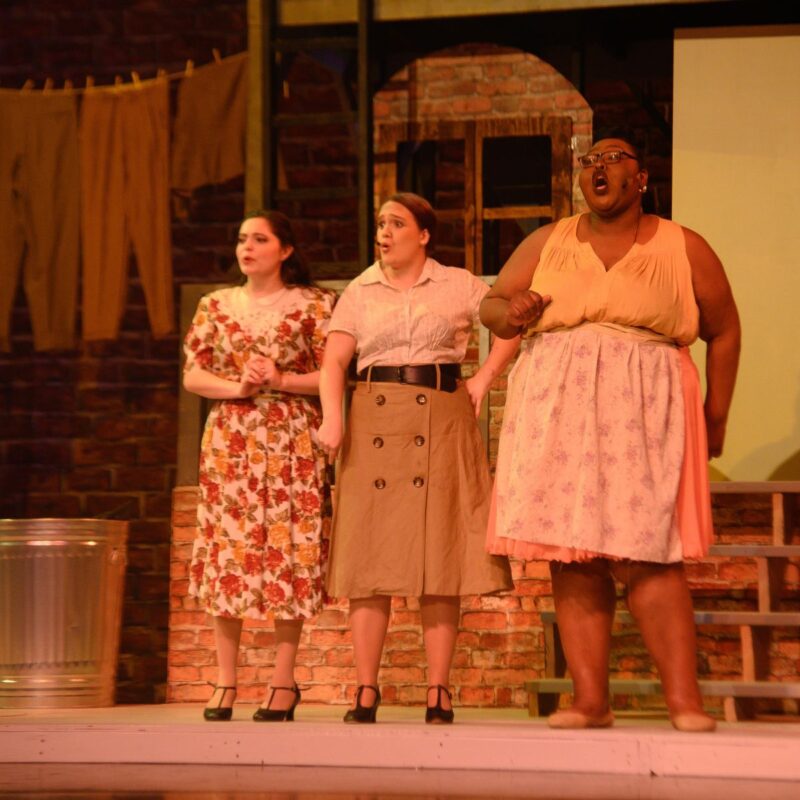
Header Image: L to R: Cipriana as Greta Fiorentino, Erika Carper as Emma Jones, Laquavia Alston as Olga Olsen