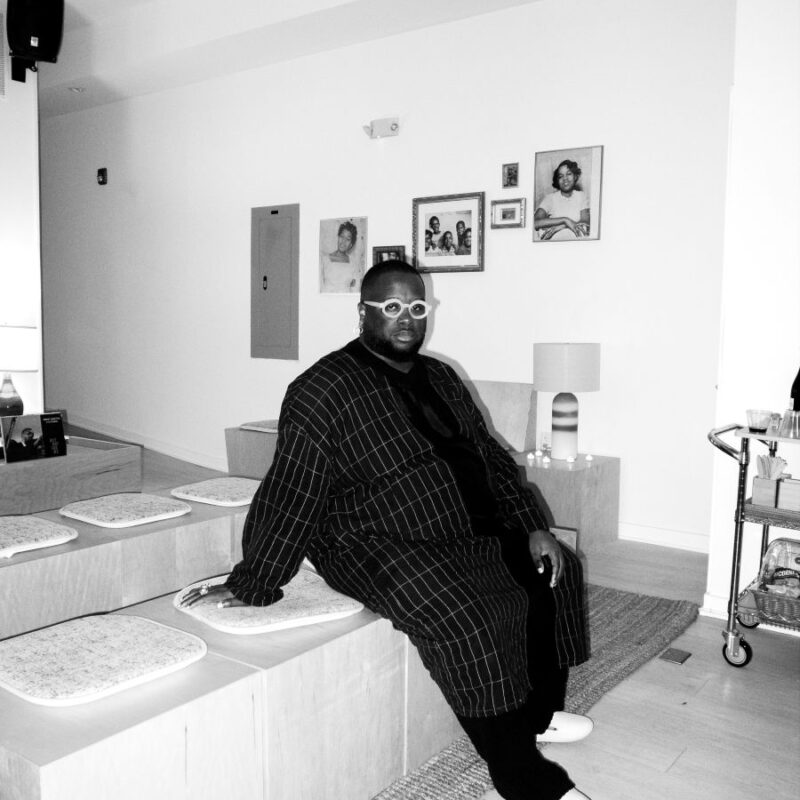
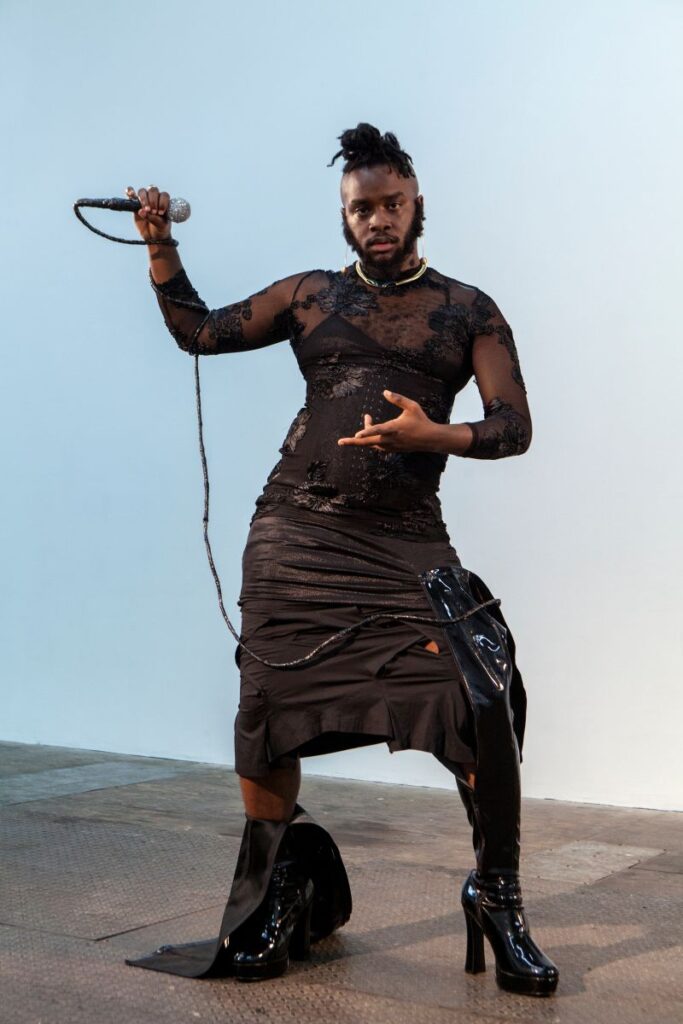
“I have always been attracted to duality. A mix of both left and right, up and down, water and fire,” explains abdu mongo ali of their multidisciplinary artistic practice. “In that space you get to access things that are creatively, intellectually, and artistically interesting.”
ali is the Baltimore Museum of Art’s (BMA) first ever Alice and Franklin Cooley Composer in Residence—an initiative that kicked off this past September, 2025 and will culminate in a public performance on Thursday, January 22, showcasing the work created throughout ali’s five-month residency.
In the press release announcing the program, BMA’s Director Asma Naeem cites inspiration from Baltimore’s artistic community in the ways it both connects and transcending traditionally defined genres, “I could think of no one more fitting to be our inaugural Composer in Residence than abdu ali, whose life and work creatively crosses boundaries of all kinds,” Naeem writes.
“It’s been a joy. It’s been chill,” ali says of the experience, “I spent a lot of time at the museum tapping into the collections they have and the work on display, and trying to transmute the different visual languages into a sonic language, to reinterpret the vibes, or the themes and techniques that the visual arts speak to, and put that into sound.”

Baltimore Museum of Art Director Asma NaeemI could think of no one more fitting to be our inaugural Composer in Residence than abdu ali, whose life and work creatively crosses boundaries of all kinds.
ali advocates for the importance of museums recognizing and incorporating sound as an art form, especially in Baltimore given the city’s rich musical heritage. But it is nonetheless relatively uncommon. “I think it’s super radical,” they say. “The ephemeral quality of music and performance is beautiful, but when it comes to market value in the art world, physical objects hold a lot of power and weight. You can kind of sell it like real estate. You can’t package and resell a music performance in the same way.”
“It’s a new horizon for everybody.” BMA’s Director of Public Programming, Tracey Beale, adds. “It allows us to expand upon the work within exhibitions, and it leans into the focus of being an artist centered institution.”
Beale emphasized that this commitment means prioritizing artists and their voices above categories or markets—not focusing on the type of art or the economy surrounding it, but on the messages artists have to share, who the creative thought leaders are that need to be heard, and how the BMA can show up to give these artists a meaningful platform.
ali has contributed to past projects at the BMA, including creating part of the soundscape for the museums’ 2023 exhibit The Culture: Hip Hop and Contemporary Art in the 21st Century. That experience deepened ali’s trust in the BMA’s intentional commitment to uplifting artists and art forms with authenticity, rather than simply defaulting to what the mainstream arts industrial complex has historically deemed important or worthy.
For Beale, ali’s residency provided an opportunity to work and co-create with the artist on a deeper level and felt somewhat like a homecoming. This is the first public project ali has been a part of since returning to Baltimore after earning their MFA in Literary Arts at Brown University.
The title of the work ali created during their residency, between every breath, there is atmosphere was inspired by their time at Brown. ali took an immersive class all about breathing, led by French philosopher, Peter Szendy. They also drew inspiration from Ed Roberson’s ecopoetic collection, Atmospheric Conditions. Ecopoetics, they explained, explores the intersection of poetry, ecology, and environment. It emphasizes our inherent connection to the natural world, dissolving boundaries between self and other, and using language as a tool to inspire a deeper sense of reciprocity with nature.

abdu mongo aliAtmosphere is not just this external thing. No, it’s also internal, the atmospheric conditions sit within us and in our bodies.
“I’ve been writing poems and making sound works about the breath and what can be held between the breath in that pause,” ali describes. “And what is held in the breath as well, and in bodies, and wind, etc. I have a poem and sound piece called ‘Between Every Breath, There is the Hold.’”
The Hold, they explain, denotes both a physical space—the lower cargo deck of a vessel used to transport enslaved Africans to the Americas during the transatlantic slave trade; and a physiological action—the hold, or pause in between a collective breath.
ali’s poem investigates how this history continues to shape the lived experience of Black people in the present day, conceptualizing breath as a shared, intergenerational site of memory. The physical space of the ship’s hold and the physiological act of holding breath converge, suggesting a psychic transmission of what was once confined there, but now lives on in Black bodies today. This framing positions breath as both an embodied and historical archive, linking past and present through sensation rather than narrative alone.
“As a Black person I’m thinking about what can be in between, or within that holding? The hold being this multi-dimensional place—a spatial reality that exists beyond time,” says ali. They compare the breath moving within one human body to the atmosphere of the earth itself. “Without oxygen, without water, we will not be able to survive, but atmosphere is not just this external thing. No, it’s also internal, the atmospheric conditions sit within us and in our bodies. We are beings born out of, into, and with the atmosphere… We are walking terrariums, and we are walking mini-universes.”
What this sparked for me was a way of thinking that moves simultaneously inward and
outward—the idea that one individual can function as a complete container, while also
holding vast networks across time and space. Through breath, ali accesses this multidimensional logic, a metaphorical and psychic bridge between internal and external worlds, where multiple realities—past and present, individual human and entirety of nature—coexist within one living form. This layered exploration paints a picture of the multiverse, providing an accessible entry point to grasp the possibility of multiple or parallel universes.
Yet from the spaciousness of multi-dimensional worlds to psychic connections beyond time and space, ali grounds the contemplation in our regional landscape and culture. “To localize it, I was thinking about how the atmospheric conditions of Maryland and Baltimore affect people from this region, in this land. Because when you think about food culture, sound culture, music culture, style, dialect and language, the way we talk and walk, the foods we like—how we respond to certain things as Baltimoreans is completely different from people who live even in DC. And all these things aren’t just ontological influences, or social, cultural, historical influences—we’re literally influenced by the land.”
“Between every breath is the ocean, between every breath there is the sun, the land, and all these different things that are region specific to Maryland,” ali continues. “I’m thinking about these things in that title [between every breath, there is atmosphere], and this is what it looks like, sonically.”
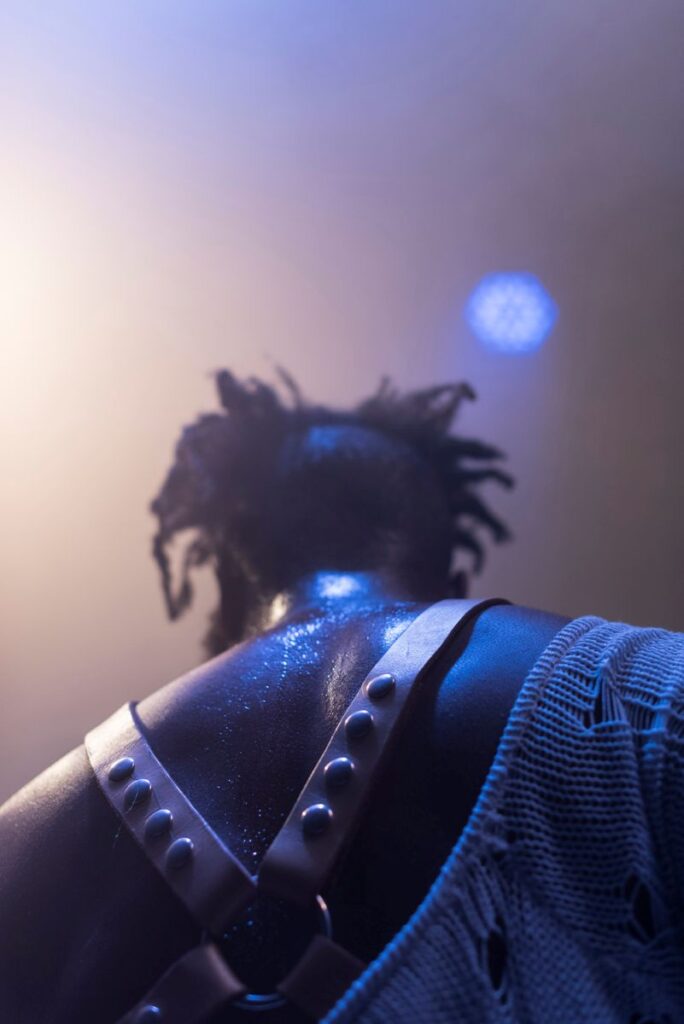
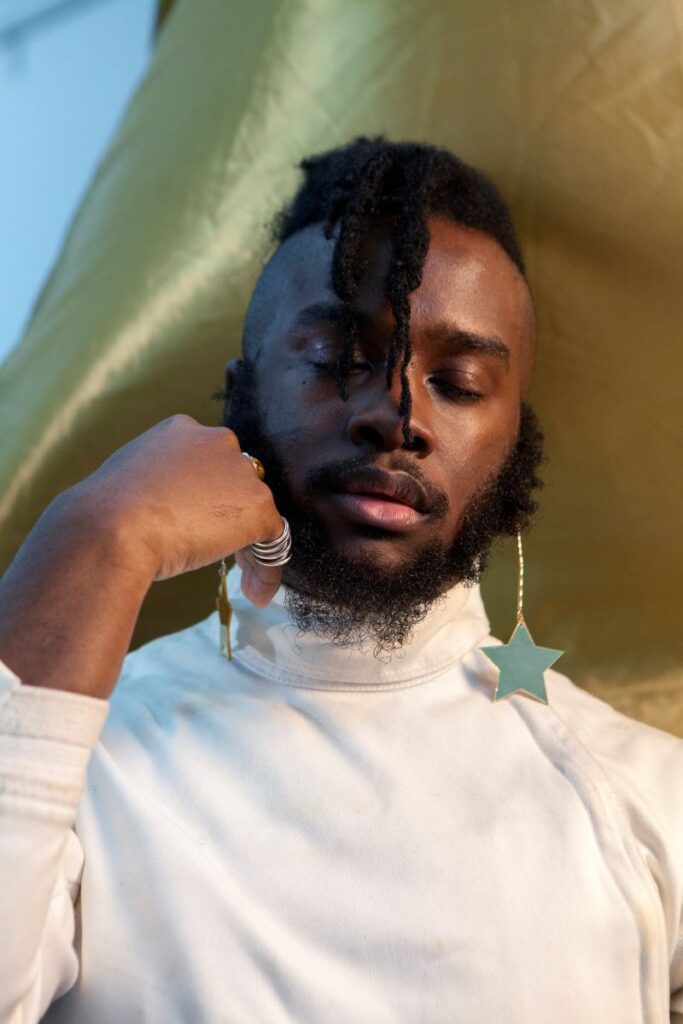
The Composer in Residence project is tied to the BMA’s ongoing environmental initiative, where artists are invited to respond to the prompt, “Turn Again to the Earth.” Beale talked about the alignment of having ali as the inaugural composer for the residency as someone who deeply explores our connection to environment, and the BMA as a launchpad for this next chapter in ali’s trajectory.
I asked her how ali’s presence has impacted the internal ecosystem at the BMA, and she told me the project has allowed space for artistic vision and curiosity to deeply interface with various departments from marketing to lighting and tech design. She expressed enthusiasm for the high level of collaboration they’ve been able to engage in throughout the residency, saying that when they can create space for that level of interaction, “…the actual production of the work becomes a work within itself.”
“And they’re a great person to work with,” Beale concluded, “they know what they want.”
Balancing artistic vision and radical self-expression with structures and systems can be notoriously difficult, and I asked ali about their approach to collaborating with large institutions such as the BMA and academia. “It’s important to come into these situations with your negotiables and your non negotiables—just like we do with any relationships,” they said, going on to express appreciation for their experience with the BMA team, “They’ve just been a joy to work with, ever since the Hip Hop exhibition. I think it’s important for the museum to lean into magnifying local artists, which a lot of places, especially in mid-size or smaller cities really don’t do. So yeah, it’s been a really cool honor.”
Engaging in collaboration as well as complex, honest discourse in this moment of deep societal divide, feels crucial to ali. Especially as one tool of fascist regimes is to make people uncomfortable discussing sensitive topics like politics, ethics, race, colorism, gender, class, and religion. Social media has created a false sense of discourse, while creating silos in real life. ali believes that while meaningful conversation matters for everyone, artists and creatives are especially positioned to lead the charge.
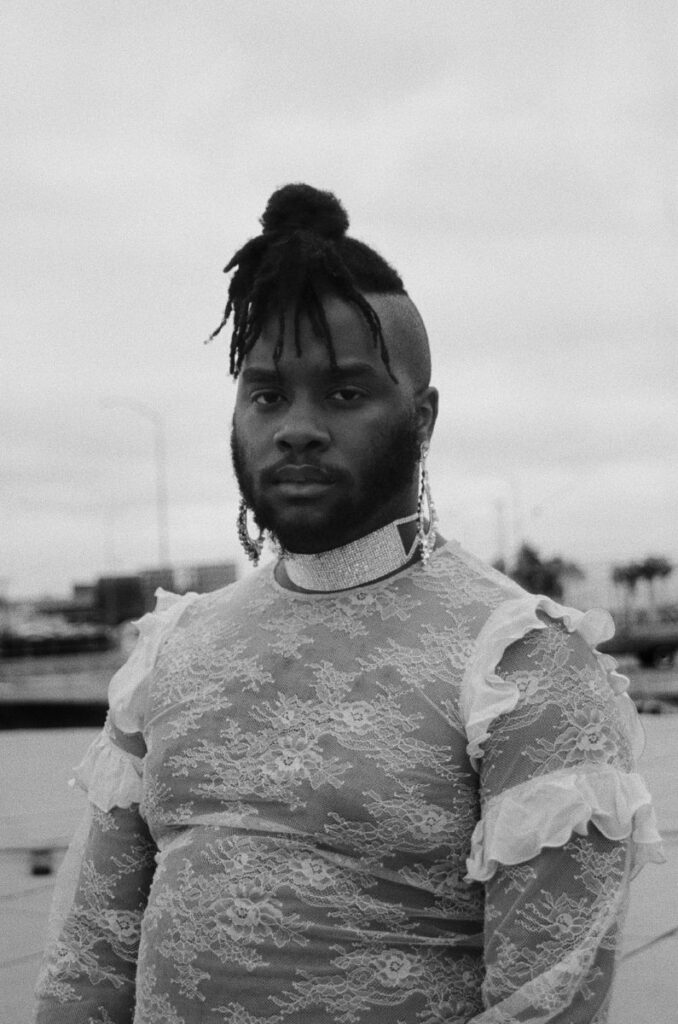
abdu mongo aliSound is the perfect medium to tap into that natural chaos of life, because it is formless in a sense, indefinitive in a lot of ways, and psychic.
“Me being Black, being queer, being dark skinned—all the things that are completely on the opposite side of what is socially and culturally uplifted in this society. I always felt othered, and in this place of imbalance—not in a negative way. I think it’s actually really beautiful.”
ali naturally leans into the power of complexity and accepts chaos as an organic element of the universe. “I’m a follower of Buddhism,” they shared, “and one of the essential principles of Buddhism is that life is Dukkha, meaning that life is suffering, and it’s full of surprises and things that are out of our control, and that life is chaos.” They don’t see chaos as necessarily destructive or negative, rather it is an energetic modality.
“Sound is the perfect medium to tap into that natural chaos of life, because it is formless in a sense, indefinitive in a lot of ways, and psychic,” ail says. Though there may be a formlessness to sound, it has the capacity to bring a group of listeners into a single, shared present. At a live concert, the audience is immersed in the same sonic field being created by the performers, who in turn are influenced by the energy coming back to them. Vibration and resonance move through air, bodies, and space, aligning attention and influencing collective attunement in real time. From this perspective, the participants become an energetic ecosystem, with individuals responding not only to the music, but to one another and to the environment they inhabit together.
I asked ali what energy they’re hoping the audience brings to their closing performance and they named curiosity, vulnerability, and openness.
“I think people should just come ready,” Beale added. “It’s not just about being entertained. You’re not just there to be a spectator. You’re there to witness. Come with the energy of witnessing what the artist wants to convey.”
She describes ali as an artist who embodies possibility, “When I think about the shape of culture and politics right now on a societal level, I’m excited for people to start to dream and think about possibilities.”
Limitless possibility is part of the legacy that ali wants to leave for the artists who come after them, they shared, “Despite the obstacles and whatever that you have been dealt with in life, in your city, in your hometown, in your family—despite that, you can still be a bad bitch. And take yourself seriously no matter the circumstances. When I think about how I started music, and not having a hardcore artistic or music training background, if I would have thought about how I was perceived I wouldn’t have made it, or even had the courage to move on. And I think my legacy represents the power of being an underdog that is beautifully delusional—in a good way.”
From explorations around the individual to the collective, connections across time and space, beautiful delusions of grandeur to crushing realities—artists like ali guide us toward shared possibility. They inspire us to step into expansive thinking, showing us a reality alive with potential—in our minds, in our communities, and in the multiple universes we inhabit and create.
abdu mongo ali’s residency at the Baltimore Museum of Art began in September, 2025 and will culminate on Thursday, January 22, 2026 with a performance of between every breath, there is atmosphere and a Q & A moderated by Terence Nancein the BMA’s Meyerhoff Auditorium, 6:30-8 pm. Reserve your seat for the event here.