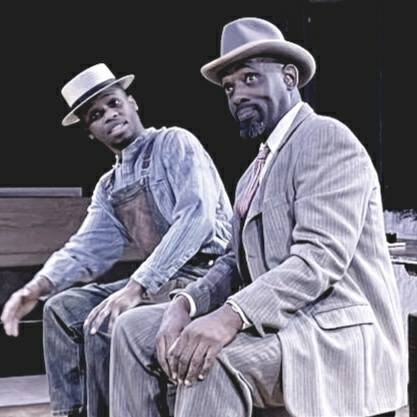
When the Baltimore theatre community united in staging August Wilson’s 100 Year Cycle, artists and audiences across the region rejoiced. Spotlighters Theatre’s production of Seven Guitars, the 5th installment, proves that enthusiasm remains well deserved. I’m going to tell you all about it. Then, Dear Reader, forgive me; at the end of this column I’ll have to break your heart.
Each of the ten plays in August Wilson’s Century Cycle is set in a different decade, beginning in the 1900s with Gem of the Ocean and culminating in Radio Golf, set in the 1990s. Seven Guitars lands squarely in the middle, in 1948. The plays are primarily set in Pittsburgh’s Hill District, a Black neighborhood populated by some of the most vivid and compelling characters in American theatre.
The works from the Cycle I know best share unmistakable throughlines: failed schemes and broken promises, the search for love and belonging, the yearning for a better life, and, finally, a hard-earned acceptance that it is what it is—for now—and that survival sometimes means making the best of what you’ve been given.
Wilson’s gift for capturing the rhythm and nuance of language from those hard streets—language deeply familiar to many people of color and others living on society’s margins—can feel like a family reunion for some. For others, this window into lives shaped by hope, disappointment, joy, and sorrow serves as a reminder that, in one way or another, we all carry pieces of the same human story. Few writers have ever told those stories as powerfully, or as honestly, as August Wilson.

Seven Guitars centers on Floyd “Schoolboy” Barton, a talented blues guitarist whose life has ended just as it seemed poised to finally take flight. The play begins on the day of Floyd’s funeral, where friends and loved ones gather and grieve—each in their own way. From there, the story moves backward through flashbacks during the week leading up to his death. Recently released from prison, Floyd returns to Pittsburgh with news that he has made a hit record in Chicago, and that the label wants him back immediately to try to recapture that success. Determined to start over, he attempts to persuade his former girlfriend, Vera, to join him—but she is resolute in her refusal (until it’s too late), unwilling to be pulled back into his cycle of promises and disappointments.
Surrounding Floyd is a vividly drawn community of characters who share a cramped Pittsburgh tenement and an even tighter bond: Hedley, older, volatile, and half-mad with unfulfilled dreams; Ruby, flirtatious, sharp-tongued, and morally unmoored; Louise, the weary but watchful matriarch; Canewell, loyal to a fault and eager for his own break; and Red, Floyd’s friend and musical collaborator. Over the course of a single week, long-simmering tensions, hopes, and resentments collide, leading inexorably to the tragic choice that seals Floyd’s fate. Just as success finally seemed within reach, Floyd proves unable to get out of his own way.
Seven Guitars premiered in Chicago in 1995 before landing on Broadway in 1996, where it received largely positive reviews. Though its Broadway run lasted only six months, the play has left an indelible mark on the American theatre canon. Spotlighters Theatre’s production rises to the work’s formidable reputation, honoring its scintillating dialogue and its piercing portrayal of Floyd as he fights to escape his precarious circumstances and climb the ladder of success—success that is almost in sight, yet tantalizingly just out of reach.
Anyone who knows this writer knows that I am not a fan of three-hour productions. I wish I could say this one changed my mind, but—sorry—it didn’t. I would never in a million years deign to criticize the writing of the venerated August Wilson, but a little judicious snipping can go a long way.
Director Benjamin Isaiah Black has assembled a terrific team to realize his vision of the play. The pacing lags a bit, particularly in the second act, but for the most part the action holds focus and moves along at an appropriate clip. I’ve come to look forward to Justin Nepomuceno’s set designs, and this one is thoughtfully conceived, sturdily handling the requirements of a garden, a stoop, and the backside of a tenement building.
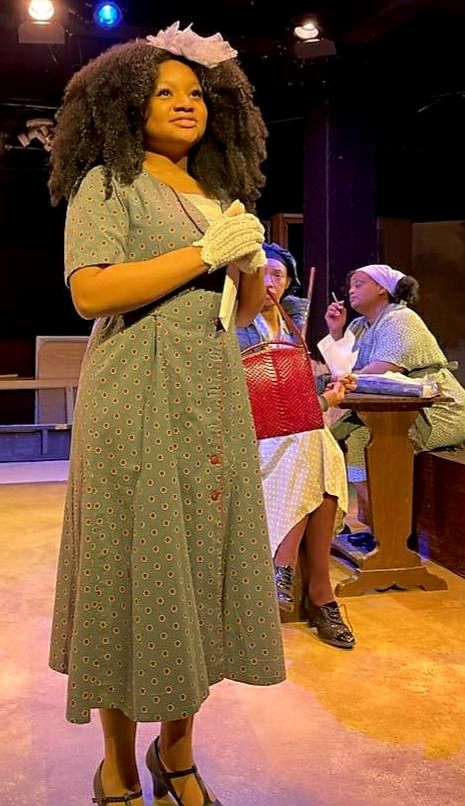
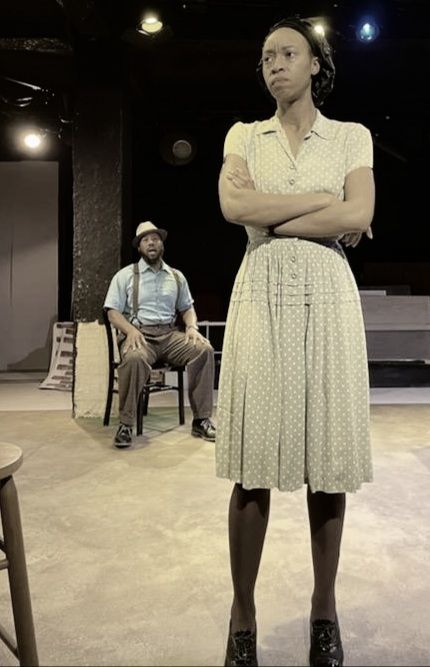
Wendy Snow Walker’s costumes nicely capture the 1940s feel across both the male and female cast (tiny nitpick: get some stockings with seams). Lighting by Jaeden Arrington creates both subtle moods and bright days and Sound Designer Lorenzo Millan’s blues-inflected mood music deserves definite applause.
As with any ensemble piece, the question is whether each character gets a moment to shine—and how well the company plays together. Seven Guitars gives everyone their turn, though I would have happily spent more time with Jenelle Brown’s Louise—the earth mama we all recognize and love, watching over her neighbors like a mother hen. David Mitchell’s Red Carter is that guy you know from the corner bar: always a little loud, usually up to something, but a pretty cool cat to hang out with over a beer. Destiny Jennings absolutely nails Ruby, the girl your mama warned you about—pouty red lips and swingin’ hips, with a surprising tenderness when it suits her purpose. Steven Forrester is fresh-faced and inviting as Canewell, like an almost-grown puppy—still a little wet behind the ears, but maturing quickly in the company he keeps.
Few actresses on local stages in recent seasons have captured my attention as much as ReginaGinaG. In her portrayal of Vera, she possesses that rare ability to sit perfectly still while waves of grief wash over her—not a sound, not a movement—yet she is as clearly heard as if she were shouting. It’s a stunning tour de force, with a face that telegraphs emotion as powerfully as any I’ve seen in quite some time.
Jae Jones’ Floyd “Schoolboy” Barton does yeoman’s work as the misguided center of the production. Jones makes you believe that Floyd believes in his dreams so fiercely that you almost—almost—believe in them too. I wished for a bit more confidence in a couple of the later scenes, but those are small quibbles. When he shines, he is genuinely brilliant.
Seven Guitars is one more gift to the community, offered under the auspices of this outstanding paean to August Wilson, brought vividly to life at Spotlighters Theatre. Lucky us. And remember when I said I had to break your heart? I’m sorry to report that the entire run is sold out. Still, check with the theatre about waitlist options—and take note that the next installment, Fences at Chesapeake Shakespeare Company), opens February 6th. Get your tickets now, okay? You won’t regret it.
Seven Guitars runs through February 1st, 2026, at Spotlighters Theatre, 817 St. Paul St., Baltimore 21230. For info call 410-752-1225. The run is sold out but view the program here.
Keep updated on the schedule and venues for the Baltimore August Wilson Celebration of the American Century Cycle HERE.