As the house lights dim in Baltimore Center Stage’s Head Theater, a common announcement is made before the show starts, asking audience members to turn off their cell phones or other electronic devices. A few things are different, however. The voice on the speaker is warm, funny, and most importantly, familiar. It’s the voice of multi-hyphenate actor-producer-writer Lena Waithe, and the announcement includes a warning to the audience that no photography is allowed because they’re about to witness “emotional nudity.”
This is an accurate assessment of trinity, a new play written by Waithe and directed/produced by Stevie Walker-Webb, artistic director of BCS. Although this is Waithe’s first foray into playwriting and stage acting, she previously collaborated with Walker-Webb on the Tony-nominated play Ain’t No Mo’ as a producer. Waithe is immediately recognizable from her prior work on Chi, Queen & Slim, and her Emmy-winning collaborative work as a writer (and actor) on Master of None.
By blending the lines between genre and inviting in unexpected audiences, trinity is a meta exploration into self that expects “emotional nudity” from both its onlookers and its performers.

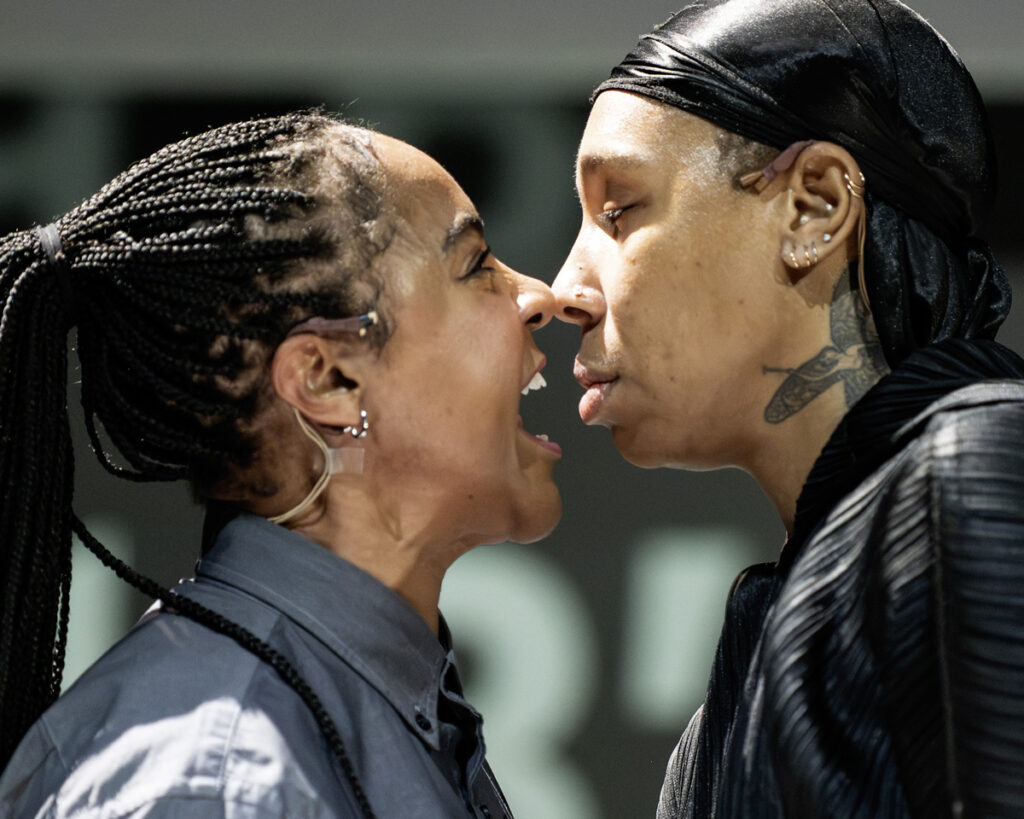
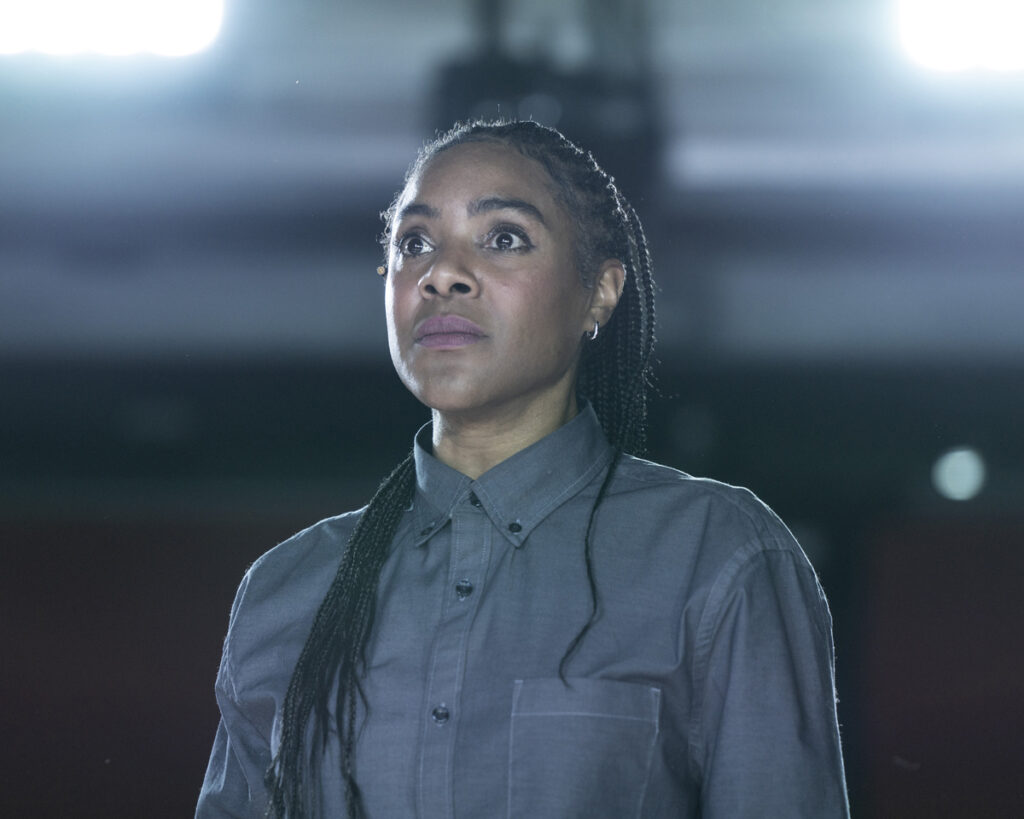
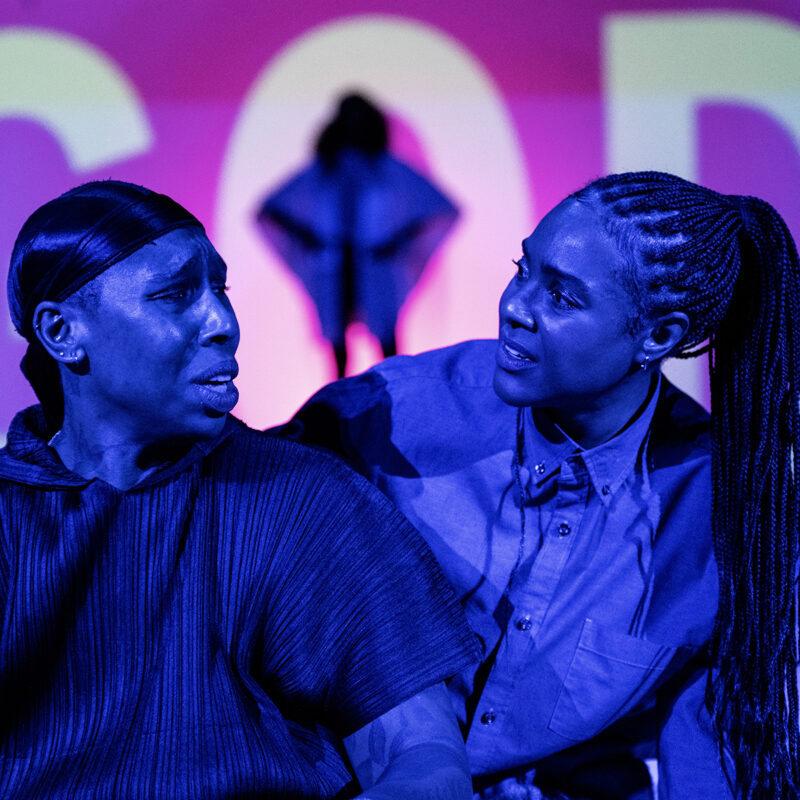
Waithe’s castmates include Fedna Jacquet and Courtney Sauls. The trio of women are captivating onstage, quickly and deftly maneuvering around intentional chaos and the stark disarray of the non-traditional set. None of the characters in trinity have names, making them relatable everywoman. It delights me to see three vastly different Black women onstage portraying a spectrum of Black femininity when tokenism can be so prevalent in some theatrical productions.
The play isn’t linear, but the throughline is the story of a love triangle from all angles. Waithe (referred to as “A”) is in a relationship with Sauls (“B”), while also having an affair with B’s best friend, Jacquet (“C”). Over the course of 75 or so minutes, the three characters interact with one another in various vignettes as A, a playwright, struggles to make sense of her life while penning a play… about her life. Overlapping memories play out as we watch the characters reckon with their actions. Why do we hurt those closest to us? Why do we hurt ourselves?
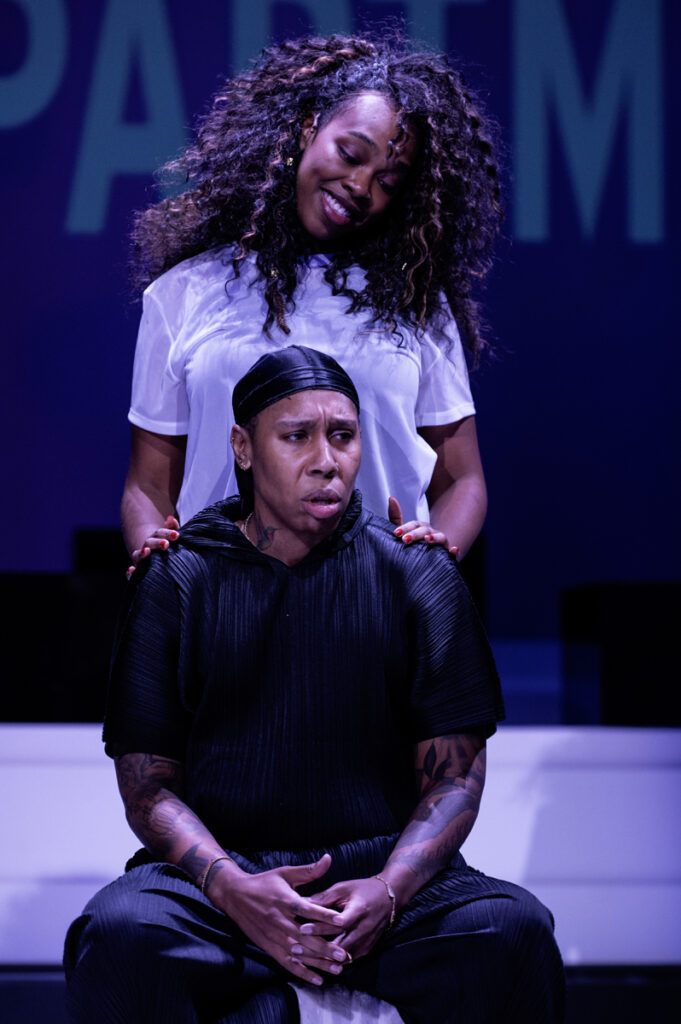
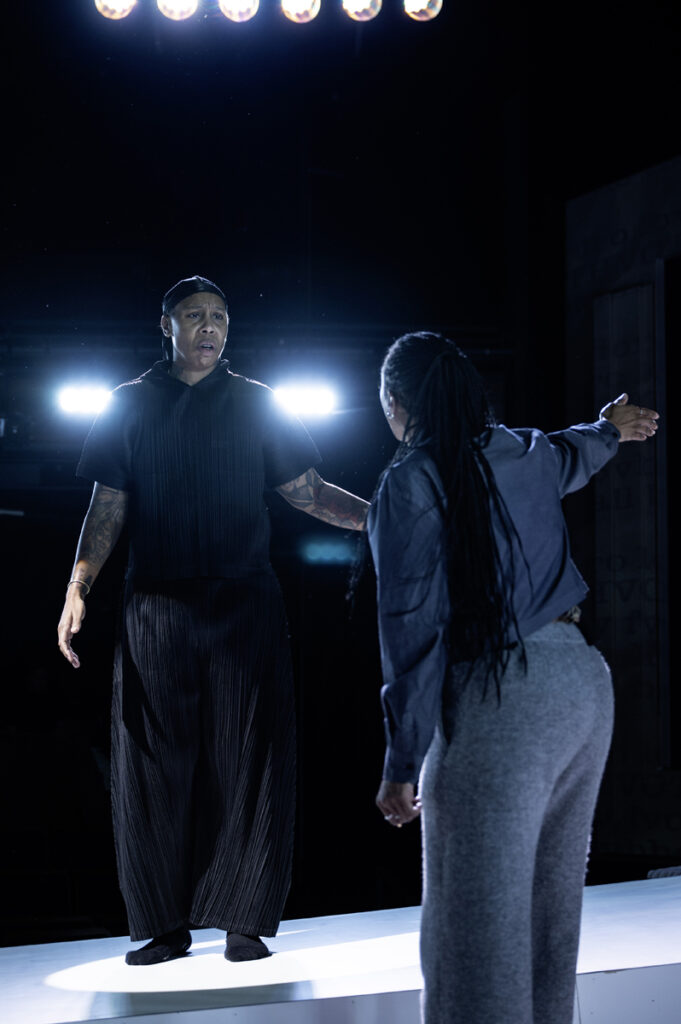
Audiences are never exactly sure of where they are in terms of reality. None of the women are reliable narrators. Characters pause in the middle of scenes and abruptly “glitch” out, questioning their own realities, replaying interactions from alternate perspectives while exploring “what ifs.” Waithe, Sauls, and Jacquet successfully explore the intersections between parental, platonic, and romantic relationships—asking many questions and providing no answers.
Sauls and Jacquet also take on multiple supporting roles, including A’s estranged mother, a priest, and God. Jacquet’s comedic timing is impeccable, often stealing scenes with a raised eyebrow or a hair flip, causing the production to hold for extended bouts of laughter. Sauls, while equally hilarious, is also able to devastate with a stillness that makes you lean in to devour her every cutting word. It’s easy to slip into their land of make-believe where all parties are entirely engaged. After viewing this play, it’s apparent that Walker-Webb and Waithe (both millennials) are familiar with the generational blessing/curse of learning to laugh through the pain.
The structure of trinity is nontraditional and experimental. Scenes are non-linear and sometimes very brief. This works in its favor, considering our abbreviated attention spans and the cultural shift towards short-form media. As a lifelong theatergoer, I’m occasionally prone to distraction. There were no moments during trinity where I found myself looking for actors in the wings or for someone offstage giving lighting cues.
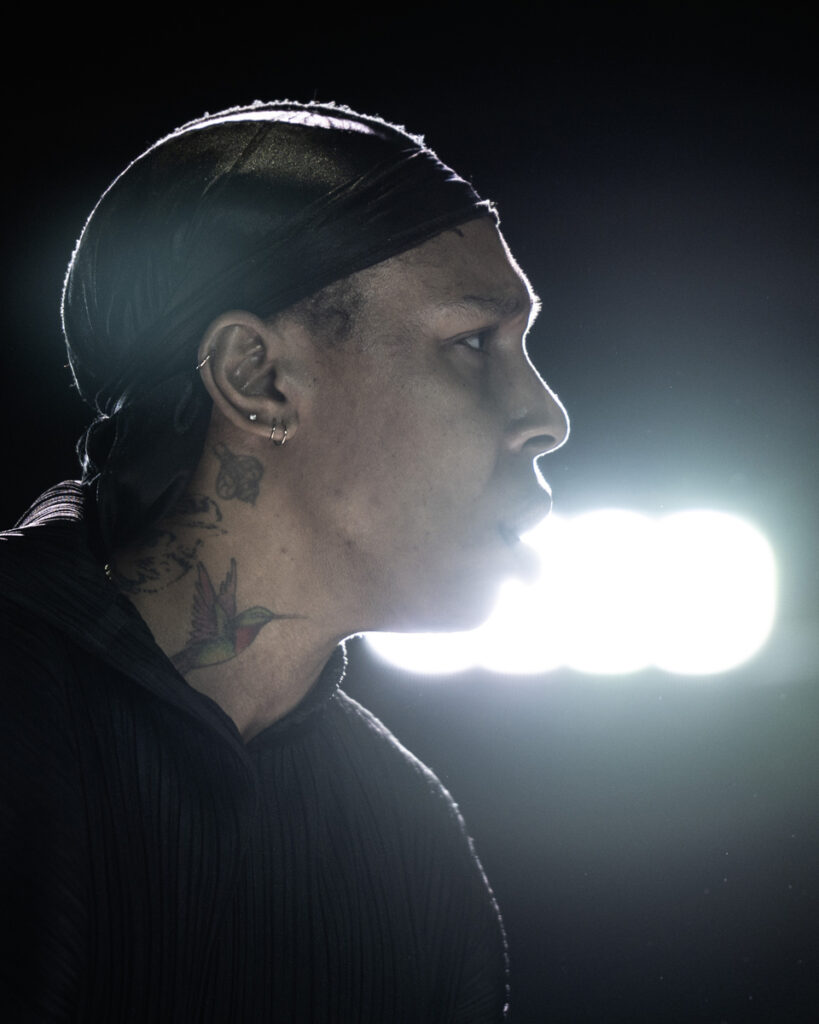
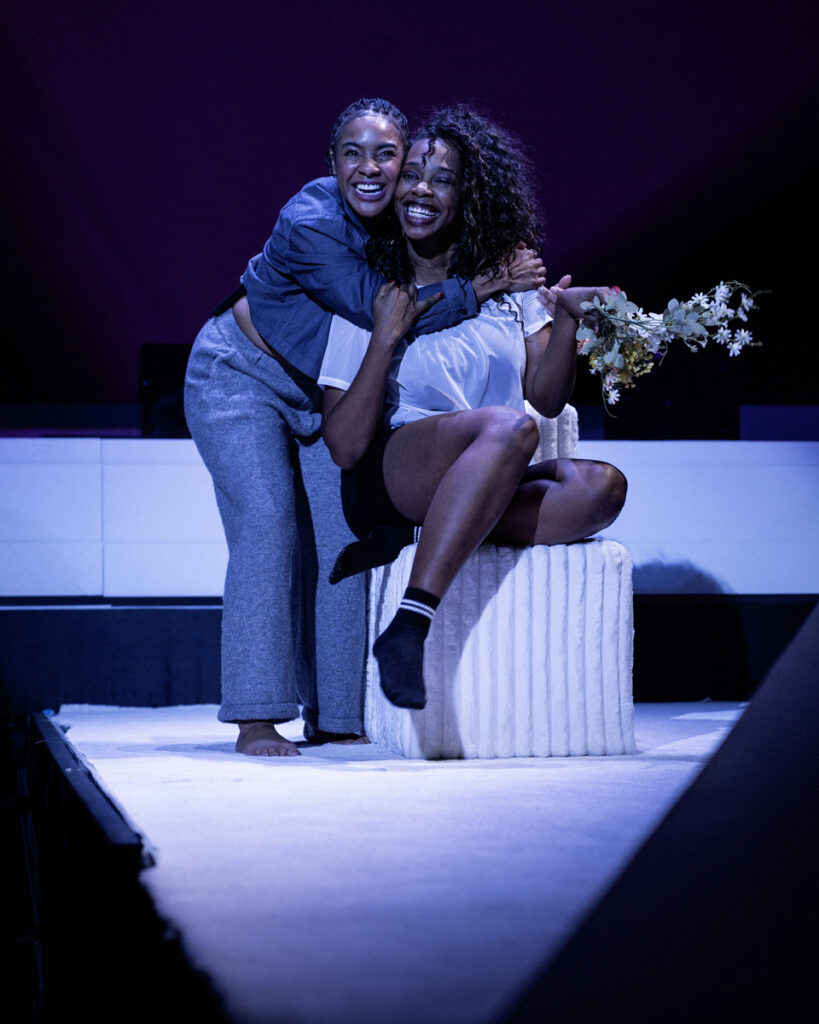
When the characters have a “glitch” in their memory or fantasy, jarring pixelations flash across a projection screen. It’s paired with a shrill sound effect to pull the audience out of the scene. It’s abrupt and almost scary, but it works. Lighting designer Adam Honoré and sound designer Taylor J. Williams work in complete sync to reflect each scene. Poignant moments are punctuated by beautifully selected R&B songs, furthering the emotional depth of the experience.
Simean Carpenter’s visionary sparse set consists of a sliding door, a ramp, a few multipurpose cushions, and a thrust stage. It’s difficult for actors to be so exposed when surrounded by an audience on three sides. There were times I wished I could see the actors’ expressions when they were facing the other side of the theater, but I do not feel that much was missed, as their voices still conveyed necessary emotions.
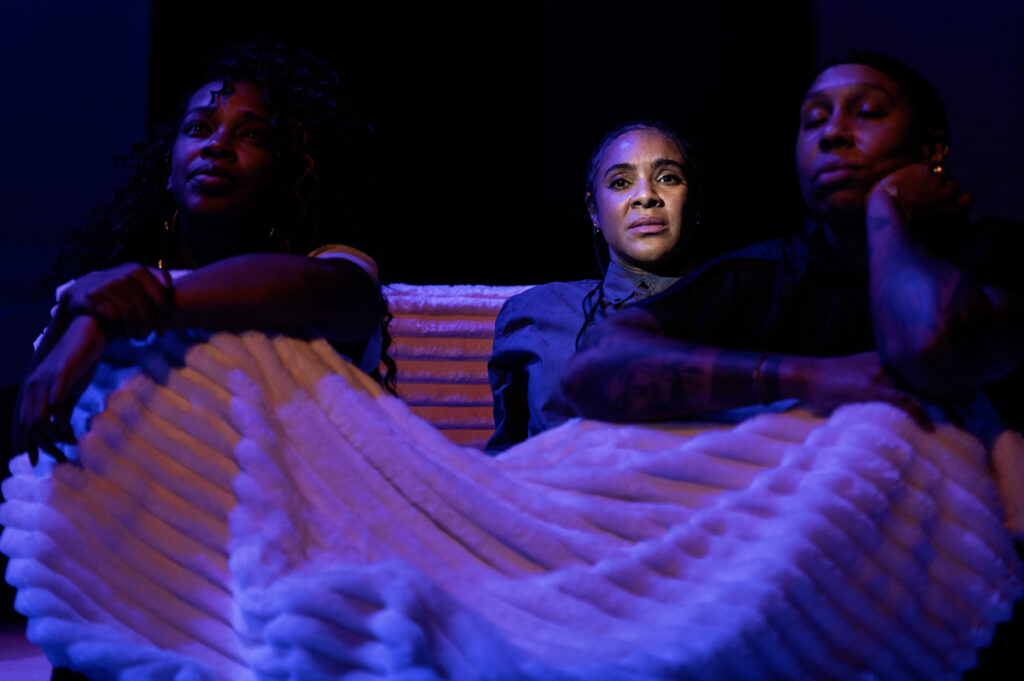
BCS and Walker-Webb clearly identify in their mission statement that they are “building a theater for everyone.” With the programming surrounding trinity, they are drawing in diverse communities to bolster support for the production. Various post-show talkbacks are planned, bringing in nationally recognized creatives to chat with cast and crew.
As tailored and personal as this role seemed for Waithe, it’s exciting to think about how this work will live on as it’s produced without her explicit, hands-on involvement. I found myself wanting more of a resolution at the end, but it’s fitting we don’t get one. Cut-and-dry happy endings don’t exist. trinity offers a more honest study, messy as it may be, of where we come from, who we are, and who we choose to take with us.
trinity is running through March 15 at Baltimore Center Stage, 700 North Calvert Street, Baltimore, MD 21202. For more information and to book your tickets visit their website.