The Baltimore Rock Opera’s American Vamp is arguably the company’s darkest—and strangest—production in over a decade. To be clear, it’s still campy and absolutely features BROs hallmarks including—but not limited to—soaring musical routines, bloody stage combat, and at least one humongous puppet. What sets the show apart from their other, recent efforts, though, is its sinister satire and timely portrayal of corporate greed.
Co-directed by Kateri and Hanna Al-Kowsi (who also wrote the original script), Vamp takes place not on a distant planet or fantastical realm, but within the stifling, gray corporate offices of Plasmacorp, New York’s “largest coordinator of biomedical supply sales.” It’s unclear whether Plasmacorp is horrific or mundane. Is their constant onboarding a sign of success or disorganization? And is it innovative or troubling that their regular work hours are 9pm to 5am?
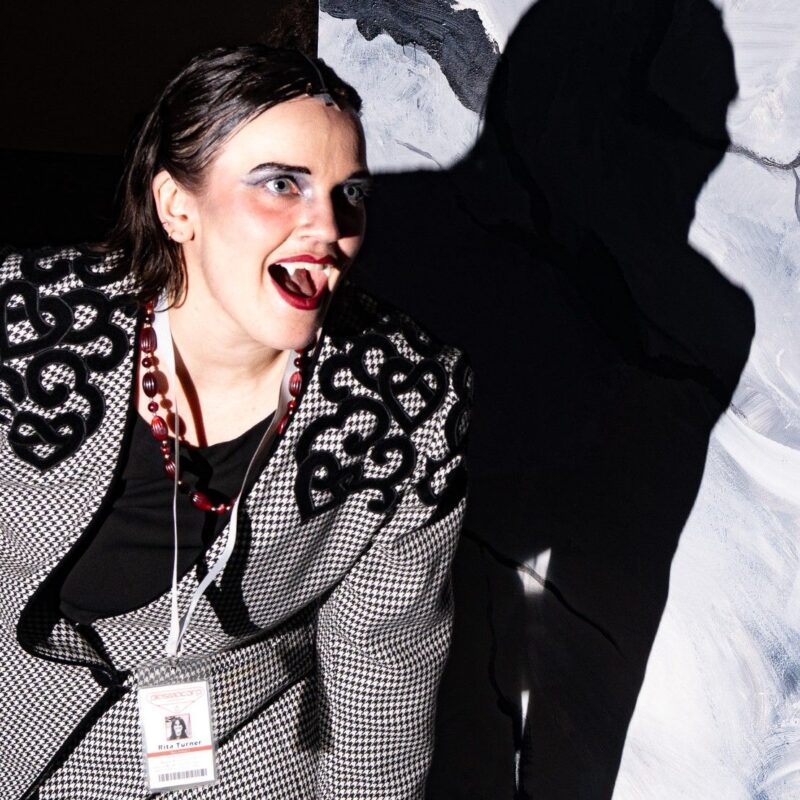
See, Plasmacorp is run entirely by vampires. But that fact is not obvious to protagonist Laura Van Felsing (mind the F). Portrayed by Liesel Arauz Vallecillo, she’s their newest human hire, a bright-eyed corporate girlie who’s unperturbed by the rude and overwhelmingly male staff. She’s in for one hell of a first day at the office, which will take her everywhere from the blood-spattered mailroom all the way to the penthouse suite of CEO, Baron Blagojevich (a scene-stealing Tevis Tsai). “I know who I am, I know what I want,” Van Felsing sings during a quiet moment of reflection in the elevator, but her self-assurance sounds forced and, in any case, will be put through some serious tests.
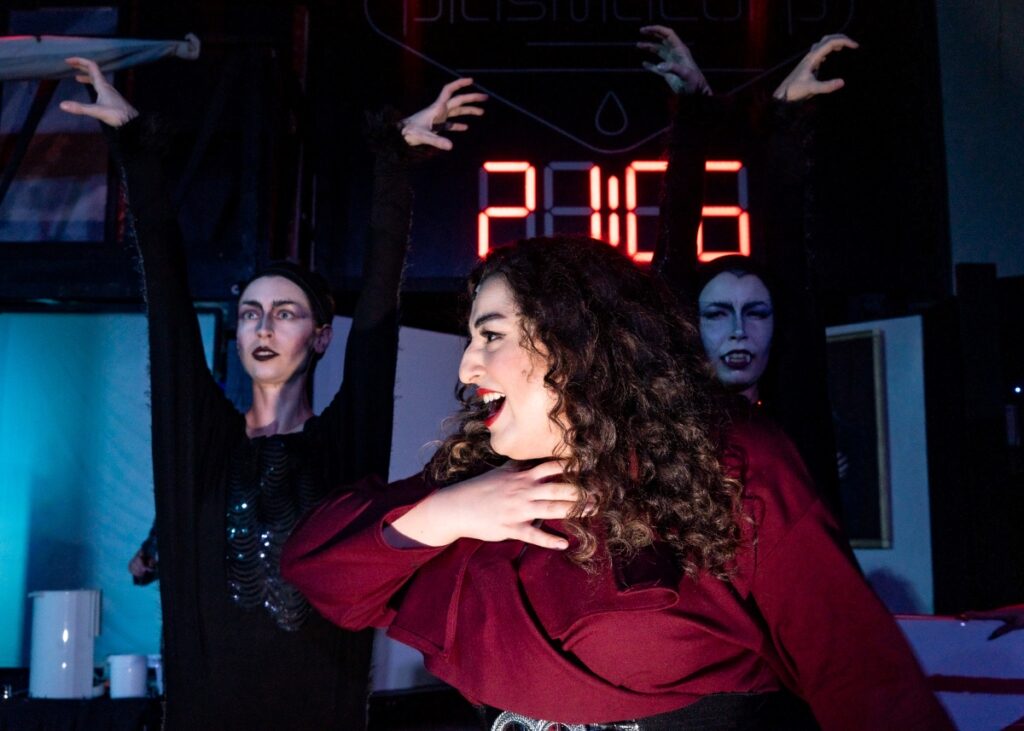
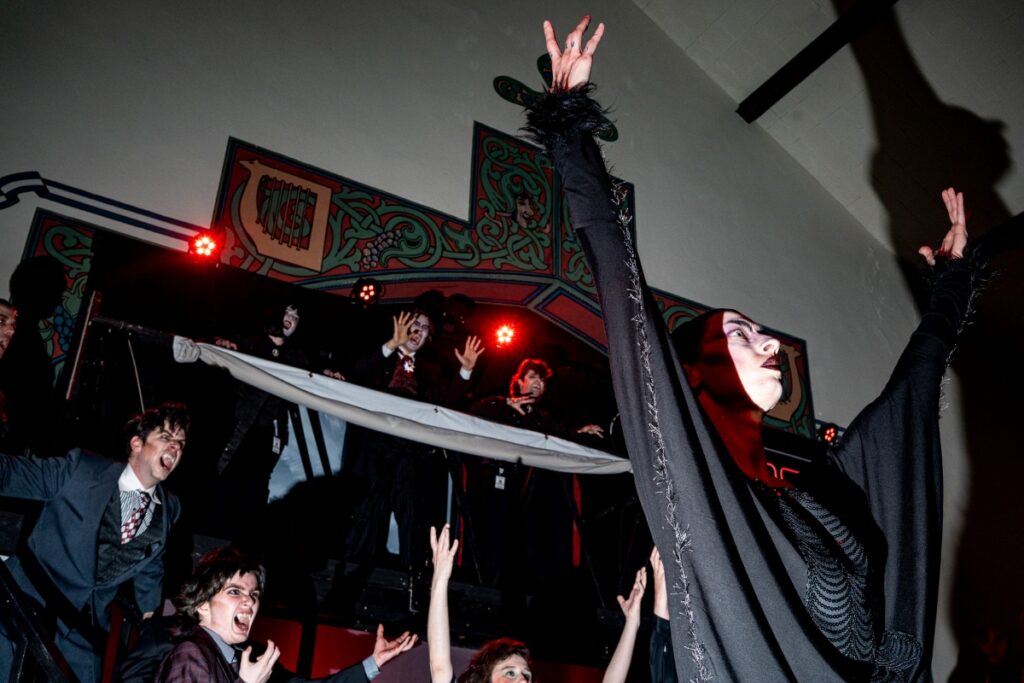
The show’s visual components impress early. The costumes (Sandy Renovetz) and makeup (Lysett McConville) resurrect the sleek and muted tones of the iconic album art for Duran Duran’s Rio, while Emmett Springer and Owen Miller-Dye’s stage design draws uncanny parallels between office buildings and Transylvanian manors. The most striking choice, however, is placing an ever-present digital clock on stage, right below Plasmacorp’s corporate logo. The clock’s numbers glow eerily through the darkness and gathering fog, and they serve as a reminder that it is time—above money, blood, and power—that exists as mankind’s most precious commodity.
Speaking of time, the decision to set this piece in the 1980s is not merely an aesthetic choice. Never mind that many of the cast and crew weren’t alive during that decade; American Vamp purposefully eschews the nostalgia trip of Stranger Things to instead view the era through the lens of Reaganomics. That was when the social safety net was thrown to the wolves in favor of the cult of individualism and the almighty stock market, resulting in a world where everyone needed to sell their soul to survive.
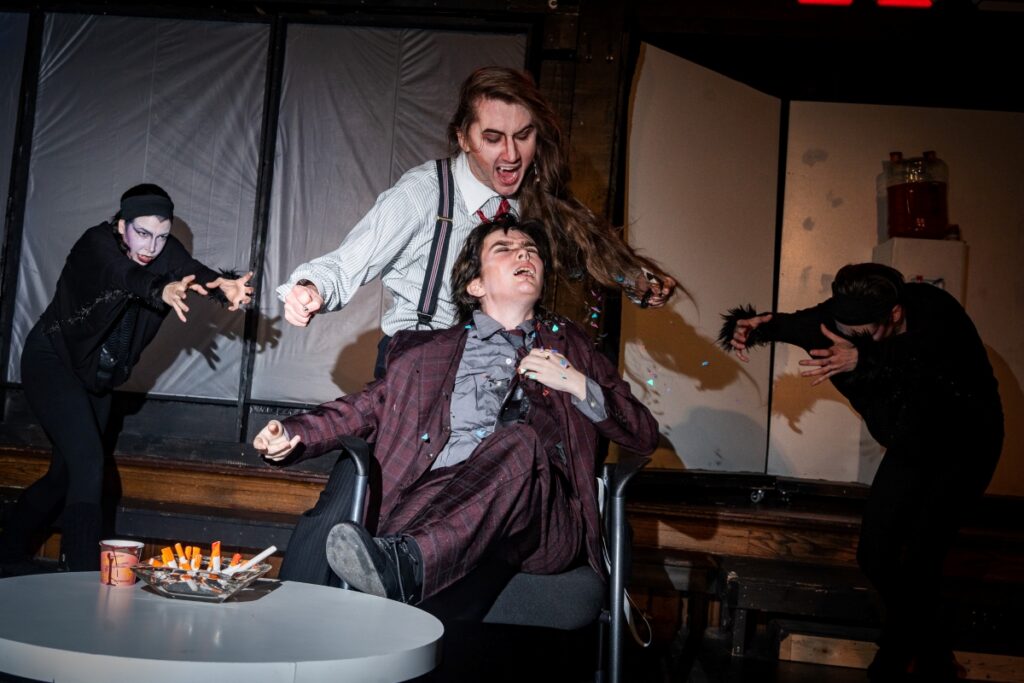
That’s the internal dilemma Van Felsing will face. She’s lucky-ish enough to meet two of Plasmacorp’s most prominent VPs: Amani Thalaba (Neva Keuroglian Sullivan) and Les Deville (Nikolai Skwarczek). The two veterans view one another as competition for a major promotion, which will absolutely not be awarded to advertising madman, Ivor the Inevitable (Josh Brown). As it is revealed early on, Van Felsing is impervious to a memory-erasing spell the vamps use to keep their living employees clueless. Rather than viewing this as a threat, Thalbaba sends Van Felsing on an errand of corporate espionage, a task the junior employee is eager to execute, even if it ends up embroiling her in company drama. Meanwhile, Deville utilizes more direct methods to position himself as promotion-material. “I’m a killer!” he boasts to Thalbaba, with confidence straight out of the Glengarry Glen Ross handbook.
It’s hard to imagine a better cast for this. Since Deville is written as an analogue of American Psycho’s Patrick Bateman, Skwarczek channels Christian Bales channeling Tom Cruise, and it’s infectious fun. Providing a contrast to Swarczek’s parodic tone, Sullivan appears freshly plucked from an actual cubicle farm. Is the hardened administrator boosting Van Felsing, or exploiting her? Looking into Thalaba’s unfeeling eyes yields zero clues. And Liesel Arauz Vallecillo is a perfect counterbalance for the huge egos and bigtime entities lying in wait from the BROs puppeteers. Functionally the show’s lead, Vallecillo portrays Van Felsing as at first optimistic and naive, but becomes convincingly fierce when needing to fight back.
Like all BROs productions, this one maintains buoyancy through rousing song and dance numbers. One of the most effective arrives early and seamlessly combines metal with a mock-utopian corporate jingle. Watching the huge ensemble snap back and forth between modes is a hoot. The house band, Vampire Weekday, serves up a live soundtrack of power ballads and catchy synth tunes that rarely overwhelm the narrative. Chugging hard rock chords effectively underscore scenes of coldhearted murder, and out of all the many able vocalists on display, Sullivan particularly shines, emoting with fiery indignation as Thalaba’s executive power dissolves like so many dreams and nightmares.
Could the script have benefitted from a structural overhaul? Possibly. For a company whose aims have always been squarely populist, the BROs most daring move with American Vamp is allowing it to exist as a character-driven piece. For theatergoers seeking tidy character arcs or emotional resolution, Hanna F. Al-Kowsi’s script may be frustrating. Alternatively, it may thrill those looking to sink their teeth into a show that emphasizes conceptual nuance and creative worldbuilding. While not exactly avant-garde, the production’s vibey second act goes somewhat leftfield and embraces the anti-logic of cosmic horror, where the motivation of humans and vampires alike pales in comparison to the dark magic of incomprehensible entities.
In this current era, when humanity’s creative output is stolen by soulless AI bros (of the non-rock-opera-society variety), seeing American Vamp serves as a pressure release valve for our collective anxieties. According to their AI policy, BROs don’t and won’t use it, and it’s heartening to see manmade, DIY performance of this scale and originality standing up for itself. As for Van Felsing and her colleagues, they face no easy decision when posed with the same question we are all posed with, day after day in the churning rat race: are you a victim… or are you a killer? Not everyone is so lucky to have a choice. But in a world that sucks, American Vamp urges us all to suck less.
American Vamp runs May 29th through June 20th at Zion Church, 400 East Lexington St. Tickets are selling fast, and are available on the Baltimore Rock Opera Society’s website.