In November 2025, the United States administration released its latest National Security Strategy, a document that reads less like policy than a catechism of suspicion: borders are described as sites of “invasion,” migration as an existential threat, sovereignty as something permanently under siege, and the world itself as a crowded room from which enemies must be sorted, filtered, expelled, neutralised. The language is absolutist, hygienic, almost metaphysical in its insistence that safety emerges only through separation, exclusion, and the pre-emptive identification of hostile bodies. It is a text obsessed with clarity: who belongs, who does not, who must be stopped, and—by implication—who may be killed in the name of order.
This rhetoric has consequences. In the past year alone, the logic articulated in such documents has materialised in increasingly militarised border practices and lethal actions justified under the sign of “security,” including the killing of people on small boats allegedly linked to narcotics trafficking, and the January 3rd attack on Venezuela resulting in the kidnapping of President Maduro and threats to other sovereign nations in the region. Whether framed as defence, deterrence, or necessity, these acts are underwritten by what Achille Mbembe has described as a contemporary “Society of Enmity,” in which political life is organised around the permanent production of enemies and the normalisation of violence against those rendered foreign, surplus, or threatening.
It is against this backdrop that John Akomfrah’s The Hour Of The Dog premiered at the Baltimore Museum of Art. The timing is not incidental, nor is the location.
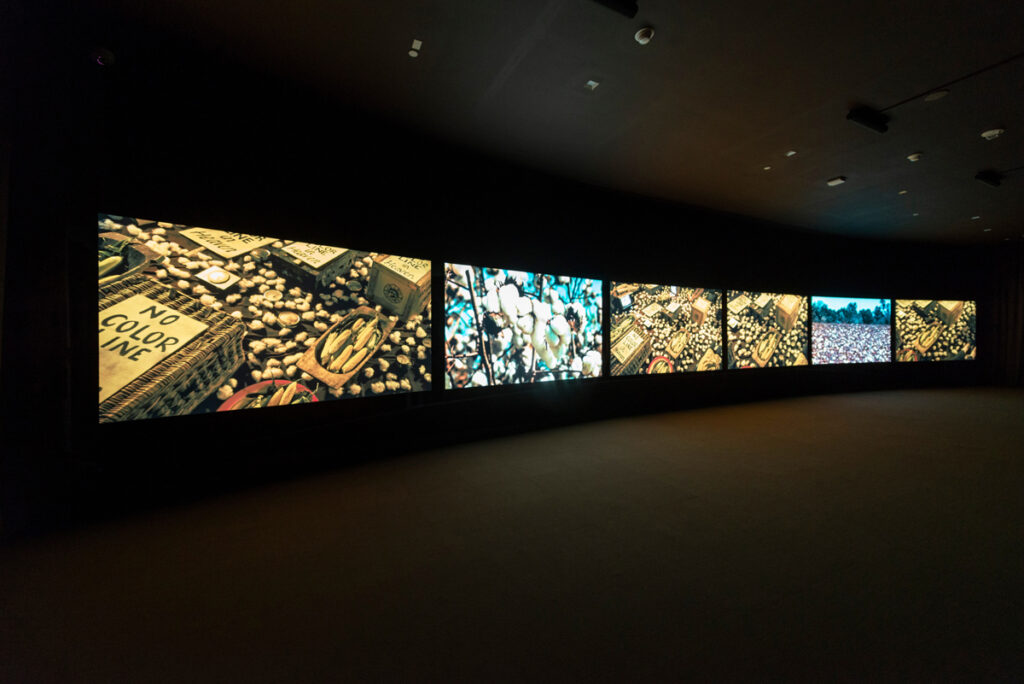
Marcio Junji SonoTo encounter ‘The Hour Of The Dog’ in Baltimore is to experience the Civil Rights Movement not as a sealed historical chapter, but as a set of unresolved energies that continue to press insistently on the present.
The Hour Of The Dog was commissioned by the BMA in collaboration with the Menil Collection, Houston, with support from The Andy Warhol Foundation for the Visual Arts.
My engagement with this work unfolds alongside a recent, sustained encounter with John Akomfrah’s practice more broadly. In 2024, in an experience that was at once academic, artistic, and deeply personal, I spent a month inhabiting his monumental installation Listening All Night to the Rain as a British Council Fellow at the Venice Biennale.
That work traced the afterlives of colonialism, with particular attention to Britain’s imperial offscourings, while allowing other historical currents to surface and resonate, including Congo’s fight for independence in the 1960s, the Vietnam War, the Nigerian Civil War, and the U.S. Civil Rights Movement—now the central lens of The Hour Of The Dog. Akomfrah approaches the latter not to monumentalize it, but to meditate on ontology, temporality, and what it means—then and now—to exist within history rather than merely pass through it. What follows is written from within that continuity.
A Work at Twilight
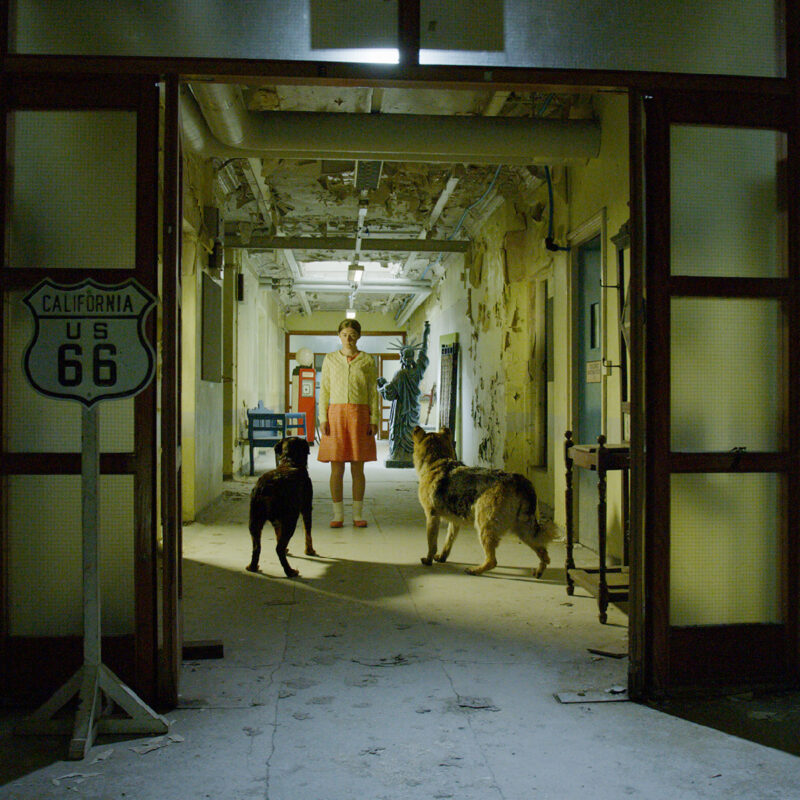
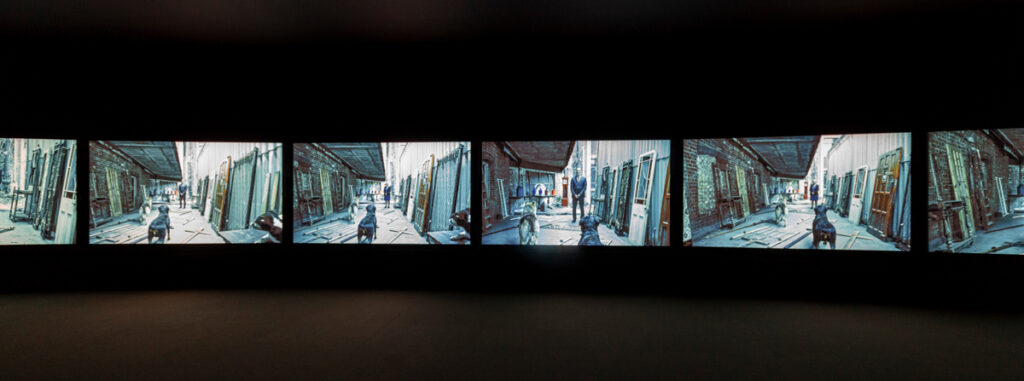
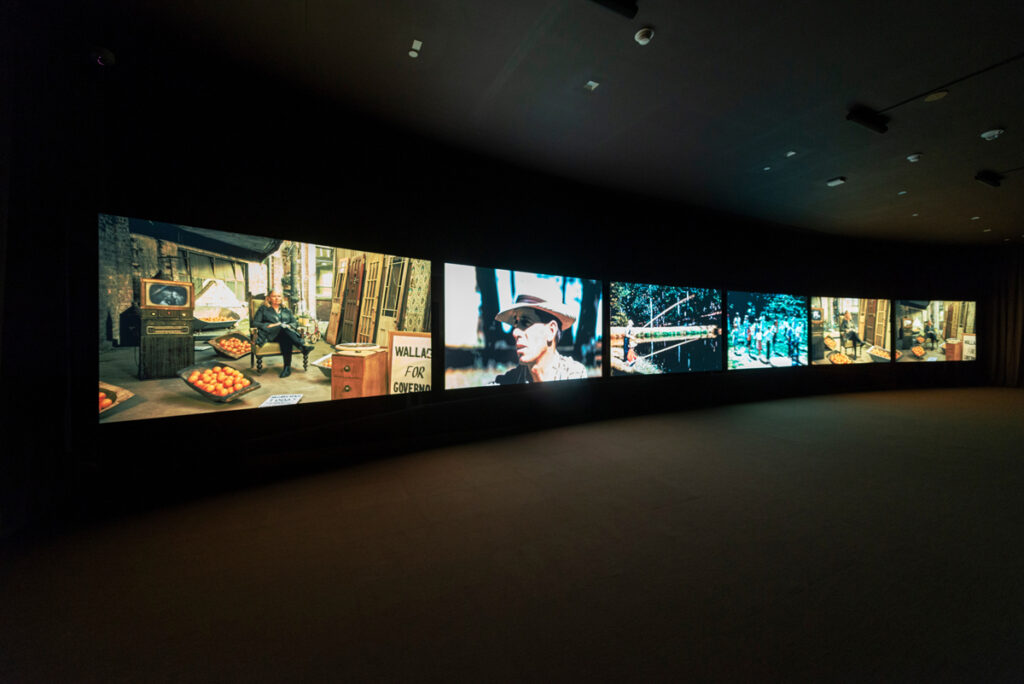
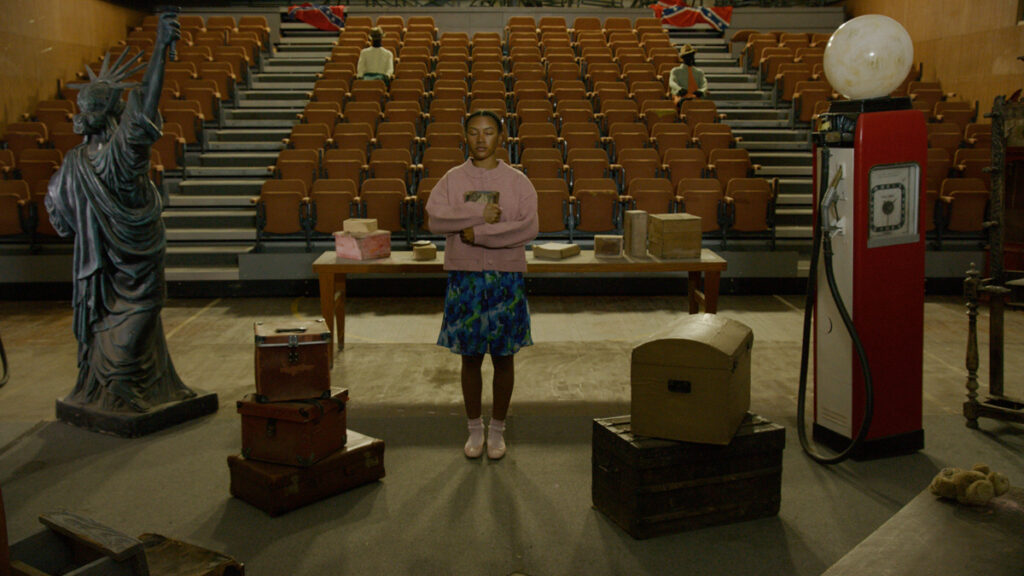
The Hour Of The Dog is a six-channel moving-image and sound installation, approximately fifty minutes in duration, organized as five parables that weave together Civil Rights–era archival footage with newly shot material. Its title derives from the Chinese zodiac, in which the “hour of the dog” designates twilight: the threshold between day and night, certainty and obscurity, the known and the yet-to-come. (“I’m interested in liminality,” explains the artist.) Twilight is neither resolution nor redemption. It is an unstable interval, a moment when forms blur, shadows lengthen, and perception becomes unreliable.
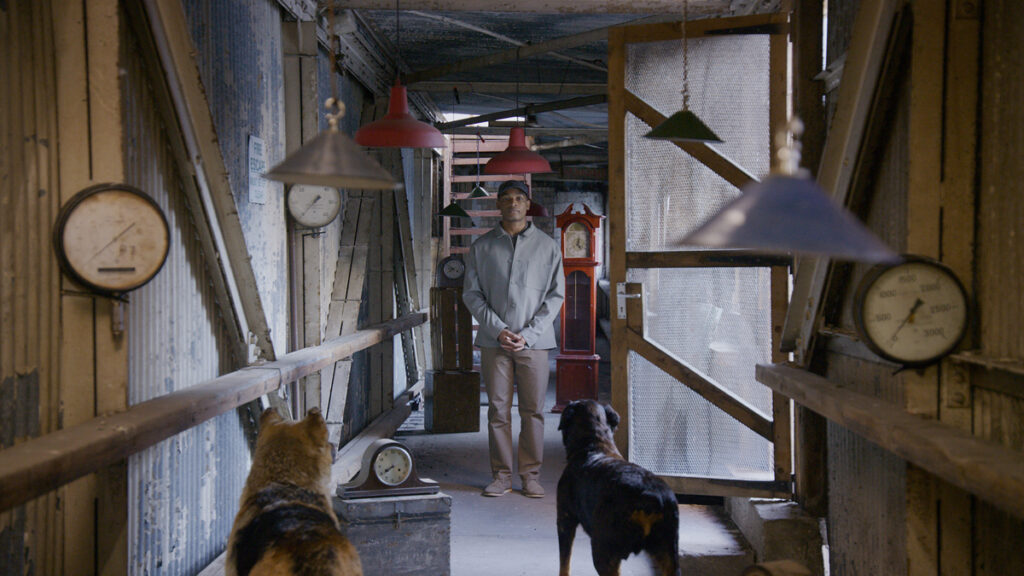
The recurring presence of dogs throughout the installation further complicates this condition of the in-between. Dogs appear variously as companions and witnesses—figures of loyalty and proximity, but also of enigmatic passivity, observing history without the power to intervene. Elsewhere, they recall the familiar sight of stray or friendly dogs moving alongside demonstrators, joining crowds—one might wonder: inadvertently, merely drawn to collective motion, or perhaps concurring with the ideology on parade?
At the other extreme looms the dog as instrument of repression: the police K9, trained to enforce order through fear and violence. Suspended between affection and aggression, indifference and solace, intimacy and threat, the dog becomes a fitting emblem of liminality itself—neither sovereign nor subjected, innocent nor coercive, but quietly entangled in the structures of power it shadows.
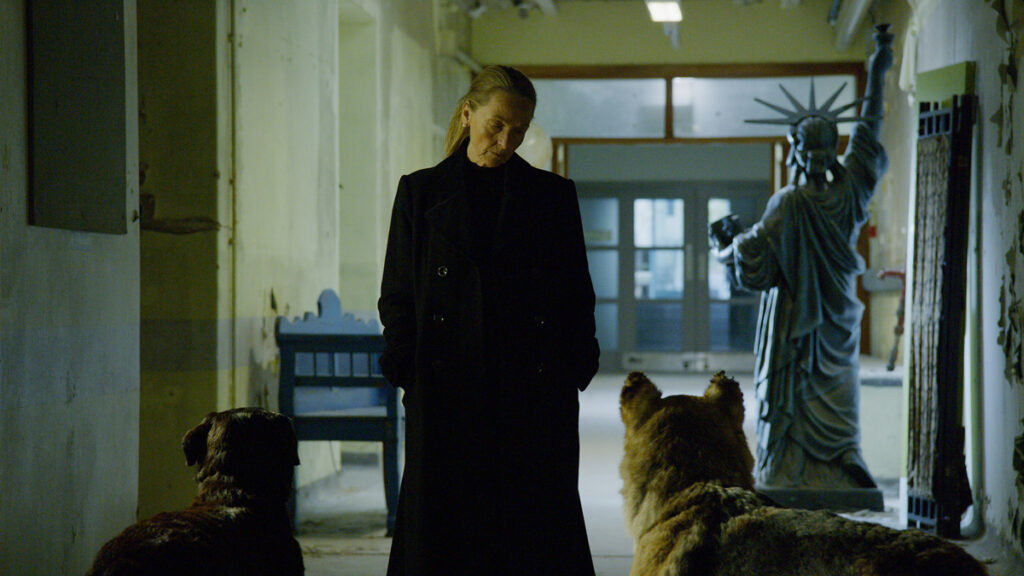
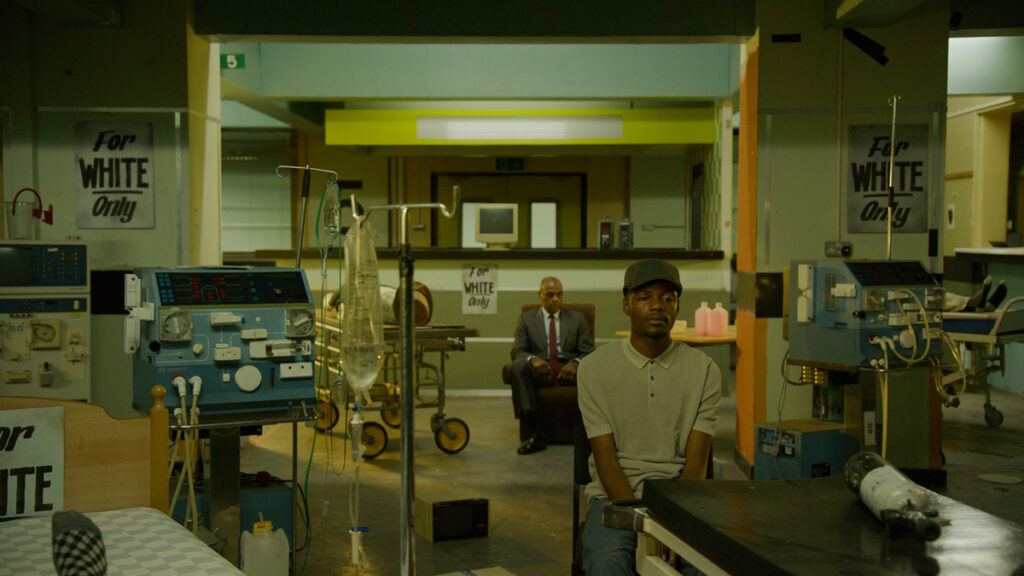
Akomfrah’s installation fully embraces that instability. Images do not align neatly across screens as a predictable composition; sound drifts, overlaps, recedes. Archival footage of protests, segregation, and collective organizing in the southern United States appears alongside contemporary scenes that seem unmoored from specific time or place, and that simultaneously suggest stillness and response. The work refuses a single point of view, a master narrative, or a linear progression from injustice to triumph. Instead, it asks the viewer to inhabit a space of fragmentation, simultaneity, and repetition —a space that feels uncannily opposed to the doctrinal clarity demanded by contemporary security discourse.
This resistance to narrative mastery has deep roots in Akomfrah’s earlier work. As a founding member of the Black Audio Film Collective, his 1986 film Handsworth Songs confronted the Birmingham riots not as a breakdown of order but as a crisis of historical narration itself, exposing how Black British life was rendered visible only at moments of eruption. More recently, the resurgence of nationalist rhetoric around Brexit—its fixation on sovereignty, borders, and fantasized cultural purity—has provided another backdrop against which Akomfrah’s fragmentary aesthetics read less as style than as necessity. In this sense, The Hour Of The Dog’s engagement with U.S. civil rights history resonates with a longer British preoccupation in his work: the refusal of state narratives that demand coherence at the expense of lived complexity.
Baltimore matters here. As a city with a deep history of Black cultural production and civil rights activism—and a present shaped by structural racism, policing, and political neglect—it is also a city whose demographics and lived realities sit in direct tension with the white-nationalist imaginary that animates the current administration’s vision of America. To encounterThe Hour Of The Dog in Baltimore is to experience the Civil Rights Movement not as a sealed historical chapter, but as a set of unresolved energies that continue to press insistently on the present.
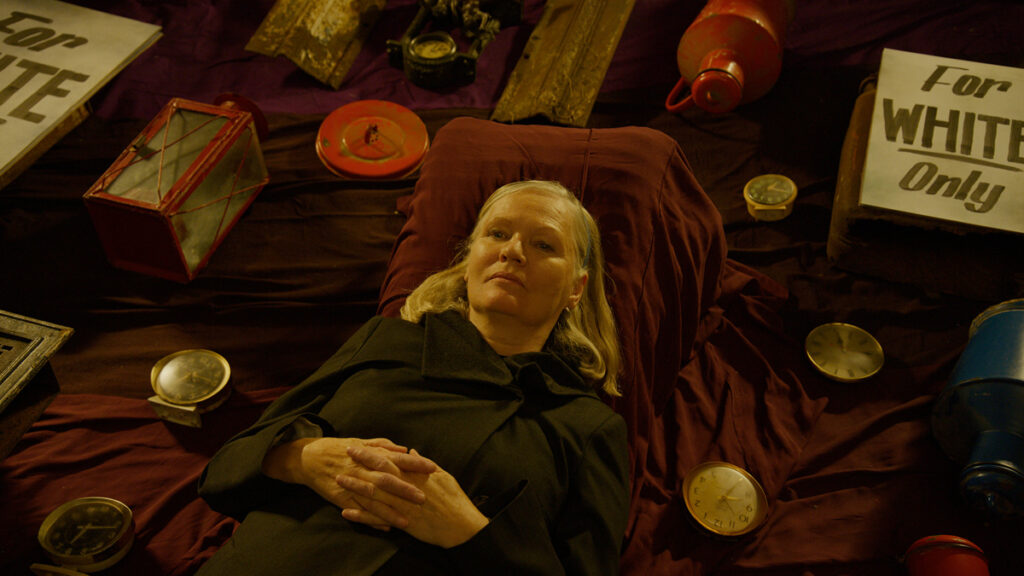
John AkomfrahI’m interested in lives lived and imagined; the gap between the two is usually where you’ll find my work.”
Montage Against Mastery
Formally, The Hour Of The Dog belongs to a lineage of Akomfrah’s multi-screen installations that resist narrative mastery through fragmentation. Watching the work is less like reading an argument than like entering a kaleidoscope: fragments of image and sound refract one another, producing shifting constellations of meaning that never fully stabilize. This is not fragmentation as aesthetic gimmick, but as an ethical, ontological, and epistemological position.
In our conversations about his Venice presentation Listening All Night to the Rain (2024), Akomfrah described multi-screen installation as a way of mirroring how we actually experience the world: sensorially overloaded, intellectually interrupted, emotionally non-linear. Meaning does not arrive whole; it accumulates, dissipates, returns. In this sense, the installation functions as a cognitive analogue rather than a representational one. It does not tell us what to think; it stages the conditions under which thinking—halting, partial, affective—takes place.
This sensibility also shapes how Akomfrah approaches the human figures that populate The Hour Of The Dog. “In a broad sense,” he has said, “I’m interested in lives lived and imagined; the gap between the two is usually where you’ll find my work.” Perhaps nowhere is this more evident than in the mugshots that appear throughout the installation. Originally produced as bureaucratic instruments of control—indexes of surveillance, criminalization, and oppression—they are here transformed into portraits of extreme dignity, even majesty. Stripped of their intended function, these images become sites where lived experience and imagined possibility collide, where the state’s attempt to fix identity gives way to a poetics of refusal.
This approach stands in stark contrast to the fantasy of total knowledge that animates contemporary security regimes. Official doctrine insists on visibility, legibility, control: threats must be named, tracked, eliminated. Akomfrah, by contrast, constructs an environment in which certainty dissolves and coexistence is inherent. The viewer is never a sovereign observer. One is always too late for one image, too early for another, caught in between.
Water, Memory, Residue
In Venice, Akomfrah mentioned his interest in the pseudo-scientific concept of “water memory,” associated with Jacques Benveniste: the idea that water retains the imprint of substances and bodies that have passed through it, regardless of dilution or scale. While discredited as empirical science, the notion operates powerfully as metaphor. In Akomfrah’s work, history behaves like water: absorbing traces, carrying residues, refusing purification.
In The Hour Of The Dog, the archive is not a fixed repository of facts but a liquid medium through which images, sounds, and affects circulate. Civil Rights mementoes are not evidence of a completed struggle, but as something still chemically active, still capable of reacting with the present. Memory is not monumental; it is ambient. It seeps.
This logic also extends to Akomfrah’s creative process itself. As he has put it, “things have spirit; matter has consciousness.” The work does not impose form upon inert material; rather, it allows the properties of the archive—its textures, rhythms, resistances—to shape the final work. Meaning emerges through interaction, collaboration, and contingency, not command.
This idea of historical interconnectedness—across time, bodies, and geographies—cuts directly against the logic of separation that Mbembe identifies as central to contemporary politics. The society of enmity depends on clear boundaries: between citizen and non-citizen, friend and enemy, inside and outside. Akomfrah’s watery archive refuses such boundaries. It insists, instead, on contamination, proximity, and shared substance.
Epic Without Closure
Chronologically, The Hour Of The Dog does not include some of the most widely canonized Civil Rights Movement milestones: the March on Washington (1963), the Civil Rights Act (1964), or the Voting Rights Act (1965). That absence is not an omission but a meaningful choice. By concentrating on the movement’s nascent phase, Akomfrah foregrounds not its epochal achievements (which are unquestionable), but its epic dimension: a mode of struggle that exceeds historical time.
For Akomfrah, “all images have a utopian dimension.” Images, by their very nature, aspire to an existence beyond the moment they are captured while generating a new past behind them. In The Hour Of The Dog, this utopian charge animates the voices of young Freedom Riders—C. T. Vivian, Diane Nash, James Lawson, James Bevel, John Lewis—alongside lesser-known activists whose words and presence form a dense discursive tapestry. Their voices do not merely document history; they chant it into being, projecting a call that was pivotal in the 1950s and 60s and remains urgently resonant today, and into the future: both future events and our future comprehension of the past.
Creating this tapestry is also a way of countering what Akomfrah has described as a contemporary crisis of language. “The language in which we are meant to be captured,” he has noted, “feels increasingly unreal.” In an era saturated with racist, othering, and dehumanizing rhetoric—language that seeks to reduce complex lives to administrative categories—The Hour Of The Dog proposes a counter-lexicon: one composed of testimony, repetition, and resonance rather than classification.
Alienation Without Cure
Okwui Enwezor’s writing on Akomfrah’s postcolonial cinema is instructive here. For Enwezor, Akomfrah’s work does not resolve alienation but inhabits it, using montage to expose the fractures produced by colonialism, racism, and modernity without pretending to heal them. Disalienation, in this framework, is not a narrative outcome but a formal condition: the refusal to smooth over historical violence through coherence or closure.
The Hour Of The Dog exemplifies this logic. The Civil Rights Movement is not presented as a triumphant arc culminating in legislative success. Nor is it aestheticized into nostalgia. Instead, it appears as a field of struggle whose energies remain unresolved, whose promises remain partially unfulfilled. The work does not console. It unsettles.
This is politically significant. In a moment when reactionary politics seeks to re-narrate history as a story of completed progress—we fixed that already—Akomfrah’s refusal of closure becomes a form of resistance. The past, in his work, does not stay put. It interrupts.
Marcio Junji Sono“There is no villain to be vanquished, no singular antagonist to blame. Power appears dispersed, structural, historical. Violence is systemic rather than spectacular. This refusal is not evasive; it is ethical. To name an enemy, Akomfrah seems to suggest, is often to reproduce the very logic one seeks to oppose. “
Enmity, Security, and the Refusal to Name the Enemy
Mbembe argues that contemporary democracies increasingly require enemies in order to sustain themselves, producing figures of threat that justify exceptional violence and perpetual surveillance. The current U.S. administration offers a near-textbook illustration of this dynamic: migrants, refugees, and racialised others transformed into existential dangers whose elimination becomes not only thinkable, but ardently desirable.
What The Hour Of The Dog refuses to do—crucially—is to offer a counter-enemy. There is no villain to be vanquished, no singular antagonist to blame. Power appears dispersed, structural, historical. Violence is systemic rather than spectacular. This refusal is not evasive; it is ethical. To name an enemy, Akomfrah seems to suggest, is often to reproduce the very logic one seeks to oppose.
Instead, the work cultivates a politics of haunting. Images return. Voices echo. Histories repeat with difference. Where security doctrine demands resolution, Akomfrah insists on lingering.
Twilight as Political Condition
The hour of the dog is not dawn. It offers no guarantee of light. But it is not night either. It is a liminal space in which new configurations might emerge, however uncertainly. To situate The Hour Of The Dog in this temporal register is to resist both despair and false optimism.
In the long shadow of the current U.S. administration—marked by aggressive nationalism, corruption, the weaponization of fear, and a renewed appetite for border violence—Akomfrah’s work does not promise a return to the moral clarity of the Civil Rights era. That would be simplistic, and a lie. What it offers instead is something quieter and more demanding: a sustained attentiveness to history as unfinished, to memory as active, and to justice as something that must be continually re-imagined rather than declared achieved.
If official security doctrine dreams of a purified nation, sealed against contamination, The Hour Of The Dog insists on mixture, residue, and relation. It asks us to remain in the twilight—to resist the comfort of absolutes, to listen again, and differently, to voices that refuse to fade.
In an age obsessed with enemies, that refusal may itself be a form of hope.
John Akomfrah’s The Hour of the Dog is on view at the Baltimore Museum of Art November 16, 2025 — February 1, 2026. The film begins every hour on the hour with the final screening each day starting one hour before closing. Run time: 50:37
Marcio Junji Sono is a curator and producer based in London, currently working in the cultural section of the Embassy of Brazil. He previously served as Head of Exhibitions at Isaac Julien Studio, and holds degrees in philosophy from the University of São Paulo and Birkbeck, University of London. His writing and editorial work has appeared in Brazilian institutional publications, including Pipilotti Rist (Paço das Artes/Imprensa Oficial, 2010) and Gary Hill: Circumstances (2010). He was a British Council Venice Biennale Fellow in 2024.