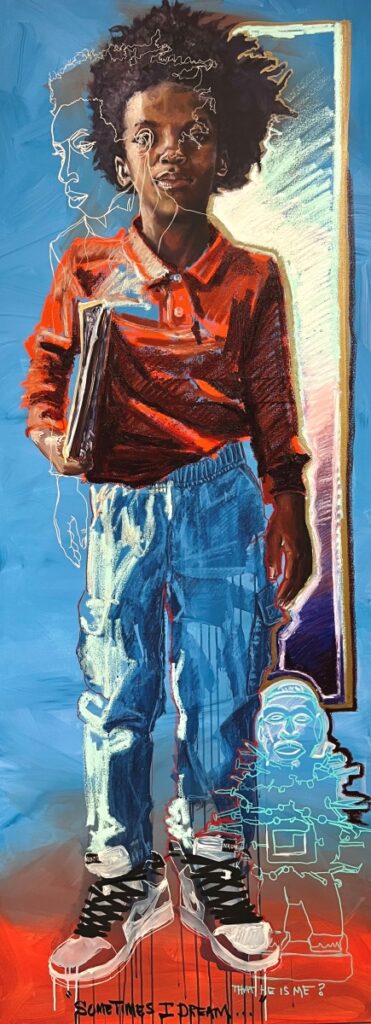
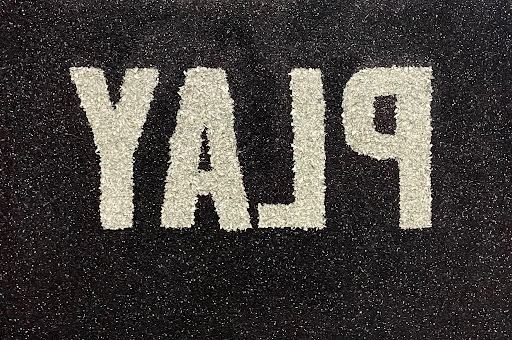
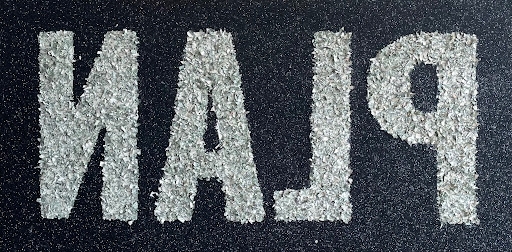
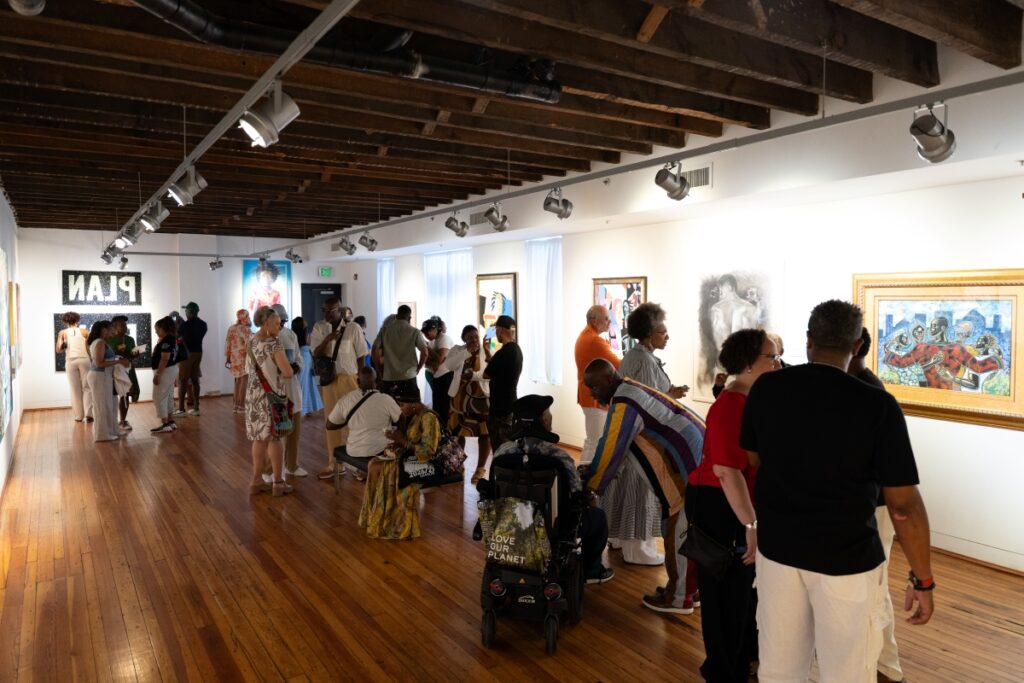
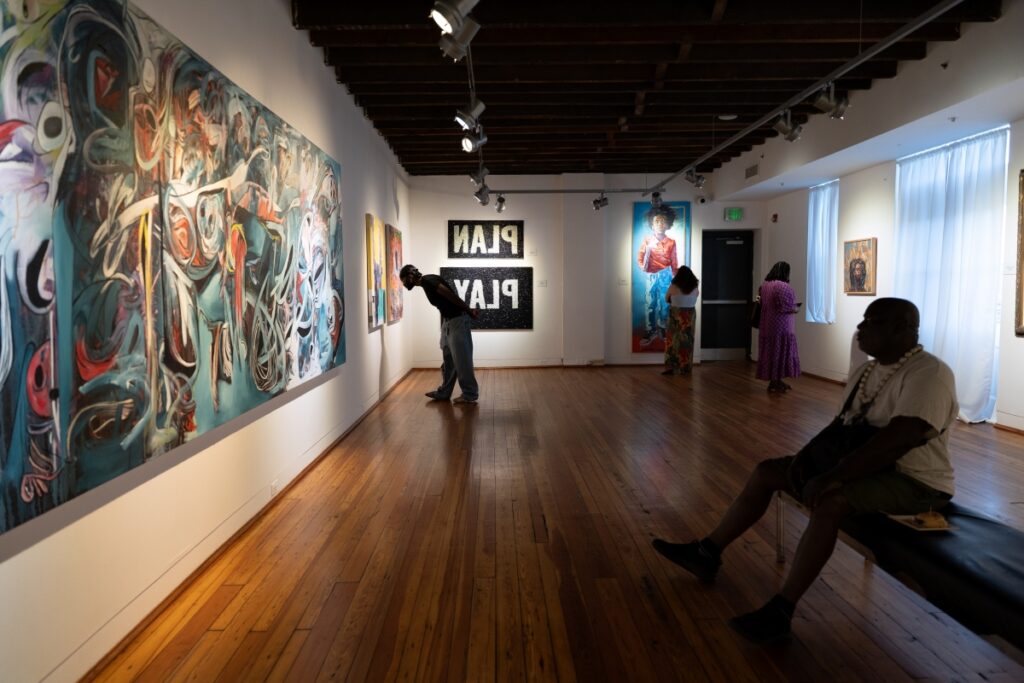
Two works by Jeffrey Kent hang stacked, one above the other: In the first, the word “PLAN,” is tightly cropped and written in Kent’s signature reverse style. It’s spelled out in shredded currency on a black sequined ground that evokes asphalt. Beneath this, the second piece reads “PLAY” and is rendered in the same style but within a wider field. Beside them, “Not Like Mike 3”—an eight-foot-tall painting of one of Ernest Shaw’s students—confidently looks out at us, Jordans on his feet and binders tucked under his arm. A line-drawn phantom of the boy turns his gaze away from the viewer, eyeing “PLAY,” as the boy himself is planning.
5 x 5 Baltimore: The Art of Black Men at the Eubie Blake Cultural Center opened on June 20th, 2026, sandwiched between Juneteenth and Father’s Day. It features the artwork of ten Black men. Curators Derek Price and Barbara Bullard, with the support of Alma Roberts, brought together five artists from Baltimore—Ainsley Burrows, Larry “Poncho” Brown, Jeffrey Kent, Jerry Prettyman, and Ernest Shaw—with five artists from Lehigh Valley, Pennsylvania—Al Johnson, Femi Johnson, Rigo Peralta, Anthony Smith Jr., and Charles Stonewall—in this massive 40-work exhibition.
I was curious to see if the timing of the exhibition was significant. It was. The opening felt a bit like a Juneteenth party: dozens of beautiful Black faces engaging with art, each other, and expression itself. While most of the work wasn’t explicitly about fatherhood, each artist brought forth a refined perspective on their lived experiences. Through their work, they explore themes of injustice, otherness, and personal psyche. I found the show therapeutic and it was validating to see the works of other practicing Black male artists being celebrated.
In the first room, artist Anthony Smith Jr.’s maximalist, sculptural collages are on display. His playfully chaotic compositions are littered with pop culture references from Kevin Samuels to The Simpsons that reveal an uncanny interconnectedness beneath the surface. Take Smith’s piece, “The Great Time Hambone Reads Invented People Should Play Rigged Games” for example; this Möbius loop features vignettes like Diana Ross’s comically large hair extensions slithering throughout the work and Marjorie Taylor Greene as the queen on a central chess board.
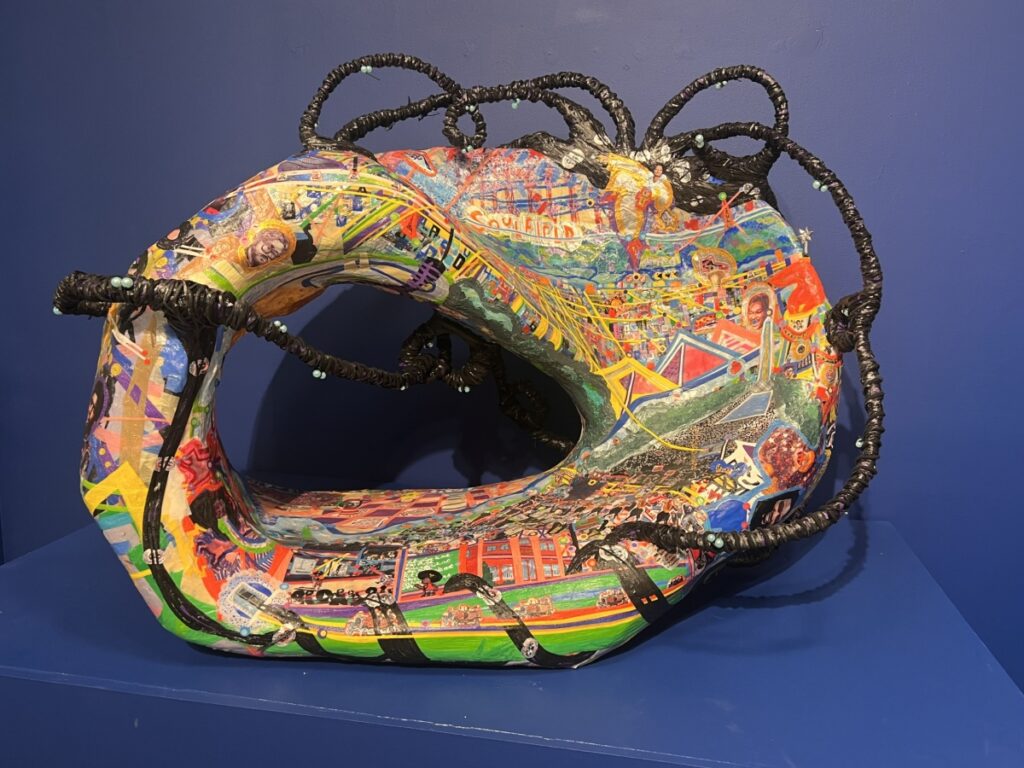
Ross’ hair extensions could be read as a metaphor for how Black identity and expression can be vilified, as with Marjorie Taylor Greene’s infamous moment with Congresswoman Jasmine Crockett, where Greene mocked Crockett’s “fake eyelashes.” Greene, a stand-in for bigotry and white supremacy, is undermined by her own prejudice—a mysterious button allows you to Fight the Power by activating a “Jewish Space Laser” (a nod to the antisemitic conspiracy theory Greene floated blaming California wildfires on a Jewish banking family) that bears the logo of Public Enemy and destroys the Marjorie Taylor Greene piece. This perhaps hints at how an … invented people [might] play rigged games.
Ultimately, though, as soon as you take your finger off the button, Greene, unfazed, reclaims her position as the queen of the chessboard. It’s no coincidence, then, that “The Hambone” takes the shape of a Möbius loop, a mathematical shape with one side and one edge and with no beginning or end, because no matter how far along the path we think we progress, we always end up right where we started.
It is also fitting that “The Hambone,” the first piece I encountered when going through the show, resembles The Guardian of Forever, a sentient portal from Star Trek that enables travel to different times and dimensions, because it serves as a portal both into the world of Anthony Smith Jr. and the greater world of the 5×5 show.
Charles Stonewall’s work, which sits next to Smith’s, occupies a more meditative place. Stonewall grapples with themes of hope, heartbreak, and grief in his body of photographic portraits. He employs single figures that are reflecting in domestic spaces that dwarf them in scale. These spaces become subjects as well, offering context that the figures alone couldn’t provide. One of my initial reads was that the space was some sort of antagonist to the figures, consuming and entombing them in brick walls and stone cellars. But neither the figures nor the spaces they inhabit convey that tension. The figures, while dwarfed by the imposing structures, don’t seem to be oppressed by them, and the structures, while framing the figures, don’t seem to imprison them. Their meaning remains ambiguous.
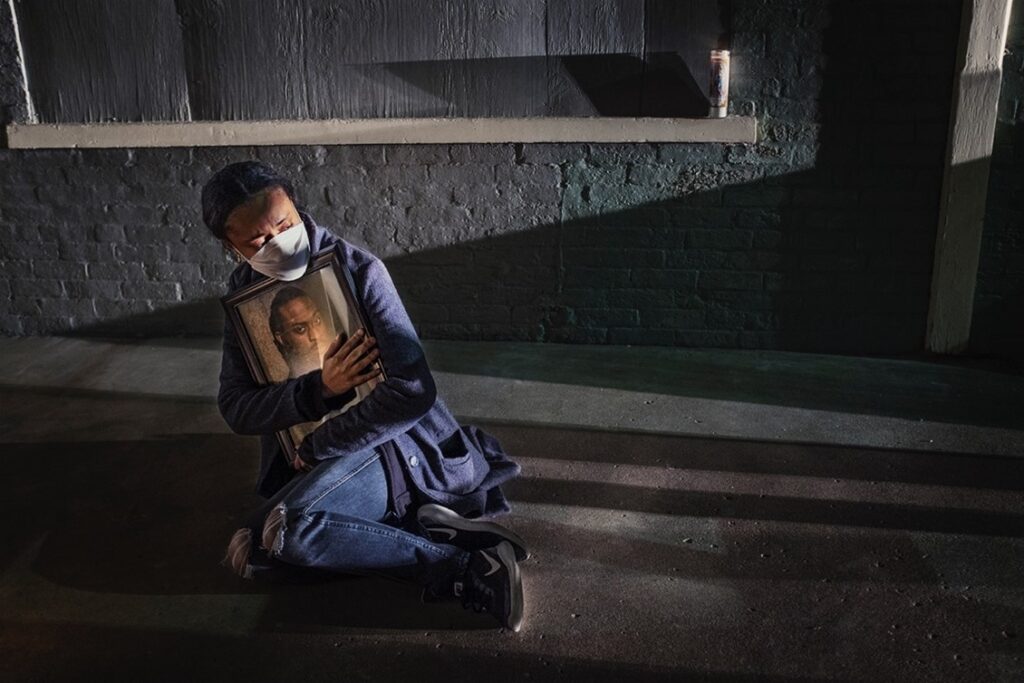
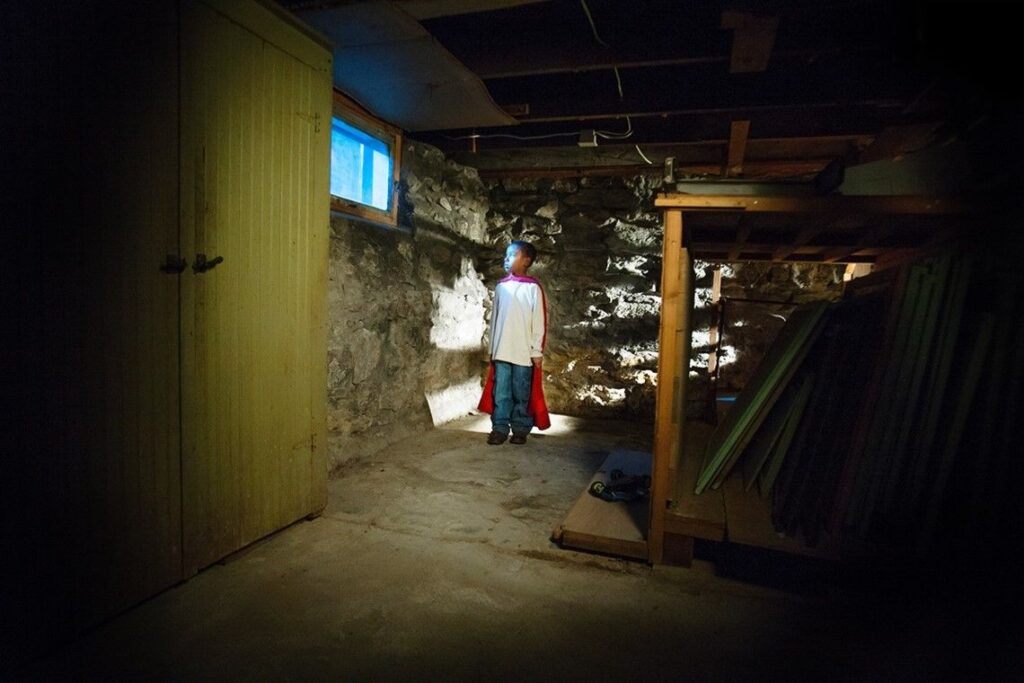
On the other hand, Stonewall’s 2020 piece, “Surviving Times of Deepest Despair,” clearly depicts a devastated woman clutching the framed image of a loved one (father? brother?) who passed away. She, distraught, averts her eyes, while he looks out at the viewer. While this image does seem to have a more straightforward narrative than some of Stonewall’s other pictures, it is no less provocative. The confrontational gaze of the framed man activates death in a way that is reinforced by Larry “Poncho” Brown in “The Killing Game #1.”
“The Killing Game #1,” situated right next to Stonewall’s photographs, is a not-so-subtle interrogation of an unjust justice system. A figurative collage built up from an actual shooting target peppered with 9mm bullet holes, “The Killing Game #1” confronts the viewer and forces them to engage with the reality of a Black body as a target and a target as a Black body. The red stained canvas exposed through the bullet holes viscerally evokes wounded flesh, and the target, given a face, but no name, looks out at the audience in visible pain and exhaustion, almost implicating the viewer as the perpetrator of his harm or at the very least, complicit in it.
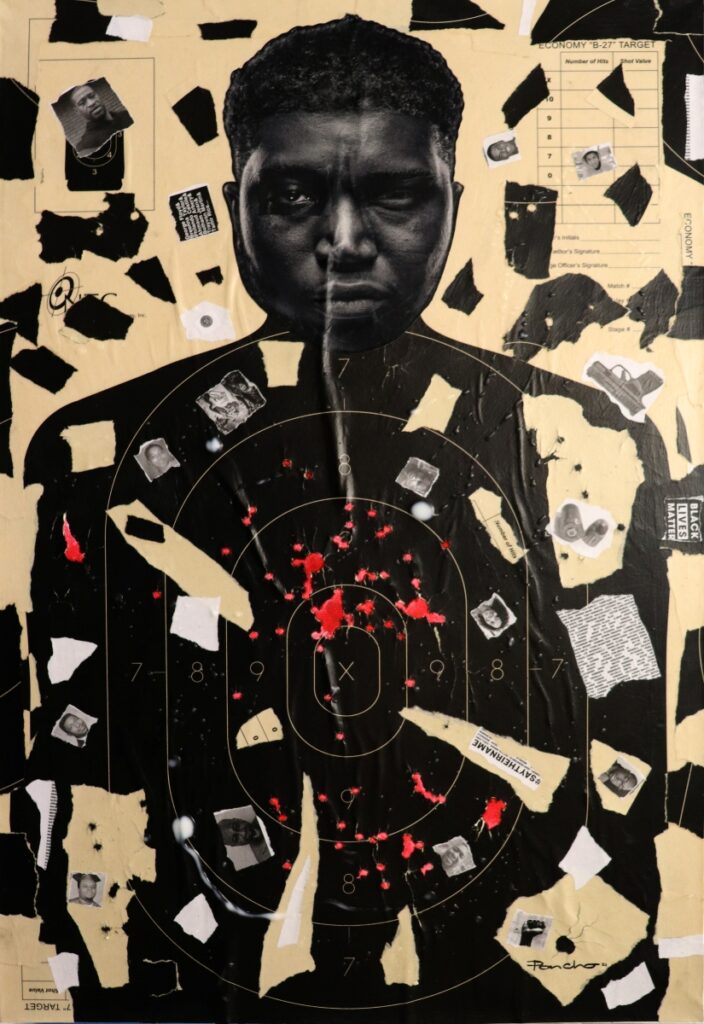
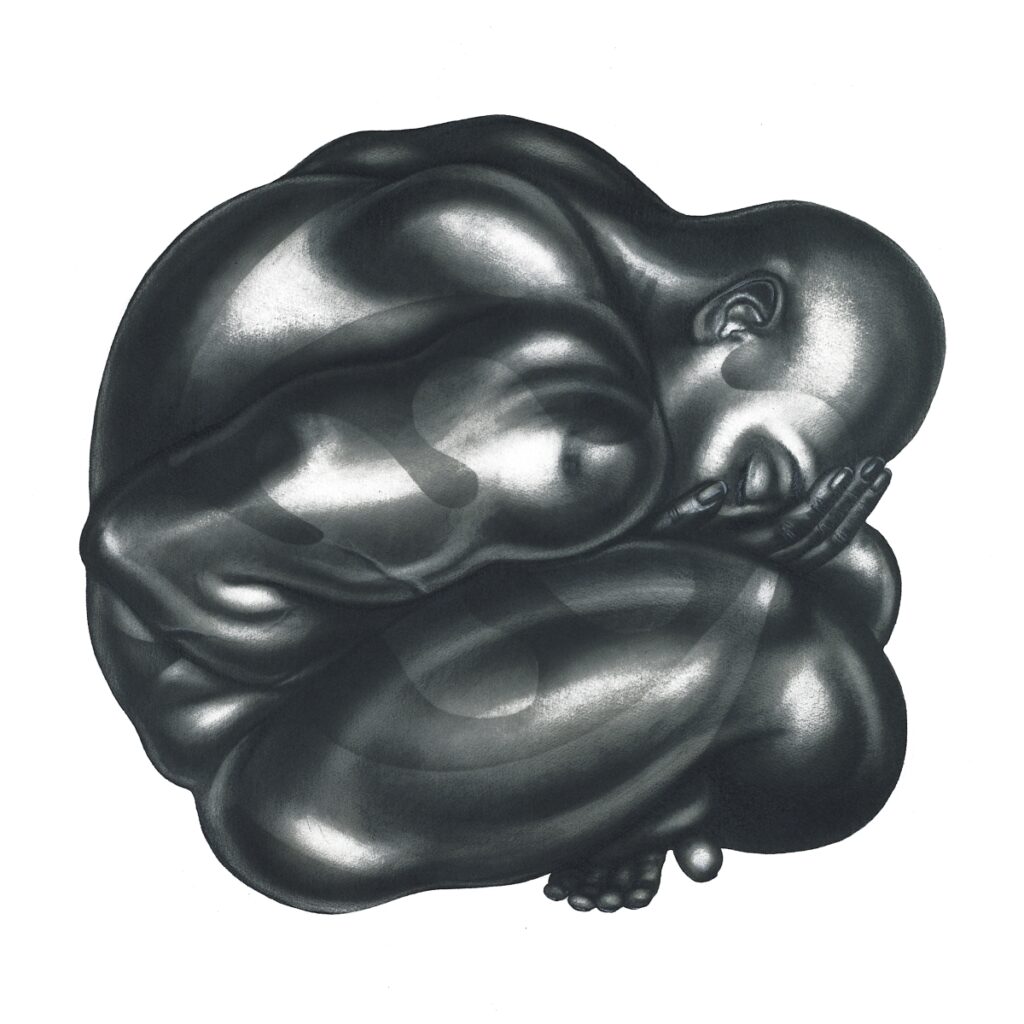
And we are complicit. The media’s narrative on Blackness trains us to see a threat when we see a Black face or a Black body. Whether consciously or unconsciously, we become vessels through which the epidemic of prejudice is spread if we do not actively counter it. Brown scatters images of George Floyd, Mike Brown, Sean Bell, Eric Garner, Tamir Rice, Philando Castile, Alton Sterling, Sandra Bland, Freddie Gray, and Trayvon Martin throughout the piece to remind us of the consequences if we don’t.
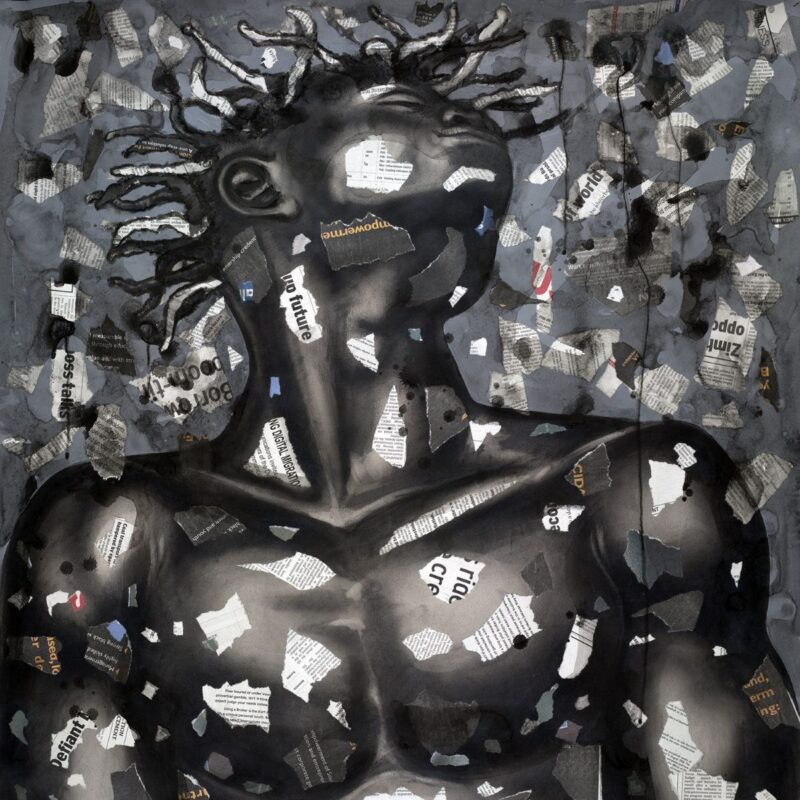
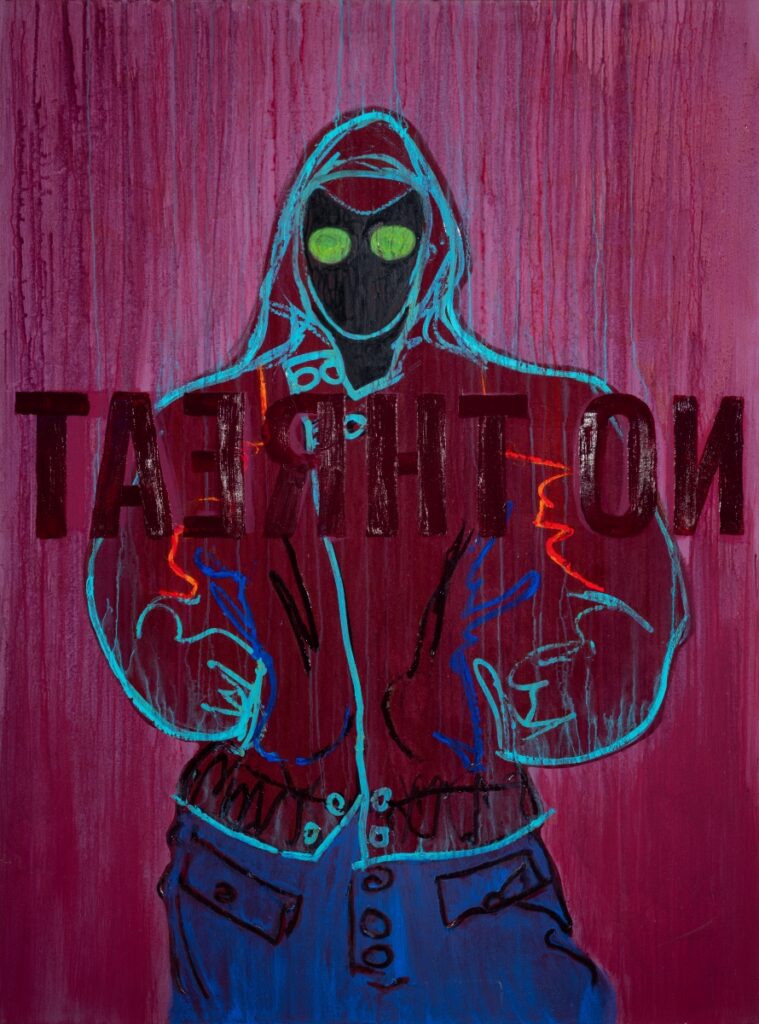
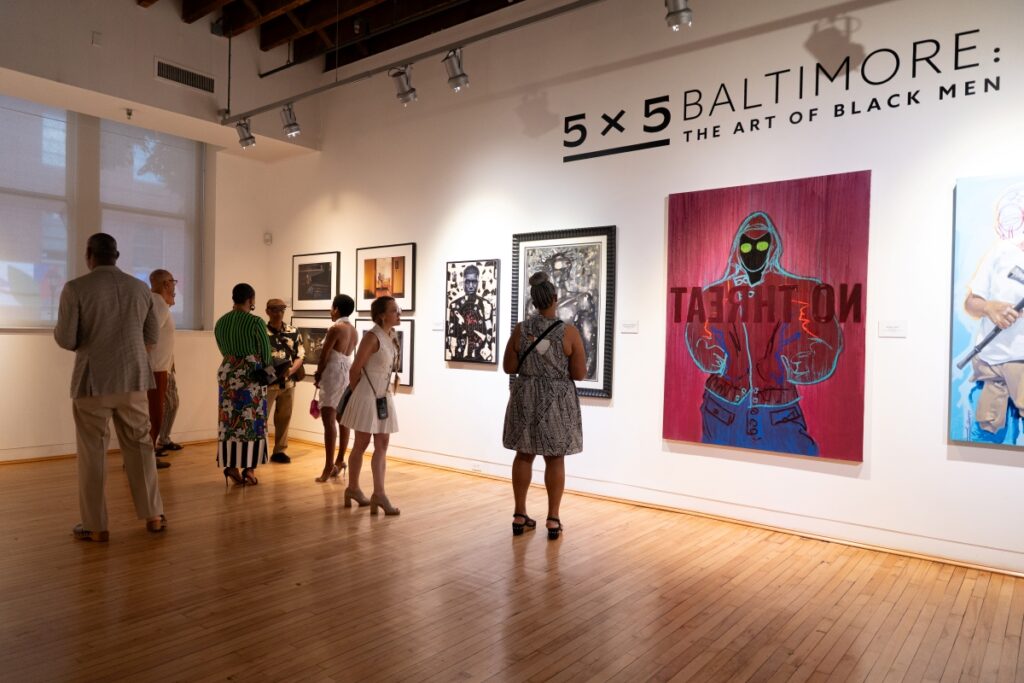
One of my favorite pieces in the show is artist Jeffrey Kent’s “Untitled.” In “Untitled,” part of Kent’s To Be Young, Gifted and Black series, Kent portrays himself as a massive hooded figure, painted with a spectre-like glow. His electric blue outline, complete with drips of paint climbing up to the top of the composition, gives him an almost Super Saiyan energy, and his green orbs for eyes and nondescript face evoke an alien entity. These otherworldly qualities are contrasted with a cool and laid-back demeanor. The mirrored text “NO THREAT” affirms that he comes in peace. He is halfway legible. Familiar yet uncanny. I can’t help but think of Du Bois’ double consciousness, the hood acting as a literal veil.
Ethan HoskinsKent portrays himself as a massive hooded figure, painted with a spectre-like glow… He is halfway legible. Familiar yet uncanny. I can’t help but think of Du Bois’ double consciousness, the hood acting as a literal veil.
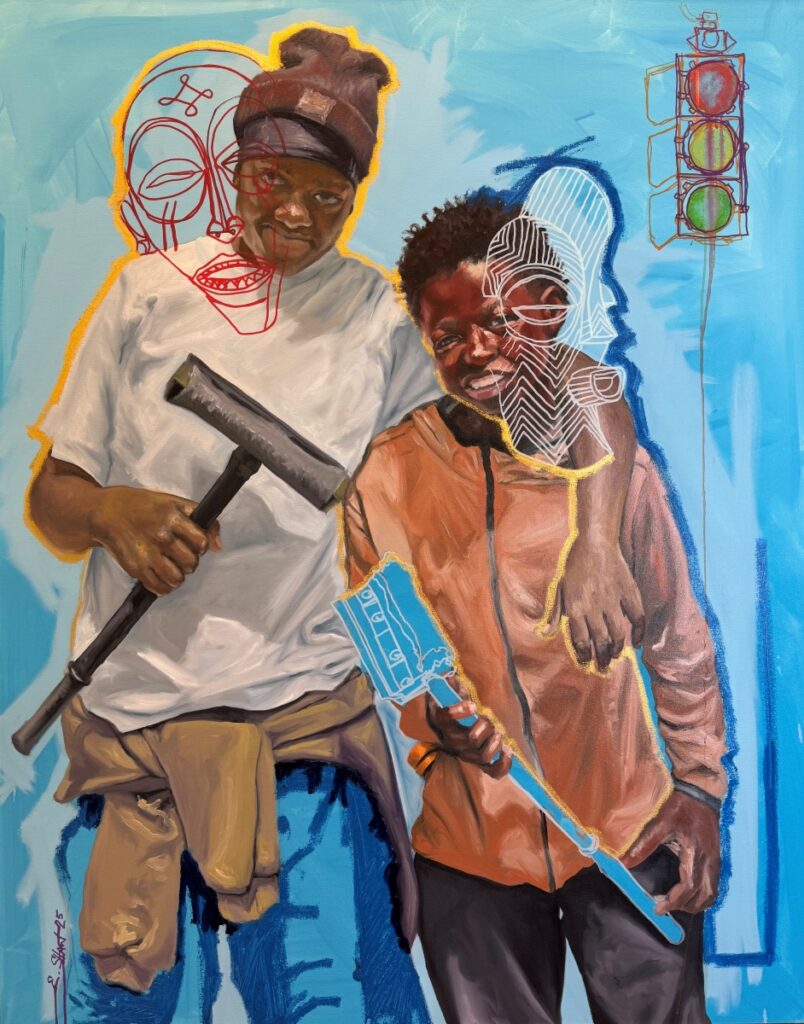
Ernest Shaw’s “Crossing Godz 6” offers resolution to the tension built up by “The Killing Game #1” and “Untitled.” Shaw, as part of his Crossing Guards series, depicts two squeegee workers on a huge 60 in x 48 in canvas. The squeegee workers are yet another charged image and symbol in Baltimore because, like a Black man wearing a hoodie, they’re too easily vilified. They’re too easily dismissed as rowdy or intimidating, when more accurately, they are young men with dreams and responsibilities, hustling and trying to find their way. Shaw paints these two young men with the tenderness of a father. He shows their humanity that could easily be missed if one only paid attention to the headlines and the hype. He makes clear that they are no threat. They are friends; brothers; sons. Floating line-painted masks remind us of a rich ancestral lineage and almost serve to protect the young men.
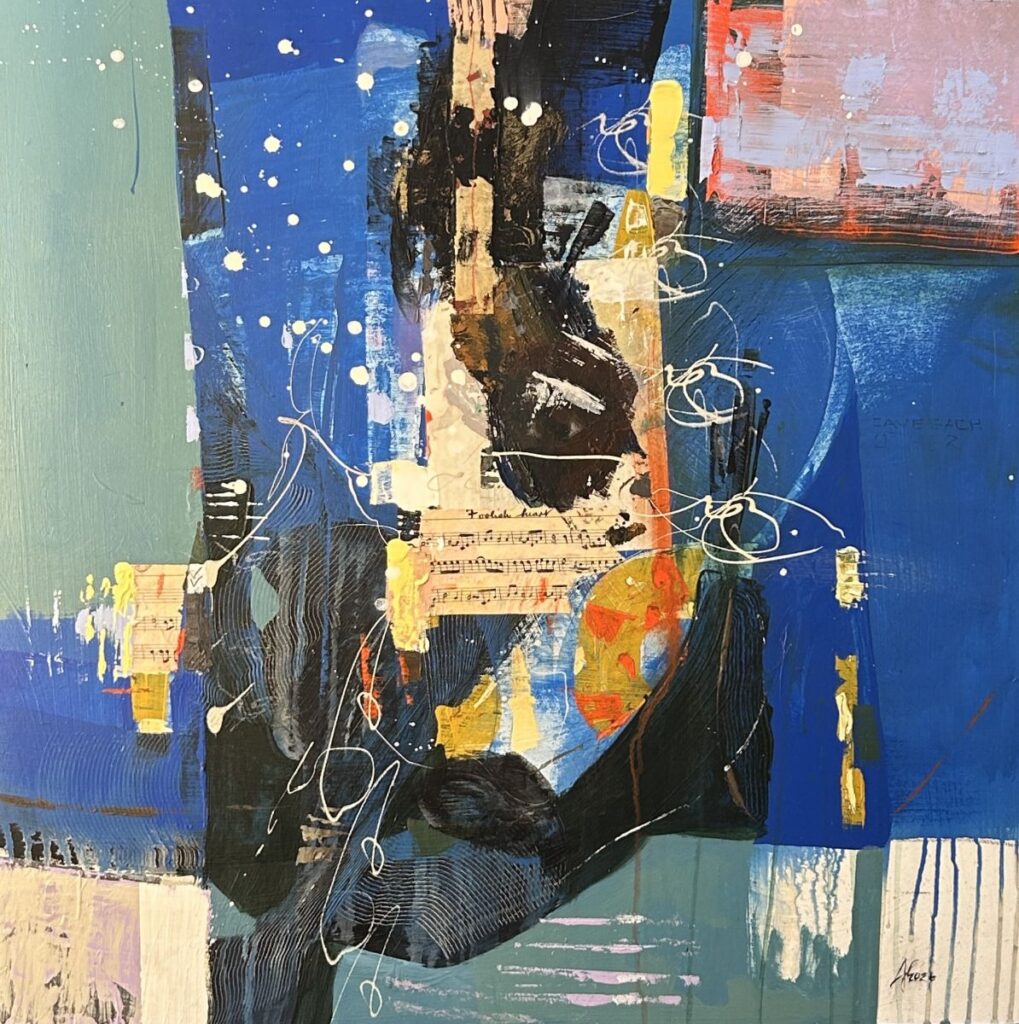
Al Johnson’s “Blue Reimagined” continues in a similar colour palette to Shaw’s “Crossing Godz 6,” providing a seamless transition from portraiture to nonrepresentational abstraction. In “Blue Reimagined,” sheet music for “My Foolish Heart,” hand drawn by Johnson’s father, provides the musical foundation for the work, while pulling on the ancestral thread opened up by Shaw. Vertical and horizontal stripes, as well as wavy black striations, rhyme with the musical staves. Blue patches provide a cool and mellow backdrop, as joyous drops of white paint dance throughout the piece. A centrally located patch of brown and white reads, to me, as an eye looking out into the audience, like some sort of temporal descendant to Shaw’s “Crossing Godz 6.” It’s as if Shaw’s figures were evaporating and Johnson’s “Blue Reimagined” captured the last trace of their legibility. “Blue Reimagined” is hypnotizing in its own right, however. Johnson’s layering of paint and paper contains a whole world in the relatively small 30 in x 30 in canvas.
Keeping in the theme of non-representational abstraction is artist Ainsley Burrows, with his painting “Atlantis aka Love Is A Stream,” is perhaps my favorite. The massive 72 in x 66 in canvas, which is not even his largest work in the show, uses bubbling forms and shifting planes, giving the sensation of sinking into the depths of the ocean, and entering an ancient, hidden portal to another dimension. There, reality seems to bend and crack as it is replaced by something fantastical. Burrows uses paint as much to crop and conceal as to create forms. Glimpses of a more chaotic underpainting peak through glitches in the surface layer.
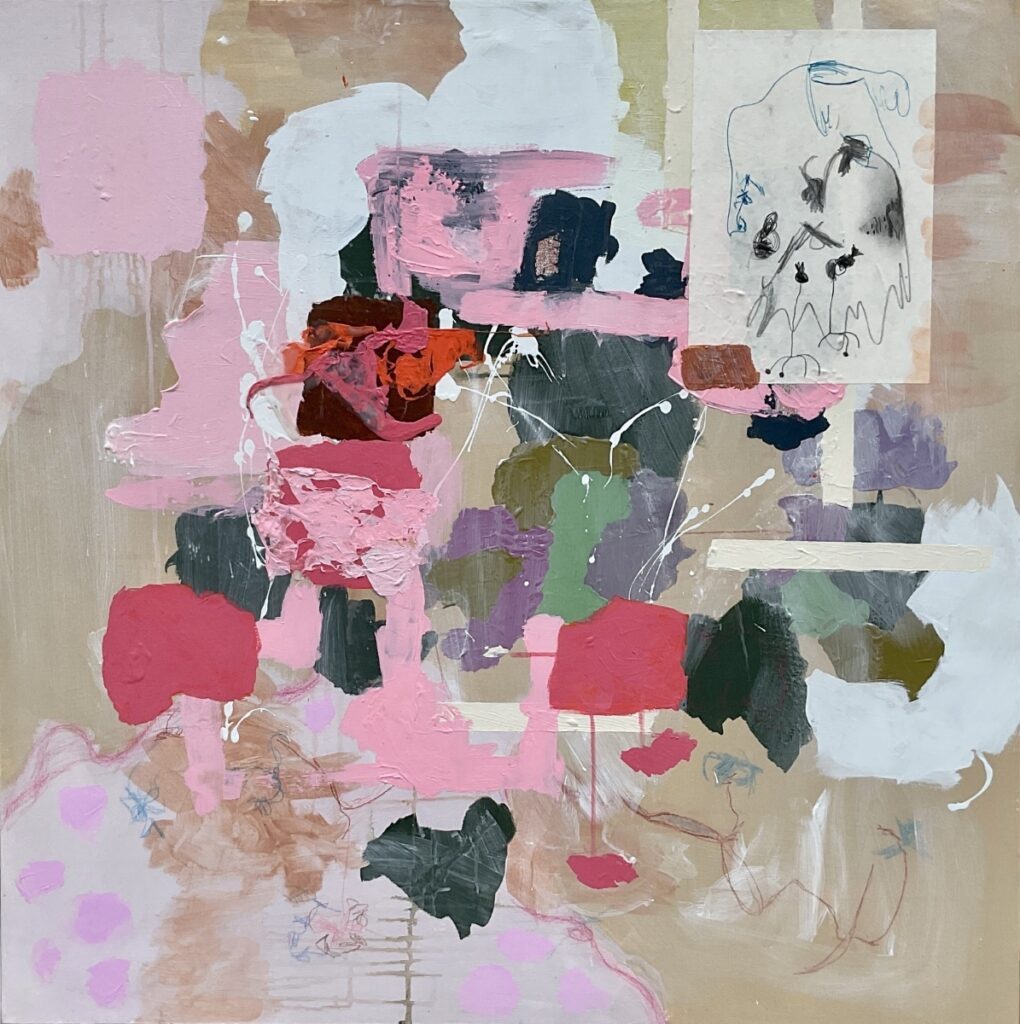
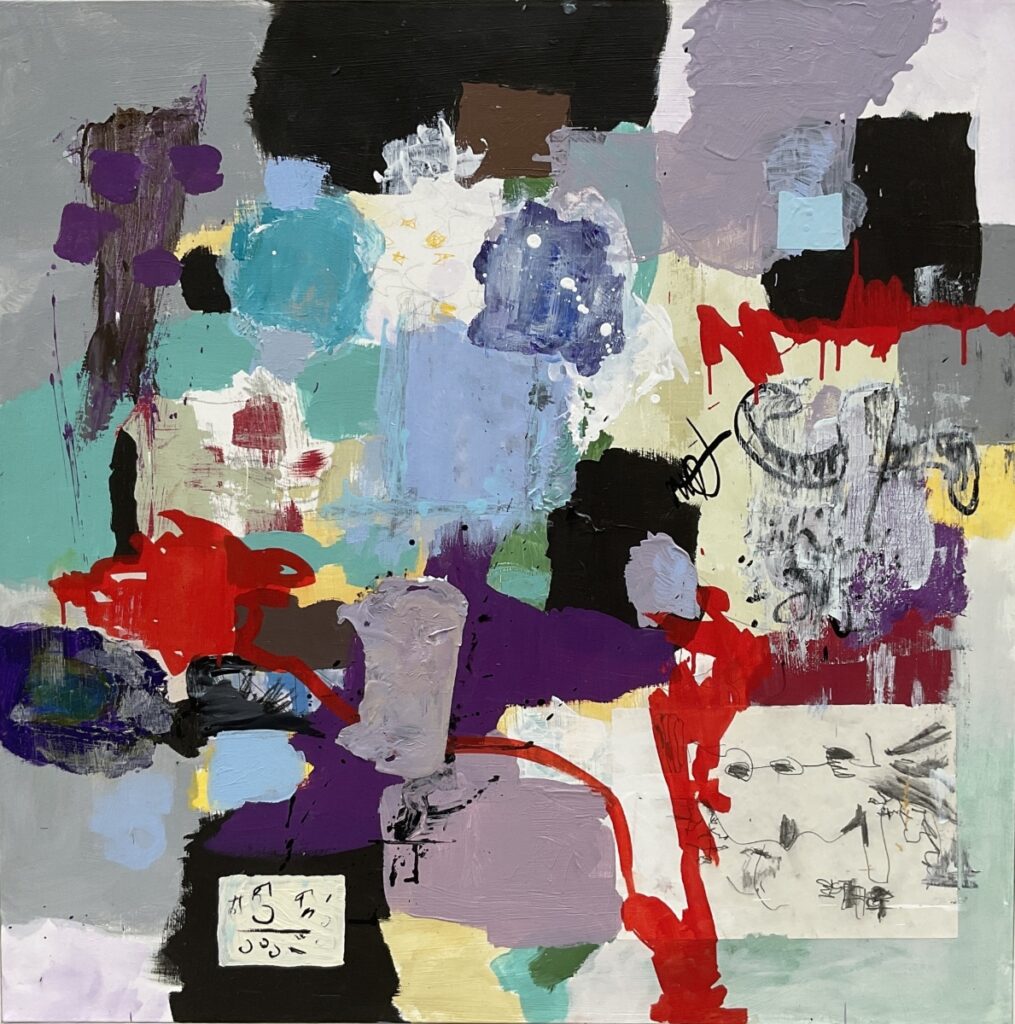
Femi Johnson is another abstract painter whose energetic compositions feature modular mark-making, line drawing, and an eye for understated colour combinations. Whether it’s a red scribble bouncing off the walls in “One For The Witches” that almost dissolves into a purple resonating through the piece, or a pink that concentrates and then dissipates and fragments into soft magenta polka dots in “Ruff Neck Delight,” Johnson has a way of creating subtly engaging compositions.
Ethan HoskinsBurrows uses paint as much to crop and conceal as to create forms. Glimpses of a more chaotic underpainting peak through glitches in the surface layer.
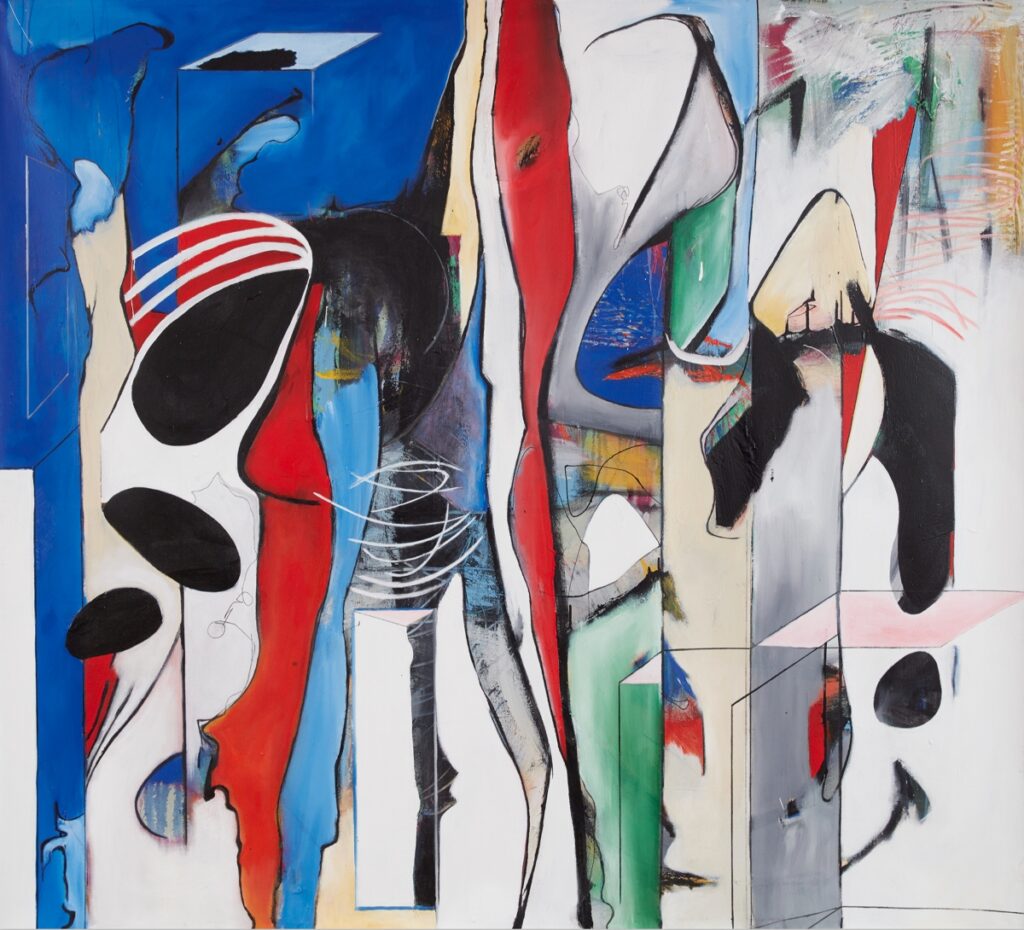
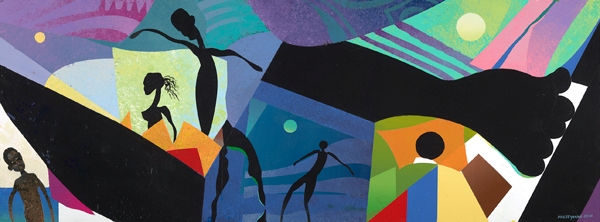
Jerry Prettyman commands a prolific practice spanning a wide aesthetic range, many examples of which are on display. From “Eternal Wisdom” which evokes Picasso’s late Cubist and Surrealist period, or the Aaron Douglas-esque stripes and silhouettes of “Maiden Voyage,” to the almost colour field quality of his “Homage” painting, Prettyman’s work takes many visual forms, but what remains consistent is his thematic rooting in Black American and African history and storytelling. In “Homage” in particular, two tall, slender figures, dressed in West African garb and reminiscent of West African sculptural tradition, stand side by side looking out at the viewer, exuding dignity.
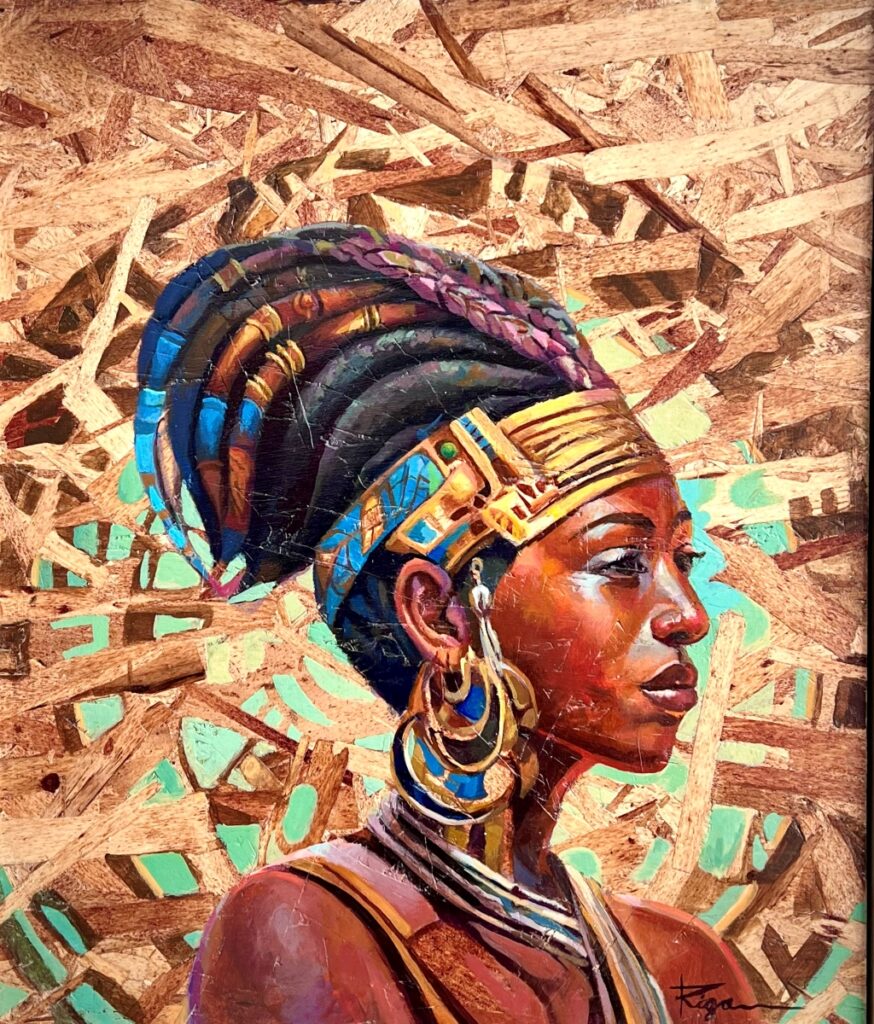
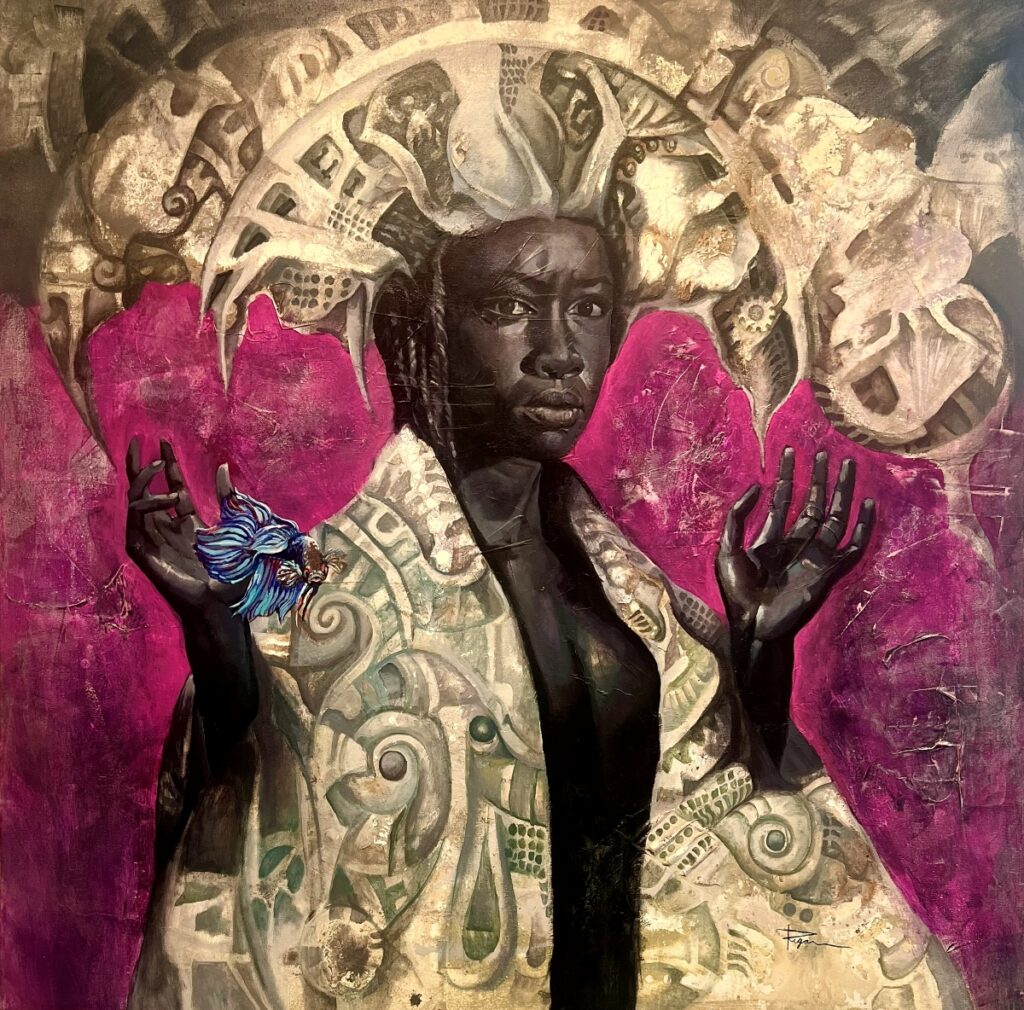
Rigo Peralta’s Afrofuturist portraits depict his muses adorned in machinery, gold jewelry, and vibrant hues that evoke an advanced society whose technology is long forgotten. His explorations of the relationship between the self and the environment are on display in “Conexion Divina,” painted on a wood panel. Its scale of 18 in x 15 in, is considerably smaller than Peralta’s other works and gives it a quieter air. That quiet presence, however, is the strength of the piece. The woman depicted has an effortlessly captivating gravity. I was also struck by the balanced relationship between the grittiness of the wood panel and the delicate brushwork of the painting itself. The subject emerges from and simultaneously splinters back into her wood-panelled ground, bringing together two disparate material languages in one compelling gesture.
Halfway through my experience of the show, Derek Price, Executive Director of the Eubie Blake Center, and his co-curator Barbara Bullard gave remarks. They introduced Alma Roberts, an advisor for the exhibition whose family fund helped sponsor the show. Roberts shared that she supported the arts as a way to honor her father, himself an artist. Ainsley Burrows, whose paintings were on exhibit in the show, performed his poem “Unplugged,” from which the following lines, encapsulating the show, are drawn:
“I am Toby and Tiger Woods,” he opens, “crucified to the speed of light”
I think of the progression from Larry Poncho Brown’s “The Killing Game #1” to Jeffrey Kent’s “Untitled” to Ernest Shaw’s “Crossing Godz 6.” From Black men as literal targets to Black men viewed as threatening because of our garments or the fact that our skin colour tattoos us with a permanent otherness, to Black men unmasked, unapologetic, and unfazed…
“I am Toussaint Louverture fractured”
…Anthony Smith’s ledger-like objects dismantling tropes, liberating us from stereotypes…
“I am the double-headed cubist”
…the fractured planes of Jerry Prettyman’s “Eternal Wisdom,” connecting to ancestral histories…
“I am Jimi Hendrix”
…Al Johnson’s collaged sheet music and expressive marks, intuitive and unregimented. Abstract, yet evocative. Connecting the creative spirits of the past to the present…
“I am tomorrow, yesterday”
…Charles Stonewall’s portraits of figures suspended in a moment of anticipation and reflection…
“I am the black boy… freestyling his way back to god”
…Femi Johnson’s improvisational marks, transcribing his conversations with the ancestors…
“I am the never not never”
…Ainsley’s very own shifting planes…
“I am face paint and tribal scars”
…Rigo Peralta with his mystical portraits of Black and Afrolatina women standing dignified and beautiful…
“Man we so beautiful, we suffer with our eyes closed, blindfolds, gold fronts, fronting because we have to survive this constant Christ-ing”
Throughout the opening, I felt the sensation of beauty. All I saw was beauty, be it in the work, the artists, or the people engaging with the work. I saw us. We remain resilient even though it seems that, like Smith’s Möbius loop, progress is illusory. Despite it all, still we shine. Still we create. Still we rise. Man, we so beautiful.
5 x 5 Baltimore: The Art of Black Men is on view June 20 – August 22, 2026, at the Eubie Blake Cultural Center.
Saturday, August 1st at 4 p.m., Eubie Blake Cultural Center will host: A Dialogue on Black Art and Identity. Register for the event here.