Even if she didn’t know it, Nikki Ann Hartman’s new one-woman play Doll Parts… has been in the works for her whole life. Now 66, the director and University of Maryland Baltimore County theater professor has, in recent years, begun to live publicly as a woman. It was a change she long desired, but always struggled to manifest. And while it is certainly a show that details the highs and lows of one trans woman’s experience, it would not be exactly correct to say it’s about issues of gender, generally. “I’m not a scholar of critical gender studies,” Hartman advises the audience early on. “What I know is my heart.”
Before the show seems to officially begin, Hartman can be seen perambulating the darkened performance space. After a stagehand politely informs her that it’s time to begin, the actress walks upstage and asks the tech director for a spotlight. When it doesn’t come, she entreats again with playful urgency, “Oh, come on! I need some light!” It’s the first of many moments that blur the performance of a play with the actual production of one, and by undercutting her own illumination, Hartman effortlessly earns her first applause of the evening when the overheads finally shine.
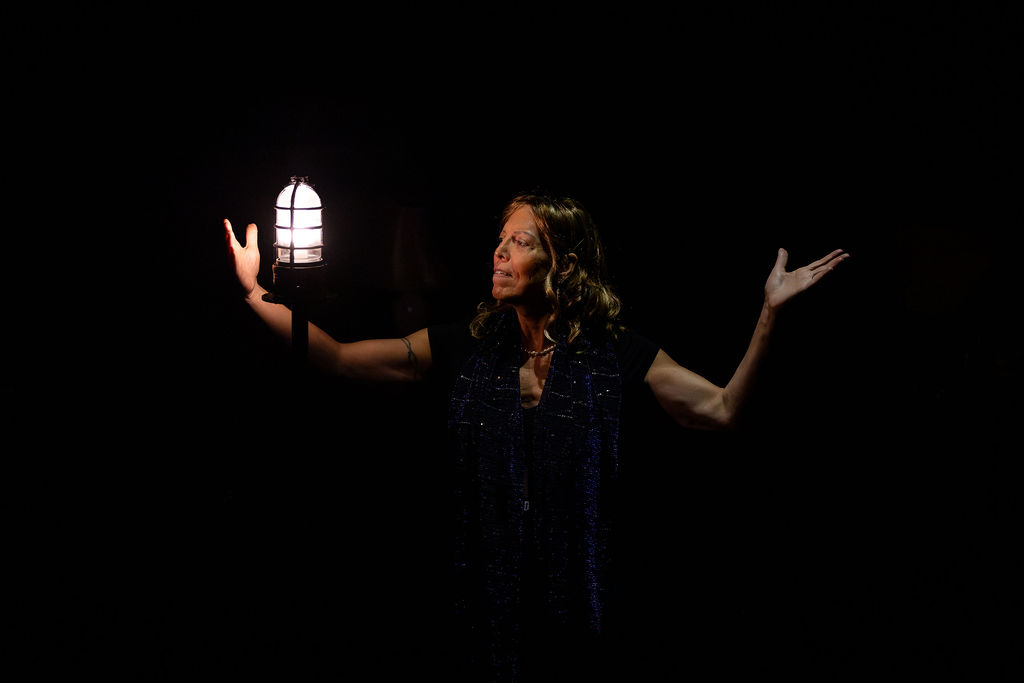
In fact, Hartman’s performance is understated throughout, which is remarkable considering the script’s emotional scope. It’s acting without acting—a performance so deeply rooted in the self that no artifice is detectable to the audience. Hartman’s onstage persona is warm and effusive, a grand dame eager to crack jokes and spill the tea, if revealing one’s own inner secrets can be considered a form of gossip.
And you’ve been warned: in Doll Parts… there is no fourth wall. Odds are good that Hartman may task you with holding her cocktail or a random piece of fruit, and if you respond to one of her numerous rhetorical questions (which is encouraged), she may begin an ongoing banter with you that continues throughout the evening.
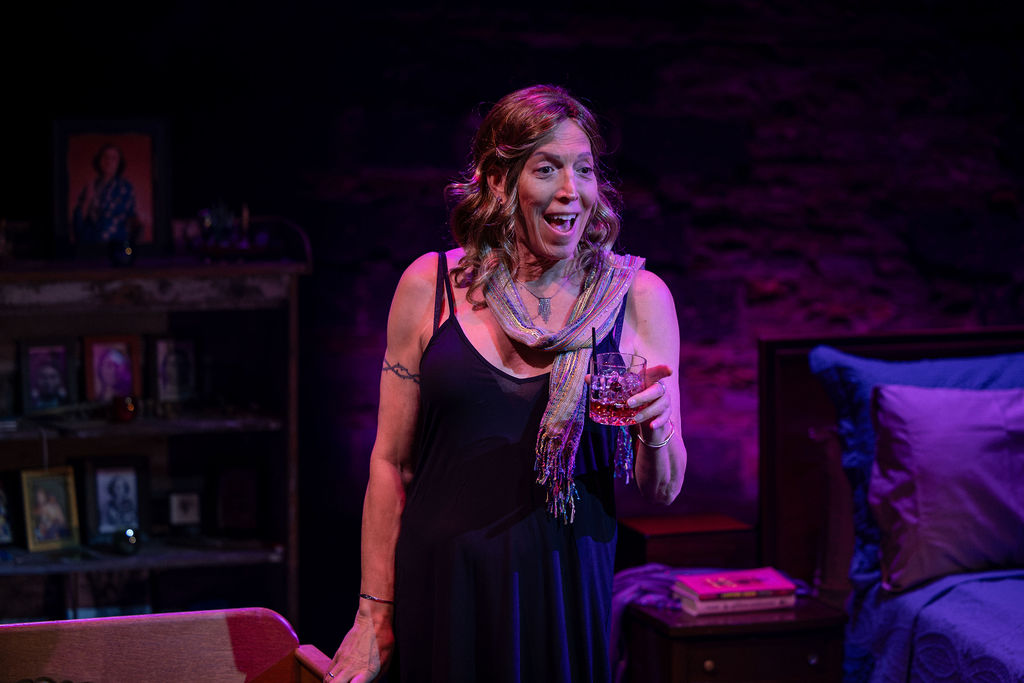
But it’s not stand-up comedy. Written by Hartman and directed by Grace Shepperd, Doll Parts… presents a series of monologues that knit a circuitous pattern through Hartman’s memory. Each scene could stand alone as a vignette, but taken together, they combine into a greater whole—building up to her decision to fully transition.
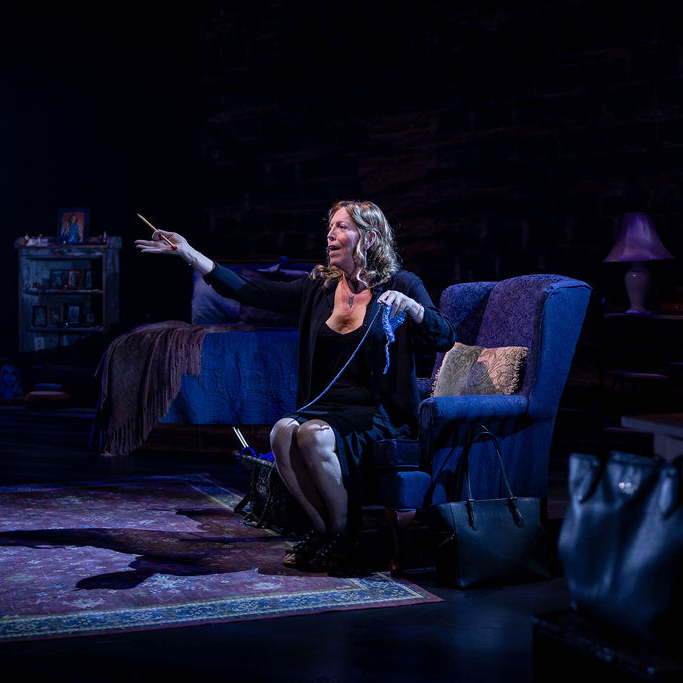
The content of each mini piece runs the gamut from Hartman’s teenage memory of seeing a nude trans woman backstage in 1970’s New York City, to her current and very valid fears about being openly trans in 2026. The pieces are prone to entertaining detours, as well. One involves an extended metaphor likening needlework to sex. “They even have a yarn called fingering,” she quips during a hot take concerning holes and poking. “I mean, knitters aren’t even trying to hide it!”
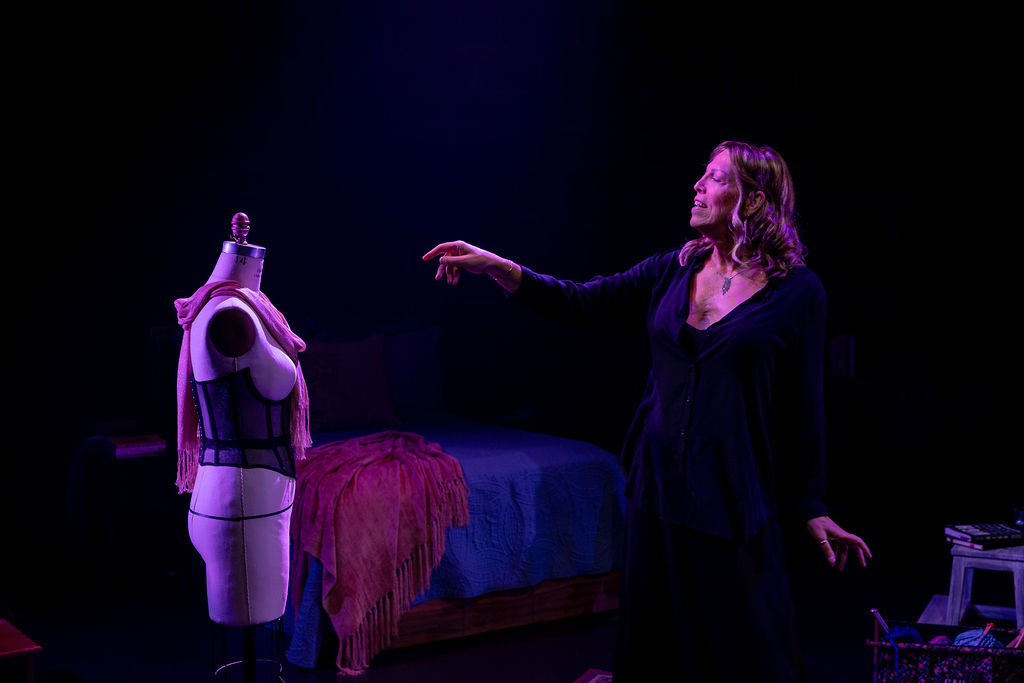
Yet Doll Parts… is most compelling in its quiet moments. Reflecting on her departed mother, Hartman likens her to a crabapple tree in her childhood backyard: strong, beautiful, and unruly. All these years later, she’s still enamored with her mother’s elegance, but is haunted by it, too—her memories come and go, blooming in her mind as the seasons allow. Later, she relates that she loves to wear pearls like her mother did, because she not only found them beautiful while gazing at them as a child, but always dreamed of donning them herself.
Similarly, when Hartman discusses finding her father’s Playboy magazines, she describes not only desiring the models printed upon the pages, but wanting to be them, too. Insights like these are startling for their honesty, and serve to develop Hartman’s layered conception of femininity. Hers, like that of so many American men and women, is informed by the confusing amalgam of family members, pop stars, and pin-up cover girls she encountered growing up. These images and experiences offered an identity she craved to inhabit as her own—even as society discouraged it.
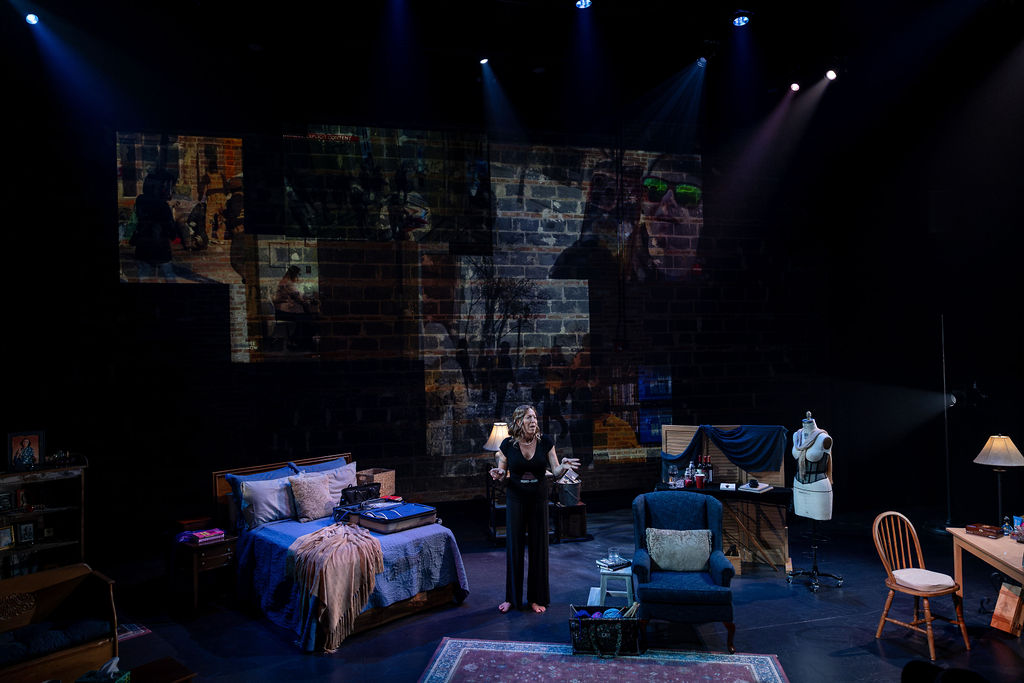
The set design, by Emerson Balthis, succeeds at creating a space for all this self-excavation. It’s homey and appears to be personalized to Hartman. There’s a comfy bed, a folding screen for changing outfits, and a dresser with a mirror, if one is in the mood for self-reflection. Books lay stacked here and there, and other details let us know we ought to feel comfortable: a bottle of wine waits to be cracked open, and a big bag of yarn suggests hidden narratives ready to unspool. It is both like and unlike a home, one whose windows outsiders are invited to poke their heads through before saying hello to its inhabitant. Meanwhile, Adam Mendelson’s lighting and projections lend a touch of dreaminess to the affair, complimenting Hartman’s visceral immediacy.
One-person plays can be said to have less momentum than ensemble pieces: no love interest serves as an object of desire, and no antagonist throws obstacles into the hero’s path. Their success depends largely on the main performer and the script. This poses a unique challenge for solo actors, but Doll Parts… succeeds due to Hartman’s nuanced performance, and keeps its audience on its toes by throwing tonal curveballs. If the final third of the play wanders astray from the emotional core of the first acts, it at least succeeds at revealing Hartman’s innermost fears and dreams—inner voices that speak within everyone, even if rarely voiced.
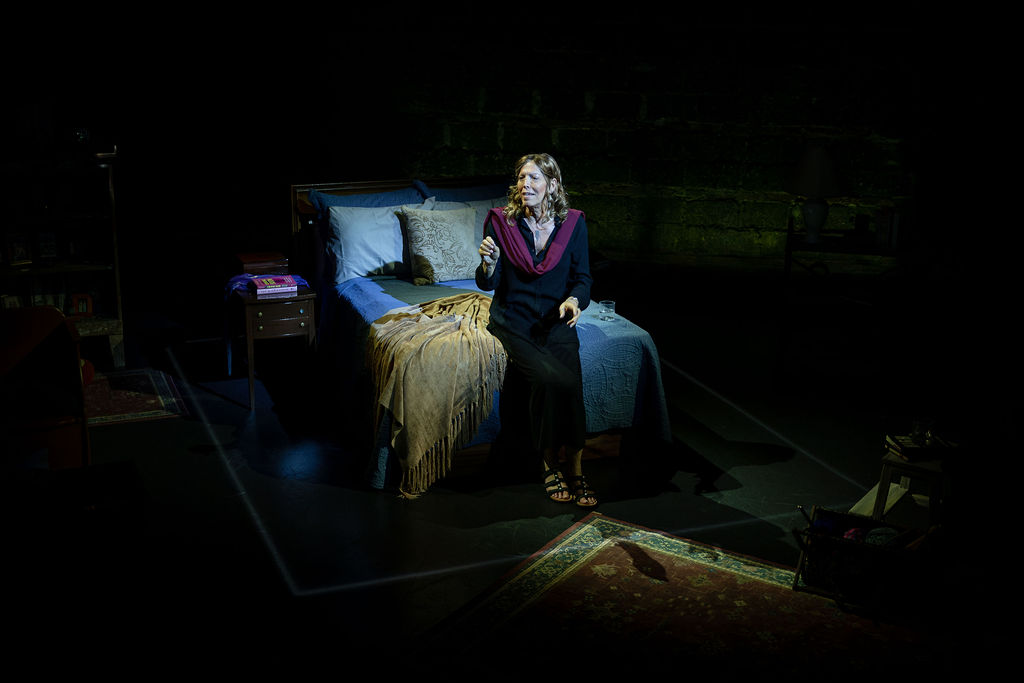
This makes the one-woman show, like the best autobiographies, deeply relatable. The narrative will resonate powerfully with those on their own gender-transition journeys, but is ultimately about the universal experiences of love, loss, aging, and self-discovery.
“I am so very different now,” Hartman says at one point, choking up a bit as she vows to sever ties with all her previous selves. The moment is powerful not for its confidence, but for its acknowledgement of how difficult—how scarring—it can be to even arrive at a place where one is capable of such radical self-reinvention so late in life. Doll Parts… never promises that becoming yourself will be easy, but that if you’re conscious, patient, and just a tad off-beat, one day you too can become the girl with the most cake.
Doll Parts… runs Thursday, July 23rd through Saturday, July 25th, at the Voxel, 9 West 25th St, Baltimore, MD 21218.
More information and tickets—which are selling fast—can be found here.