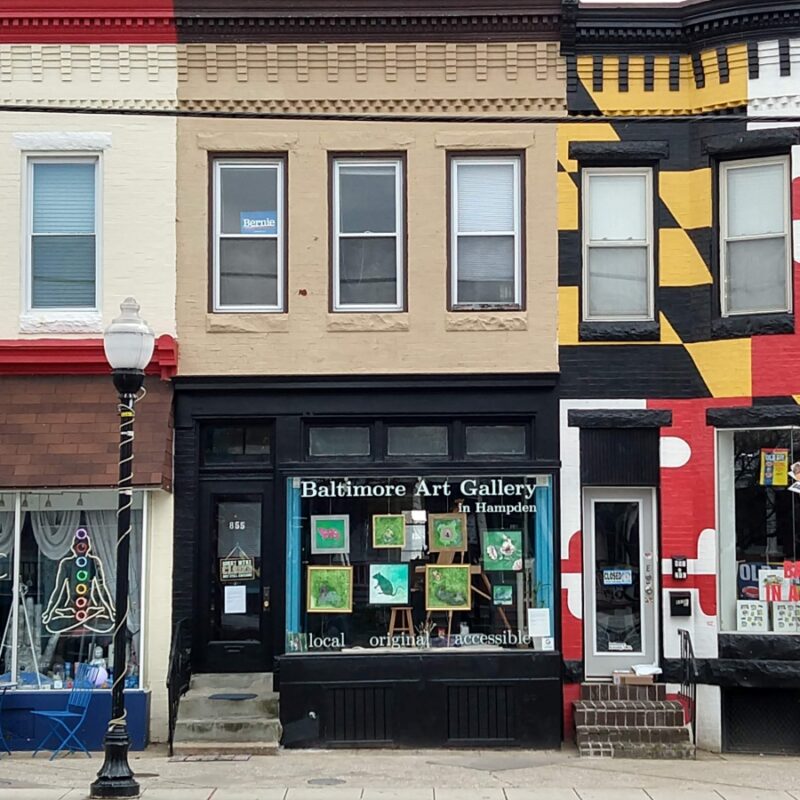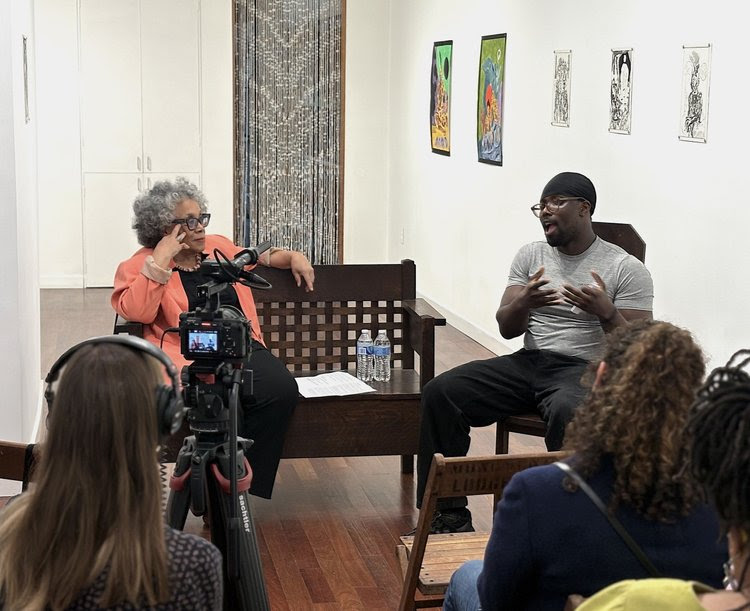
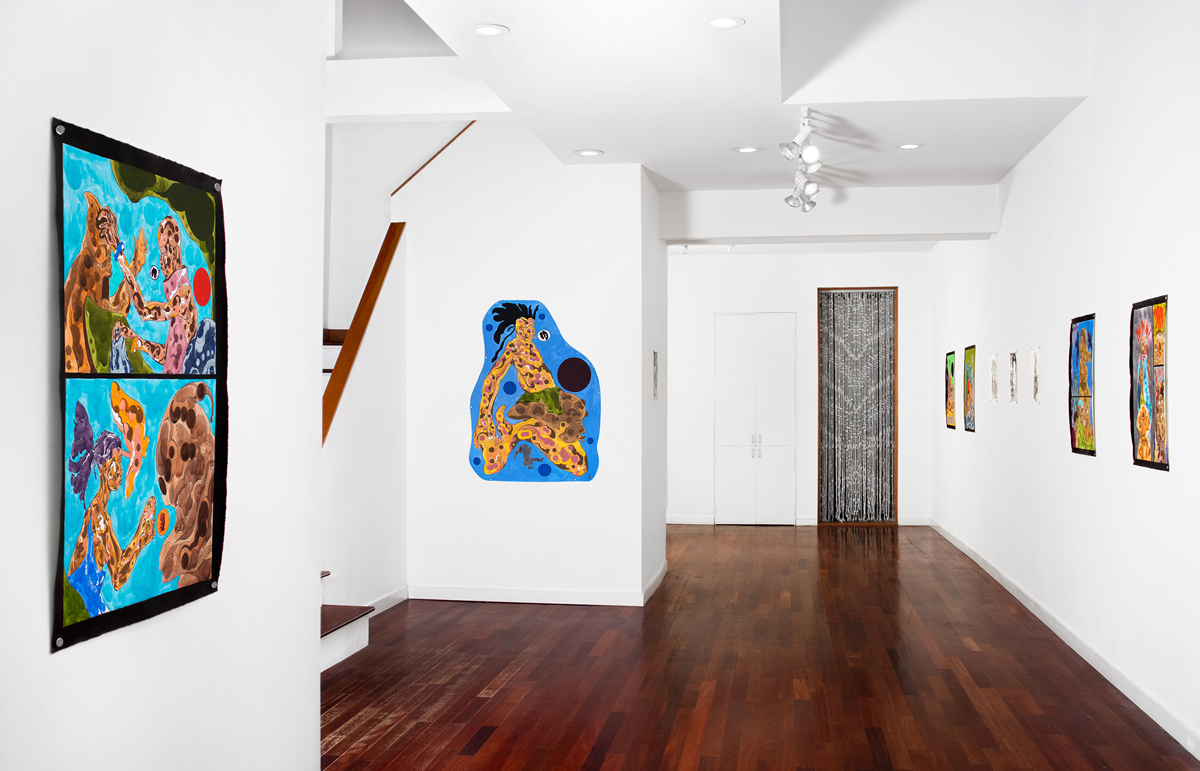
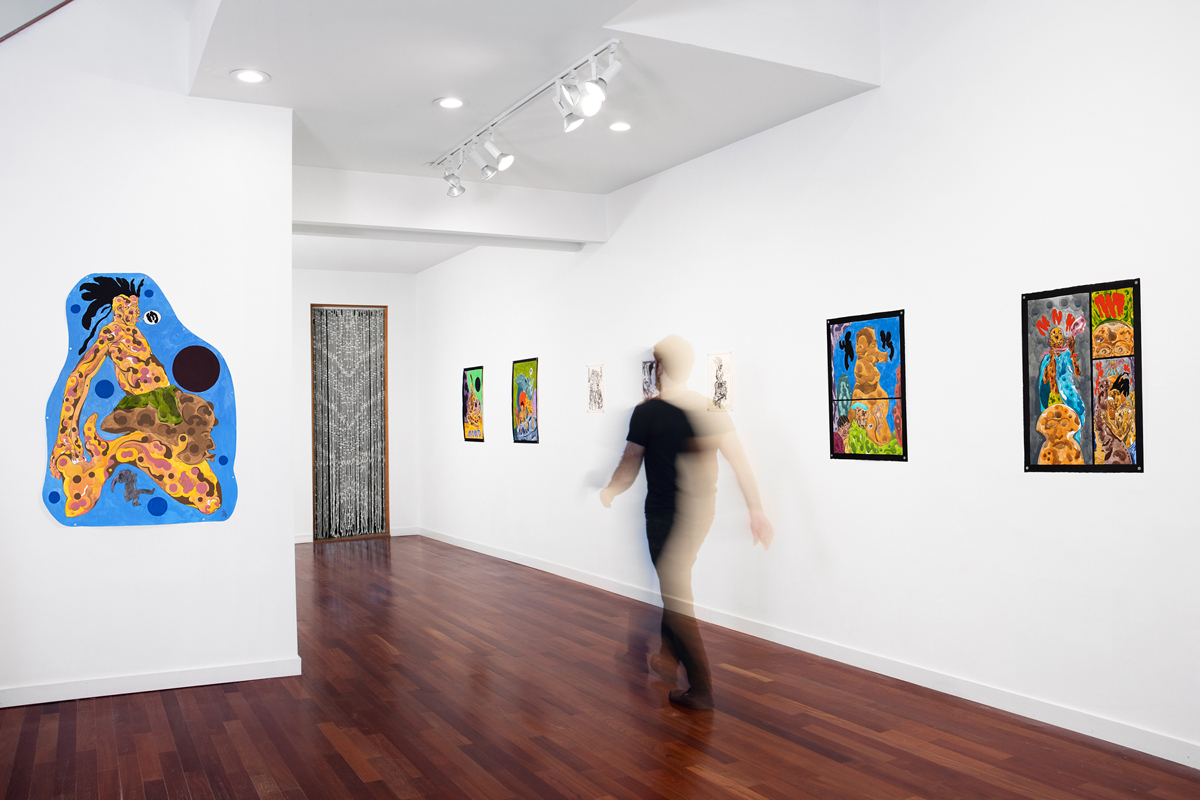
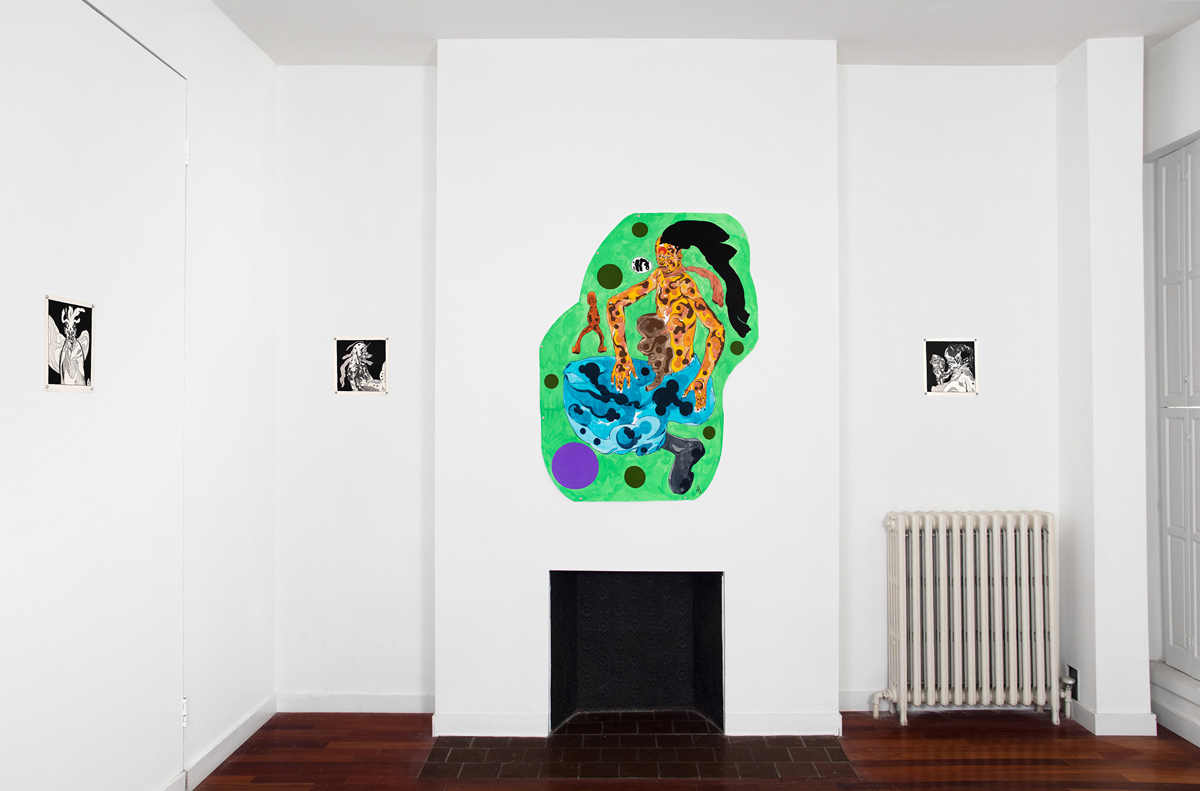
CPM Gallery recently announced that the run of Richard Ayodeji Ikhide’s solo exhibition Tales from Future Past would be extended to November 22 by appointment. At the opening on September 27, the British-Nigerian artist was interviewed by luminary art historian, curator, and educator Lowery Stokes Sims. CPM was kind enough to share that transcript with BmoreArt, as well as the accompanying images.
Lowery Sims: So this is your first time in Baltimore, you’ve shown in New York, why don’t you start by telling us from the beginning, your artistic journey, what were the first indications that you were artistic when you were young? And talk a little bit about your artistic training.
Richard Ikhide: I think I started drawing when I was five. I drew on the walls of my grandparents’ house in Lagos… we would have a bit of pencil, a bit of paper, and you just go. From a really early age, drawing has been a kind of anchor, it’s been a constant thing. I had a cousin who would bring me comic books, which was one of my earliest introductions to art…I moved to England when I was about 14,15. So in that transition I learned about things like art school and that I can actually take this seriously, because all I was aware of at that time being quite young was you’re either making comics or you might do things like cartoons or animation—I wasn’t aware of the art world per se.
Lowery Sims: You’ve told me about how early on you were involved in textile arts, so how did that happen?
Richard Ikhide: So in the UK we have college, which is basically the equivalent to high school here. So you would have to take two subjects as your choices and I took art and textiles. I had an amazing textiles tutor who introduced me to a summer school run by Central Saint Martins, which is an art school under the University of the Arts in London, and they ran a menswear course. So initially I was thinking I’d love to go into menswear and then study fashion…and I did my degree in print design—so a lot of dyeing fabrics, and I specialized mostly in screen printing.
For my final degree showing I was working with printing on linen… and I got sponsorship…to go to Belgium to visit flaxseed farms and linen production facilities. It was lovely but…going into third year a lot of my ideas around textiles were in the realm of visual art and… my tutors would be like “you’re making art and this is unnecessary for design applications, so you might have to rethink what you’re doing”…because I was trying to make art in the design course…So I did few internships, and…was working retail …in quite a few art stores, and I found out about the Royal Drawing School…that helps people transition into making fine art. So that was the moment of like, okay, I think I’m gonna have to part with textiles for a bit and make this transition to thinking of my practice as being more of a fine art practice.
Lowery Sims: Yeah, I find that kind of interesting because when I left the Met and the Studio Museum and started working for the Museum of Arts and Design in the early aughts, around 2006, 2007, the museum rebranded itself, and the whole idea was to look at what they called the “blur zone” among art, craft, and design. So it’s interesting that the schools were so intransient in distinguishing design from art. Okay, so you take this course in drawing and find that you love drawing and watercolor. I can’t think of two media that are more difficult, where you can’t really hide, and you said that you wanted to make watercolor as important a media as oil painting for example. Tell us what led you to that journey?
Richard Ikhide: So you know, in art school there is a lot of competition and everyone is trying to find their niche, right. And in England, when it comes to art, things can be quite conservative and it’s like, “oh a serious painting is an oil painting”— that was what I heard from some tutors…it’s Leon Kossoff and Lucian Freud—those were the people we would kind of look at. And my personal interest, I’m looking at a lot of illustrators and people that work on concept design for video games.
There was a particular artist called Yoshitaka Amano who works on a series called Final Fantasy, who works with inks and watercolors. He’d had this huge retrospective in Japan and in Japan people who make manga have the same reverence as fine artists…So that was illuminating for me like, oh wow, this medium can be taken seriously…And also as a young student looking at the art world and thinking, if I’m gonna be involved in this career, what would be my calling card in terms of what this person does that’s different from from everyone else?
Lowery Sims: Okay, let’s tackle your relationship with the human body. Looking at these compositions, there seems to be a great deal of improvisation. I mean, you’re not sitting down looking at a model and recreating what you want. Even if you’re drawing in the sense of design or animation, there’s quite a bit of hybrid imagery that’s coming out and it looks very improvisational, so talk about that. And the other thing I want you to really talk about is that you mentioned that you don’t want the line to just encase the color, but you have these very activated surfaces with lots of different color areas. So I’m interested in how you see this as a way to approach the body and specifically in a context where we’re looking at a black body.
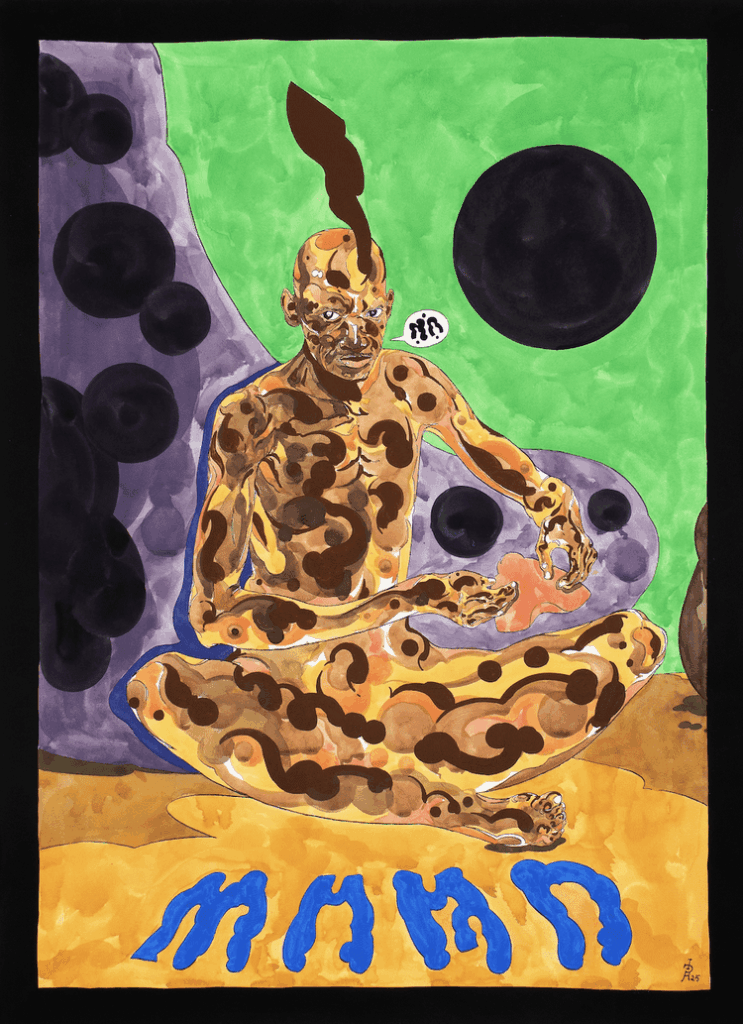
Richard Ikhide: Well, there’s a lot of things to unpack, but I’ll start with colors first of all. So during my textiles degree, I’d read Josef Albers’s, Interaction of Color. And it was like a light bulb moment—Wow, okay, these temperatures and how they affect each other. And that was something I was really experimenting with while I was doing printed textiles (in college) and I was dyeing a lot of my fabrics and then printing on top of them. So I was interested in how color wasn’t just a filler…I was also doing a lot of research into perceptions of color based on cultures. For example, in Japan they wear white to funerals, whereas in the West, we wear black. So perception of color changes based on your associations and that can change from individual to individual…
And in terms of the black body, the problem I had is like, okay—burnt umber, sienna, a very limited range, right? It’s super, super limited. You know, in my family, everybody comes in different shades. I have cousins who are really light-skinned and I’m quite dark-skinned myself. So, even in this perception of coloring the black body, I felt it was very one-dimensional in terms of representations and examples I’d seen, and I want to push against that. Because it also makes the experience of being black, and the experience of a black body, especially viewed by others, very, very narrow…Living in Nigeria, it is a homogenous country. Everybody is black, and you don’t see many foreigners. And then coming to England, there are all these different people, different cultures, …and encountering racism, being othered, all these things, you’re like, OK, we’re perceived in a certain way. And through the work I also want to open up that experience of what being black is. It’s not just this one dimensional monolithic experience.
In terms of line—for me, putting a pen on a piece of paper…it’s like one of the most incredible things you can do as an artist. It’s like wow, mind-blowing. And I’m always thinking about how making a line is a very old idea, right? Even if we’re looking at cave paintings and petroglyphs …it’s a very ancient language in a way of us trying to make sense of the world. And I’m also thinking about the artist as a channel or a vessel for something other than yourself. So in my own work, yes… I’m looking at anatomy but I’m also trying to express things that are abstract and immaterial…I feel like…in the world we are locked to so many different systems and patterns and ways of thinking and looking at things. I’ve lived now half of my life in England, in the West and then half in Nigeria…half of me is like in Nigeria and my history and heritage and half of me is exposed to the West. I’m like, yeah, I love El Greco. I went to the Prado in Spain and I’m like, ah, these are amazing. So…all of these different conversations are happening and maybe the work is trying to coalesce and amalgamate all these things together.
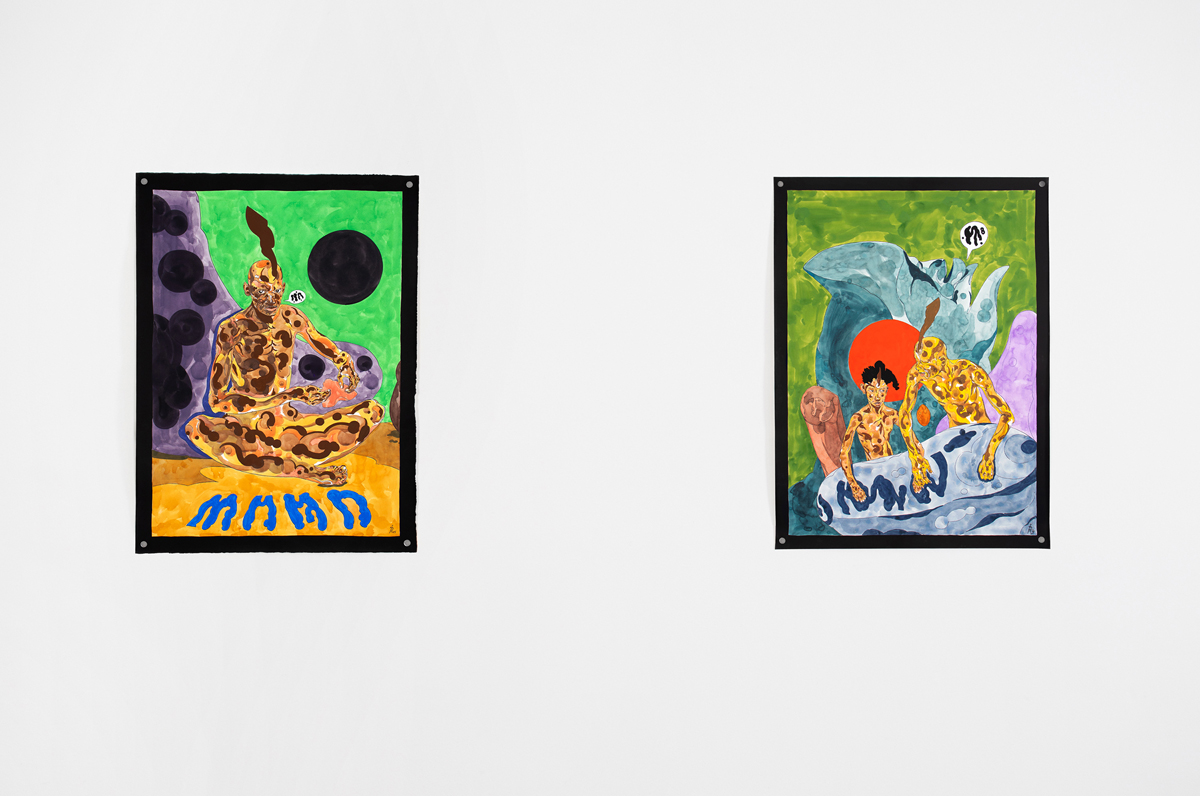
Lowery Sims: So I’m just wondering, you know, the work you were just referring to and all those different blues and other colors in the skin—can we sort of see that as also a way to deal with the role of light on surfaces and how you can have reflected light, you know, even on the black skin?
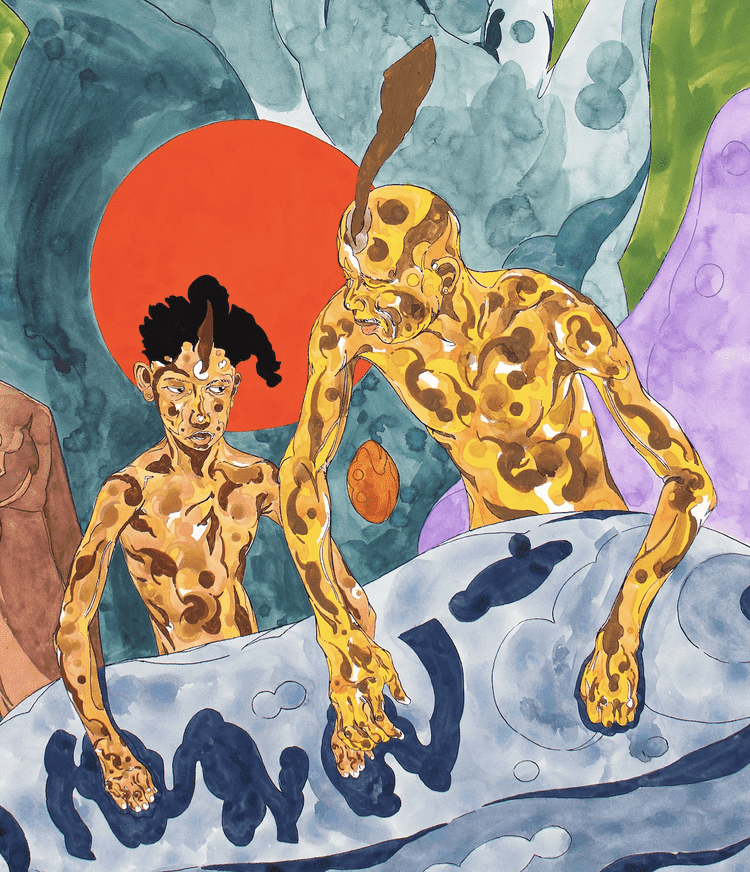
Richard Ikhide: Yes, yes 100 %. So during my time doing textiles—so with the screen printing…you can have a translucent layer and then you have an opaque layer. You can really play around with surface textures and how things come together. And transitioning into watercolors, depending on the washes you have, you can still play around with opacity and translucency. And I thought, oh wow, I can translate some of my sensibilities from doing textiles into how I handle color and temperature in watercolor…Also, again, if we’re talking about black skin, like I said, it’s very one-dimensional. You know, light hits your body in different ways, and we all come in very different hues. The body can also have these different topographies in terms of how the skin looks and that was something else I would like to play around with and express that in the work.
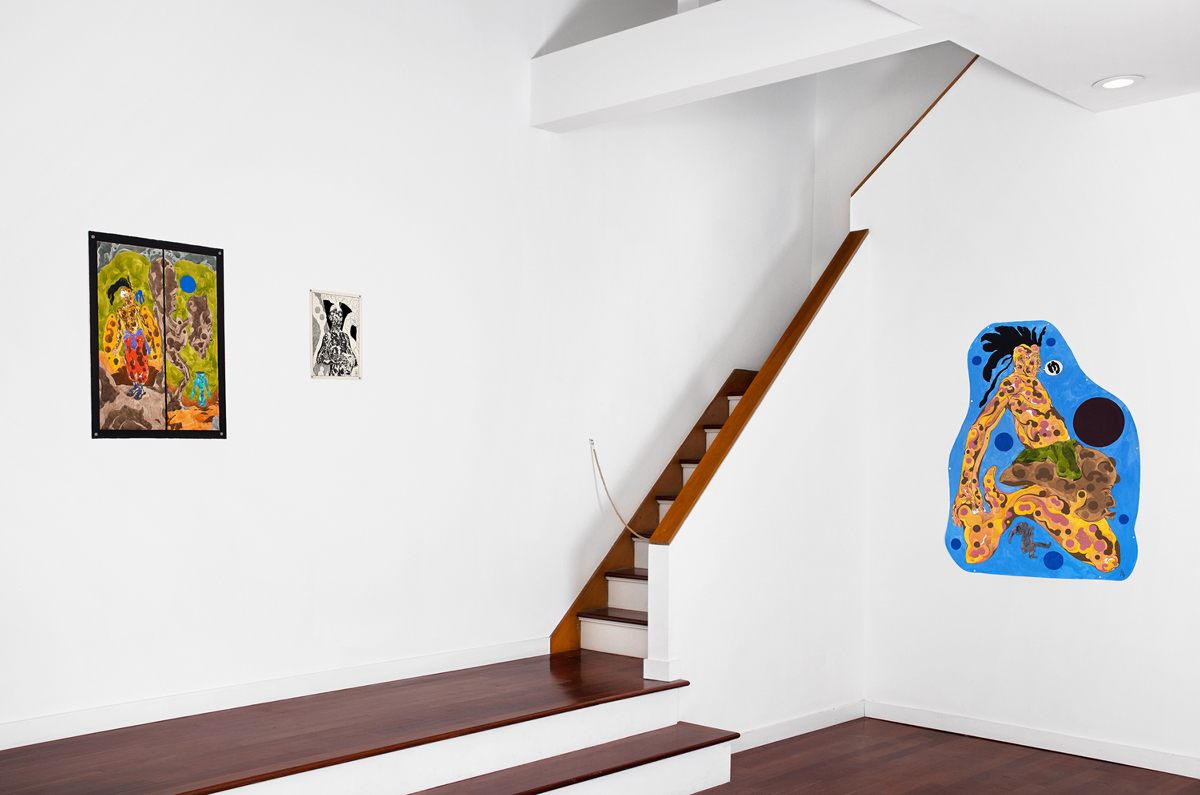
Lowery Sims: So in the introduction Vlad alluded to your interest in this mythological focus. And we talked about your interest in the work of Mircea Eliade, writing about initiations, and Joseph Campbell—one of my faves. And you indicated how initiation ceremonies provide a means to pass on systems and values to younger people. So how does your work relate to that and how do you think it relates to the state of the world now in terms of generational relationships
Richard Ikhide: One of the pieces in the show is called “Elder.” In Nigeria you honor your elders, and I lived with my grandparents for a large part of my childhood, so they’re very important figures in my life…We’re from the Edo region which was within the Benin Kingdom…my granddad would tell me about the bronze’s…and when I came to England and I would go to the British Museum and think, oh my granddad told me about these. You know, these are things that have been looted and now I’m sitting in the British Museum with these lauded pieces of artwork, but for me that was just home…
And now having a child, I’m always thinking about how can I pass on things to my child and what would she pass on to her children? There’s this kind of continuation of history through lineage. And also, one of the tutors at the Drawing School had said to me, “outside of your own personal history as an individual, there are certain artists you can look up to that you’re in that similar lineage because you’re searching for similar things”…and William Blake was someone like that for me in terms of how he talks about the imagination…and this personal mythology he was building, but then also relating to the wider British society at the time. I came across a pamphlet he made with a guy called Thomas Stoffard on the abolition of slavery…and that was incredible to me because a lot of Blake’s work was very fantastical and I didn’t know he’d made this sort of work.
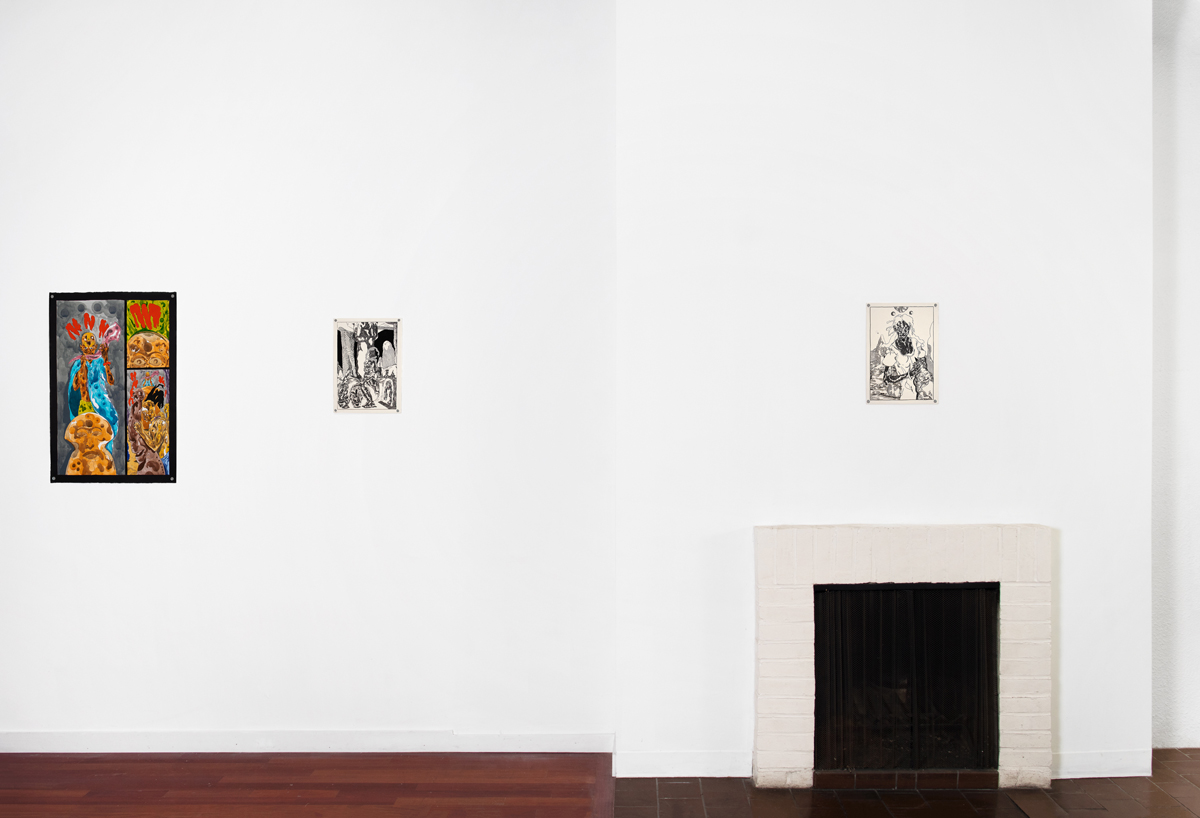
Lowery Sims: So who are these figures in your work? And explain to me the script that appears every so often as a vocal bubble or a sort of inscription in the foreground.
Richard Ikhide: So when I was making this body of work over the past six to eight months, I’ve been reading a lot of Mircea Eliade, as we were saying, and there’s this book called “Rites and Symbols of Initiation”. He was doing a lot of research into initiation ceremonies around the world and this idea of how initiation gives certain principles and ideas to young people to engender certain qualities that make them active members of the community or society. So I teach at the drawing school and I’m always thinking, what do young people have in terms of things that can engender them into being active and productive members of society? I’m in my 30s and I look around and I’m like, what do you have? You have things like incell culture, red pill—all these crazy ideas that are being propagated, especially through things like social media, right? So I’ll speak maybe specifically for men, you know, if men had men’s groups where you would have older males who’d mentor and help give younger men avenues where they can express themselves in different ways so they don’t fall to certain vices. So there are all of these elements in the work but essentially I am trying to talk about issues personal to me and my life, the family dynamic and also issues in society at large…
And with the script and the writing… I’ve spent a bit of time doing loads of automatic drawing, and during that process you’d kind of just let your subconscious guide you. So that was how a lot of the shapes of the script and the writing came about. Because if I would put English there, which has dominated the whole world, it locks in the interpretation and the context within a certain framework. So when we look at language, it starts with logograms and pictograms and then that language gets condensed and condensed and it becomes letters…I was also looking at things like sigil magic—in the southwestern region of Nigeria you have Nsibidi, which is a form of a condensed language using knots and crosses. And this then gets transported to the Caribbean and Brazil…That was how I was conceptualizing some of the language.
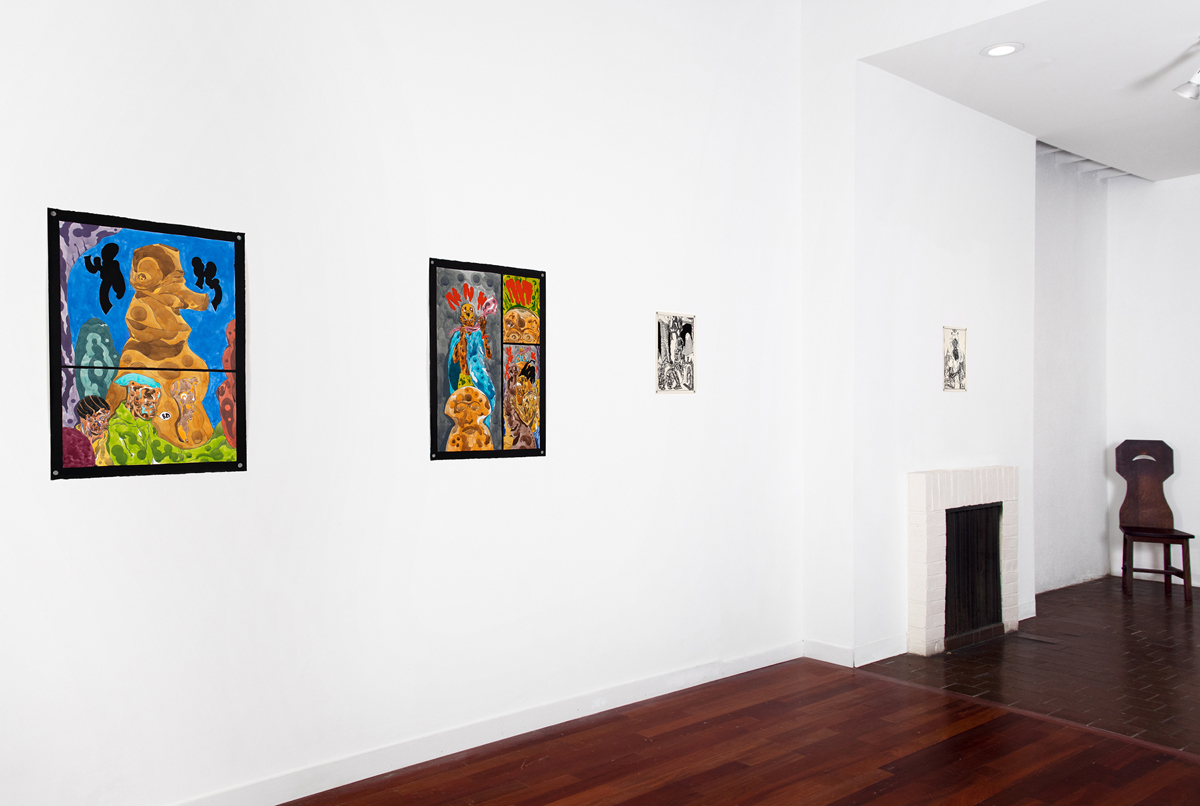
Lowery Sims: I know an artist in Washington, DC, named Victor Ekpuk. And he uses the Nsibidi language. And when he first came on the scene like 10 years ago, it was like aha, see African cultures are not pre-literate or anything like that. So I’m interested in the way that you’re talking about masquerades and the functions of masks, and how this informs your work, but you’re not illustrating that. Do you feel as a person in your thirties and going back and forth between Nigeria and England that these kinds of ideas and traditions still have a viability today.
Richard Ikhide: Yeah, 100%. It’s like this funny thing— in Boots, which is a supermarket in England, I noticed that they started to sell these chewing sticks for toothbrushes, right, but growing up in Nigeria that’s what people would use—but now it’s like “oh this new organic way of cleaning your teeth” and I’m like yeah, that’s exactly what I’m talking about in terms of there being value in these cultures. And obviously, through things like colonialism it was like “this is archaic, there’s no use, there’s no value”, but now they’re selling charcoal toothpaste, you know. I remember seeing women in Nigeria—that’s what they would use you know.
It’s so interesting to me how history is cyclical and some of these ideas come back again…That’s why the idea of “Future Past” is very interesting because yes, we’re moving towards this future and technology and all these things, but also in looking back at the past—a lot of algorithm systems are based on African textiles and some of the patterns for that. And now it’s interesting to see how the algorithm dominates social media today. But then if we look at the origins of the algorithm, this is maybe from a culture that you might say has no value. So it’s interesting to highlight the value of some of these practices and some of these religions today.
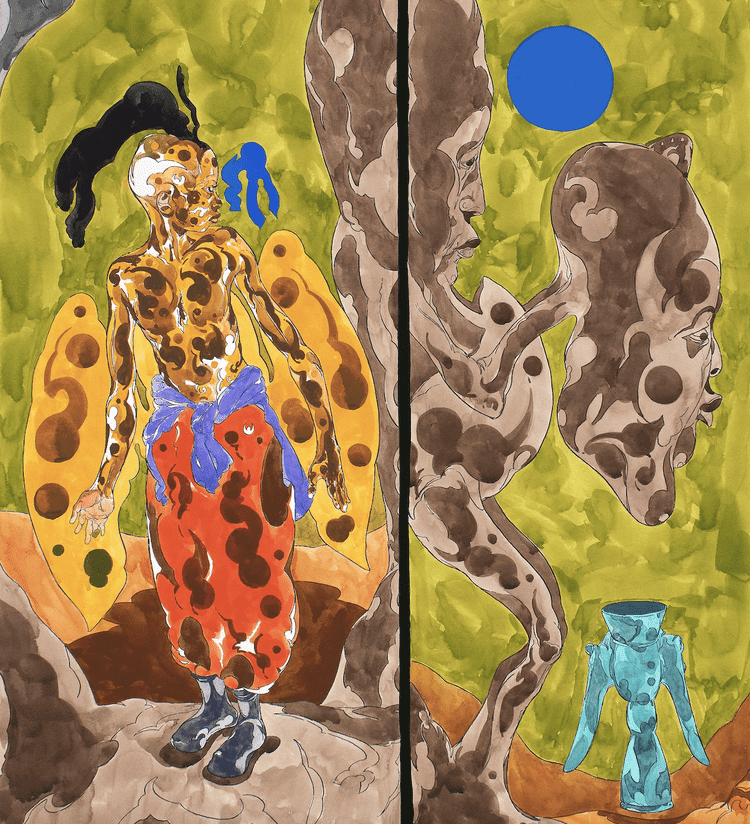
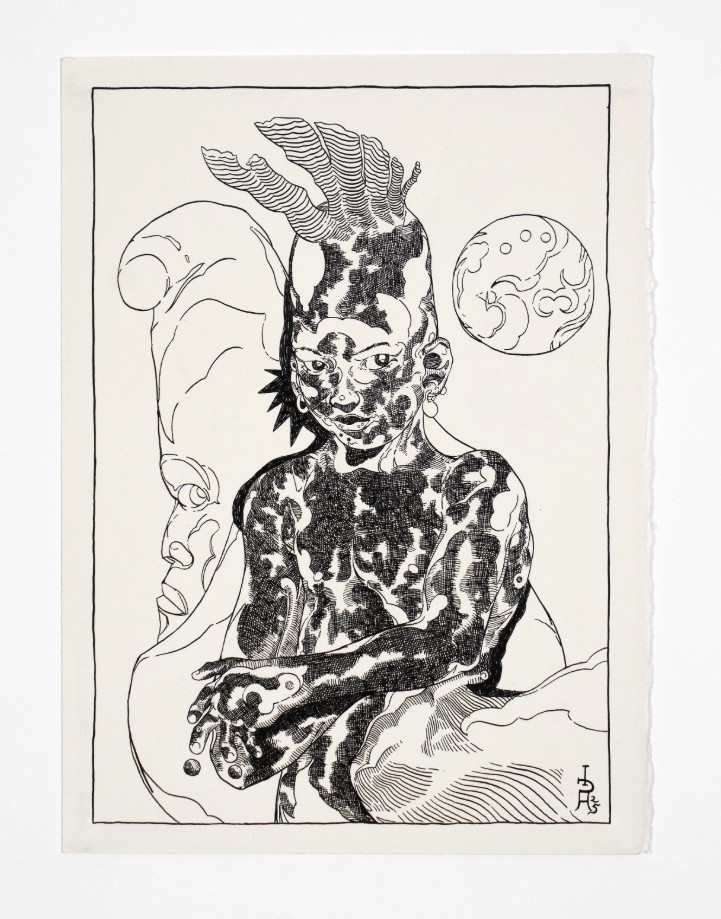
Audience Question #1: Can you talk a little bit about the relationship between the framing edge in the composition and in particular this sort of decision to start exploring shaped paper?
Richard Ikhide: So with the shaped paper I was looking at things like Elizabeth Murray and then also looking at things like talismans and tablets. And I was thinking, okay, how does the figure rest within this shape, and how does it conform to the parameters?…And in terms of the framing—I’ve been looking at a lot of sequential art. I’m looking at things like the Benin bronzes. So the bronze plaques are arranged on a pillar… arranged in a sort of sequential manner, which is really interesting. So for me, the idea of the sequence is not necessarily just something in film or comics. It’s a very old idea. If we look at hieroglyphics in Egyptian or Sumerian artwork, things are in panels…It’s a very old and ancient idea..that develops into things like Ukiyo-e prints and frame by frame animation. So the panel and the grid is something I thought would be interesting to work with…
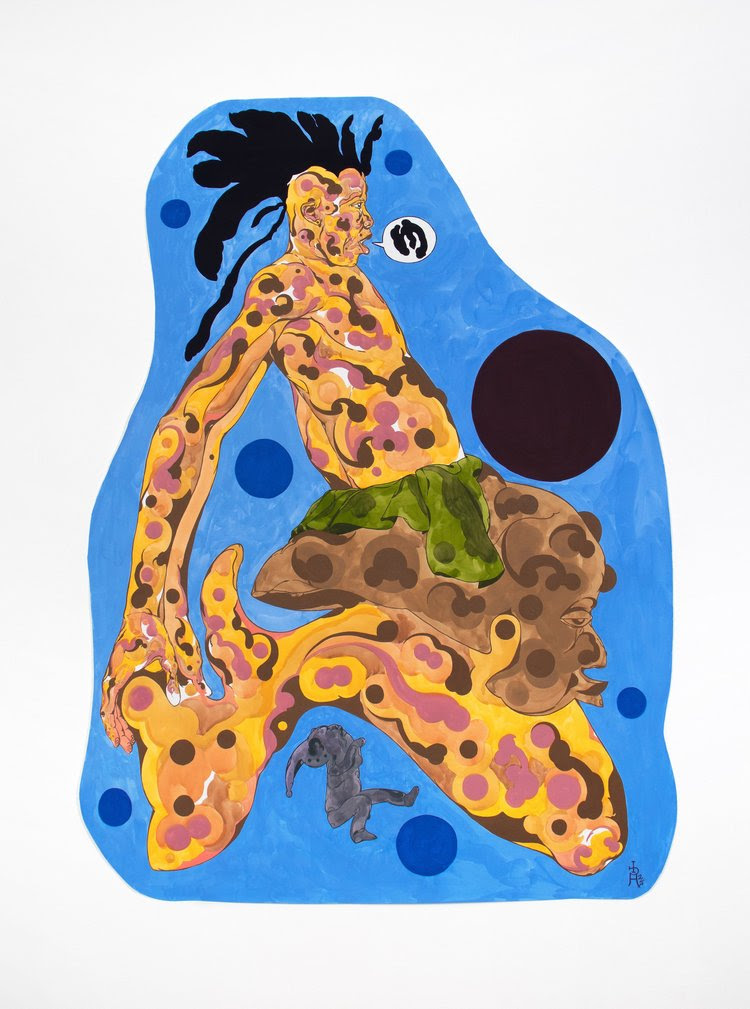
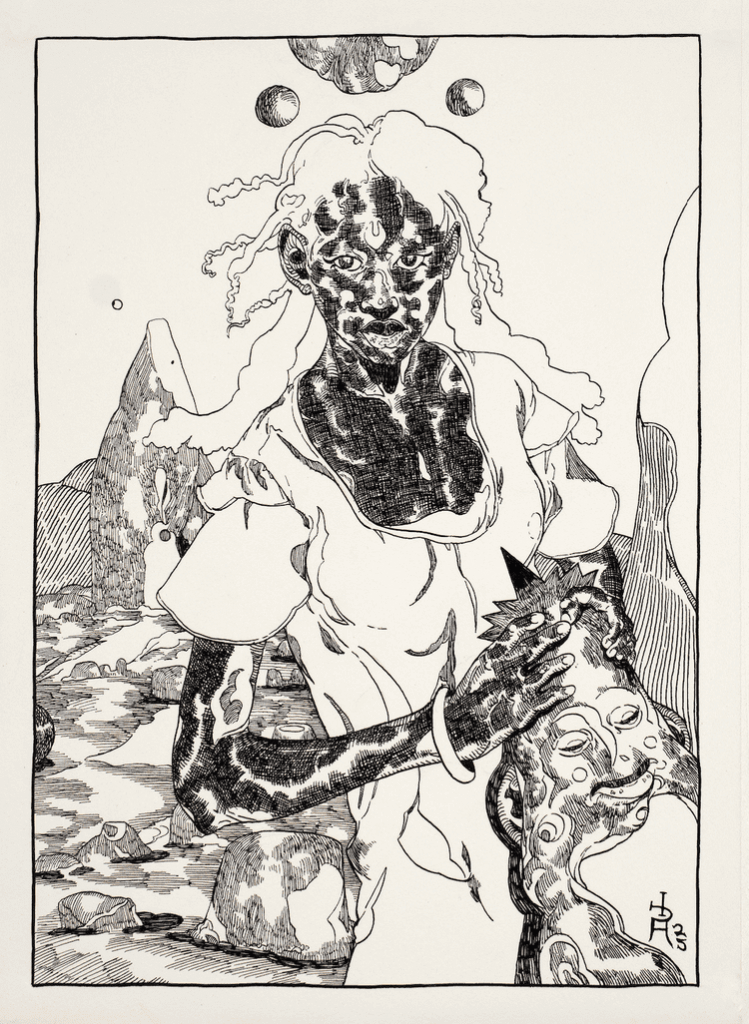
Audience Question #2: I see in your work a lot of shapes that are fluid or instinctual or swirling and amorphous—and then there’s the circle. So I was wondering if you could talk a bit about how you think of the shape of the circle in your work?
Richard Ikhide: So I always think of them as points of meditation, points of rest. And also, the circle is a universal shape and it’s also a naturally occurring shape. It’s just something I’ve been really drawn to since delving into my fine art practice… and also it links to so many things— it can be an atom it, could be a womb, it could be a pixel. I feel like there many associations—I’m into video games, like you’re looking at pixel art, you build it dot by dot…So I’m seeing it as a representation of a few different things, but in terms of the formal aspects and qualities of the work, I’m interested in how they affect the surface of the work, and how they could also be points to follow through. You can go through all these diagonals and points almost like a system or way of reading the image.
Lowery Stokes Sims is a distinguished art historian, curator, and educator, recognized for her pioneering contributions to diversifying the field of art history and expanding the representation of artists of color, women, and craft-based practices in major institutions. She began her career at The Metropolitan Museum of Art, where she worked for nearly three decades as a curator of modern and contemporary art, before serving as executive director and president of The Studio Museum in Harlem, and later as chief curator at the Museum of Arts and Design in New York. Sims has organized numerous groundbreaking exhibitions, published widely on artists from Jacob Lawrence to Faith Ringgold, and mentored generations of scholars and curators. Her career reflects a deep commitment to championing overlooked voices in the art world and reshaping narratives around modern and contemporary art.
Richard Ayodeji Ikhide creates works on paper using ink, watercolor, and gouache that investigate cosmology, mythmaking, and parallel realities. His practice is rooted in Nigeria’s cultural history and the Edo religion, where the world is divided into visible and invisible realms, with rituals and offerings used to interact with the spirit world. The visual style of Ikhide’s works melds traditions from his birthplace in Lagos with a wide range of influences he encountered as a young man growing up in London, including Japanese manga, comic books, and Renaissance artists such as Giovanni Tiepolo and William Blake. Recent solo exhibitions include: ‘Ties That Bind with Time’, Candice Madey Gallery, New York (2024); Acts of Creation, Victoria Miro Projects, London (2023); MythMaking, Steve Turner, Los Angeles (2021); Future Past, V.O Curations, London (2021); Osmosis, Zabludowicz Collection (2019).