The Institute of Contemporary Art/Boston is an architectural marvel of sharp, clean lines, cantilevered upper floors, and an elegant aluminum and glass exterior. On a recent cloudless summer morning, it’s giving more of, well, an enormous retro television screen.
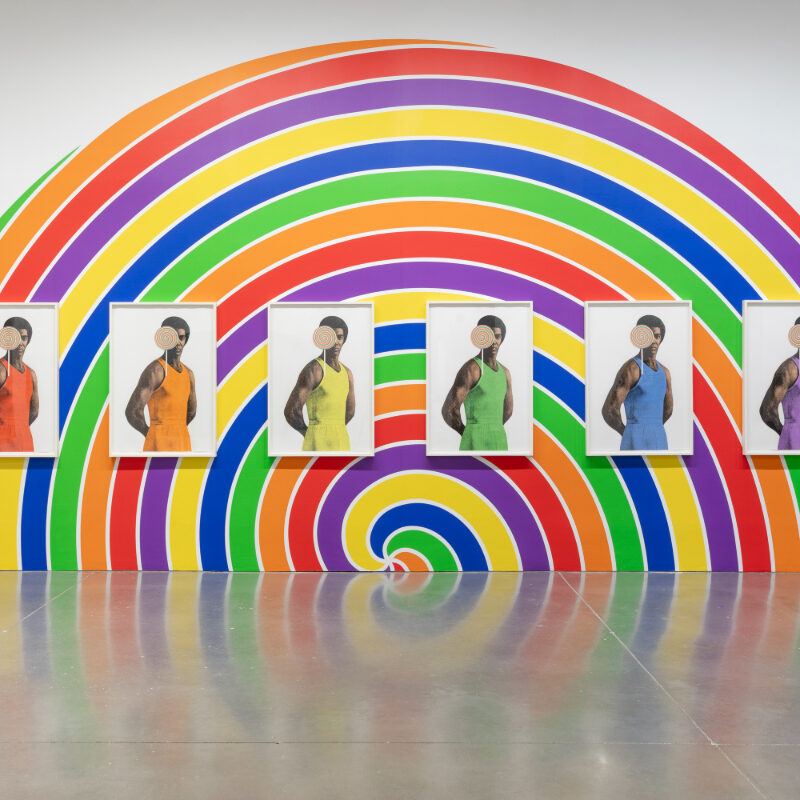
For its current exhibition, Derrick Adams: View Master, the Baltimore-born, Brooklyn-based artist wrapped the structure in one of his favorite motifs, color bars. The reflective surfaces of the Boston harbor water and surrounding office buildings transform the visual test pattern familiar to TV viewers everywhere, which was designed to ensure color is calibrated correctly on broadcast monitors, from static image into self-replicating transmission signals.
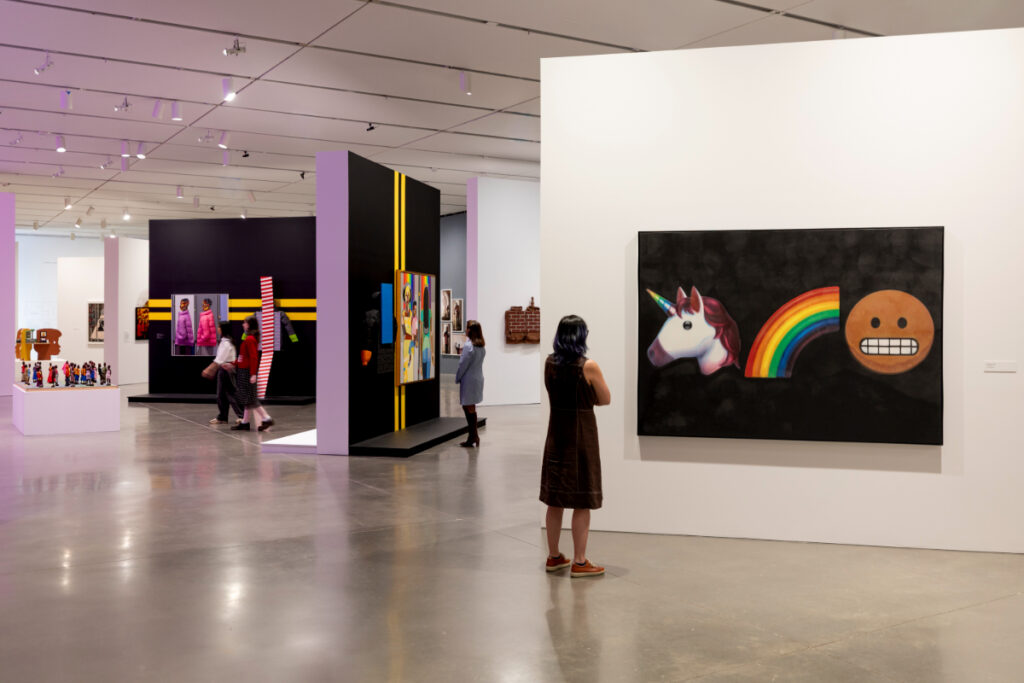
Near the museum’s entrance, a group clambered on top of a trio of “Funtime Unicorns,” Adams’ twist on playground bouncy horses. They rocked back and forth with abandon until the winner of an imaginary race was declared. These carefree jockeys (did I mention?), all fully grown-up adults.
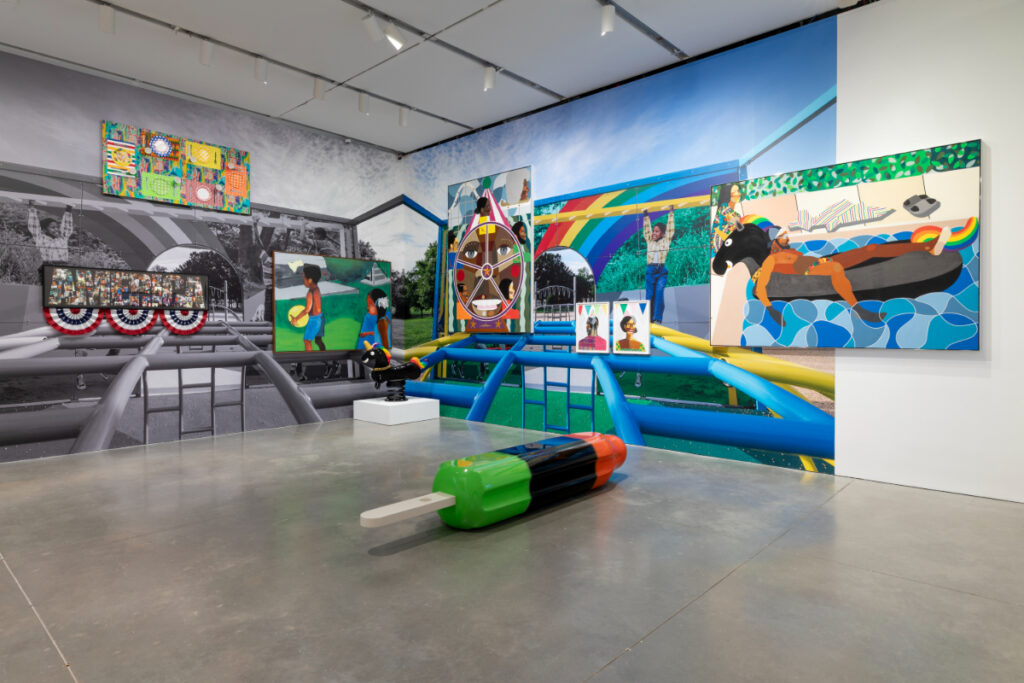
It’s a taste of pure Adams before even getting to the gallery—the unexpected juxtapositions, the sense of humor, the invitation to see the familiar with new eyes—all of which are hallmarks of one of the most compelling artists and astute chroniclers of Black culture at work today.
View Master, the artist’s first (and overdue) mid-career survey, consists of 100 pieces from over 20 years, dating from Adams’ earliest efforts to newly created works. Curators Dexter Wimberly and Tessa Bachi Haas have wisely divided the show into five broad thematic (versus chronological) sections that showcase Adams’ skills across mediums, including paintings, collages, sculptures, videos, performances, and public projects. Its open flow and immersive design, on which Adams collaborated, encourage viewers to trace Adams’ decades-spanning, persistent preoccupation with depicting signifiers of Black life in America and the worlds of his imagination. Adams’ artistic influences are impressively varied from Pop Art to Cubism, Jacob Lawrence to David Hockney, Black Panthers to Sesame Street.
The slow burn of Adams’ early career starting in the mid-1990s has gone into hyperdrive in the past decade. His pieces have been acquired by the Whitney Museum and The Met for their permanent collections and featured in the travelling exhibition Giants: Art from the Dean Collection of Swizz Beatz and Alicia Keys. He’s represented by mega-gallerist Gagosian and has been the subject of (more than a few) admiring profiles in The New York Times. Born and raised in Baltimore, the 56-year-old artist has also become a bit of a patron saint of the city’s creative life via his non-profit Charm City Cultural Cultivation.
As his profile has grown, Adams has been tagged as a flag-bearer for “Black Joy”—celebrating positive Black experiences or simply ordinary pleasurable moments of leisure, repose, and connection. While View Master delivers on that reputation, it also provides a hearty corrective to any one-dimensional reading of Adams’ talent.
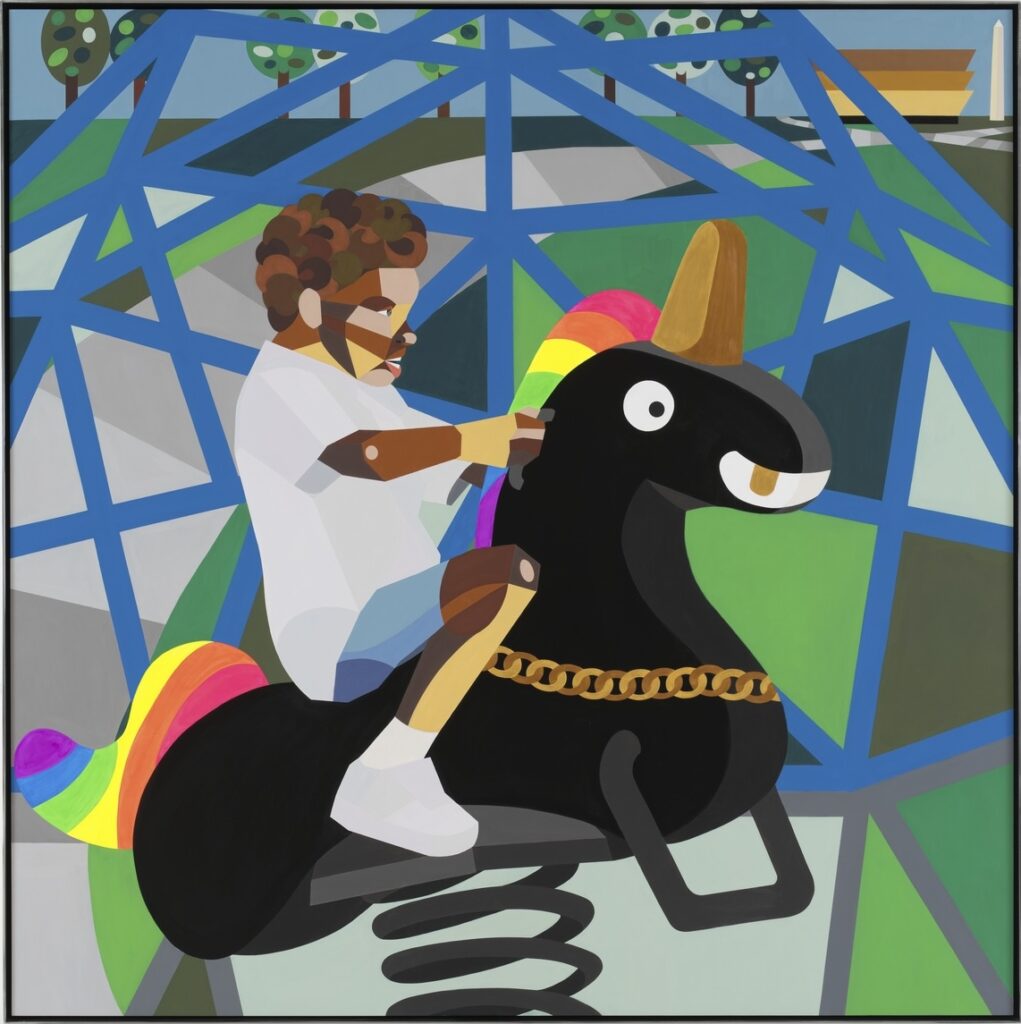
The show reveals an artist adept at accessing a range of subtle emotional registers, for instance. In “Braving the Path” (2023), a child sits astride one of Adams’ cast-metal unicorns. The mythical-creature-cum-playground equipment is painted black, with a rainbow-colored mane and tail, large gold chain, and wide, slightly maniacal grin. The boy’s expression, in contrast, is one of determined concentration, the unself-conscious absorption of solitary play that’s the opposite of exuberance.

A young man and his bare torso lie diagonally across the frame in the “Figure in the Urban Landscape 13” (2018) collage. Pillows lay on either side of his face, and his body is bisected by angular lines representing black-top roadways onto which model cars have been affixed. From the unusual perspective of looking down on the figure at rest, we see the unfocused, distracted gaze of a daydreamer. He could be imagining himself at the wheel cruising the neighborhood or simply letting the wafting traffic noise carry images through his mind.
In fact, few of the faces portrayed in View Master sport conventional expressions of joy. Anyone who’s been admonished by a stranger to “Smile” can attest that the expectation can be reductive and even repressive. In contrast, more often than not Adams’ figures seem to me portraits of reserve, melancholy, and disquietude, even, that undercut the surface sheen.
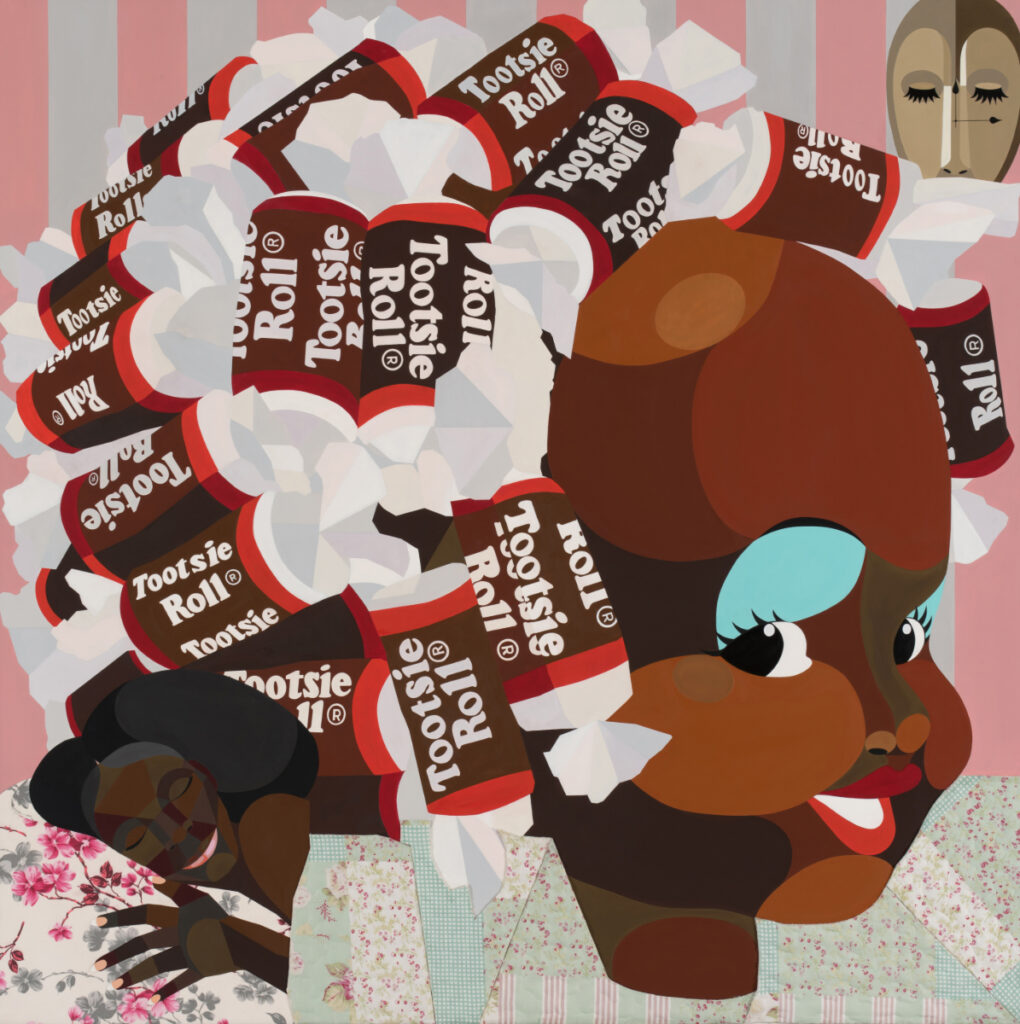
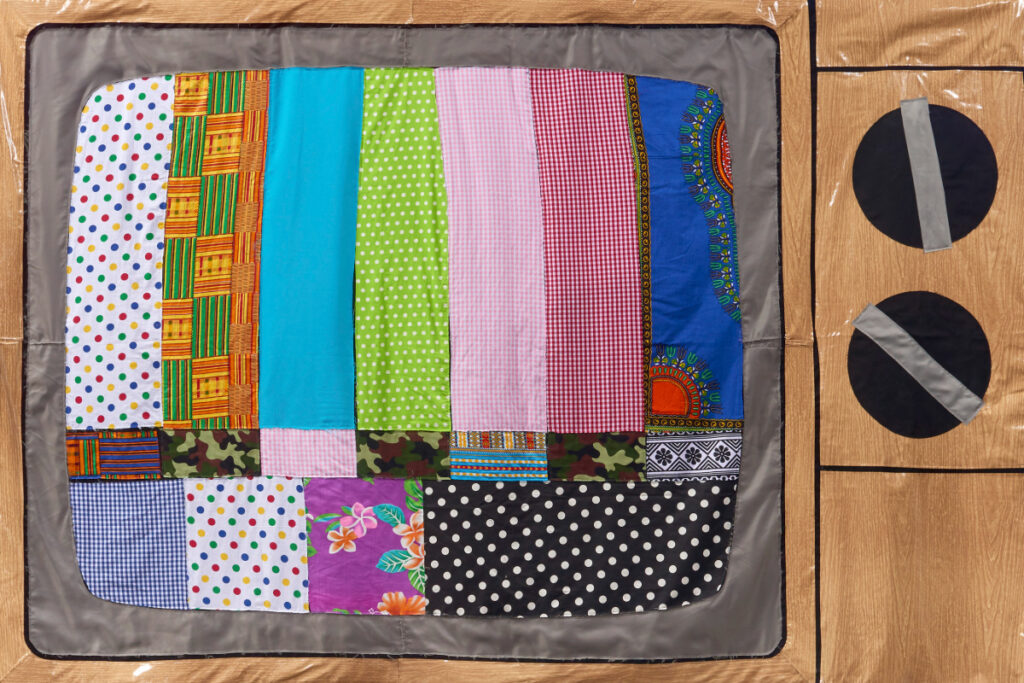
This sense of unease is heightened by surreal touches. A brick building wears a puffer jacket, a head opens up to expose a mid-century modern decorated living space, the curls framing a dreamed-up baby’s face are a tangle of Tootsie Rolls. Adams makes mischievous substitutions of materials, like the color bars of “Fabrication Station 4” (2016) composed of fabric strips instead of pixels, or an ornate hair style formed by shards of shelf lining in “Head No. 13 (Floor Plan)” (2012). All is not what it appears.
Coley GrayA brick building wears a puffer jacket, a head opens up to expose a mid-century modern decorated living space, the curls framing a dreamed-up baby’s face are a tangle of Tootsie Rolls… All is not what it appears.
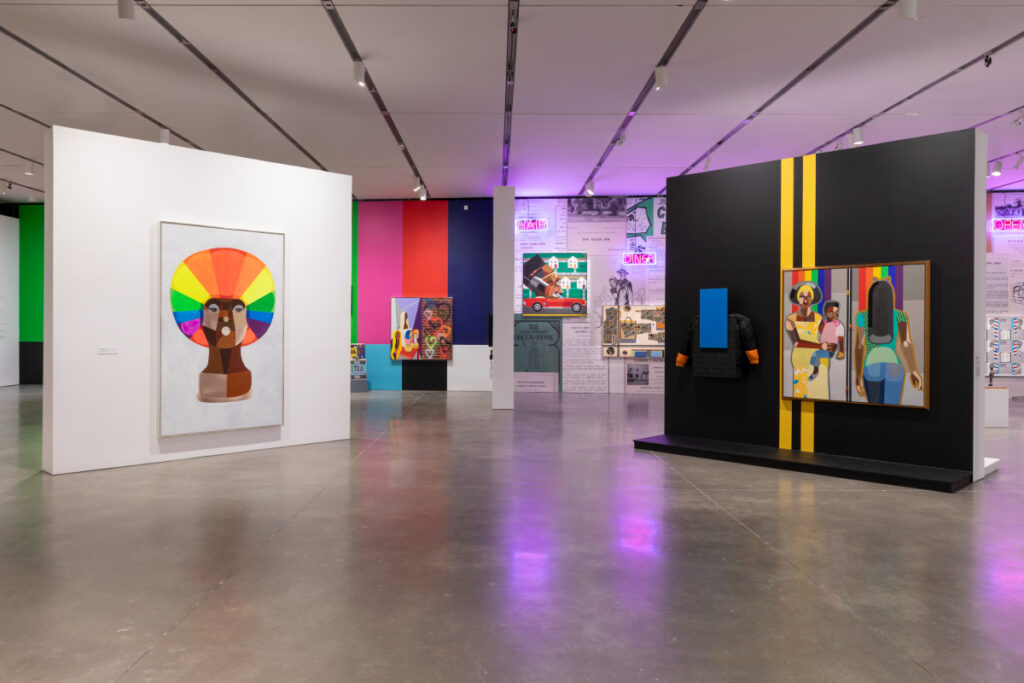
Adams revels in the challenge of transforming planar shapes into human faces and figures. The intersection of a sloping line of two irregular rectangles of different shades produces a cheekbone. The rise of pursed lips is signified by a set of uneven ovals. In the resplendent “Style Variation 35” (2020) that greets gallery-goers entering View Master, Adams paints a statue head whose face and neck are an angular jigsaw of brown and taupe blocks of color around a pair of unblinking eyes. It evokes traditions of ancient statuary and modern wig shop display, and nods to Kwame Brathwaite’s celebration of Black women’s beauty. But the addition of bright slices of color to form a rainbow Afro transports it to another level of dazzle.
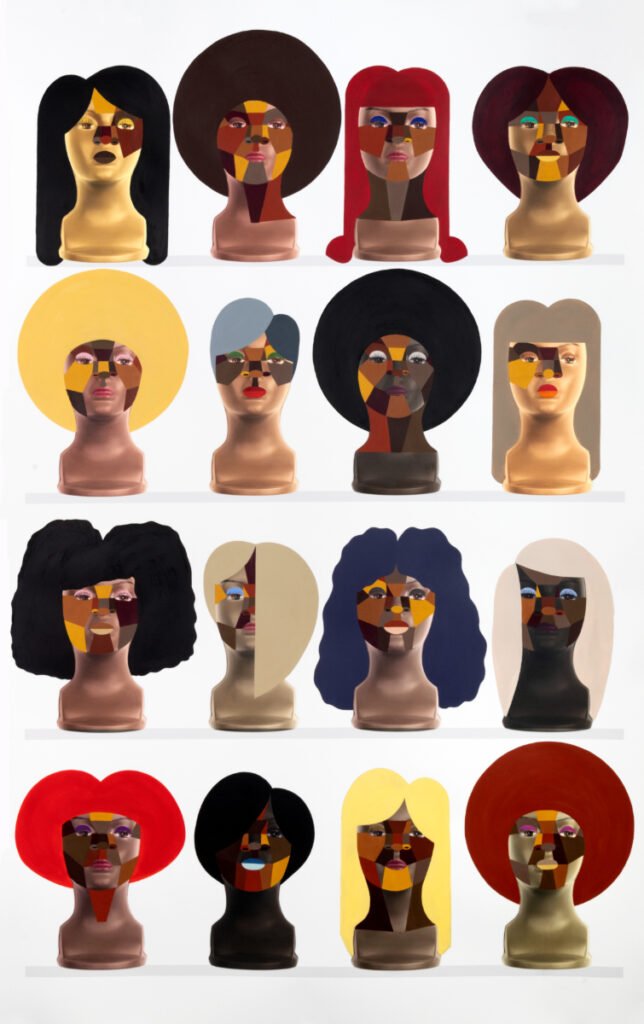
One favorite in the exhibit is the painting “Style Variation Grid 3” (2018), which shows similar head statues arranged in four-by-four rows and columns like mannequin heads on wig shop shelves. Each has different features, make-up, and coiffures and all stare directly at the viewer. By altering dimensions, placement, and hues, the repetition with variation highlights Adams’ virtuosity in eliciting expressiveness from geometry. Up close, the works reveal subtle shadings and a more delicate hand with lines than come across in reproductions of his work.
By altering dimensions, placement, and hues, the repetition with variation highlights Adams’ virtuosity in eliciting expressiveness from geometry.
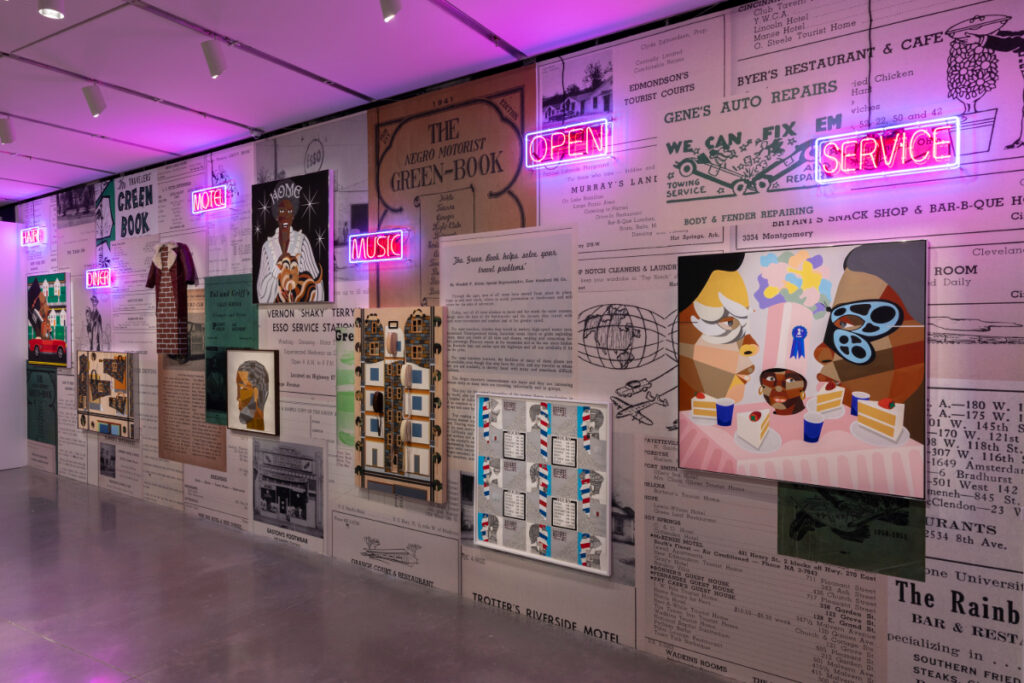
The way Adams determinedly interweaves the past and present, through sometimes incongruous mashups, is cleverly spotlighted in The Urban Landscape section. This room pulls together about 20 of Adams’ takes on contemporary streetscapes, architecture, and fashion in mediums as diverse as neon signs and a regiment of small African wooden statues dressed in streetwear. Across the back wall Adams has ingeniously crafted a wallpaper out of the pages of The Negro Motorist Green Book, the 20th-century guide for Black travelers to finding safe spaces in racially segregated America. By making the publication’s text and graphic design into the substrate for modern life, Adams visually conveys how the Green Book’s era may be over but its legacy lives on in Black collective memory.
In the Future People nook of the exhibit, Adams takes this search for places of security and freedom, like many artists before him in the Afrofuturism lineage, into outer space. In this series, he forsakes his typically saturated palette used in his earthbound scenes for gentle renderings in grayscale. The mixed-media collage “Orbiting Us 8” (2017) gives viewers a glimpse through a spaceship’s porthole window of a vista past which random flotsam and jetsam drift—celestial objects, obsolete terrestrial technology, and African carved sculptures. Most intriguing are the floating, disembodied heads whose faces are obscured by paper plates except for cutouts around their eyes. Who are these imaginary space travelers escaping the bonds of this troubled planet? Through what heavens are they tumbling untethered?
In a piece created for the exhibit, “View Master” (2025), Adams debuts a standout acrylic and fabric collage that speaks to the show’s themes of seeing and being seen. The piece scales up a View-Master—the bright-red ersatz camera that uses two-view stereoscopy to make images appear three-dimensional—to fill an entire 6’ X 8’ canvas. It is a visual pleasure and archetypal expression of Adams’ formal interests: the deft application of blocks of bold color, the fixation with the relation between flat planes and 3D, and the aestheticization of everyday objects.
But it’s also a moment of re-visioning.
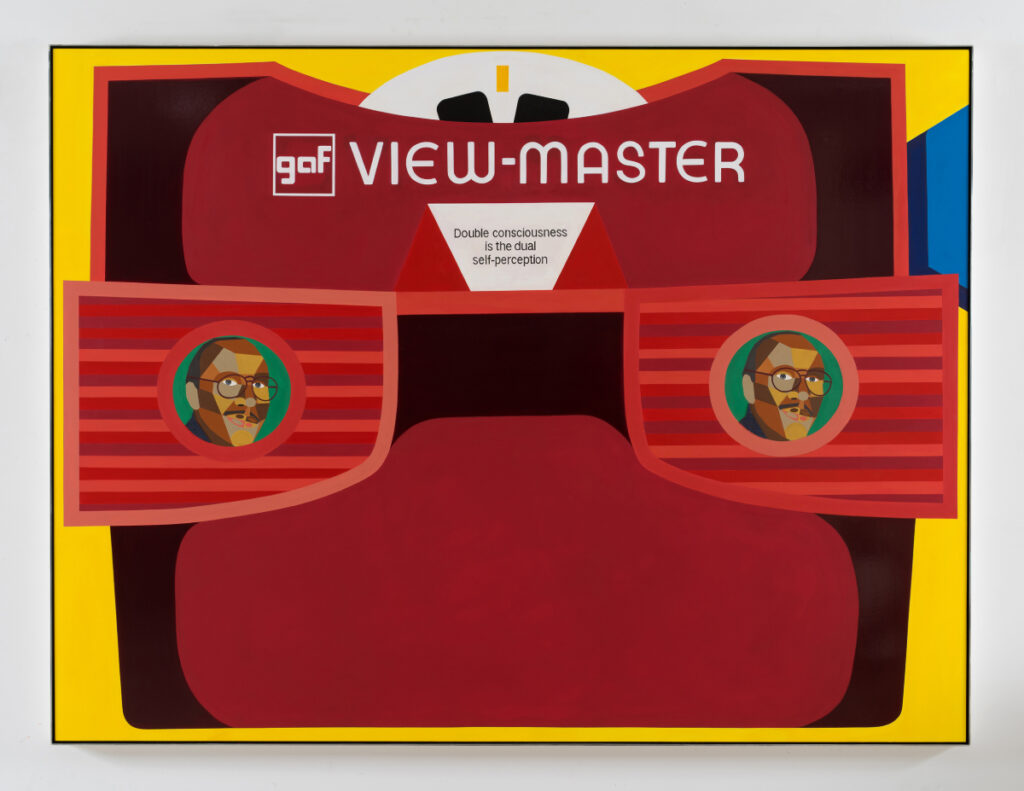
Many exhibit-goers might remember the View-Master as an iconic childhood toy but not assign it much significance. However, the face depicted in the device’s two eyepieces is African American industrial designer Charles Harrison. Harrison revamped the plastic device in the mid-1950s, meeting with overt discrimination at the time and fading from historical memory since then.
Adams uses text sparingly in his works but does so to great effect here by tracing the phrase “Double consciousness is the dual self-perception” on the bridge of the View-Master. This references the concept introduced by Black intellectual W. E. B. Du Bois of “this sense of always looking at one’s self through the eyes of others” experienced by African Americans, which he argued results in a fragmented sense of identity. Here, Adams uplifts the history of Black contributions to American life that are overlooked even when in plain sight, and he imagines a world in which Harrison appears in duplicate but with no disjunction between the two images.
With his characteristic mix of play and earnestness, Derrick Adams: View Master demonstrates an artist whose has mastered the art of commanding a point of view, creating and curating what critic Tina Campt describes as a distinctly Black gaze that “shifts the optics of ‘looking at’ to a politics of looking with, through, and alongside another.”
The chance to see Adams’ career output in the impressive setting of ICA/Boston is well worth a trip up the East Coast before the show closes in September. Calling all art institutions in Baltimore, though, for a better idea: bringing the show to the hometown that continues to ground and inspire his creativity.
Now, that would be genius.
Derrick Adams: View Master is on view April 16 – September 7, 2026, at the Institute of Contemporary Art/Boston.
Support for travel to write about this exhibit was provided through the generosity of the Rabkin Travel Grant program for visual arts journalism. The author and BmoreArt are grateful for the opportunity to cover this milestone exhibit of a renowned local artist that otherwise would not have been undertaken.