Using “Tulipomania”—the 17th century Dutch luxury agricultural speculation bubble and crash—as an easy cautionary tale for the artworld’s esoteric economics is probably a cliché at this point. But hey, both have inspired some truly whacky market manipulation and one of my absolute favorite paintings in The Walters’ collection! It was a difficult thought to shake as I diligently checked-in with dozens of gallerists and artists over the course of the first 48 hours of NADA and Untitled, trying to get a sense of how their sales have been going relative to overhead after months of so much uncertainty and outright panic across the industry.
Mostly, though, I found myself thinking about floral economics because nearly every hushed conversation about the art world’s recent money problems (too many fairs! too much art! too much flipping!) was happening with a dizzying number of subjectively-priced flowers within my peripheral vision (and I have extreme adult ADHD).


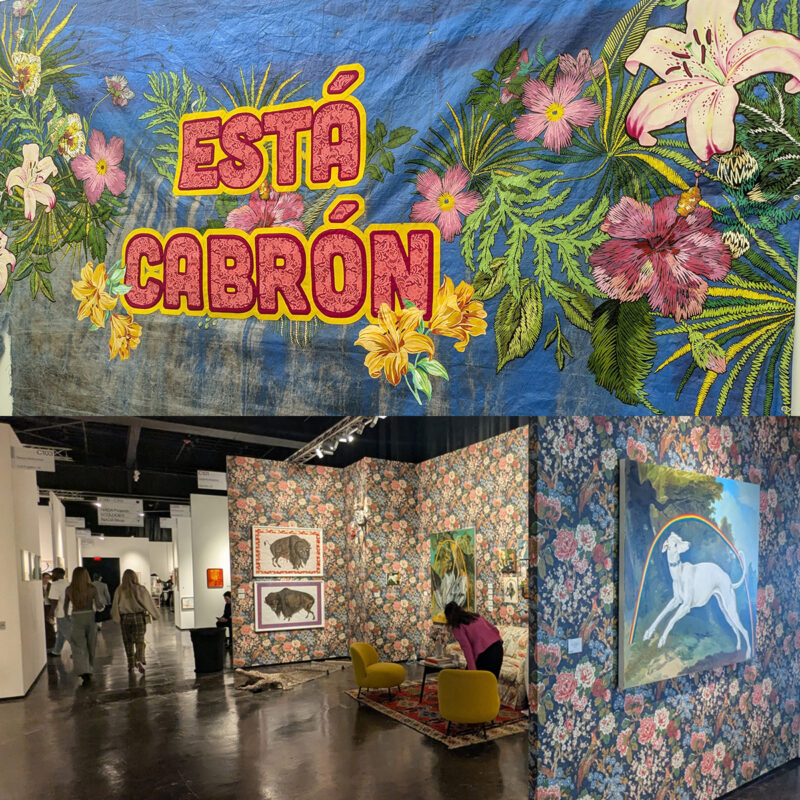
NADA and Untitled are packed with more florals than an old Laura Ashley catalog someone thought would be great reading material for their toilet magazine rack in a Hamptons guesthouse (there’s a story behind that analogy, but that’s for a column of a different nature entirely). Both fairs are abloom with flowers rendered in whatever media one could possibly imagine—ceramics, steel, collage, digital prints, weaving, wooden inlay, wallpaper, and so much very lovely oil pastel or paint smeared or delicately applied to surfaces from linen to aluminum.
New York gallery Post Times even hedged their bets in the dreaded “Tuesday Triage Tussle” by showing Michael Assiff’s very seductive concrete bas reliefs of wildflowers in booths at both NADA and Untitled. I joked with art advisor Sibilla Maiarelli, who was holding down the NADA booth when I finally swung by, about the fairs’ rivalry. We struck up a conversation and it turns out she used to live in a punk house with basement shows just around the corner from the BmoreArt offices and now has a similar initiative to our Connect+Collect program in New York aimed at young collectors. Small world!


Michael Anthony FarleyI must admit, I did not see this millefleur zeitgeist coming like a tsunami.
I am not, however, complaining. “Let there be a thousand blossoms bloom, as far as I am concerned!” to quote a politician from a state with large predatory reptiles far more pragmatic than Florida’s leadership. And collectors don’t seem to be complaining either. That might be down to something dealers are catching on to that Dutch farmers in the 1630s did not: maintaining an illusion of luxurious scarcity can be just as ruinous as overinvesting in a commodity without fundamental value.
Nearly every gallerist I met over the past few days has excitedly pulled out smaller, unabashedly affordable works whenever I showed interest in one of their artists’ show-stoppers—something that used to happen almost exclusively after pricier works had sold out later in the week. In many booths, wall space is split evenly between a handful of large pieces for “bigger fish” collectors and grids of modest works on paper—often with visible prices well under $1000, no QR codes or sheepish pricelist email inquiries required.

“I love the thought that a first-time collector who discovers the artist can just buy a drawing and carry it out,” beamed Thomas Martinez Pilnik, whose new Los Angeles gallery Feia is showing Melanie Delach’s dreamy mixed-media, sculptural paintings as well as a rotating selection of $850 drawings at NADA. “We brought extra frames and everything, and have just been swapping them out as they sell.”
Delach’s intimate, materially-experimental assemblages and works on paper allegorically chart the artist’s path from alienation in a conservative Catholic Long Island suburb to sexual self-discovery and acceptance in a queer community. “It was important for us that this work be accessible,” he explained despite their labor-intensive nature, “this is Melanie’s first art fair… and our gallery didn’t even exist a year ago, but here we are at our first fair!”
Pilnik has even brought some hilarious “Art Daddy” and “Matron of the Arts” hats, joking “I figured selling some $30 merch means we wouldn’t stress ourselves out too much about selling the art.”

Feia is one of a number of new exhibitors at NADA, which like Untitled, also features a refreshingly broader selection of galleries from non-coastal US regions typically underrepresented at international fairs. About one third of the exhibitors are first-time participants—almost as many as NADA member galleries. I asked a long-time NADA exhibitor if they noted an unusually pronounced infusion of fresh blood. Their take was in line with something I’ve heard murmured for months: several of their colleagues from Europe and Latin America confessed that they were avoiding US fairs this year because of the political situation and that “Europeans especially just don’t like coming to Miami anymore… it’s partly cultural, but for a lot of gallerists and collectors, it’s no longer fun and not worth the expense.”
Is this freeing-up floorspace for overlooked domestic talent? Does even thinking that make me sound like one of the isolationist/trade-war apologist/protectionist talking heads on Fox News?! The fair’s own stats, however, count representatives from 30 countries among their nearly 140 participating galleries or institutions. Maybe flowers are one last apolitical beautiful thing we can all agree to love?
Across the bay at Untitled, which announced participants from 29 countries among its 160 exhibitors, I did notice that many of the foreign galleries either already had brick-and-mortar spaces in the United States, were returning longtime participants, or had been hand-picked for the vastly-expanded curated “Nest” section and enticed with subsidized booth fees.
I asked the opinion of a gallerist from the UK, who looked around before confessing under their breath, “three of my friends who run galleries in London said they’re not doing the fairs anymore because of what’s happening in America. But with everything going on in the world, perhaps that’s why everyone brought art that’s colorful and cheery. I want to be around art that makes me happy” [Compare this mindset to the brooding, dystopian vibe dominating ARCO Madrid this year in comparably stable, sunny Spain!]


Combined with the closure of so many galleries in New York, London, and Los Angeles over the past year, somewhat of an opportunity seems to have presented itself for less-established dealers looking to try their hands at one of the continent’s most important art weeks. When a big tree falls in the dense Amazon ecosystem, all the little guys expend their stored-up energy to shoot for the gap in the canopy. Untitled has expanded its curated, sponsor-subsidized sections for solo projects, nonprofits, and invited thematic galleries—smartly plugging and diversifying some of the would-be gaps left by absentee exhibitors with geopolitical or economic jitters.
But there are also some familiar faces who’ve swapped places. Perennial Untitled highlight Bill Arning Projects decided to switch over to NADA this year because the lower booth cost was less of a gamble in what looked to be a market contraction. He’s showing the playful embroidered paintings of Alexandria Deters (also with some Catholics and sapphic imagery) and Jean-Paul Mallozzi, whose energetic paintings of queers have been one of the gallery’s dependably charming go-tos for years.


Meanwhile, Baltimore-born, New York-Based gallerist Cierra Britton decided to switch to Untitled from NADA this year when she was invited to the Nest section, which worked out to be about the same price as a NADA booth. This allowed her to keep the prices for her Nola Ayoola show competitive. Ayoola is an artist from Lagos whose practice combines various techniques—painting, traditional printmaking, deconstructing and weaving found materials—into abstractions informed by the colors, rhythms, and textures of her hometown.
It wasn’t until I got up close that I realized some of her compositions are made by slicing canvasses into curved, interlocking irregular strips and then reassembled to weave together like a satisfying puzzle. The result are collage-like surfaces that function in the realm of painting but dialogue with textile tradition, all while referencing acid-colored tropical landscapes and the chaos of the city. They might’ve been inspired by the hum of Lagos, but they’re perfect for chaotic, seaside Miami as well.

By happy coincidence, her booth is directly across the aisle at Untitled from MICA alum Kyle de Lotto’s with LA-based gallery Giovanni’s Room. In a personally-informed, satisfying bookend to Ayoola’s conceptual concerns, I first met de Lotto when we were roommates on a study abroad trip that was a collaboration between the Fibers and Environmental Design departments to study vernacular urban morphology and textile traditions in Spain and Morocco. We hadn’t seen each other in years, until a chance encounter at Mac’s Club Deuce (of course) the night before the fair previews.
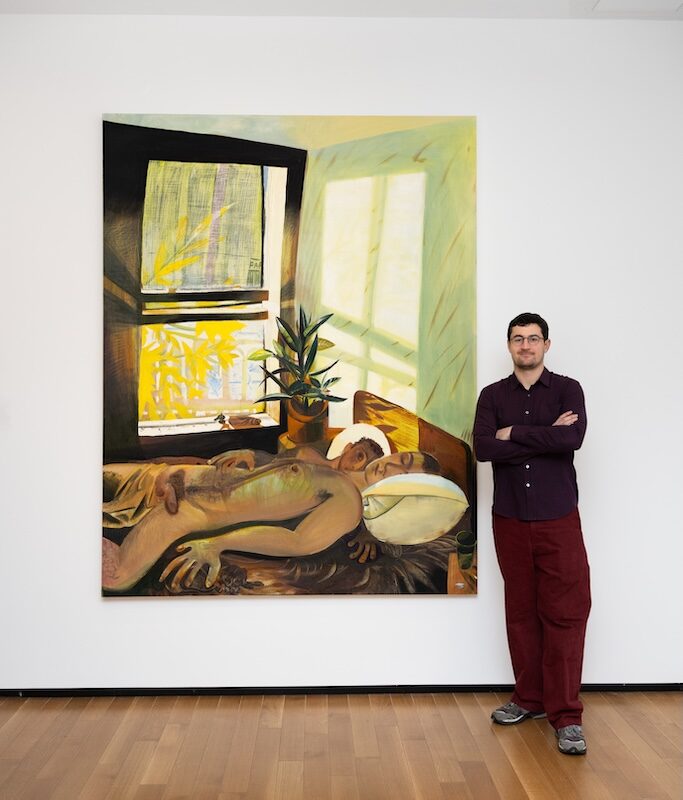
His new paintings are a really lovely demonstration of considered but informal paint handling, providing just enough information via a subtly-calibrated, murky, muted palette to suggest a narrative like a half-remembered, overcast seaside holiday. There’s a push-and-pull between the economy of gestures and generous application of oil paint—at times washy, at times buttery and impasto—that makes me, at least, happier than most of the candy-colored flowers defining the fairs this year.
They might be the most ambiguous representations of the shore and its surroundings—faces mask-like and lit in a perpetual dusk—I’ve seen in Miami this year. In a strange way, they strike me as very Spanish in their play between heady restraint and moody drama. Damn, MICA really produces such great painting nerds.

I was happy to hear a few of the smaller works on paper from a stash in storage (just ask to see them) sold within the first few hours of the preview and several collectors had asked for time to consider acquiring the larger canvases. At both fairs, that was a common refrain well into the second day. I suspect this is indicative of a scheduling/logistics conflict among NADA and Untitled that’s not really working in anyone’s favor anymore.
Prior to 2023, NADA historically opened later in the week—sometimes on the barrier island itself—and Untitled was the undisputed queen of Tuesday afternoon. Their decision to start opening before Art Basel was hailed as a boon for their galleries at the time. The problem is, this year especially, I think there’s way more emerging and middle-market overlap between NADA and Untitled’s collector base than those who choose to do their post-Thanksgiving shopping at the convention center.
Most gallerists and artists at both fairs reported decent, speedy sales at the low-end of the market, but bemoaned potential collectors rushing out mid conversation to catch the other show while promising to circle-back for conversations about the costliest works. That’s nothing new, of course, but this Tuesday in particular was a nightmare for most arts professionals. Basically everyone I know missed a meeting or lunch date with a curator, collector, artist, et al. because it was impossible to be in both fairs at the same time and they’re not exactly convenient to casually bop between.
I felt vindicated by my advice to take the new-ish Water Taxi (can we please start calling it the vaporetto?) to the Metro Mover while watching gridlock creeping across the causeways from the glamour of a boat ride. But the Miami Beach dock is an awfully long schlep from Untitled’s oceanfront digs. Your shuttle, Uber, bus, or even complimentary black car has to sit in South Beach traffic anyway. (Pro tip: the dock is just a five minute walk from underrated Art Gaysel, though!)
Realistically, we all know not every collector is going to be able to revisit both Untitled and NADA to spend the necessary time with their will-they-won’t-they acquisitions placed on tentative hold with a thousand other events and shows to see in the coming days. I wish more conversations hadn’t been so rushed by the “see it all” logic of the week. It sucks for all parties involved (except Post Time, who brilliantly splurged to set up shop on both sides of the causeway).
Everyone is going to hate me for saying this, but one of these two beloved fairs should bump their VIP day to Monday. Just think what a logistical stress relief that would be for traffic, artists showing with multiple galleries, and overbooked art handlers or others with commitments at both fairs—as well as a likely foot traffic boon for local institutions or galleries with brick-and-mortar spaces who could program events on the mainland following a hypothetical NADA opening not in direct conflict with Untitled.
Both fairs’ expanded outreach and collaborations with nonprofits and institutional partners tells us that they understand all healthy ecosystems need cross-pollination to thrive. But then again, natural selection pushed flowers to be both attention-grabbingly beautiful and accessible in the spirit of competition. If only us cultural worker drones could evolve wings…
Below, some highlights from both fairs:


I was happy to see these amazing assemblages from Devin Morris, presented by the Robert Blackburn Printmaking Workshop, who also collaborated with the artist to produce a limited-edition print available in the fair’s gift shop.