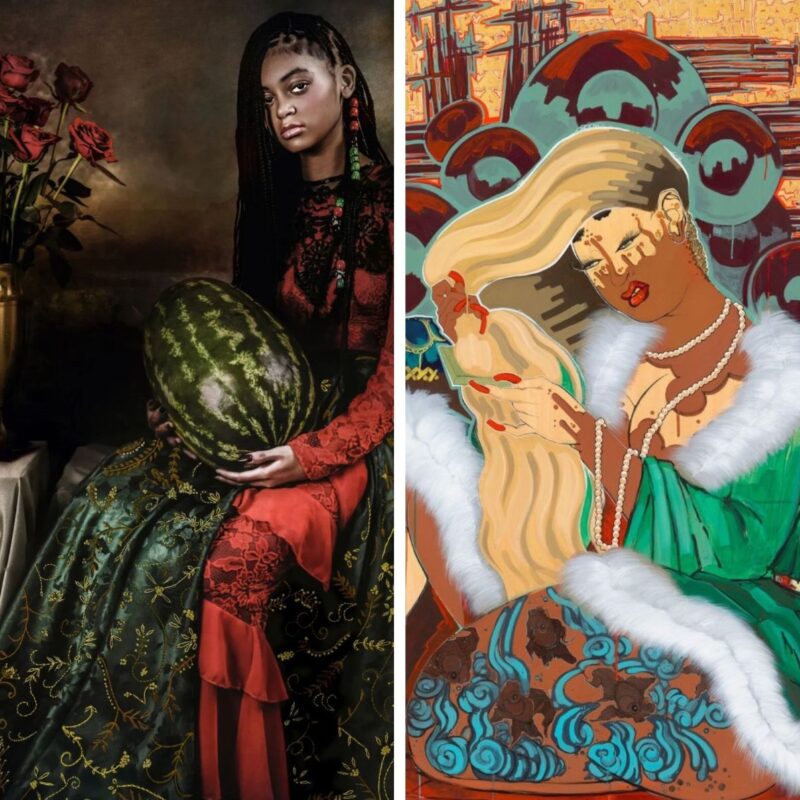
Looking back on 2025, Amy Sherald’s decision to withdraw her survey exhibition American Sublime from the National Portrait Gallery and the show’s subsequent homecoming to the Baltimore Museum of Art will likely be the art headlines that define that wild year in the history books. But portraiture by two other Black women artists from the region is currently on view in the nation’s capital, both in dialogue with art’s historical canon. Tokyo-born, Maryland-based artist Tawny Chatmon and DC native Rozeal. (yes, there is a period at the end of her name) are featured in exhibitions at the National Museum of Women in the Arts and nearby National Gallery of Art, respectively.
Tawny Chatmon: Sanctuaries of Truth, Dissolution of Lies
National Museum of Women in the Arts – October 15, 2025 through March 8, 2026
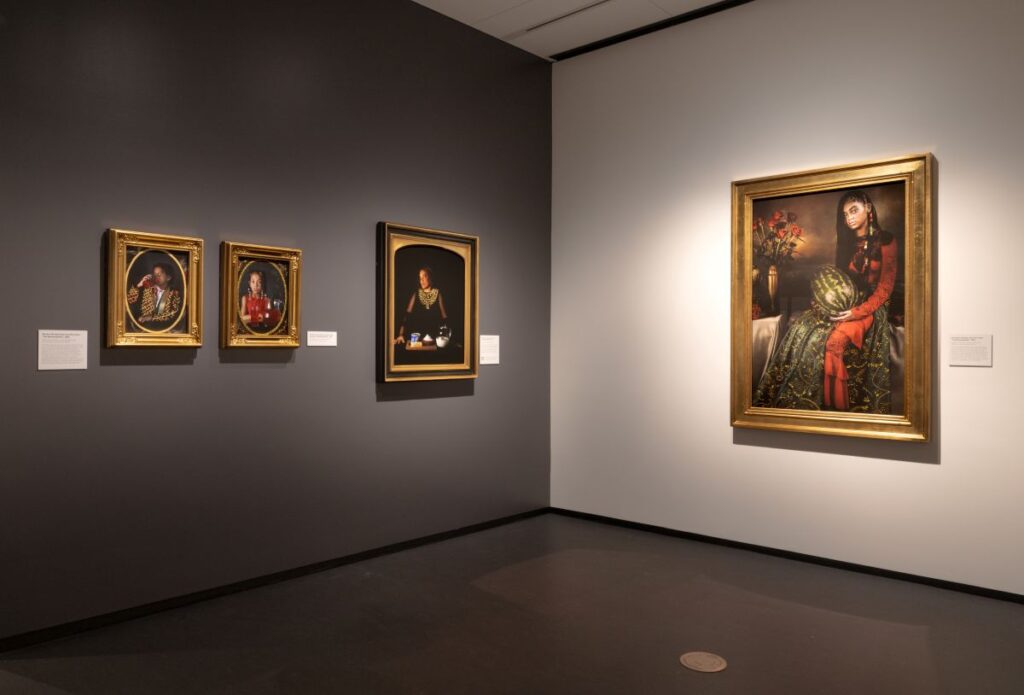
Tawny Chatmon’s aptly titled solo exhibition at the National Museum of Women in the Arts Sanctuaries of Truth, Dissolution of Lies is both visually and conceptually compelling. Photography has long wrestled with the relationship between artist, sitter, content, and process. Chatmon, a self-taught Maryland artist, has established a complex technique that explores these connections—complicating both the assumed “veracity” of the photographic image and reconsidering the medium as something that is crafted rather than indexical.
Historically, photographic portraits were seen as “truthful” revelations of a person’s soul. Simultaneously, they captured a specific time and place. Chatmon builds upon the portrait tradition by creating powerful images of African Americans employing photography (currently a Nikon D850 camera), hand-crafted elements such as costuming, symbolic objects, sets, and decorative framing. She combines sophisticated image making with oft-ornate embellishment of the printed photograph—incorporating gold-leaf, embroidery, collaged fabric, painted motifs, beading, and other media into her portraiture, deliberately referencing Gustav Klimt’s signature decorative portrait style.
Chatmon mostly photographs family members and friends wearing bespoke garments. Her work begins with collaborative relationships with her models, which sometimes include her children (who, she comments, are very clear about their boundaries). The handwork that adorns many of the photographs adds to their complexity. Before the invention of color film processes, color was added by painting directly on the photographic surface. Chatmon’s painterly portraits allude to this history, and she often does apply pigment directly on the surface. Despite art-historical references, her work resonates today.
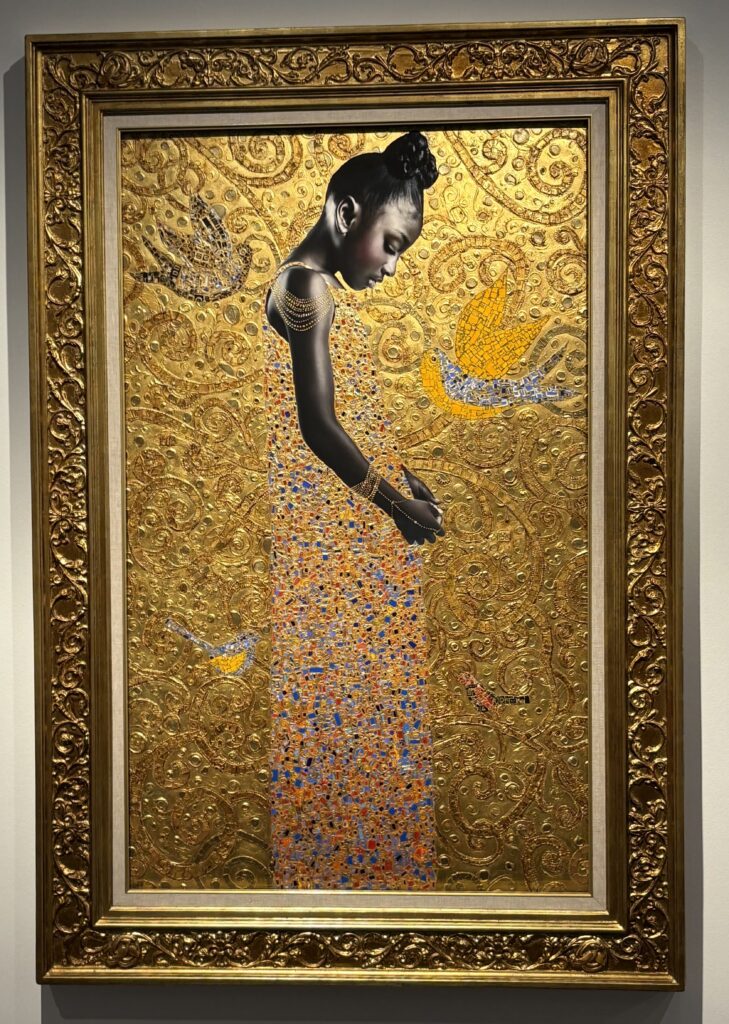
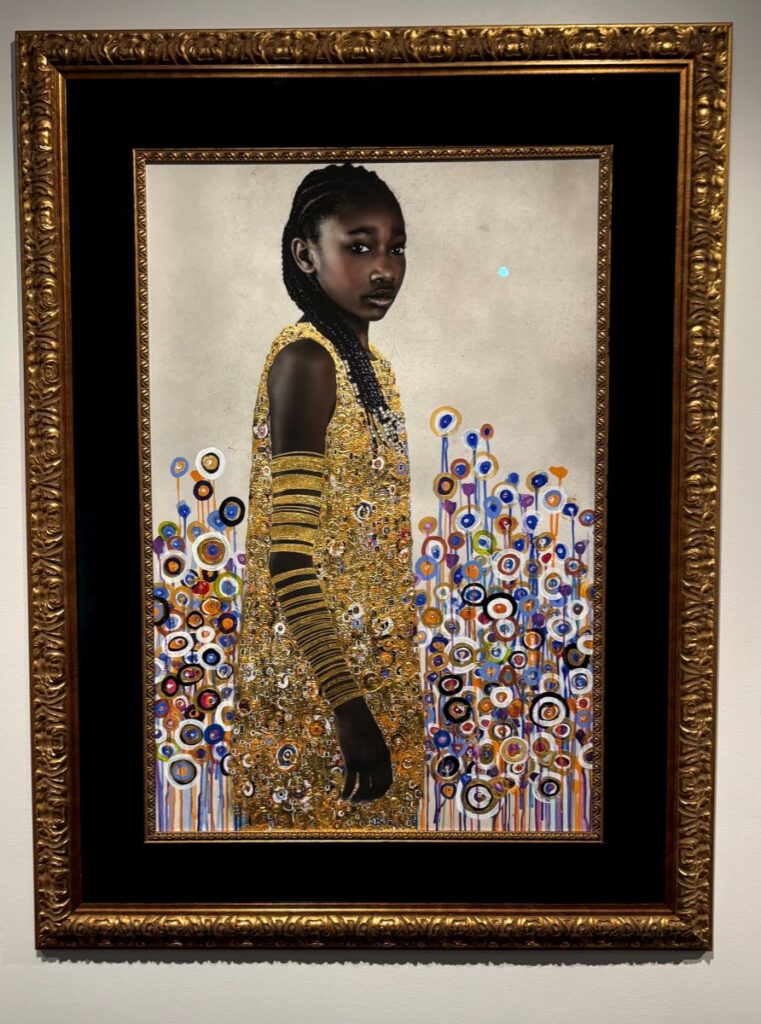
Chatmon became taken with decorative patterning, especially when she saw mosaics and tilework in Venice, Italy. The sitter in “Blossom” (2019)—from her series The Redemption—wears a garment of gold in circular patterns applied with acrylic paint. She stands amidst a field of stylized flowers; their colors correspond with her dress.
“Peace and Joy Are the Birthrights of All Beings” (2021-22) from her series Remnants also demonstrates the value Chatmon places upon visual composition and decorative color, where gold hues and patterning emphasize the richness and worth of the Black body. Here the girl is covered and encased in gold swirling shapes, echoed in the enclosing frame. She appears royal and dignified—someone who should be treated with care and respect. Paramount in these two works is the influence of Austrian artist Gustav Klimt. For both artists, pattern and decorative design are essential elements in elevating figures to an almost supernatural level.
The frames play a significant role in the overall composition of this body of work. Chatmon often designs her own frames, working collaboratively with a master frame builder. Initially, she employed actual gold, as in gold leaf—a material she later turned away from due to her concern over the human costs of gold mining, especially in the Democratic Republic of the Congo (DRC). She now also uses found historical frames adapted into new arrangements and structures, and has sought other materials to replace gold, such as acrylic paint and thickly-sewn, gold-colored embroidery thread.
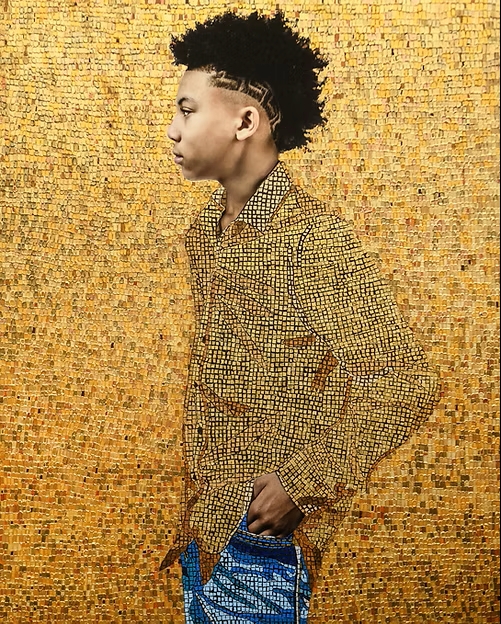
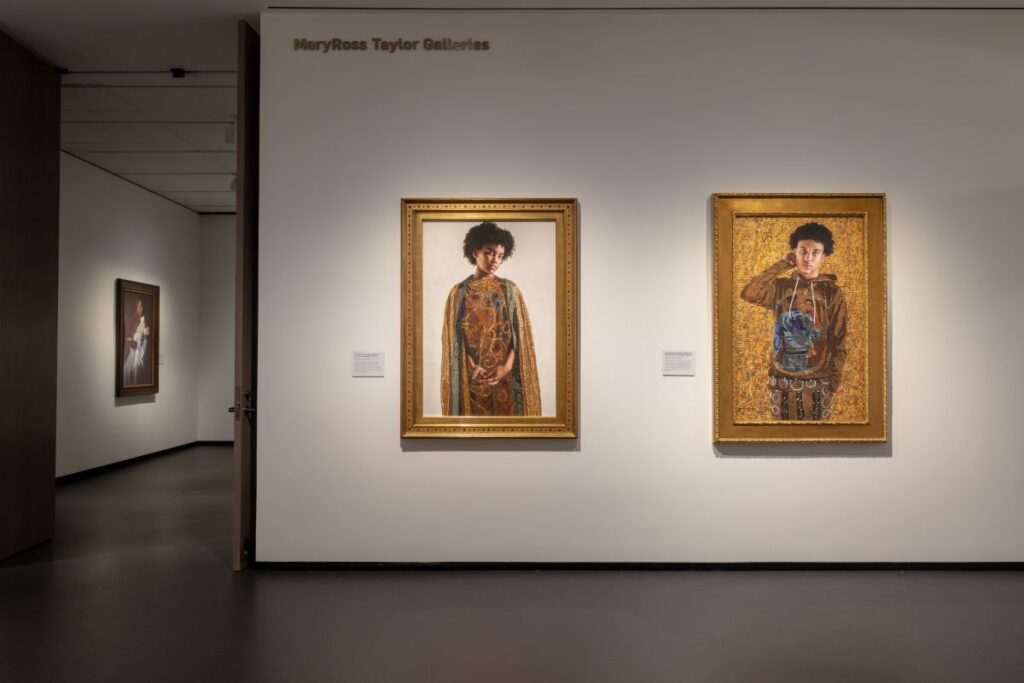
Two images from Chatmon’s Iconography series explore the male figure: In “May His Steps Be Divinely Guided,” (2023-24) a Black boy, maybe a young teenager, turns to the left of the frame, as if looking ahead to a future or place the viewer can’t see. Chatmon still employs gold leaf on the frame, but goes farther here. Collaged with pieces of painted paper, his shirt and the background surrounding him shimmer gold as well. The color of royalty.
In “We are the Ones We’ve Been Waiting For,” denim and acrylic painted paper “tesserae” cover the surface. Here the boy stands in a casual pose, meeting eyes with the viewer. The image on the front of his hoodie is decorated with the tesserae. It pictures a father, in hues of blue, holding a toddler, who, in parallel with the wearer, looks back at us. It appears as a reflection of his past and preciousness in the hold of family.
Don’t Just Read, Belong
Support BmoreArt by becoming a member! Memberships include invitations to private events, subscriptions to our semi-annual print magazine, two tickets to our fabulous launch parties (depending on your membership level), and more.
Join TodayChatmon’s content is directed, in part, toward her own children, letting them know their importance, as well as admonishing the public to recognize the value of all Black children. Images from The Restoration series such as “Honored and Guarded” and “Unstitching the Past, Becoming the Future,” both 2023-2025, juxtapose the vulnerability and simple innocence of childhood as they delve into the oppressions of US history.
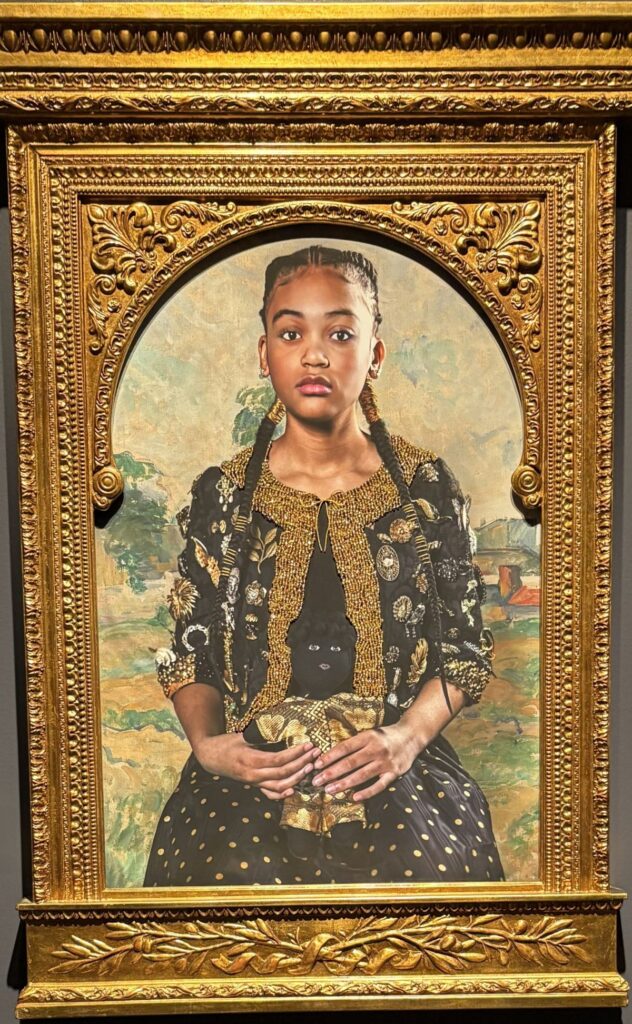
In the first, a restored antique doll rests in her daughter’s hands. Chatmon collects these “mammy” dolls and other types of racist, dehumanizing objects commonly in the possession of white families in the Jim Crow South. She does this in part to remove them from the market. She then remakes them, frequently with her mother helping, to eliminate their racist, exaggerated features and mannerisms.
Here, Chatmon’s daughter regally poses in a highly decorated garment in front of a loosely depicted landscape enclosed by another gold picture frame. The brooches that decorate the jacket were inherited from the artist’s father and grandparents. It is a reframing of historic, painted portraits of the past that presented the children of wealthy white landowners with identifying objects and clothing. Its size as well as the rich picture frame reinforce these associations.
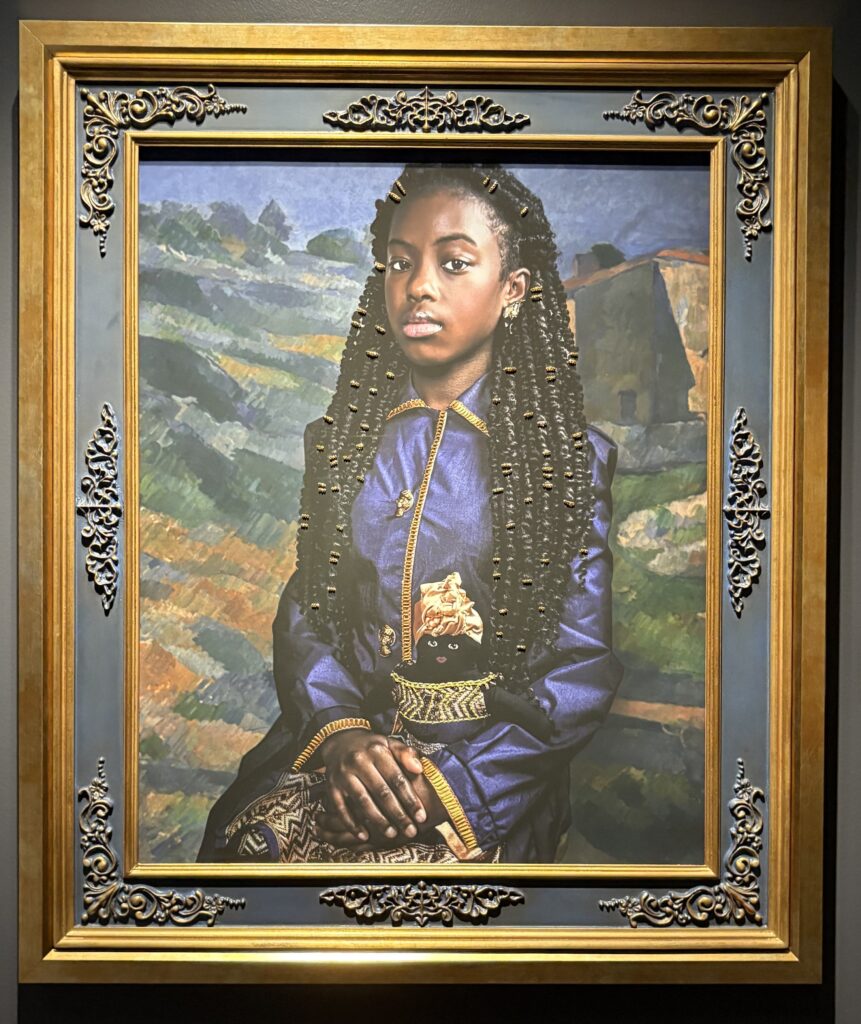
Similarly, “Unstitching the Past” depicts one of Chatmon’s friend’s daughters with a rehabilitated “mammy” doll in a landscape within an architectural frame. Details of the image show the elaborate stitching Chatmon undertakes on many of her photographs. Her process is to attach the photographic print to a substrate and then hand embroider through both materials. It is a tedious task that requires meticulous attention. The juxtaposition between the machine process of photographic replication and hand-crafted stitching contributes to the overall richness of the images. The result is a complex relationship between representative portrait, setting and costume, and actual surface decoration–between the real and the crafted.
In works from The Reconciliation series, Chatmon turns her attention to food and its various roles from bringing families together to signaling history’s charged racial stereotypes. For instance, “Economic Heritage” (2024) evolved out of an experience she had with her youngest daughter when they were shopping together in a grocery store and the artist picked up a watermelon. Her daughter, age 11, declared, “Mommy, that’s racist!” The artist turned that experience into a reclamation by producing a majestic and powerful portrait of her daughter holding a watermelon.
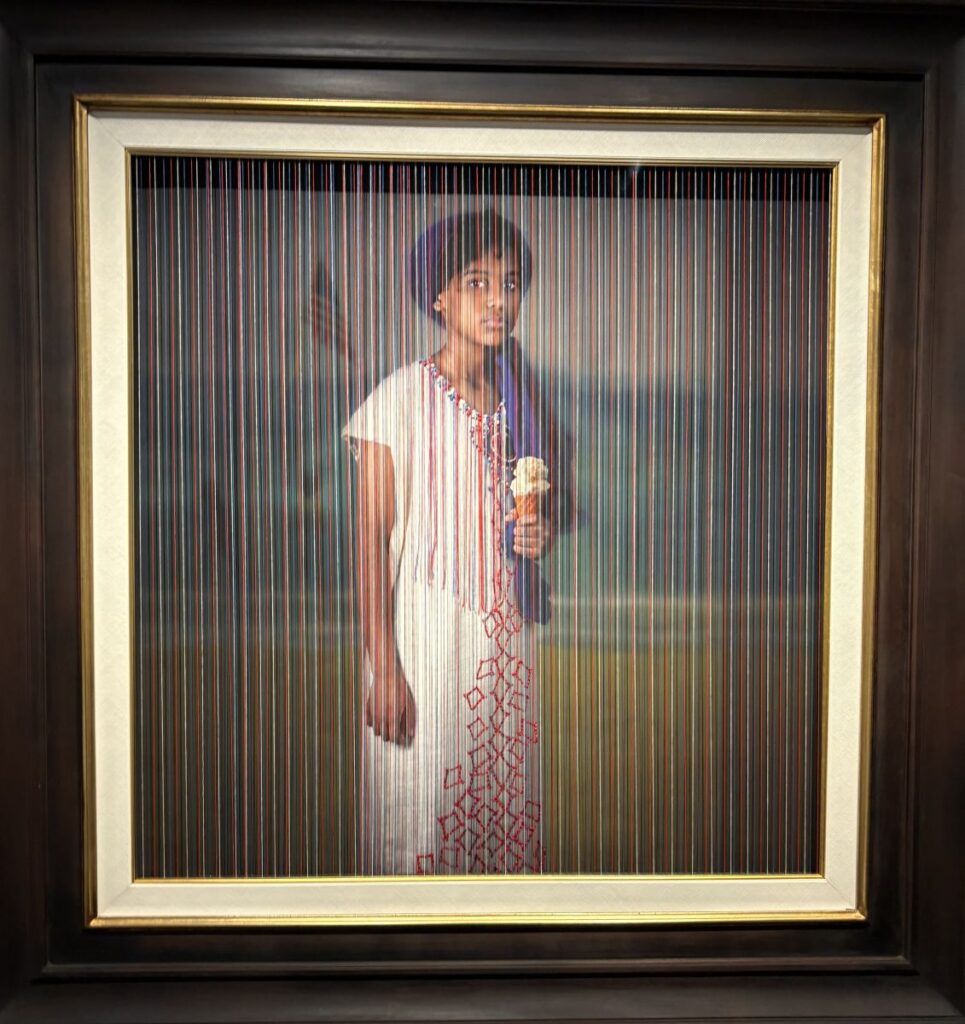
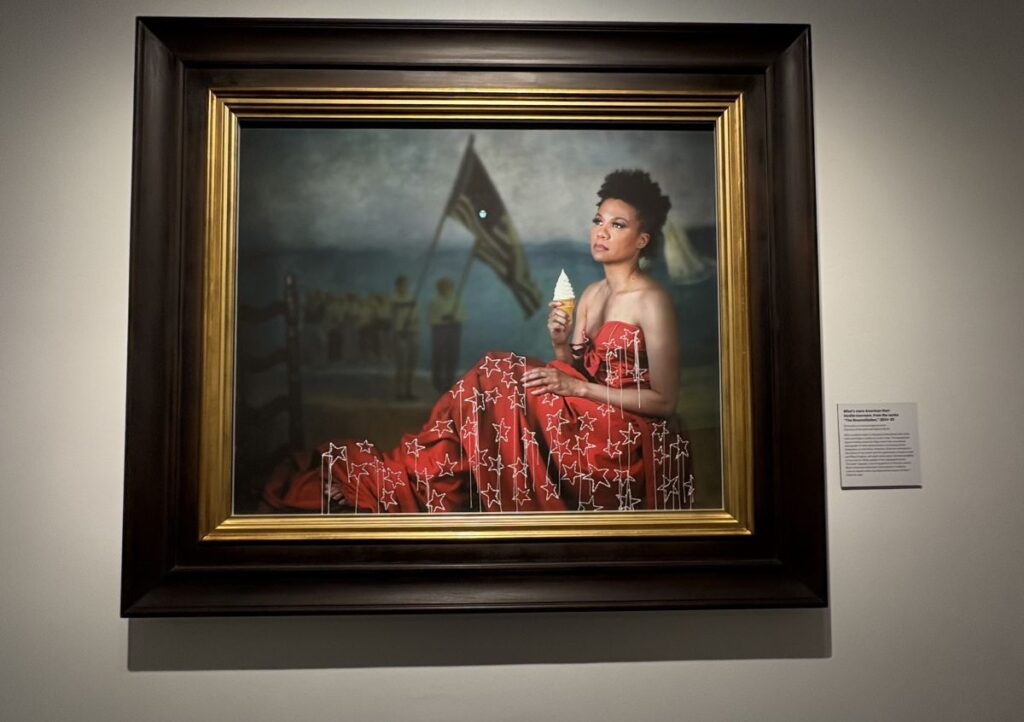
Chatmon comments on two large pieces from the same series, “What’s more American than Vanilla ice cream” and “Truth Soft-Served” (both 2024-25) that “Black Americans have been instrumental in creating cultural staples while also being denied access to them.” She notes that James Hemings, who trained in France while enslaved in the US by Thomas Jefferson, brought an early version of vanilla ice cream back with him to Monticello. Another Black man, Augustus Jackson, who served as a White House chef for 20 years in the early 19th century, established modern methods of ice cream production. Chatmon writes: “Even more ironically, while Black men helped create and refine this American staple, both [the poet] Audre Lorde and the [writer] Maya Angelou wrote about being denied it (during the Jim Crow era).”
Tawny ChatmonThe photo is hand-stitched with white stars onto her gown, symbolizing a nation in the process of unraveling. Where some cling to old ideals, others fight for belonging and equality.
In “What’s more American than Vanilla ice cream” a Black woman in a red gown embroidered with white stars holds a cone of vanilla ice cream. The background is taken from a 1959 archival photograph in the Library of Congress collection of white demonstrators waving flags and protesting school integration in Little Rock, Arkansas. Chatmon explains: “The photo is hand-stitched with white stars onto her gown, symbolizing a nation in the process of unraveling. Where some cling to old ideals, others fight for belonging and equality.”
In “Truth Soft Served,” an American flag unravels in the background while red, white, and blue threads cover the subject’s dress as she too holds a vanilla ice cream cone. Meaning in these two large works emerges in symbolic and literal layers.
There are many more important photographs in this show than can be discussed here. Chatmon’s works, considered together in this retrospective exhibition, provide a narrative of history’s both sorrowful and joyful moments. Her employment of art historical underpinnings in portraiture, as well as her elaborate and labor-intensive processes come together to form a stunning and intense chronicle.
Back and Forth: Rozeal., Titian, Cezanne
National Gallery of Art, West Building – April 26, 2025 through April 26,2026
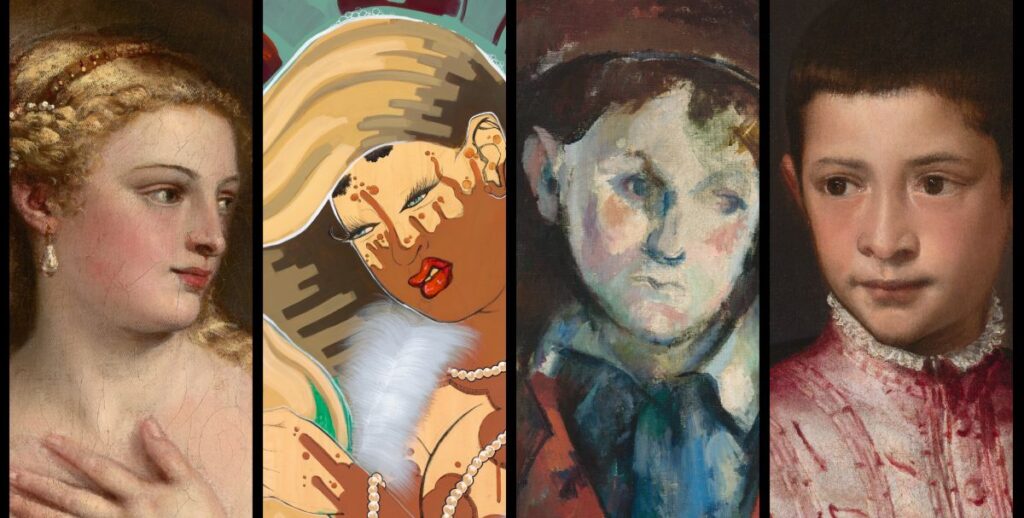
Not far away from the NMWA, at the National Gallery of Art on the Mall, West Building, a small exhibition, Back and Forth: Rozeal., Titian, Cezanne, examines art’s historical relationships by comparing four works from their collection. Rozeal.’s work here “afro.died, T.” (2011), one of two in the museum’s collection, represents the only Black artist in this conversation.
Rozeal. has an interdisciplinary background which includes performance art and work as a DJ, and an extensive art education citing inspiration from hip-hop, popular culture, as well as Japanese cartoons and Ukiyo-e prints from the eighteenth and nineteenth centuries. In her statement for the exhibition, Rozeal. writes, “From my experience studying art, you gravitate not only toward art, but artists, and learn from what you see.” Like Chatmon, she employs multiple media.
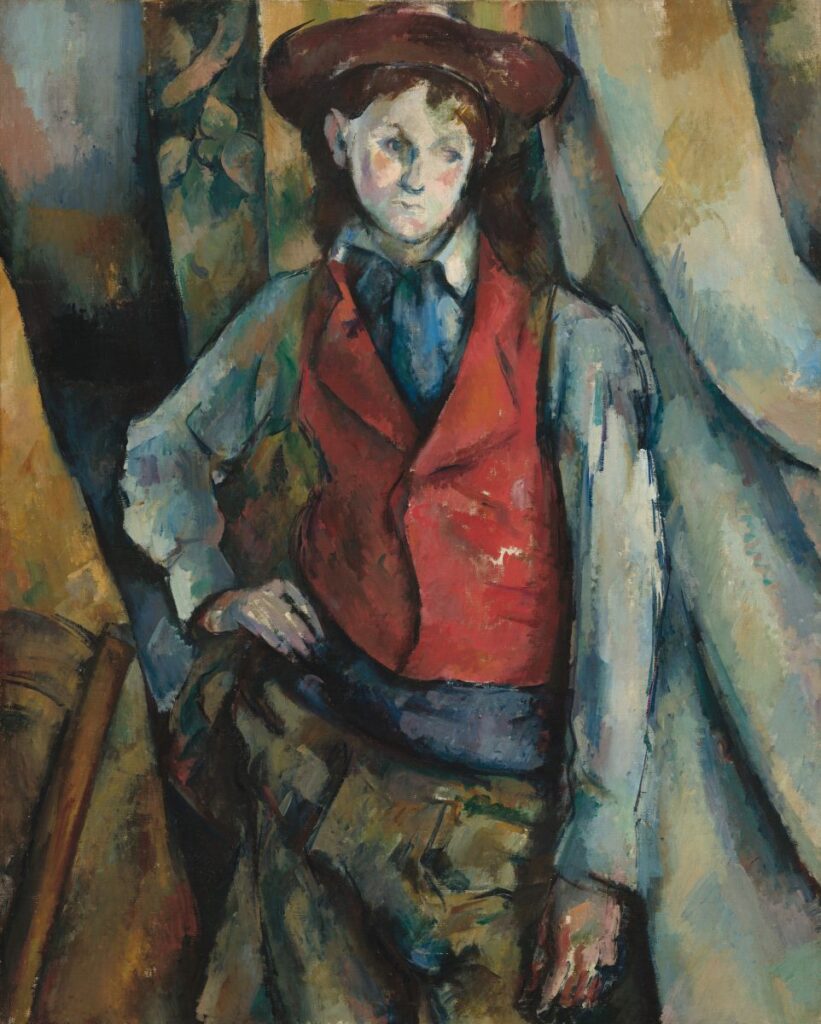
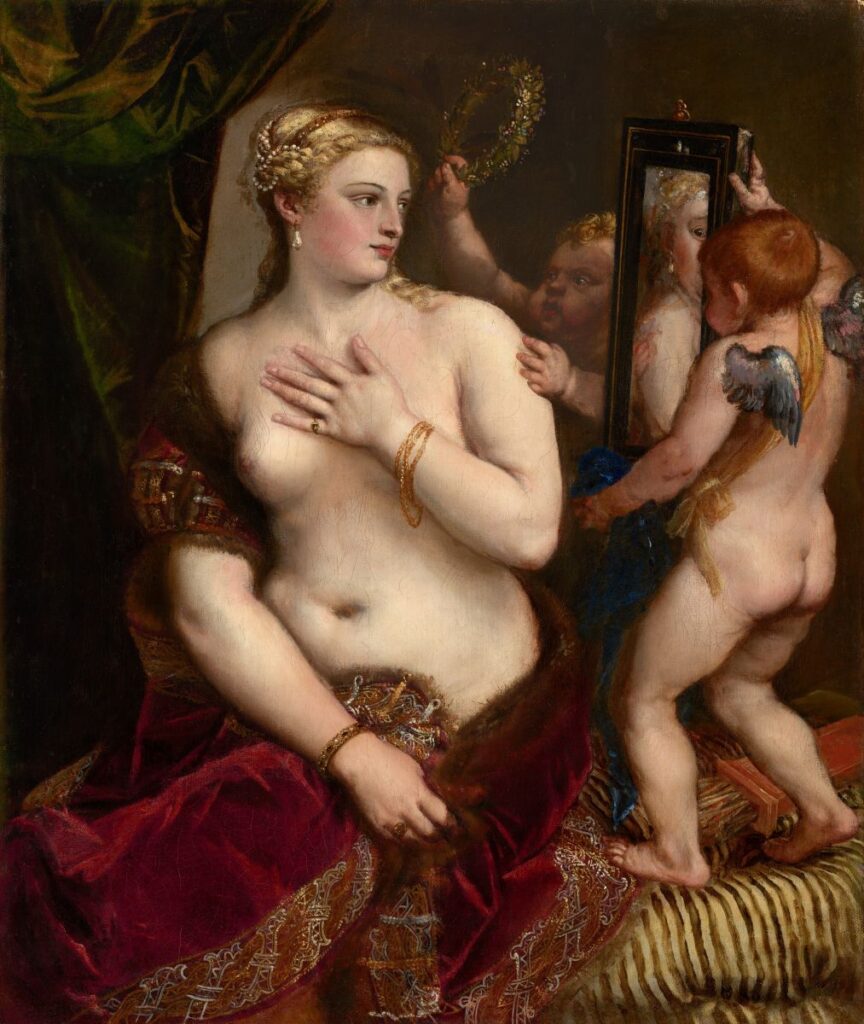
The show is in a smallish rotunda, practically intimate, given the scale of the NGA. The three other paintings are by two artists from the art historical cannon, Cezanne and Titian. The goal of the exhibition is to present unexpected connections between the four works. Two are portraits of male figures (Titian’s “Ranuccio Farnese” and Cezanne’s “Boy in a Red Waistcoat”), while two are images of imagined females depicted in their boudoirs or private chambers (Titian’s “Venus with a Mirror,” and Rozeal.’s, “afro.died, T”). In this grouping, the men are “real” while the women are from the mythological world: the Greco-Roman Goddess of Love and Beauty (known as Venus to the Romans, Aphrodite to the Grecians).
There are four didactic panels designed as different sides of an obelisk-like structure centered under the dome titled: Subject, Pose, Space, and Gaze.
Each provides important and necessary interpretive context for the exhibition. Subject compares Titian’s two paintings, the “Ranuccio Farnese” with “Venus with a Mirror,” contrasting portraiture with allegory. Pose compares Cezanne’s “Boy in Red Waistcoat” with Titian’s “Ranuccio Farnese,” examining the role that contrapposto plays in both compositions. Space discusses the two backgrounds for the figures in Cezanne’s “Boy in Red Waistcoat” and Rozeal.’s, “afro.died, T.” Gaze contrasts Titian’s Venus with Rozeal.’s Aphrodite.
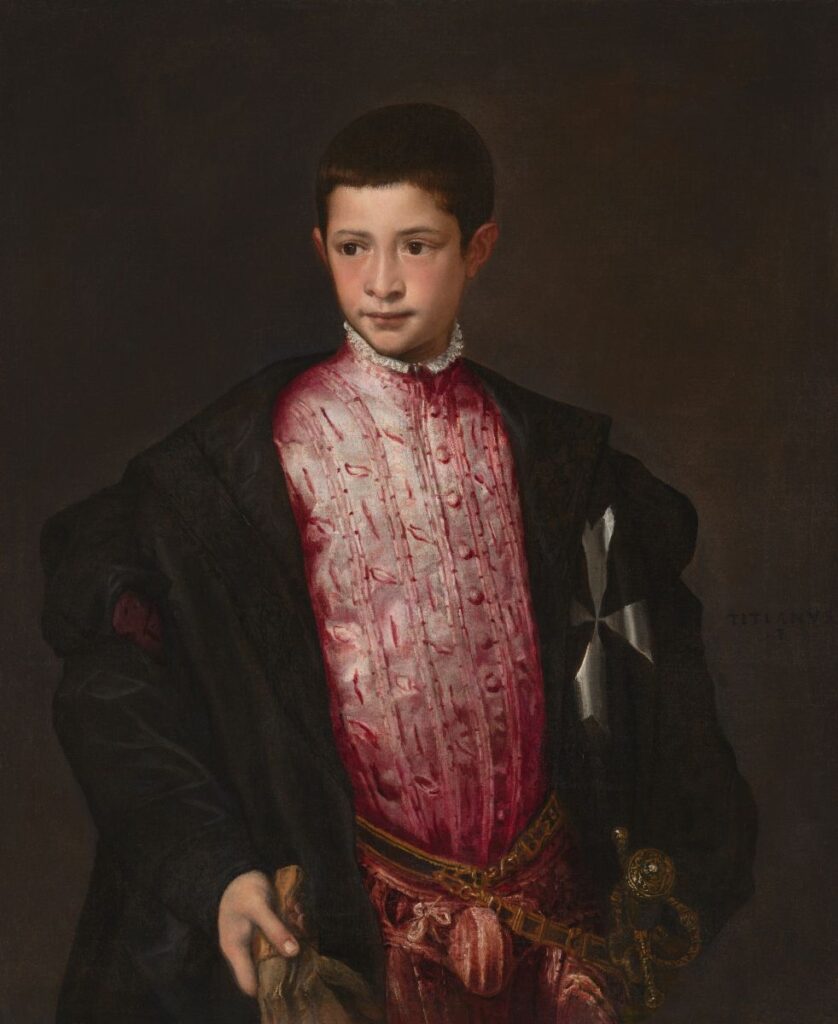
Gaze is a generalized term that was originally coined as a psychological premise for active seeing, but by 1975, it evolved more specifically into “the male gaze” as identified by film critic Laura Mulvey. The museum points out that we as contemporary viewers are free to stare at the women. While Titian’s very fair and nude Venus, gazing at her own reflection in a mirror held by a putto (cupid), was specifically intended for male eyes, it also becomes a double-gaze composition. It would be easy to conclude that the Renaissance was a different time, but there are many images for male gazing today too.
Quite differently, Rozeal.’s “afro.died, T” is a contemporary woman (goddess) in charge of her surroundings. Her brown skin seeps up into the white of her forehead and drips down her body onto her leg. She sports long, light colored hair that is dark at the roots, which she holds onto with her extravagant red nails. Rozeal.’s interest in Asian art, particularly in the Edo period, which took as their subjects the theater and courtesan quarters of Edo (modern Tokyo) is indicated through the figure’s facial features and dress as well as the flatness of much of the composition.
Susan IsaacsRozeal.’s “afro.died, T” is a contemporary woman (goddess) in charge of her surroundings. Her brown skin seeps up into the white of her forehead and drips down her body onto her leg.
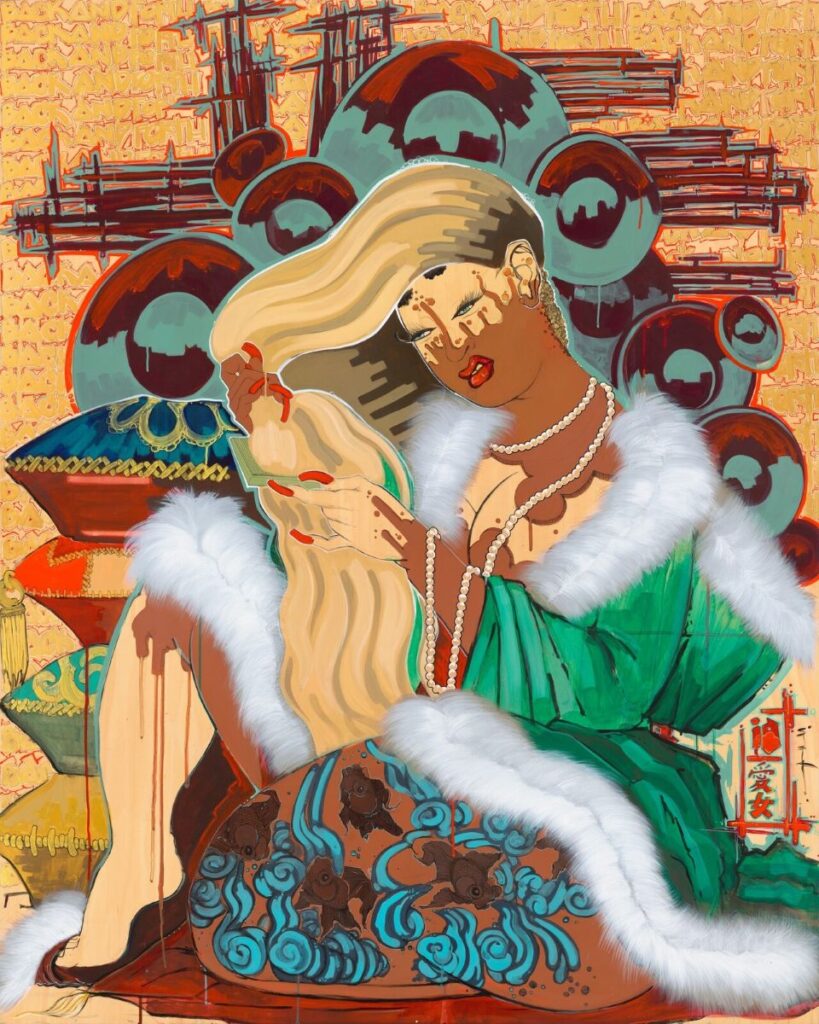
Also apparent is the artist’s background in DJing. “BACK AND FORTH”, lyrics from Willow Smith’s song “Whip My Hair”, appear in repetition as if graffitied on the wall behind subwoofer discs. The goddess wears an extravagant fur-lined green robe and rests on a tower of pillows. Rozeal. is a skillful painter who combines her art historical knowledge with her broad interests. In the company of art’s exclusive forefathers, even without an elaborate gold frame, Rozeal.’s painting stands its ground.