Within Reach of Silence, Temi Edun’s show at Gallery Blue Door offers an invitation to those who might come with various hungers: for a wash of stillness, or an encounter with color worked into mottled and oblique layers, vivid portals into the interior life of figures who are animated by their own inner sources of fire and earth and black light.
The walls are weighted with their faces and postures. Lounging, dreadlocked men, their heads turned heart-ward, dole out tenderness and mystery (see “Red Feldspar” and “A Matter of Inches”) even as their anatomical features recede into the canvas or into a lack of definition, offering visions of masculinity that go against the social grain.
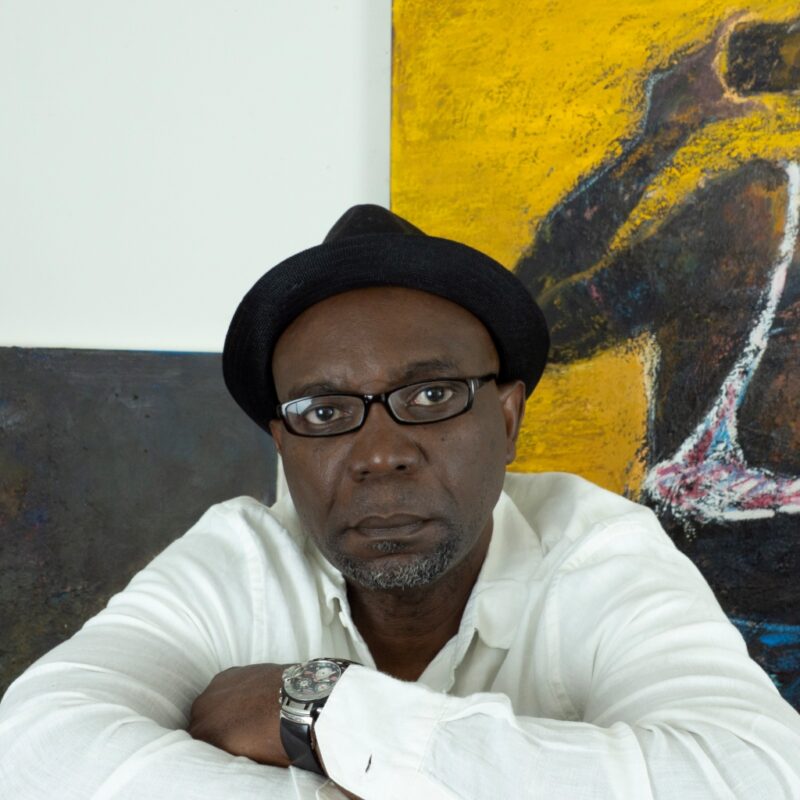
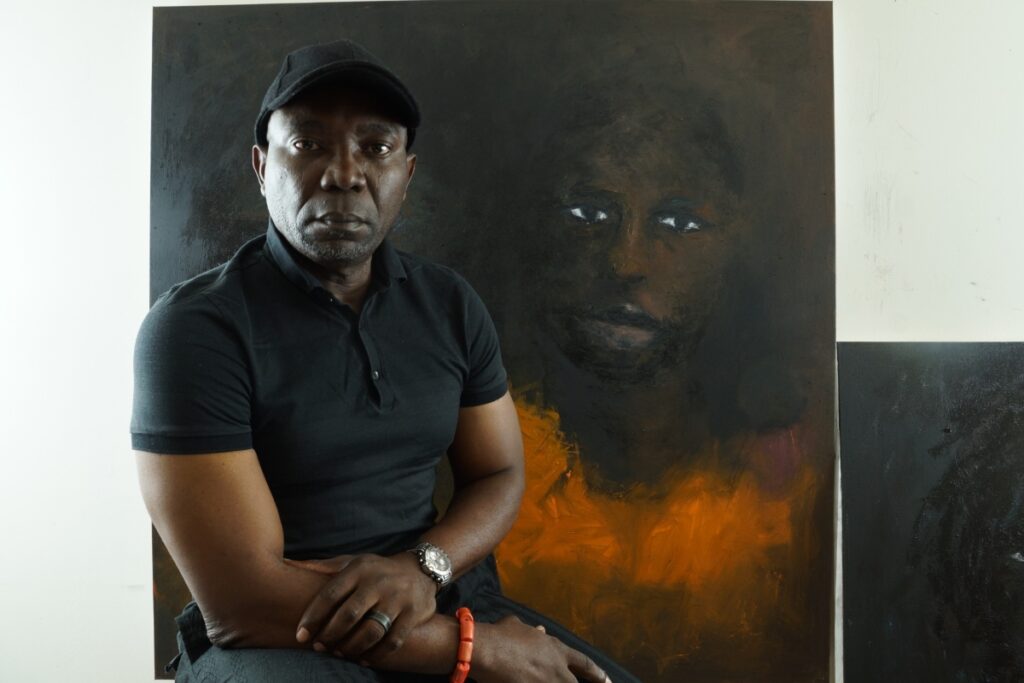
Edun is a figurative artist based in Columbia Maryland, born in Ibadan, Nigeria. His work calls for looking slowly. Find the song in the sonorous tactility of “The Moth,” a brilliant study in movement and contemplative stillness; discern the slips of pink beneath the white surface in “The Grammar of Sitting.” The images are not portraits or character studies, they pulse with material density, gathering volume and light for meanings to emerge, but within the container and reach of silence.
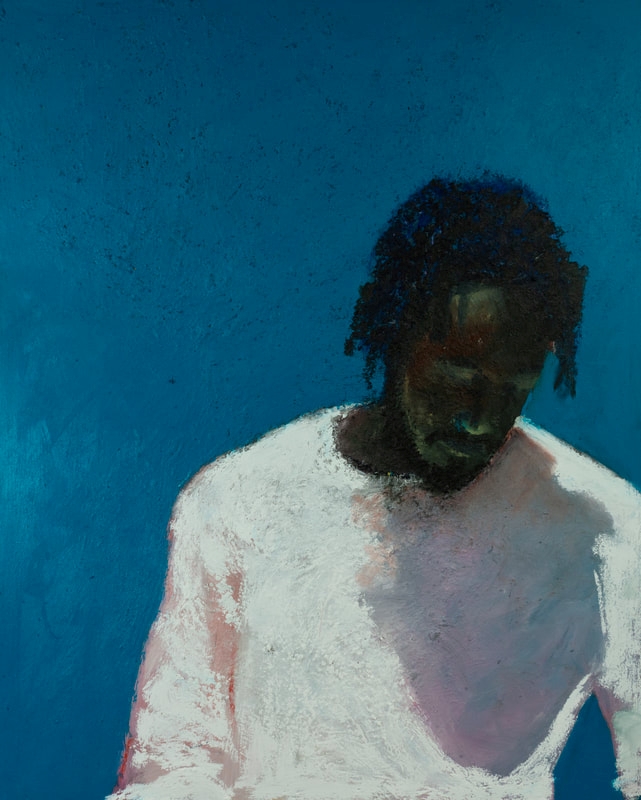
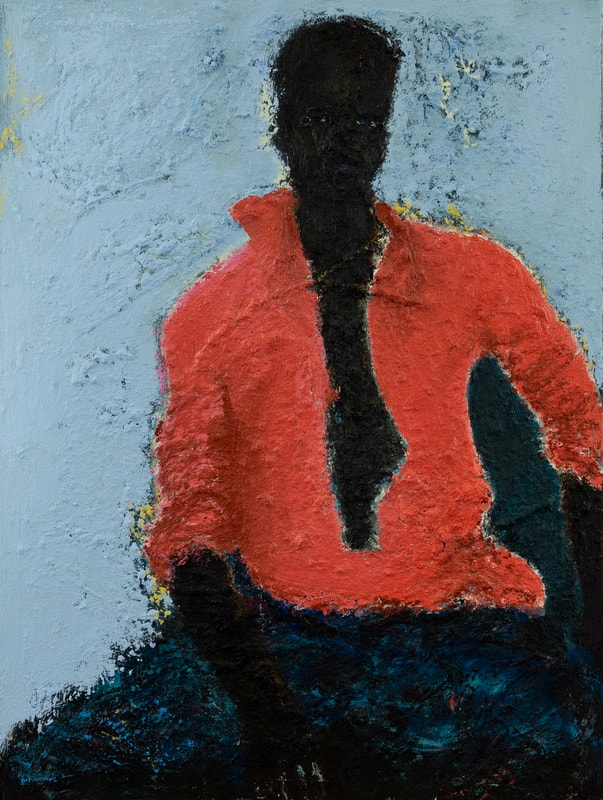
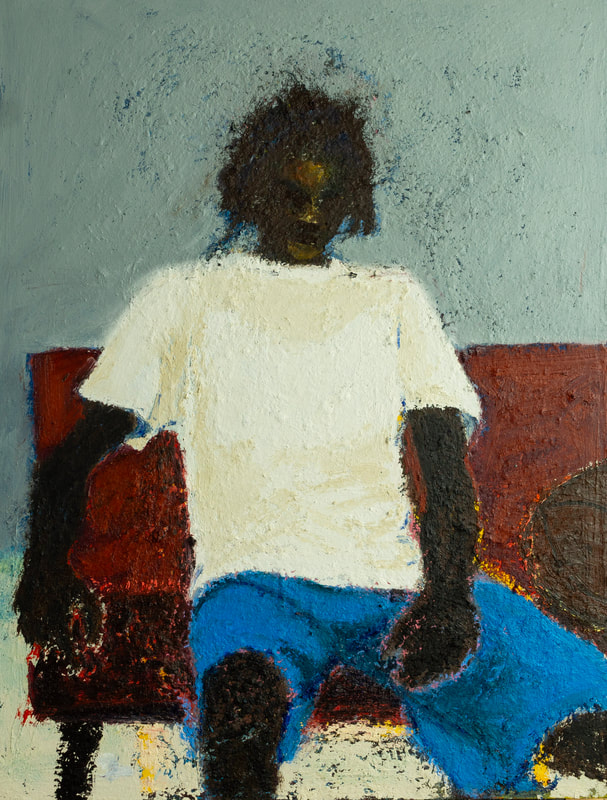
I started my conversation with Edun on this topic of silence.
Why silence?
On the surface, the time that we’re in is noisy. You can’t recede from it. For me silence is way more than the lack of noise. Silence is actually a structural part of the process of creating my work. I’m looking at silence as compositional restraint. What do I mean by that? It has to do with details I leave out. They are part of the structure that I use in creating the pieces. Second, as a psychological architecture. The way to express the narrative of most figurative work is with gesture that suggests what is going on. If you don’t have that articulation to help the viewer negotiate the work, the viewer has to spend time exploring its intricacies. Third, I use silence as a resistance to legibility. So, a lack of obvious information creates a tendency to stay and assimilate the work over time.
Finally, silence organizes the viewers’ attention. Lack of detail is what I call silence as a structural part of creating my compositions. For the last couple of years, that’s the main thing I’ve been trying to explore with my work.
One of the reasons this is fascinating to me is what it says politically. When you think about black figuration and black presence, there’s always an emphasis on gesture, as a kind of intervention into the political sphere. But what you’re saying is to refrain from gesture.
To withhold, yes. There are a lot of ideas behind this. The work of James Baldwin is very influential in my work. His book of poems crystalized an idea that, as Black people we don’t owe anybody the reasons, we don’t have to articulate, why we should be. We are. You don’t have to explain. Coming into this culture, I find that you seem to always have to explain yourself, especially in white spaces. As a human imbued with dignity, I don’t have to explain myself to anybody, it’s my prerogative. Another writer who says this even more clearly is this writer from the Caribbean.
Aime Cesaire?
Yes! He crystalizes what James Baldwin is saying. We don’t have to explain ourselves. A couple of years ago, I asked myself how do I articulate this in my work as a painter? For me, my figures do not, just like me as a Black man—I don’t have to explain myself. I don’t have to have a reason for being here. If you want to know me, spend time.
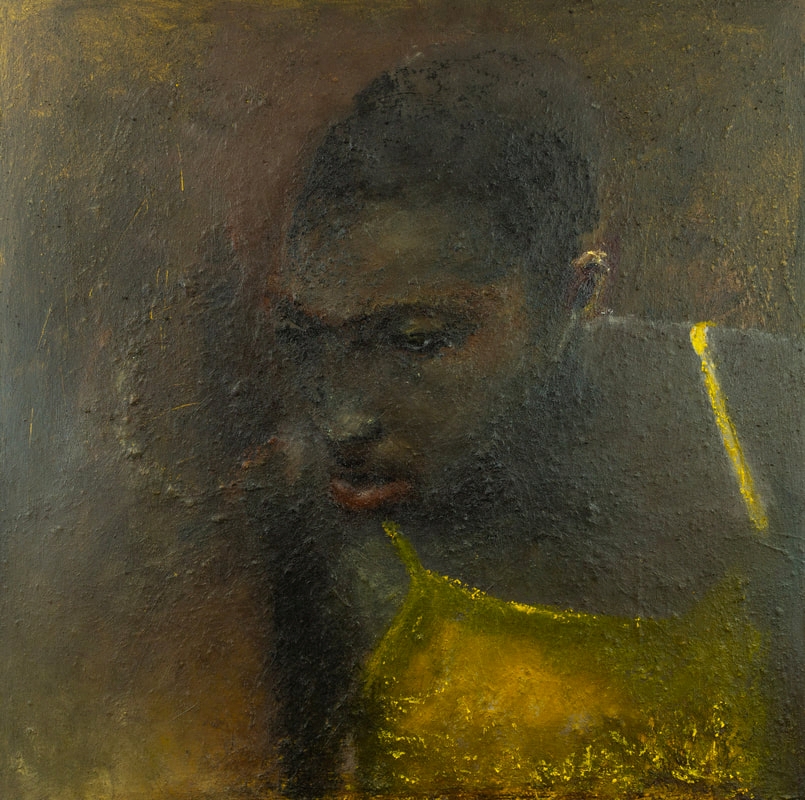
Temi EdunEvery artist has something they have to say. At this moment, my language and what I’m striving to get across is the right to be, without excuses, I don’t have to give an excuse for being.
Tell me about the resistance to portraiture?
Traditionally, portraiture is trying to capture, trying to represent somebody. I’m not painting any specific person. I’m actually painting the essence of a person. My figures are Black people because that is who I know. I paint figures to speak to issues that need to be addressed. Every artist has something they have to say. At this moment, my language and what I’m striving to get across is the right to be, without excuses, I don’t have to give an excuse for being. That’s the gist of it.
What are the artistic influences in your work?
There are three. My original influence was Ben Enwonwu, the reason I went to college to study fine art. He was called the original African modernist. I can see some elements of his work in what I do. And then through college and developing as an artist, I would say Alberto Giacometti. A more recent influence would be Nathaniel Olivera, whose work deals with existentialism. He was part of the California Bay area artists. He tended to do single figure compositions in austere nonrepresentational backgrounds.
I’m curious about the African influences particularly in relation to silence, in the resistance to explaining oneself. What’s the link between being an immigrant and your aesthetics?
I do a lot of heads. The head is very prominent. The stylization of the head comes from Yoruba sculptures and Yoruba art. In Yoruba cosmology, the ori (the head), embodies what in Christianity we would call the soul. That is where everything resides. That is my direct link. It’s something I consciously strive to do—the focus on the head.
And in terms of not having to explain myself: growing up in Nigeria, there are things you take for granted. You don’t have to explain yourself. For instance, when you invest in something and you don’t really get what you expect out of your investment, you tend not to investigate your adequacy.
I came to this country in my 20’s and up to my 40’s, as an artist, and for a long time, when I would get into a space I wasn’t expected to be in, there was always the pressure to explain where you’re coming from and why you are. I don’t feel the need to explain myself anymore, but everybody has the right and it’s a good thing to have some element of concealment. If you want to share, that’s up to you.
The more mature you are, some of the things you conceal are part of your dignity. Nobody should go about naked. That’s what I’m trying to let people see and grapple with, that ability to conceal yourself. And if anyone wants to know more, they need to spend time and learn and earn the right to know.
This resonates with an aspect of African aesthetics where concealment and revelation are always a part of art.
Because African art is more than just something to look at and admire. It’s spiritual. There’s always a mystery to it. The value is in the mystery. The more time you spend, the more you learn, the more you can know. That’s the point of the Ori, the Yoruba way of looking at life. It’s a slow process; there’s a patience to knowing.
How comfortable are you with this articulation, my highlighting the Yoruba aesthetics? Can it feel like pigeon-holing your work into a particular kind of discourse?
I’m good with that, because there is a connection. It’s actually part of what I’m working with. It’s a vehicle that carries me forward. Without that, I wouldn’t have had a fundamental basis. I think art has to be rooted in something for it to be vital. It’s only natural. I grew up in that culture. I went to school at the University of Benin in Benin city, which is traditionally rooted in Beninois art. That art is intrinsic to my evolution as an artist. It was part of my training. Is it everything in my art today, of course not. But it is part of the vehicle in which I ride at the moment and where I’m trying to go. The nature of the silence and the structure is derived from Yoruba art and the Yoruba way of thinking.
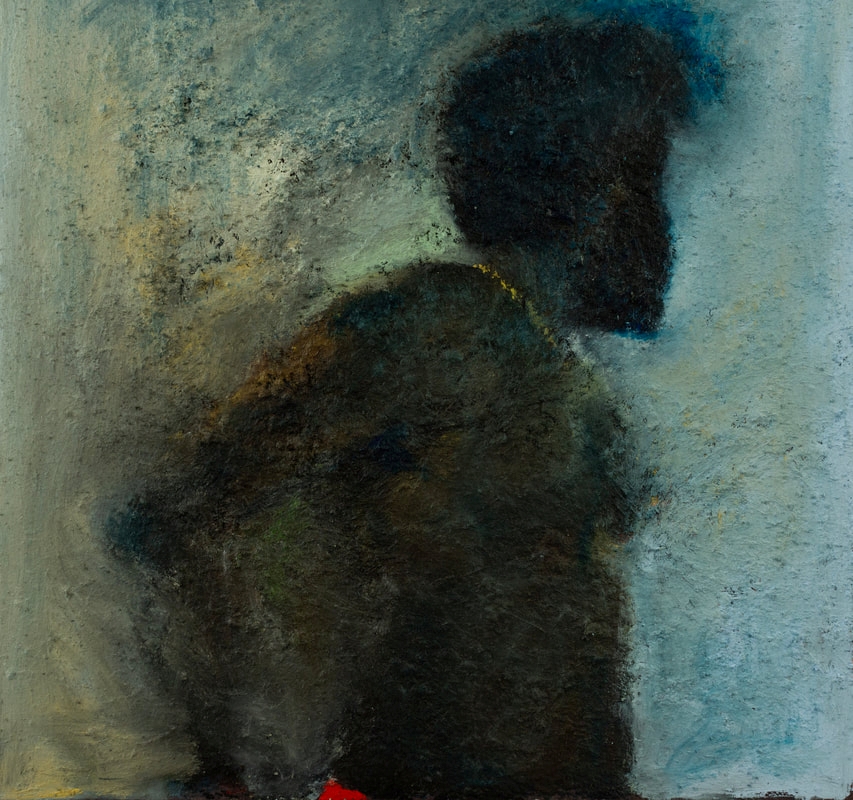
Temi EdunI found over the years that distortion is what pulls you into figure. At the beginning it’s more realistic. Then I start to remove. That’s how the silence is a structural part, to distill it down to images that capture the essence.
Even though you’re painting figures, there’s an abstraction there.
The stylization itself is abstraction. There is no desire to represent an actual person. I find that what I’m trying to achieve gets compromised if there’s photorealism. In and of itself that is okay. People who do that have amazing technique. But the more spiritual and psychological aspect is what I’m striving to attune my view with; a realistic depiction removes the spirituality of what I’m trying to do.
And again, from my influences, they distorted the human form, I found over the years that distortion is what pulls you into figure. At the beginning it’s more realistic. Then I start to remove. That’s how the silence is a structural part, to distill it down to images that capture the essence. I’m attuned to the abstraction of it, and it’s part of the technology of how I build my composition. I remember telling some friends of mine that I marvel and I’m in awe of how they’re able to visualize the canvas without representational elements. My mind does not work like that.
I find your work sculptural, in another nod to African art, in that you’re removing, not adding.
Yes, interestingly, at the university of Benin, my degree was in sculpture. When I came to the states, I had an apartment in DC. Creating sculpture was a challenge. I was doing bronzes back home in Nigeria. And I didn’t have the resources to do that. For my very first adventure I created clay sculptures I wanted to cast into bronze, and went to a bronze caster in DC who called my work primitive. It was so disappointing. That’s how I started painting. And I stopped doing art for a while. I had a family and kids. All the time I was not making art though, there was a big gaping hole in my life. I was so unfulfilled.
What a poignant story. It shows how racism silences. It’s another meaning of silence, isn’t it, of racism and oppression and repression. Then there’s the meaning of silence that is a pregnant presence, what your work is trying to capture and explore.
The societal and cultural baggage that wants you to explain who you are and why you are.
Are there current artists you are paying attention to?
Yes, Amy Sherald, Amoako Boafo from Ghana based in Ghana and Austin, his work is sublime, it’s just incredible. Also Lynette Yiadom-Boakye.
I feel a resonance there with your work!
I get that a lot. The interesting thing is, I became aware of Yiadom-Boakye’s work during the pandemic. I had never heard or seen her before. And I’ve been developing what I’m doing now since 2016 when I started painting again. Yes, I can see the synergy there. There’s a fluidity to her work that I love.
What is your studio like, how would you talk about your workspace?
My workspace is the basement in my home. I have sketches of faces everywhere, my easels, a ton of oil pigment sticks, and my cameras. It’s where I draw and sketch.
What do you do with the camera?
I take photos at different stages. After I produce them, I load them on my computer where I do a lot of my analysis. In school we did not have cameras, we stood back, took some distance. I see areas that I don’t want on the canvas and there are elements that I’m looking for. I have this one professor of sculpture whose voice is always echoing in head. He always talked about balance. I think that is why my work has some texture to it. I work like I’m sculpting with my hands. Not that everything has to be aligned geometrically, but there has to be visual symmetry. There’s a compositional logic.
Do you think you will go back to sculpture?
I dabble with it from time to time. I have clay at the house. One day I might do a show that has some sculpture. That’s a dream.
Within Reach of Silence by Temi Edun is on view at Gallery Blue Door January 17th, 2026 – April 18th, 2026.