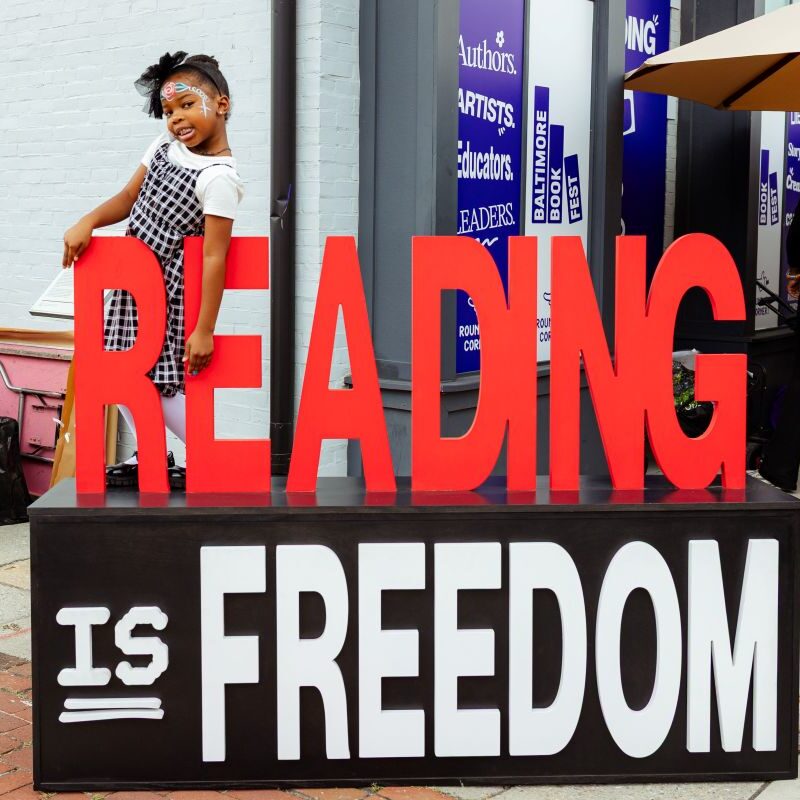
When I saw the theme Reading is Freedom for a cultural activation brought to life by Derrick Adams’ Charm City Cultural Cultivation (CCCC) as part of the Baltimore Book Festival, I’ll admit—as a longtime festivalgoer, participant, and scorned Black woman in America—I was skeptical. Was freedom really the right word for this activation? With countless human rights and basic liberties lost in our country’s recent years, how much possibility can reading really hold?
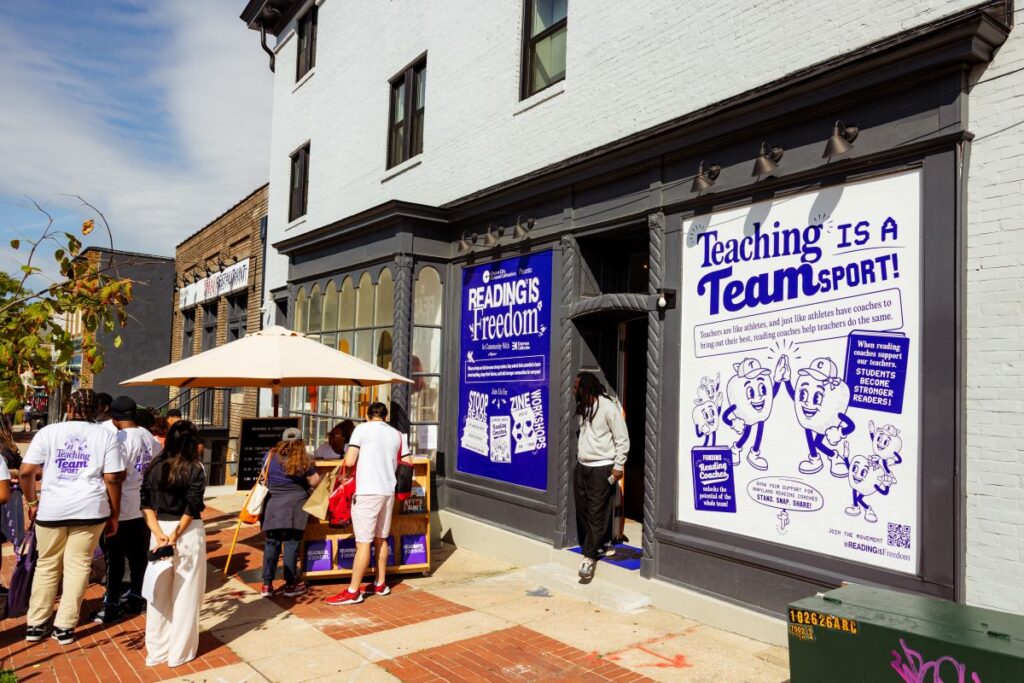
Reading is Freedom took place on September 19 and 20, 2026 at the historical Waverly Hall aka CCCC HQ “in community with” Emerson Collective and The Baltimore Book Festival as an addition to the over eight stages during the broader festival. Ahead of the event, I asked a slew of Baltimore’s literary, arts, and civic leaders what freedom in the context of reading actually means to them.
Adams didn’t hesitate on the matter. He told me that he’d first seen Reading is Freedom as an activation at the Roots Picnic in Philadelphia and thought it might be “impressive” to bring the concept to Baltimore.
“When you think about just the idea of accessibility, being able to excel in the society that we live in, literacy is one of the key objectives that will help elevate most people’s condition, either economically or just intellectually,” Adams said. “Reading is something that I believe is very joyous, and something that you can do for fun.”
Derrick AdamsFor me, reading has always been a beautiful escape. And I think that yes, we’re challenged with really reinventing reading for the younger generation, to keep that interest, because everything is so distracting.”
Growing up reading often, Adams told me he’d often go to the library and buy books at the public library sale in Park Heights during elementary and middle school. “For me, reading has always been a beautiful escape,” Adams explained. “And I think that yes, we’re challenged with really reinventing reading for the younger generation, to keep that interest, because everything is so distracting.”
The West Baltimore native explained that he and his team at CCCC are working together to find ways of building community around reading. He’s hoping the Reading is Freedom activation will be the beginning of something larger, though he didn’t say exactly what shape that takes yet. “I do feel like with more knowledge and understanding from the written word, and perspectives from different writers around the world, will only build a broader understanding of oneself and also other cultures,” Adams said.
On the question of freedom and whether it might be found in the books we ignore for our phones, I also consulted New York Times bestselling author D. Watkins. “When I was a kid growing up, there were a few neighborhoods that I really locked in with, and if it wasn’t for them, I wouldn’t even think about having a conversation with you, about your perspective, who you were, or what mattered to you,” Watkins said. “That was a form of prison. I was locked up because of my own thoughts, and my inability to think outside of the reality that I was living in.”
“So when I became a reader, when I became a person that loved words, when I became a person that did the mental labor needed to develop as a critical thinker, I was free in a way I couldn’t imagine,” he continued. “That freedom is being able to think outside whatever situation you’re in, to dream bigger, to try new things, to think your way through. Reading brings a kind of peace and clarity that is just transformative.”
D. WatkinsWhen I became a reader, when I became a person that loved words, when I became a person that did the mental labor needed to develop as a critical thinker, I was free in a way I couldn’t imagine.
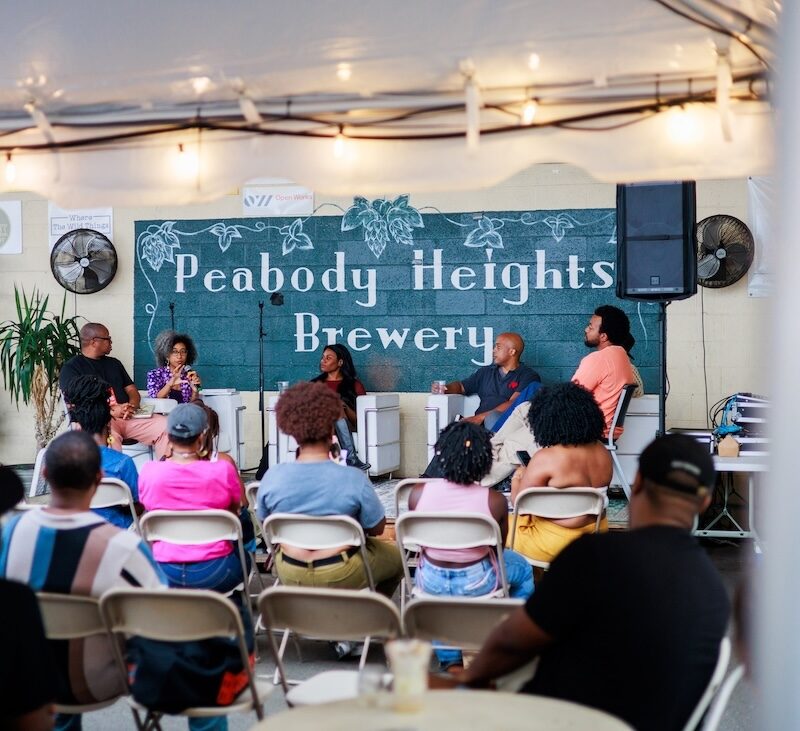
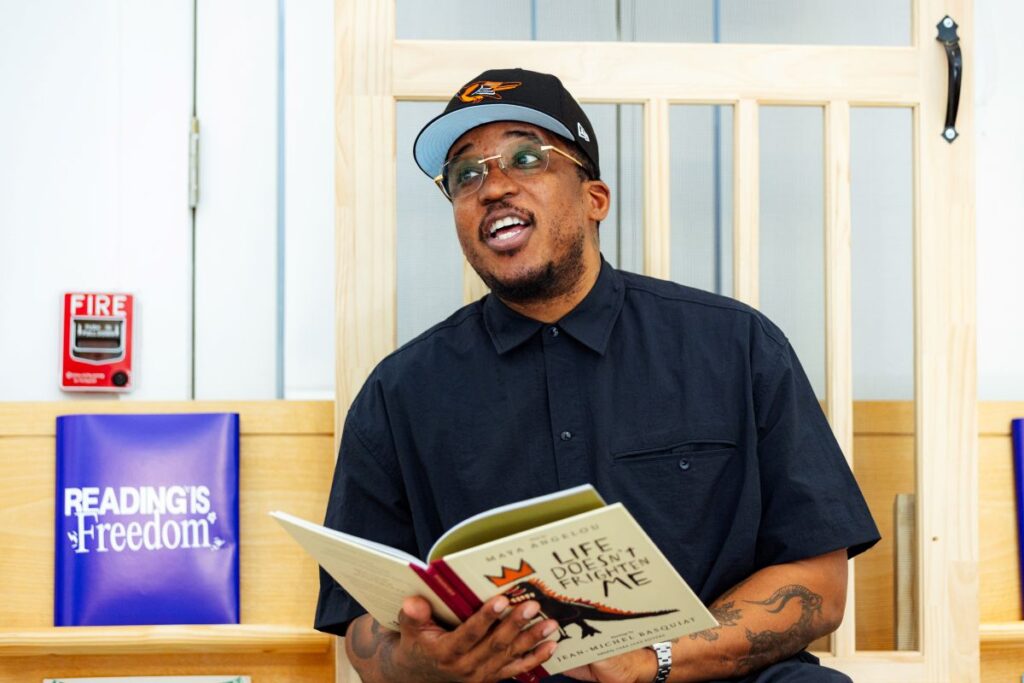
D. Watkins was tapped by CCCC and Emerson as one of a handful of “hometown heroes” and to be a reader for the Reading is Freedom stoop-reads activation and installation at the CCCC HQ, alongside his literary peers like author Lawrence Burney who led a teen zine workshop on Saturday. Both authors were on other panels for the Baltimore Book Festival as well. I spoke with Burney, whose book No Sense in Wishing is the 2026 One Maryland One Book selection, via text voice memos ahead of the festival weekend.
“There’s different levels of freedom that can be achieved from reading, but I do think that even just on a personal level, there is a sense of freedom when you gain more knowledge, or perspective, on how to think about a story,” Burney said. “For me as a writer, I think reading is framed for me not just because I obtain new information, but I get to observe how to craft information for an audience. When I read something about a topic I’m not super familiar with, I always come away from that feeling extremely encouraged to just dig deep.”
Burney, who is working on his second book, Sing Back to Me, takes pride in being a reader and a writer from Baltimore. Baltimore is a city he says is “distinctive” for its layout and its perspectives, a place that shapes how people see the world and tell its stories.
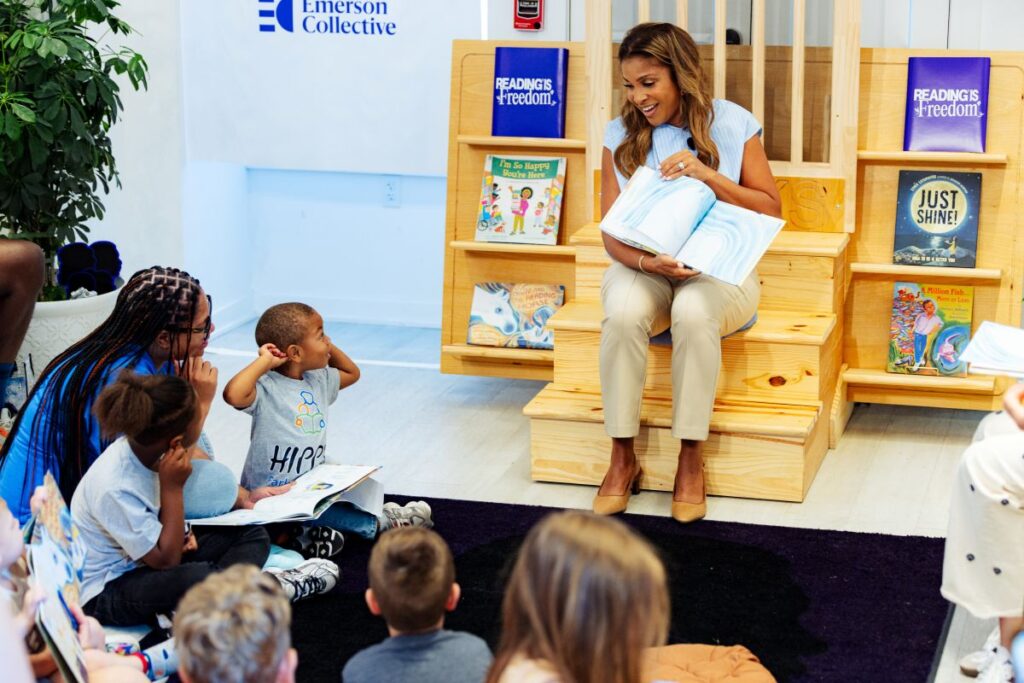
That civic pride was also reflected in the presence of city and state leaders, including Baltimore City Councilwoman Odette Ramos who helped to found Village Learning Place in an old Enoch Pratt Free Library on St. Paul Street and Maryland First Lady Dawn Moore. Both showed up in person as stoop-readers, lending their voices to the activation and to my search for answers about whether or not freedom is alive and well. So far, it seems it is, if we’re bold enough to challenge our attention spans to read in 2026.
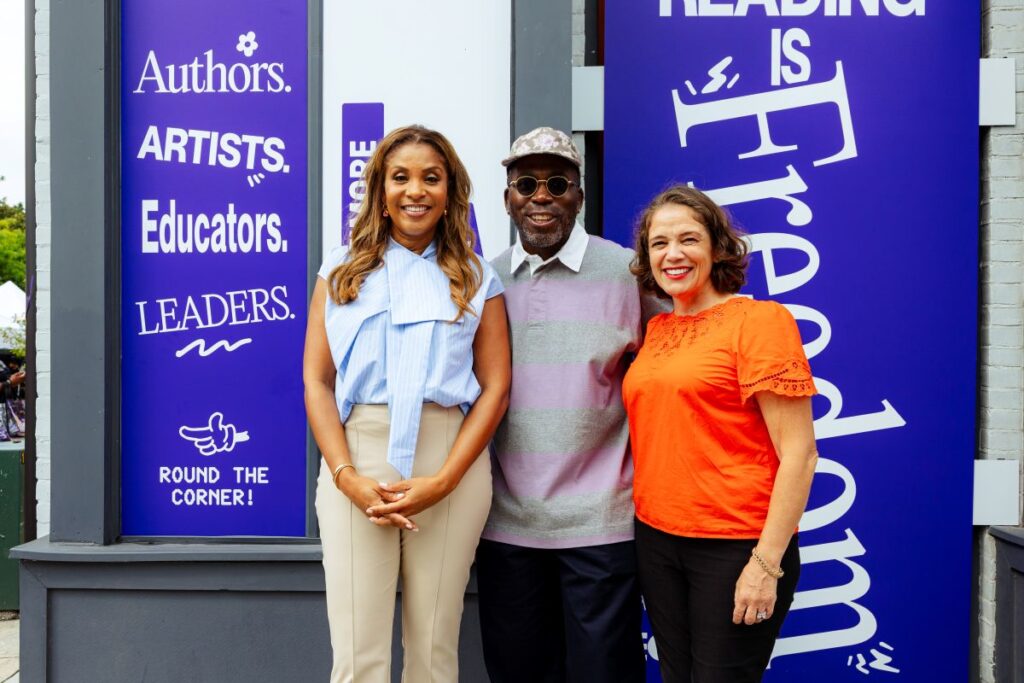
“In Maryland, the importance of education, the importance of reading, is something that my husband’s administration has taken very seriously. And so we had an initiative called #ReadMoreMaryland, and we were so proud to bring families in, bring communities in,” said Moore, who also cited reading as a way of opening up the mind.
On a call ahead of her stoop read of Just Shine! How to Be a Better You by Associate Justice Sonia Sotomayor, Ramos, who shares Puerto Rican heritage with the author, said she’s proud to represent the bookshops in her district, and proud she could play a part in convincing Mayor Brandon M. Scott to move the annual book festival to Waverly.
“The biggest thing about this festival is certainly the celebration of books. We are in Baltimore,” Ramos said. “We don’t ban books! We don’t ban books! We celebrate them! We write them. We read them. This is a book town.”
In her street interview with me, Moore who read Rain and the Reading Horse by Maria Gianferrari during her stoop-read said Baltimore is grateful to have someone like Adams, who has traveled the world but is back “lifting up our community.” She said anything that opens people’s minds to creativity and education is something she’ll show up for.
While he was not in attendance for Book Festival weekend, Mayor Brandon M. Scott had something similar to say about Adams and the Reading is Freedom activation, in an email to me, as part of my search for clarity around freedom, the theme, and the importance of reading.
“This activation is especially important right now, because we’re seeing an increase in censorship, book bans, and direct attacks on education across our country,” Scott said. “Here in Baltimore, we believe in teaching our young people the whole truth of our history, because we know that will only make them stronger, better leaders for the future. I’m grateful to Derrick Adams, MOACE, First Lady Moore, D. Watkins, and all of the other folks working together to make this a success.”
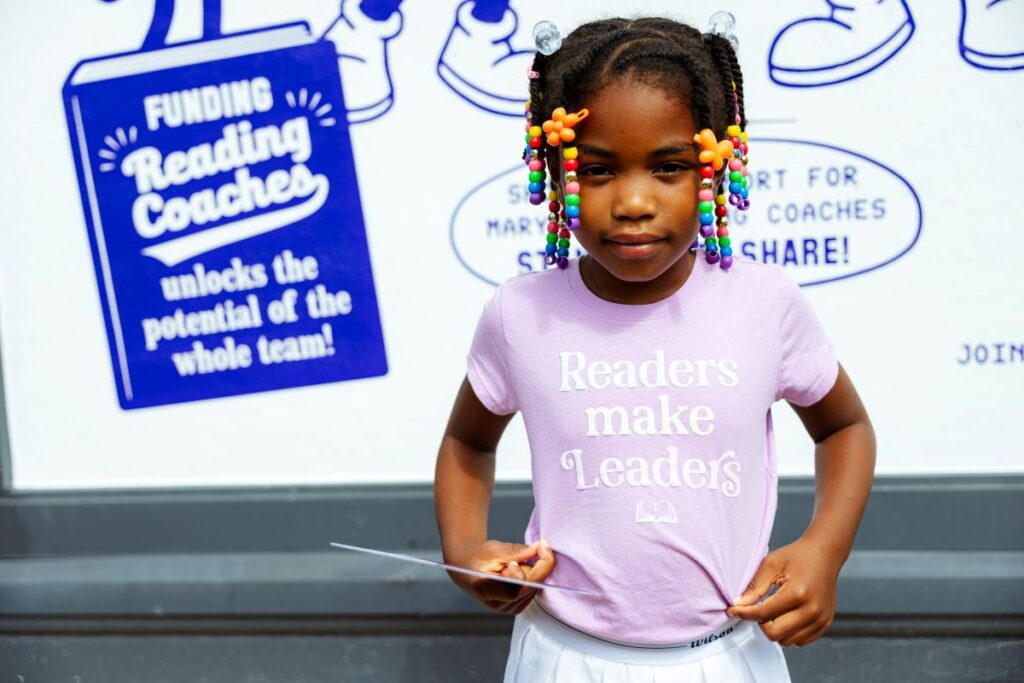
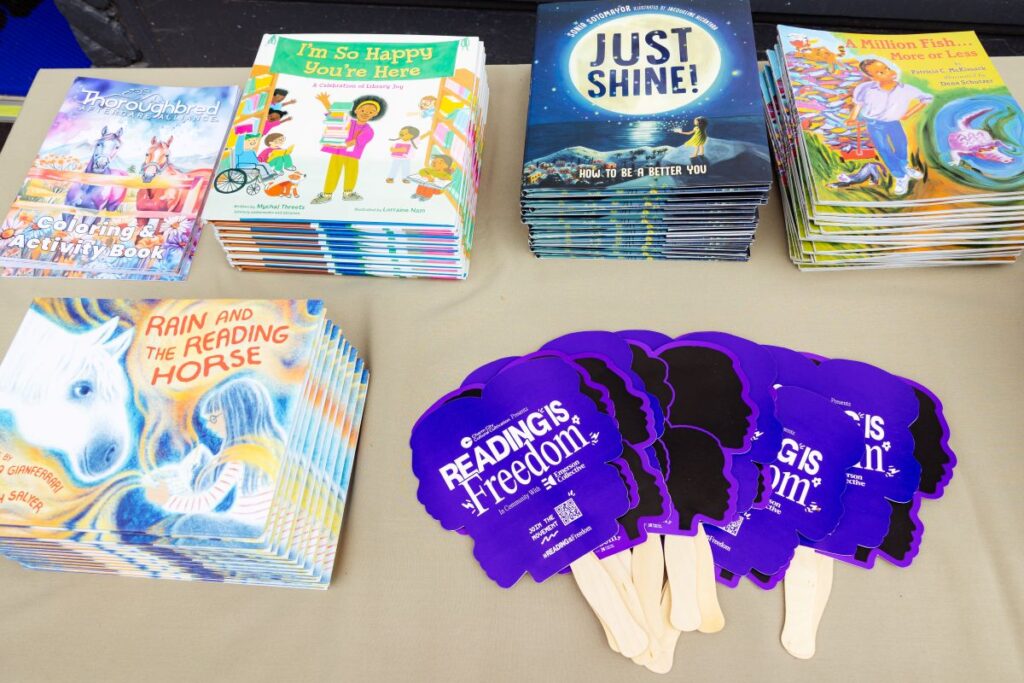
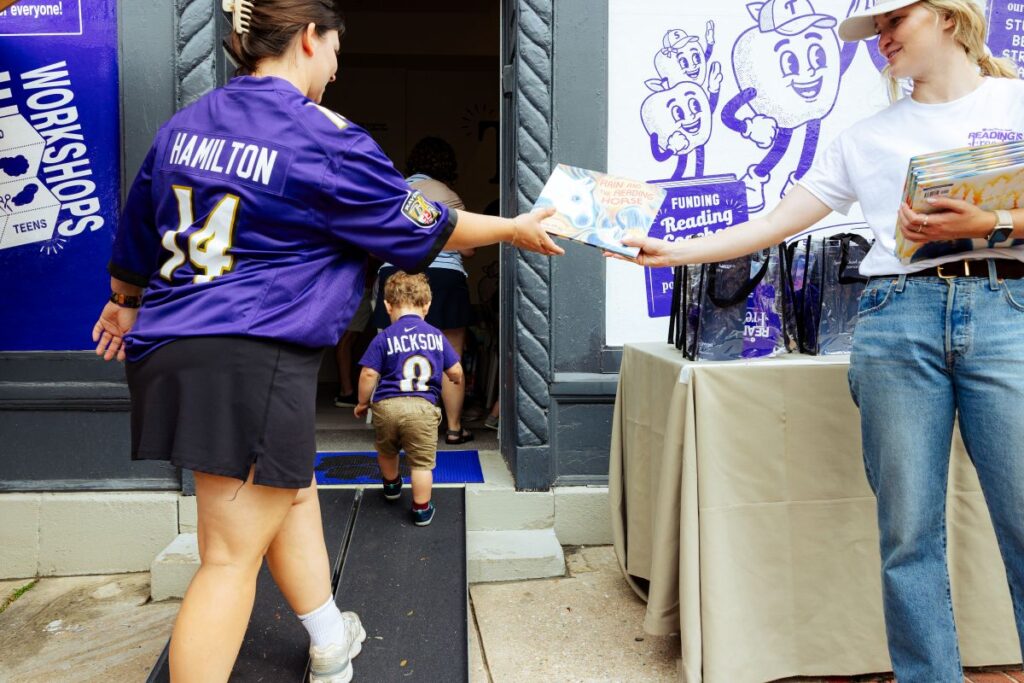
CCCC and Emerson gave out dozens of copies of each title read on the stoop activation throughout the weekend. National reading advocates like Mychal Threets or “Mychal the Librarian” were also tapped for the event. He read two books during his stoop read on Sunday: his own, I’m So Happy You’re Here: A Celebration of Library Joy, and I Am a Spicy Nugget by Loryn Brantz.
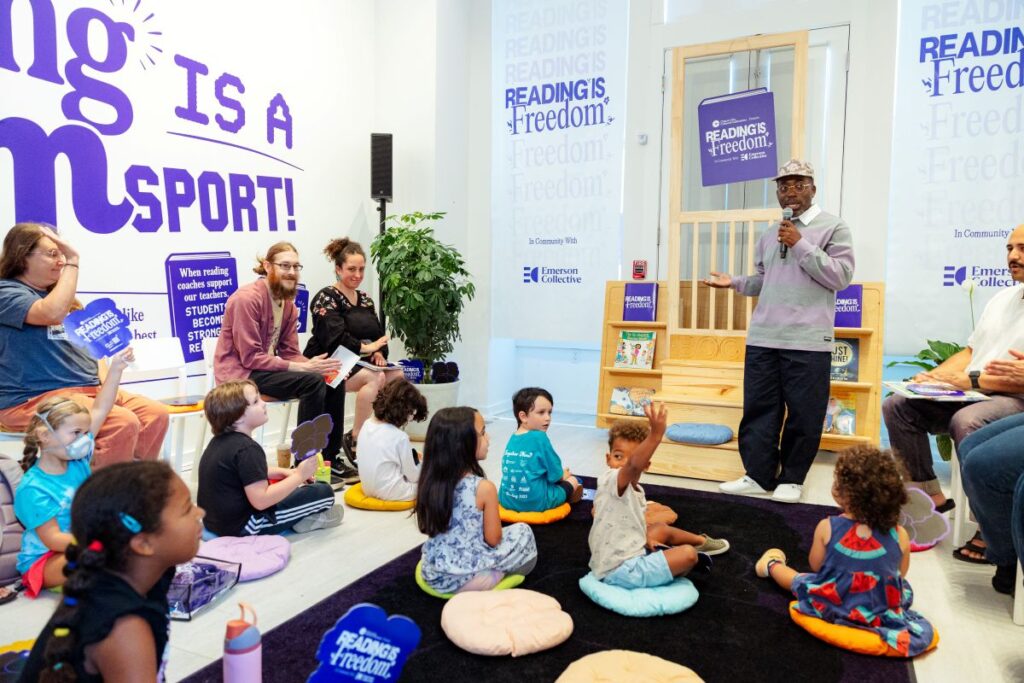
Threets prefaced his reading of the two short children’s books with a check-in about knowing it’s okay not to be okay. His timing and energy couldn’t have been more perfect. He sat surrounded by colorful pillows along a carpet like you’d find at a library storytime. Threets started out hearing only from the young people who’d come to read along in his call-and-response. But soon the adults, myself included, began chiming in, and something like cobwebs seemed to clear from spaces in our adult minds we don’t often activate, not with busy schedules, children, and everything else pulling at us.
When’s the last time someone read to us? Asked if we were okay? Dedicated an entire weekend, or even an afternoon, to exploring what is possible through books?
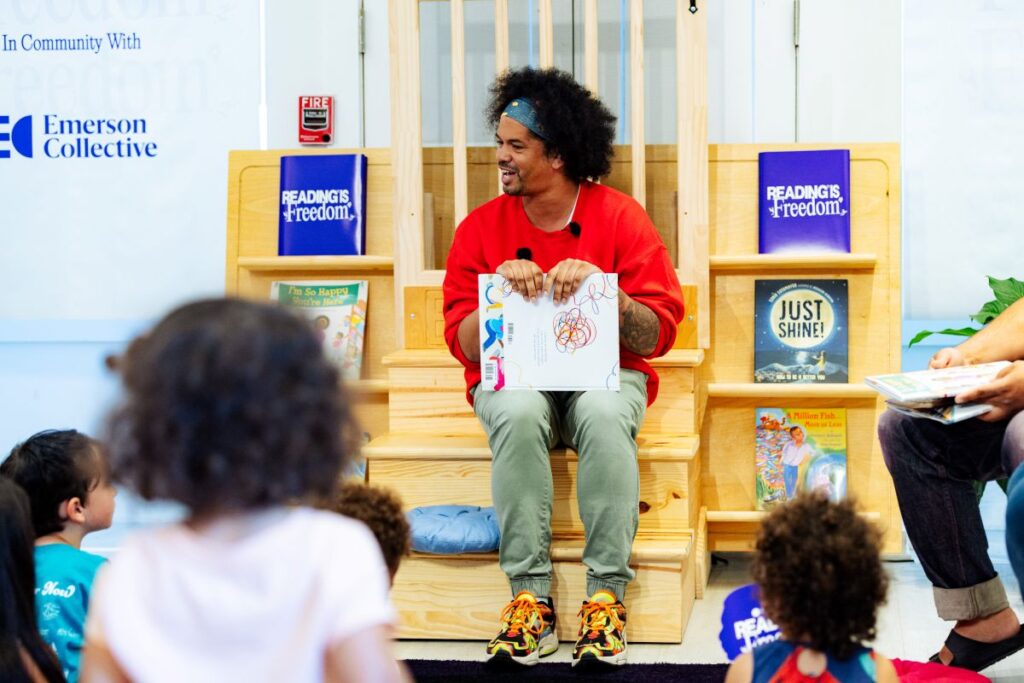
Each reader who took to the stoop warmed the space. Alongside the bright decor and branded gallery wall decals, stories came to life—not just the ones on the pages, but the ones in the eyes of the listeners around the room at CCCC HQ. It showed up in deep breaths and sighs of relief, dropped shoulders, and a moment for mothers with strollers to just take a beat. I was reminded, there’s not just hope inside books, but in the spaces we share literature in.
That warmth is what makes experiences like this necessary. The books were free. The Baltimore Book Festival was free. As for the question of whether reading fosters freedom, well… What doors has it unlocked for you?