On a recent Sunday afternoon I drove my Prius to downtown Baltimore, listening to NPR news stories about the uptick in local and national laws that target the existence of queer and trans people, women, immigrants, racialized minorities, and other vulnerable communities. The segments then pivoted to describe the latest developments in the ongoing wars in the Middle East, Sudan, and Ukraine, and included speculation about rising fossil fuel energy prices that would likely come out of these conflicts. There was no mention of climate change.
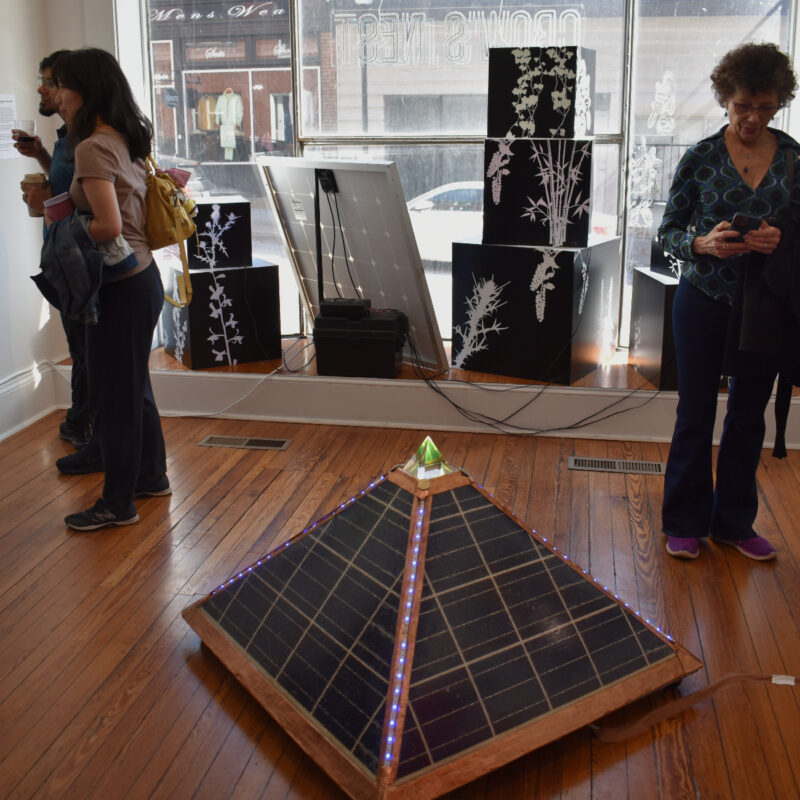
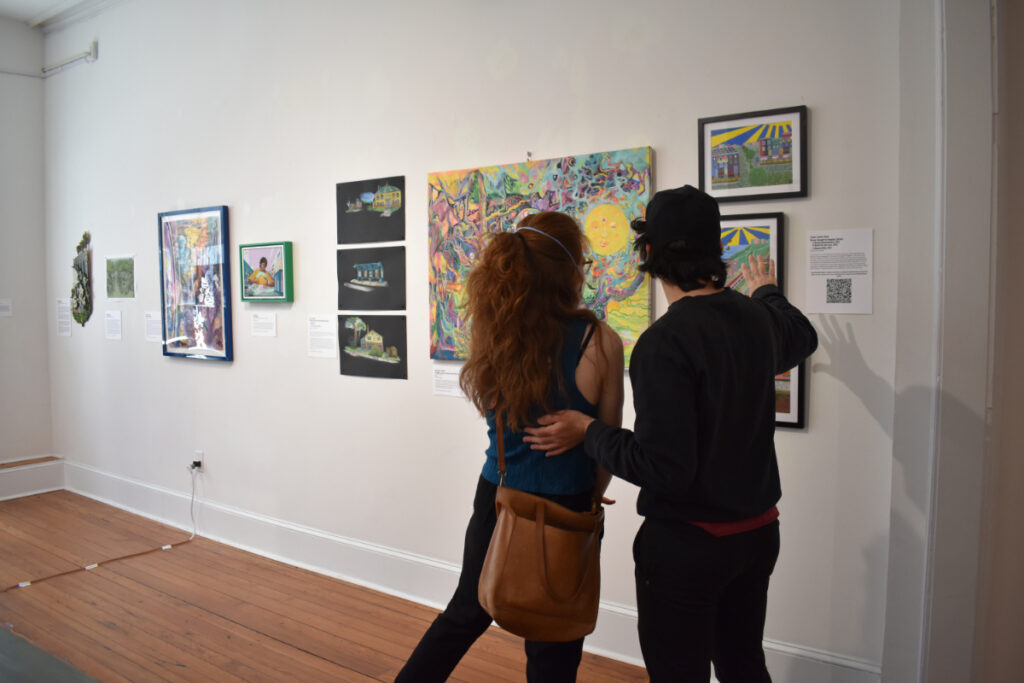
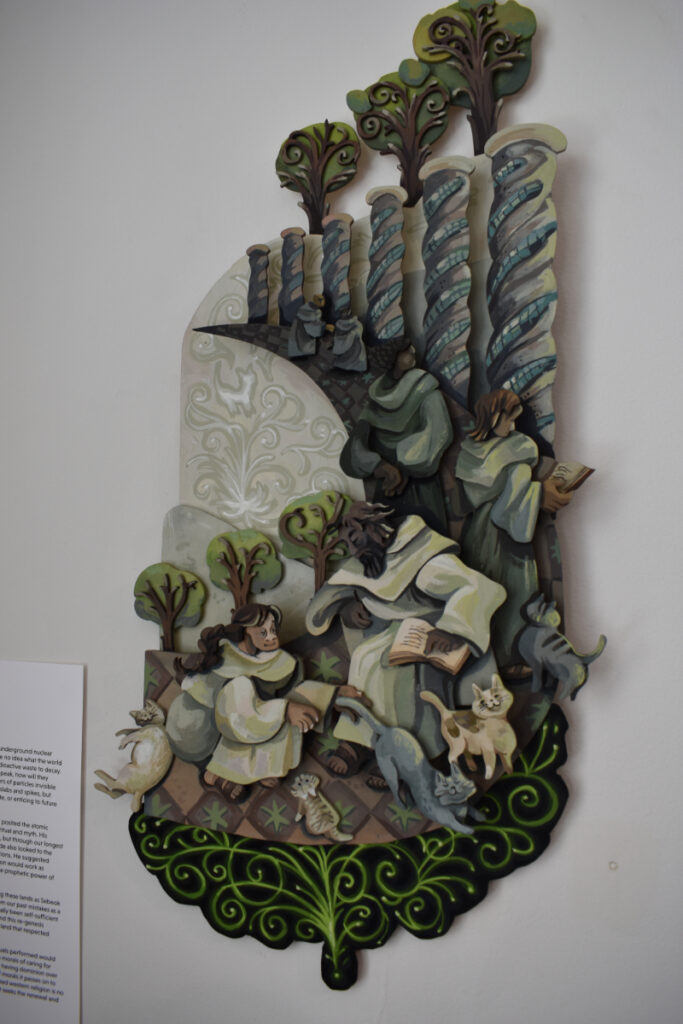
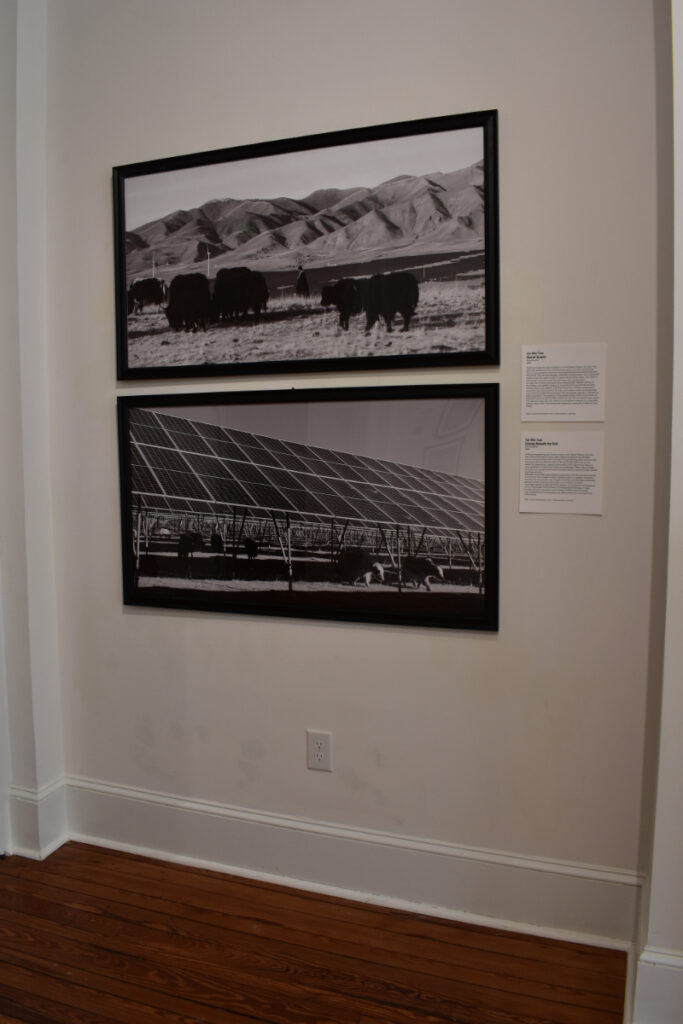
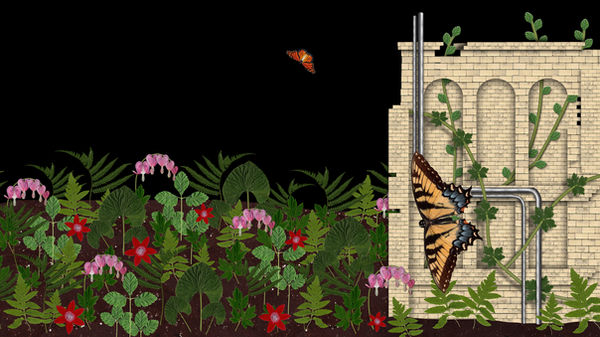
When I arrived at my destination,The Crow’s Nest arts incubator, I found myself surrounded by other stories and other, better, future worlds. There was a graphic narrative about DC 100 years from now, covered in greenhouses and forests (by Xena Ni). On another wall was a laser cut wood relief, showing the daily life of a priestly caste 1,000 years in the future, herding cats that glow in the dark at an ancient nuclear waste dumpsite (by Emerson Goheen). In the middle of the space I saw large format photographs of cattle serenely grazing under and around the loving grace of solar panels and giant wind turbines on the Tibetan plateau (Tse-Wen Tsao). There were actual solar panels present in the space as well (in work by Mary and Jim Opasik and Samantha Sethi), soaking up the sun after a mid-April storm had broken and drenched the streets. As if summoned by the rain, networks of mushrooms and fungus were everywhere, in paintings and drawings and fleshy, funky, physical reality (as a sculpture by Rachel Rusk).
The Westside of Downtown Baltimore is a good place to think about the future while remembering the neighborhood’s long history of Civil Rights activism. The area is pockmarked by vacant lots and buildings—casualties of past, failed projects aimed at “renewal” or “revitalization”—that signify potential in a transit-infrastructure-rich area. It’s also home to numerous art spaces which, in the same spirit as The Crow’s Nest, prioritize collective and long-term thinking. As a professor and now Program Director at Morgan State University’s School of Architecture and Planning, I’ve been inviting my students in urban design to speculate about the future of the Westside for years now, as part of a project that imagines what this place could (or should, or shouldn’t) be like in half a century.
And here on Mulberry St., The Crow’s Nest—an art space focused on climate action and environmental justice that opened in 2024—is carrying on that tradition. I was here to see Solarpunk, a new show assembled by curator Alexi Scheiber and founder Leonardo Martinez-Diaz. The show is about the challenges and opportunities that come along with imagining new worlds that are more generative, interconnected, and just than our own.
Philosophers like Frederic Jameson and Donna Haraway, as well as fiction authors like Ursula K. Le Guin and Kim Stanley Robinson, have often talked about how utopian thinking can serve to critique the status quo. The exploration of speculative fictional worlds can help us walk through new ideas that might otherwise seem implausible and unlikely, however much we might want them to be real. This critical faculty is intentionally deployed by the curators and artists at The Crows Nest, utopian worldbuilding as critique is a key part of almost all of the work here.
Solarpunk is the name of the show, it’s also the concept that guides this process. One early protagonist in the solarpunk movement is writer and consultant Jay Springett, who recently described it on an episode of the Neomania podcast. “If cyberpunk was about one semiconductor technology, the microprocessor … how it might change society,” Springett told host Lance Robotson, “Then solarpunk is about another semiconductor technology, the solar PV cell, and the falling costs of that.” The show’s curators underscore this when they talk with me about the concept’s relationship to cyberpunk and steampunk ideology and aesthetics. Solarpunk presents other alternatives to both, they tell me, leaving behind the imperialism and coal fired power of steampunk futures, and presenting more collectivity and hope than the bleak and shiny cyberpunk worlds can inspire.
“Worlds are the 21st century’s newest medium,” said Springett, and this show is full of them. But how do you invoke entire worlds with artifacts and images that fit on the walls of a gallery space on Mulberry St.? Worldbuilding as an art practice is having a moment right now, and one of the interesting things about that turn is that there are many ways, new and old, to answer this question that artists and designers are surfacing all the time.
Time-based narrative methods for exploring worlds are tried and true, and we see that used to great effect in the gallery’s screening room. Especially in the case of Nicole Dextras’ short film “Chronos; time of sand,” the slow pace lets us contemplate the implications of this dried-out universe and its lush oases by way of the artifacts and costuming with which the characters interact. Every object and piece of clothing seems to have a mysterious history and purpose.
Xena Ni’s sequential art for “Dispatches from 2120,” mentioned above, borrow strategies from graphic novels to hint at the politics and culture of her future DC in just four small color panels, deftly drawn. This piece is part of Ni’s “Futuretelling” practice – a collaborative process that invites and coordinates groups of neighbors and activists to come together and build worlds together.
Other pieces act more implicitly, not telling stories but invoking environments around the objects. Tse-Wen Tsao’s photos of future energy infrastructure in Central Asia (also mentioned above) remind us that there is more to the present world than we know. Fiona Bell makes precious and evocative objects out of food waste—3D-printed pieces on the gallery’s mantlepiece are printed from a paste made of ground eggshells, showing us how the fast production enabled by this new technology doesn’t have to drown us in a sea of plastic junk. Her sculptures will naturally compost themselves in a period of weeks when returned to the ground.
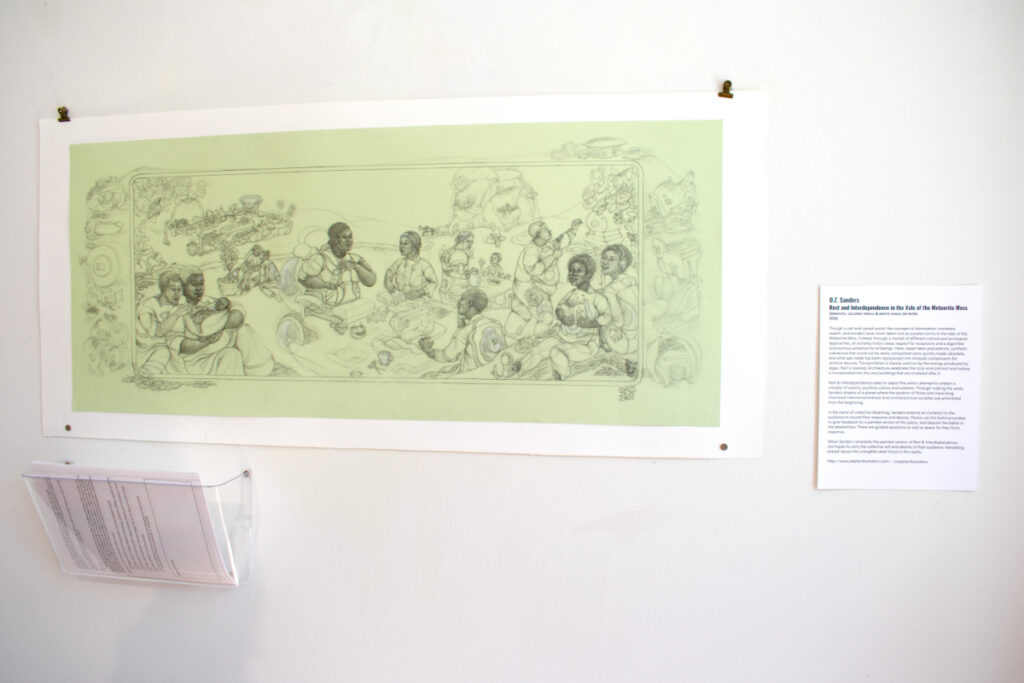
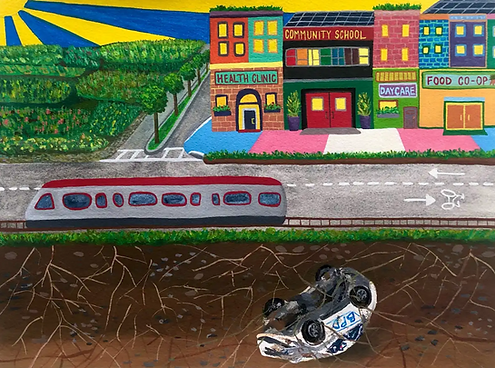
The tension between collectivity and identity is generative in these worlds. If everyone can make their own food, energy, and staples, then what would public life be like? What would bring people together? Making things with friends and family is more rewarding than working alone, artist OZ Sanders seems to answer. In a large graphite drawing, we can see material and human culture working its magic, as groups of people socialize, work, and play in a universe where everything is made with intention and care. Urban spaces and infrastructures support this collectivity, and they show up everywhere as well. “Eco-City Dreaming,” a drawing by Sara Dunn, shows us an elegant plant-draped neo-Arts Nouveau intersection. Taylor Smith-Hams brings this public works speculation back to Baltimore, with a series called Brave Enough to Imagine. These ask, could we—right now—re-arrange our politics in a way that de-prioritizes abuses of police power (Defund BPD), and re-centers collective investment in transportation (Build the Red Line)? How far away is this future world anyway? One year? One day?
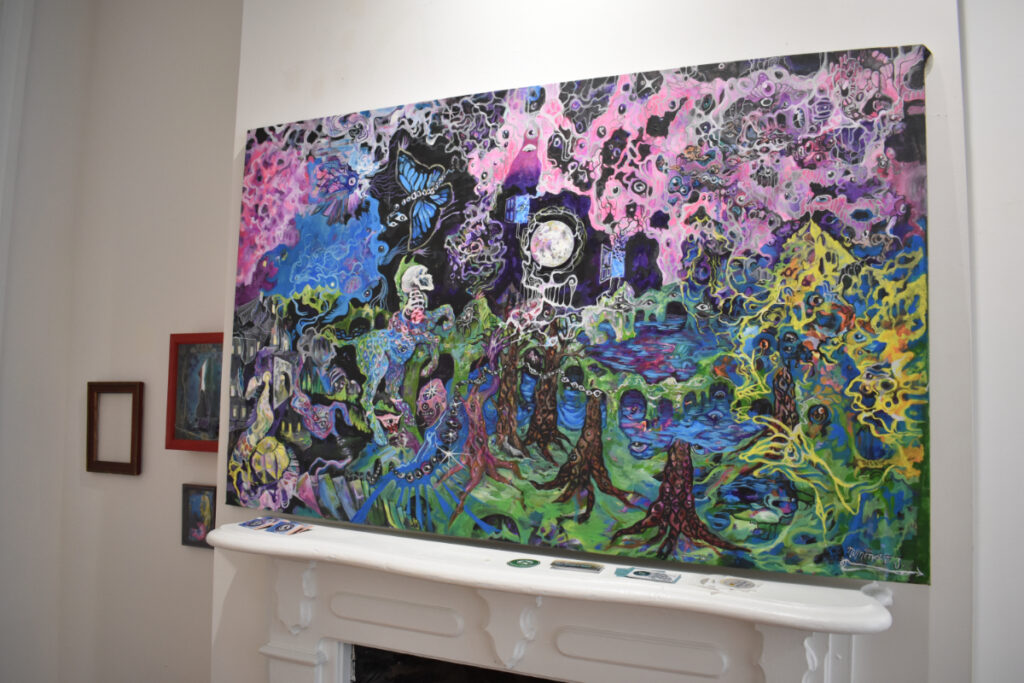
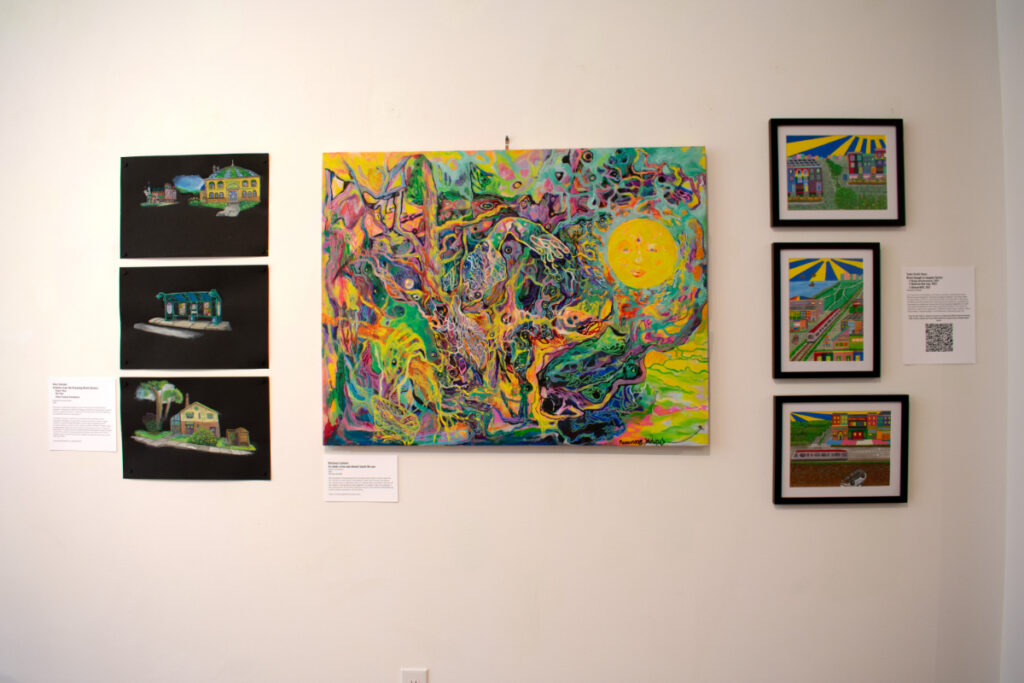
Standouts include two large paintings by Numinous Jachens, “To Climb a Tree and Almost Touch the Sun,” and “Navigating Peripheral Mysteries.” These accomplish worldbuilding by way of immersion. We step into them like a warm bath. Rachel Rusk’s “Resonance” is another stunner, but one that works in more oblique ways. Right at the gallery’s entrance a low table holds three objects: reishi mushroom fruiting bodies in beds of sand on custom platters carved from black walnut, resting on richly textured blue fabric. Are these diorama islands? Organisms? Centerpieces from a spaceship cafeteria? Yes and yes.
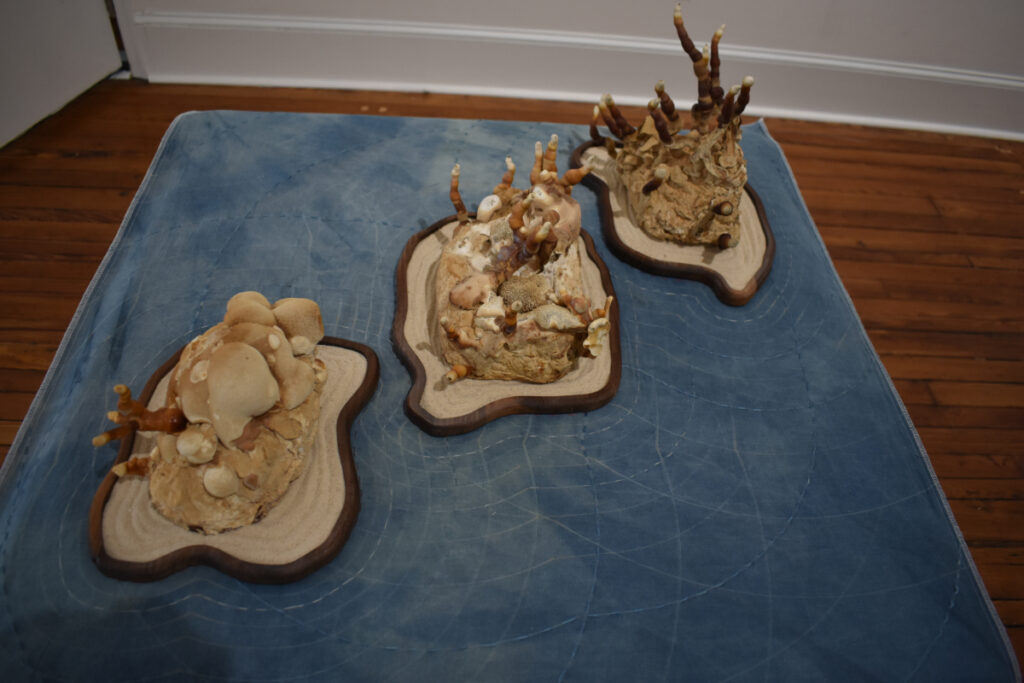
Whatever they are, they are not as isolated as they seem, from one another, or from us. “It’s a community.” the curators told me, when I asked what it was like to think about the future in West Baltimore. Like the many manifestations of mycelium itself, all of the institutions, DIY spaces, organizers, artists, activists and neighbors here rely on and support one another. And the pieces in the show also form a network. Scheiber says that one reason mushrooms are so interesting is that they are queer—abject, even—a part of the forest ecosystem that expresses itself with hundreds of genders, doing the valuable work of recycling what’s no longer needed, and affecting our hearts, bodies, and minds in so many new ways.
They contain worlds. There’s a particular kind of line-making and form-making in much of the work here that resonates with the form of the mushroom—not a straight line but always one with a subtle or sudden curve, expressing abundance and change. Science fiction writer Ursula K. Le Guin—no stranger to worldmaking or solarpunk herself—writes about these lines in her 1972 book, The Word for World is Forest, and her description could also encompass this show: “No way was clear, no light unbroken, in the forest. Into wind, water, sunlight, starlight, there always entered leaf and branch, bole, and root, the shadowy, the complex. Little paths ran under the branches, around the boles, over the roots; they did not go straight, but yielded to every obstacle, devious as nerves.”
Upcoming Programming at The Crow’s Nest: