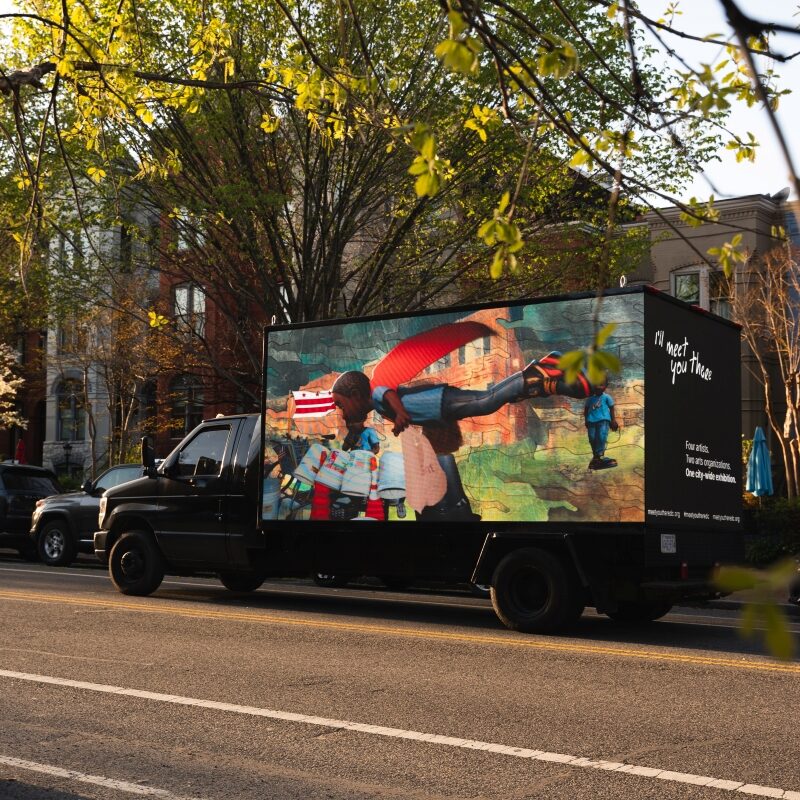
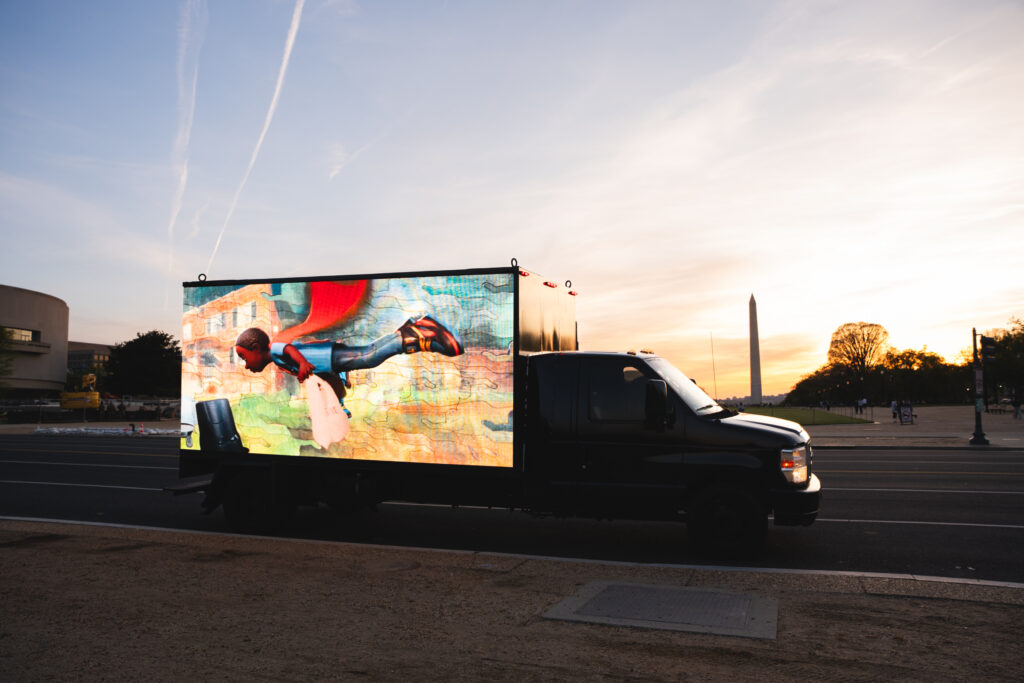
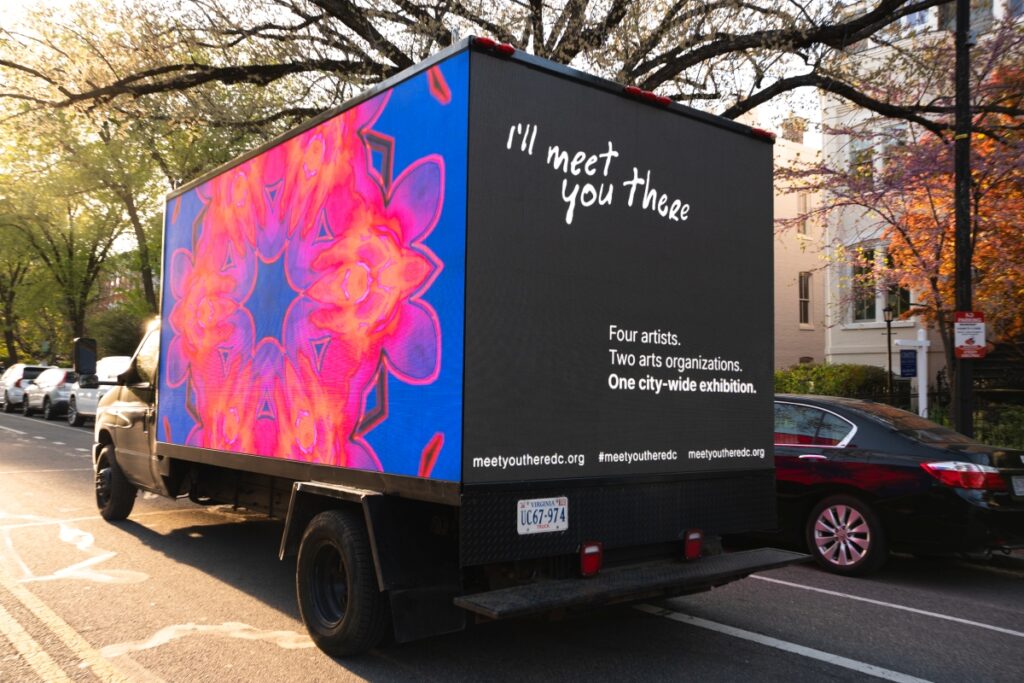
A young boy flies through the streets of DC. His superhero-red cape flutters behind him as he travels home carrying bags of groceries in each hand. The animated image glows on a digital billboard box truck as it drives through the city. It is a welcome reprieve from the aggressive political messaging or blaring advertisements for lawyers you find on similar trucks in the District, and a creative approach to getting art outside of a fixed gallery and into the flow of daily life.
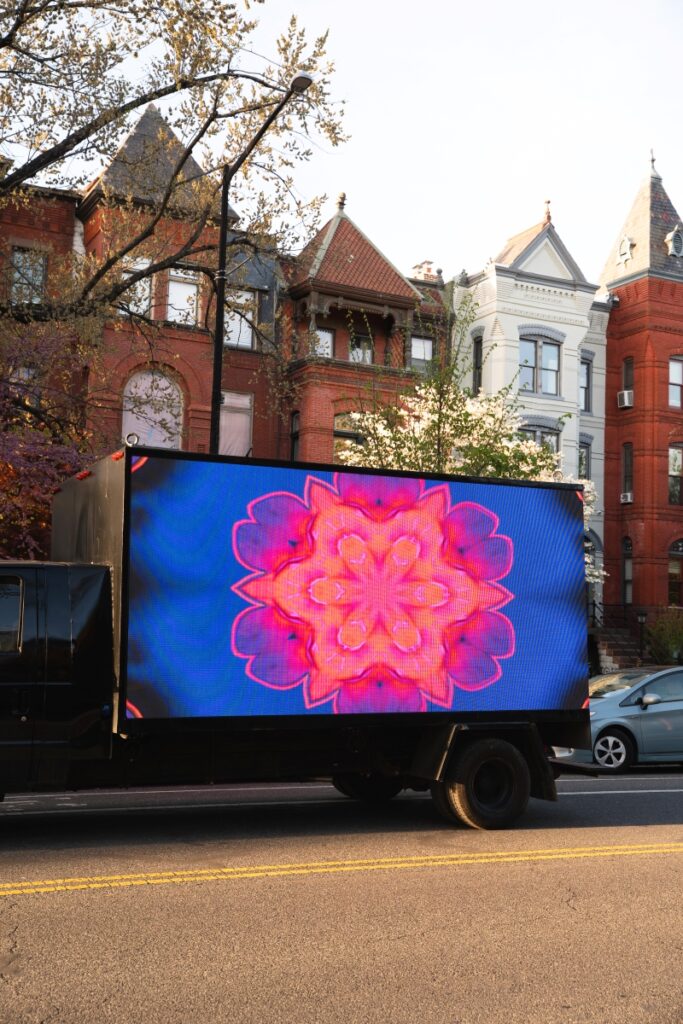
I’ll meet you there, an exhibition organized by Hamiltonian Artists and The Nicholson Project, features a 20-foot digital billboard truck in motion or parked in various destinations across DC. The videos are also viewable on the front window of Hamiltonian Artists and made into murals installed at The Nicholson Project.
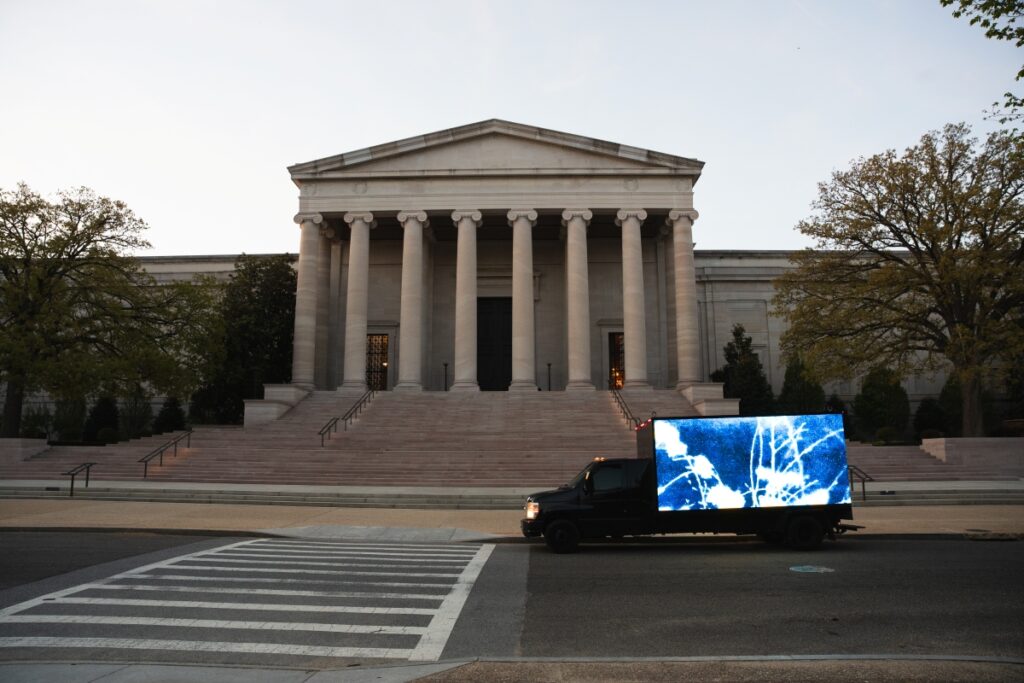
The roaming show carefully considers what should be injected into the arteries of a bustling, complex city—and, according to the project’s description “what it means to inhabit a space of uneasy familiarity.” That inhabited space isn’t merely the truck, nor the streets, but the experiences of the four featured artists—Stephanie J. Williams, Jermaine “jET” Carter, Edgar Reyes, and A.J. McClenon—whose practices have each been shaped by the area.
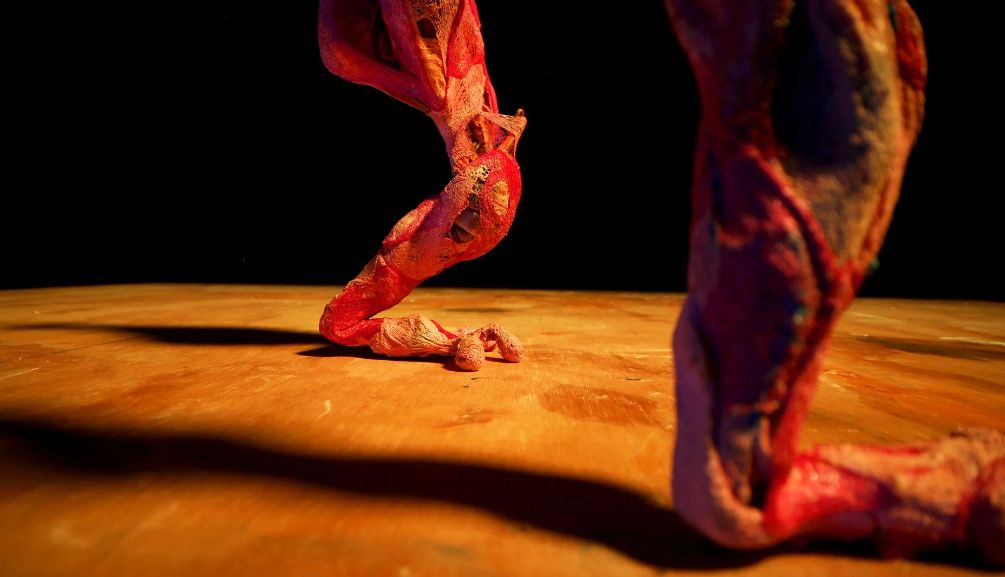
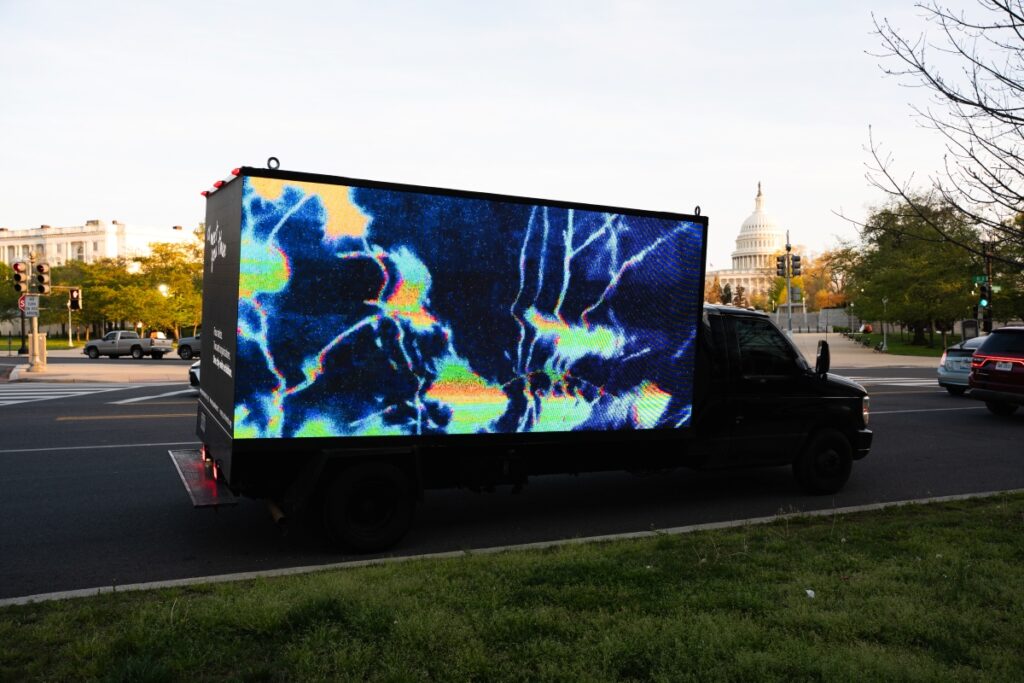
From March 16 to April 11, DC and Baltimore based artist Stephanie J. Williams showed The Expectation of the Observed. The stop motion animation stars the limbs of an imagined animal: a fusion of sinewy bird legs with sticky pink frog feet. The feet tap as the juicy muscles flex and jump to a drumming musical composition by Andrew Keiper. As the toes bounce, tissue sloughs off. The melt reveals the alarming wet textural reds of puppet viscera. The video is a non-narrative nor linear flow ready to be dipped into at any point.
While creating the work, Williams, who teaches stop motion animation at Maryland Institute College of Art, was moved by conversations she had with faculty union organizers. She was struck by a repeated theme: unrecognized labor. “They were talking about their bodies, they were talking about all the stuff that they do to hold it together that nobody—they don’t think anybody really sees,” said Williams.
That labor can be disguising physical pain or discomfort, monitoring language for fear of repercussions, assessing the psychological safety, and potentially the physical safety, of any given room. These layers of emotional, psychological, and physical safety are heightened for people who are regularly targeted by the current administration set on social and political regression, forcing institutions to comply through foundational shifts in language.
According to Williams, the educators likened protecting their livelihoods to a nuanced, exhausting, perpetual dance; it is somewhere between stealth movements, narrowly avoiding red laser beams and a high wire act. There is a desire to move differently but the strain has increased as the dance has had to become elegant and undetectable to the powers that be, yet still investigative and undoing, in any way possible. Between delicate jumps, the toes of the puppet wiggle, nearly touching, and then they hop once more. The body is worn down, the sinew melts, and the dance begins again.
Circulating now through May 30 is Man of the Sky by Jermaine “jET” Carter. Carter, who grew up in DC and is now based in Alexandria, VA, debuted his work on Saturday, May 9 launching from DCity Smokehouse in Southeast.
The video is an animated evolution of an earlier work titled Man of the House: a gouache and colored pencil rendering of a young boy standing confidently with arms crossed on the walkway to a rowhouse. A pile of grocery bags are gathered at his feet and more are still in his hands. His shadow stretches taller against the house behind him. From one window, a hanging red curtain flies in the wind aligned to give the boy’s shadow a cape.
The work “depicts the tension between childhood innocence and early expectations of adulthood.” Carter explained that these early tests of adult responsibility can be exciting as a kid and that the Man of the Sky “came from thinking about how as kids, especially Black boys, we’re often asked to step into responsibility early.”
“Sometimes it’s simple like taking out the trash or carrying groceries, but those small acts begin shaping identity and building character,” said Carter.
That figure, which Carter said is a younger version of himself, is now on the side of the video truck flying like a real super hero with a red cape and groceries in hand. He transformed the original painting into a 3D rendered figure. He animated two more versions of the boy, one is playing bucket drums and the other is dancing in the beat ya feet style famous to DC. They can be seen in the background as the boy flies by. Behind them are neighborhood scenes of Valley Avenue Southeast, downtown DC, the Washington Monument, and Congress Heights, all are related to Carter’s upbringing across the city.
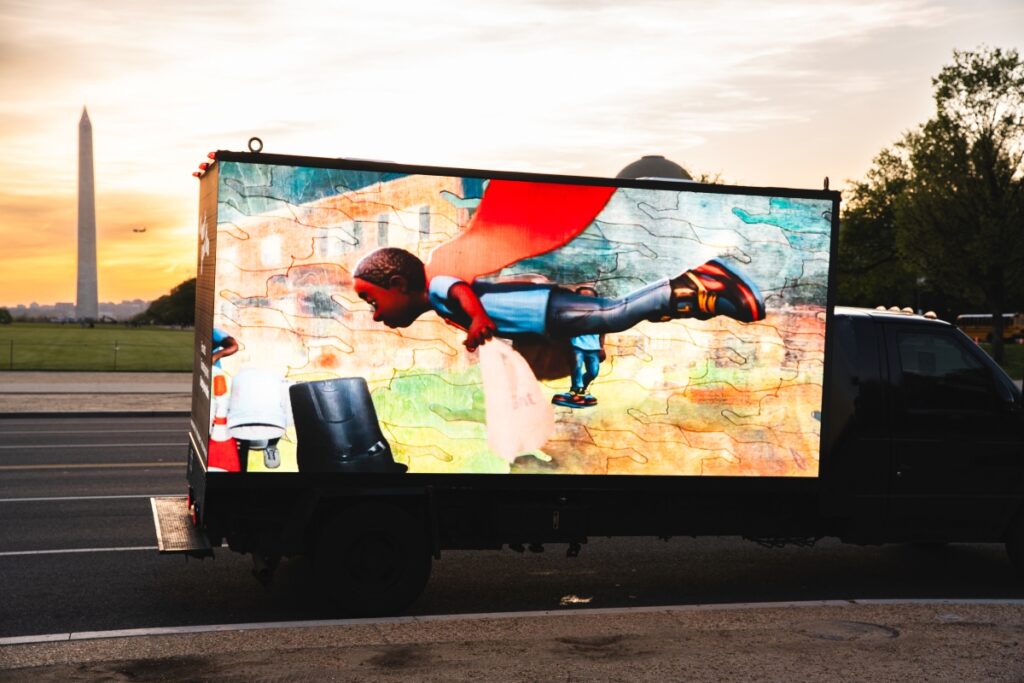
The neighborhood scenes and the figures behind the flying boy repeat on a loop. The background is layered on top of interconnecting forms, like wooden puzzle pieces, made using the silhouette of the flying boy. The shape is rotated to create infinitely repeatable interlocking forms, called tessellations, causing some of the silhouettes to lie on their back. The background is then made of flying and fallen boys. The flying boy is the bucket drumming boy is the beat ya feet dancing boy. For a 20 second viewer or a 10 minute viewer, the ending is the same: the boy never lands, grocery delivery perpetually imminent.
Carter builds the world of his paintings, drawings, and animations from photographs he takes around the city. “It’s almost like I’m archiving different parts of DC as I’m moving around there,” he says. His work balances the reality of “darkness and lightness” that comes with growing up in DC but tries to capture the light first, “and then we see through it and we work and we talk with it. But I like to leave it as an open slate for people to project onto.”
The work will circulate as Mayor Muriel Bowser insists on emergency implementation of youth curfews. The curfews are in response to altercations occurring during youth-organized “teen takeovers.” Legislation to extend the police chief’s ability to create emergency curfew zones, where teens under 18 and in larger groups than nine are banned from gathering after 8 pm, is awaiting congressional review. Critics, including teens, said the curfews enable racial profiling, criminalize youth, and don’t take into account why teens may not want to go home. In tandem, the Mayor’s 2027 budget proposal includes significant cuts to social programs that can actually prevent crime.
Carter said he hopes the work offers a kind of surreal positivity to viewers. He wants the work to be seen “ as a sign of hope” and “as a sign of culture not being erased.” That culture and this city is rendered in tessellated forms, in an infinite animation, and is now “permanent and exists inside of this loop” archiving a place that is constantly changing.
From June 22 to August, I’ll meet you there will host work by Edgar Reyes and then A.J. McClenon.
Reyes, currently based in Baltimore, grew up around the DMV area after moving as a child to Los Angeles from Mexico. Soon after his family settled in North Virginia. He traces his lineage through the materials, cultures, places, and sounds that have influenced his artwork and his life. Reyes realized “you first have to understand who you are, where you stand, where you’re from, how has it shaped your perspectives before you start wanting, at least from my point of view, before you start wanting to impact or change other people’s.”
In his video, Los Vemos Pronto (See You Soon), flowers and landscapes are filtered beyond recognition and churned through a psychedelic kaleidoscope creating shifting geometries. The visions are made of greens, purples, and pinks and are paired with a variety of sounds connected to Maryland and Mexico. The sounds blend audio captured at Patapsco Park when suddenly Reyes realized he could hear no human activity and began recording. Carolina wrens and mourning doves sound off as shades of green form a vortex-like dodecagram.
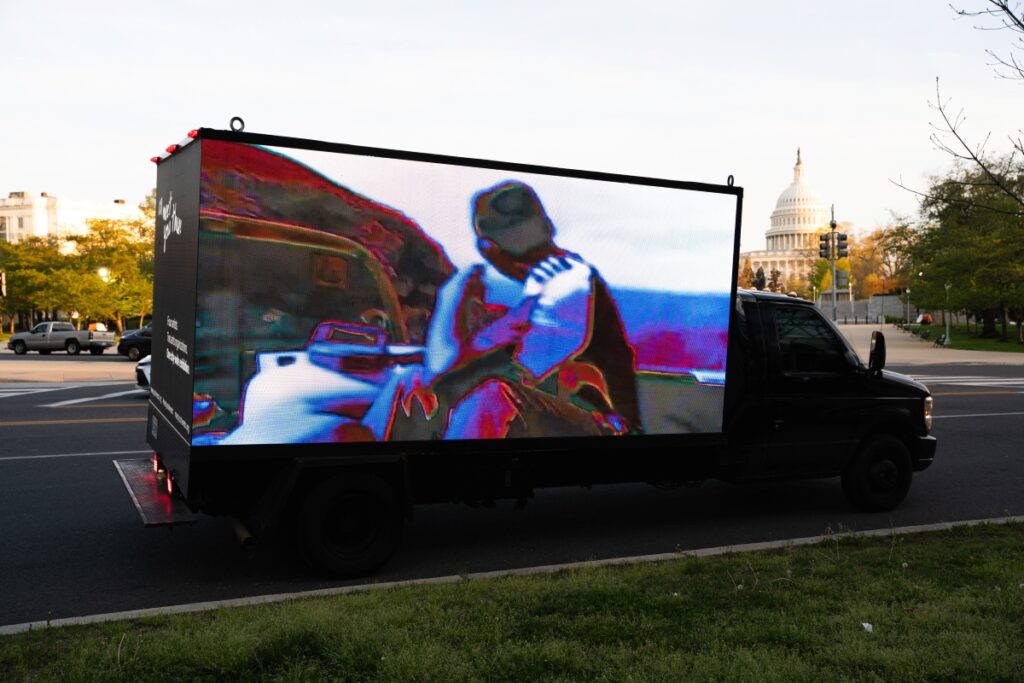
The sound becomes muffled and dreamlike shifting to a Norteño style song, then Los Alegres de la Sierra sings an echoing and longing Suerte He Tenido as fluorescent pink and blue floral forms fold into each other. The music and images fade. A Red-eyed vireo sings and the viewer is seated in the bed of a pickup truck watching a young man, obscured by filtering that imitates thermal imaging, as he looks over the edge of the truck to a sprawling valley outlined and glowing in reds, pinks, and oranges.
The filtering mimics thermal imaging used by the US Border Patrol and Customs and Border Protection to track people and heat maps that measure the effects of climate change, which Reyes said, impacts “certain communities higher than others.” The figure’s body is mostly shades of grey, his shirt ripples in the wind of the traveling truck, both are outlined in the same neons as the landscape.
The figure is Reyes’ cousin. He captured this video while on a trip in Mexico, not knowing it was the last time they would visit his grandfather before he died. He said the work has made him reflect on loss and “the beauty of just being present and understanding the complexities of life.”
Reyes continued, “We don’t realize how beautiful that experience is until we can’t experience that experience again.”
The sound evolves into Aztec drumming, recorded outside of his grandfather’s house. The image fades back into a new purple and blue kaleidoscopic form. The shifting scenes, set in 20 and 30 second increments, are mindbending, not only because of their hypnotic forms, but the scene in the back of the truck, eventually to be played on the side of a truck, will place viewers in the bed, on the journey traveling not just alongside but within the work.
“I think it’s important to realize people that look like me and have had the experiences that I’ve had, whether it be migrating by choice or by force, we’ve always been part of this fabric of the US and we will continue to be.”
He adds, “And I think for me, I’m in a point of privilege where I can, within limitations, show up unapologetically. Even if it’s not me, it’s my work.” Art can be loud, and “in people’s faces” even when Reyes himself cannot be “because it’s people that look like me that are being targeted.”
Los Vemos Pronto (See You Soon) will launch at the Mexican Cultural Institute on June 27. Reyes said he’s always wanted to do something there, having grown up visiting the building for more mundane, and bureaucratic reasons. His project shares the “nuances of narrative” and the nuance of lived experience, like displacement, migration, “the ugliness and the beauty.” For generations his family has moved fluidly between the US and Mexico, and that’s a tradition not likely to change.
“It’s part of human nature to move and transition from one place to another. And there’s beauty to that even though there’s this ugliness that has happened and continues to happen,” Reyes says. There’s beauty that can come through and I’m hoping the piece is showing that there’s beauty and nuances to this life that we live.”
Finishing the exhibition from July 20 to August 15 will be A.J. McClenon’s Vega Travel Run Five Hundred and Ninety Eight to Three Hundred and Fifty Six.
McClenon’s work pierces through space-time and invites viewers to join through short film and multimedia artworks. Born in DC and now based in Chicago, McClenon is returning to the city with this world in tow—where ancestry and escape to parallel universes chart mythical courses to freedom, and perhaps even offer a model for reexamining our own world, and our own tangible choices.
McClenon’s alter-ego character, Vega, is documented utilizing different cameras to conjure multiple and overlapping time periods. Vega is a revolutionary playing both sides, the government and the Future Freedom Party. Vega is conceptualized as McClenon in the future, and the character, like McClenon, visits DC as a homebase. In this future world, Vega “helps imprisoned people escape a government-designed program that forces imprisoned people into alternative universes.” By learning where the access points into alternate universes are and how to travel them, Vega will share this knowledge and find an escape.
McClenon says showing this work on a truck resonates with the story of Vega who is within a pursuit toward escape. The truck symbolizes that ongoing journey. Exhibiting in McClenon’s hometown, to McClenon’s family is exciting, but visiting comes with time’s own impact: gentrification renders spaces once formative, unrecognizable.
Despite this, McClenon hopes that the work is a reminder that we all have access to being a revolutionary, “in small and big ways.”
“And it doesn’t have to be grandiose, saving everyone… it’s just thinking about the small ways of connecting and offering support and even asking for help,” McClenon said.
I’ll meet you there is funded by the DC Commission on the Arts and Humanities (DC CAH), Public Art Building Communities Grant. At the opening of Carter’s work at DCity Smokehouse, DC CAH Executive Director Aaron Myers, said of the Commission “in the last three years, 23.5% of its funding has been cut. And they’re proposing another 14.5% to be cut next year.”
Myers explained that funding helps retain artist residents in the city, and that exhibitions like this demonstrate the kind of artists DC produces. Ironically, only one of the four artists featured in this exhibition currently lives in DC. Rising costs combined with decreases in arts funding have made it difficult to retain or attract artists, even those born and raised here.
With institutions quaking, as a result of the administration seated in DC, I’ll meet you there is an essential interruption. The project, though it will reverberate beyond DC, speaks to this city, and everyone in it, especially the people who have not historically been seen, recognized, or cared for. The works meet viewers where they are—in the midst of familiar pulsing streets, and our complicated, overwhelming lives.
To reside in such close proximity to a power committed to atrocities and having a congested daily commute can be a horrific, flesh shedding dance, as Williams animated, where life is predicated upon an ability to brace indefinitely and commit to routine.
When suddenly a Black boy flies by in his superhero cape, there’s a new question. How that question will be examined by any one person is an individual journey; but there is at least an opportunity, a chance that a question could be asked, a routine could be halted, that our choices, and our city, could be different.
I’ll meet you there is on view until August 15, 2026. The exhibition occurs throughout Washington, DC via a combination of storefront video screenings, outdoor mural installations, and a traveling 20-foot video billboard truck. The title of the exhibition comes from a line in A Great Wagon by the 13th-century poet Rumi, and is translated by Coleman Barks: “Out beyond ideas of wrongdoing and rightdoing, there is a field. I’ll meet you there.” You catch up with the truck by tracking its location here.