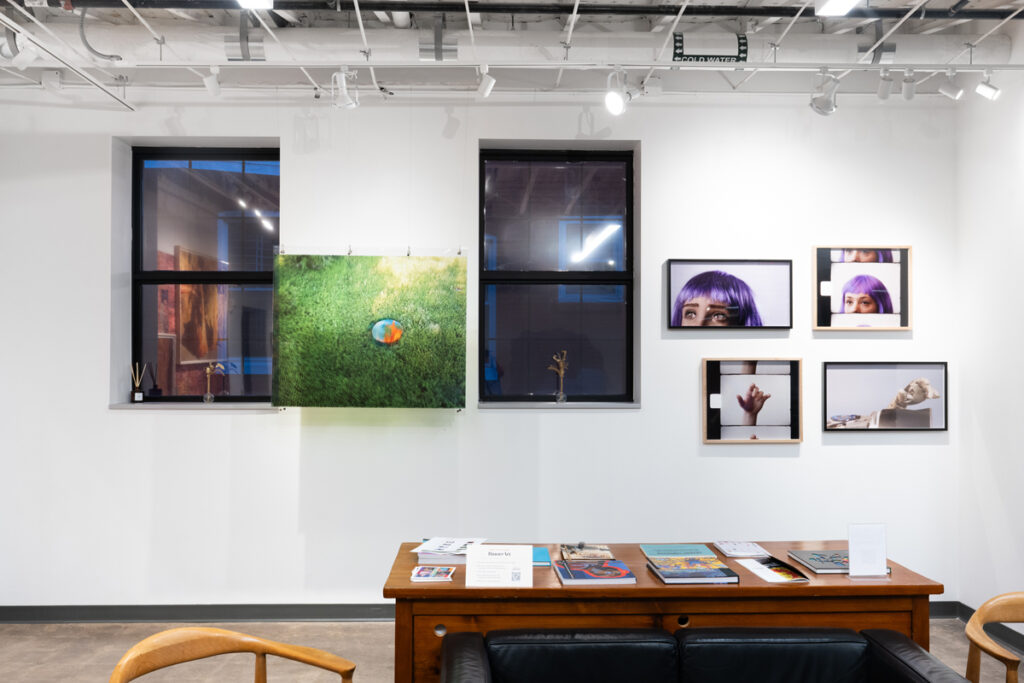
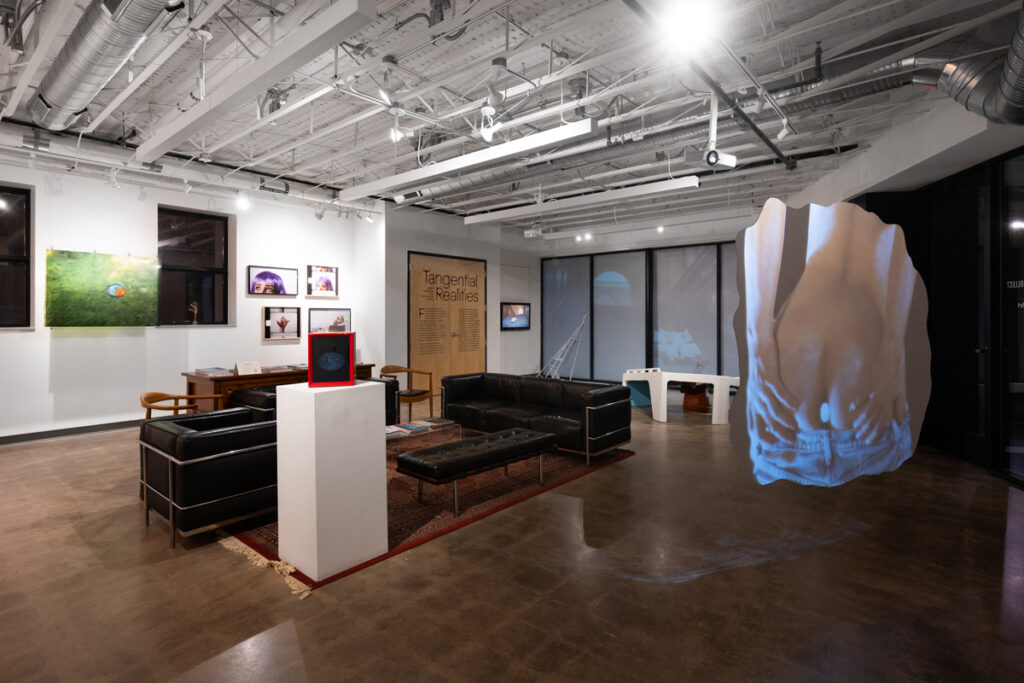
When entering BmoreArt: Connect + Collect Gallery, the sound of bell rattles entrances you into alternate realities, from the reenactment of a family story of astral travel, to a fantasy land of fiery dreamscapes, to the remains of a disappearing island community in the Chesapeake Bay, to poetic meditations of earth-body monumental forms. These immersive environments ask us to pause, confront our steps, transform; allowing us to reimagine through magic realism, a historical moment, or memory.
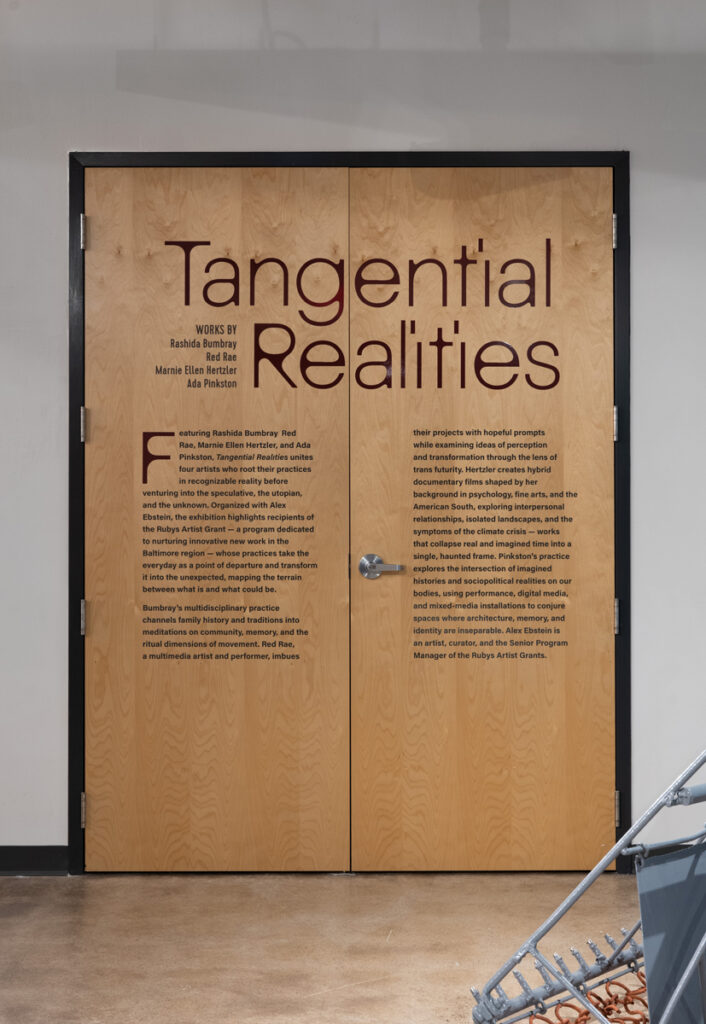
Tangential Realities features Rashida Bumbray, Red Rae, Marnie Ellen Hertzler, and Ada Pinkston, four artists who root their practices in recognizable reality before venturing into the speculative, the utopian, and the unknown. Organized with Alex Ebstein, the exhibition highlights recipients of the Rubys Artist Grant—a program dedicated to nurturing innovative new work in the Baltimore region—whose practices take the everyday as a point of departure and transform it into the unexpected, mapping the terrain between what is and what could be.
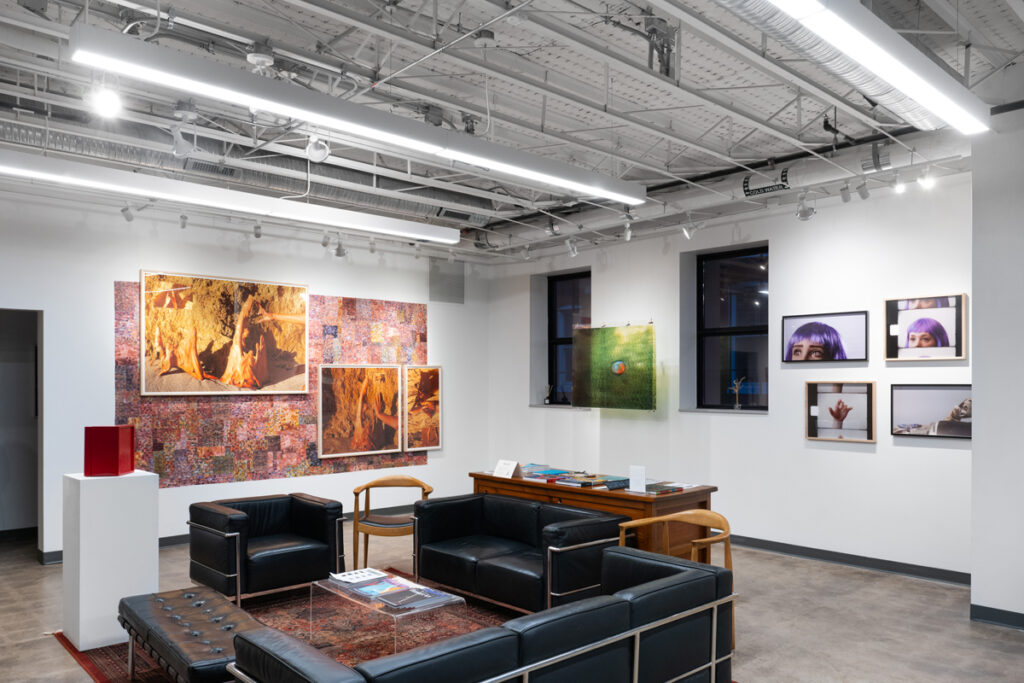
Bumbray’s multidisciplinary practice channels family history and traditions into meditations on community, memory, and the ritual dimensions of movement. Red Rae, a multimedia artist and performer, imbues their projects with hopeful prompts while examining ideas of perception and transformation through the lens of trans futurity. Hertzler creates hybrid documentary films shaped by her background in psychology, fine arts, and the American South, exploring interpersonal relationships, isolated landscapes, and the symptoms of the climate crisis — works that collapse real and imagined time into a single, haunted frame. Pinkston’s practice explores the intersection of imagined histories and sociopolitical realities on our bodies, using performance, digital media, and mixed-media installations to conjure spaces where architecture, memory, and identity are inseparable. Alex Ebstein is an artist, curator, and the Senior Program Manager of the Rubys Artist Grants.
What follows is a conversation between the Curator, Alex Ebstein, the featured artists and Gallery Coordinator, María Sánchez.
María Sánchez: The exhibition highlights recipients from the Rubys Artist Grant. I am curious what was the process of selecting these artists for the show?
Alex Ebstein: The Rubys is a program that supports a range of artistic media and prioritizes risk, research and personal, creative growth and it was important to me to include work that exemplified those shifts in each artist’s career. I joined the program in 2022 as the Senior Program Manager, and in that time I have worked with a number of artists who have used their Rubys grant opportunity to realize a relative shift in the scale of their work, dig into a new collaboration or pivot one practice into an adjacent medium. When considering artists who’d recently completed projects that were gallery appropriate and fit those criteria, or were still in the active process of exploring the potential of those changes, a handful of artists stood out to me: Red Rae, Thea Canlas, Rashida Bumbray, Marnie Ellen Hertzler, Elena Volkova, Jimmy Joe Roche, Abigail Lucien, Jordan Carter, Mick Prescott, Zara Kahan etc. From there, I started to look for prevailing themes, urgency of topic, and then artists whose work initially inspired my passion for the Rubys program, like Jackie Milad, Ada Pinkstone, Oletha Devane, Elissa Blount Moorehead, Lu Zhang, Phaan Howng and so many more. Given the space limitations of the gallery and the number of Rubys artists who’d previously been featured in Connect + Collect exhibitions, I was soon able to see the show clearly in my mind and schedule studio visits to make sure it would come together as intended.
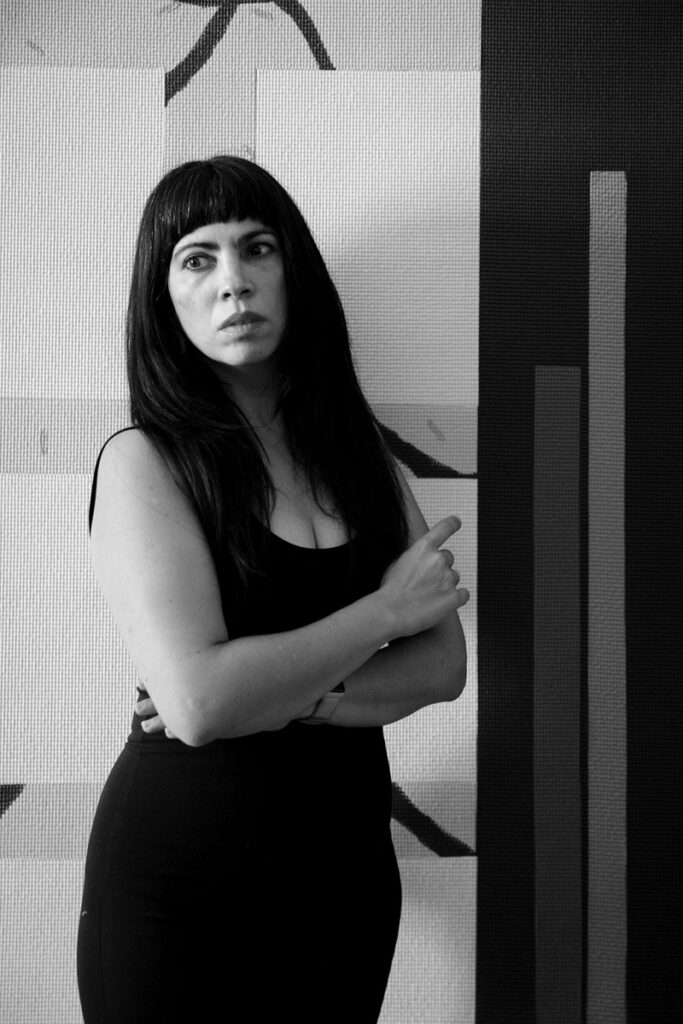
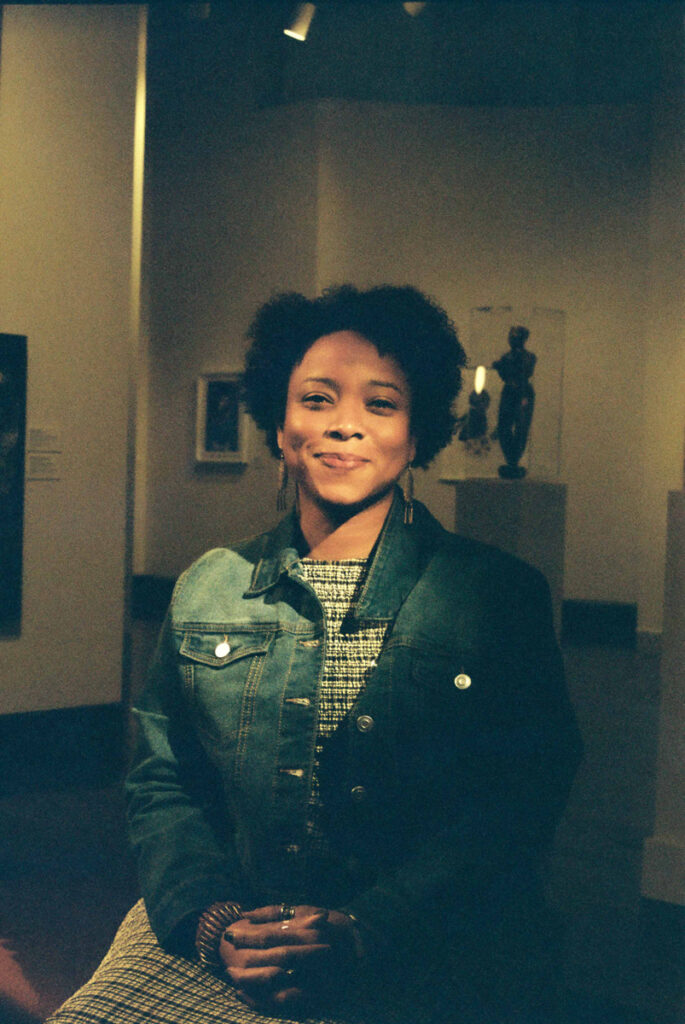
Alex EbsteinArt is one of the most enduring ways we record the stories and concerns of our time. I want an audience to experience that feeling, seeing these practices as the culmination of research, documentary and imaginative leaps that universalize the stories being told.
Do you see a relationship between these artists’ art practices?
The artists in Tangential Realities take on big topics like identity, utopia, climate change, anxiety over artificial intelligence, and our movements through time and space. Together, these pieces invite us to participate in an active curiosity about the ways humans limit their experiences of the world as a result of constructed categories. Each of these artists also has a practice that involves collaboration and site-specific research and making.
These artists are recipients of Performing Arts (Red Rae, 2024) and Media Arts (Rashida Bumbray 2024, Marnie Ellen Hertzler 2023), and Visual Arts (Ada Pinkstone, 2017) How did you navigate the multiple practices in the gallery space?
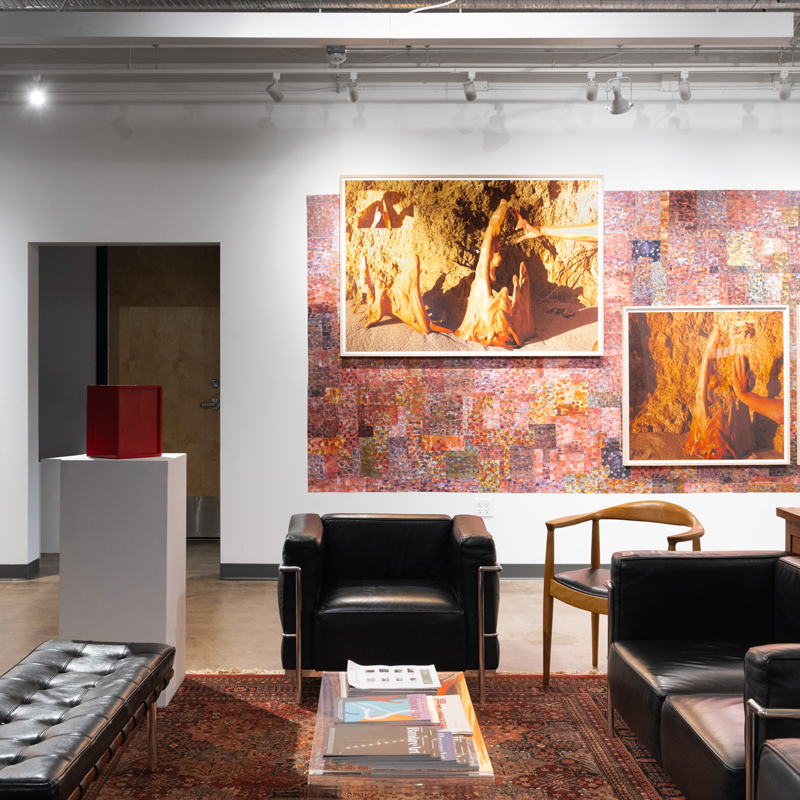
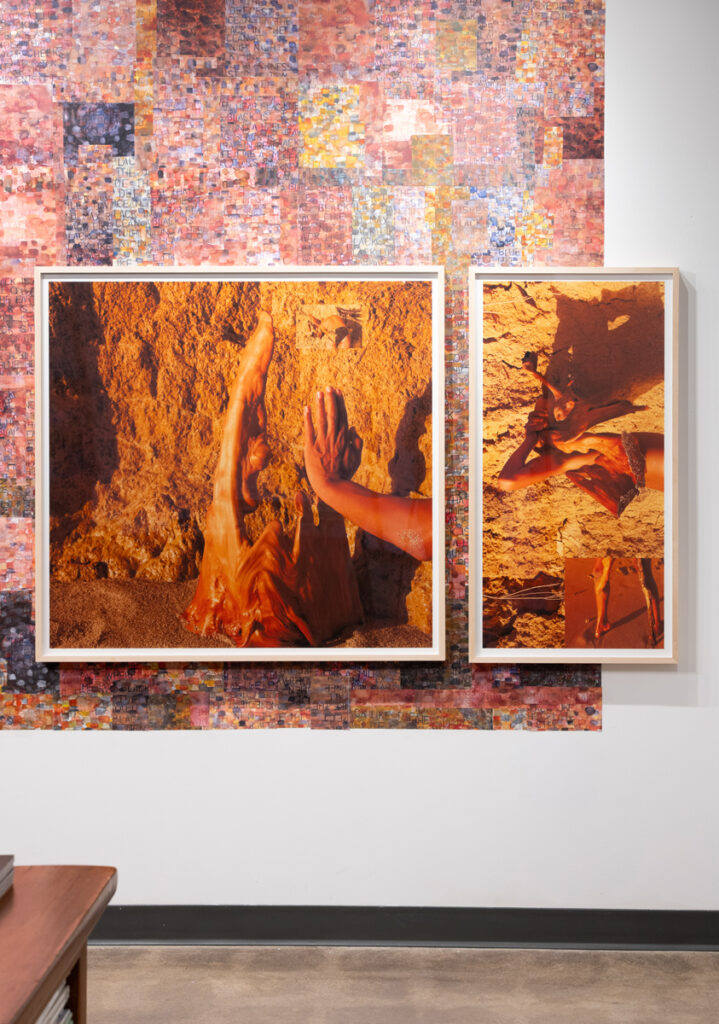
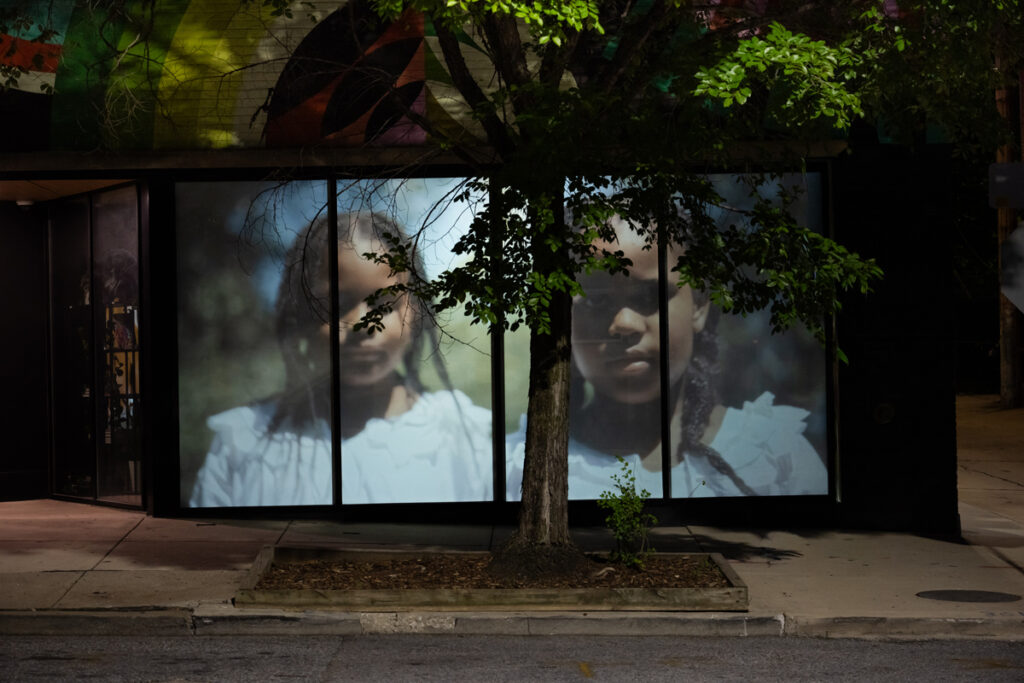
The short answer is by dedicating a similar amount of space to each artist’s work, and by working with technicians like Greg St. Pierre and the Connect + Collect team to realize a dynamic installation. Red and Marnie were able to present new pieces that they completed for the exhibition with the space in mind. Ada used the opportunity to present her works in a new way, integrating a series of watercolor paintings that are installed as a wheatpasted mural behind her photographs. It was important to me to give that same presence to Rashida’s film, simultaneously playing it on a monitor and rear projected in the gallery’s windows.
What do you want the audience to take away from these four artists? Does Baltimore play a role?
Art is one of the most enduring ways we record the stories and concerns of our time. I want an audience to experience that feeling, seeing these practices as the culmination of research, documentary and imaginative leaps that universalize the stories being told. As a reflection of the Rubys program, I hope it demonstrates the breadth and ambition of the awardees, and inspires further investment in artists and their unruly, interdisciplinary, creative visions.
Is there a connection between your curatorial practice to your position as the Senior Program Manager for the Rubys Artists Award?
On the front end, not so much, except that I try to curate jury panels that have a range of experience in their discipline. After the Rubys cohorts come together, I often get to work with the grantees to help set up studio visits, relevant programming, and various creative problem solving that feels closer to the work of a curator. Wearing either hat, I consider it a privilege to work closely with artists as they’re developing their work and to do my part to support that process.
As the first exhibition highlighting recipients of the Rubys Artist Grant, how do you plan on moving forward emphasizing Baltimore’s creative community in the gallery space?
I hope this is the first of many exhibitions that feature the Rubys Artist Grant recipients. Each year I am thoroughly impressed by the work of our grantees, and I think it would be an exciting biannual goal to identify unifying themes, and a challenge to include work from all four disciplines in future iterations. As an artist and curator in the city that I love, it is always my intention to be contributing to and supporting the creative community in galleries and alternative spaces. The art community is why I love living here and my personal mission is to hold more space for the incredible work being made here
Ada Pinkston
As a recipient of the Rubys Artist Grant, how has this grant impacted the work shown in the exhibition and your current art practice?
I initially received a Rubys Artist Grant in 2018 to create “LandMarked: Make Memory Move.” The project was first conceptualized in 2015, following the massacre at Mother Emanuel AME Church in Charleston, South Carolina. In the years that followed, as Confederate monuments became the subject of national debate and several were removed from Baltimore, the work took on an even greater sense of urgency and relevance. One thing I always share is that I applied for the Rubys Artist Grant several times before receiving it. I mention that because I want other artists to know that rejection is not the end of an idea. Sometimes it takes persistence for the right opportunity to align with the work, and resilience is an essential part of an artistic practice. The first “LandMarked: Make Memory Move” performance honored the life and legacy of Fannie Lou Hamer, the freedom fighter whose organizing helped secure voting rights for African Americans in Mississippi and across the country. This abstract performance sought to channel her spirit while reflecting on the unfinished struggle for justice, from the aftermath of the Civil War and Reconstruction to the codification of racist systems through Jim Crow laws, redlining, and other discriminatory policies.
Over the years, the Rubys grant has become the foundation for an evolving platform of public performances that uplift the stories of people whose lives and contributions have been overlooked within traditional monument architecture. Rather than commemorating history through static monuments, this work asks how memory can be embodied, activated, and shared through performance.
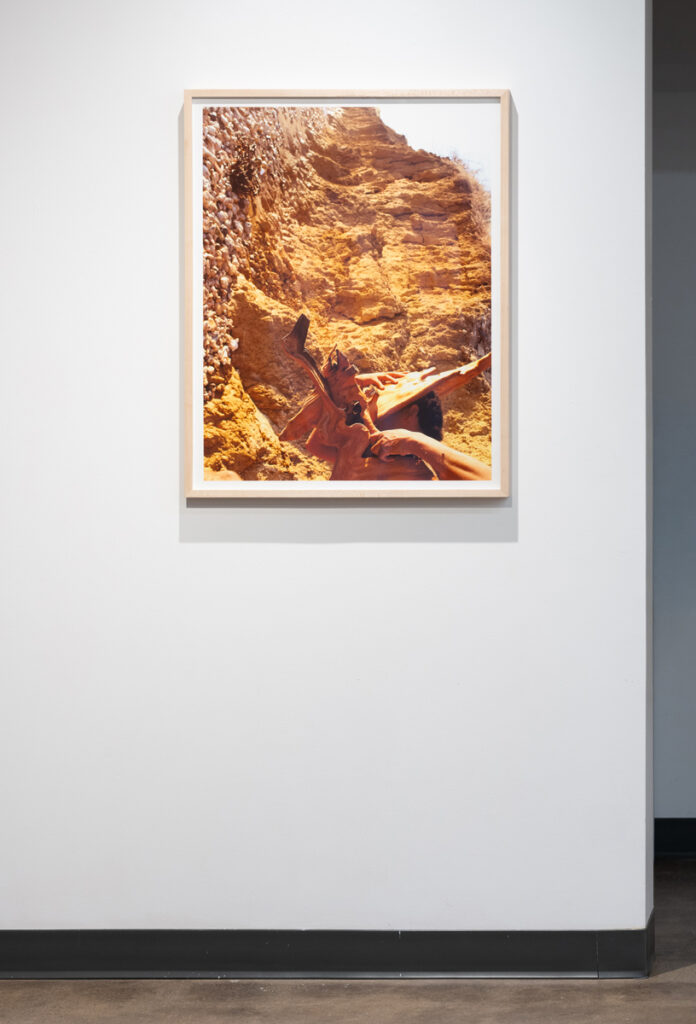
The photographs featured in the foreground of the exhibition are from a series I made with my longtime collaborator, Justin Kennedy, in St. Croix, U.S. Virgin Islands, in 2022. Working from the idea that both the body and the earth are monumental forms, Justin performed with the intention of merging their body with the natural materials of the land where they were raised. These images continue my exploration of monumentality through the body, landscape, and collective memory.
The wallpaper installation in Tangential Realities comes from another body of work that began during my artist residency at Yaddo in Saratoga Springs, New York. While there, I gathered walnuts from the grounds and developed my own walnut ink, which became the foundation for the Series of Nonsequitters paintings.
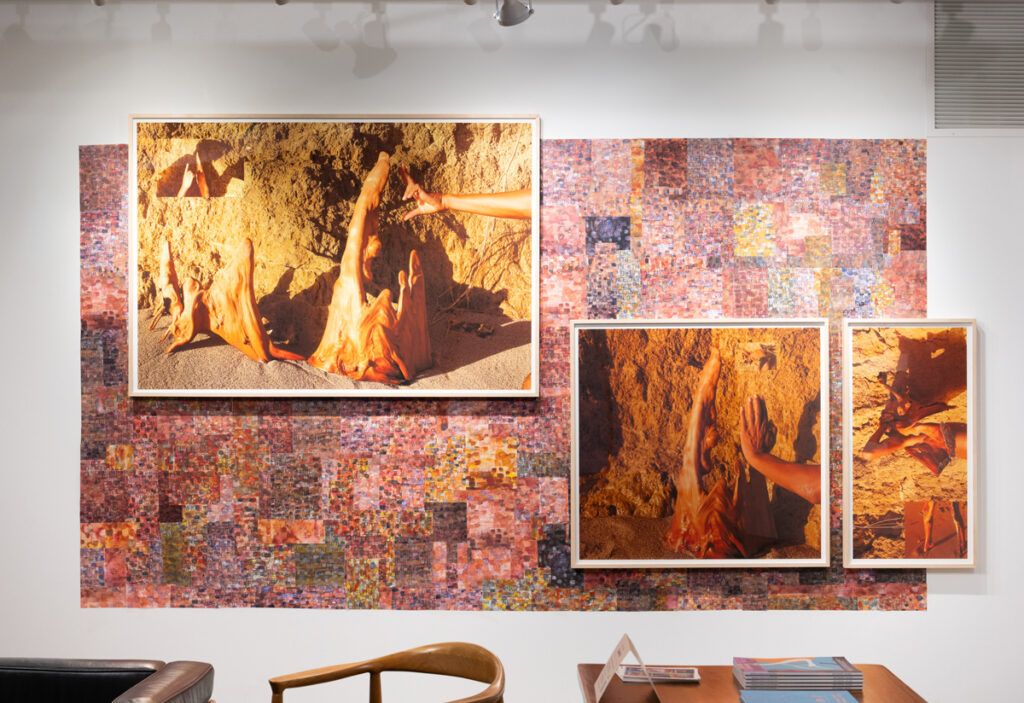
The series began as a tongue-in-cheek exploration of Blackness, drawing from familiar sayings, everyday experiences, cultural observations, and seemingly unrelated ideas. Over time, the work evolved into poetic meditations on what it means to be a Black woman in the twenty-first century. I think of these works as poetic interpretations of paintings, or perhaps paintings that function as poems. I began the series in 2022 and plan to continue until I have completed 365 paintings, which I hope to exhibit together as a single installation.
What does Tangential Realities mean to you in your art practice?
For me, Tangential Realities describes both a way of thinking and a way of making. My studio practice is driven by following tangents, allowing myself to become deeply immersed in a concept, material, shape, or form. The freedom to hyperfocus, experiment, and trust unexpected connections is one of the greatest gifts of being an artist.
I have come to understand that those tangents are not distractions; they are where discovery happens. They create space for intuition, memory, and history to intersect in ways I could never have planned. My hope is that these objects and aesthetic experiences invite viewers into that process, moving them closer to their own humanity. Through that closeness, I believe we can begin to imagine a future grounded in truth, justice, and our shared responsibility to one another.
Marnie Hertzler
As a recipient of the Rubys Artist Grant, how has this grant impacted the work shown in the exhibition and your current art practice?
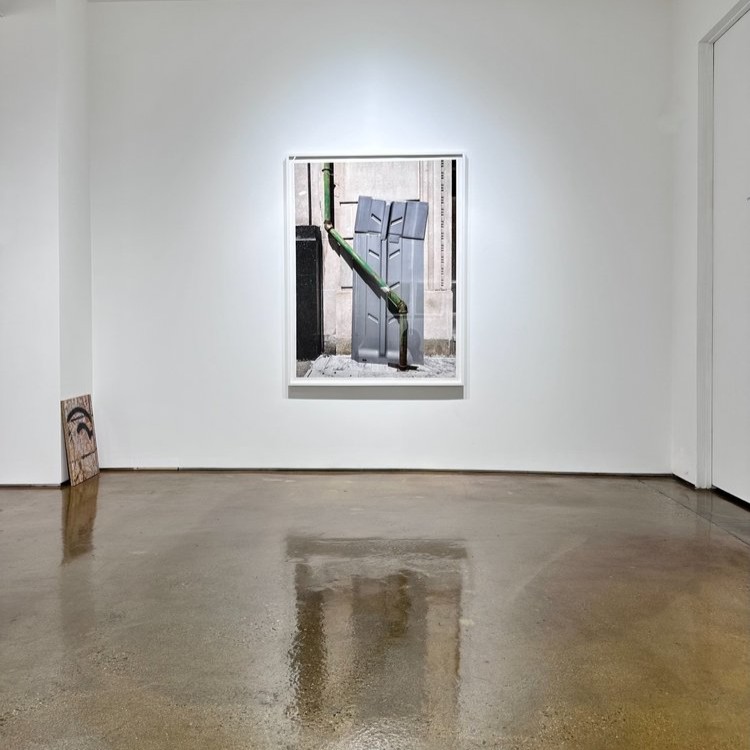
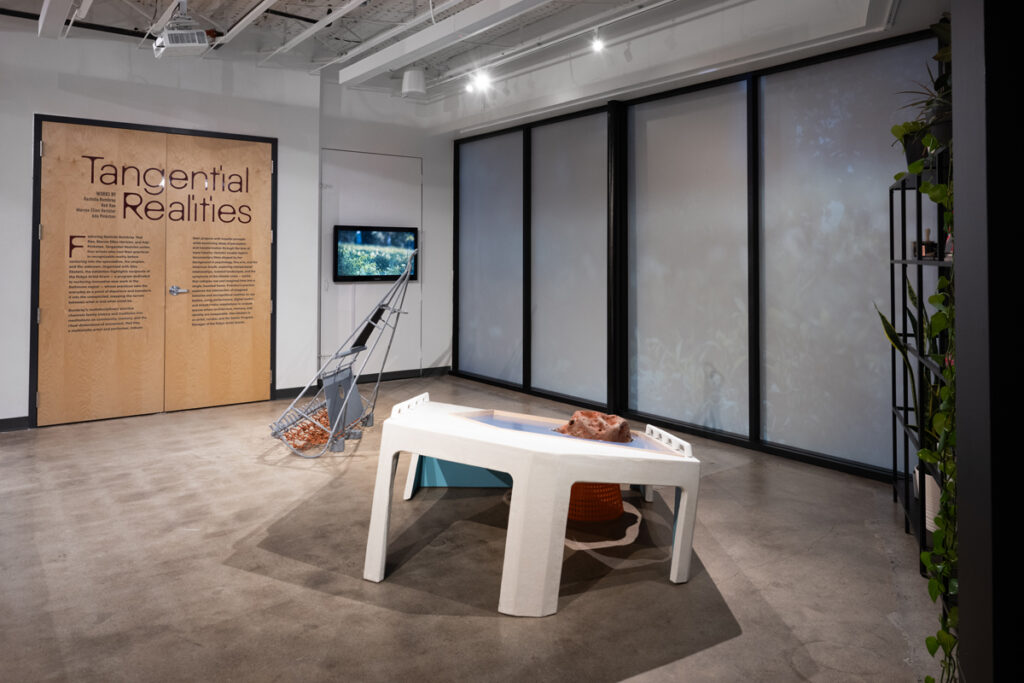
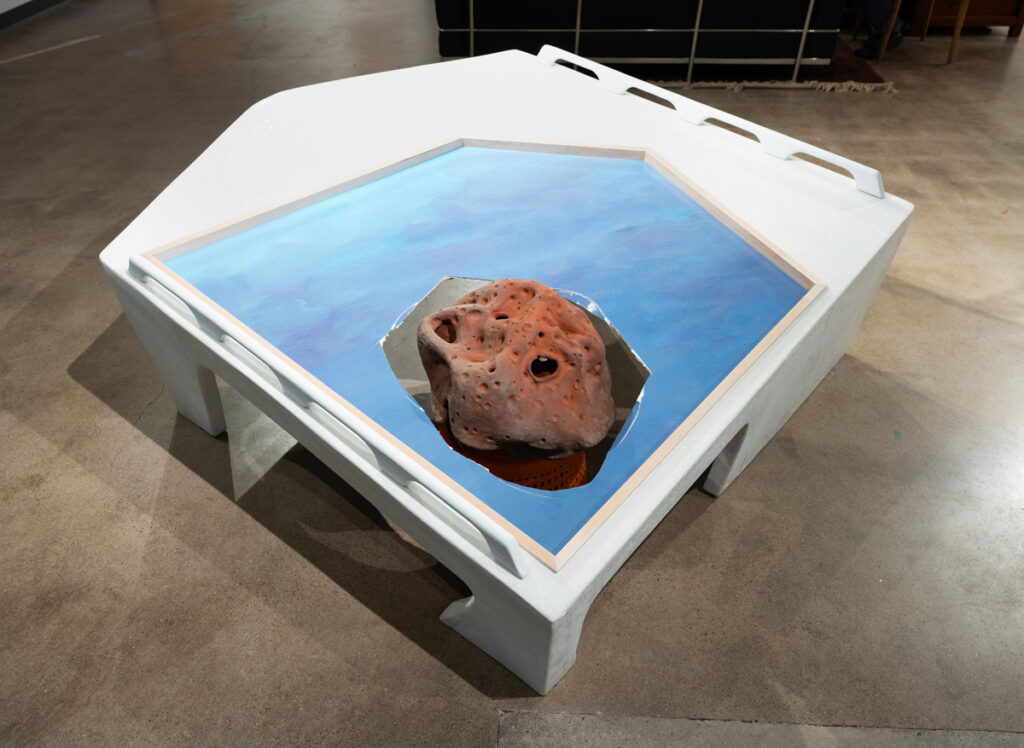
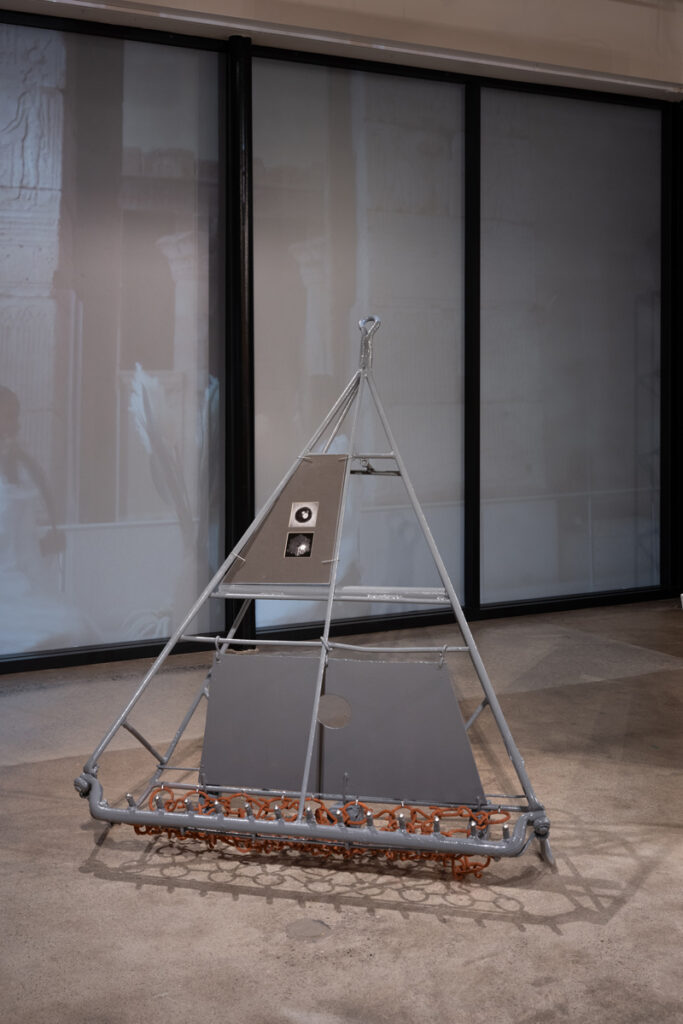
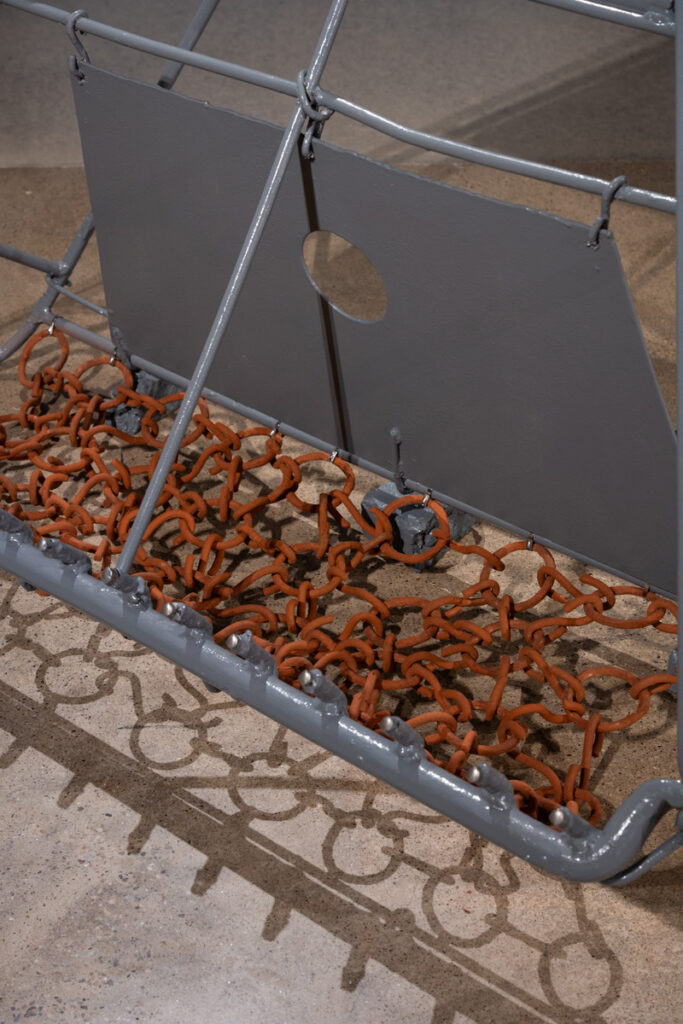
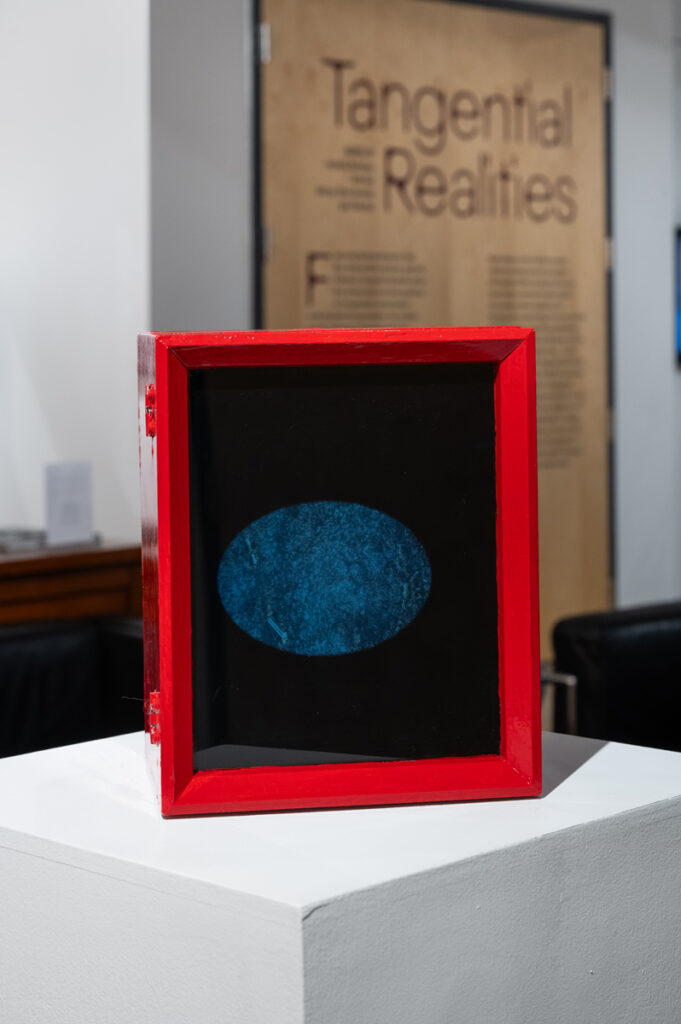
The Rubys funded the post-production of Eternity One, my documentary feature about Tangier Island, a fishing community in the Chesapeake Bay that is disappearing into the water. Post-production is where a film finds its final form, and the grant let me finish that work after six years of returning to the island. The sculptures in this exhibition came out of those same returns. Retina and Deadrise are built from the island’s working materials: an oyster dredge, a harvest basket, boat parts, clay dug from the Bay itself. Some of what I found on Tangier could not be held by a frame, so it became sculpture instead. The grant supported a film, and in doing so it fed everything around the film.
What does “Tangential Realities” mean to you in your art practice?
The Chesapeake Bay sits inside a meteor crater. The clay I dig from Tangier Island formed inside that impact 35 million years ago. A woman plays bingo at the firehouse on an island scientists say will be uninhabitable by 2051. These realities run alongside each other, touching at a single point, and that point is usually an object. An oyster dredge is a tool, a livelihood, an instrument of ecological collapse, and a relic, all at once. My work tries to hold the object still long enough for the other realities to become visible. “Tangential” means they never fully merge. The marsh and the town share an edge. The edge is where I work.
Red Rae
As a recipient of the Rubys Artist Grant, how has this grant impacted the work shown in the exhibition and your current art practice?
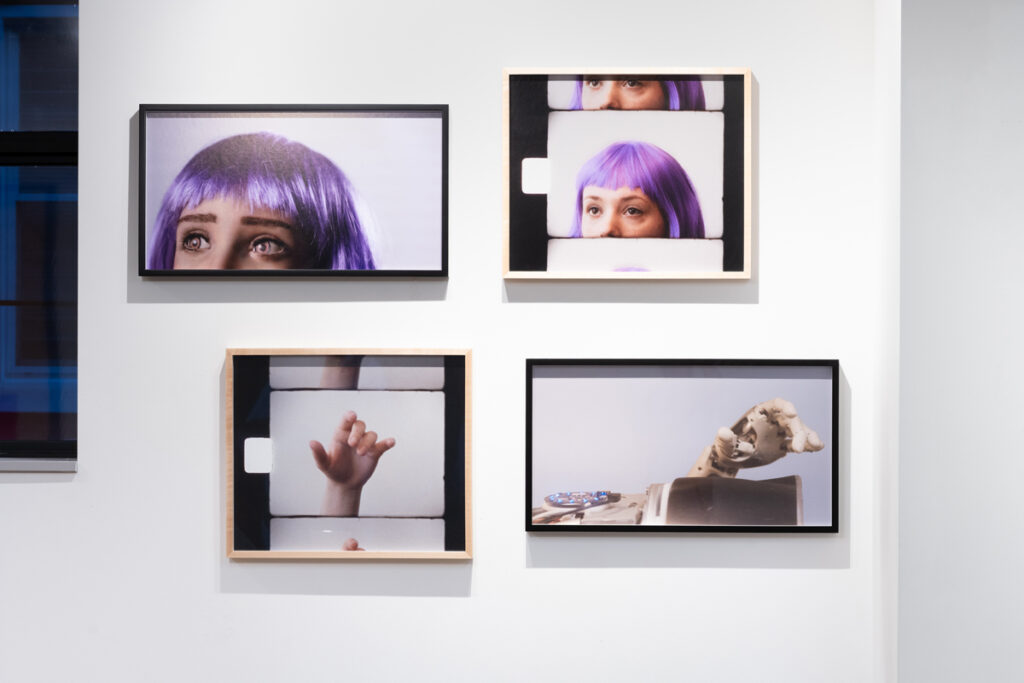
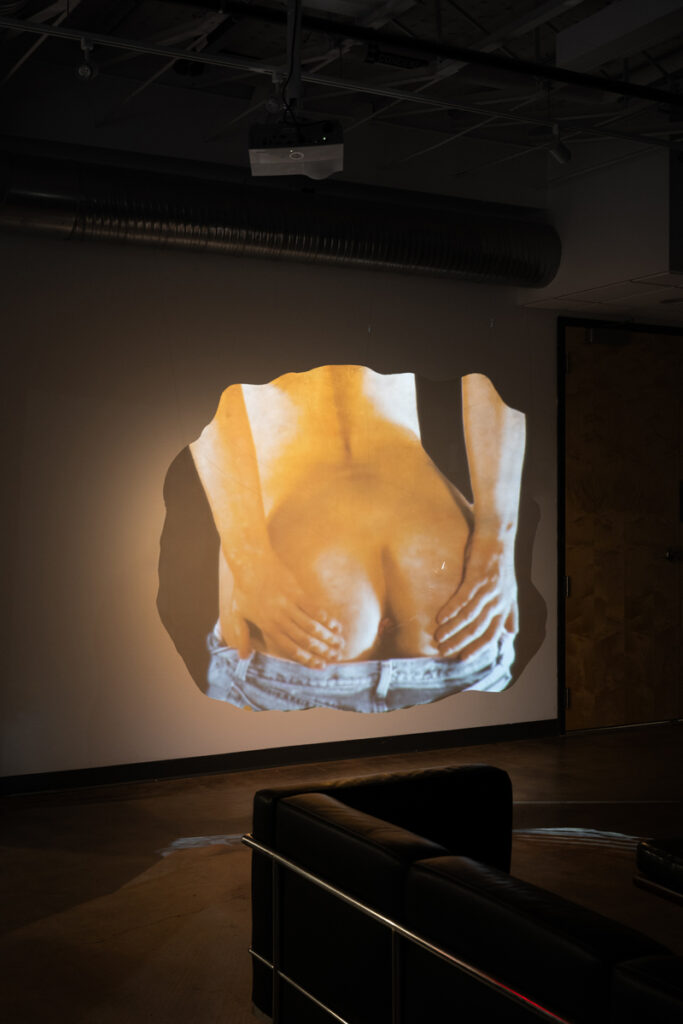
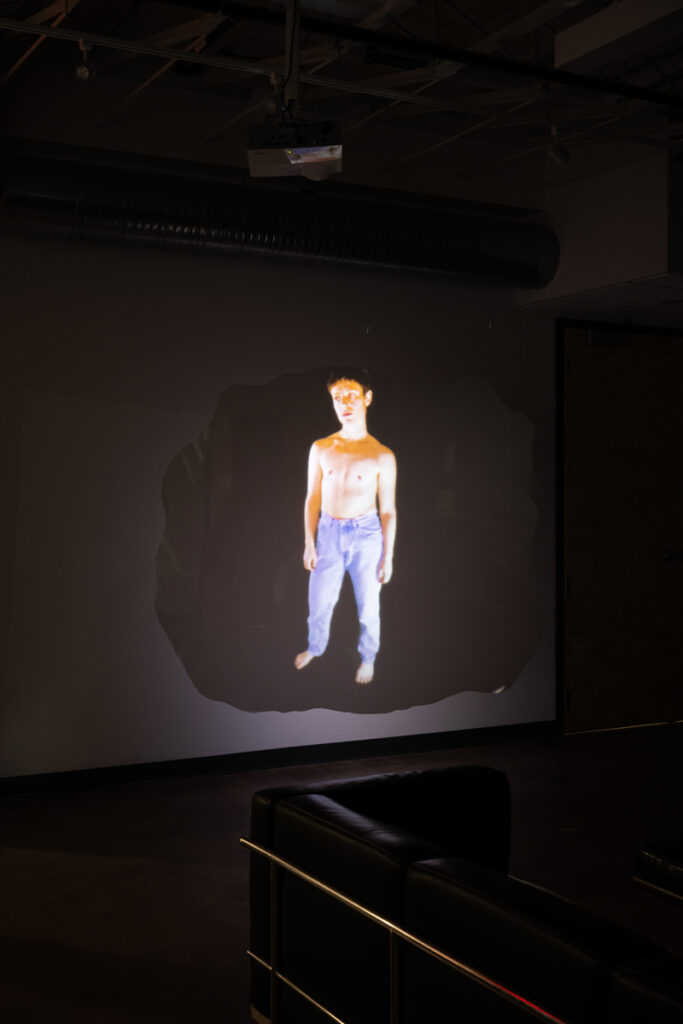
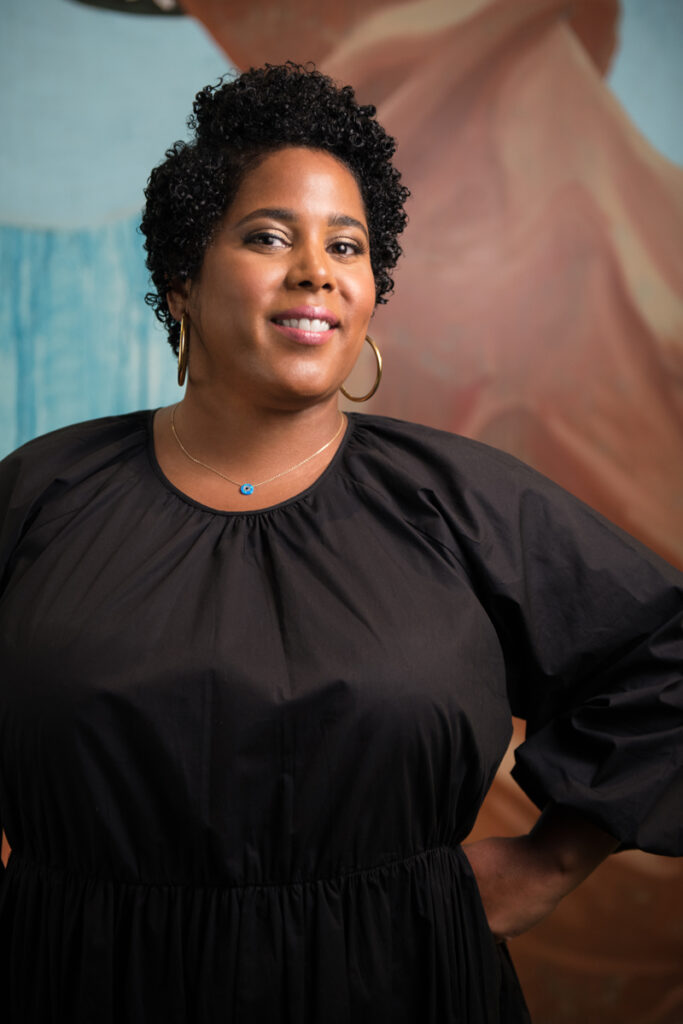
The Rubys enabled me to mount my largest and most ambitious show to date titled Paradise Portals. In May 2025, I filled Area 405, a 5250-square-foot gallery, with large projected portals, small portals hidden in the framework of the building and an accompanying performance series. I made the work in collaboration with other queer and trans artists, scholars, poets, drag queens, and witches. I painted portals opening onto and into our bodies that lead to alternate realities that we created together. Our portals led to queer historic spaces, trans history, cruising fairy forests, Divine’s grave, our inner gluttony, resting in the center of a flower, our grief, and our desire. The grant supported the Paradise Portals project and in doing so enabled me to confidently propose work of that scale to other spaces. I am hopeful that the impact of receiving the Rubys is ongoing and continues to unfold.
What does “tangential realities” mean to you in your art practice?
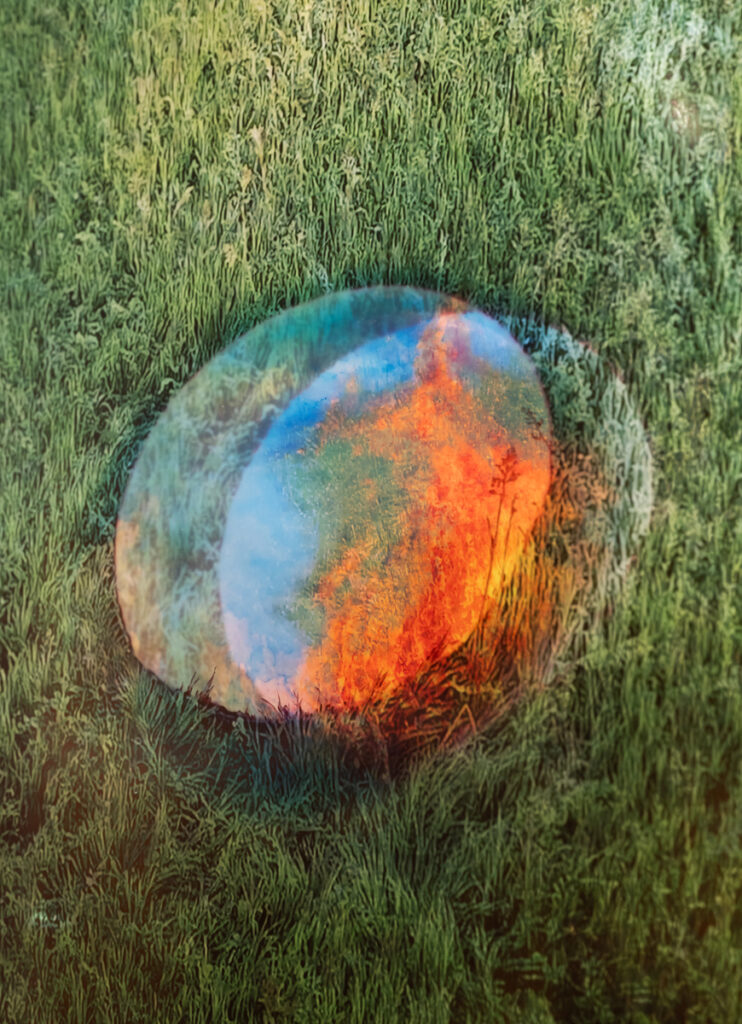
A portal is an opening into an alternate reality, a place that is always present but otherwise hidden. A portal can lead to a parallel timeline, a significant past, a fantasy land, a place that is far beyond our comprehension, or a Tangential Reality. The three Fire Portals open into my body, a lush prairie and burnt landscapes. They evoke the way fire has been a powerful force in political resistance as well as in forestry and prescribed burns.
In May, I had the opportunity to go to Nebraska to learn prescribed burn techniques. I experience first hand what it means to collaborate with destruction in service to life. My three fire portals in Tangential Realities draw on that ancient knowledge. We can learn so much from the deep history of fire evolving alongside life and use that knowledge to re-contextualize our relationship with destruction. The Fire Portals open continually in the Connect + Collect space (and in my body and in the prairie) to reveal fiery dreamscapes that show that we all contain that which is necessary for both our evolution and our destruction.
Rashida Bumbray
As a recipient of the Rubys Artist Grant, how has this grant impacted the work shown in the exhibition and your current art practice?
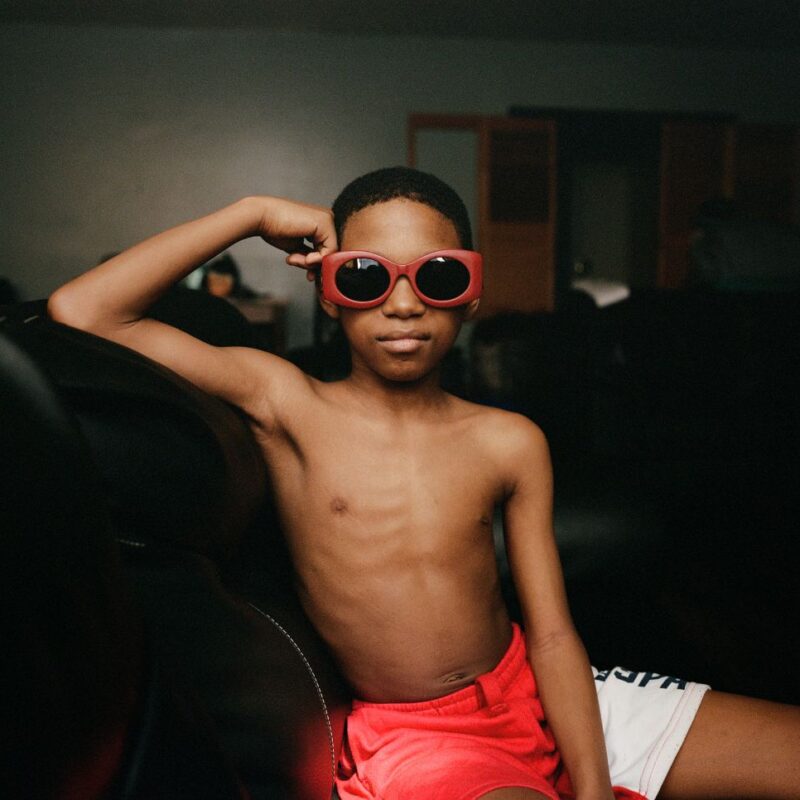
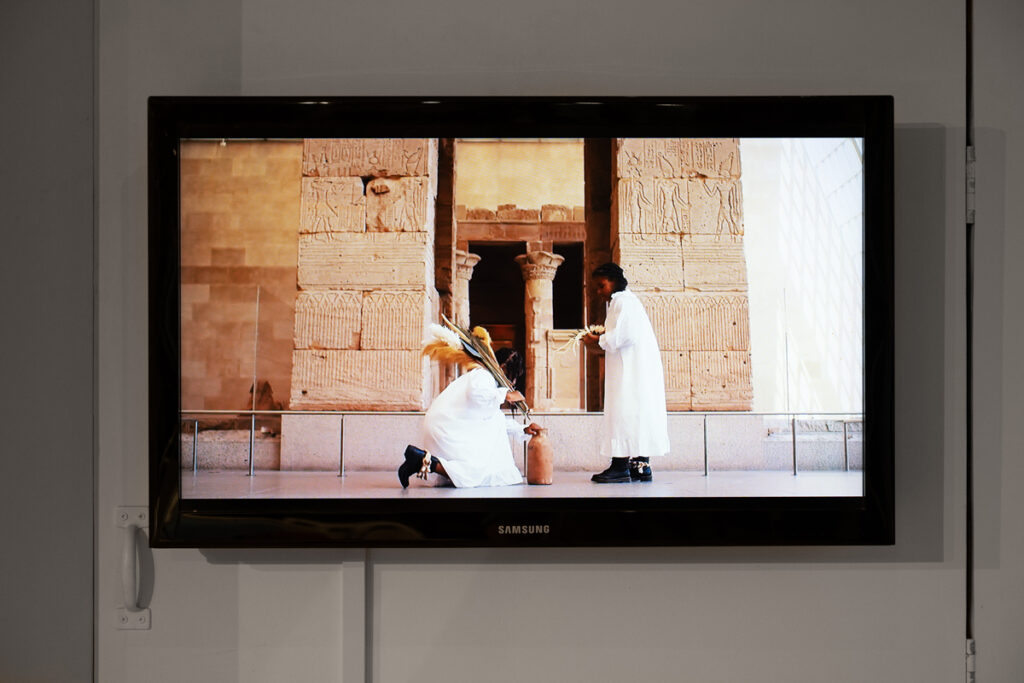
The Ruby’s Grant is truly what made this work, “Untitled (How High the Moon)” possible, by supporting the post production. As such, the film or an installation of this film has been presented in many exciting contexts, including the exhibition “Flight Into Egypt!” at the Metropolitan Museum of Art, New York, curated by Akili Tommasino, and at the Black Star Film Festival, Philadelphia where it won the Black Star Film Festival Audience Award for Favorite Experimental Film and was Jury Nominee for Best Experimental Film. It has also been screened as part of the Maryland Film Festival, Baltimore, the New Orleans Film Festival, New Orleans, the New York Shorts Festival, New York, and was included in the exhibition, “Rashida Bumbray & Amanda Kerdahi,” at Texas Woman’s University, curated by Lauren Kelley.
What does tangential realities mean to you in your art practice?
I love the concept of alternative realities, specifically those that are tangential to an accepted mainstream “reality.” Many of us understand ourselves, and our lives through a lens or prism that is inward gazing, internally facing and sometimes invisible or illegible to the mainstream; this is an important posture in a climate of displacement and erasure. This is increasingly relevant during this period of intense collapse of the scaffolding of empire where the realities we have been taught to accept as the norm are imploding. Therefore, I am more interested in Magical Realism; as defined by Kamau Brathwaite: the forms, music, literature and movement languages developed by Black people in the New World as an alternative to insanity and a result of the catastrophes of colonialism and the middle passage.
Tangential Realities is on view at BmoreArt’s Connect + Collect Gallery through September 30 by appointment. Please use this form to schedule a visit.