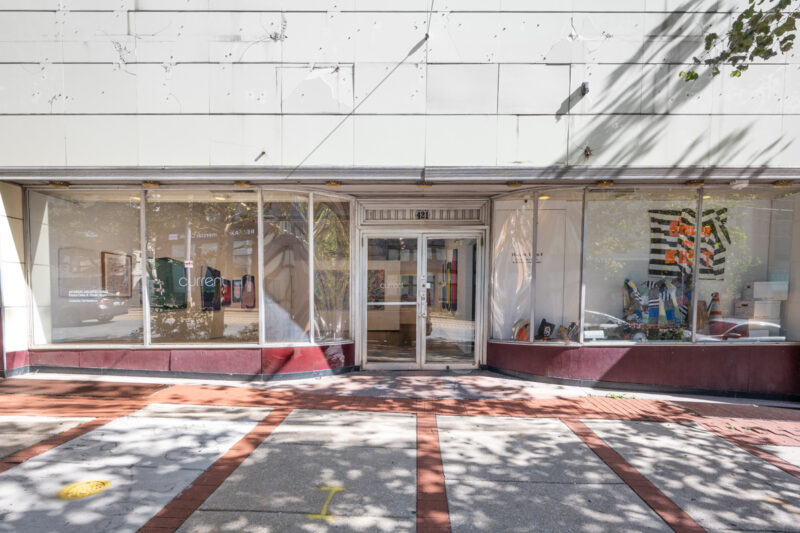
On October 3, Current Space opened two two-person exhibitions: Interior Architectures and Back East. In the latter, installed in the smaller of the galleries, Rahne Alexander and Erin Stellmon retrace and unpack their journeys from the West Coast to Baltimore, while the larger space hosts Interior Architectures, curated by Teri Henderson. Henderson’s exhibition features bold, vivid paintings and drawings by Baltimore-based artists Emma Childs and Vinnie Hager. Together, these group shows find kinship through collaborative artistic practice.
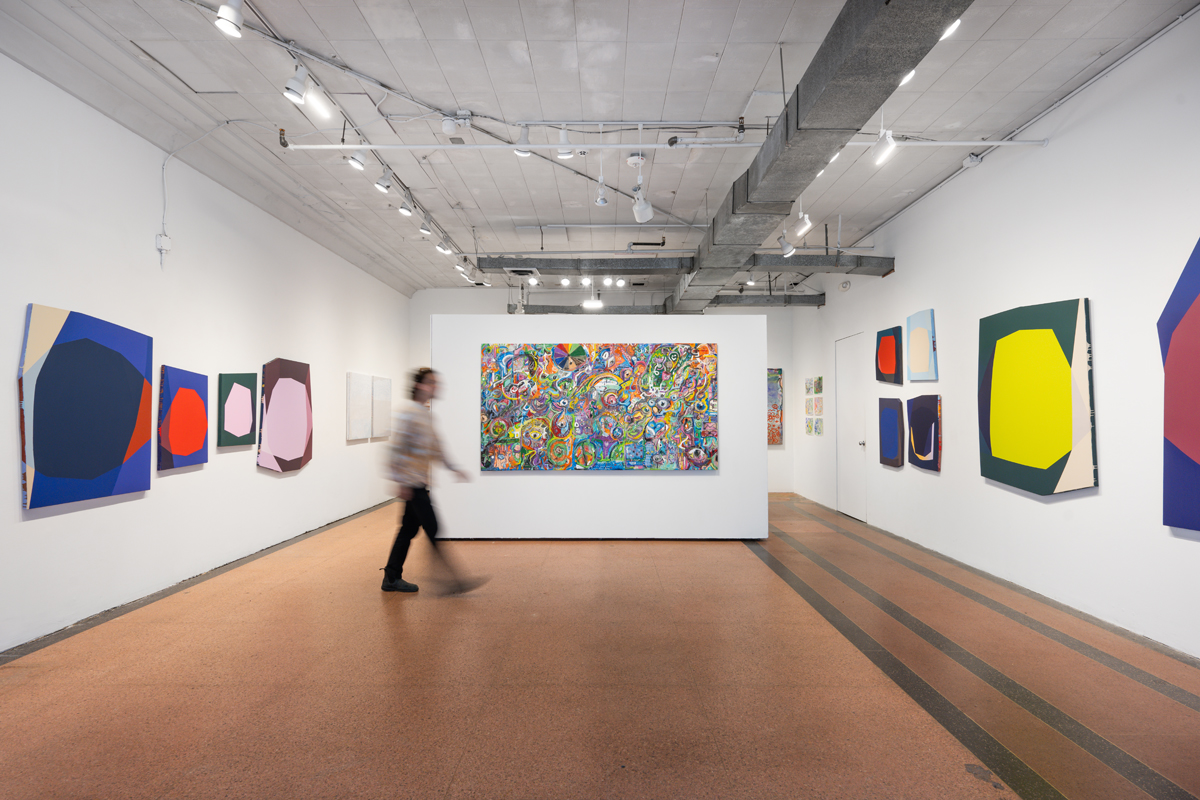
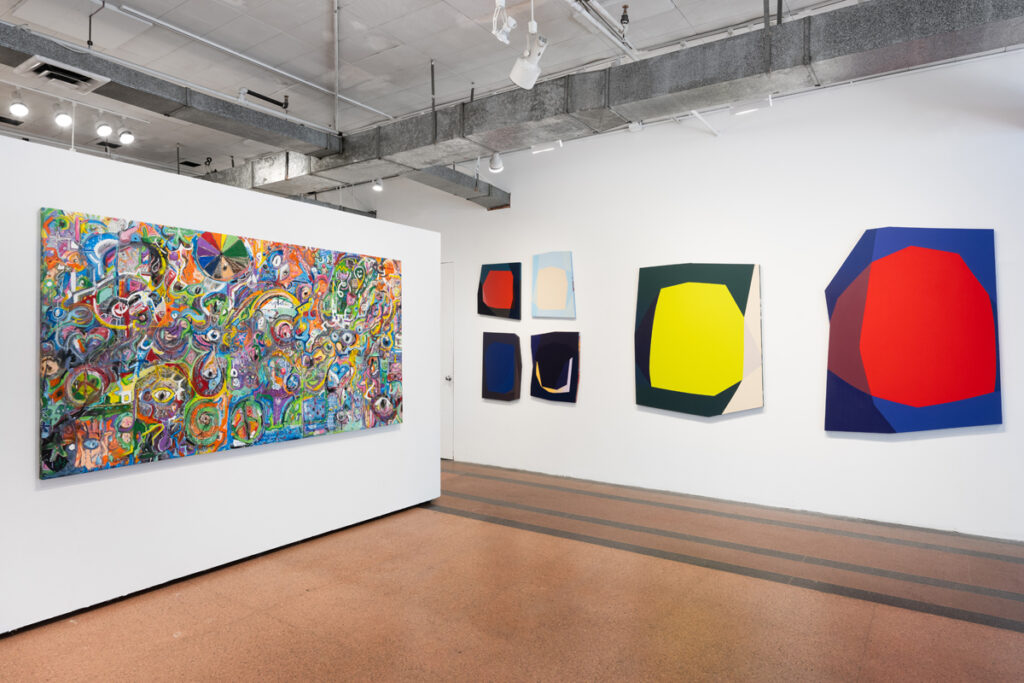
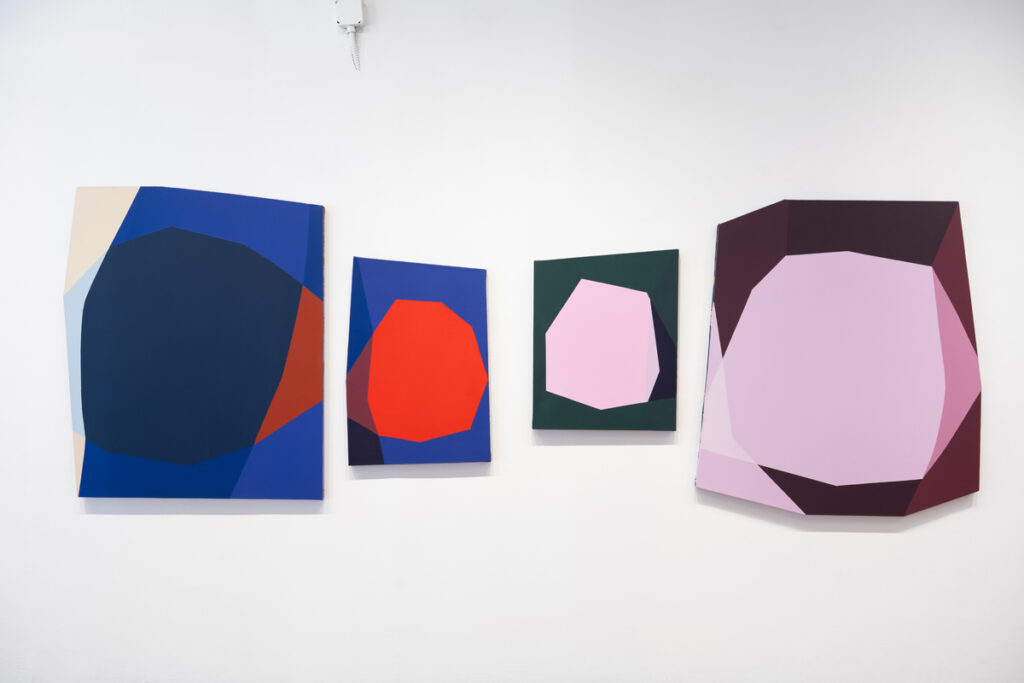
Interior Architectures explores Hager and Childs’ collective visual language and sculptural clarity. Childs’ “Oblivious” and Hager’s “Smudge” instantly set the tone of the exhibition. Childs’ canvas, hewn at the left corner, gives the painting sculptural depth while her color palette—washed out whites, creams, and grays—creates strong simple lines and angles structured by calculated shading. Replete with symbols of eyes, flowers, ghosts, peace signs, and envelopes, Hager’s “Smudge” seems born from endurance, an exercise in drawing in which these forms allow us into his world.
...a literal translation of how artists can communicate across time and space through works…to reflect on the ways we construct and inhabit our own internal worldsTeri Henderson, curator
Meanwhile, paintings such as “Tennis Match” showcase Childs’ vision in manipulating paint into voluminous forms. Resembling a gemstone, a streak of beige hangs from the upper left of the canvas. Underneath, a rivulet of light blue paint complements the dark blue form, eye-like, dominating the middle of her composition, at once jagged and round. At right, a sliver of red-orange seems to evoke the clay on a tennis court. Close-up, these layers of paint afford the viewer an opportunity to look inward and consider the worlds we build up around ourselves. If this two-person exhibition is to embody world building, however, it feels invaluable to home in on Hager’s largest and accomplished painting in the show “Experimental Wetland.”
Hager’s painting rightly centers the gallery, hanging from a single central wall. Taking cues from street art aesthetics, “Experimental Wetland” reads like a mural we might see while walking down a Baltimore alley. With more space and built up paint, it offers endless possibilities for experimentation. Here, Hager’s all-over technique charges the work with a palpable windswept energy that brings us deeper into nature, layering purples, swampy greens, lavenders, pinks, oranges, and whites throughout the canvas. The continual juxtapositions between symbols and vast swaths of paint only heightens Hager’s savvy painterly style which simultaneously alludes to Willem de Kooning and Keith Haring.
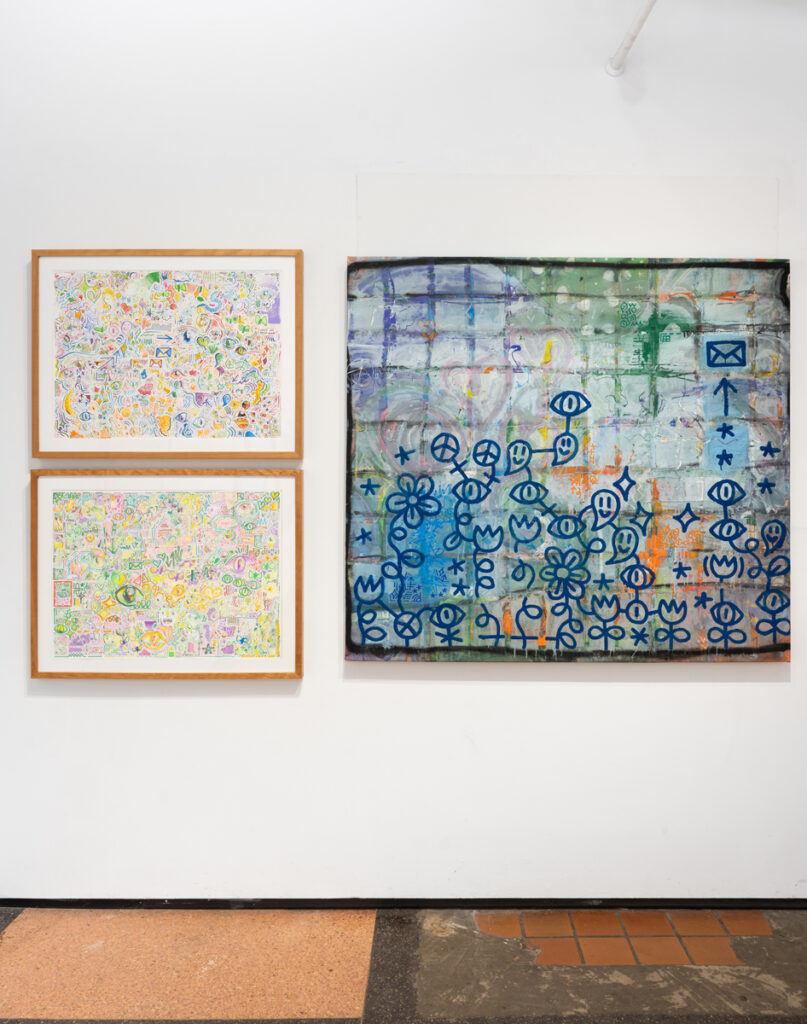
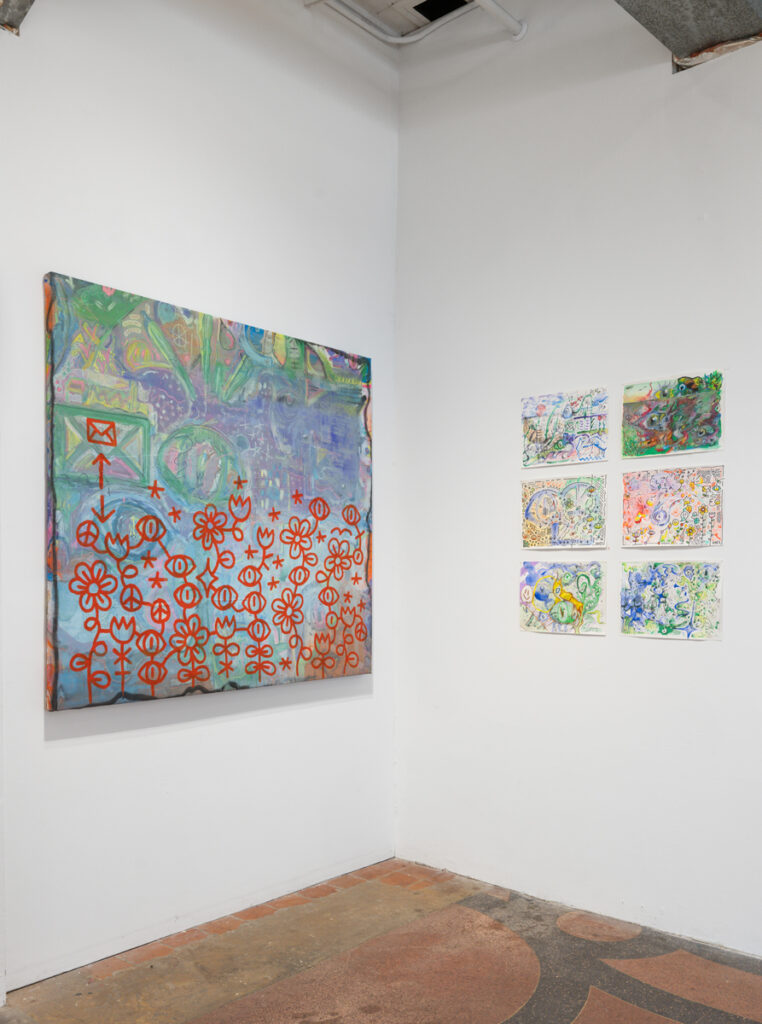
But what conversations might arise from Childs’ and Hager’s convergence? Although we see moments in which their paintings hang side by side, the back of the gallery displays six collaborative paintings. “Untitled #2,” for instance, incorporates Childs’ sharp coral pink and brown forms that stand out against Hager’s white symbolic work: a spider web, eyeballs, and many squiggly lines. It is a result of trust, a call and response that highlights both the artist’s particular strengths and intuition. According to Henderson, these paintings “are a literal translation of how artists can communicate across time and space through works…to reflect on the ways we construct and inhabit our own internal worlds.”

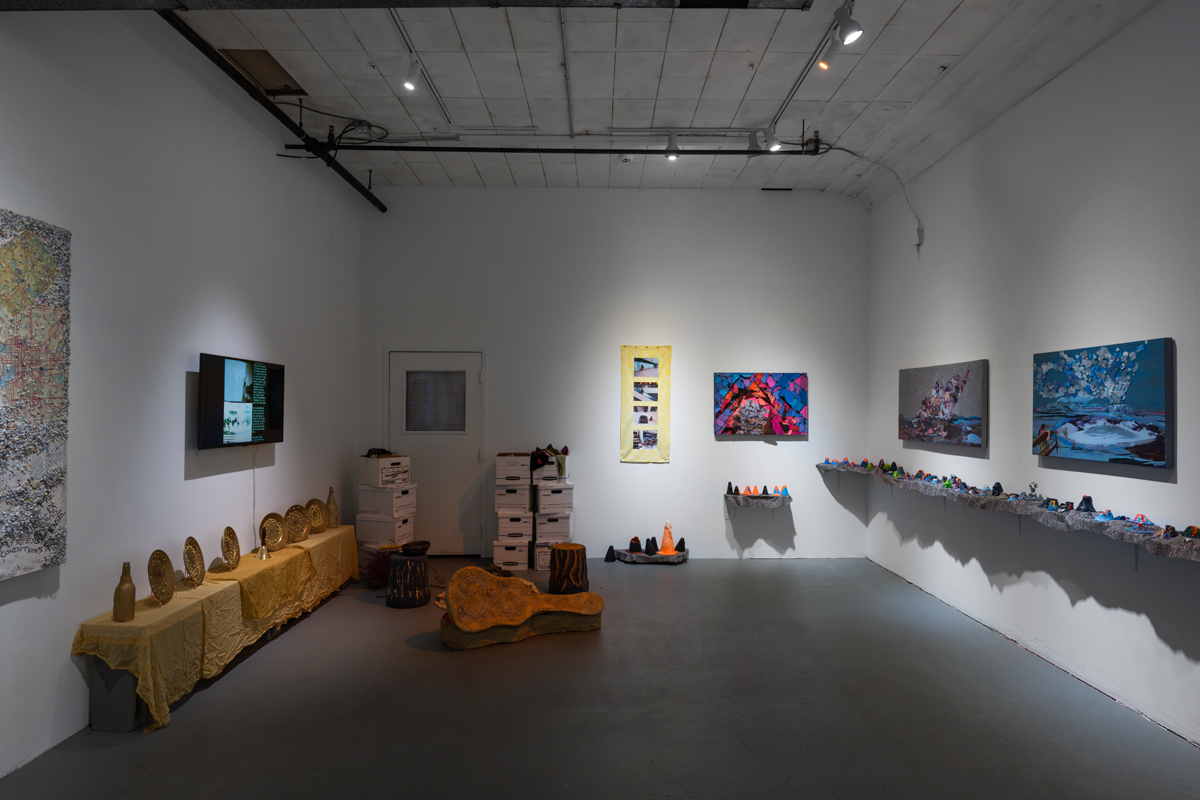
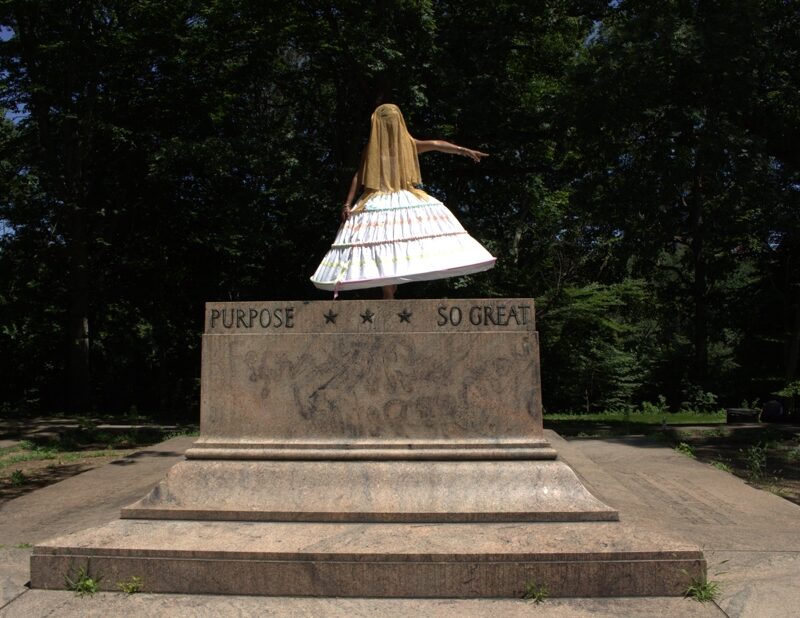
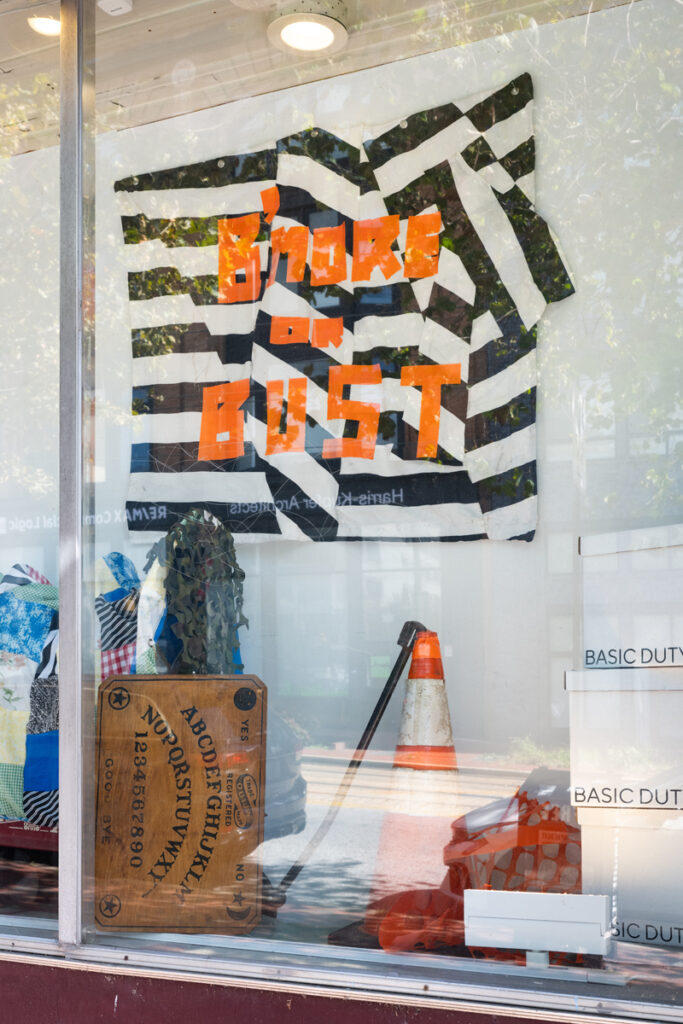
Meanwhile in the smaller gallery, Alexander and Stellmon’s Back East features traffic cones, ceramic volcanoes, gold plates, a trans camp, and banker boxes filled with clothes and shoes. These materials are tropes and catalysts for inspiration the artists return to again and again. Foregrounding Alexander and Stellmon’s exhibition is “Go East Young Weirdo,” a single channel video that finds the two artists journeying around Alexander’s home in Waverly. As they navigate these spaces, Alexander carries around a blank canvas while Stellmon pulls a covered traffic cone in a wagon. In true pioneer fashion, we see them settling down for the night at a campfire before continuing their trek in the morning—blank canvas and headboard in toe.
Viewers will recall Alexander’s untouched canvas from the initial video installation which she fully realizes in “Pre-Existing Conditions.” Using text from Roland Barthes’ Mythologies and a gamified Mormon path that dead ends in Utah, we see Alexander question her former life as a Mormon. An innumerable amount of tiny crumpled up pieces of paper informs her composition alongside street maps and symbols. Together, these components suggest how her former life held no future and why she needed to head east.
Similarly, “Testimony” another single-channel video juxtaposes lines from Mormon texts with glitched out scenes from Little House on the Prairie and Battlestar Galactica. The latter of which Alexander notes was the first television series created by a Mormon. But because she obscures and complicates these video clips, it asserts her frank misgivings with Mormon values and beliefs. It marks an abdication from her past while upholding her current views today.
On the gallery floor, we see a campfire, skillet on a stump, and an acoustic guitar painted in gold with text down the fretboard that reads, “WE WILL OUT LIVE THEM.” Inside the guitar case lies a dagger and pages slashed from a Mormon bible. This trans camp, as Alexander puts it, empowers trans folk through urgent textual slogans.
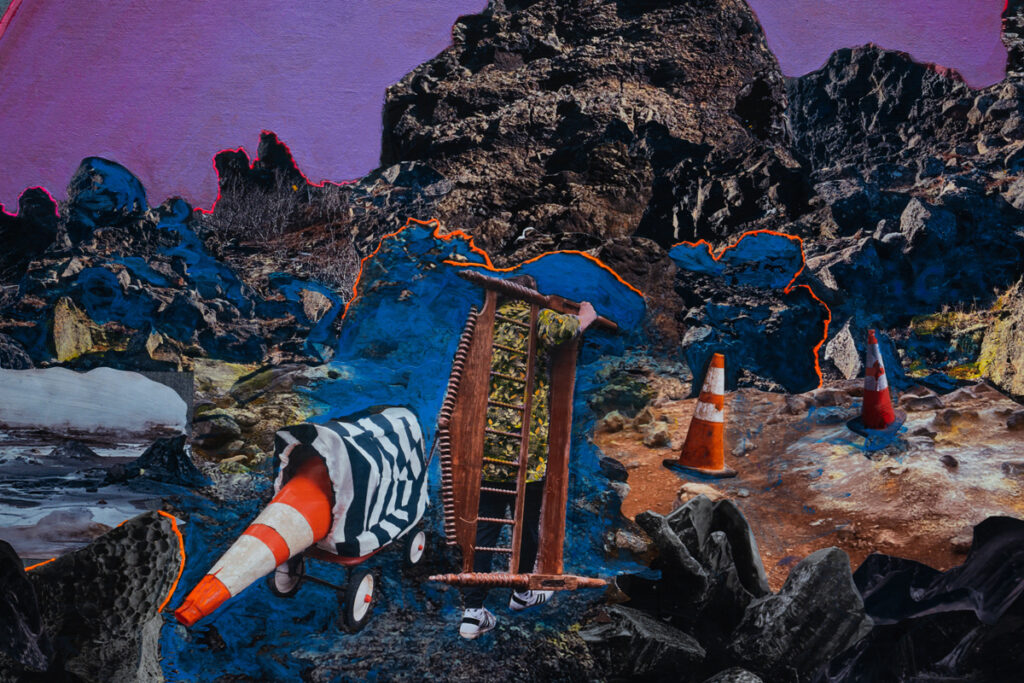
I was happy to chat with Stellmon who eagerly shared some context for Back East. The headboard she frequently hefts around in these images is a family heirloom that traces back to her ancestors along the Oregon Trail. Photographs in the exhibition show her holding the headboard while taking an escalator and sitting down with it at an empty mall food court, as though it were a friend.
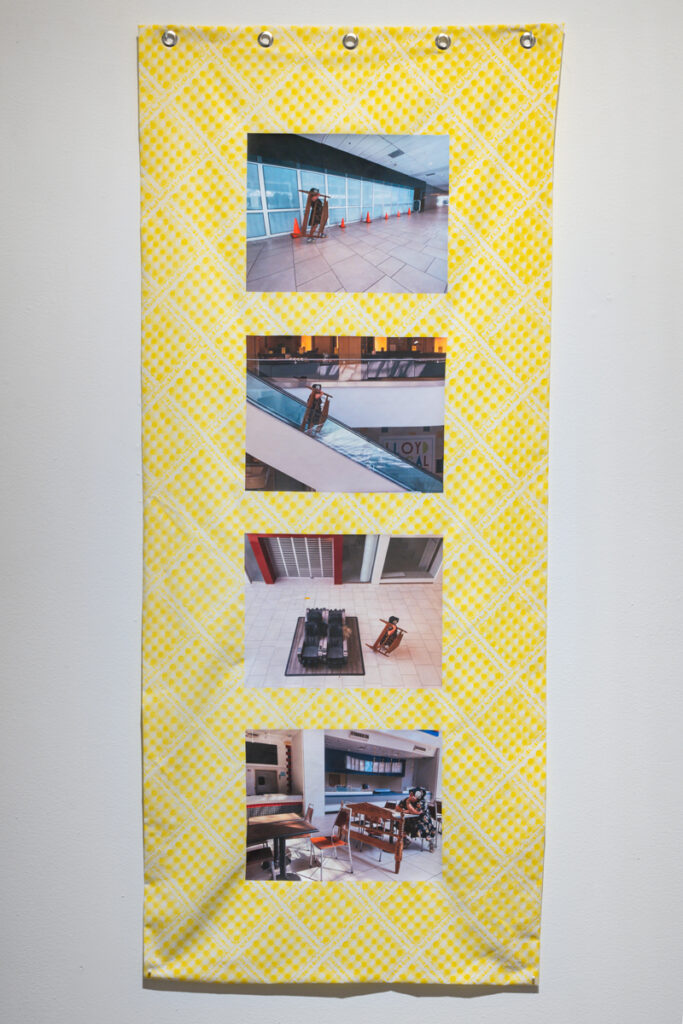
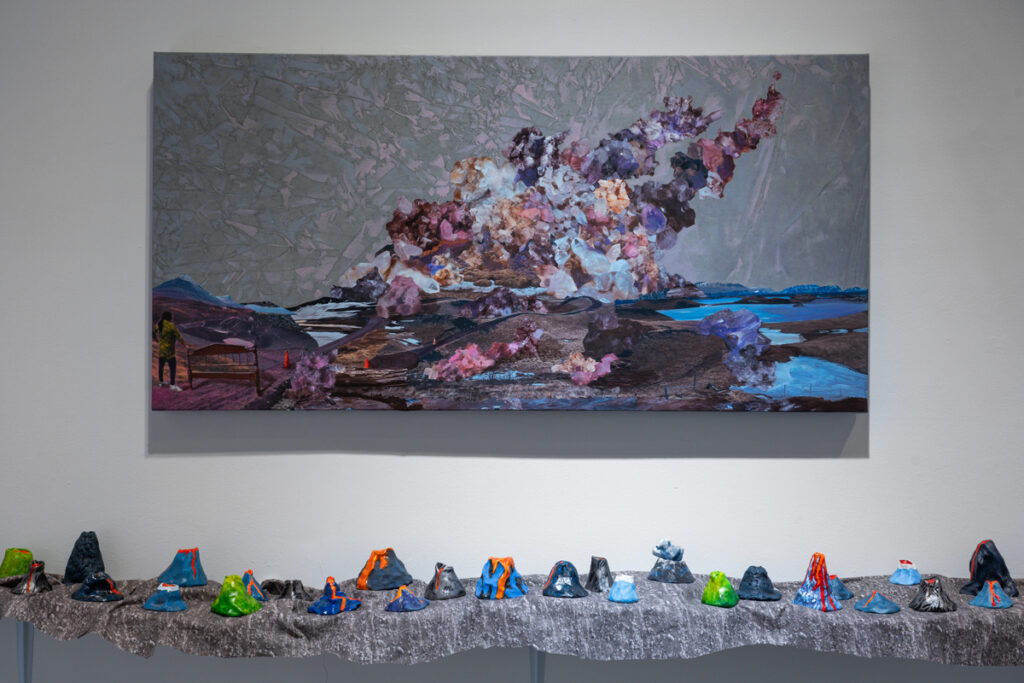
Along the opposite wall, Stellmon inserts herself into her work via several photo collages. For example, in “Trek by Comet Light,” she shoulders her headboard along a path teeming with volcanoes and lit up by a bright green comet. She lines the road with traffic cones to guide her, alluding to the ways in which women have forged their own way in the world. Although the journey seems perilous, Stellmon’s volcanoes refer to novelist Ursula K. LeGuin’s volcano metaphor, which celebrates powerful women who erupt like volcanoes. Extending the length of the wall beneath the photo collages lies an array of amorphous ceramic traffic cones and volcanoes.
Something inherently Baltimorean resides in Interior Architectures and Back East. Alexander and Stellmon, long-time friends and collaborators, complement Child’s and Hager’s paintings, collages, and work on paper. What results is an experience that sustains philosophical dialogue alongside visual beauty. When sitting with these objects, we are reminded of the power of pure color, the value in making calculated decisions, and the challenges we face when forging our way in the world on our own terms. That Henderson permits us to see Heager and Childs working in tandem, stepping back, and returning again to the work, reveals how artists translate each other’s ideas to the world.
Interior Architectures and Back East are on view at Current Space through November 2.
Performance by Rahne Alexander with DJ Ducky Dynamo: Sunday, October 19th from 3-6pm
The Closing Reception & Artist Talk: Sunday, November 2 3-6 pm.