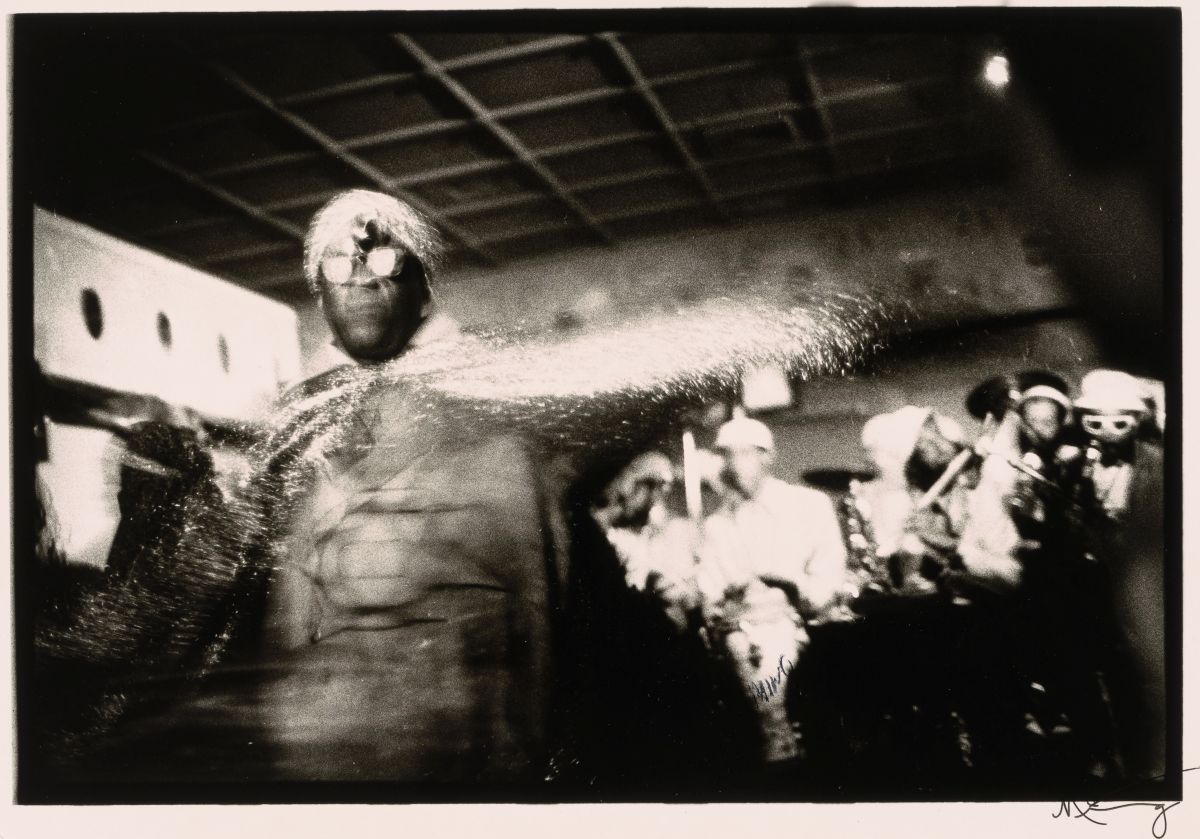
Any exhibit that starts with Ming Smith’s portrait of Sun Ra signals that it is determined to grab ahold of you from the jump and not let go. In this 1978 black-and-white photo, the idiosyncratic Afrofuturist jazz musician is a blur whose headwrap, sunglasses, and levitating swirl of a cape create a shimmering corona at the center of the frame. His dynamic presence seems to bend the laws of physics, his force field causing the tiled ceiling to tilt and the fuzzily-outlined band to almost float behind him.
Smith was one of the few women members of the groundbreaking Black photographers’ collective, the Kamoinge Workshop, and the first Black woman photographer to have her work acquired by MoMA. You can see why her accolades are well earned. Sun Ra’s features are hard to make out, but his one-of-a-kind out-of-this-worldliness is flawlessly rendered: photographer’s style and subject’s essence perfectly in sync.
Blown-up to almost six feet by eight feet and mounted on a free-standing wall at the center of the gallery room, “Sun Ra Space II, New York, New York,” is the eye-catching introduction to the recently opened Photography and the Black Arts Movement, 1955-1985 at the National Gallery of Art. The exhibit is co-curated by the doyenne of Black photography, Deborah Willis, and Philip Brookman, long associated with NGA and organizer of its recent Gordon Parks: Camera Portraits from the Corcoran Collection. The two worked on putting together Photography and the Black Arts Movement for more than five years.
Photography and the Black Arts Movement, 1955-1985 documents for the first time the role of photography in developing, fostering, and advancing a distinctly Black art and culture, representing an artistic endeavor that intersects with the American and international civil rights movements,” according to Brookman, speaking before the exhibit opened.
It contains approximately 150 works by over 100 artists, some as well-known as Smith and others likely to be fresh discoveries to exhibit-goers. American artists are the majority represented, but African, British, and Caribbean artists are included as well to reflect the US-global connections. To achieve this scale of show, 50+ lenders of pieces for the—archives, private collections, museums, and artists themselves—are acknowledged in the catalog. This testament to Willis and Brookman’s curatorial ambitions and NGA’s logistical acumen affords visitors the rare chance to see so many works from outside the region in a single show close to home.
The resulting exhibition is an encyclopedic, entrancing, and enigmatic display that fills nine capacious rooms at the NGA. The exhibit will surely set the benchmark for all future surveys of 20th century photography and of Black visual culture, even though it promises something in its title different from what it ultimately delivers.
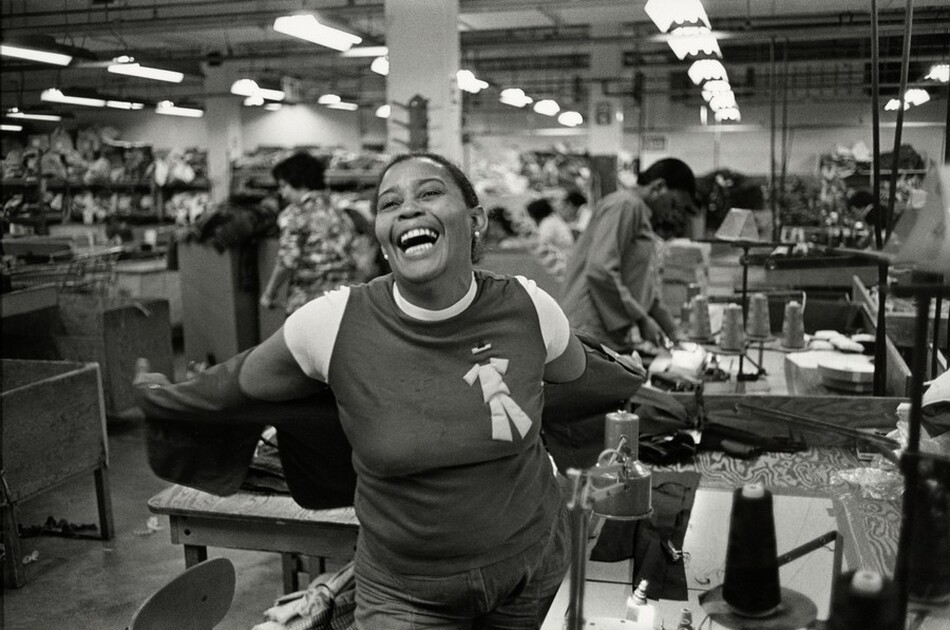
The exhibit’s spirit of expansiveness manifests itself in nearly every aspect of its conceptualization and execution, starting with its organizational logic. “The show is not laid out chronologically. It’s really laid out thematically,” Brookman noted. The nine sections devised by the curators allow, he continued, one to “see then how the range of other works of art that are in the show of photographs and paintings and multimedia works could intersect with the work we’re more familiar with.”
Some of the sections, such as “Activism” and “In the News” might be expected for a show focused on this time period in American and global history. Here, the curators juice what could feel like well-worn (though always relevant) themes by highlighting the role the striking visuals played in sustaining the Civil Rights and Black Power Movements. Brookman writes in his introductory essay in the exhibit catalog that a range of these groups “all understood how photography could transform their movements. It was the social media of the times.”
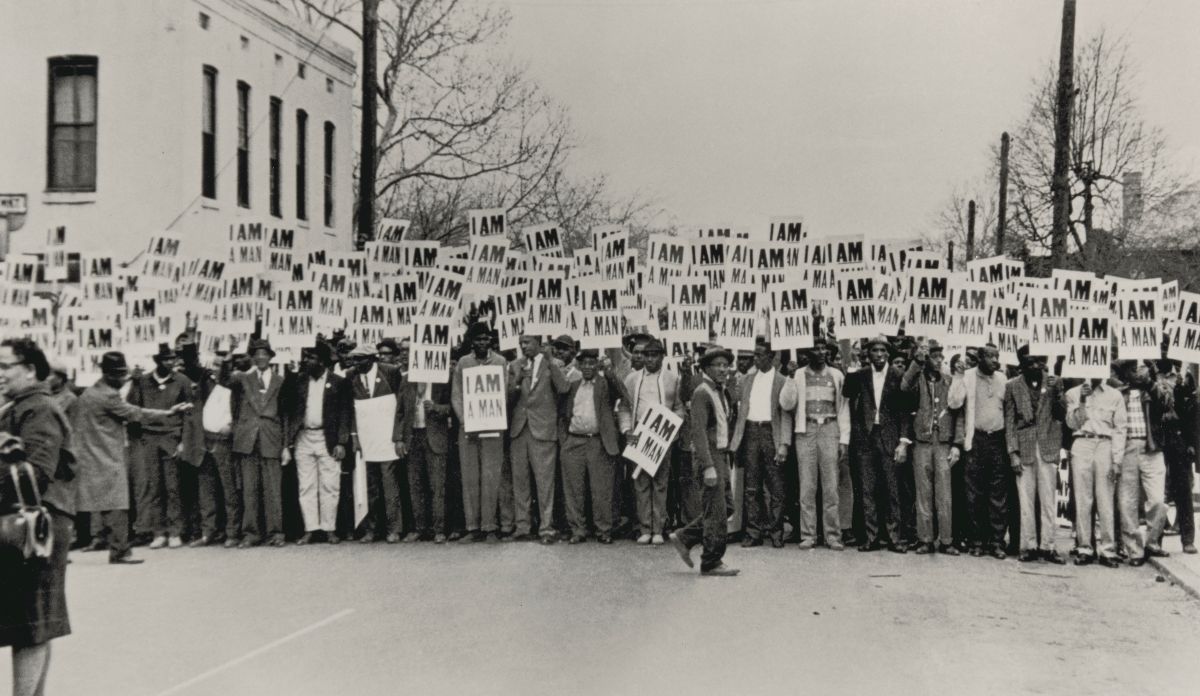
In appreciating the aesthetic impact of Danny Lyon’s “Voting, Mississippi Freedom Democratic Party” (1964) or of Emory Douglas’ distinctive photomontage graphic design that came to define the Black Panthers’ visual identity, “You Can Jail a Revolutionary, But You Can’t Jail A Revolution,” (1969-70), the curators underscore, these essentially propagandistic purposes should not be lost. The images were produced and circulated with the explicit intent of not just documenting events but of both inspiring their supporters and changing hearts and minds of the American public. Many of them did enter the mainstream news media and Black press, like Ernest Withers’ by now iconic “I Am A Man, Sanitation Workers Strike, Memphis, Tennessee” (1968), to great effect on American public opinion.
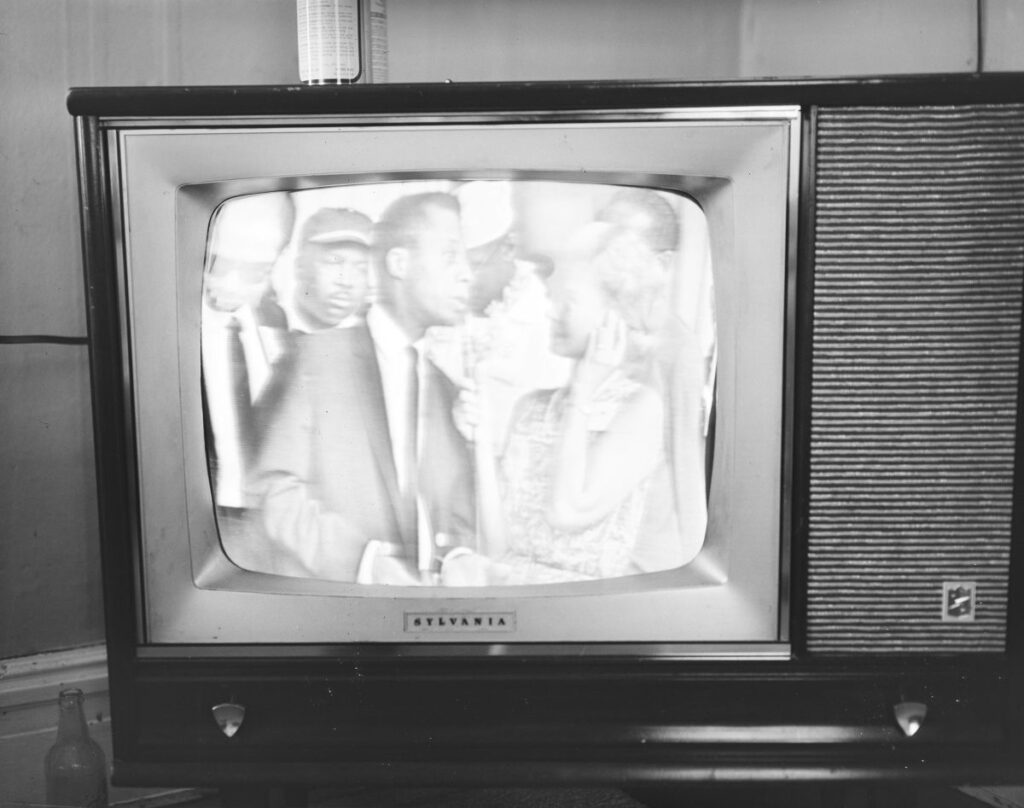
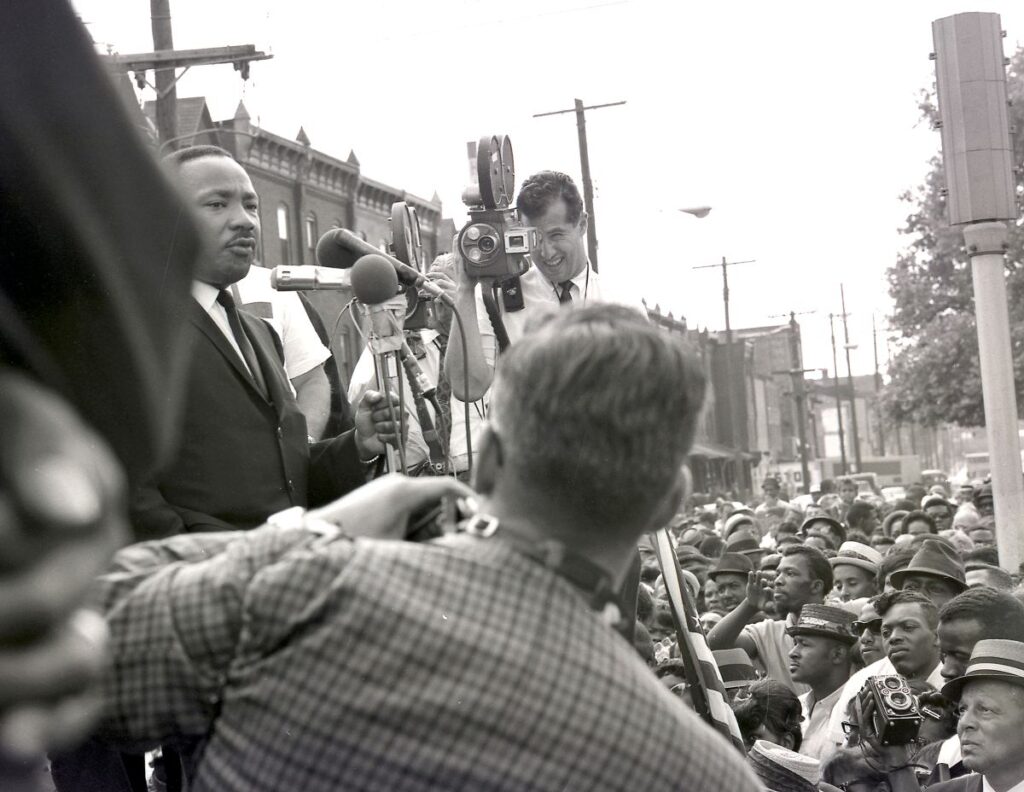
Media itself is the subject of a number of works. John Mosley’s shot of “Dr. Martin Luther King Jr. addresses civil rights demonstrators in front of Girard College, Philadelphia,” makes the clutch of photographers, cameraman, and microphones around King the central focus. King himself is only half visible on the side. Charles “Teenie” Harris captures the 1963 March on Washington not from the protest’s frontlines but through a shot of James Baldwin being interviewed on television. The square outline of the TV screen and then of the TV set emphasize the several layers of intermediation connecting participant with spectator at this historic gathering. The March was broadcast live on television by all major TV networks, which is how most national and international audiences would have experienced it.
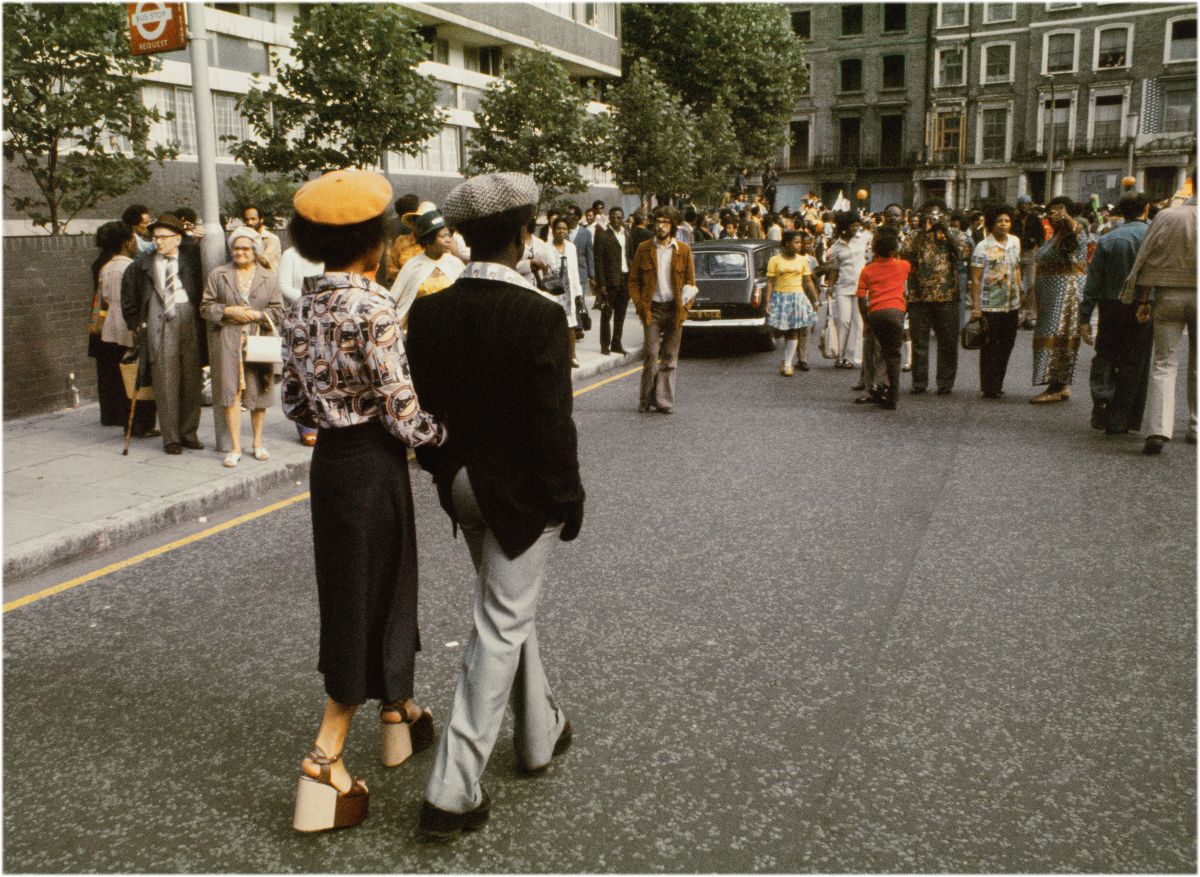
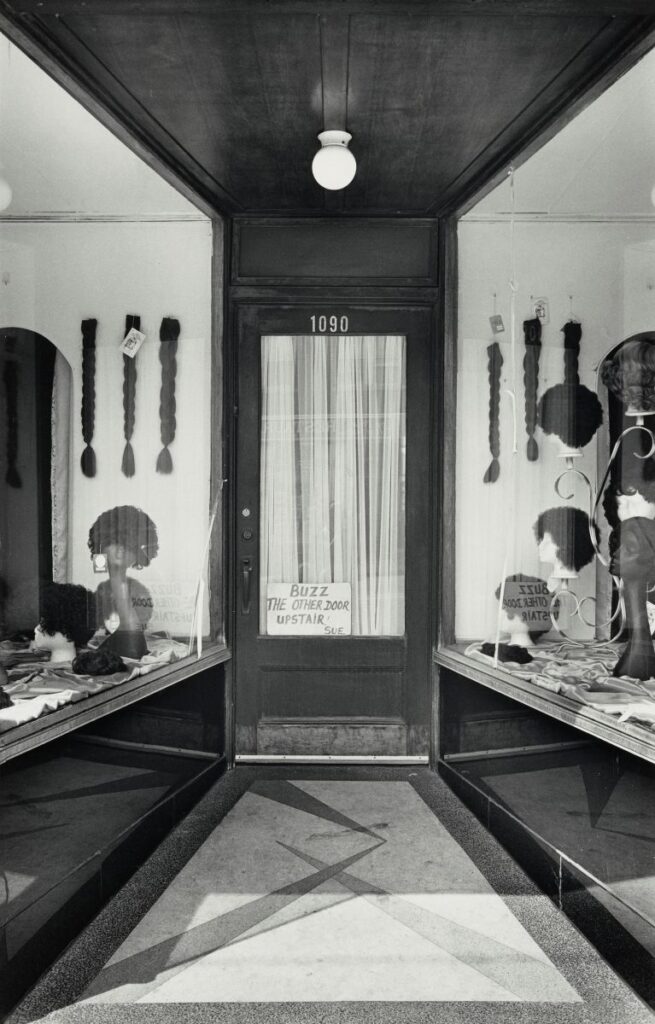
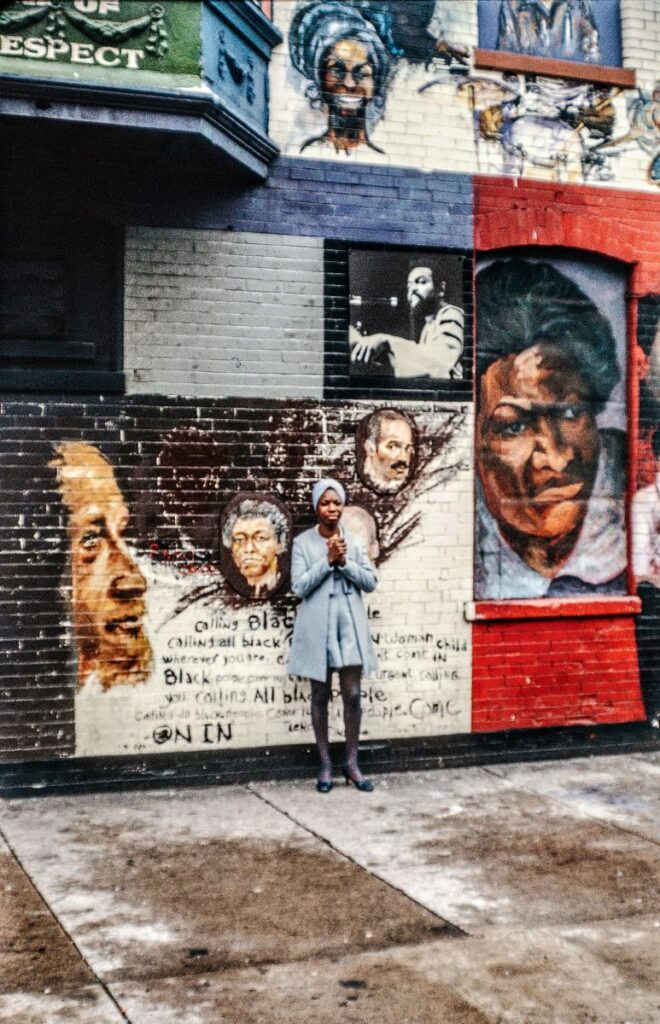
I was particularly taken with the sections “Fashioning the Self” and the “Picturing the Self, Picturing the Movement.” The former takes fashion and the sites of beautification and display in the Black community as seriously as it does the protests of the civil rights movement. The “Natural Kuumba Hair Salon” (Rolland J. Curtis, 1969) or the street that doubles as a runway for the stylish couple in Horace Ové’s circa 1972 “Walking Proud, Notting Hill Carnival” elevate humble everyday spaces into exuberant protected enclaves of self-possession and pride. A scholar quoted in the catalog observed, “to ‘Think Black’ meant not only being politically conscious and concerned with issues facing the black community but also reflecting that awareness of self through dress and self-presentation.”
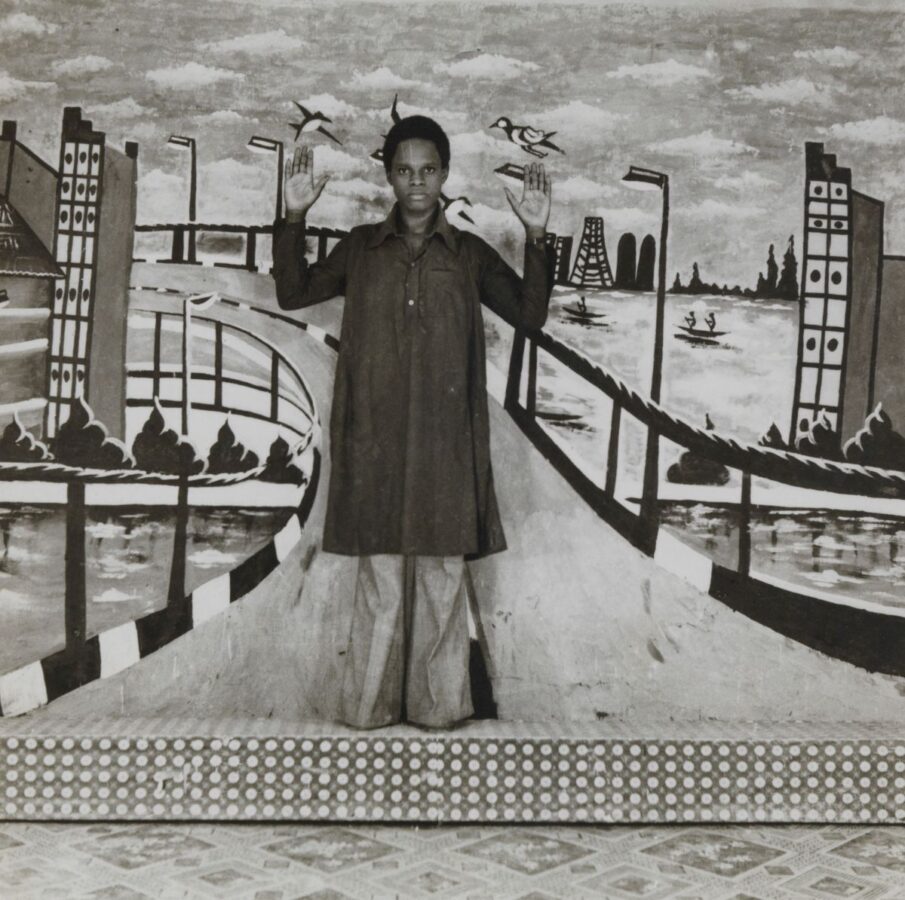
The latter section is an eclectic mix of portrait subjects and styles of portraiture, all of them extremely striking and inviting deep inspection. Mixed in among the faces of famous Bob Marley, Amiri Baraka, and Fannie Lou Hamer is a delightful self-portrait of Samuel Fosso, who has spent most of his working life in the Central African Republic.
The visual language draws directly from the African studio photography tradition, and also, according to his biography in the catalog, “African-American imagery in magazines brought by American Peace Corps volunteers.” Dressed in a voluminous shirt and wide-legged pants, Fosso poses in front of a detailed yet childishly painted city riverscape. The scene has playful touches but Fosso stands stony-faced in a classic “hands-up” pose. Has the play-acting taken a perilous turn, but why? A tantalizing moment of uncertainty.
Other sections, like “Ritual” were not as successful, in my opinion. This section (and the concluding section, “Transformations in Art and Culture”) speak to the curators’ desire to include contemporary art practices that became more prominent as the Black Arts Movement faded, such as conceptual and time—and performance—based works. “Ritual” comprises just two experimental films by Barbara McCullough and two large-scale photos. Perhaps after being conditioned by other sections to expect excess, this room felt like a not fully formed thought.
Photography and the Black Arts Movement is generous in drawing its time boundaries. Usually, the core period of the Black Arts Movement is considered to span 1965 to 1975. The show’s curators argue for extending the starting point for this survey a decade on either side. The justification for 1955 is the rise of what they deem the modern Civil Rights Movement, pointing to such milestones as the 1954 Brown v. Board of Education Supreme Court ruling racial segregation in schools was unconstitutional and the Montgomery Bus Boycott in which Rosa Parks featured so prominently. It was also the year The Sweet Flypaper of Life was published, with photos by Ray DeCarava and words by Langston Hughes, which became an inspirational touchstone for many photographers to come.
The rationale for extending to 1985 is less clear (perhaps just symmetry?), but it does allow the exhibit to include a range of pieces that reflect the addition of more formal and conceptual approaches by artists like Lorna Simpson beyond traditional documentary modes. Her 1985 work, “Gestures/Reenactments” is a sequence of six black-and-white photos of a Black man in a white T-shirt in various poses that deliberately focus on his torso leaving his head partly or totally out of the frame. They are accompanied by a set of panels of text statements beneath.
The ordering of the photos paired with words, which function almost like a dialogue, produce a novel, in-between form—more than static photo and less than fully moving image. What the decontextualized phrases mean (“Cecile with hands on hips got angry & told him about himself in the kitchen/he stood by the refrigerator” reads one placard in totality) and their ambiguous relationship to the images prompts a sort of narrative co-creation between the viewer and the artist about Black masculinity.
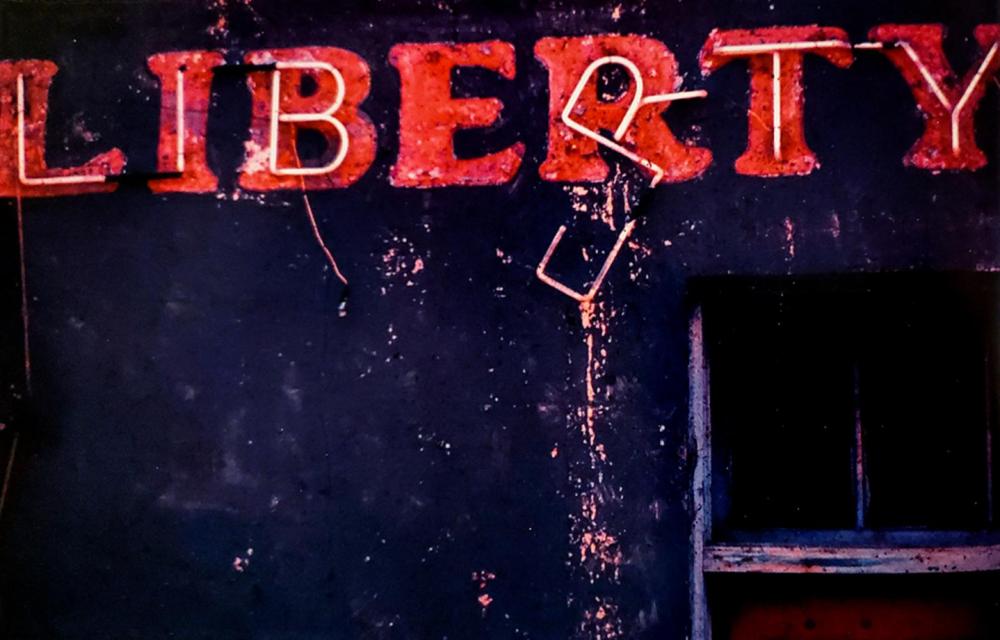
Found in the exhibit’s concluding room, this studied, studio-based work feels miles away from an earlier generation’s street photography. Yet, it also serves as a callback to a number of her predecessors who play with the legibility of text (though placed in their cases within the frame). In Anthony Barboza’s “Pensacola, Florida” (1966), a forlorn neon sign spelling LIBERTY hovers at the top of the frame against a nearly pitch-black wall. With the “R” canted leftwards and “E” almost totally missing, a viewer might take this as an ironic comment on the state of freedom for Black Americans.
Barboza, though, remembers thinking something more positive when he took the shot. “Liberty meant I was free,” he said on The Modern Art Notes podcast, “and it also has the meaning of the liberty of my people.” A reminder that a simple sign outside a Florida bar can be read with meanings as multi-layered as those elicited by more elaborate conceptual pieces.
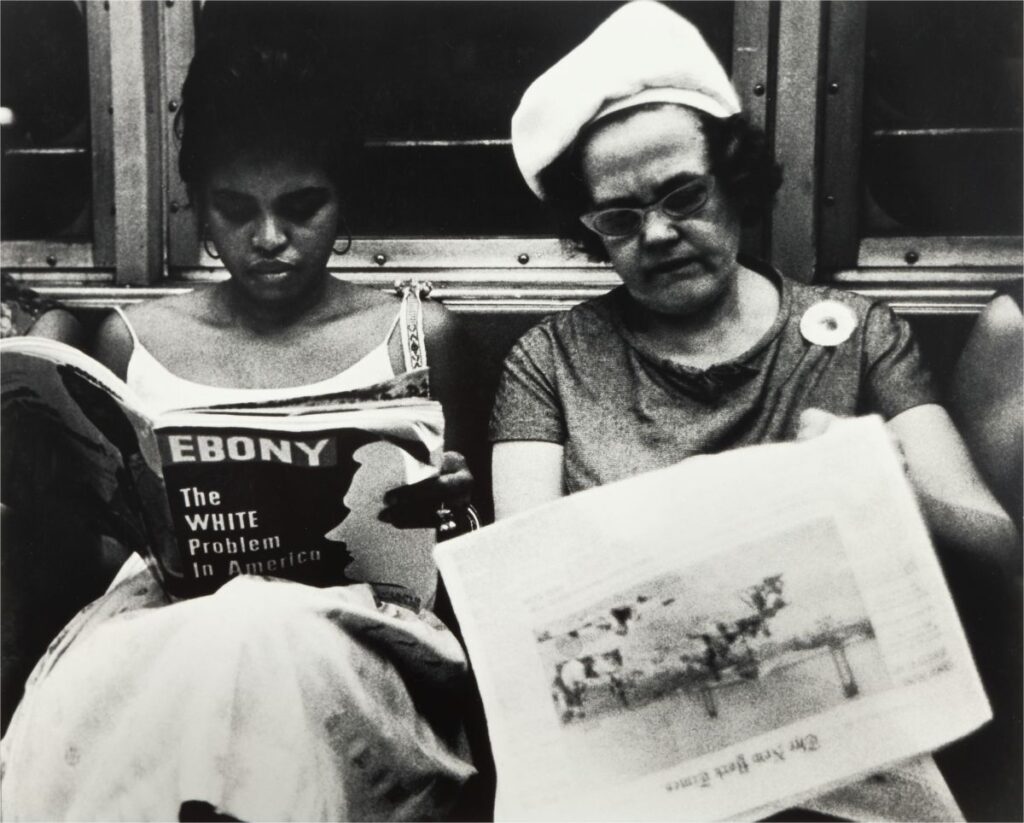
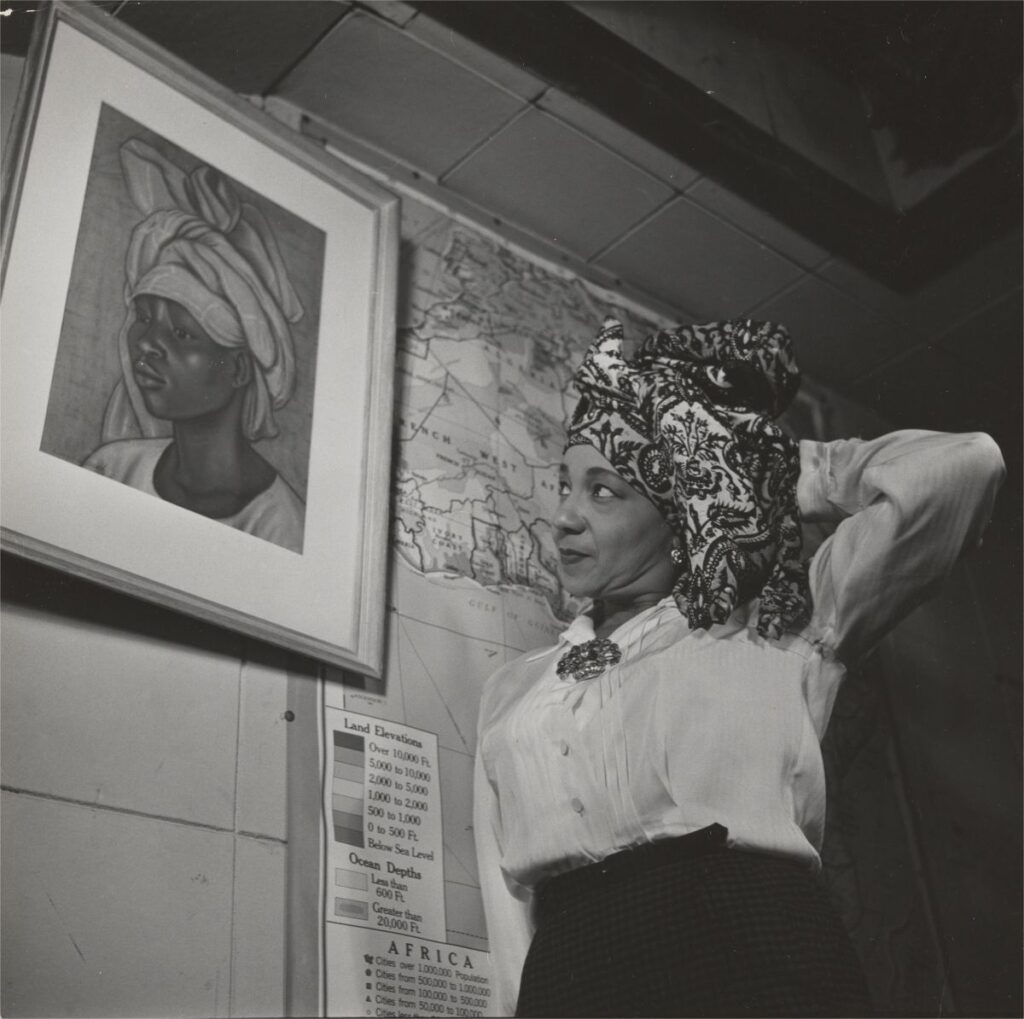
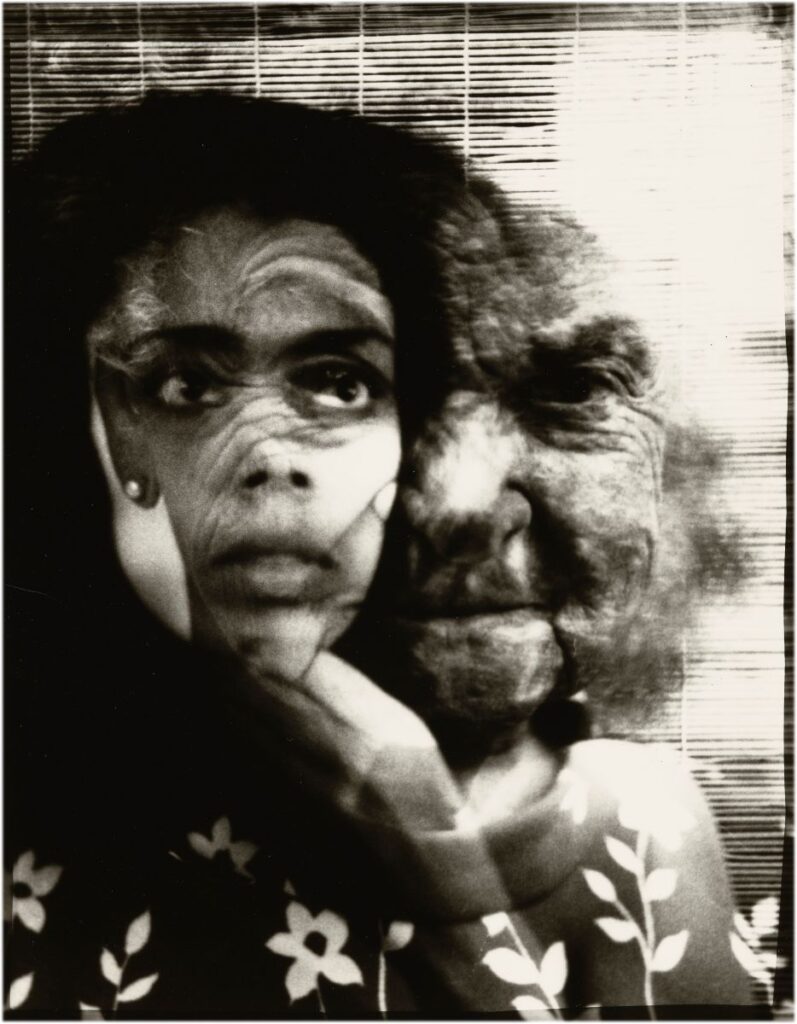
Photography and the Black Arts Movement makes a deliberate effort to include women, co-curator Willis said, as subjects, yes, but also as makers shaping the Civil Rights and Black Arts Movements. This strategy uncovers gems like Coreen Simpson’s experimental “Self-Portrait.” (1978). Simpson captures what is difficult in a static photo: the passage of time. Simpson’s out-of-focus visage, eyes cast sideways, meets cheek-to-cheek the superimposed gnarled face of an old woman on her left.
The two faces aren’t distinctly separated; a shadow cast by the old woman falls across the younger, and at the same time she appears ensnared in Simpson’s hair. Simpson’s expression is decidedly ambivalent. Is the past a burden or a gift? Is every moment of looking forward inevitably suffused with spirits of the past? A just released monograph on this lesser-known but clearly talented artist should make for fascinating reading.
Staff photographer for the Southern Christian Leadership Conference Elaine Tomlin’s contact sheet of images from a 1969 protest in South Carolina is turned into a large-scale photomural in the “Activism” section. Tomlin repeatedly puts herself within feet of the physical clashes between brutal state troopers and defiant protestors and mere onlookers. A photo from this series was published in Jet magazine, but presenting the negatives’ sequence of shots one after makes clear Tomlin’s courageous act of witnessing. It also emphasizes the behind-the-scenes process of winnowing the images that end up publicly circulating.
Still, the show (or should I say American society?) has a gender problem. My rough estimate is that women make up less than 20 percent of the artists represented. Celebrating the artistic and political achievements of liberatory movements shouldn’t come at the expense of calling out where these principles of equality and opportunity failed to be applied within, a sidestep made in the show and Willis’ catalog essay “The Photograph, Women, and the Movement.”
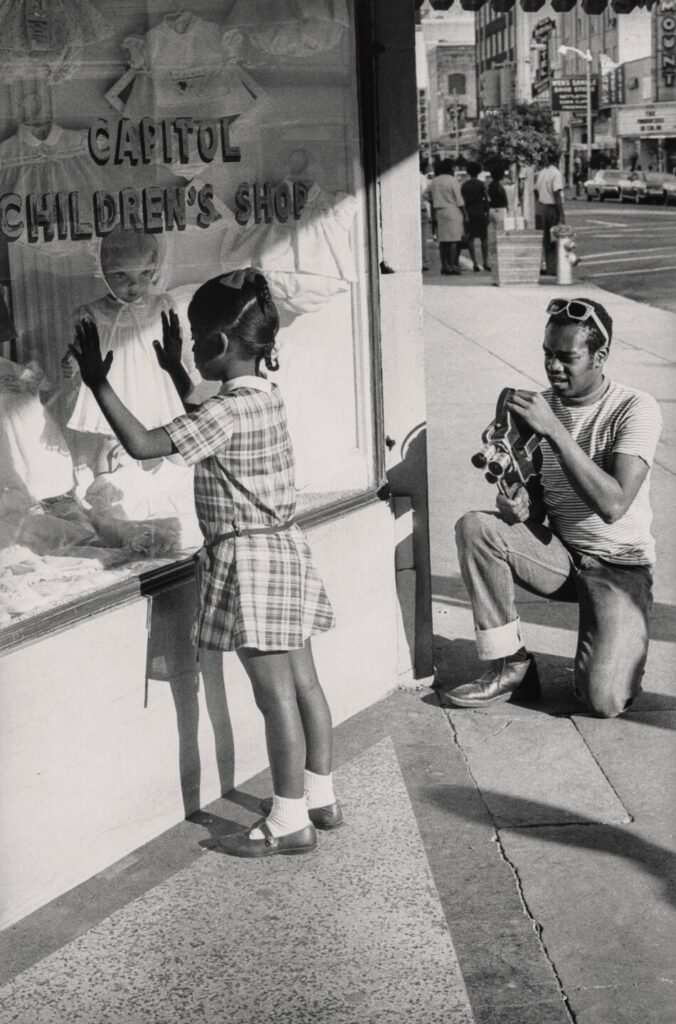
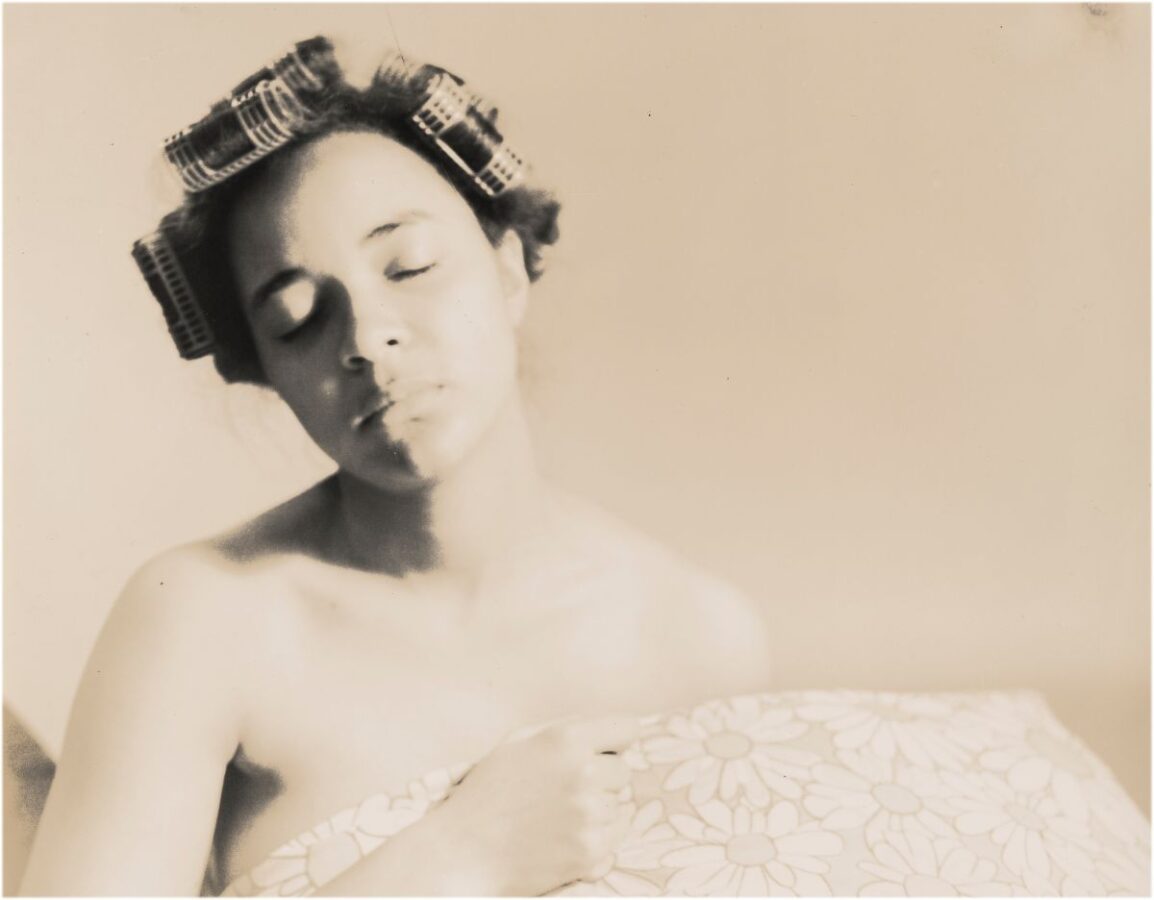
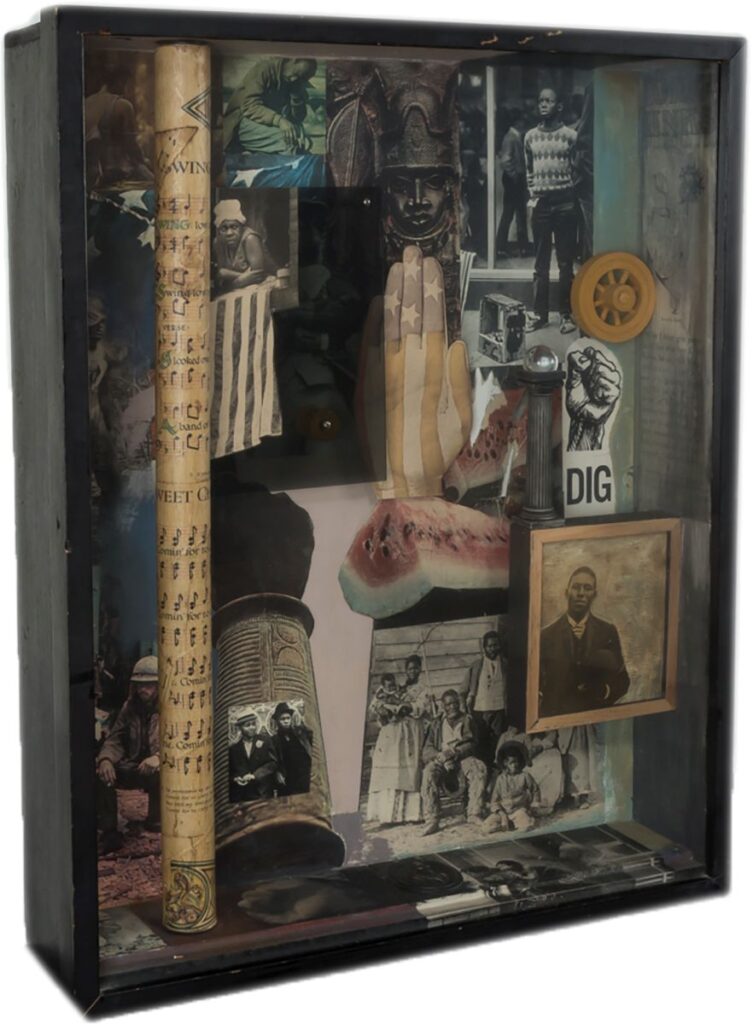
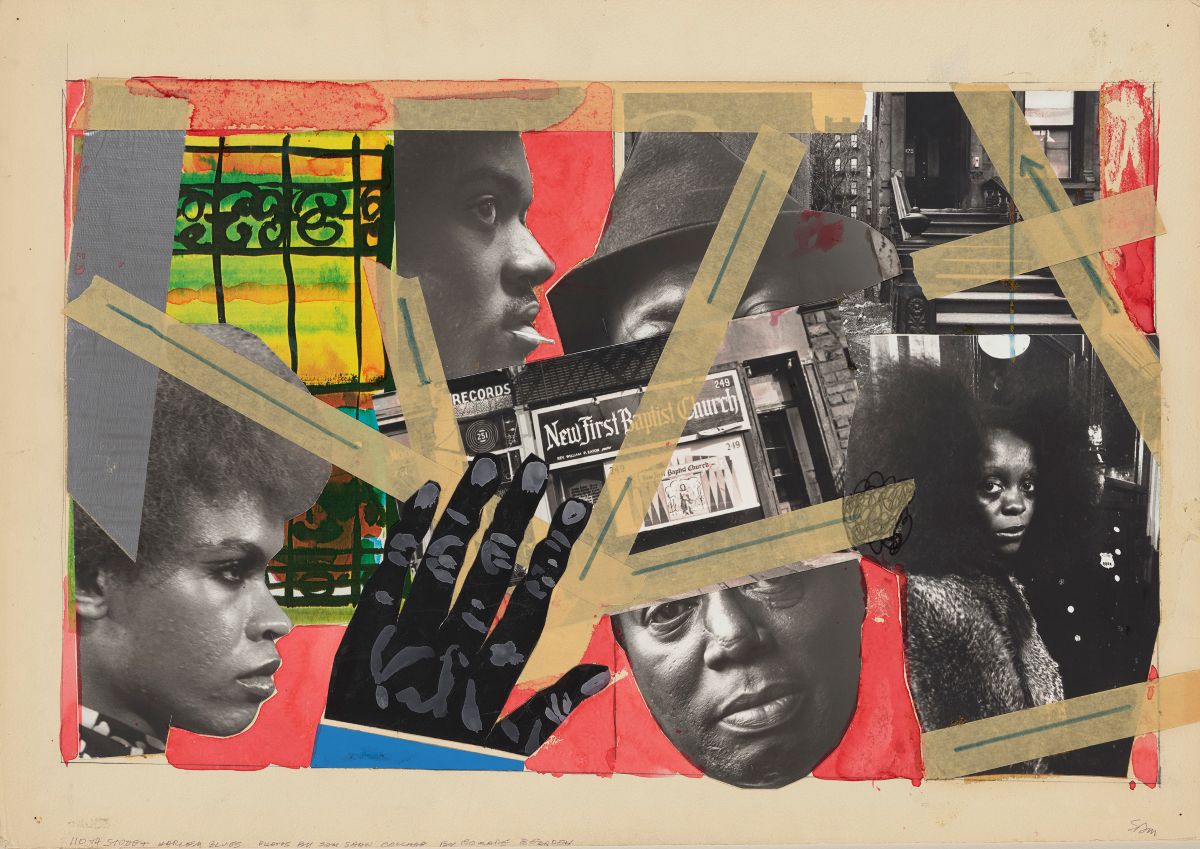
Photography and the Black Arts Movement is intentional in broadening beyond simply photographs and embracing their repurposing into collage and mixed-media assemblage. Not surprisingly, stellar examples of Romare Bearden and Betye Saar’s output are included and welcome. The 3D capsule of centuries of African-American history, “Soul Box” (1969), introduces us to an artist not as well-known beyond his Chicago hometown as he deserves.
Within a two-foot high glass-fronted box, Ralph Arnold’s assemblage of found objects and collage brings together ancient roots (a cutout photo of a Benin Bronze mask), a lineage carried down through elders (an archival photo of a sharecropper family), and the modern generation (the two jaunty, dapper young men in Billy Abernathy’s 1962 “Mother’s Day from the series Born Hip,” a graphic Black power raised fist). Arnold alludes to cultural traditions that also bind, like food (a picture of a slice of ripe watermelon) and faith, embodied in a piano player roll of “Swing Low, Sweet Chariot.” Willis praised this complex “curiosity box” at the press preview as “just so fantastic,” and visitors will undoubtedly agree.
The virtues of Photography and the Black Arts Movement are so prodigious they almost obscure a fundamental puzzlement at its core. The title suggests this show will examine a particular relationship: “How did photography impact the Black Arts Movement (BAM)?” Brookman’s formulation of the exhibit’s motivating inquiry in the first sentence of the catalog’s introductory essay. The exhibit seems to have firmly wrapped its mind around the first half of the equation in deeply examining the particular medium of photography over its chosen 30 year period. But not around the second half relating to BAM, since the exhibit consistently elides articulating specifics of the Black Art Movement and its aesthetic principles in theory or in practice.
One of BAM’s foundational thinkers, Larry Neal, named the movement as “the aesthetic and spiritual sister of the Black Power concept.” However, the exhibit forgoes a meaty discussion of the Black Power Movement and its precepts of nationalism and self-determination. Instead, BAM is more blandly described as “[a]n artist-driven endeavor closely linked to American civil rights and international freedom movements.”
While some of the catalog essays attempt to helpfully unpack aspects of photography’s relationship to Neal’s call for “a separate symbolism, mythology, critique, and iconology” [FYI, that’s the word he uses] and to other BAM artistic manifestos, this exhibit stays away from this intellectual territory. A nuanced articulation of the ways in which BAM’s twinned goals of political liberation and cultural renaissance represented a break (or not) from related movements, and how photography for its part played a role, is hard to make when BAM remains a cipher.
An exhibit visitor might avoid the cognitive dissonance sparked by the confounding avoidance of the critical question the exhibit has set for itself by enjoying the exhibit on alternate terms: a commanding tour of three decades of photography and Black visual culture, full stop. For the ultimate form of expansiveness of Photography and the Black Arts Movement, 1955-1985 is that it doesn’t choose in its collection of works among the many threads that makeup the Black experience but gathers them together: joy and struggle, beauty and violence, individuality and collective identity, personal expression and social conscience, creativity and political action.
The impressive Photography and the Black Arts Movement succeeds on a large canvas at a leading cultural institution in giving tangible expression to cultural critic bell hooks’ claim in her essay about the role of photography in Black life, “More than any other image-making tool, the camera offered African-Americans, disempowered in white culture, a way to empower ourselves through representation.”
Photography and the Black Arts Movement, 1955-1985 is on view at the National Gallery of Art through January 11, 2026.
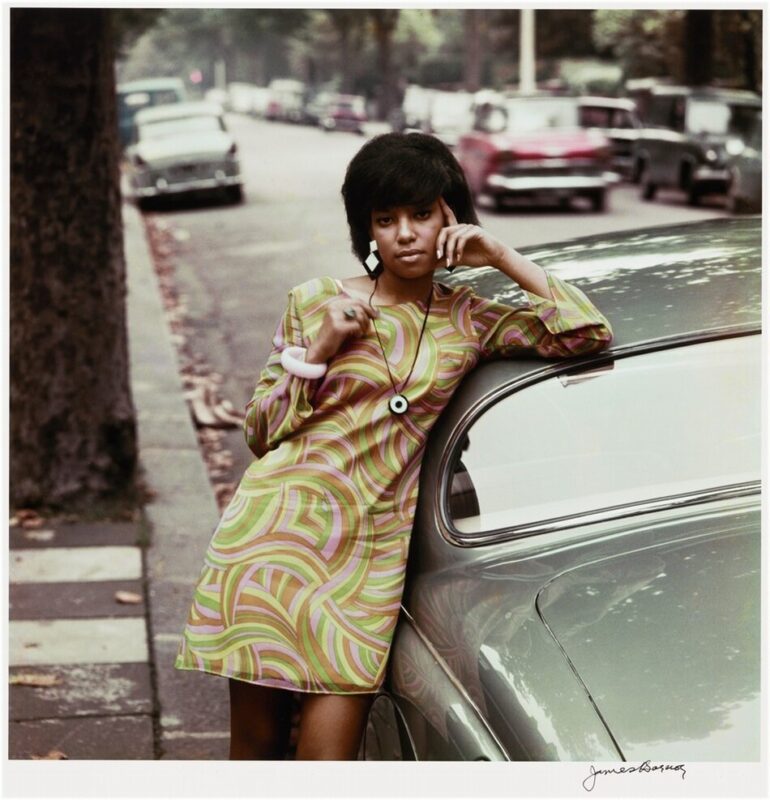
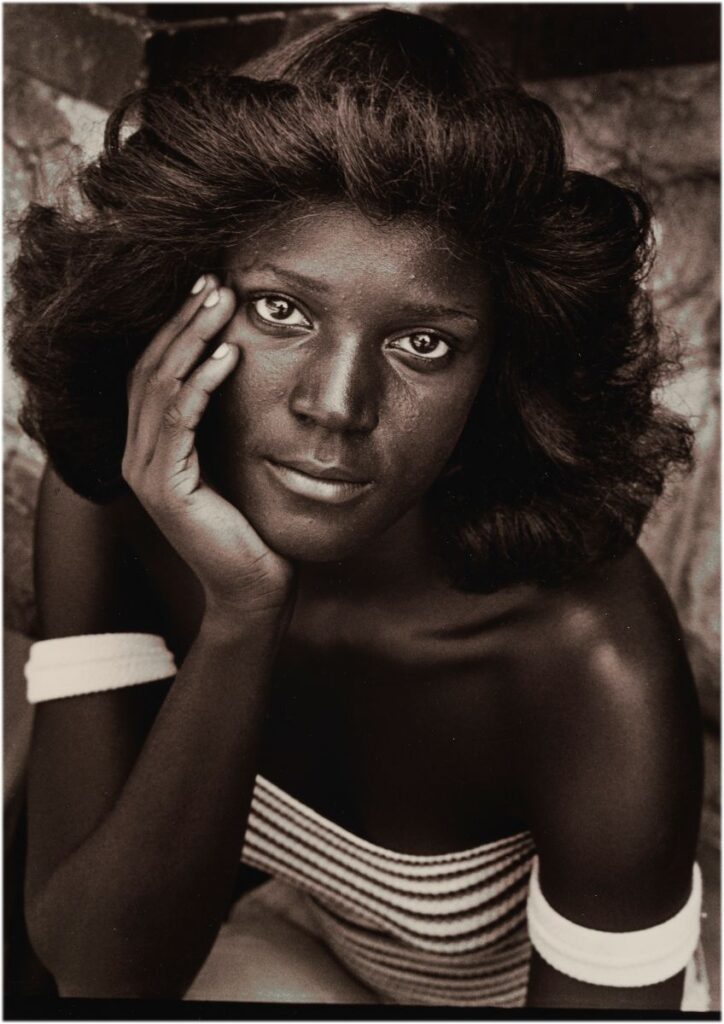
Header Image: James Barnor, Drum cover girl Erlin Ibreck, Kilburn, London, 1966, printed 2023, chromogenic print, courtesy of the NGA