Visitors to Art Basel Miami Beach this year have been confronted by one unexpectedly menacing painting on their way to the new, Instagram-friendly Zero 10 section for digital art. Its classical physicality and vulnerability feels like a challenge to the tech-bro-bait getting so much attention at the convention center this year.
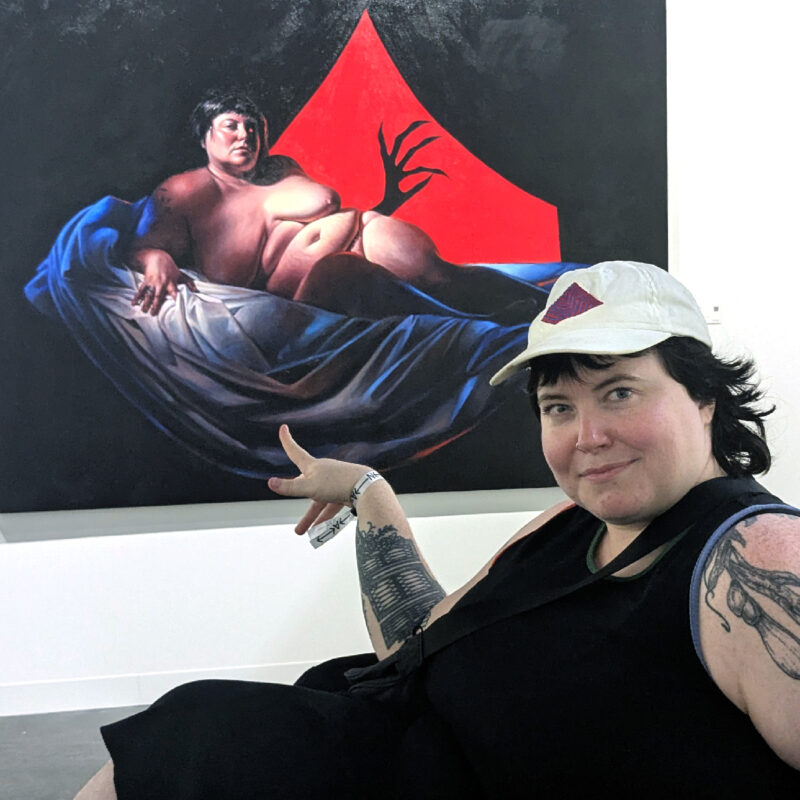
It’s Lydia Pettit’s menacing “The Nightmare (After Fuseli),” a 240 × 150 cm oil painting that looms over even the tallest Swiss collectors doing double-takes. The self-portrait depicts the artist’s inner PTSDemon incarnate with claw-like hands, backlit above the sleeping painter. Blending vampy slasher-flick theatrics with Pettit’s classically-trained skill, it’s a weird, fitting entrance to Galerie Judin’s booth—which we’ve affectionally been calling “the one with the spooky girls.” (Judin is also showing dreamy, moody paintings from Ellen Akimoto and Hortensia Mi Kafchin with surreal, uncanny flourishes.)

Pettit, a Baltimore native, studied painting at MICA and received her MFA from the prestigious Royal College of Art in London, where she lives and works today. In the years between her studies, she founded the Platform Art Center, a studio and exhibition space I loved so much I moved in next door and tried to replicate (to less success).
On a personal level, seeing Lydia Pettit and all her eccentric brilliance showing in the hallowed halls of Art Basel is so satisfying. This is a painter who (along with myself and others in Baltimore’s art scene) ten years ago threw a warehouse party fundraiser to bring our peers’ work to Miami for Satellite’s pop-up Artist Run Fair in an abandoned hotel. From selling Natty Bohs and tearing-up moldy, hurricane-damaged carpeting and sleepless nights paintings walls—Pettit has always worked hard to support other artists.
Here, it’s great to see the spotlight on her—in all her manifestations, from demonic to angelic. I caught up with Pettit at the fair for a chat about horror, taste, art history, and learning to love your inner theater kid.

Michael Anthony Farley: Here we are sitting in your show at Art Basel Miami Beach… which feels surreal because exactly a decade ago we were in Miami Beach covered in dust and paint installing our shows at a really chaotic DIY hotel fair…
Lydia Pettit: Satellite! Yes, so fun. The last time we were in Miami together was the second iteration in 2016. Beautiful Times.
And now, full circle…
Now, I’m showing in the main fair!
This is amazing. These are huge paintings and that scrappy little DIY curator in me is partly getting a panic attack thinking about the logistics of transporting and hanging paintings this large… so huge props to your art handlers!
Yeah, I’m very lucky that Judin is very serious when it comes to meeting the needs of the artists and handling that admin stuff. We all know if we make a big painting, it’s gonna get here…

They have this theatricality… We’ve talked in the past about your love of directors like Dario Argento and classic horror.
Yeah, Italian horror! And I collaborate with my friends who go by the moniker Scandebergs, an Italian fashion photography duo, and they also love Italian horror. I often collaborate with them for the reference images because they’re masters of light and so much of what makes 70s and 80s horror is the primary, absurd lighting, and the direct reference to theater
These paintings are both inspired by Fuseli’s “The Nightmare”—the painting of the woman with a demon on her chest. It’s been co-opted by the internet as a descriptor of sleep paralysis. The hyper drama of Romanticism and horror, I think, are a really good intersection and kind of legitimize horror through the language of art history.
Your work’s always been so much about the body and physicality, and of course horror is a fitting bridge into something more—I don’t say pop culture, but you know? Accessible?
Horror is this massive Rolodex of imagery that even if you don’t engage with it, you have on some level: the shadows with the red eyes, or the slasher and the victim, the beast woman, lycanthropy zombies—we all have these understandings, even if you don’t like horror films or never seen one. I think it’s nice to meet people with that buffer when you’re talking about really fucked up personal shit.
These two paintings, “The Nightmare” and “The Dream” are about the fracturing of the self after you experience trauma, and it’s like you’ve become multiple identities within your body. You bury things like anger and desire, and they’ve become frightening to you… and “The Dream” is about the reintegration of those things which you’re embracing: the more ugly or taboo aspects of the self, as well as the more comfortable parts. So it was nice using that painting as a jumping off, and getting to also lean into these vivid reds and blues—which is a nice departure when you’ve had such a traditional arts education, and you’re so concerned about realism, you know?

I also like that this work has—I don’t know if “camp” is the right word? Melodrama?
Oh camp is a huge part of my work! The painting behind you is more about the eeriness and the uncanny. I think there’s an element of my work that’s about silence and about an undercurrent of something disturbing or something confusing. And then there’s stuff that’s in your face. And horror is camp to me… there’s something about it that is so in your face—there’s no subtext. But the best horror films have a balance of both.
I oscillate between the two, and it is nice sometimes to just be a theater kid, you know? I’ve never been a theater kid, but I do kind of desperately want to be.
It’s never too late to be a theater kid!
I keep becoming friends with horror film directors, and I’m like, give me a roll bitch! Put me in your movie! I’ll give you a baby!
Is horror as big of a subculture in the UK? How differently has your work been received there?
Yeah, I mean, it’s different. In one sense, they look down on it. In another sense, they take it more seriously. In general, I think people don’t take horror seriously as a genre.
You never see horror films nominated for awards in the same context as other films. And if they are, they’re “thrillers,” not “horror” film… Silence of the Lambs, you know.
Weirdly, it just occurred to me that a lot of the most iconic, “crowd pleaser” paintings in art history have an element of horror…
The most popular paintings in the history of oil painting are kind of like horror paintings! Well, that’s why I’m referencing Fuseli, because he’s a weirdo. And William Blake, and this era of Romanticism, where also referenced by Guillermo del Toro in Frankenstein… that was so ridiculously melodramatic!
That era and its paintings are so melodramatic, and I think sometimes people write that off as kitsch, or they write it off as too saccharin or tongue-in-cheek. And I think it’s important to embrace the weird shit.
I mean—popular paintings— Bosch is obviously another massive contender for weirdo of the millennium. I think it’s important because it’s making you uncomfortable for a reason. It’s addressing something deep down that maybe you don’t want to face, and I think that’s why sometimes my paintings are difficult for people—I’m confronting them with something that’s a little bit too honest, but it’s easier when you use this lens of media and cinema.

Have you gotten a lot of good interest from collectors or curators this week? I know your booth has been really popular on social media…
Not that I know of yet. Right now, it’s a bit difficult. I think that people aren’t really interested in buying confronting, intense paintings.
Everyone wants happy paintings of flowers!
Yeah, things are so shitty now—the economy is uncertain, the market’s like crap. And people want something that’s a bit more palatable and safe. I’ve always been told my work is difficult even when I was selling everything that I made, and I’ve always known that.
I’m probably gonna have a small but dedicated group of collectors rather than loads.
I’m not doing florals—and also not delegitimizing people who do—but I think art collecting is emotional, as much as it is political or strategic. People are very scared and don’t want to be confronted with what’s going on in the world, even through the lens of some white lady.
And that’s the thing I was thinking: even if no one buys my work, I need to make two really cunty paintings that really talk about who I am.