I first saw Qrcky’s work while accompanying gallerist Nancy Blackwell on a studio visit last January. Immediately, we noticed that every wall of his Baltimore townhouse was packed with his distinctive portraits—so much so that Nancy half-jokingly admitted how overwhelmed she was. As a painter myself, I could only dream of being that prolific.
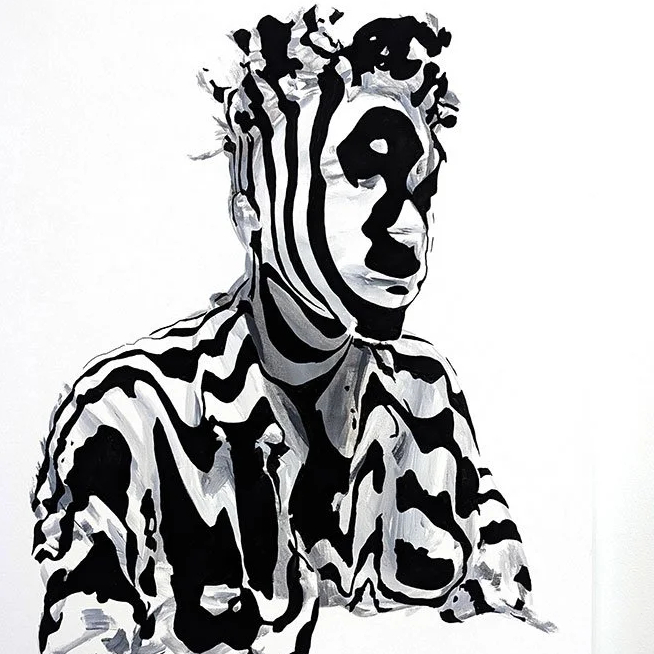
But it wasn’t only the sheer volume of work that was striking, it was the work itself. The more time I spent with his paintings, the more they resonated with me. Each portrait is painted with a vibrant fluidity, with swirling stripes radiating out, as if the subjects were made of a self-contained mass of water whose serene surface had just been disturbed by a single poke. Stark bands, reminiscent of a zebra’s pattern, give each piece a hypnotic rhythm, making the figures feel simultaneously familiar and so alien. There is also an eerie, statuesque quality about the subjects, as if these were portraits of sculptures rather than portraits of living models. That sensation is amplified by the sharp white backgrounds that they’re thrown against. They live in limbo.
Looking at these paintings, I was captivated by the cadence of Qrcky’s visual language, but I had the lingering sense that something more was at play. The work was resonating with me on a deeper level.
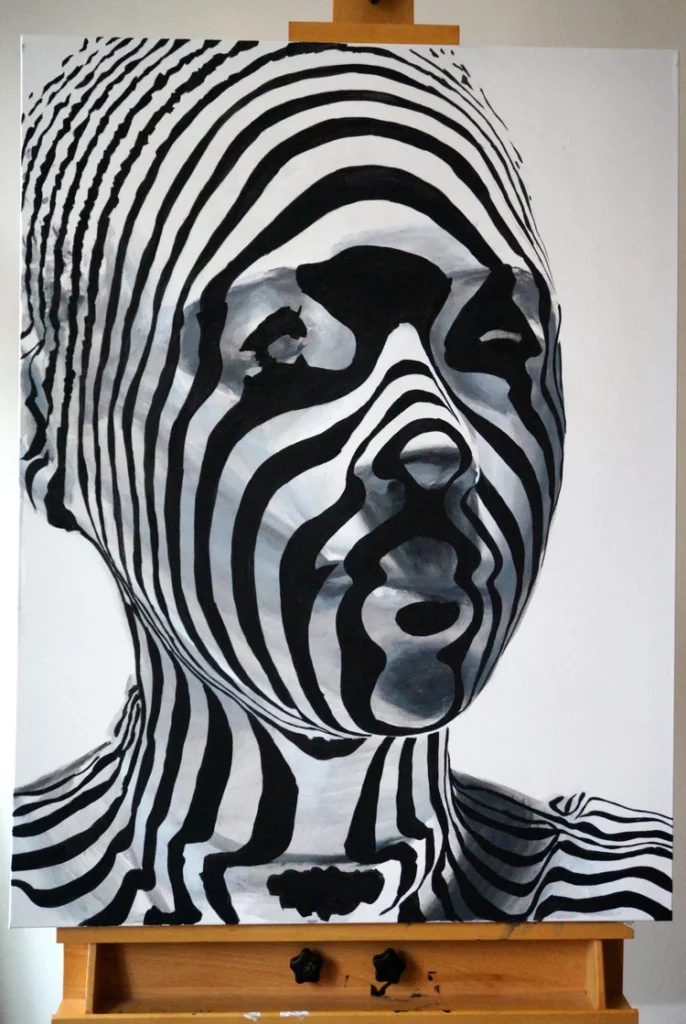
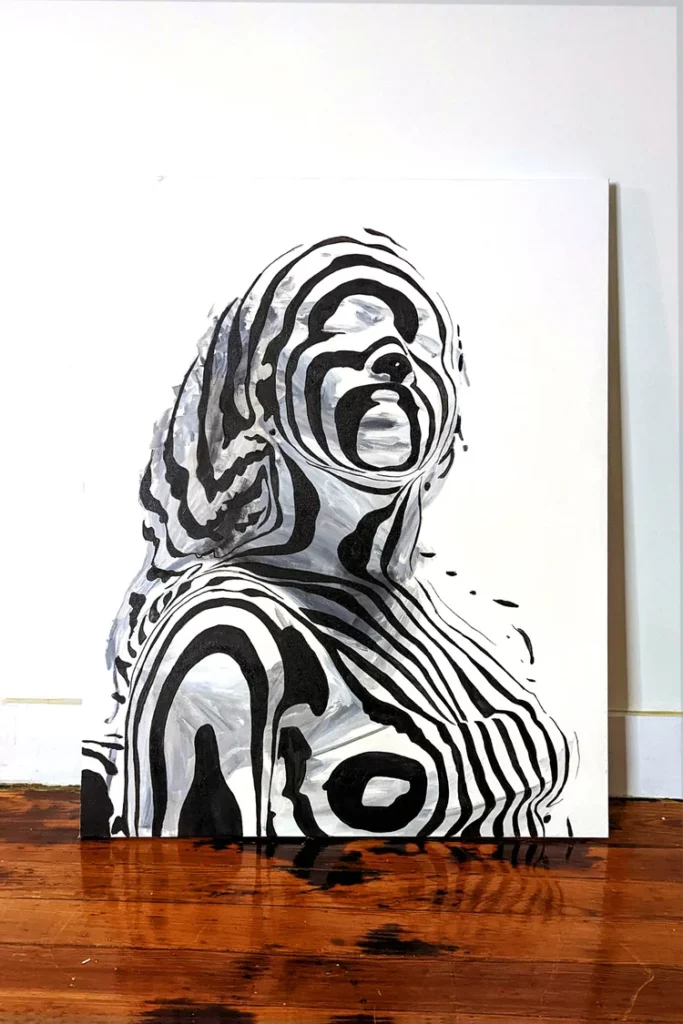
Ethan HoskinsHe doesn’t merely expose his subjects, however, he strategically fragments them, disorienting the gaze and disrupting their legibility.
That’s when I saw it: dazzle camouflage. Dazzle camouflage, or dazzle paint, was a technique primarily used during World War I, to paint battleships. It employed bold black and white stripes in irregular patterns in an attempt to disrupt the contours of the ship and confuse enemy onlookers.The goal was not to make the ships invisible, but rather to make it difficult to gauge a ships location, speed and direction, and thus prevent attacks.
It wasn’t until much later, while working on this article, that I truly considered the implications of Qrcky’s reference to dazzle camouflage in his work. In the medium of portraiture, his use is a means of investigating the complexities of the hypervisibility of Blackness and the inherent danger of living in a Black body.
Portraiture has a long and storied history in art, most often as a visual record of powerful elites. Portraiture, especially pre-photography, was used as a way to create lasting images of the subjects, typically white patrons of high social status or wealth, who commissioned the work. In short, portraiture historically reinforced the visibility and legacy of those in power.
Qrcky’s portraits of everyday Black Americans challenge and subvert the fundamental tenets of classical Western portraiture. This isn’t in itself new or unusual in 2026. Artists like Kehinde Wiley and Kerry James Marshall have long depicted Black people in an array of contexts for decades now. But where Marshall and Wiley underscore the humanity of their subjects through realism and discernable profiles, Qrcky envelops his subjects in dazzle-like patterns that diverge from this thinking and open up a new and interesting parallel. Like a 30,000-ton World War I vessel, a Black body is unavoidably visible in America. As a Black man, I’m acutely aware of my own presence. As I wade through white spaces, I can feel eyes surveilling me or deliberately avoiding meeting my gaze, subtly signaling that I don’t belong.
This is, in essence, what hypervisibility means: the salient sensation and awareness of being marked as other. The concept of Blackness, for example, historically existed as a way to define the normality, appropriateness and superiority of Whiteness. Hypervisibility also encompasses the inherent danger of being seen as other. If Whiteness is pure, good, and safe, then Blackness must be tainted, evil, and menacing. Like battle ships, Black bodies are seen as a threat by default, and therefore must constantly brace for confrontation.
Instead of trying to hide his subjects to shield them from whatever artillery their Blackness provokes, Qrcky leans into their inherent visibility, painting them boldly and strikingly. He doesn’t merely expose his subjects, however, he strategically fragments them, disorienting the gaze and disrupting their legibility. While they still maintain their alien otherness, they don’t bear the cross that a defined blackness would afford them. This act of disruption offers protection without muting expression.
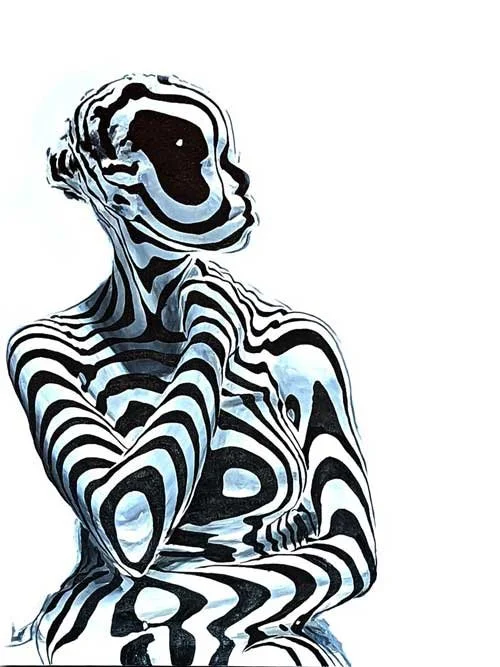
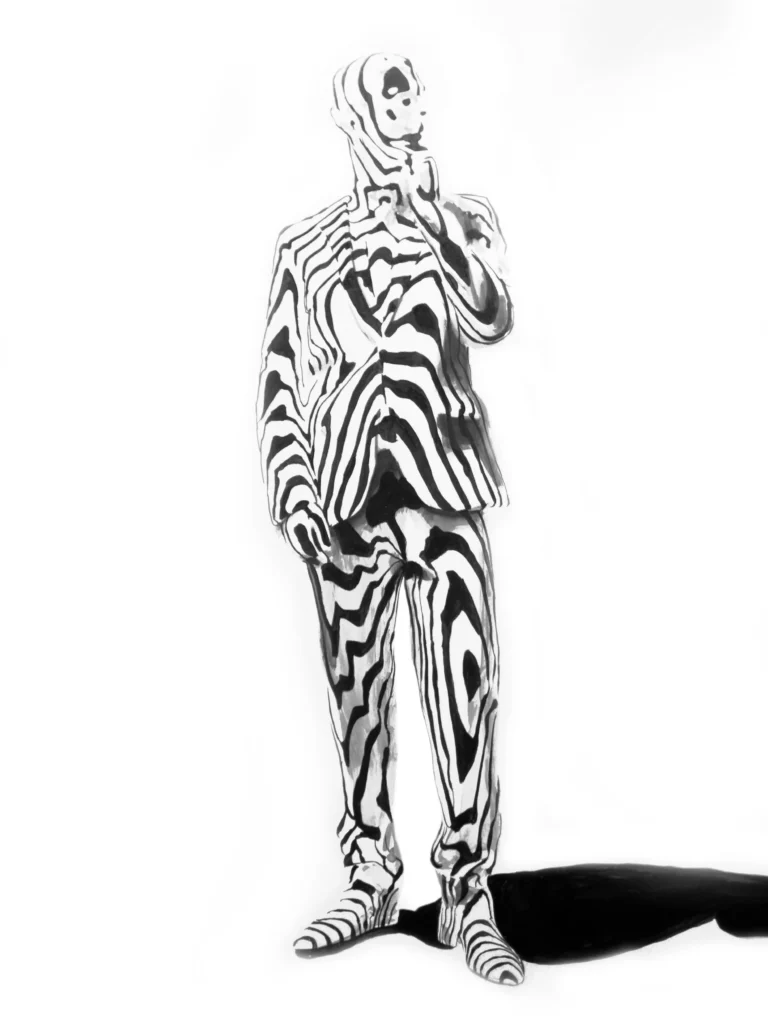
Ethan HoskinsThis is, in essence, what hypervisibility means: the salient sensation and awareness of being marked as other.”
The fragmented nature of Qrcky’s portraits also evokes the concept of code switching. Code switching is the act of morphing one’s behavior, speech or presentation to assimilate into the dominant racial, cultural or social norms of a given setting. This process can create cognitive dissonance and leave one feeling fragmented and distorted—much like the subjects of Qrcky’s paintings. In a way similar to dazzle paint, code switching is designed to disorient an external gaze and misdirect onlookers from the subject’s otherness.
Given all of this context, there are areas where Qrcky’s work has the potential to be even more powerful. A deeper exploration of why his subjects are dazzled and the implications of dazzling the figures could make the work more compelling.
While having these busts exist in a white void helps to establish Qrcky’s visual language and conveys the tension between assimilation and resistance, it would be exciting to see these figures situated in more specific settings. What would it look like to have a figure standing at a bus stop on Greenmount, or for a group of figures to walk through Guilford? How might a dazzled figure interact with a non-dazzled figure? How might a half-dazzled figure look or engage with the world?
Adding more of a context, especially through colour, would give the dazzling a deeper logic, conveying the idea of hypervisibility yet inarticulability. It would provide a space to further explore Blackness, code switching, and their implications on both the subjects and the world around them. Expanding the context of the dazzled figures could heighten the sense of otherness, and challenge the effectiveness of code switching and the dazzle camouflage as a means of protection, while adding visual intrigue and tension.
Qrcky’s dazzle paint metaphor is as relevant now as ever. In today’s politically charged landscape, where Black and Brown bodies remain politicized, his patterned figures prompted me toreflect on the way I present myself, how I may choose to lean into or out of my hypervisibility, how I may choose to be defined or fragmented, and what type of confrontation I face as a result.