Believe it or not, the Jewish Museum of Maryland was already planning its ping-pong installation before the teaser for Marty Supreme—loosely based on the story of real-life Jewish table tennis legend Marty Reisman—dropped in August 2025.
In the film, Timothée Chalamet’s Marty Mauser hustles an arrogant amateur named Roger (played by Isaac Simon). By day, Simon works at the largest Holocaust museum in New York—and even faced off against JMM executive director Sol Davis on the opening day of Open Court: Ping-Pong Pop-Up in March.
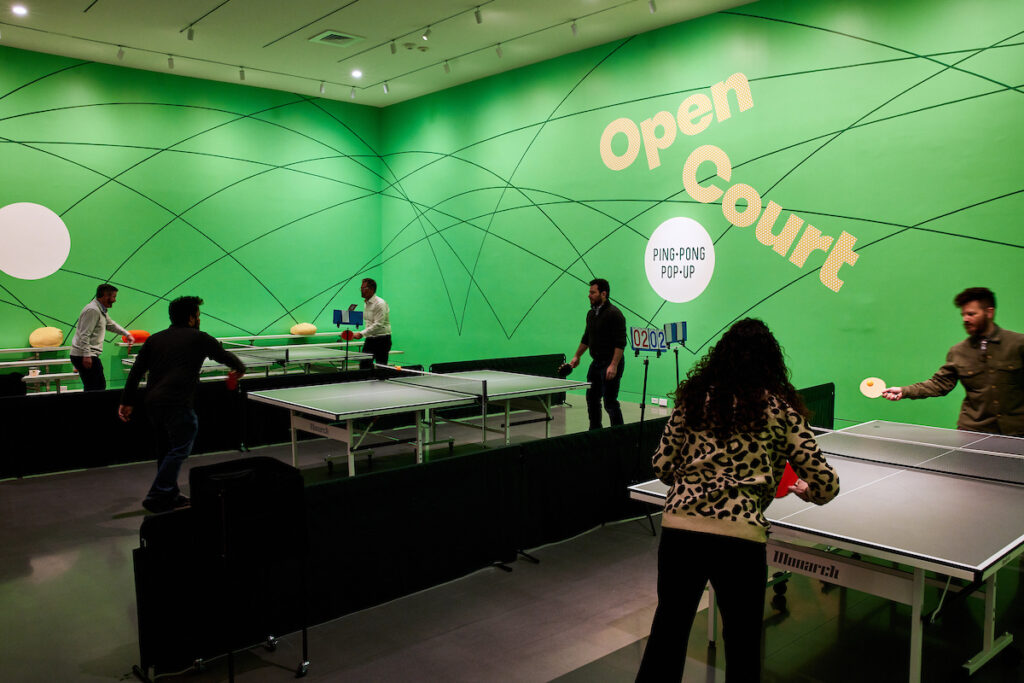
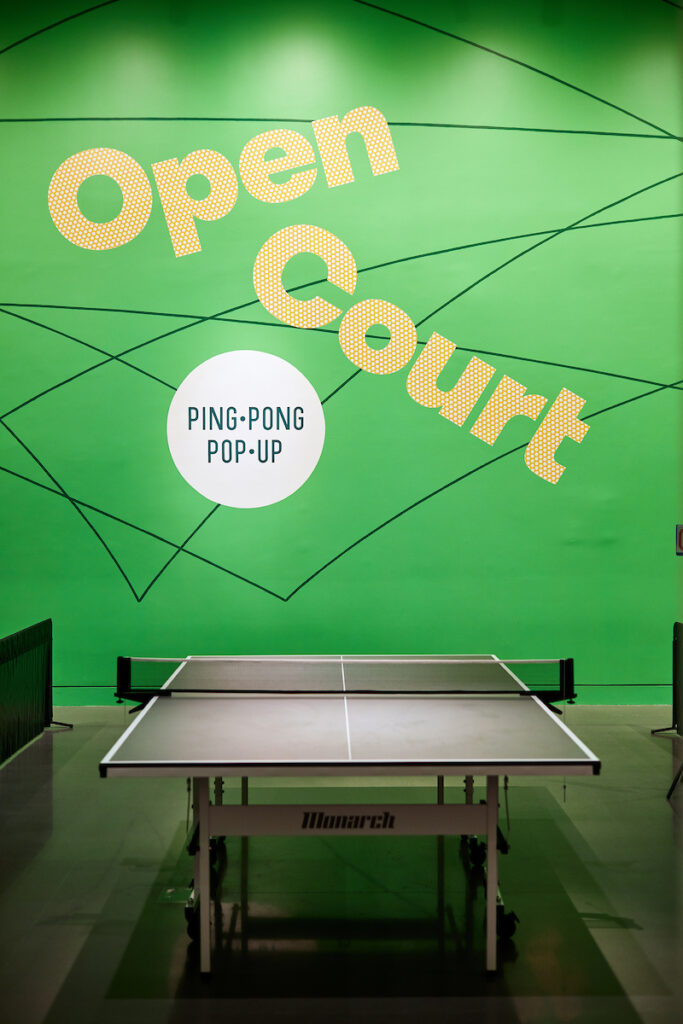
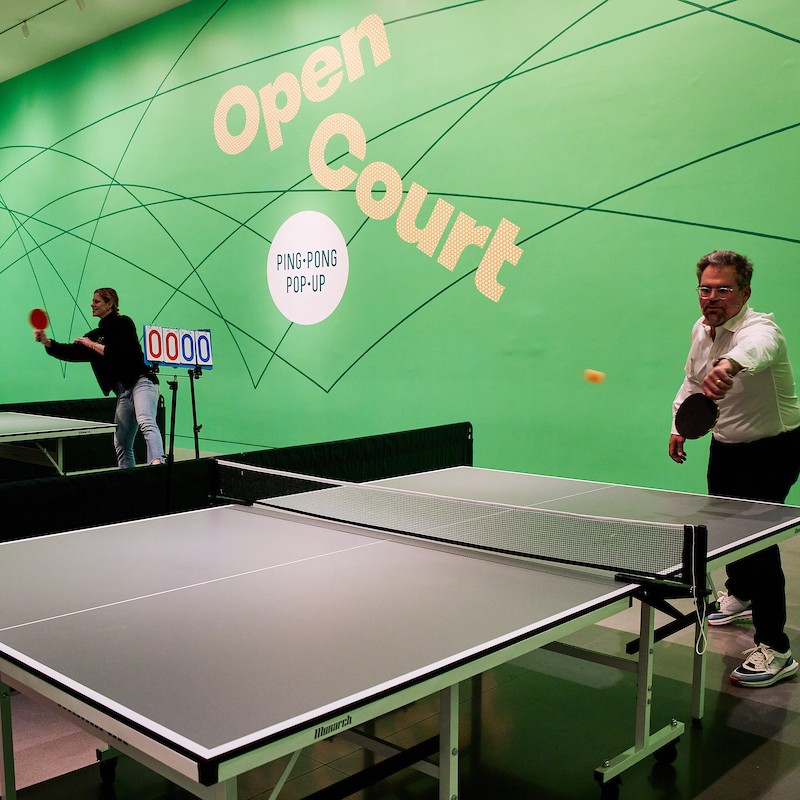
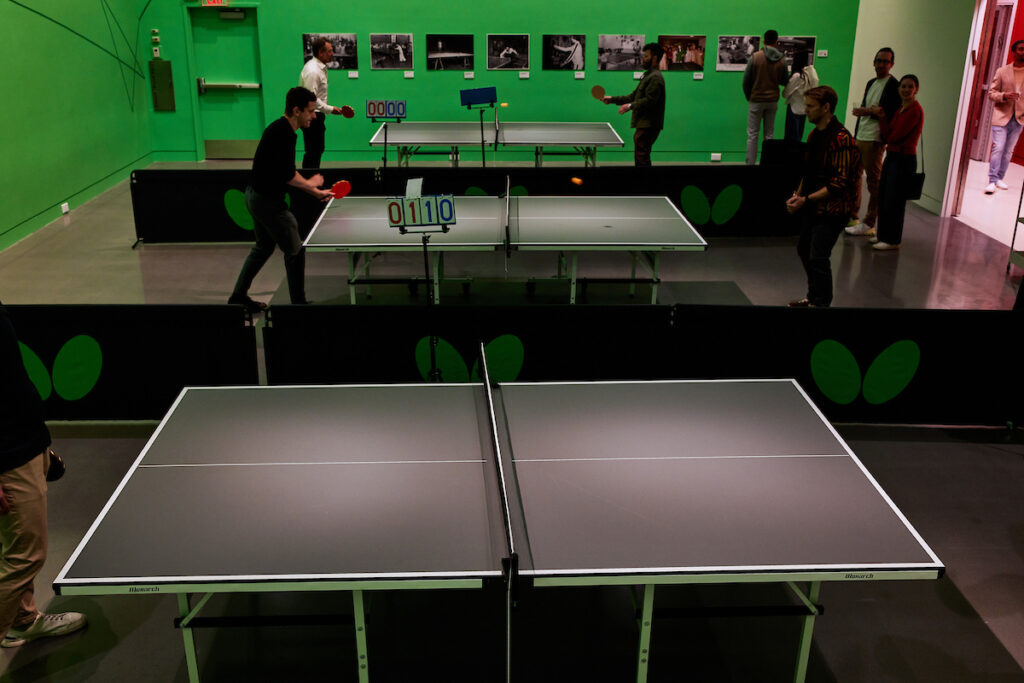
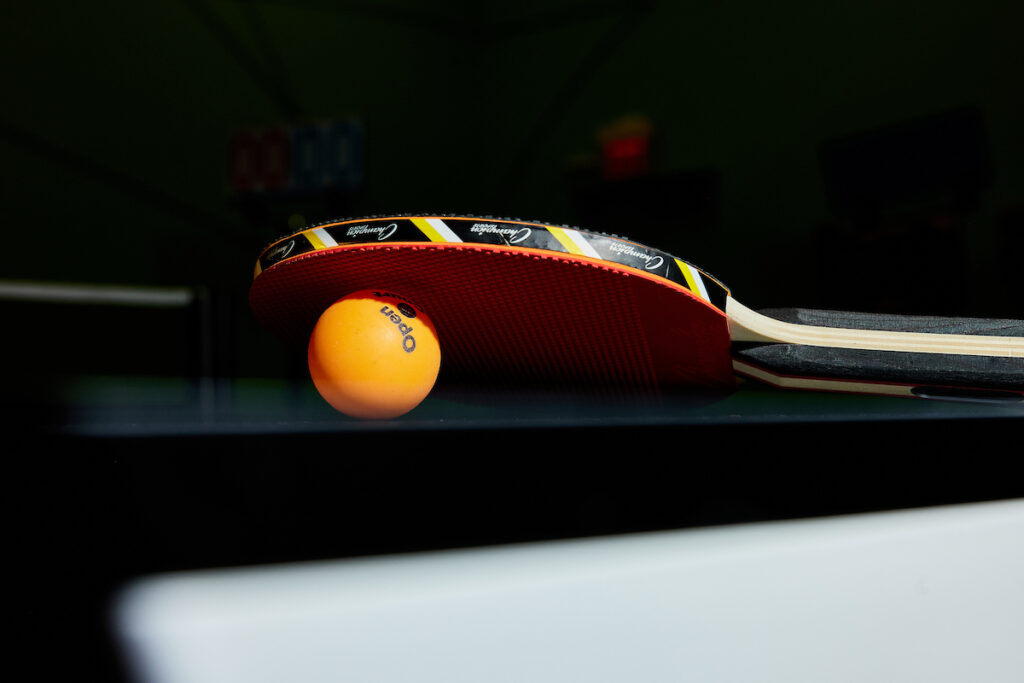
Just as Marty Reisman turned midcentury table tennis into a form of artistic expression, Open Court transforms JMM’s largest gallery into a ping-pong arena, blurring the line between art and sport with spotlit tables, bleachers, scoreboards, and archival images.
Visitors can also drop in for paired play, or reserve tables for group outings, workplace events, and after-school programs. Even a cocktail—“The Supreme,” which I helped name during the course of reporting—is part of the experience (after hours, that is).
“Something I always want to do in my practice is disrupt preconceived notions about what a Jewish museum is and what it can do,” Davis said. “For years, we’ve been having conversations about experiential ways to use our galleries. This is the first foray.”
“It’s a test,” he added, “to see what the reaction is to something a little different.” It’s also a statement—placing something unexpected in a gallery space.
One early idea was Centre Court at Wimbledon reimagined for pickleball, given the sport’s seemingly unstoppable popularity. But there were space constraints and concerns about injury risk. It was a “short leap” to ping-pong, Davis said.
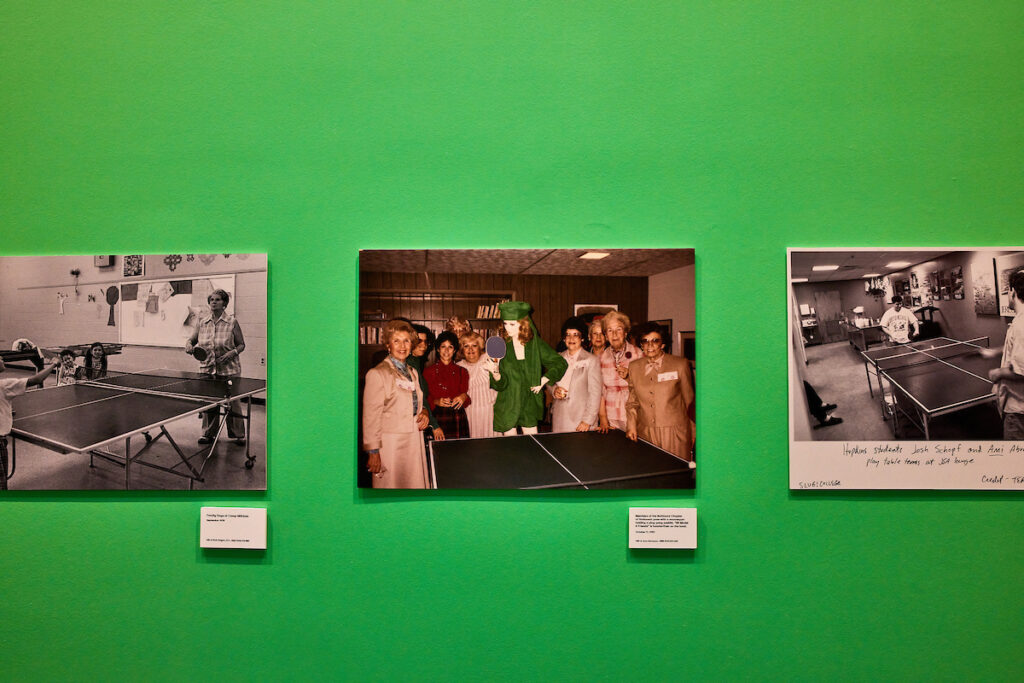
What ensued was unexpectedly substantive. In the museum’s collections, staff discovered a century’s worth of photographs documenting the intersection of Jewish life in Maryland and table tennis. They also received permission to use film footage, mostly from the 1930s and 40s, “in some really spectacular settings,” Davis said.
These materials, paired with the Marty Supreme preview, helped ground the project and “make it make sense,” Davis said, noting his surprise at “how deep the Jewish connection to this game is”—from backyards, youth groups, and summer camps to elite international competition.
For example, during the interwar period and just after World War II, Hungary’s Viktor Barna, Romania’s Angelica Rozeanu, and Austria’s Richard Bergmann—three Jewish table tennis champions—together amassed 46 world titles. Poland’s Alojzy Ehrlich, the inspiration for Marty Supreme’s striking honey scene, was reportedly spared the gas chambers at Auschwitz after being recognized by a guard.
And there’s Long Islander Estee Ackerman, who, at age 11, beat tennis superstar Rafael Nadal in a promotional ping-pong match ahead of the 2013 US Open.
Even without this rich context, “we were doing it anyway,” Davis said of the installation, which JMM exhibits manager Katie Andril oversaw.
“We want people to come to the museum and find joy,” Davis continued. “I’ve worked with a lot of heavy and heady content, and there’s so much heaviness and headiness in the world.” Running through May 31, Open Court is one gallery in one of the country’s leading centers for Jewish history and culture “where it’s not so serious.”
Open Court is also “multisensory,” he said. While playing, visitors start to sweat a little, and the rhythm of ball and paddle dances over the net like “beautiful music.”
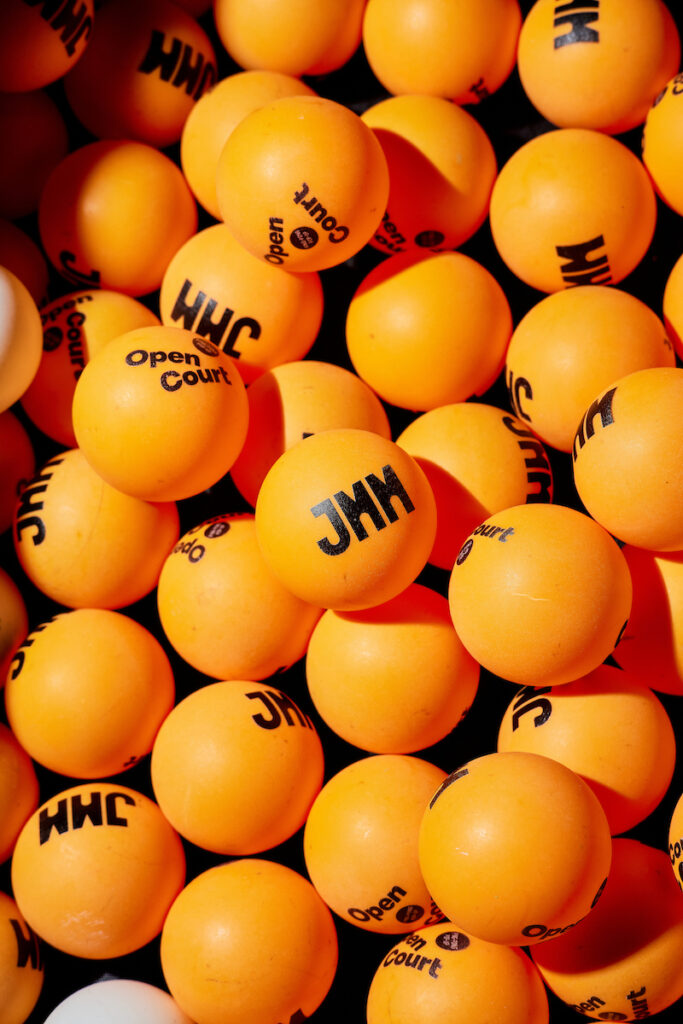
The lightness of the pop-up complements the nostalgia evoked by JMM’s other exhibitions—community-sourced photographs and stories; ornate ritual objects used by Marylanders to observe Shabbat, the weekly day of rest; and mezuzahs, doorpost cases with Torah scrolls, from around the world. Jews of Maryland at the Crossroads of Identity centers a 200-year-old law that granted Jewish men the right to run for state office.
In the arcade, visitors can watch a documentary about the two historic synagogues located next to the museum. And, just around the corner, they can order from Attman’s Delicatessen, JMM’s official deli and one of the last holdouts of Baltimore’s once-bustling Corned Beef Row.
“It’s giving visitors a range of entry points—all kinds of connections can be made,” Davis said, describing a “relational aesthetics” that fosters a “deep Jewish cultural experience.”
JMM is sometimes mistaken for a place of worship because it is flanked by them on either side. “It’s a museum for the public,” whether Jewish or not, Davis stressed. “Hopefully, this is a way we can break down some barriers to entry. It’s an ‘open court’—it’s open to everyone, and if table tennis brings people in, they’ll have a meaningful experience.”
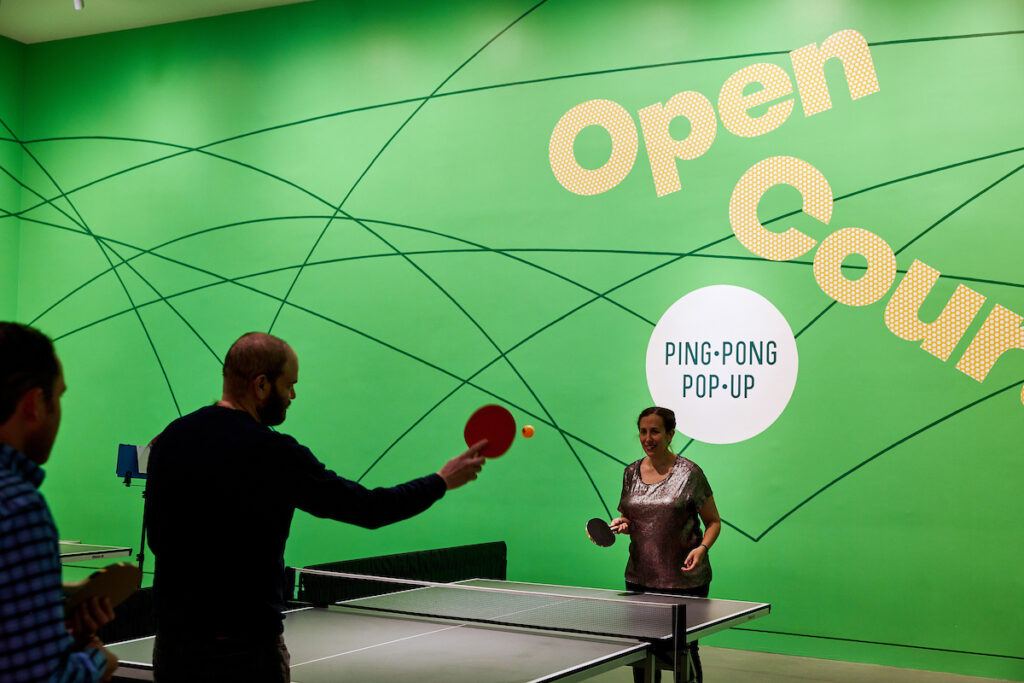
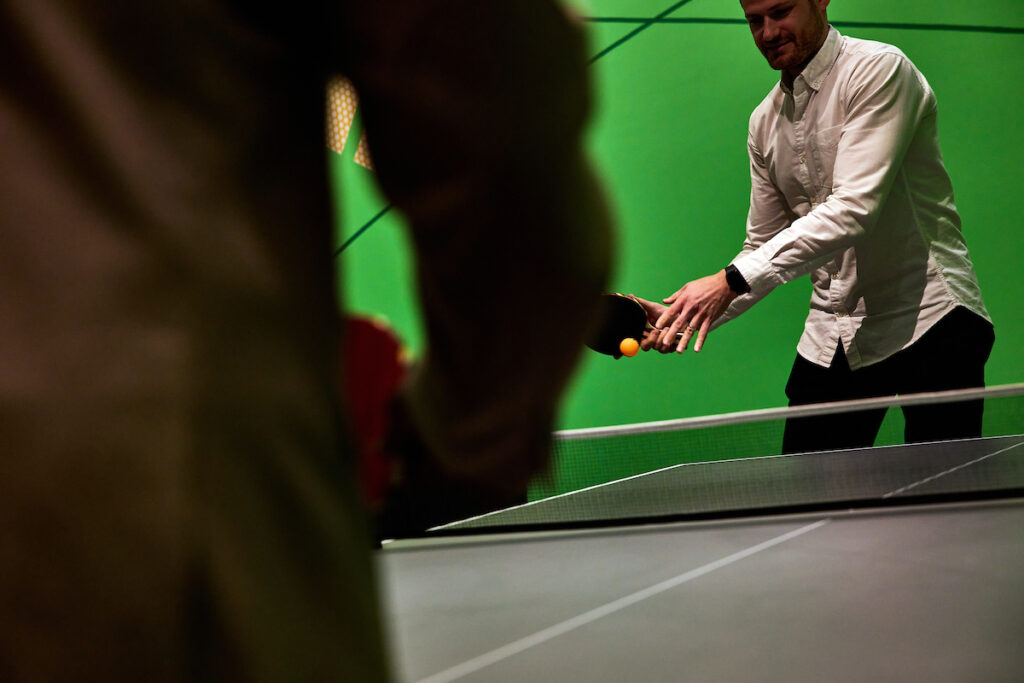
For Davis, table tennis operates similarly to chavruta, a Jewish method of paired study. Both are structured exchanges in which meaning emerges through sustained, attentive back-and-forth. “It’s a way to loosen things up,” he said, and a “tool for facilitating more expansive” discourse.
He has been holding meetings on the courts—a change of pace from sitting in an office or boardroom. “Being around the ping-pong table opens up new directions and possibilities,” he said. “It has a kind of magic to it.”
Open Court has already hosted—or will host—a T. Rowe Price departmental lunch, a 35th birthday party, and a Jews United for Justice social. Artists with Baker Artist Portfolios—among them Public Mechanics founder Bruce Willen, who designed the space—are also convening there.
To some extent, the installation recalls the agora, a central public space in ancient Greek city-states that served as a marketplace for goods and ideas and a hub for artistic, athletic, political, and spiritual life, embodying philosophy, civic engagement, and democracy.
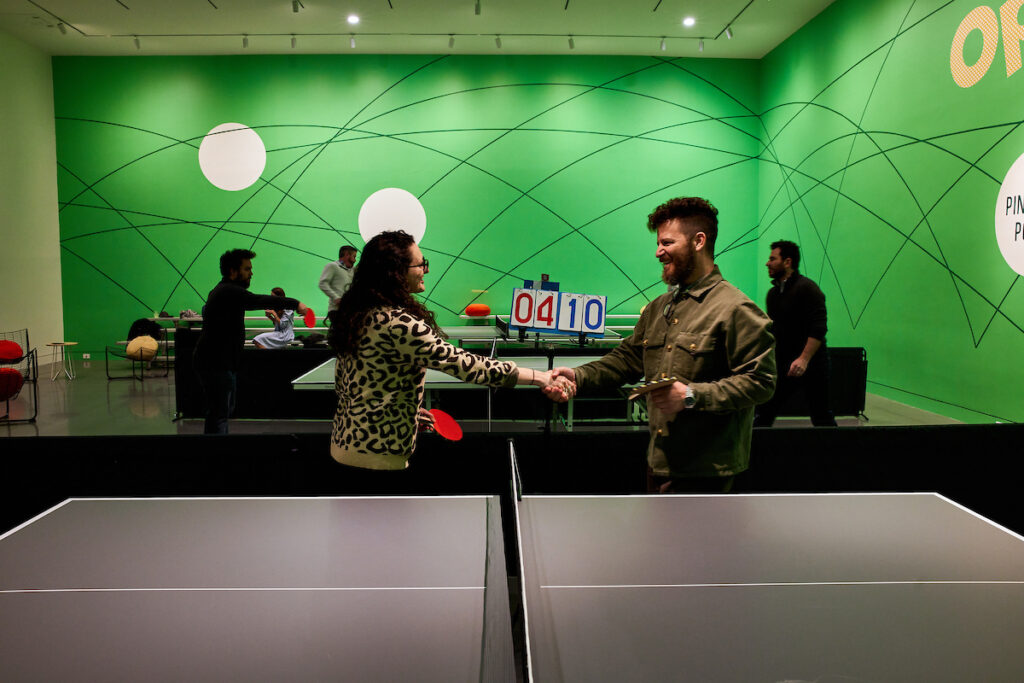
JMM isn’t the first museum to take on table tennis as a medium. For example, the Contemporary Jewish Museum in San Francisco staged The Ping Pong Project in 2011.
More than two decades earlier, in 1990, the San Francisco Museum of Modern Art mounted Barbara Stauffacher Solomon’s “Ping Pong Table” paintings exploring space, gardens, and the built environment. The Palm Springs Art Museum recreated elements of the work in 2019, featuring “supergraphics”—large-scale graphic designs—that Davis said helped inspire Greg Gannon’s hand-painted illustrations in Open Court.
The same year, Rirkrit Tiravanija filled a room at the Luigi Pecci Contemporary Art Center in Prato, Italy, with ping-pong tables bearing the words “Tomorrow is the question,” inviting a usually passive public to take part in the exhibition and engage with the future of humanity. The display referenced the J.K. Ping-Pong Club (U.F.O.), an art project first presented by Július Koller in 1970 that used the sport to playfully reflect on society.
Similarly, in 2024, Les Abattoirs in Toulouse, France, showcased J.K. Ping-Pong Club (U.F.O.), a fictional club questioning systems of control while proposing new forms of interaction. And SFMOMA premiered Get in the Game: Sports, Art, Culture later that year.
Open Court won’t be the last pop-up at JMM. “There’s more to come,” Davis said. “We’re not sure what will be next, but our imaginations are churning… Table tennis feeds the imagination.”