Louis Fratino is a Maryland-born artist whose portraits, interiors, and still lifes convey open curiosity. Many of his pieces are academic, reading like studies, but they retain warmth in part because they feel so confessional.
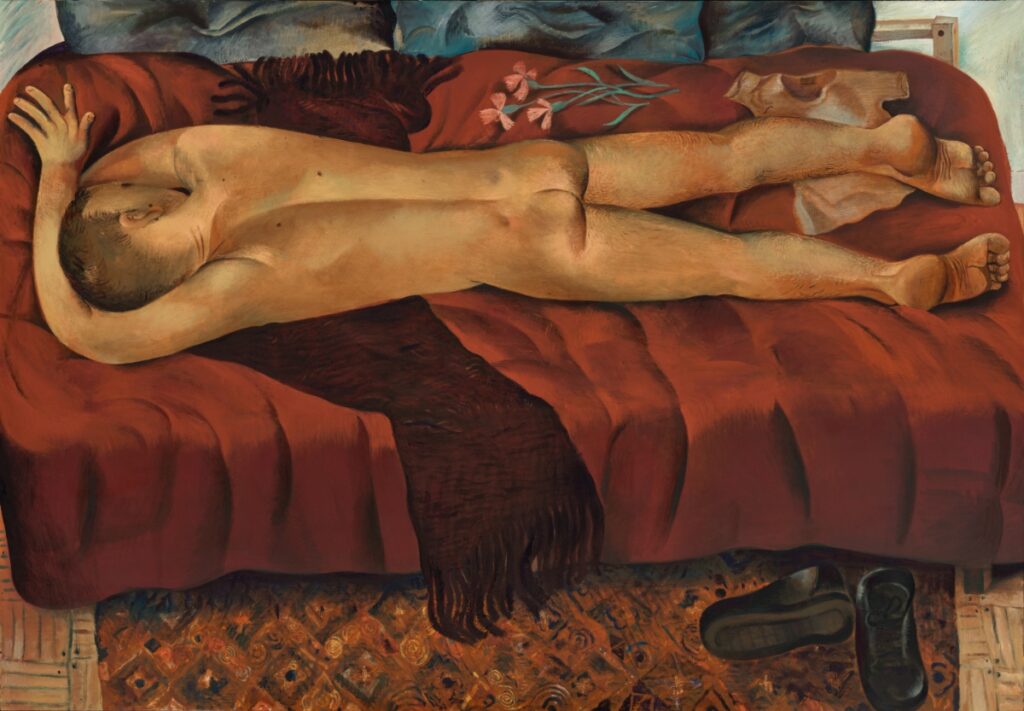
“Red nude (after Mafai)” (2023) borrows the basic composition of the Italian painter’s “Nudo sul divano (1933)” but replaces the nude woman with a nude man, a noodly arm framing the figure’s head to shield him from the Sunday Scaries. Fratino plays with proportion, approaches hands and feet with whimsy, and magnifies quotidian detail. A plastic coat hanger, a barbell earring, or a cereal bowl anchor Fratino’s images in the present day, even if he draws clear inspiration from the American and European modernists.
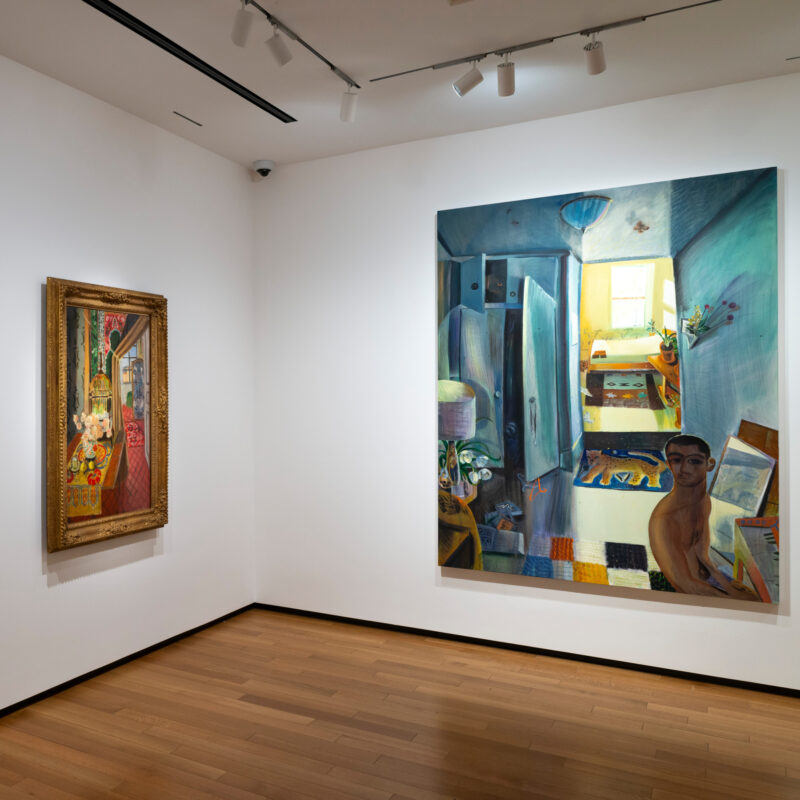
When Fratino was a student at the Maryland Institute College of Art in Baltimore, he spent a lot of time with the Baltimore Museum of Art’s expansive Matisse collection, returning to the Cone galleries again and again. Matisse and Fratino share an affinity for the private moment, the intimacy of domestic space that retains vibrancy even in banality. In the BMA’s current exhibition, Fratino and Matisse: To See This Light Again, they also share wall space, highlighting the great strides Fratino has made since his MICA days. Now his self-portrait hangs beside Matisse’s own, both looking at the viewer through round, wire-rimmed glasses—one notably more wizened and guarded than the other.
Pairing a young artist with a revered master of Modernism for a major museum exhibition could be perilous, but how could the young artist decline? The exposure is vital, the clout bolstering, for one’s still-burgeoning career. Yet there’s the risk that, side by side, the audience might view the younger artist as auxiliary. Even if Fratino isn’t burdened by the anxiety of influence, the viewer explicitly compares. Is this new work inventive or complimentary? Iterative or derivative? What does Matisse afford Fratino, and what does Fratino achieve in assigning himself these prompts?
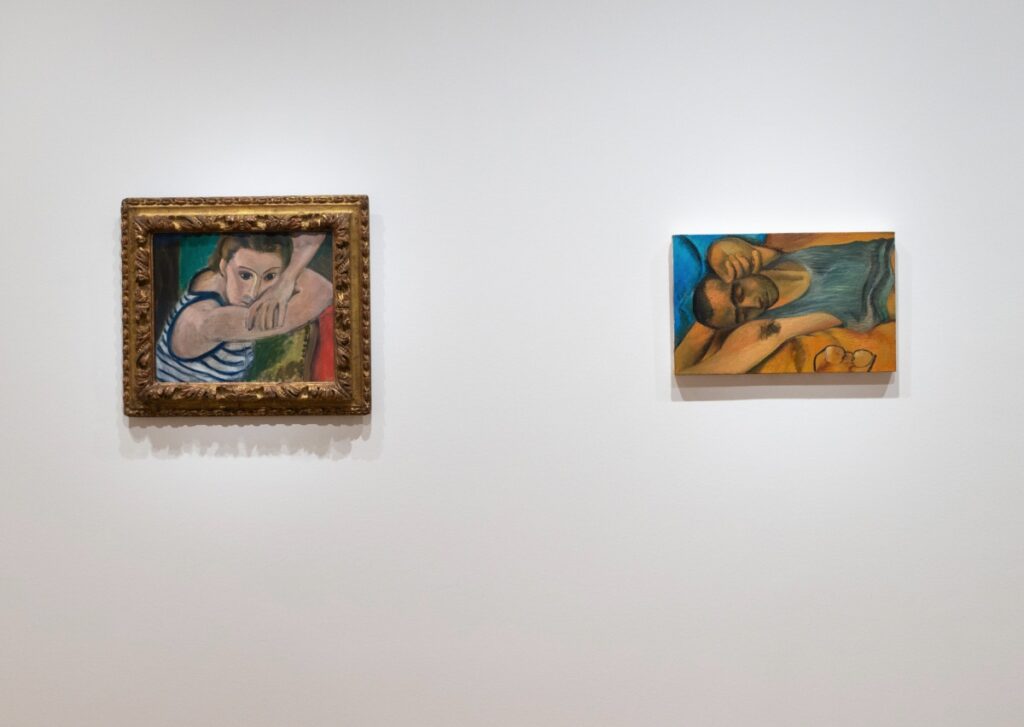
One such pairing of works is Matisse’s “The Blue Eyes (1935)” and Fratino’s “Ochre Alessandro (2023),” close-cropped portraits of similar dimensions. The woman in “The Blue Eyes” rests her head on her arms, which are folded atop a green upholstered chair. Rather than the crystal blue one might expect from the painting’s title alone, her almond-shaped eyes display deep navy irises. Like her half-covered lips, her eyes invite the viewer in, but only partially. Meanwhile, “Alessandro” is fully reclined, glasses cast off to the tangerine bedding in an unplanned moment of rest. His are eyelids closed and shadowed beneath his large hand, arms stretched overhead. Fratino might be asking if the window to a man’s soul is not his eyes but his tufted armpits.
The BMA gave Fratino the choice of which works from Matisse to exhibit beside his—an impressive and frankly shocking amount of agency in how to represent his artistic inquiry. With the world’s largest public holding of works by Matisse, Fratino had plenty of pieces to choose from and approached the assignment with tremendous enthusiasm. In this light, it’s striking that so many of the subjects shared between the artists are languishing: collapsed on a bed, stretched out in repose, or leaning on elbows with head in hand. Even the heads of the roses and anemones weigh down their long stems.
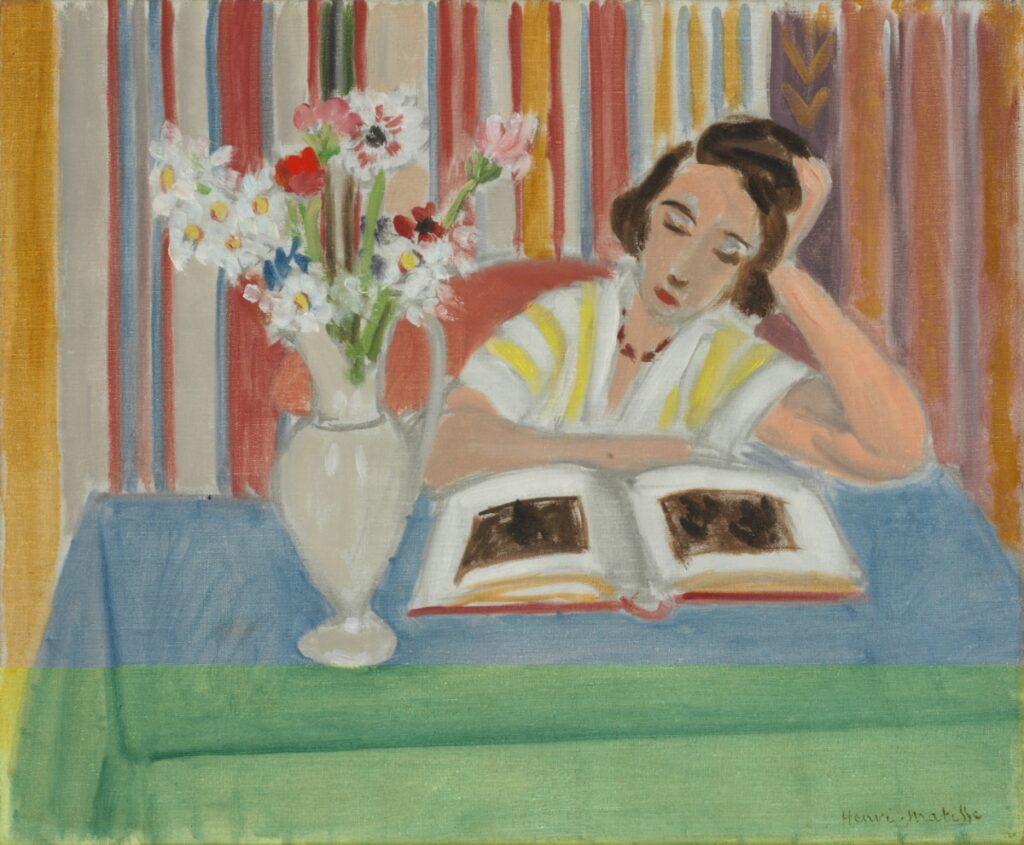
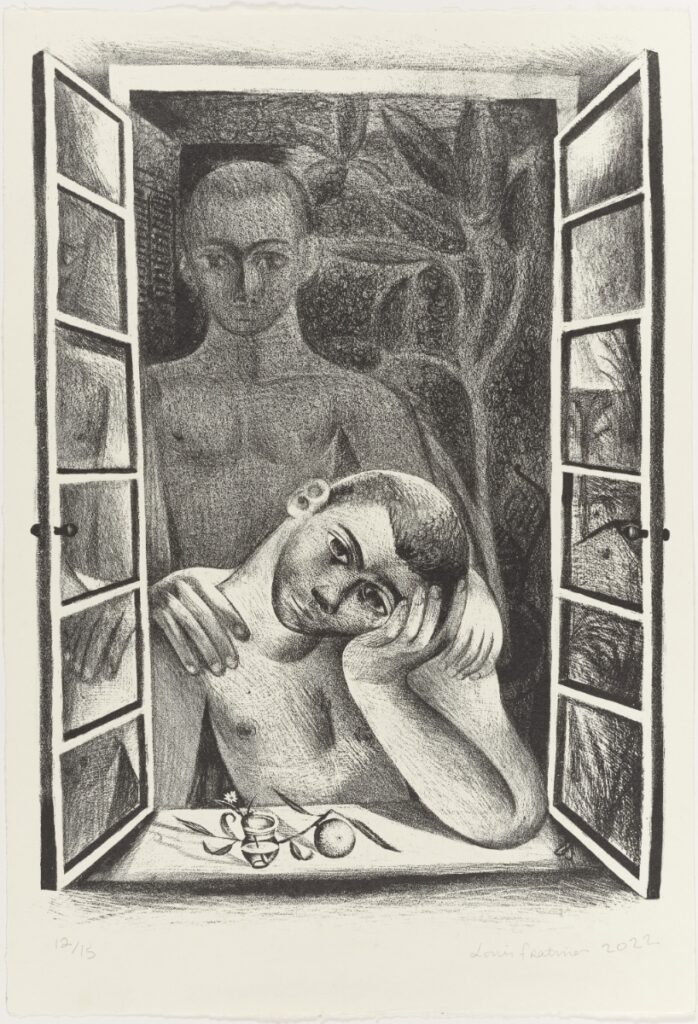
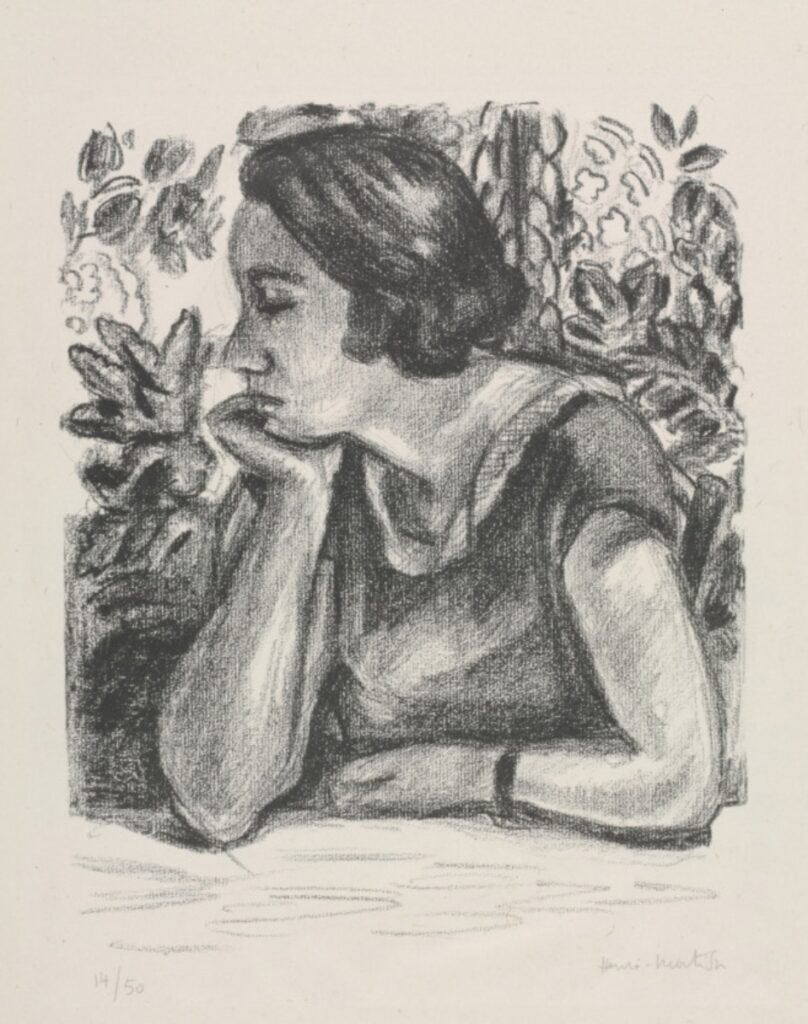
One might be tempted to say the subjects of these portraits are bored; however, rather than plagued with boredom, the figures in the numerous portraits have a fractured attention in what would otherwise be a cohesive, undisturbed moment. The girl browsing a book grows weary of the brown images on the page, decidedly darker than the bright flowers or the colorful striped wallpaper that surrounds her (“Girl Reading, Vase of Flowers,” Matisse 1922). The young man seated at the windowsill turns his attention from a lover to the street, total satisfaction proving elusive (“Naples,” Fratino 2022). The figures share a palpable longing muted just enough to fix them in place. Heavy is the head that lives its days indoors.
Matisse, and Fratino in suit, are in contrast quite absorbed—joyful even. These portraits are invested in the present moment, fascinated in the subtle tensions of their subjects as well as their environments. While Matisse reflects his subjects’ fractured attention in patterned textiles and papered walls, Fratino more often uses angled light. “Waking up first, hard morning light” (2020) is a large-scale painting by Fratino that illustrates his attunement to the details that make a quiet moment buzz with life. Sun filters through yellow tree leaves, a window screen, water in a green glass; rays bounce off a fingernail, a gold ring, a discarded bit of paper on the nightstand; a potted plant, the folds of a bunched sheet, and the crook of an elbow all cast varied shadows.
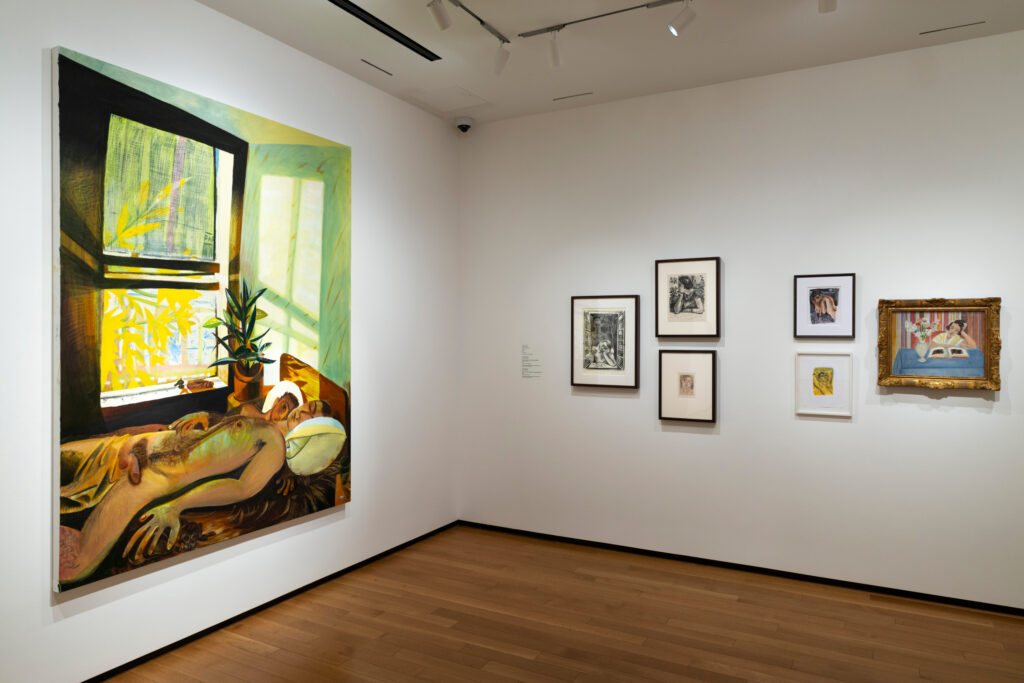
Laurence RossThese portraits are invested in the present moment, fascinated in the subtle tensions of their subjects as well as their environments.
However, Fratino’s geometry enters the realm of the fantastic when one tries to follow his lines too closely. The whole interior lists, as though in the sway of a slight hangover. The accuracy Fratino achieves here isn’t measured in precise degrees but felt in the stomach, which is exactly where the wide-eyed lover rests his fingers on his sleeping partner. What might at first glance be a sun-drenched pillow is an uncanny halo, as if there is something holy in the moment before foreplay even begins.
Fratino paired his painting “Tom” (2019) with Matisse’s “Large Reclining Nude” (1935), and this is a rare moment in the show in that Fratino’s piece is smaller. “Large Reclining Nude” has many of Matisse’s hallmarks—an elongated figure with sinewy lines, surreal proportions, and angular elbows; a facial expression delivered in a few lines, patterned backdrops. Tom answers like any echo, which is to say the similarities are clear but the tone and texture are also clearly distinguishable.
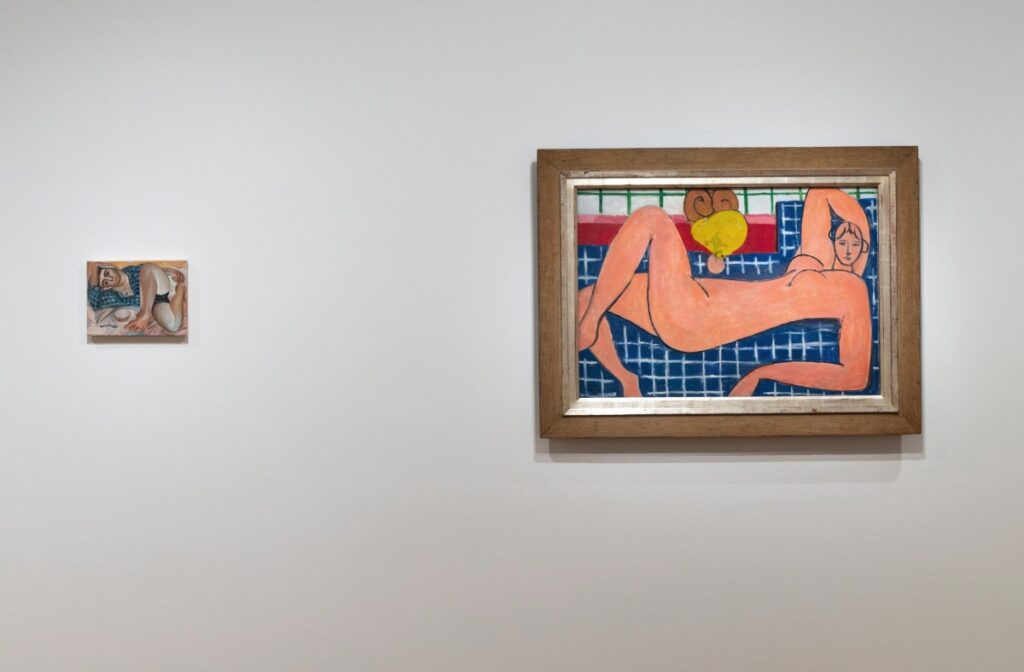
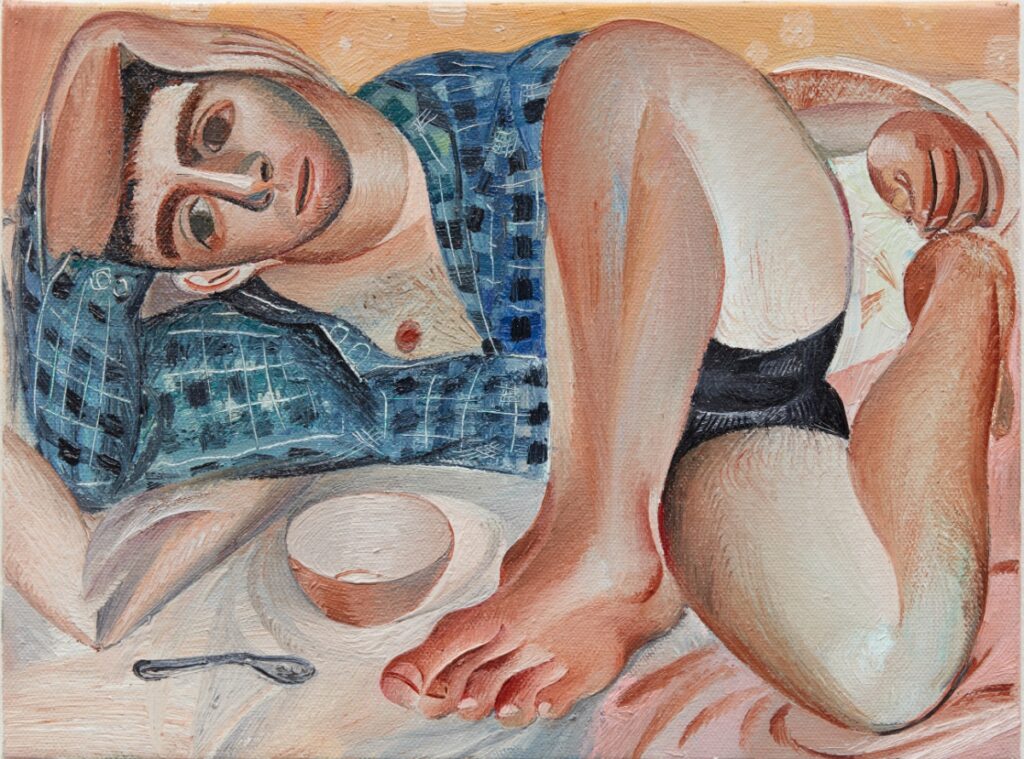
For example, Fratino pulls Matisse’s the blue-and-white checkered backdrop into the softer, more pliable pattern of a button-up shirt. Though neither figure is fully dressed, Tom seems more self-consciousness that he is the center of attention. The woman’s eyes remain inscrutable—difficult to say if they are open or closed, though they seem aimed squarely at the viewer; Tom’s eyes are wide open, dilatated, with their focus just out of frame, a person who is revealing something intimate but is slightly too uncomfortable to look you in the eye while sharing it. While this woman is more abstracted than one of Matisse’s many odalisque paintings, she still reads as more available than Tom, not only because she is completely nude, but because her left arm is held away from her body like an invitation.
Is there a marked difference between a straight man painting nude women at the start of the 20th century and a gay man painting nude men at the start of the 21st century? Arguably, there’s more to it than simply expanding an established genre for queer visibility and representation, or even updating harem pants for a pair of black trunks. With Matisse, his subjects are studied, appreciated, and at least at times desired. His joy is in the opposite sex, and therefore located in bodies who are by definition othered from himself—an otherness amplified in his increasingly abstract late-career cut-outs. With Fratino’s work, one can’t easily tell the portraits and self-portraits apart, which signals a greater potential for empathy and introspection. Fratino could be any of these young men: the one waiting for his partner to return home and occupy the empty chair; the one prone on a daybed, too exhausted to find a vase for the flowers at his side. Matisse is roused by the exoticized odalisque; Fratino is himself the odalisque, servicing our desire to be roused by his private space.
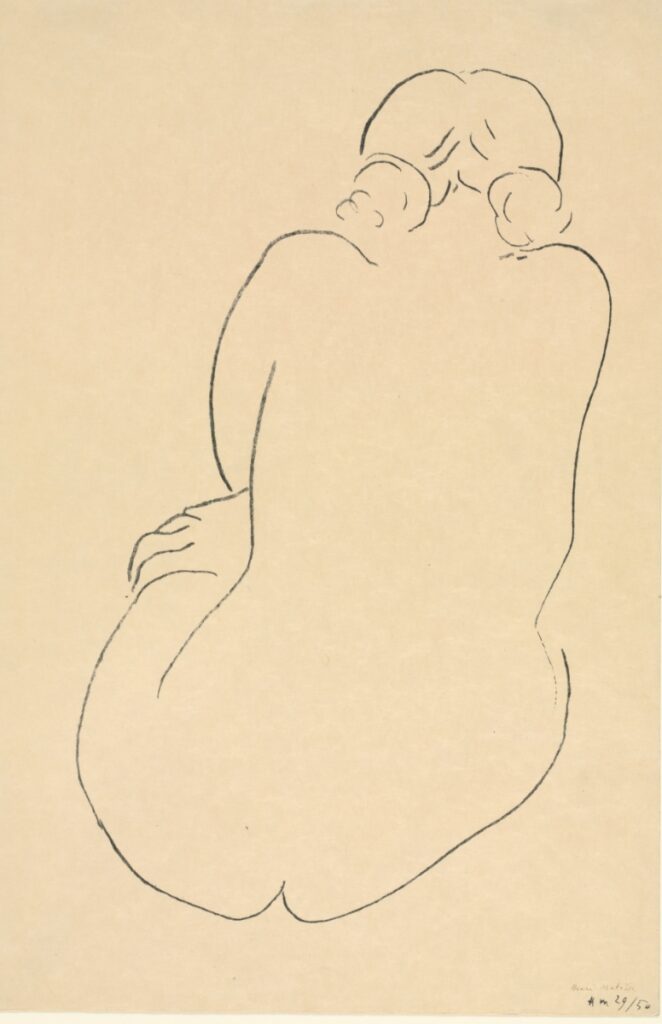
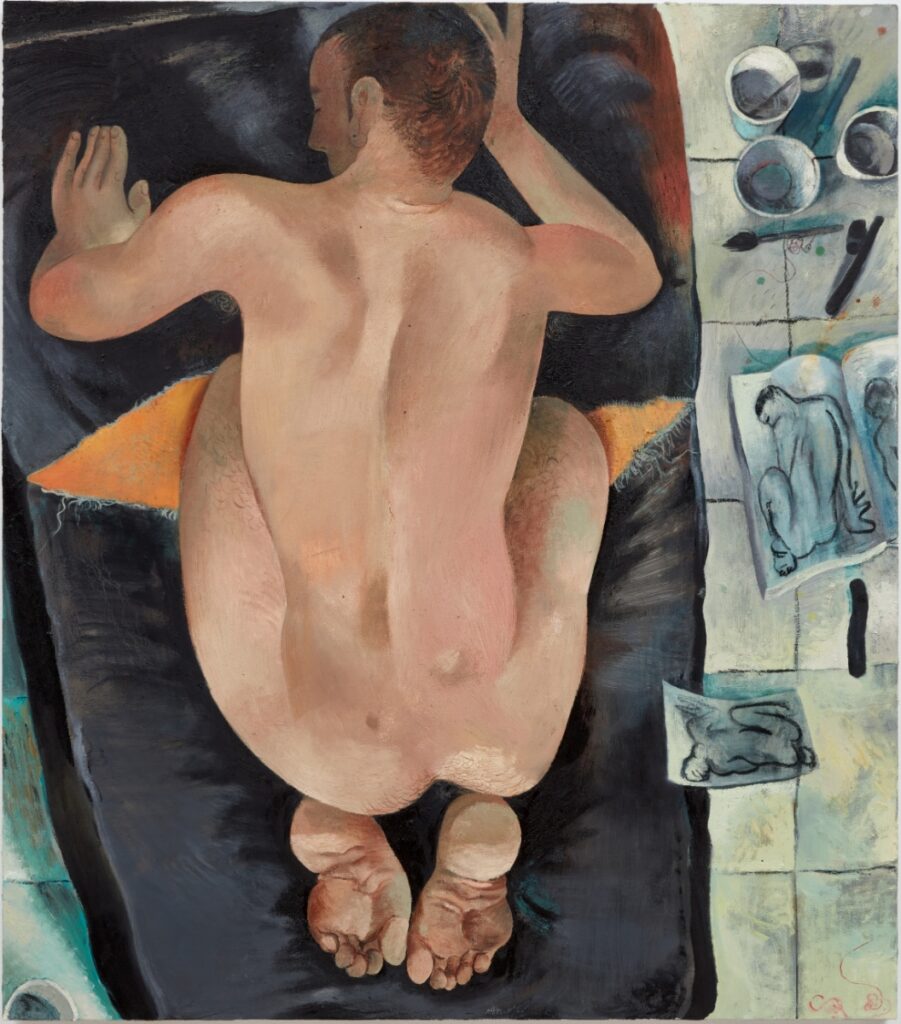
“Studio Nude” (2025) is a new painting Fratino created for this exhibition, juxtaposed to Matisse’s “Seated Nude, Viewed from Behind” (1913). Here, we are given a bird’s eye view of artistic practice laid bare, how inspiration leads to mimetic response. Matisse rendered the female figure for this crayon transfer lithograph using exceptionally few lines. Fratino, though borrowing the woman’s huddled pose, presents the viewer with a veritable landscape of skin: the crevice at the nape of the neck, the summit of scapula, the ridge of erector muscles, the smooth slope of flank. This rich range of colorful detail extends down to the feet, where Fratino may have lingered the longest. Each ball and heel and toe has its own distinct shades and characteristics, as if the feet were a field of boulders. There is heaviness here, as the weight of the body depresses and stretches the torn cushion.
The figure’s nude body bridges a fissure of bright orange foam, and his position is especially vulnerable: face to the floor, knees to chest, submissive. The split fabric is frayed, and seems to have endured a failed repair attempt or two, suggesting safe play isn’t always possible. But the figure’s pose could alternatively be read as protective, as if the young man were shielding something he wants to safeguard. What of Matisse’s oeuvre does Fratino wish to preserve, and how does he hope to distinguish himself? Hanging one’s work alongside a beloved, canonical painter is hardly playing it safe, but risk can sometimes be its own reward.
Fratino and Matisse: To See This Light Again is on view through September 6th at the Baltimore Museum of Art. The BMA will host a conversation between Fratino and Curators Virginia Anderson and Katy Rothkopf on Thursday, May 21 from 5:00 to 7:30 pm. Details here.