Private collections tell a different kind of story than museum collections do. There’s no committee behind them, no consensus — just the unfiltered eye of someone buying what moved them. Seeing the Essential, now on view at the Baltimore Museum of Art, is a portrait of exactly that kind of eye. A midcentury Picasso lithograph, all sharp angles and bullfight violence, hangs in dialogue with a woolen Diné “Storm Pattern Rug,” its geometry imposed in soft, muted color. They have almost nothing in common except that Sigmund and Mary Hyman wanted them both. This tension, between wildly different objects and one very consistent sensibility, is what makes this show worth seeing.
Mary Bloom Hyman grew up on Cape Cod and came to Baltimore for Goucher College, where she built a career in science education. Her husband Sigmund was a decorated World War II veteran turned financial planner. Together they spent more than sixty years buying American art and living with it, becoming fixtures of Baltimore’s museum and arts communities along the way. When Mary died in 2024, the bulk of the American work came to the BMA; a smaller cache of European modernist pieces went to the Cape Cod Museum of Art.
What survives that donation, and what the curators have shaped into this exhibition, is a deeply coherent body of work: over 100 pieces, mostly modest in scale, overwhelmingly figurative, and centered on the Ashcan School, the early-1900s New York painters who turned their attention to the city’s saloons, tenements, and street life rather than its parlors. As BMA director Asma Naeem put it, the Hymans collected with “an astute curiosity, an abiding belief in the power of history, and a sense of conviction.” You can feel it in every gallery: this is not a survey assembled to fill wall space, rather it’s the record of two people circling back, decade after decade, to the same questions about what modern American life looked like.
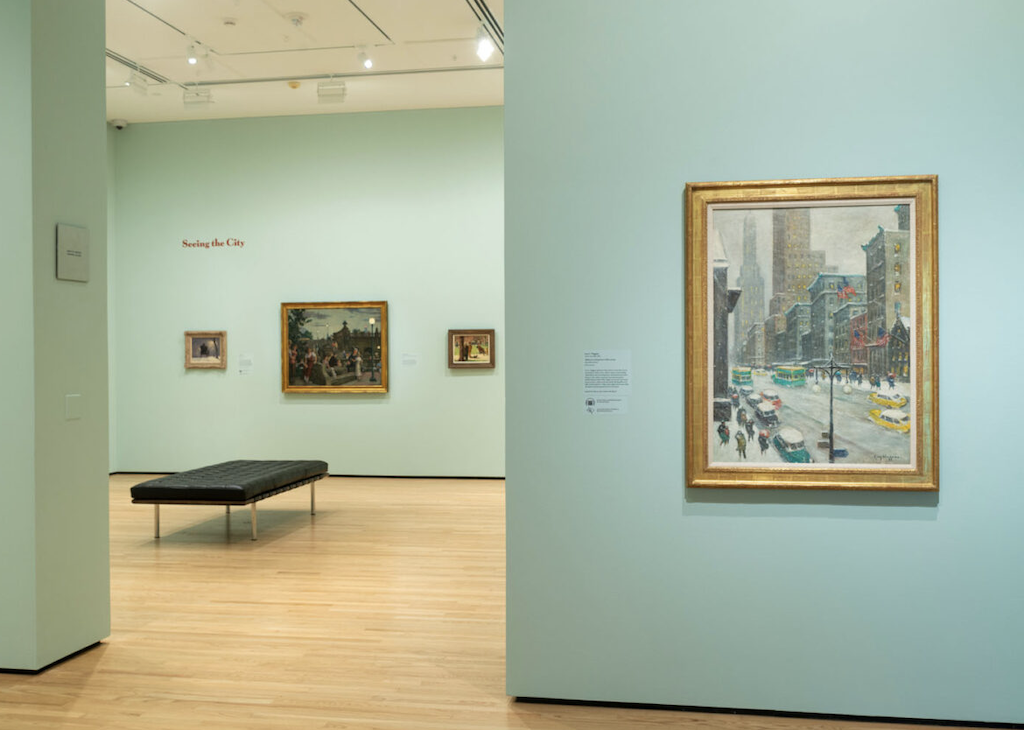
Rather than a chronological march, the curators have organized the collection thematically — Cities and Structures, Seeing the City, Seeing the Country, Out and About, The Essential Figure, Interior Lives — and the choice pays off. Many of these small, quiet works could sit comfortably in more than one category but grouping them this way turns the exhibition into something closer to an essay than a checklist: each room makes an argument about a facet of modern experience, and the works illustrate rather than simply illustrate-and-move-on.
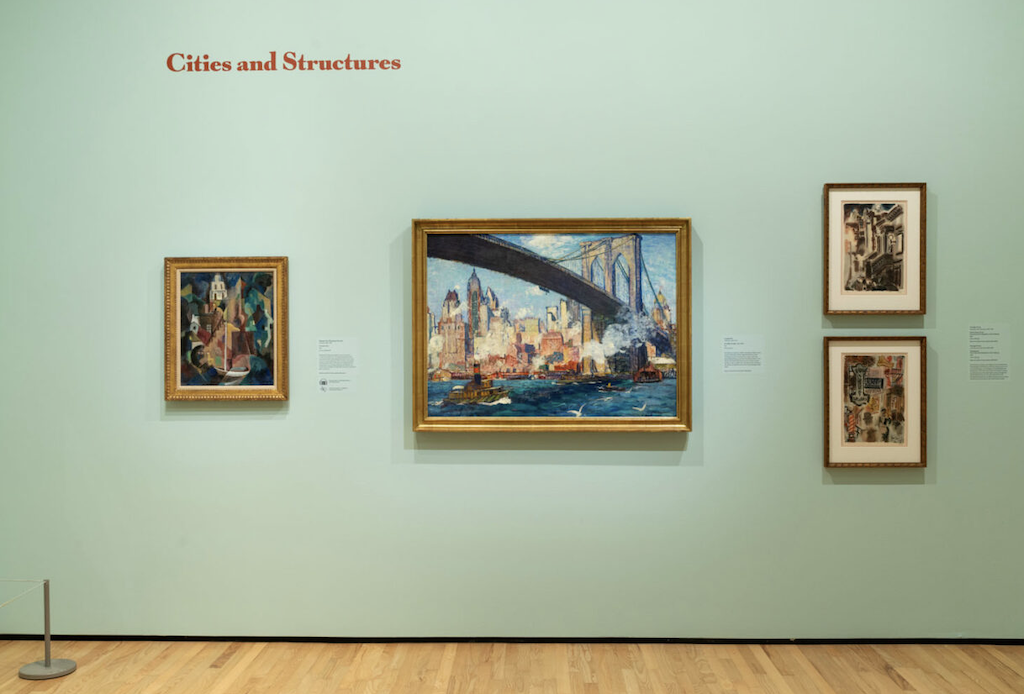
The first gallery sets the terms. It’s built to make an impression, full of paintings and prints wrestling with the modern city—specifically a New York reshaped by immigration, its Lower Manhattan streets dense with new arrivals. Two 1935 color collotypes by George Grosz anchor the room: “The Bowery,” teeming with crowds and signage, and “Brown Stone,” a quieter nighttime study of a single building. Grosz had fled fascism for the U.S. only three years earlier, and his German Expressionist angularity gives both prints a jittery, exaggerated energy — heightened by the collotype process itself, a now-rare technique that yields a velvety, continuous tonal range closer to a one-of-a-kind print than a mass-produced one. Seeing prime examples of it here is a genuine treat.
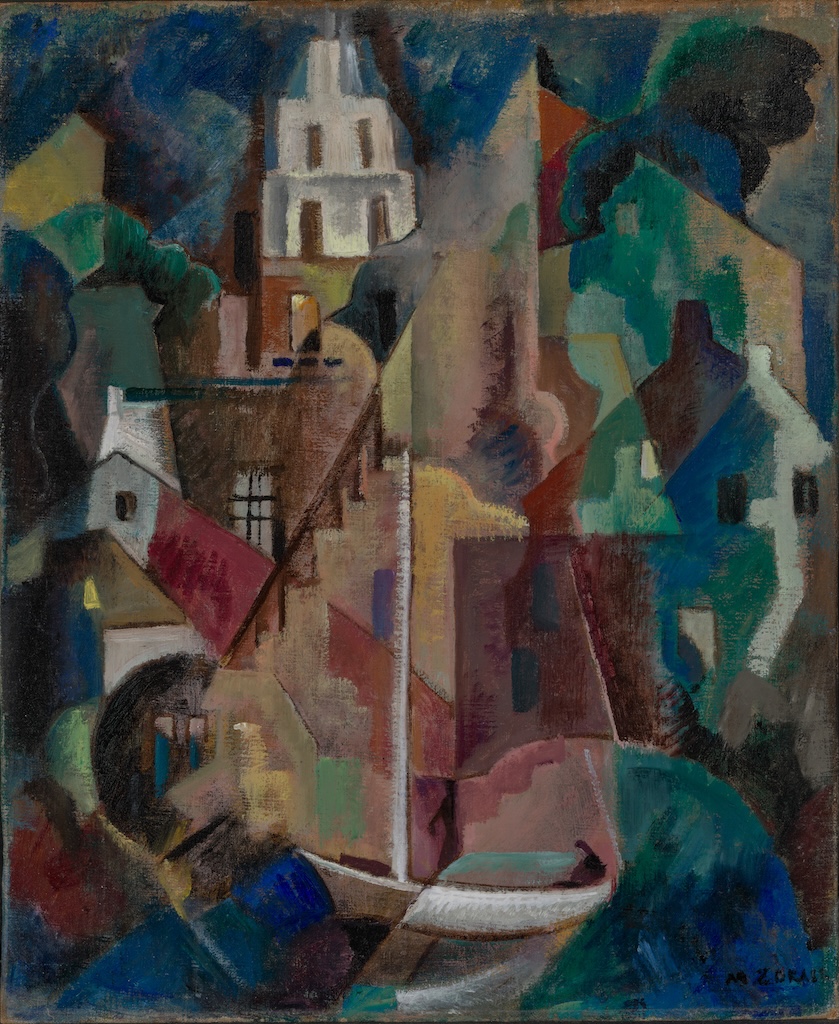
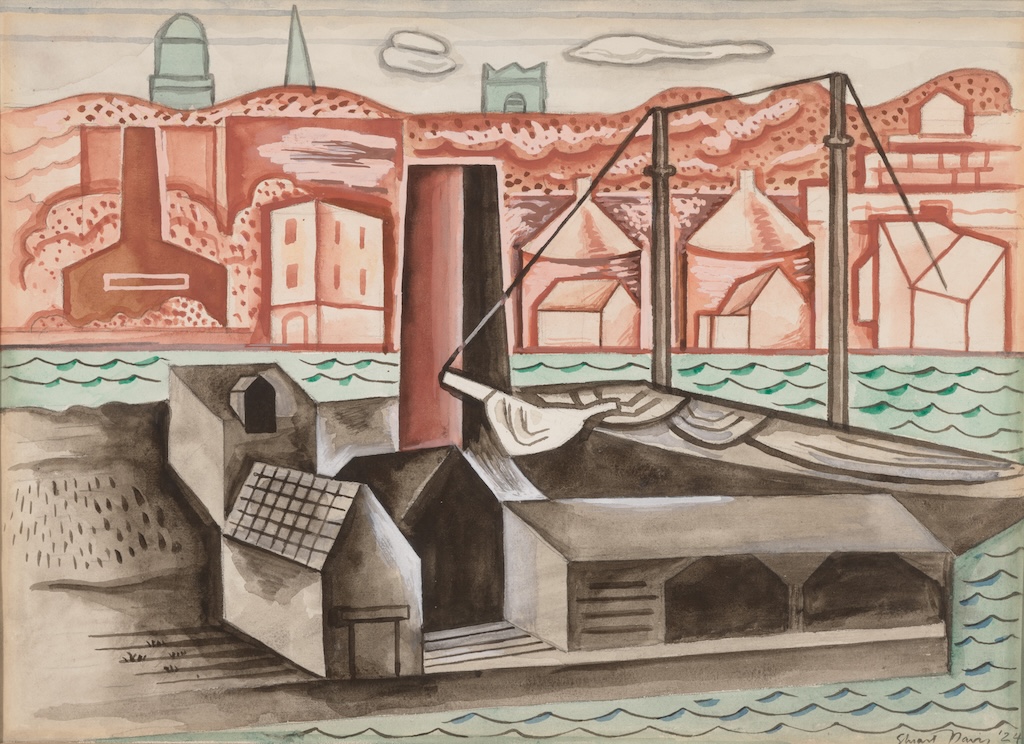
The collection reflects its era in an uncomfortable way: women artists are scarce. The exception worth lingering over is Marguerite Thompson Zorach, represented by two very different works. Her 1916 painting of Provincetown—the Unitarian Universalist Meeting House tower, a scatter of buildings, a sailboat—carries the angularity and simplification she picked up studying Fauvism and Cubism in France. Later, in The Essential Figure, a looser, more charming watercolor of a woman in a boat shows the same modernist vocabulary applied more gently. Stuart Davis’s nearby 1924 view of Gloucester harbor makes a useful companion piece: another American artist visibly digesting Cubism, working out how much of it to let into an otherwise representational scene.
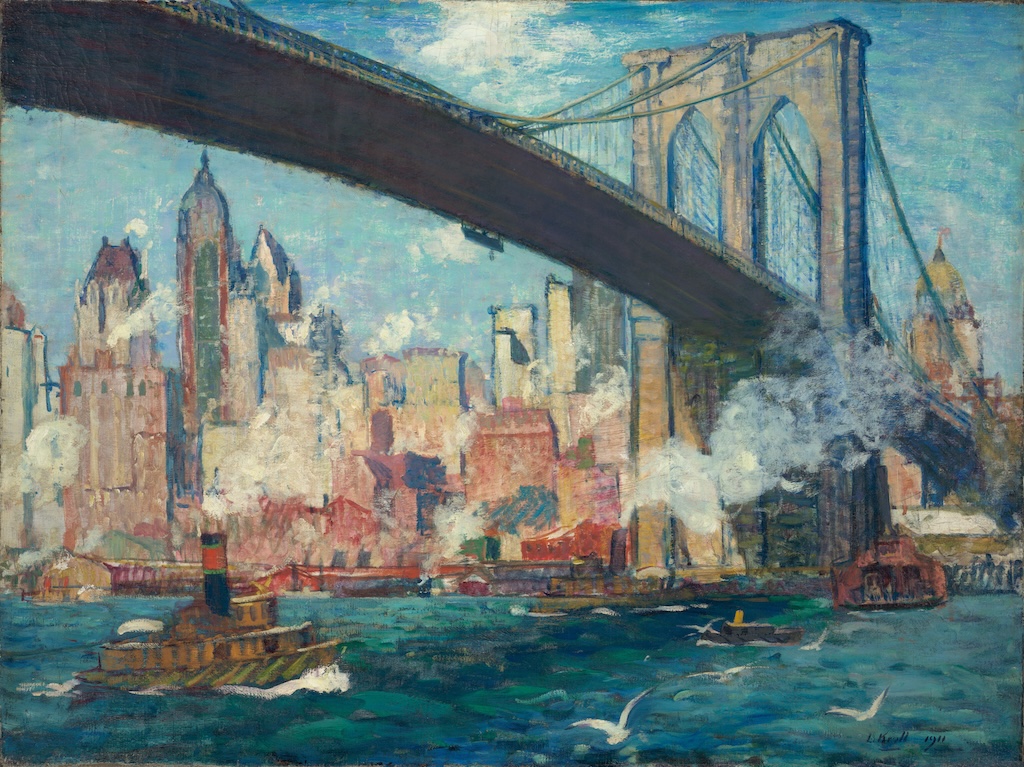
One of the exhibition’s few large-scale works, Leon Kroll’s 1911 painting of the Brooklyn Bridge, offers a change of pace — a bright, loosely painted wintertime view toward Manhattan, tugboat cutting across the water, indebted more to Impressionism than to anything Cubist. It’s a reminder that the Ashcan sensibility wasn’t a single style so much as a shared subject matter approached from several directions at once.
No artist dominates the collection like John Sloan, who appears in more than twenty works spread across nearly every section—arguably the show’s real spine. Sloan started as a Philadelphia newspaper illustrator before Robert Henri, the group’s charismatic teacher and de facto leader, talked him into fine art. (Henri himself gets only a single small drawing in the exhibition, but his fingerprints are on nearly everything around it — his belief that an artist’s job was to observe modern life and distill its essence shaped the whole Ashcan sensibility, later collected in his influential 1923 book The Art Spirit.)
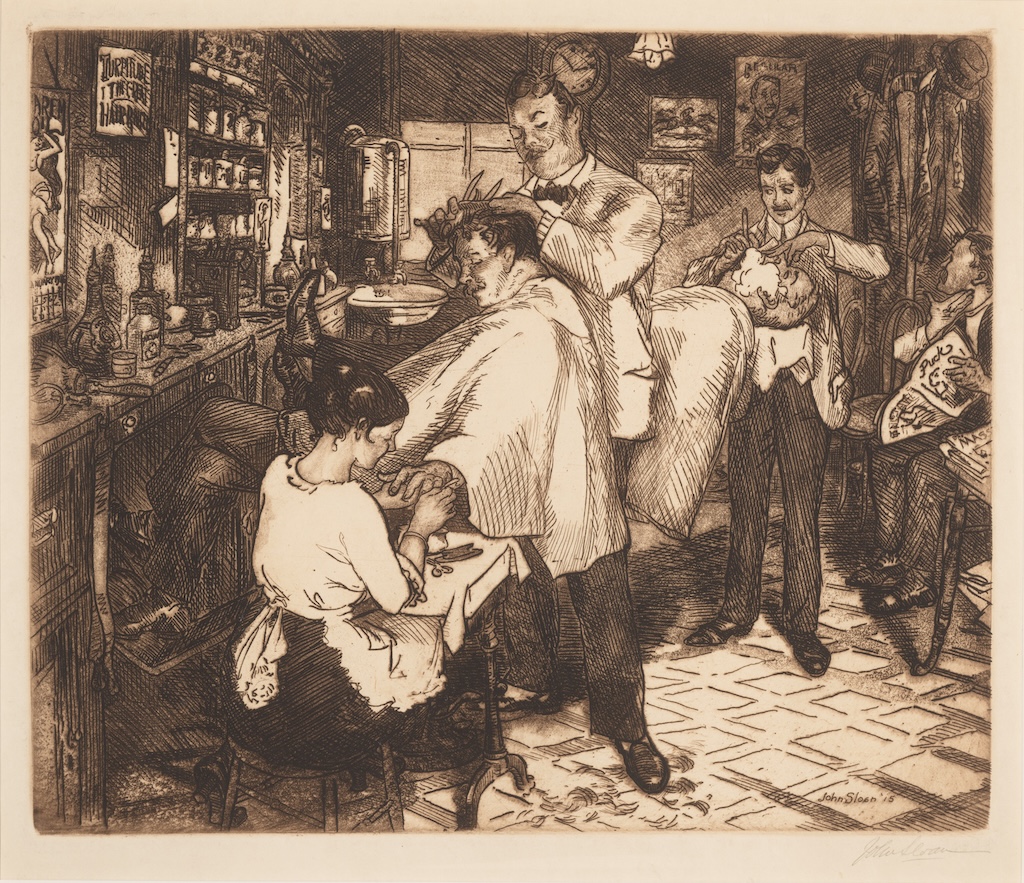
The wall of Sloan etchings is a highlight: “Fun, One Cent” (1905) and “Barber Shop” (1915) both zero in on working-class leisure with a satirist’s eye, earning Sloan comparisons to Hogarth. Later, a run of oils from his five Gloucester summers—including “From Schoolhouse Hill, Gloucester” (1914)—shows him loosening up under Impressionism’s influence, pulling fast, essential impressions from the landscape rather than working them over.
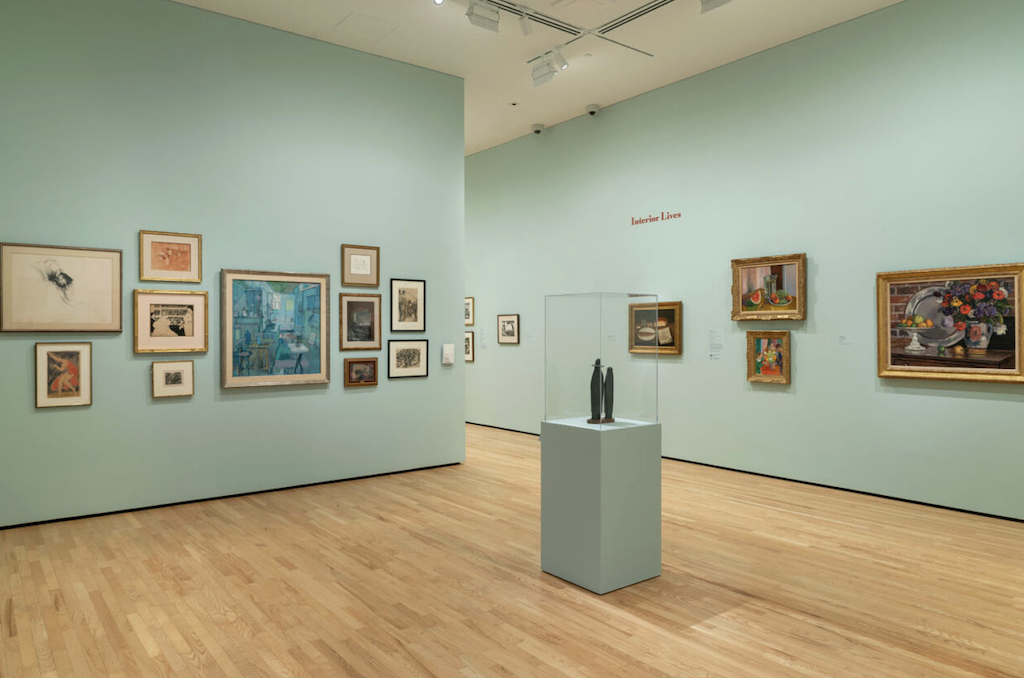
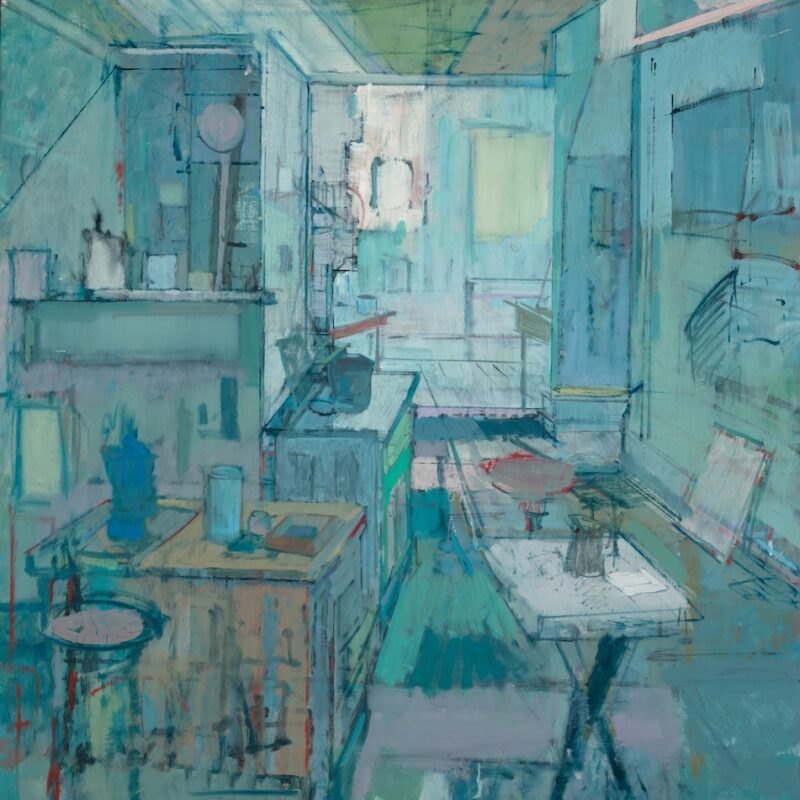
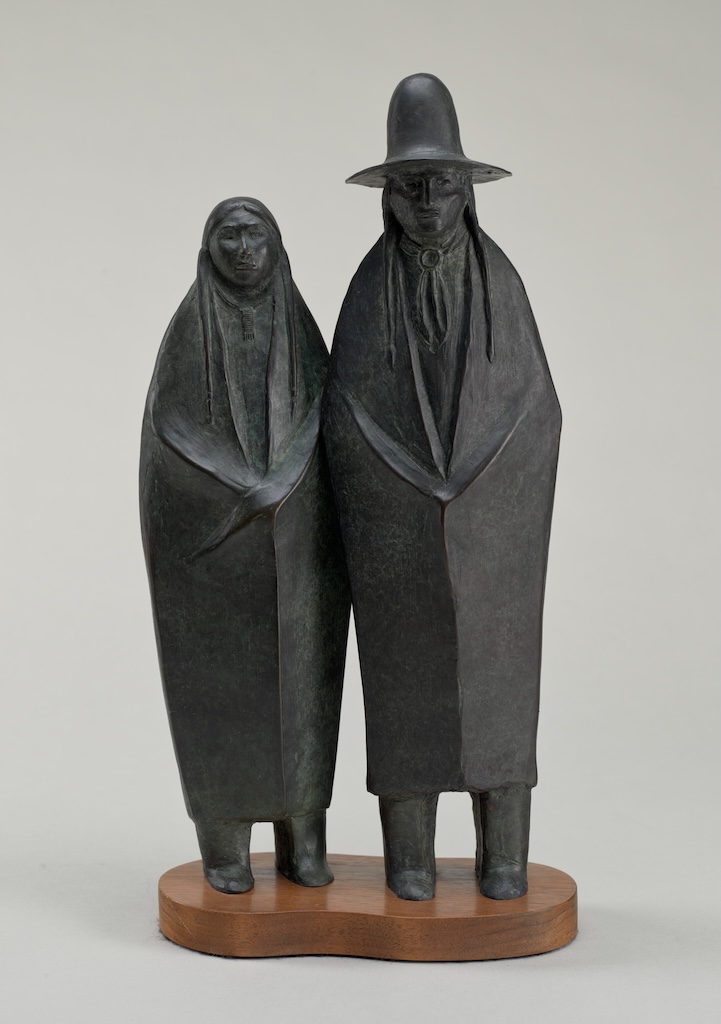
The final gallery, Lives of the Artists, is where the show’s underlying thesis comes into focus. It’s a deliberate grab-bag: John Heller’s oversized, almost mystical 1964 painting “In Louis’ Studio”; Abraham Walkowitz’s lively watercolor of dancer Isadora Duncan mid-movement; two later works on paper by sculptor Dorothy Dehner, whose inclusion makes more sense once you know she studied under Jan Matulka, also represented in the collection; a Picasso print; a sculpture by Chiricahua Apache artist Alan Houser; and that Diné storm-pattern rug from the show’s opening comparison.
Placed together, these less representational, more abstract pieces make an argument the rest of the exhibition has been building toward all along—that the modernism absorbed by American painters from Picasso and company runs in a current alongside, and sometimes converges with, the abstraction native to art forms like Navajo weaving. It’s a quietly ambitious note to end on, and it recasts everything that came before it.
What makes Seeing the Essential work isn’t just the quality of individual pieces, although there’s real quality here. It’s the coherence of a lifetime’s worth of looking, organized by curators who trusted the collection enough to let its through-lines emerge thematically rather than chronologically. The result reads less like a survey of “American art, 1900–1950” and more like two people’s sustained argument about what deserved attention, made object by object over sixty years.
It’s also a rare chance to see this much of it at once: works on paper don’t stay on view long, and the BMA’s free admission means Marylanders can return before the show closes in September. In an era when taste is increasingly shaped by algorithm, there’s something bracing about spending an afternoon inside someone else’s deliberate, idiosyncratic eye.
Seeing the Essential: The Sigmund M. and Mary B. Hyman Collection of American Art is on view at the Baltimore Museum of Art May 10 – September 13, 2026
Co-curated by Virginia M.G. Anderson and Robin Owen Joyce