O, let America be America again— / The land that never has been yet— / And yet must be—the land where every man is free.
In his poem “Let America Be America Again,” Langston Hughes yearns for an America that has long been purported to be the land of the free—an America that never truly existed but was proclaimed, as if willed into existence by the sheer act of naming it. Hughes calls on Black, Indigenous, and other marginalized communities to reclaim and redeem the America that was supposed to be, and to “bring back our mighty dream again.”
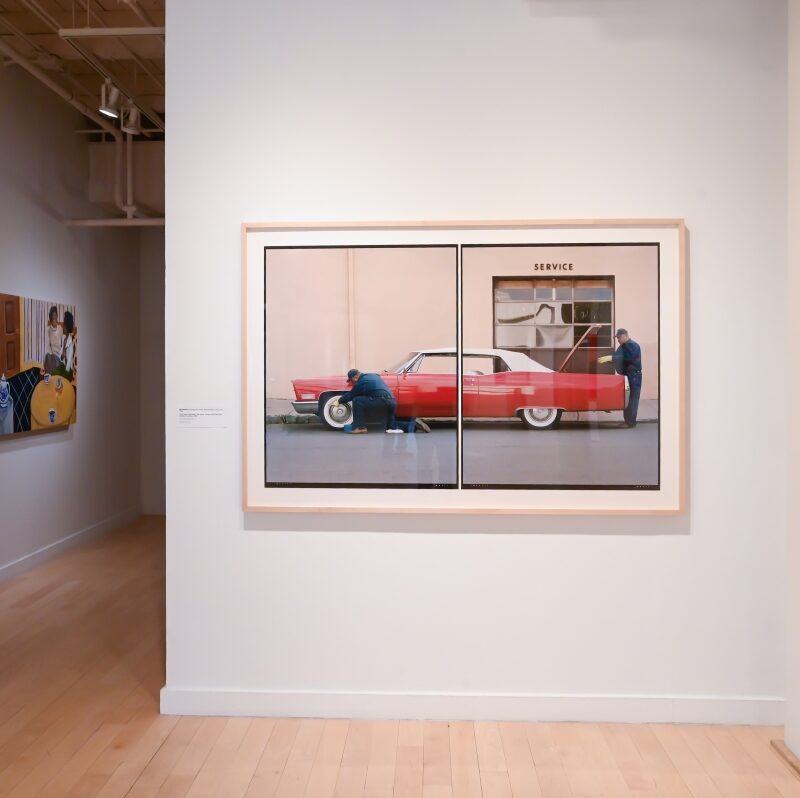
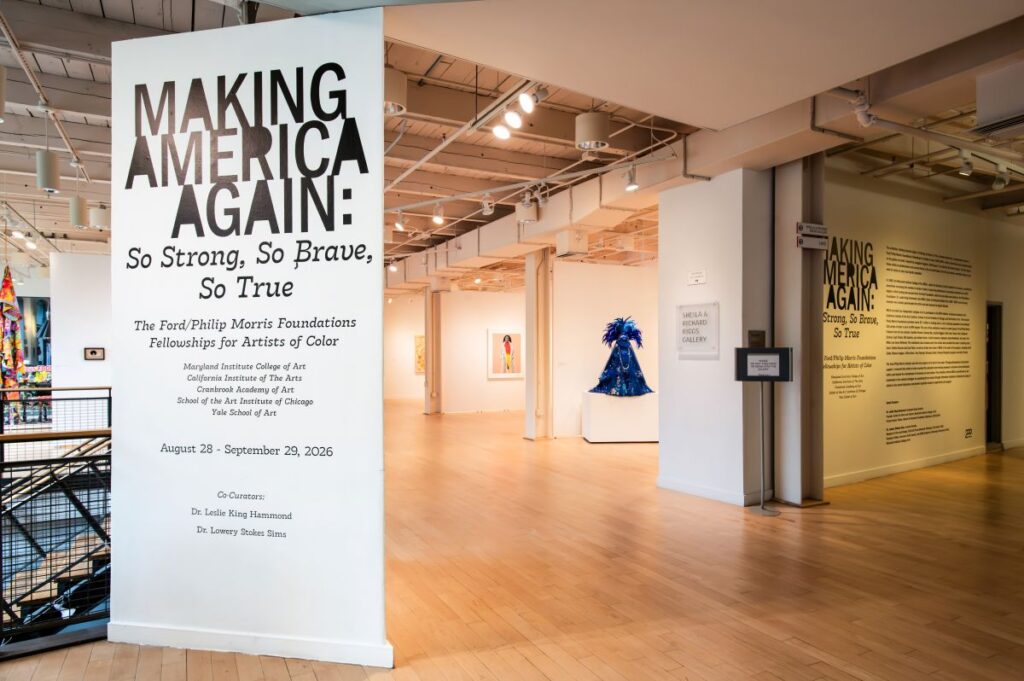
Making America Again: So Strong, So Brave, So True, an exhibition in the Sheila & Richard Riggs Gallery at the Maryland Institute College of Art (MICA), takes inspiration from Hughes’s 1935 poem while signaling a not-so-subtle rebuke of the current administration and the slogan that rallied conservatives. In contrast to President Trump’s vision for America, artists in the exhibition present a radiantly diverse version, representing viewpoints that have historically been underrepresented or blatantly excluded. This America is bold and bright, defiant and at times playful, and confident in the range of perspectives that emerge when given support for experimentation.
Case in point: René Treviño’s “Regalia, Moscas Brillantes (Azul)” pulls visitors into the first gallery, drawn by a dazzling blue figural sculpture that sparkles with sequin appliques and rhinestones and is crowned by a jaunty headdress of blue feathers that conveys both power and grace. Peer in closer and viewers are rewarded by the details: the light catches the iridescent wings of tiny but tirelessly everpresent moscas (flies), and a stiff ruff collar associated with early 17th-century European aristocracy is reclaimed in an ostentatious figure of power that is defined more by the vivacity of individual expression than by wealth.
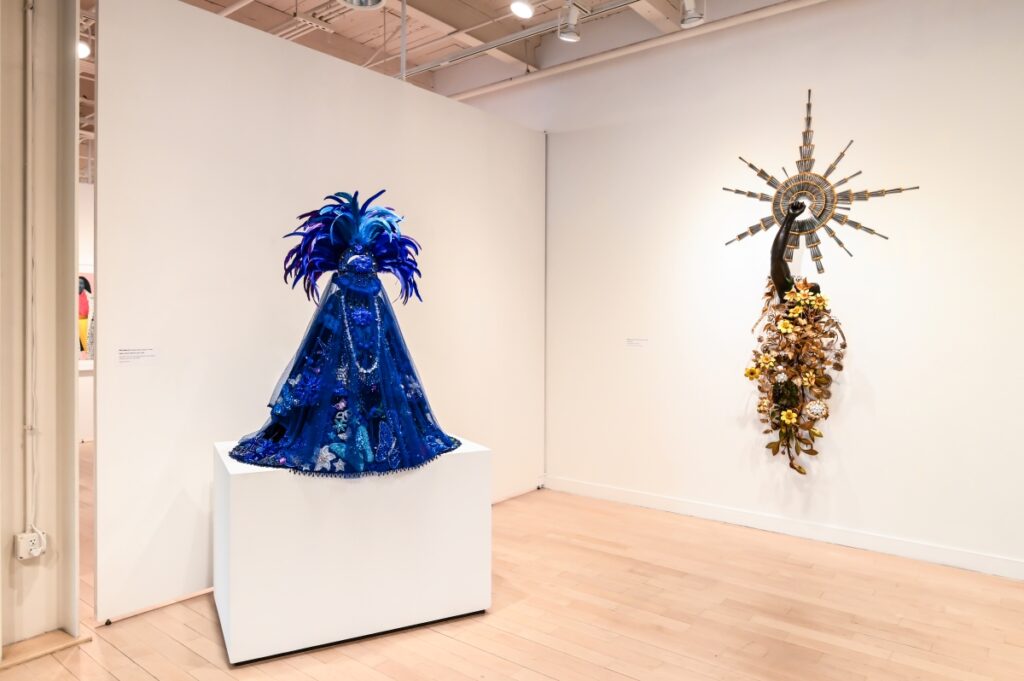
Sharing a sightline with Treviño’s work is Nick Cave’s “Arm Peace,” in which a raised fist is placed at the center of a circle from which thin gold rays emanate. The fist emerges from a cascading arrangement of interlocking yellow flowers and gold metallic leaves. By placing “Arm Peace” and “Regalia, Moscas Brillantes (Azul)” next to one another in the first gallery of the exhibition, curators Dr. Leslie King Hammond and Dr. Lowery Stokes Sims open their show with a powerful display of strength and fortitude, the kind that does not arise from colonialism and conquest but from beauty and creativity. As Hughes wrote, “Let America be the dream the dreamers dreamed.”
In the mid-1980s, King Hammond’s dream to increase opportunities for artists of color became a reality, when she found a way to support many artists in the exhibition. She worked with then-MICA president Fred Lazarus to tackle the lack of diversity among the student population. During remarks at the exhibition opening, King Hammond recounted the time she told Lazarus what artists of color need to obtain fine arts degrees: “The problem is not red, white, black, or brown. I said the problem is green. They will not come. They do not have the support.”
So Lazarus and King Hammond worked to gain support—initially from the Ford Foundation and later from Philip Morris. As a result, between 1985 and 1999, 200 artists of color were offered tuition support to pursue fine arts degrees not just at MICA but also at the Cranbrook Academy, the California Institute of the Arts, the School of the Art Institute of Chicago, and the Yale School of Art.
Many of the artists who received a Ford/Philip Morris Foundation Fellowship for Artists of Color became hugely influential if not world-renowned. Candida Alvarez, Dawoud Bey, Sanford Biggers, Nick Cave, and Tom Miller are among the many talented fellows whose works are included in the exhibition.
Theresa SottoAs Hughes wrote, “Let America be the dream the dreamers dreamed.”
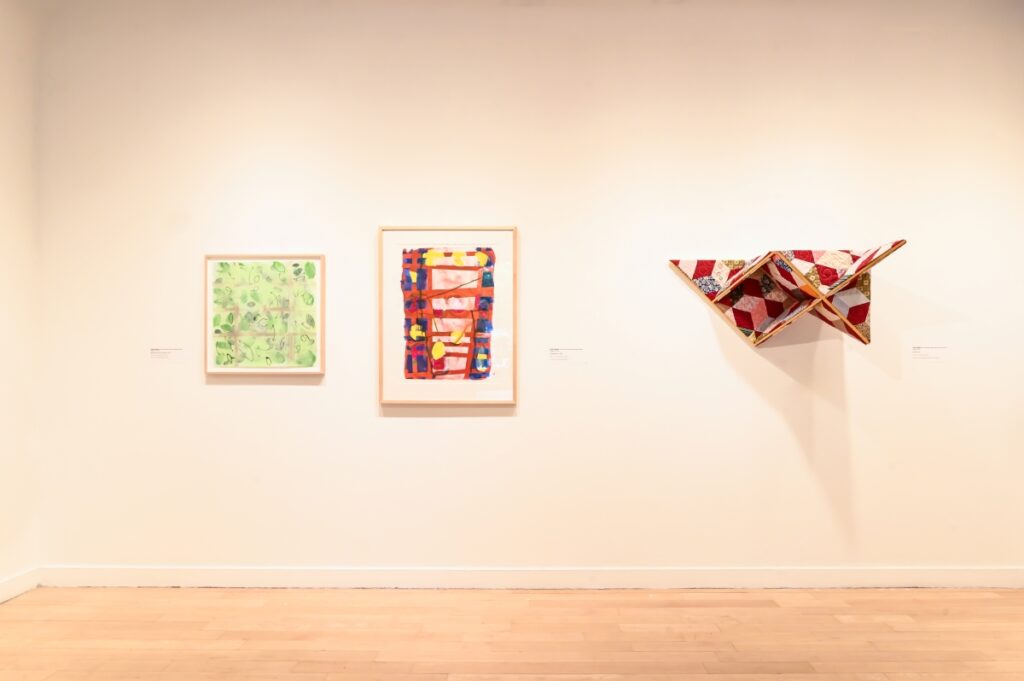
One standout is Sanford Biggers’ “Tumbler,” in which an antique quilt was transformed into a geometric, three-dimensional sculpture, its angular edges of plywood mirroring the triangular pattern of the quilt pieces. The resulting sculpture is simultaneously soft and angular, concave and convex, antique and contemporary.
The installation also includes artists such as Joyce J. Scott, Oletha Devane, and Lola Flash, who broke racial barriers prior to the launch of the Ford/Philip Morris Foundation Fellowship. They graduated from MICA in the 1970s and early 1980s, just over a decade after MICA dropped their racist policy of admitting only white students, which was in place from 1895 to 1954.
Scott’s figurative assemblage, “Inkisi: St. John the Conqueror”, is one of two of her works in the exhibition. In the title, Scott references sacred healing objects (nkisi) from Central Africa, and assigns sainthood to an embodiment of John the Conqueror root, which is believed to have protective qualities in African American folk culture. In an exhibition that celebrates artists of color who persevered in predominantly white institutions, the inclusion of a work that conjures healing and protection seems fitting.
During the exhibition opening, Joyce Scott stood proudly at the podium and shared the role that MICA played in her artistic journey. “I am an artist. And I continue to be an artist, because I know that is my right. That is what my ability gives me. That is what my spirit is about. And part of that is because I took every advantage I could of my time here in MICA,” said Scott. She credited MICA with leading her away from her early forays in painting by exposing her to different media and techniques. “There was a freedom for me here that I hope still exists,” she said.
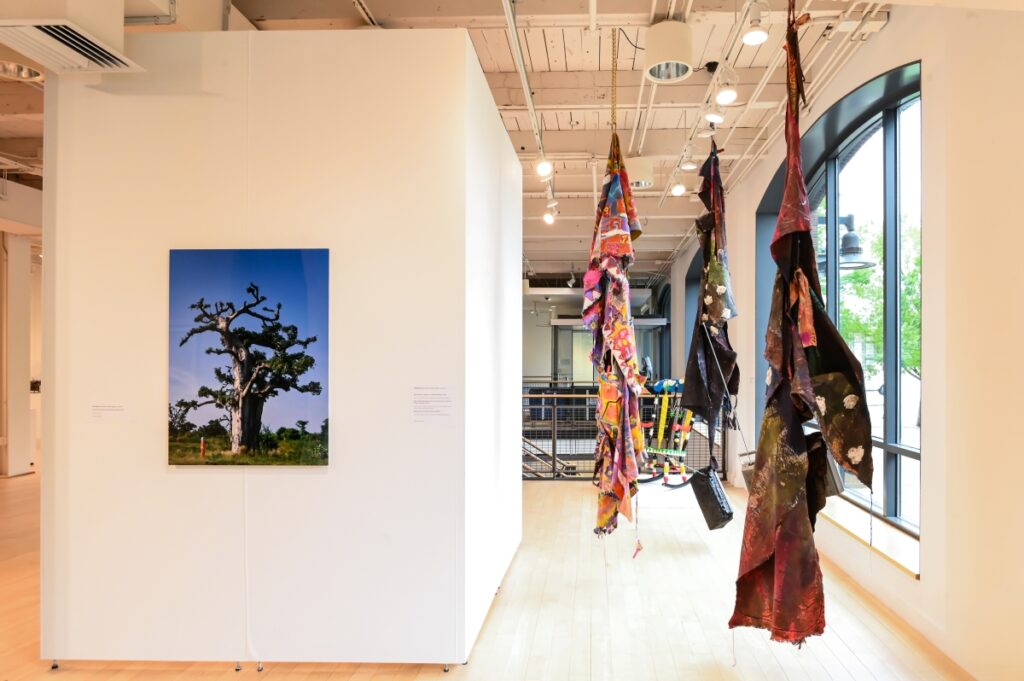
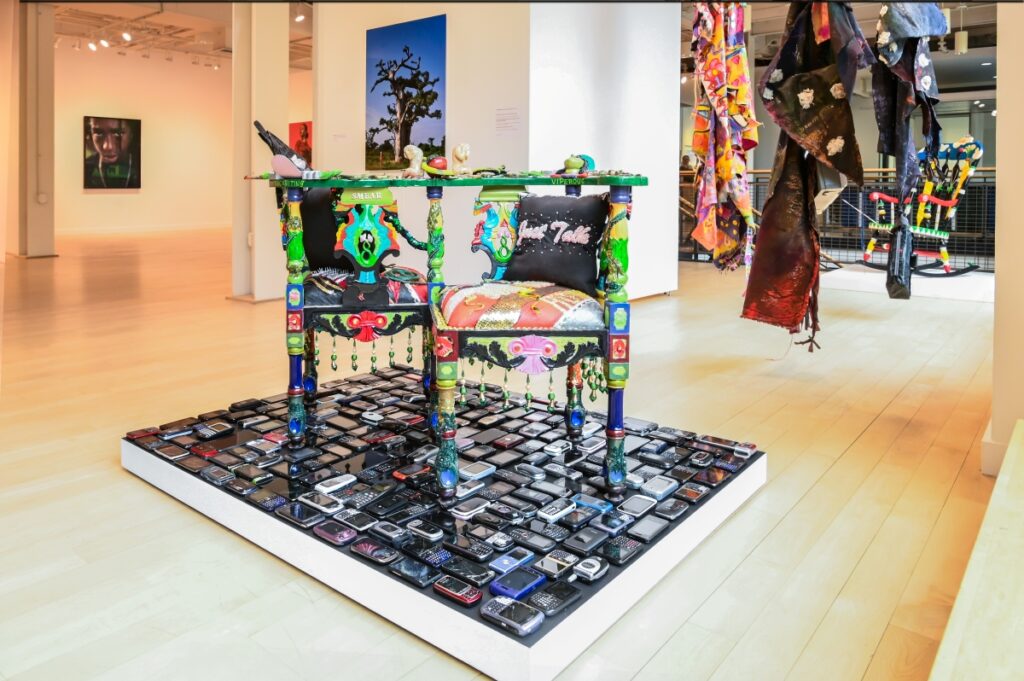
Several artists who came to MICA after the fellowship program ended are also included in the exhibition, and the range of artistic styles represented suggests that the freedom Scott valued during her time at MICA has continued. For example, in three works displayed from Jeffrey Kent’s “Echoes of Catalysts” collection, swaths of deconstructed and manipulated upholstery, flags, and apparel are suspended from the ceiling, re-imagined as kinesthetic three-dimensional forms that dangle mid-air and rotate by a motor. With the titles “Black American”, “High Fashion”, and “Brown”, Kent invites viewers to question how those terms are defined and by whom.
Kent’s works are adjacent to Oletha DeVane’s “Social Media (chair)”, which comprises a two-sided chair adorned with colorful beads, snakes, and the words “gossip,” “just talk,” and “smear.” The chair sits atop a platform laden with cell phones, as if the common ground between two imaginary sitters have been overtaken by devices that were designed to connect people but often do the opposite. Both Kent and DeVane reconfigure and recontextualize various functional objects for social commentary.
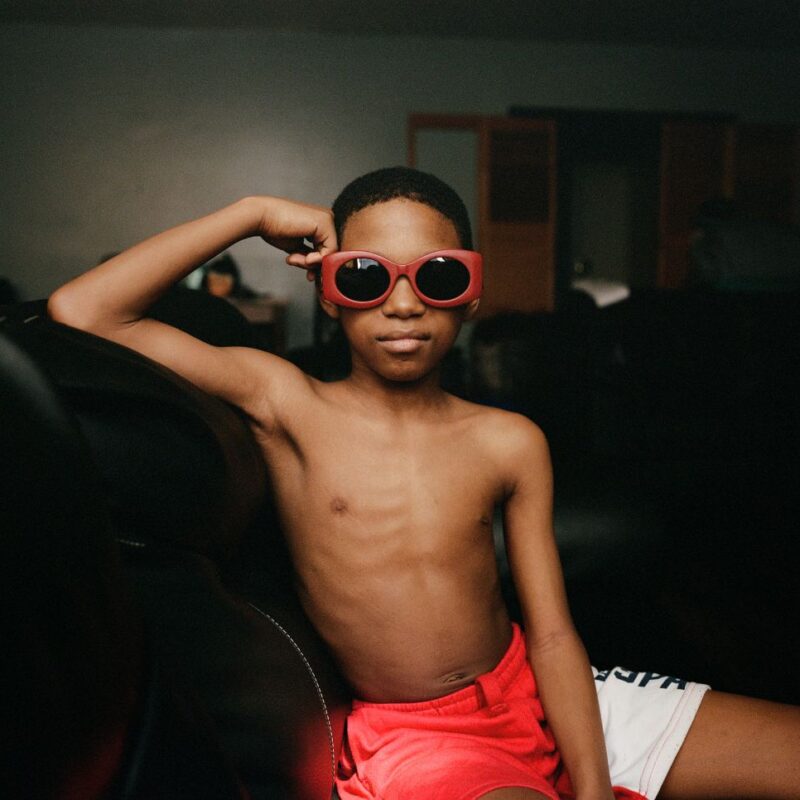
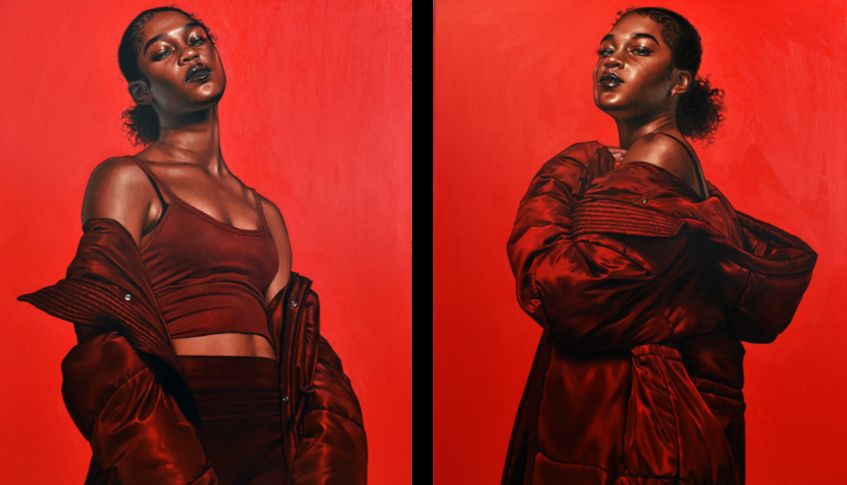
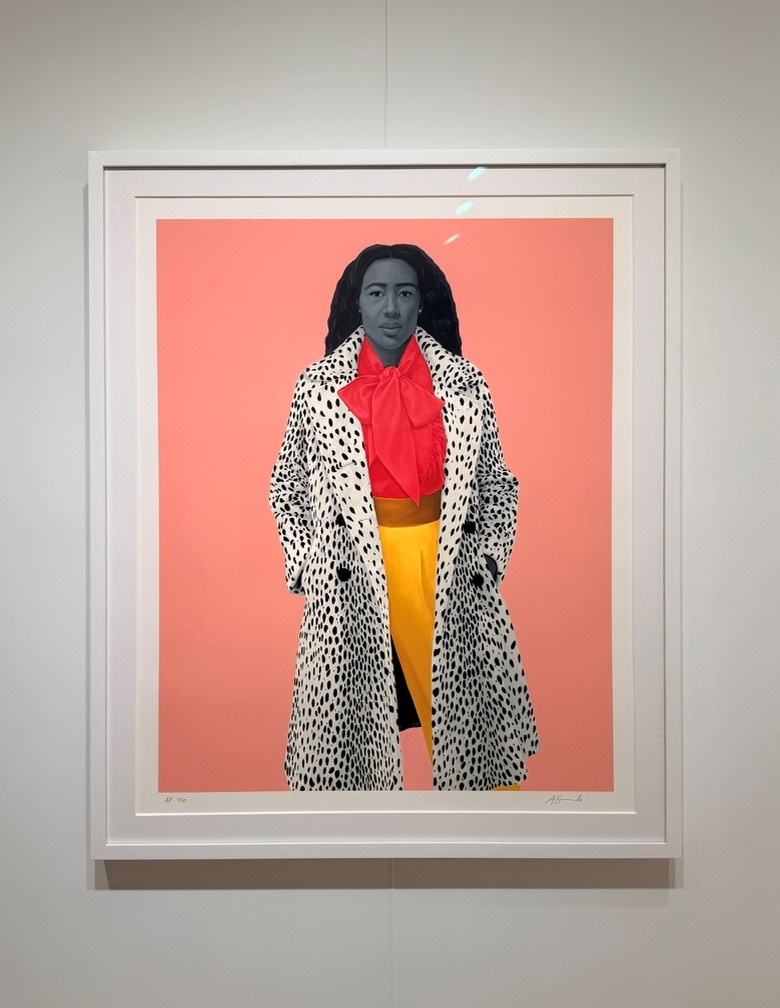
While the mixed media works in the exhibition juxtapose disparate images and employ layering techniques to create new meanings, a nearby gallery of two-dimensional works portray people realistically, their gazes directly confronting the viewer. Each figure staring out from these works—Dawoud Bey’s “Diamond”, Monica Ikegwu’s “Open” and “Closed”, and Amy Sherald’s “As Soft as She Is”—displays a formidable strength, not because they’re physically muscular or intimidating world leaders, but because they exude the kind of strength that comes from being their authentic selves.
Making America Again: So Strong, So Brave, So True is an eclectic exhibition, but intentionally so—one that celebrates diversity in all forms. As Langston Hughes suggests, the individual dreamer must be empowered to envision a more equitable version of America until the dream becomes a reality.
Yet I’m the one who dreamt our basic dream
In the Old World while still a serf of kings,
Who dreamt a dream so strong, so brave, so true,
That even yet its mighty daring sings
In every brick and stone, in every furrow turned
That’s made America the land it has become.
Making America Again: So Strong, So Brave, So True is on view at the Sheila & Richard Riggs Gallery at the Maryland Institute College of Art (MICA) through September 29, 2026.
The exhibition features works by Candida Alvarez, Dawoud Bey, Sanford Biggers, Nick Cave, Sonya Clark, Stephanie Dinkins, Espi Frazier, Bill Gaskins, Lyle Ashton Harris, Cynthia Hawkins, Napoleon Jones- Henderson, Joe Lewis, Tom Miller, Joyce Wellman, Joyce J. Scott, Oletha Devane, Lola Flash, Jerrell Gibbs, Monica Ikegwu, Jeffrey Kent, Amy Sherald, Shinique Smith, Pamela Phatsimo Sunstrum, and René Treviño.