Being trapped in the quagmire of Draconian laws and absurd legal maneuvering is a nightmare no one should ever have to endure, but it happens every day to ordinary people. Just ask anyone who has tried to fight a denial from the Social Security Administration or Veterans Affairs, navigate the labyrinth of bureaucratic rabbit holes, or negotiate the legal complexities of taxes and wills.
It’s like trying to understand a language you have no working knowledge of, and that lack of understanding can cost you in any number of dramatic ways. In Arlene Hutton’s drama, Blood of the Lamb, a young woman finds herself caught in a web of Texas abortion laws with such dire consequences that there is no good solution for her—and it may cost her her life.
Such is the predicament at the heart of this searingly timely drama, now on view at Strand Theater, produced by Rapid Lemon Productions. A young woman, Nessa, is traveling by air from Los Angeles to New York City. In the air, she begins to have a medical emergency that requires the plane to divert to the Dallas airport. She is removed from the aircraft and transported to a local hospital.
Timoth David CopneyWhat happens when that “child” is dead, the mother is alive, and the two sets of interests collide?
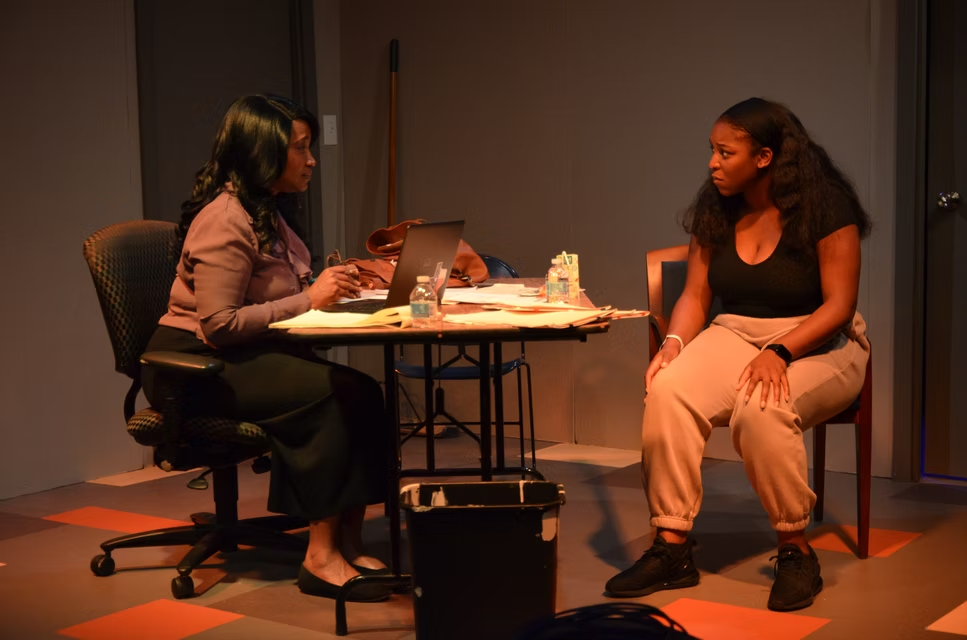
There it is determined that she is pregnant, but the fetus is not alive. Under ordinary circumstances, the fetus would be removed, but as this is Texas, it is not nearly so simple as that. She is remanded to an interrogation room, where she is being “interviewed” by what she assumes is someone advocating for her release. As it happens, the other woman is indeed a lawyer, but she is there to represent the dead fetus’s rights, not those of Nessa. Hutton imagines a legal system pushed to its most frightening logical extreme: if life begins at conception and the unborn child possesses legal rights independent of the woman carrying it, what happens when that “child” is dead, the mother is alive, and the two sets of interests collide?
Adding to the situation is the fact that the attorney is a woman with seven children, who holds strong views on abortion and a dogged determination to uphold the law—one that, at first glance, seems to reflect her own beliefs. She readily admits there is no legal precedent for this situation; it is the first time this particular question has confronted the courts under Texas’s new abortion laws. In a state where the law recognizes an unborn child as a legal person from the earliest stages of pregnancy, she must reconcile representing a fetus that no longer exists against a living woman who does, and who faces life-threatening consequences of her own.
The premise is deliberately extreme, but it is rooted in a very real legal landscape. Texas has banned nearly all abortions except in narrowly defined circumstances, levying severe penalties on doctors found to have run afoul of the restrictions. According to The Texas Tribune, the state clarified the law in 2025 to make clear that doctors do not have to wait until a woman’s death is imminent before providing life-saving care. That such clarification was deemed necessary at all only adds to the underlying chaos of this legal dilemma. Hutton takes that uncertainty and pushes it into a Kafkaesque legal nightmare: what happens when the fetus is already dead, the woman is still alive, and nobody has ever decided which of them the law protects?
And Kafkaesque is exactly the right word: nightmarishly complex, surreal, and illogically bureaucratic, leaving its victim feeling helpless, disoriented, and oppressed—precisely the state of mind Hutton creates for Nessa. She takes real legal anxieties and builds a chilling scenario around them. Texas has since taken steps to ensure a mother would not literally be sacrificed to a badly written law, but the scenario Hutton poses is rooted in genuine uncertainties that could easily have produced exactly the fear and confusion Nessa experiences.
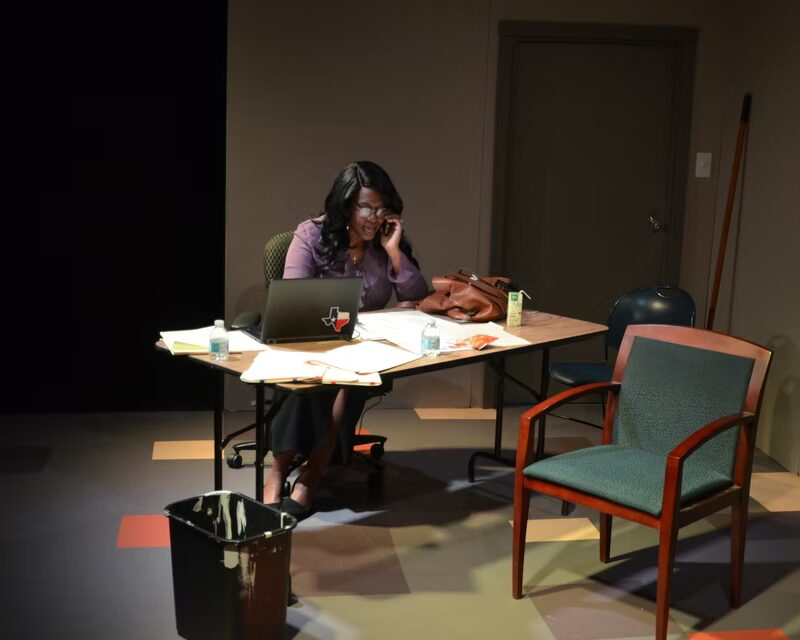
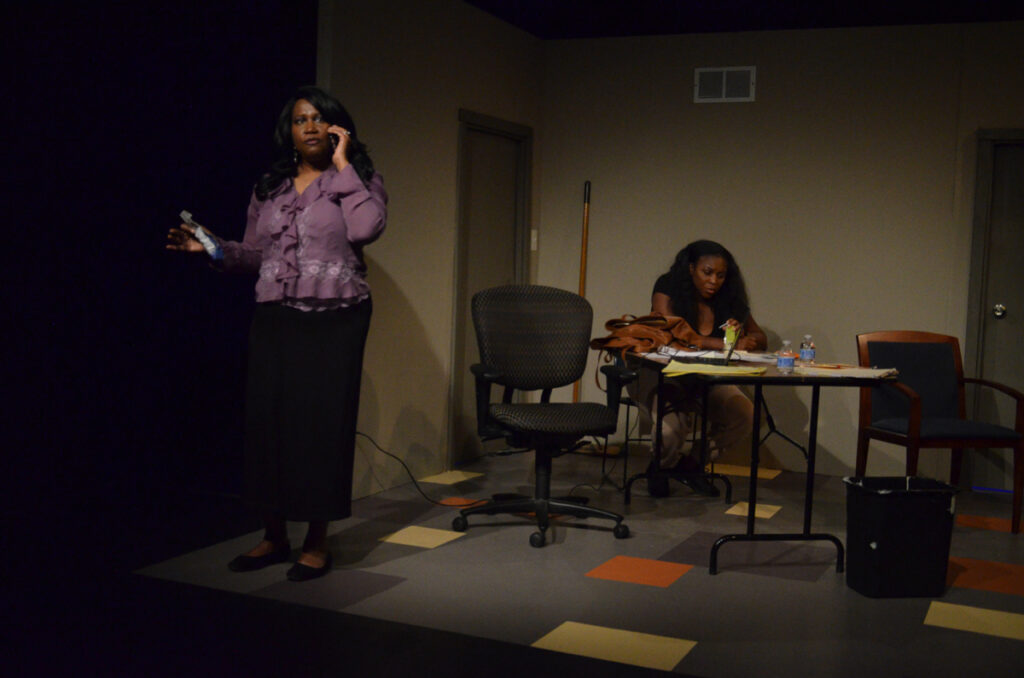
In her production of Hutton’s award-winning script, director Jalice Ortiz-Corral effectively conveys the tension of the situation and its emotional impact on both actors onstage. The pacing was unsteady and at times dragged, but the single-set, 80-minute play is well served by the austerity of a six-foot table, a couple of chairs, and one or two pieces of set dressing. JR Schroyer’s set design captures the bleakness of an airport interrogation room (I’m guessing)—no wall art, no plants, nothing to suggest any degree of comfort, which suits the piece well.
Allan Sean Weeks’s lighting design fits the mood, if sometimes surprisingly, with seemingly random light cues that suggest emotional moments, though some don’t coincide with the action as well as others. Costumes are uncredited but fit the characters nicely—an exhausted traveler and an overworked public defender. Daniel Lin’s weirdly appropriate original music adds to the atmosphere, and I found myself wanting to hear more of it.
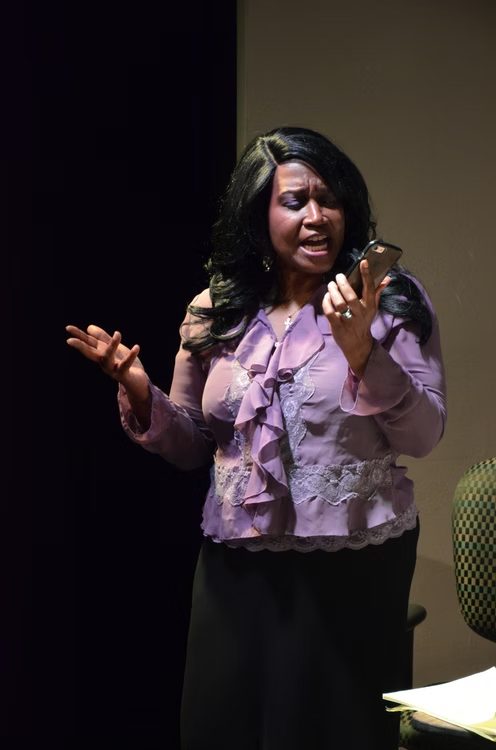
Sharon Carter Brown, as Val—the overworked lawyer, wife, mother, and team player trying desperately to do her job even when it seems absurd—is spot-on. I don’t want to dwell on the plot twists and reveals, but suffice to say that Ms. Brown reveals surprising depth that comes into play as the story progresses. There is a lot going on beneath the surface, and watching it emerge carries an emotional wallop.
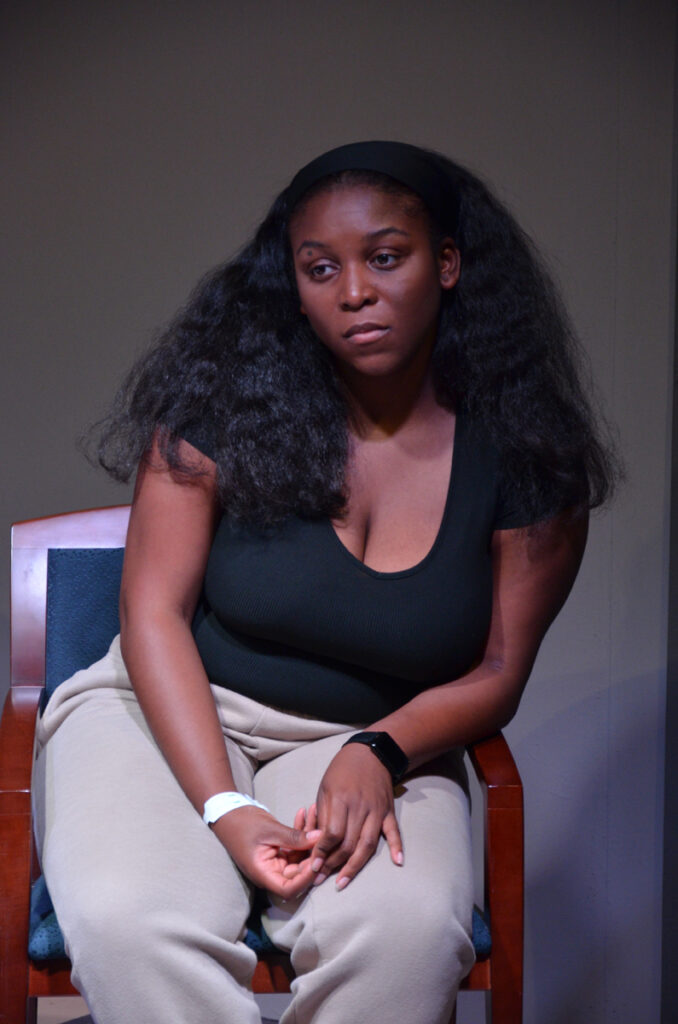
As Nessa, Rakell Foye remains in character but sometimes seems oddly disengaged for someone going through such a trying time—dealing with the death of her baby, unjust incarceration while the wheels of legality grind on, and her own physical discomfort. But when she sparks in the dramatic scenes, she exhibits some serious acting chops that I only wish she had more opportunities to share.
RLP has been staging its works in this compact, intimate space for a while now, and the advantage is that the audience, close enough from every seat to catch every flicker of emotion, gets something like a close-up view of the actors’ faces.
In a drama built on weighty silences that give the audience time to read those two expressive faces, that intimacy helps us see the inner conflicts of these characters.
Heavy dramas like this one—female-focused stories that tell of experiences most of us will never have to face personally—are an integral part of the theatre scene, and all of us are better for becoming aware that sometimes the unthinkable can occur. And any of us could well be next.
Blood of the Lamb runs through September 13th at Strand Theatre, 5426 Harford Road, Baltimore, MD 21214. Tickets are general admission, $25. Click here for tickets and information.