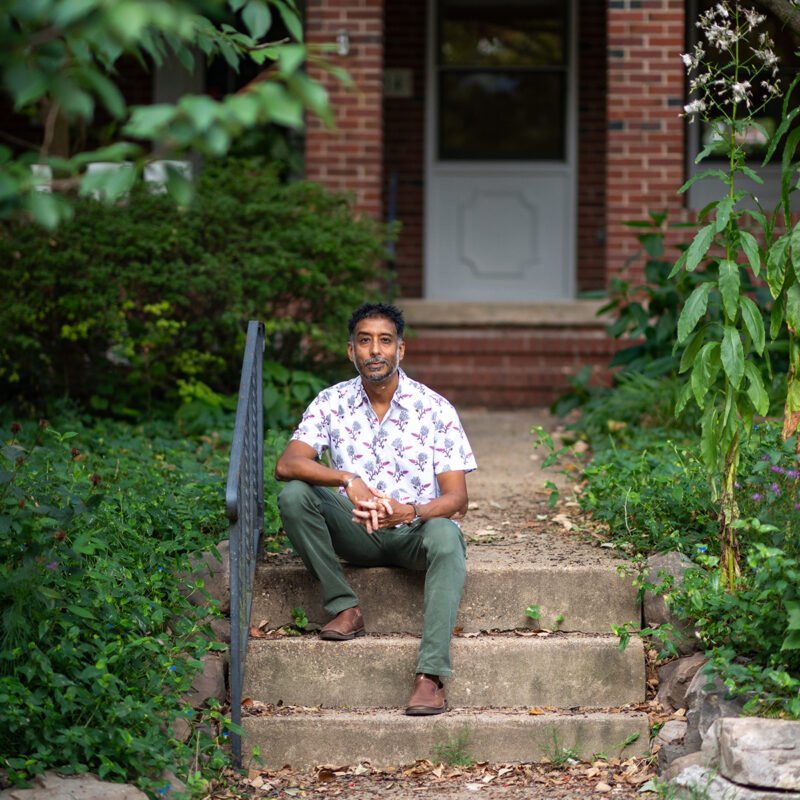
Anand Pandian, like the vast majority of humans who have ever existed in the couple hundred thousand years of our species’ total history, walks to work. That’s still certainly not uncommon in Baltimore City. But in the national context of the contemporary United States and its labyrinthine gated “communities” and office “parks” designed around parking garages, we East Coast city folk represent somewhat of a statistical anomaly these days.
Cutting through leafy Wyman Park on his way to the Johns Hopkins Homewood campus, where he has taught since 2007, Pandian might bump into neighbors, colleagues, students, or—perhaps most importantly—complete strangers on the trails. It’s hard to imagine a better commute for a nature lover who’s turned the art of people watching into a celebrated career.
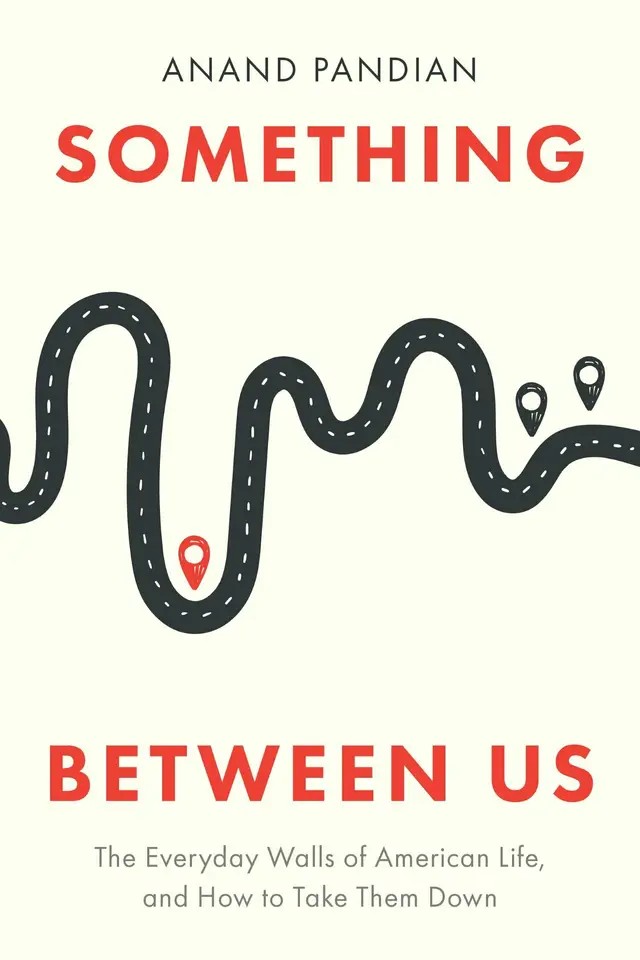
“I fell into anthropology pretty much by accident,” Pandian says with humility. His Something Between Us: The Everyday Walls of American Life, and How to Take Them Down (Stanford University Press, 2025) has just been awarded this year’s Zócalo Book Prize, and the author has been invited to speak on placemaking and “neighborliness” with everyone from urban planners to pastors. Since the 2016 election, he’s spent much of the past decade researching how America’s political and spatial division, xenophobia, and general distrust of “others” have fostered a self-reinforcing fortress mentality. It would be tempting for any fan of a good portmanteau to name Anand Pandian as this country’s foremost misanthropologist.
But the soft-spoken father of two projects a defiant optimism about the possibilities of a kinder, more open world throughout his writing, teaching, activism, and our conversations.
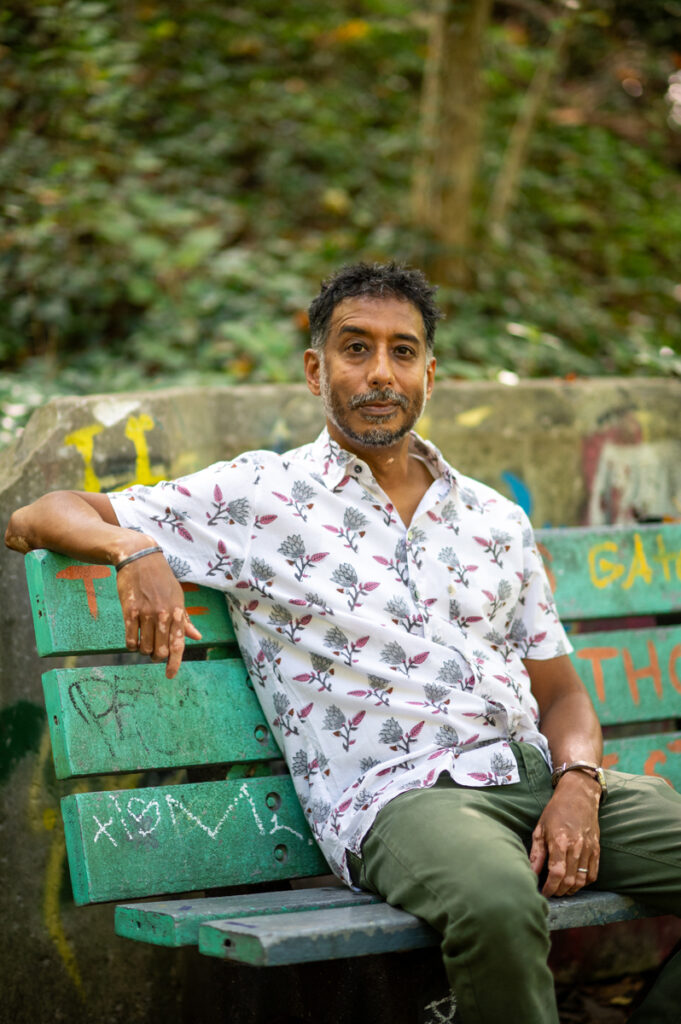
Pandian—Krieger-Eisenhower Professor of Anthropology at Hopkins since last year—speaks with the thoughtful diplomacy of someone who has spent decades navigating the politics of academia. But his enviable conversation skills—chiefly attentive, tactful listening even when I find myself rambling—are best deployed in his fieldwork. I take solace in estimating that even my least articulate rants about this country’s politics likely don’t rank anywhere near the 100 most unhinged things Pandian has heard while interviewing anti-vaxxers, white supremacists, conspiracy theorists, or right-wing organizers.
“As anthropologists, we wander around, we wind up in places where we don’t belong, we talk to people that we don’t know very well, but we come back with stories,” Pandian says of his penchant for listening. “There are a lot of people in the world who trust the insights of observers… and that’s how we work in fields like mine.”
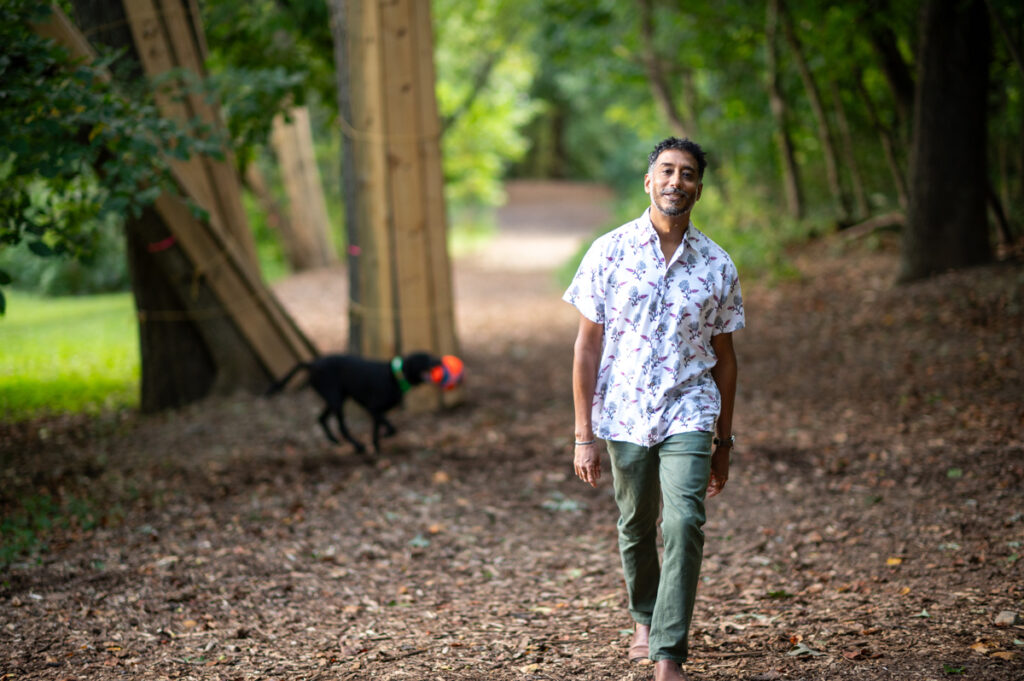
Anand PandianAs anthropologists, we wander around, we wind up in places where we don’t belong, we talk to people that we don’t know very well, but we come back with stories.
Pandian’s trajectory to his field, much like Baltimore’s best hiking trails, was not a straight line. Born in New York and raised in Southern California, he became interested in environmental activism as a teenager. At Amherst College, he designed his own interdisciplinary major in Political Ecology. “I didn’t take a single class in anthropology in undergrad,” Pandian explains. His interest arose at UC Berkeley, where he had originally intended to pursue graduate work in environmental studies. He switched tracks with the realization that understanding people was crucial to the crises impacting the planet. Scientists have long known the consequences of fossil fuel combustion or ocean acidification—but humanity has been the unpredictable catalyst in the peculiar chemistry of our Anthropocene.
“I was really vexed about the kinds of decisions that people make—habits and cultures that seem to be so destructive of nature,” Pandian recalls. “I realized I didn’t have a good enough understanding of why people do those things… Maybe I needed to just learn a little more before asserting that things should be done differently? And it was that desire, really, to try to understand why so many people’s visions… were so different from my own that ultimately led me from a more activist orientation to a more anthropological orientation.” That research took him to India and beyond, and eventually back home.
Conceived in the days of dismay and uncertainty following the 2016 election of Donald Trump—when many a cultural commentator wondered aloud if “blue-state intellectuals” had been living blissfully in “a bubble”—Something Between Us reads refreshingly more like a roadtrip travelogue than a heady postmortem for American democracy. Zig-zagging across the continent, Pandian describes membranes of all kinds—”bubbles” in the shape of suburban subdivisions, hostile infrastructure, pandemic-era body horror, car addiction, racial fear—contexts often deliberately designed to keep our fellow Americans apart, paranoid, and decidedly un-neighborly from Fargo to Los Angeles.
One particularly harrowing chapter sees Pandian (the son of Indian immigrants) attend a white nationalist demonstration in Shelbyville, Tennessee. Set months after the deadly “Unite the Right” rally in Charlottesville, Pandian’s account possesses a palpable suspense—as well as a twinge of surrealism—that’s rare in nonfiction. The author speaks to white supremacists in the lead-up to the event, as well as immigrants to whom “Southern Hospitality” apparently doesn’t extend. The first-person narrative builds tense anticipation, climaxing not in violent confrontation, but a series of absurd dialogues with ethnonationalists.
Throughout it all—even commenting on the irony of anti-immigrant protestors heading to a Mexican restaurant after their rally—Pandian remains remarkably composed, at times conveying something akin to compassion for a hateful mob comprising fearful individuals with their own vulnerabilities.
“I saw some terrible things, and I owe a lot to my wife Sanchita, and the support of our family and friends. But the task of an anthropologist is to try to understand different ways of living in the world from the inside out, rather than from the outside in,” Pandian answers, ever diplomatically, when I wonder aloud how he keeps his cool when interacting with wildly illogical and/or cruel people. “We have to be careful about the judgments we make… the commitments we have ourselves, the positions we have ourselves. It doesn’t mean that we don’t have them. It’s just that as a matter of research method, we have to sort of bracket those, and try to get at situations from the standpoint of others… As difficult as that challenge is, the fact remains that we are stuck with each other’s company.”
The book takes its title from a James Baldwin quote. In 1965, the famed queer African American writer and activist was invited to debate the archconservative William F. Buckley at Cambridge University. Baldwin, who had been living in more tolerant Europe, noted, “…I finally left the country, and found myself abroad, in other places, and watched the Americans abroad—and these are my countrymen—and I do care about them, and even if I didn’t, there is something between us.”
The ambiguity of the phrase “something between us” enables it to describe a commons, a barrier, or an object—such as a highway—that functions as both. Pandian optimistically ends each section of his book on a case study of a community uniting across divides to tackle a shared problem, often relating to basic bodily needs such as clean water or hygiene.
I ask Pandian whether these planned moments of congregation can fulfill the same social role as the third spaces and chance encounters we tend to take for granted. In most of this country, unscripted interactions are increasingly rare by design—from the drive-thru to the garage or the Amazon delivery to video doorbell—the average suburbanite lives in a world planned against unplanned human contact, seemingly counterintuitive to an entire eon’s worth of evolution resulting in a bipedal, social species.
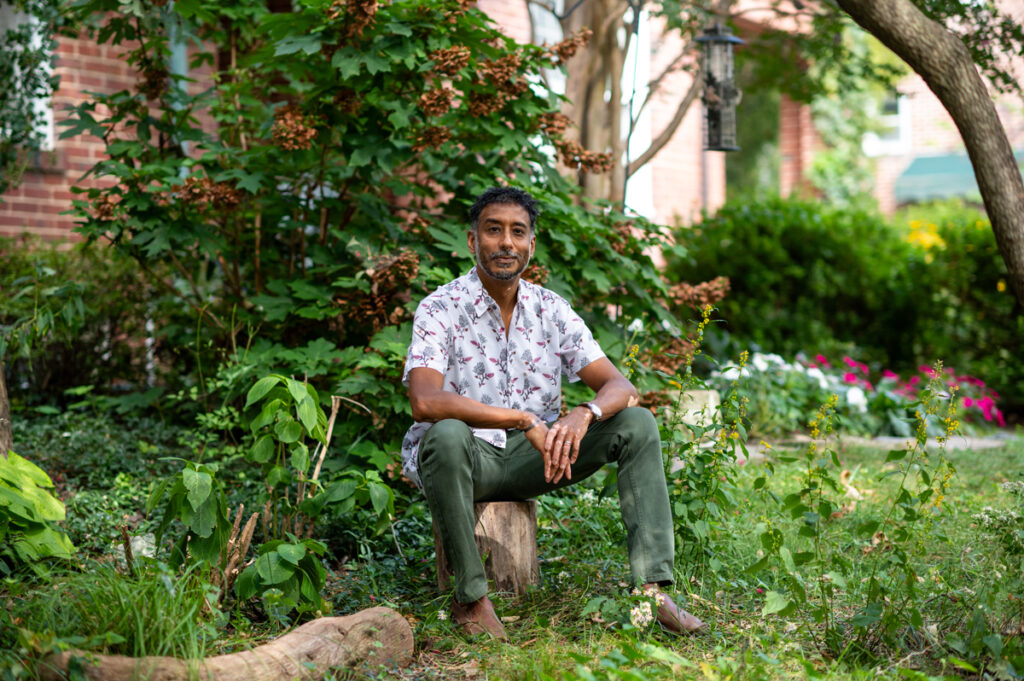
Deliberate exercises like charrettes and community planning sessions, he says, “exist because chance encounters have become less common, because people are more isolated… and they can do really important and interesting work.”
He points out, though, that urban life—although less choreographed—is only made possible by different scenography. “What might happen on a sidewalk, or a trail, or at a cafe—however improvisational those things feel, they are also designed. Cities have to make the commitment to put down sidewalks, to create space for trails, to support occasions like farmers markets or street festivals… and if we’re missing those things, that is also designed.”
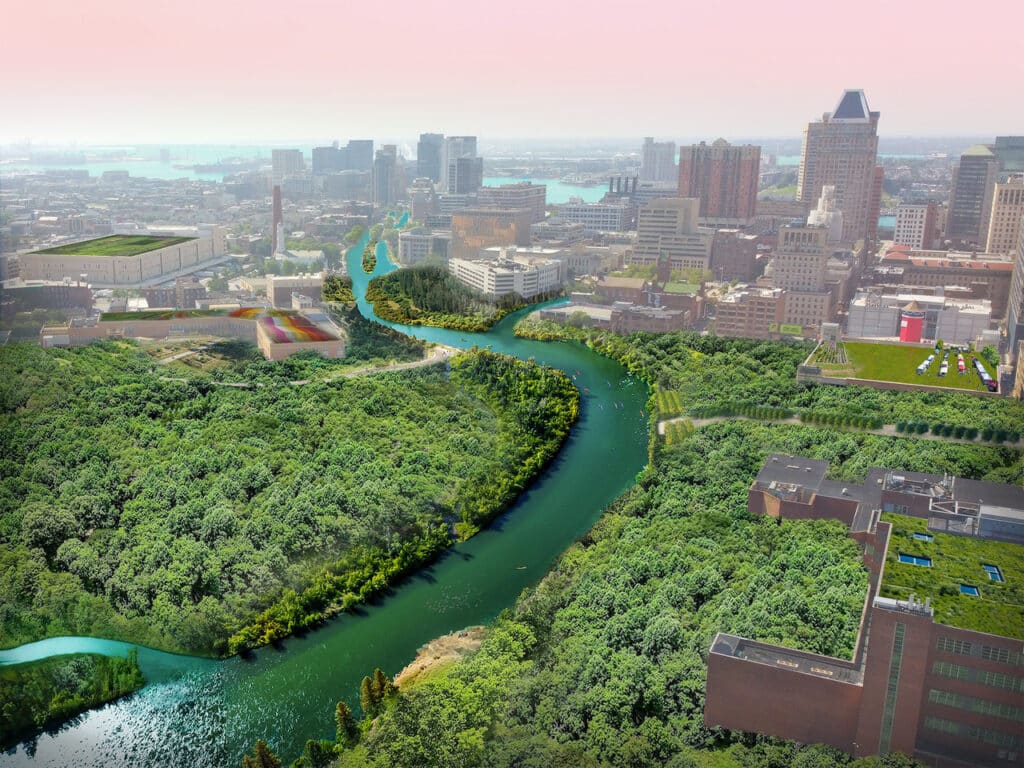
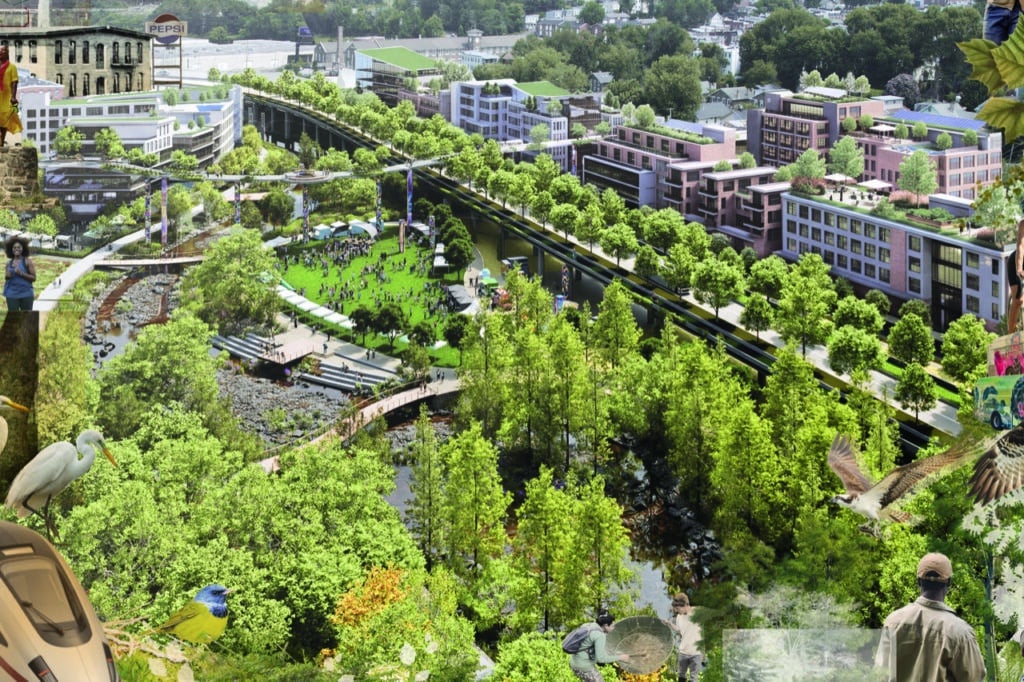
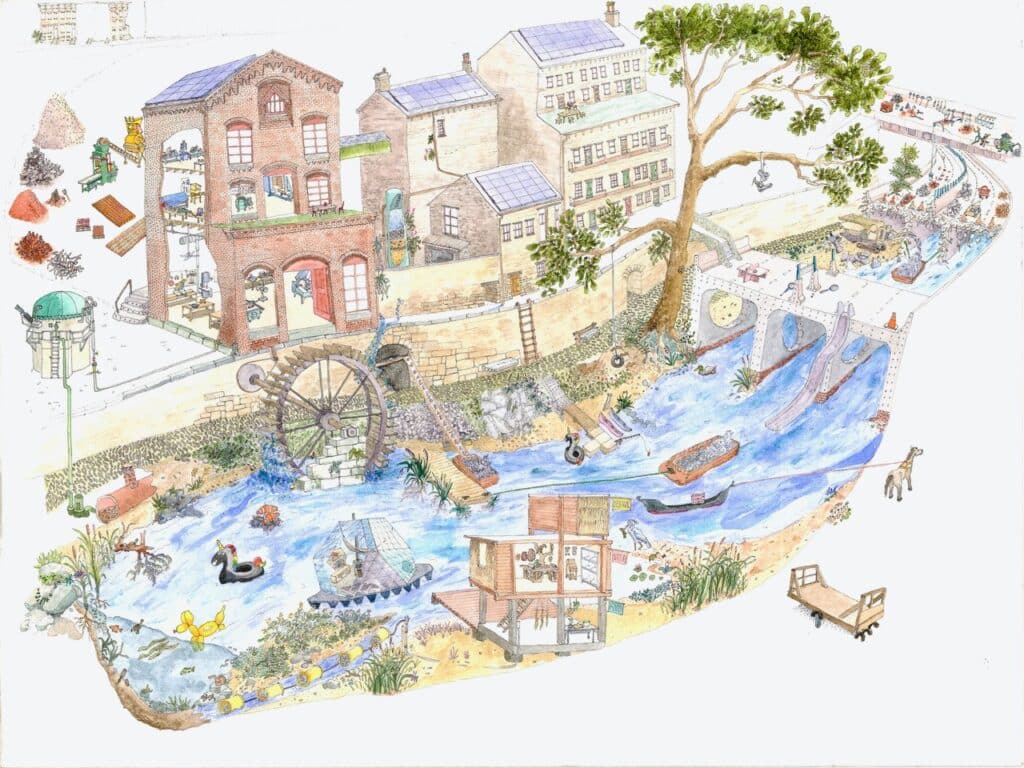
So how might we set a better stage for Baltimore and its improvisational street theater half a century from now? Along with Lee Davis and Bruce Willan, Pandian has been organizing Jones Falls 2076—a speculative design project centered around the future of Baltimore’s infamously buried waterway, the highway above, and the neighborhoods it borders. An exhibition resulting from collaborations with designers, artists, and a broader public will be on view at the Peale Museum through November 22.
Heading to the Peale, look around at the parking lots and elevated roadways strangling the potential for neighborhood life in the blocks north of City Hall. And think of Anand Pandian and his commute thirty blocks uptown—stopping to look at an interesting fish in the stream or chatting with an acquaintance on the trails, always listening for a good story. It’s hard to imagine those two scenes are part of the same watershed, just as it’s hard for me to think of anyone “rollin’ coal” as my “countrymen.” But Pandian has a unique talent for understanding connections, how people and their environment shape one another reciprocally, and reminding us that, like it or not, we’re stuck on this planet together.
Jones Falls 2076 is on view at The Peale through November 22, 2026
Exhibition Event Details:
Future Directions for the Jones Falls | Thursday, November 12, 6-7:30 PM | RSVP
A panel of city officials, planners, and environmental leaders in Baltimore will discuss ideas around possible highway removal and river restoration in the city, in a discussion moderated by reporters from the Baltimore Banner.
Stories of Rivers Reclaimed | Sunday, November 15, 2-3:30 PM | RSVP
Panelists from Baltimore, Washington DC, and New York City will share case studies of other cities that have decommissioned highways and restored buried waterways. The panel will discuss what lessons Baltimore can learn, and how these precedent projects might inform future plans for the Jones Falls.
Closing Roundtable and Ritual | Sunday, November 22, 2-3:30 PM | RSVP
The exhibition will close with a roundtable conversation with curators and several contributors, followed by a procession to the Jones Falls and a ritual of release.
This story first appeared in Issue 22: Third Spaces. Print copies are available in local booksellers and will soon be available for purchase online.