Katie Andril, exhibitions manager, was deep in the archives of the Jewish Museum of Maryland when she found the complete run of the former historical society’s 1978-2012 publication Generations. Her attention was piqued by an intriguing article titled, “Brief Burst of Glory.”
The story ran in the fall of 1998, its author, artist Jacob Glushakow, described the flourishing of a cohort of Jewish artists in 1930s-1960s Baltimore—a cohort to which he himself belonged. It was a network of relationships between artists of varying ages, experiences, and artistic goals whose lives and artistic work nevertheless intersected in an overlapping web of associations, brought together by their shared Jewish identity and by Baltimore’s ecosystem of neighborhoods, institutions, and informal networks.
Andril had been looking for the spark of an idea, and an organizing principle, for what would become their current show Modernisms. “Brief Burst of Glory” provided both—and its combination of art and community-based history was a compelling fit for the Jewish Museum’s forward-looking institutional goals.
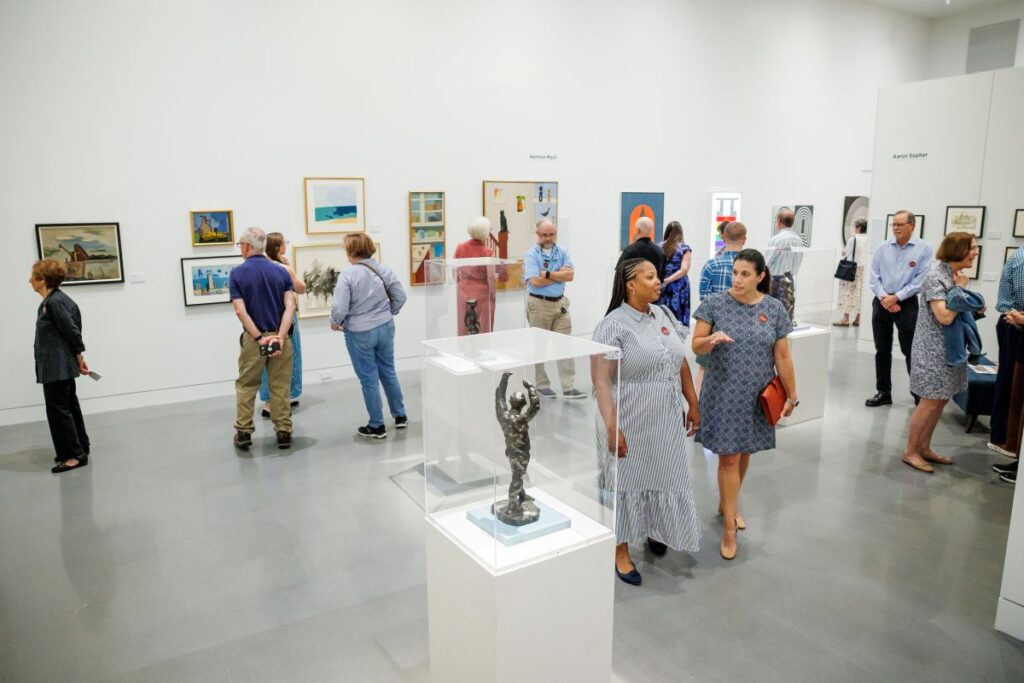
Mollie EisenbergDavis sees art as a way of using the legacy of culturally specific traditions to imagine transformative futures.
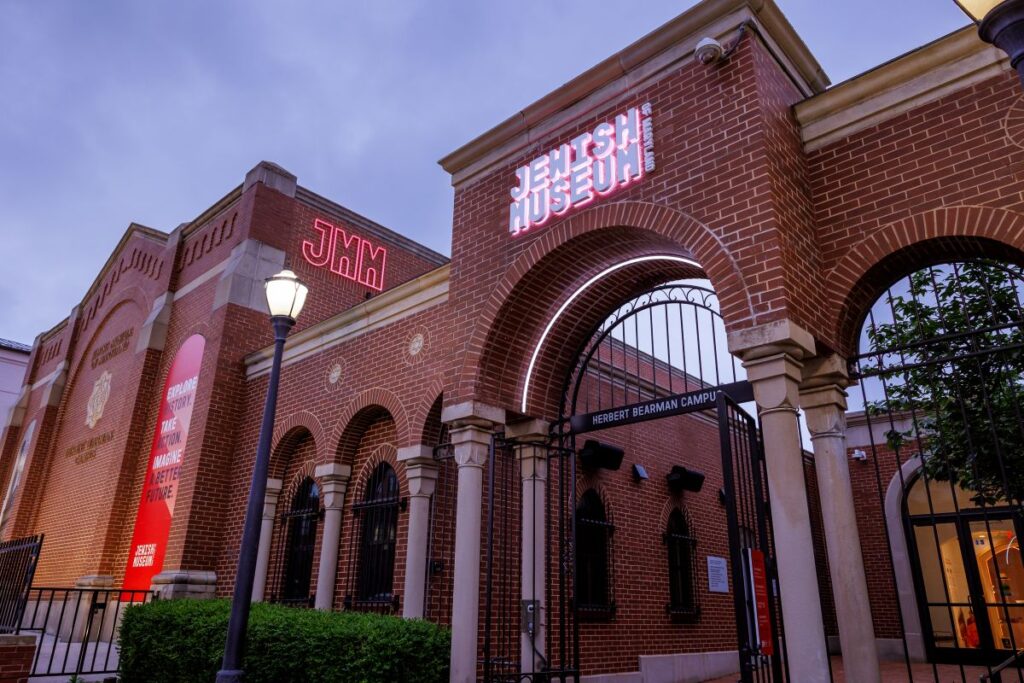
Executive Director Sol Davis arrived at the Jewish Museum of Maryland in 2021, by which time his background in culturally specific historical sites had already acquainted him with what he describes as “this kind of dichotomy between history and art”—a dichotomy tending to confine arts programming to the margins of institutional mission.
“There’s so much art to present in Jewish museums,” he says, “and it just doesn’t really happen very much.”
To Davis, that binary relationship between art and history is counterproductive: “I think they’re deeply intertwined.” Davis sees more intentional art programming as a core part of his leadership vision at the Jewish Museum. It is a way of making the most of existing assets; of course, as Modernisms makes clear, the museum’s collection contains some gems. More significantly, though, Davis sees art programming as part of turning the former historical society’s attention to embracing the present and envisioning the future as fully as it has been to conserving the past.
To Davis, artists are the inheritors of a “prophetic tradition.” Inspired in part by theories of Afrofuturity, Davis sees art as a way of using the legacy of culturally specific traditions to imagine transformative futures: “I want a Jewish museum to help us dream wildly about the future.” Art, in his view, is key to that dreaming, an imaginative vision that opens avenues for evolution and change.
In the present, where potential futures meet past legacies and theory meets practice, Davis is interested in knitting the museum into the community. He is focused on deepening community interaction with “socially engaged practice,” comprising not only programming focused on community, but “an invitation for the public to co-interpret, co-produce, co-experience.” That engagement both invites dialogue and captures an ongoing historical record.
With the support of a recent capital campaign, a new podcast studio sits outside the exhibition room of Modernisms, ready to capture the musings of museum visitors. “The gallery is a point of departure, and hopefully a spark, for layers of additional engagement,” says Davis.
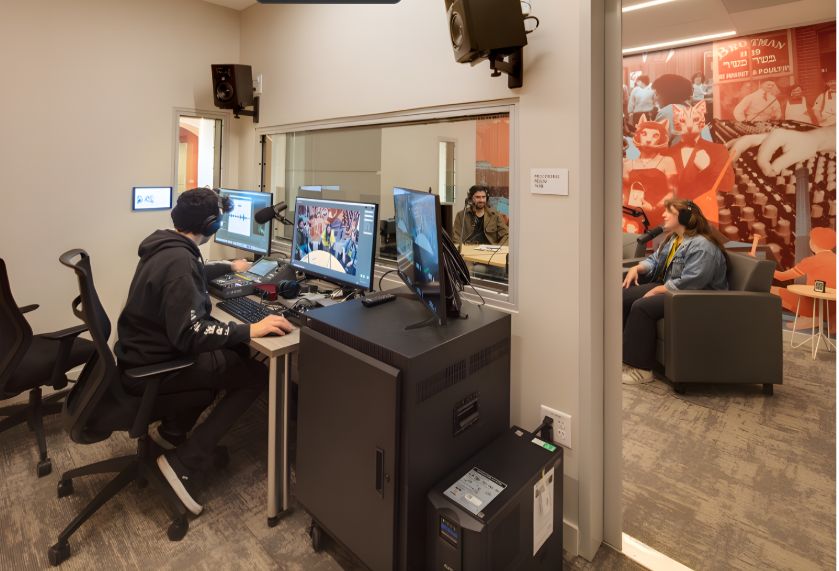
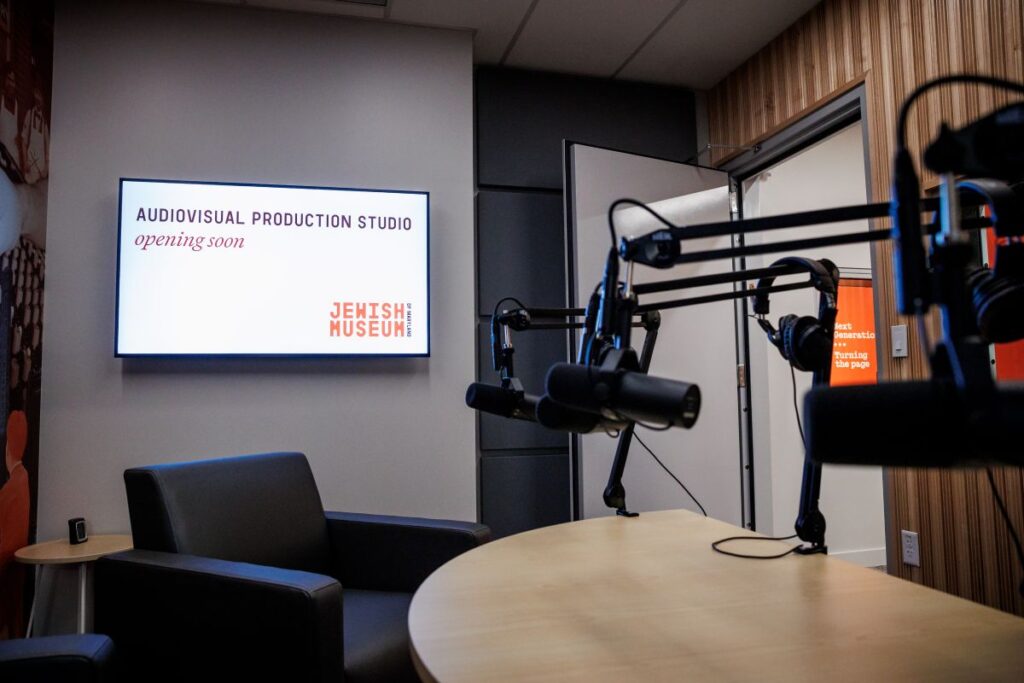
The Jewish Museum has chosen to work with guest curators as it expands its art programming—an approach both pragmatic and principled. Davis imagines the future of the museum delving deeper into “democratic and pluralistic practices,” including institutional “polyvocality.” This way, Andril agrees, “more voices can be involved… we can go out and find the people who are experts on the topic we want to cover and invite them in to give their point of view.”
So with Andril’s spark lighting the way, the Jewish Museum reached out to guest curator Susan Isaacs, who had curated a major Amalie Rothschild retrospective at Towson’s Center for the Arts in 2012. Rothschild had been mentioned in the Glushakow article, and they thought it might pique Isaacs’ interest. They were right. She “pored over it,” Davis says, “and [Modernisms] began to take shape right away.”
The Jewish Museum was also interested in expanding the borders of Glushakow’s cohort, illuminating artists who worked in the midcentury’s margins. Andril wondered about fleshing out the scanty characterizations that Glushakow gives many of his female colleagues; she and Isaacs looked to surface more complete representations of their work, with some successes and some setbacks (they were unable, for example, to find much on Helen Reiss, whom Glushakow mentions in passing).
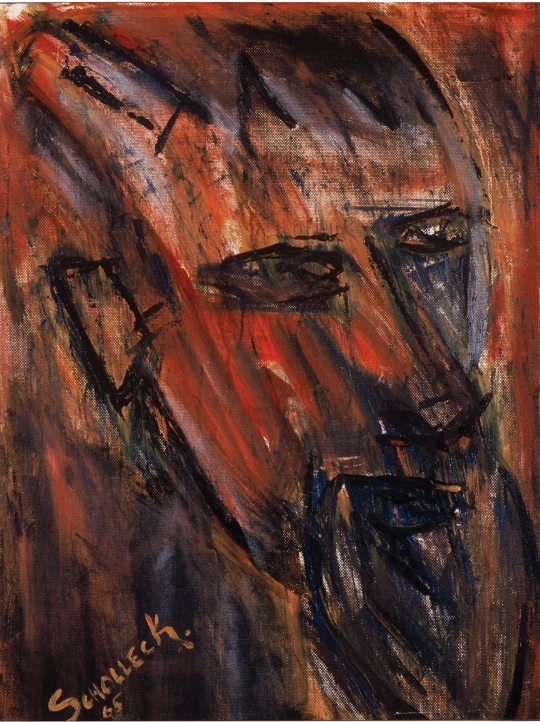
Modernisms also expands its parameters by including the work of Peter Scholleck, a self-taught artist who exhibited only twice during his lifetime but left a legacy of expressive, textural work engaging modernist movements from Fauvism to Futurism.
Mollie EisenbergAs the show came together, with Isaacs, Andril, and others trying to track down work and the details of the artists’ lives, they found themselves the recipients of an unexpected bounty of community generosity.
There were some constraints. Some of the artists considered were very well represented in the museum’s collections; others less so. The Jewish Museum’s collection is compact, and it skews figurative in its perspective. Reflecting the institution’s background as a historical society, “current collecting policy is very specific about art,” Andril explains, requiring it to represent specifically relevant subject matter—a condition difficult for more abstract work to meet. And the timeline of the exhibition precluded securing loans from peer institutions like the BMA.
But there were also some unexpected assets. As the show came together, with Isaacs, Andril, and others trying to track down work and the details of the artists’ lives, they found themselves the recipients of an unexpected bounty of community generosity, often spontaneous or serendipitous.
Just as Baltimore’s intimate networks had knit together the lives and work of the cohort of artists on show, the city came through for the Jewish Museum. A researcher passing through the museum noticed the materials Andril had spread out on a table, recognized the work of Edward Rosenfeld, and happened to know David Paulson, a family member who had moved out of state—but who would go on to loan the show Rosenfeld work from his private collection.
Andril also found herself on the receiving end of offers of loans from family members of other artists in the show—including Peter Scholleck’s daughter, Eileen Koenigsberg, and a grandchild of Gladys Goldstein, author Mattilda Bernstein Sycamore, who loaned one of the pieces Andril found most spectacular. “With a lot of family help,” she says, “we were able to fill in the gaps… it was fun what a community effort it ended up being to put it together.”
“Bringing so many generations of these families into the space has been really meaningful,” Davis affirms.
Not only meaningful, but meaningful in a way that suggests Davis’ efforts to knit the museum into the community, to engage in new ways and generate conversation, are already paying off. On the night of the curatorial conversation accompanying the opening of Modernisms, a lively crowd packed the Jewish Museum’s event space. New information, new leads, and even new loans were offered by the audience to the experts on the dais, a dynamic that neatly embodies Davis’s interest in reversing the “unidirectional” dynamics of traditional museum programming.
Still, recalling the fraught relationship between art and history Davis discusses, these efforts—worthy though they are—can occasionally presage programming that is more interesting for its community appeal or its historical record than for its perspective or its sheer artistic punch.
That is, thankfully, not the case for Modernisms. The show not only elevates interesting artistic careers and surfaces some remarkable highlights in the work itself, but also fields a genuinely innovative take on approaching some of the major questions that still linger in the wake of the modernist revolution in visual art. Indeed, from a critical perspective, there is real theoretical boldness on display in Modernisms.
Don’t Just Read, Belong
Support BmoreArt by becoming a member! Memberships include invitations to private events, subscriptions to our semi-annual print magazine, tickets to launch parties (depending on your membership level) and more.
JOIN TODAYMollie EisenbergModernisms offers a particularly capacious perspective on what it means to make modernist art, or to make art in relation to modernism.
Modernism, as a subject, can intimidate. It can invoke highly specific expectations—a core canon, a core interpretation of that canon. Historically, interpreters of modernism—museum curators, for example, or university professors—have tended to render modernism as singularly synonymous with the avant-garde experimentations and highly theoretical abstractions inaugurated in Europe in the early twentieth century by tight-knit groups of enfants terribles experimenting with form and abstraction, exploding perspective, and rewriting the rules of art.
That aesthetic revolution cross-pollinated the parallel strain of American modernism, which runs at a temporal delay on this side of the Atlantic due in no small part to the Great Depression—a historical influence that evades scholarly understandings of the period surprisingly frequently, but does not evade Glushakow, who opens his article with it. Nor does American modernism and its relationship to social realities evade Isaacs and the exhibition team—the Works Progress Administration strain of American modernism is particularly well represented here, perhaps due to its close relationship with the Jewish Museum of Maryland’s historical focus.
But Modernisms is impressively independent of doctrinaire approaches to its subject. Andril herself registered some initial uncertainty about the approach as the show began to take shape. “When Susan first proposed this interpretation… these different views of modernism, it felt like a stretch,” she said—but she was convinced as soon as she saw it.
The show’s dedication to its plural offers a view of modernism in all of its varieties, diffusions, and complexities. Modernisms offers a particularly capacious perspective on what it means to make modernist art, or to make art in relation to modernism. It asks how artists have incorporated the theoretical abstractions of canonical high modernism into artmaking practices grounded in individual inquiries, community perspectives, and material conditions. And its capaciousness allows the viewer to see the ways that core modernist themes evolve, change, and—in all their multiplicity—still run cohesively through the work on display.
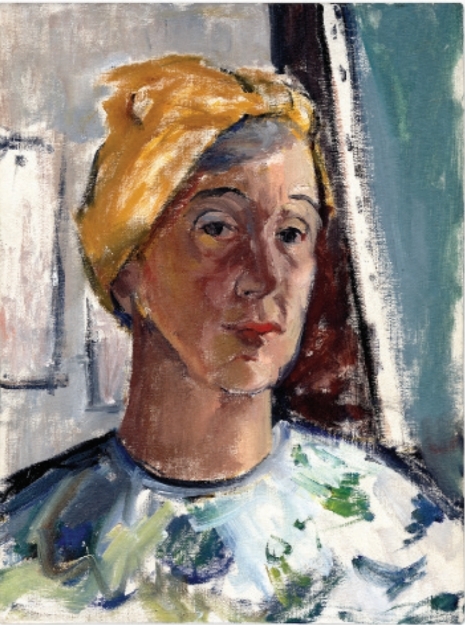
The cohort framework is an asset. A cohort is, after all, one of canonical modernism’s most fundamental units, from Britain’s literary Bloomsbury set to the French Surrealists to the American Abstract Expressionists. Isaacs and Andril have taken Glushakow’s initial cohort—already diverse in its chronology, its perspectives, its material conditions, and its stylistic approaches—and expanded it further, to valuable effect.
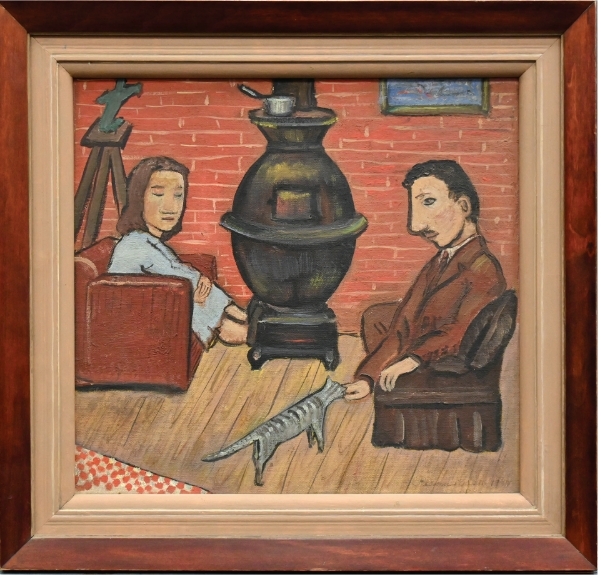
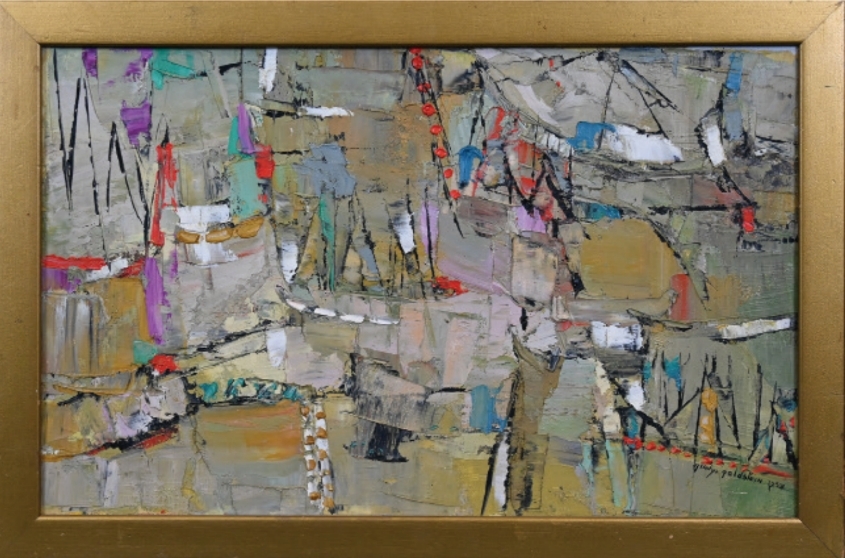
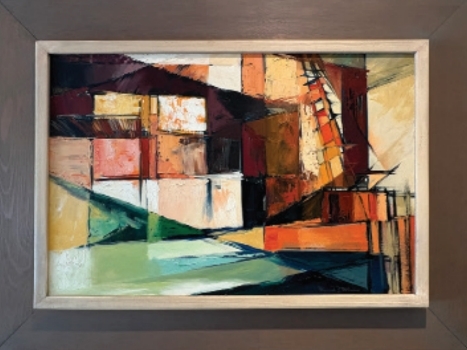
Gladys Goldstein’s vibrant canvases expand the show’s reach into mixed media and fiber arts, relating abstraction to works of art sometimes dismissed with the feminine coding of “craft.” Perna Krick’s portrait of domestic life within the cohort similarly expands its reach into the domestic realm (as well as representing a non-Jewish artist nevertheless related to the core cohort through her marriage to Ruben Kramer). Bennard Perlman’s muscular, abstract cityscapes recall Rothko’s color fields and the intense energy of Abstract Expressionism. The work of the self-taught artist Peter Leo Max Scholleck, who engaged modernism in a rigorous but solitary practice, offers a counterpoint to the ways that institutional training may tend to reproduce stylistic or theoretical consensus.
In choosing to organize around this Jewish cohort, and then to expand its parameters, Modernisms spans the Atlantic as European Jews immigrate to the States and cosmopolitan Americans travel. The exhibit stretches the boundaries of chronology from modernism’s origins to its afterlives, and persistently devotes itself to representing a breadth of perspectives, stylistic approaches, and strains of modernist aesthetic thought. The result is the startling, intriguing chance to observe the multiplicity and interconnection of what Glushakow’s article calls “cross currents in the larger world of art, both in this country and in Europe.”
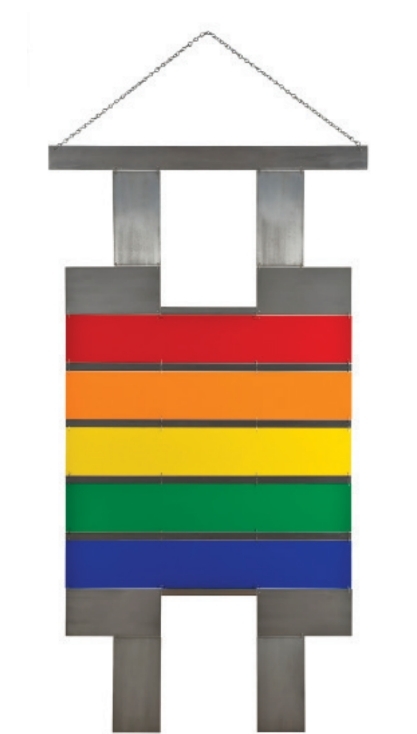
The work of Amalie Rothschild is the show’s clearest connection to the canonical high abstractions of European visual modernism. What is on view here is—judging from my own experience—enough to make visitors who missed Isaacs’s Rothschild exhibit sorry, and to pique interest for future opportunities to see Rothschild’s work in the Baltimore area, where it is well represented in collections like the Corcoran, the Phillips Collection, the BMA, and the Walters.
While Rothschild was a mid-Atlantic regional artist—and most specifically a Baltimore artist—by choice during her lifetime, her incredible range and productivity, as well as the breadth of influences and styles she inhabits and engages, speak to a career that deserves more recognition on the national and international scale. Rothschild’s work is accomplished and wide-ranging, reflecting an extraordinary lifelong engagement with a multiplicity of forms and traditions—from post-impressionist painting to pop-influenced abstract sculptures—as well as a startlingly original style that runs throughout. She juxtaposes cutting-edge visual abstractions—colorblocking, bold shapes, flat fields—with age-old Jewish themes to particularly intriguing effect.
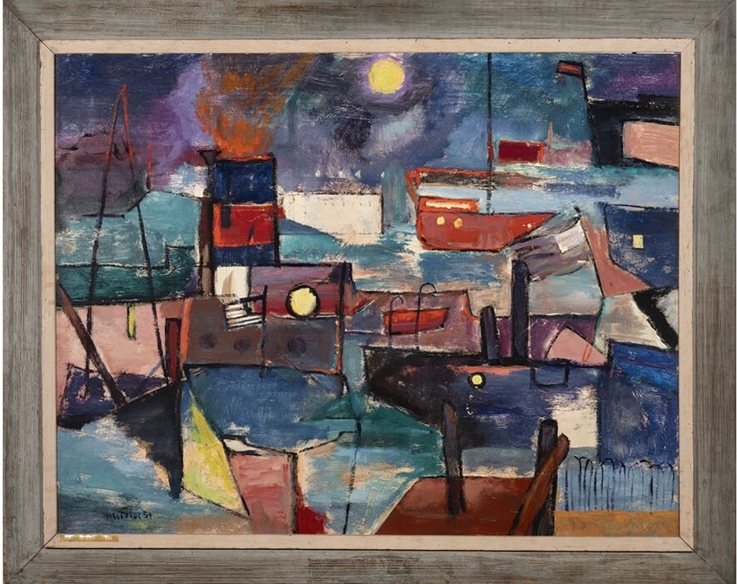
The WPA style of American modernism is also abundantly represented in works by Glushakow, Edward Rosenfeld, Karl Metzler, and Florence Austrian (Mervin Jules and Bennard Perlman were also supported by the WPA, but their entrants here are outside its stylistic parameters). Here, modernity comprises not only the rise of theoretical abstraction, but the gaze trained on the new forms of modern life: the city, with its dense interconnected webs of humanity.
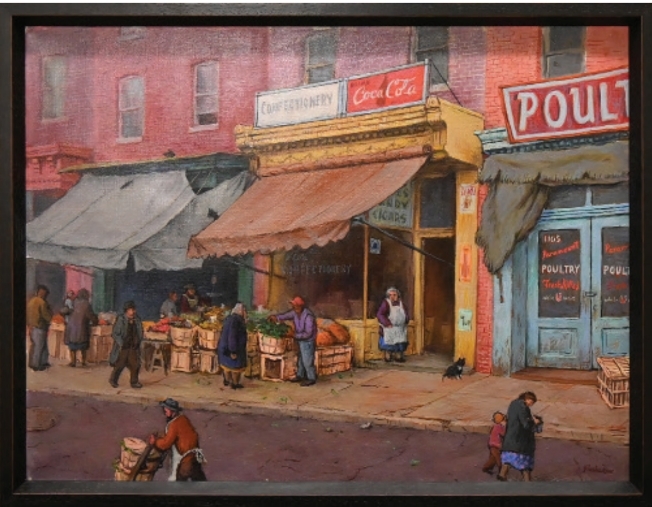
Mollie EisenbergJewishness, like modernism, is powerfully multiple. Here, surrounding Jewish art from many perspectives like a cubist experiment in perspective, something emerges that feels continuous.
Not all of these works are particularly distinguished, but in relation to each other, they become a chance to compare and contrast, an opportunity to make visible the role of individual choices, styles, and perspectives that undergird or diverge from the consensus canon of modernist style. They make visible relationality and individuality at once.
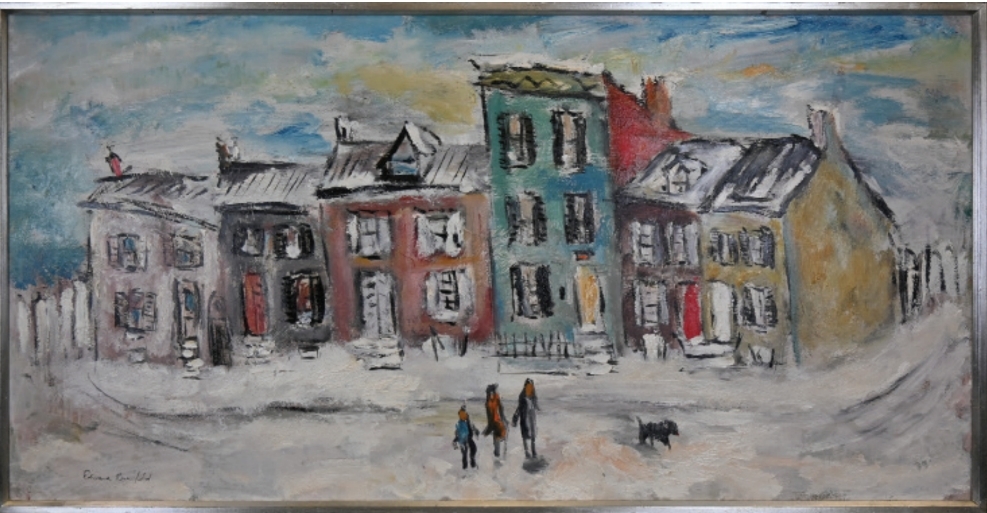
And while Glushakow’s original article argues that there is no “Jewish art,” seeing these pieces together suggests the opposite. Jewishness, like modernism, is powerfully multiple. Here, surrounding Jewish art from many perspectives like a cubist experiment in perspective, something emerges that feels continuous, even in its diffusion and dynamic tension. Seeing the sturdy social realism of the WPA, so analogous to the Workmen’s Circle strain of Jewish thought and practice, next to the Old World formalism of the Ukrainian immigrant Glushakow (born at sea during his parents’ emigration to America) next to Rothschild’s cosmopolitan experiments—Jewish perspective, like modernist perspective, emerges as a set of themes and variations.
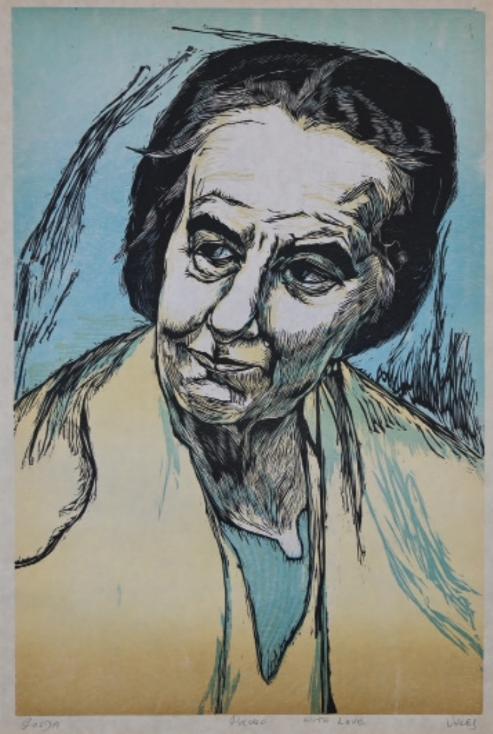
Again and again, there is the old neighborhood, rendered in styles that suggest optimistic American progressivism, experimental zeal, European nostalgia, and everything in between. We see its storefronts and inhabitants portrayed in Glushakow’s accomplished realist style and Florence Austrian’s post-impressionist warmth, now mapped minutely by Edward Rosenfeld’s attentive portraits of single objects, now rendered in Selma Oppenheimer’s romantic haze and now abstracted as part of Bennard Perlman’s striking, idiosyncratic depictions of urban energy.
The convergence both substantiates something continuous about the experiences and objects of attention of this cohort and also disrupts single narratives of nostalgia in a way that recalls the museum’s interest in rethinking the relationship of past to present and future.
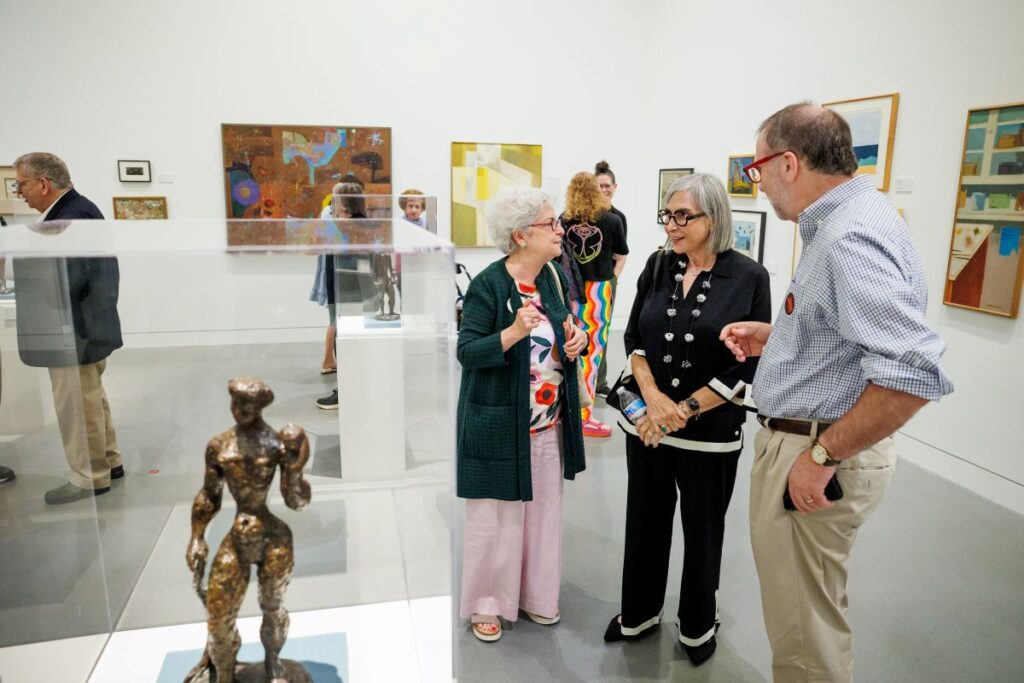
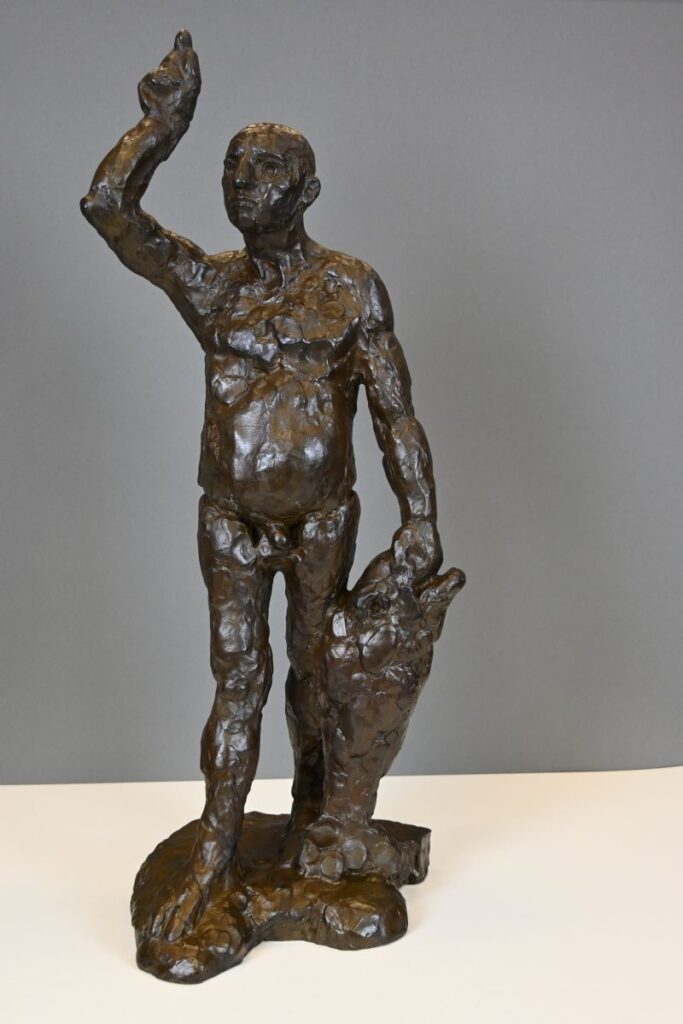
And then there are the bronzes of Reuben Kramer. The figures’ attenuated extremities evoke Brancusi’s well-known spare forms, but Kramer’s are determinedly earthbound, almost fleshly. Their embodiment is emphasized by faceted surfaces that preserve the sculptor’s touch, a disruption to realist representation that is simultaneously characteristically modernist in its abstraction and achingly, indelibly human. They seem to place something fundamentally Jewish in provocative contact with core modernist themes—and their impact and interest have lingered since my last visit to Modernisms.
But Kramer’s sculptures are not the only memorable highlights that make this show worth visiting. The work of Gladys Goldstein brings nuance and originality to modernist abstraction, both engaging and expanding its modes with her multimedia.
Peter Leo Max Scholleck’s canvases are also an important addition. For one thing, this is the first time that they have received full exhibition, given the solitude in which Scholleck painted during his lifetime. While Scholleck’s autodidacticism registers in his technique, like Rothschild, he demonstrates impressive range driven by voracious individual curiosity and a desire to explore the innovations of European aesthetics. The canvases, brushy and emotionally intense, provocatively blend modernist approaches with idiosyncratic innovation, and their impact lingers.
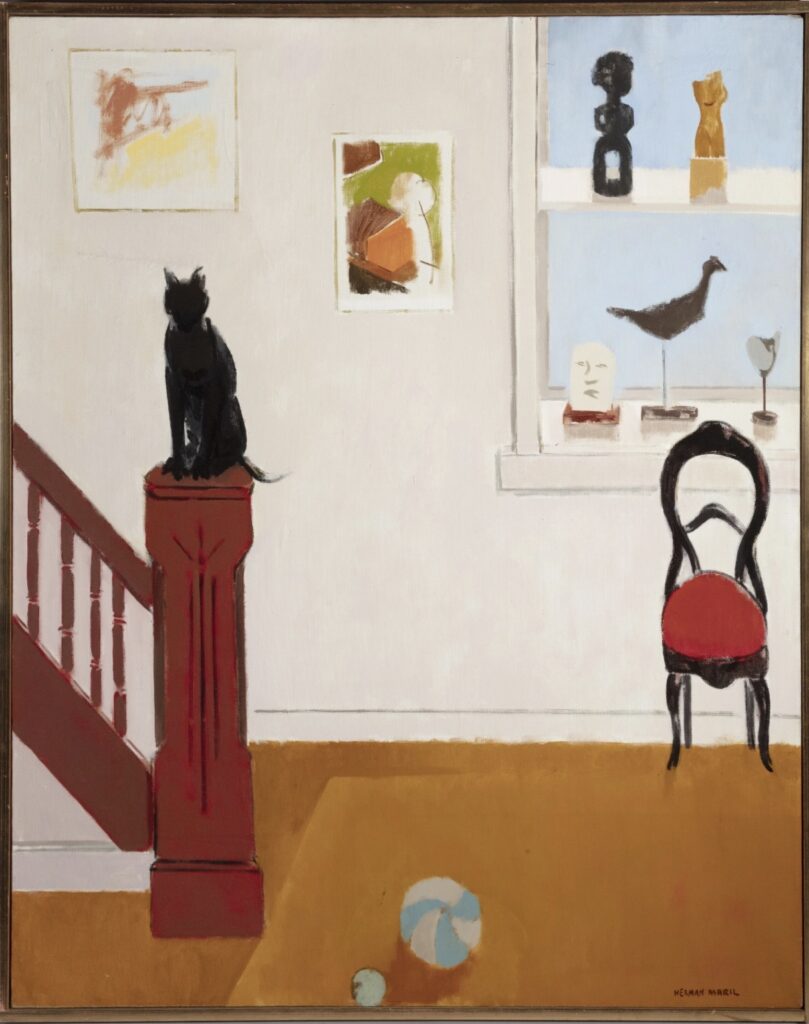
And the corner of the Weinberg-Cohen Gallery devoted to Herman Maril is something of a revelation. A painting of a staircase marries the European tradition of studio painting with American naturalism; its brightness and near-flat field recall Cézanne, but with a lived-in domesticity and contemporaneity that anchors the reference to something human, grounded, personal.
Maril’s WPA landscape is rendered in evocative strokes the more resonant for their spareness. His sense for color and light are remarkable—Dark Water is both landscape and near-abstract color study, and Dune Trees renders dusk more, rather than less, acutely in brushy black and white. Maril’s work lingers indelibly, shimmering at the intersection of the European and the American, the canonical and the contemporary, the abstract and the representational.
Modernisms should be widely seen and considered—for the highs of its highlights as well as for the insight it offers into questions of what it means to be a modernist artist and a Jewish artist. Indeed, there is plenty of material here worthy of an expanded take on this “brief burst of glory,” especially given the family members and additional works which have emerged during the production of Modernisms. But whatever the prospects of a fuller consideration of this intriguing cohort, the endeavors of the Jewish Museum of Maryland’s new directions seems inarguably bright. There is, Andril promises, more art coming. Davis agrees: “The next show is already forming.”
If Modernisms is anything to judge by, that is a very exciting prospect indeed.
Modernisms is on view at the Jewish Museum of Maryland August 10, 2025 – March 15, 2026. For more information on this and other exhibitions at the Jewish Museum of Maryland visit their website.