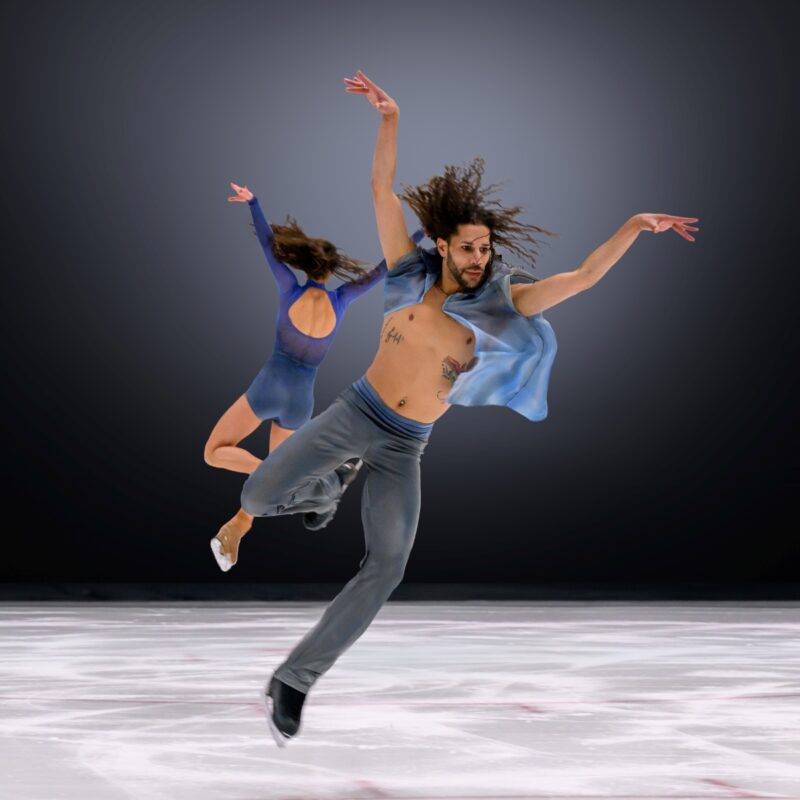
Ardmore, PA: During the day, the Philadelphia Skating Club & Humane Society is lit by the sky. Arched skylights hug the rink’s semicircular ceiling, and a wall of windows provides a forest backdrop at the far end of the ice. Below the sylvan view sits a mirror, meaning the rink both opens out to the world and folds in on itself.
It’s a spectacular stage. And on it—this first spring evening lengthened by an hour of daylight—skates Ice Dance International (IDI), a ten-member troupe. IDI is not an ice show. They’re a dance company. But ice is required for their choreography. So are skates. Not required–but welcome–are Olympic medals in ice dance.
Douglas Webster, IDI’s founding director, shepherds the troupe of skaters between cities and venues. We talk when he’s fresh off the road from Ashburn, finally eating lunch after unloading the company van, and again a week later when he’s en route to pick up a rental car in Los Angeles.
Just a week after Alysa Liu’s Olympic victory, Webster’s troupe set out on a fourteen stop tour hoping to show the world that skating can exist apart from competition—that outside of sporting strictures, skating can be art. That a blade meeting the ice can be as transfixing as a pointe shoe meeting the stage.
“I think that a lot of the public doesn’t see ice skating as an art form,” says Alissa Czisny, IDI cast member and two-time U.S. national champion. “You know, we see ice skating in the Olympics or we see Disney on Ice with our children.”
Every IDI cast member got their start in competitive skating. That’s the natural entry point to the ice, the path that skating instruction leads toward. And that’s how the general public encounters skating once every four years. That’s how 7.5 million people have come to follow Liu on Instagram after the Olympics, despite—or perhaps because of—her insistence that she now competes to showcase her art.
But now, members of the IDI cast are still skating because they understand that their once-sport is something more.
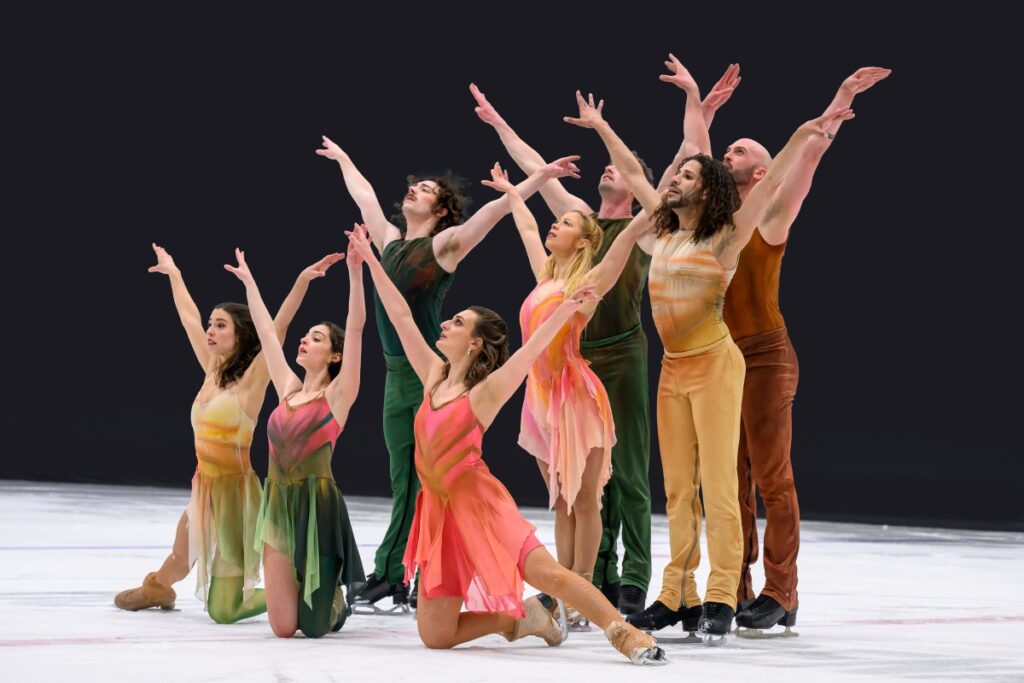
Alissa Czisny, IDI cast member and two-time U.S. national championI think that a lot of the public doesn’t see ice skating as an art form… you know, we see ice skating in the Olympics or we see Disney on Ice with our children.
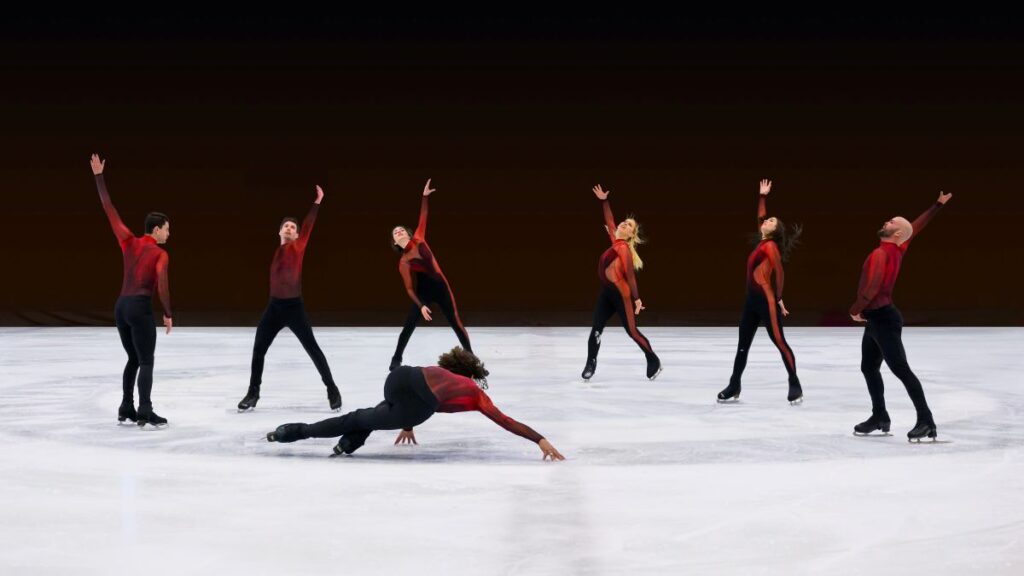
Three years ago, Japanese ice dancer Tim Koleto stood on the podium at the Paris Olympics, finally receiving the silver medal he’d earned in the team event in Beijing (the medal ceremony had been delayed because Russian skater Kamila Valieva had tested positive for a banned substance). In that same Olympics, French ice dancer Gabriella Papadakis earned gold in the individual event. Both have stepped away from competitive skating, but today, both step on the ice in “Spring Awakening,” the first piece in IDI’s 2026 tour The Seasons.
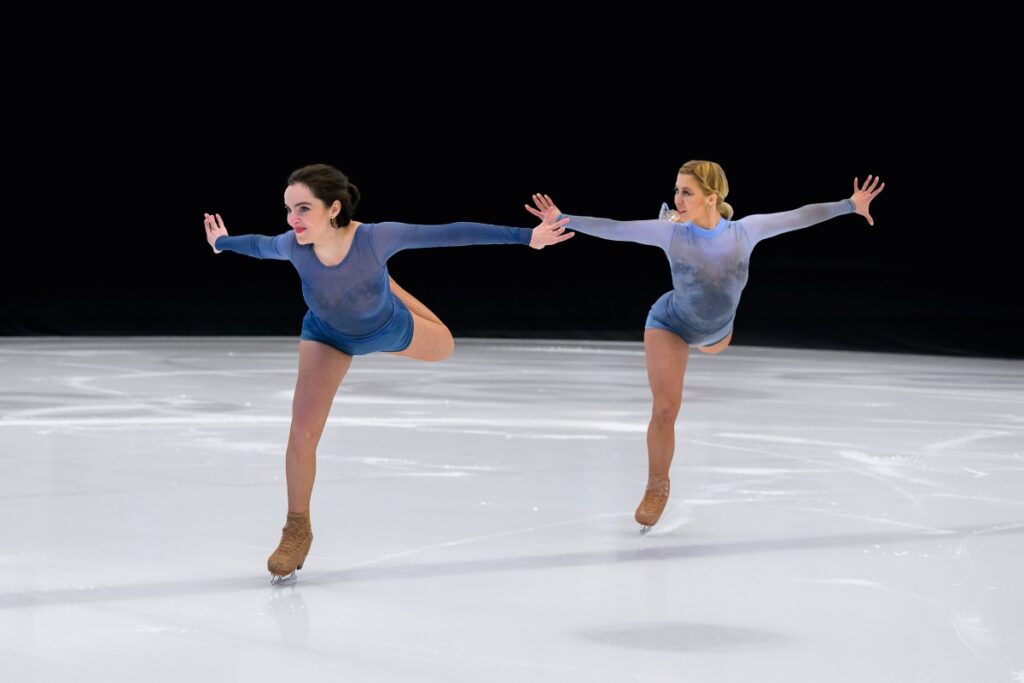
Papadakis and Koleto are paired as one of four couples who skate together and then separate into ensemble work in the piece Webster choreographed in 2016. While the two trained together in Montreal during their competitive careers, they didn’t skate together. But now, they’re part of an ensemble, bringing new life to choreography in IDI’s repertory.
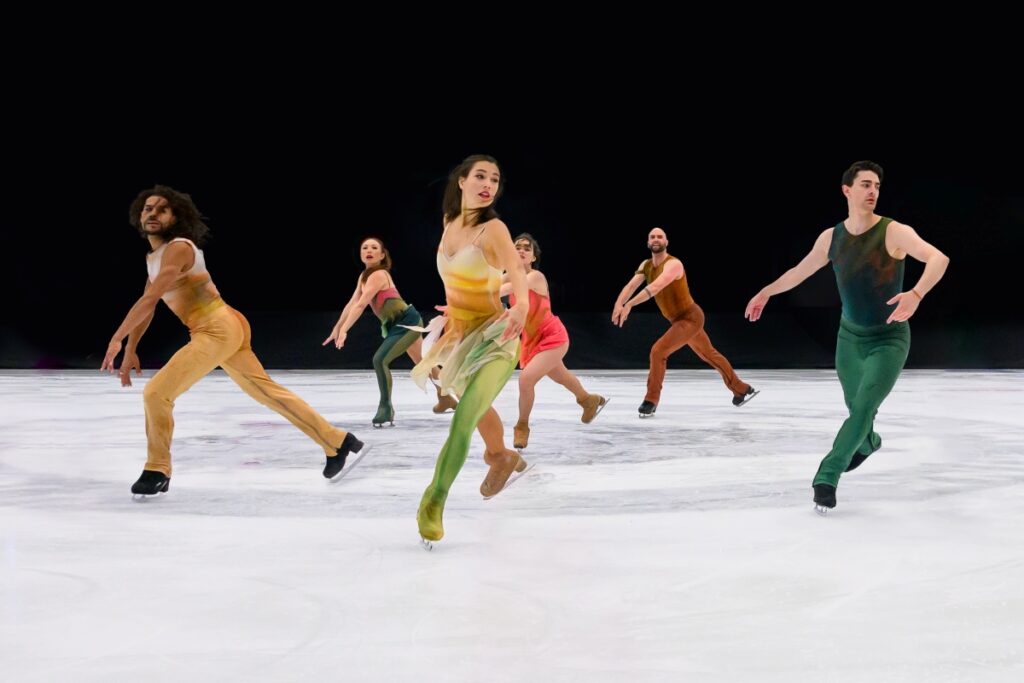
“Usually when you’re partnering, it’s with the same person, always. So you’re used to that person, but in a group of ten people it’s a lot of people that you’ve never skated with before,” Papadakis says. “You really have to stay alert all the time and pay attention. And that is something I enjoy doing.”
Czisny was a singles skater, winning national titles in 2009 and 2011, and credits IDI with the fact that she’s still skating. “One of the first things I noticed is that I get way less nervous when I skate with other people. It just feels like other people on the ice are a grounding factor for me–you know, being able to look at someone that’s on the ice or hold their hand or skate with them. You have to match timing so you’re consistent every night. But I also think that you can create more as a skater on the ice with other people.”
The concept of a dance troupe on ice emerged from John Curry, the 1976 Olympic champion from Great Britain. Winning the top prize in competitive skating didn’t satisfy him. “I wanted to skate better than I’d ever seen anyone skate before, in a different way,” Curry once famously said. “To convince people that skating had more to offer than was genuinely seen, and to work with people who were masters of movement and music.”

Douglas Webster, Founding Director of IDIThere’s certainly the huge value of competitive skating, but you have to think about, well, what happens after that? And that is the goal of Ice Dance International—to provide new ways of seeing skating.
In 1985, the year Webster graduated from high school, he saw Curry’s company perform at the Kennedy Center. Performing in concert halls was the norm for the John Curry Skating Company, which did shows at London’s Royal Albert Hall and New York’s Metropolitan Opera House. “And Willy Bietak had a company called ‘Festival on Ice’ that performed at Wolf Trap. And I saw both of these amazing skating shows on stages at a very, you know, impressionistic time,” Webster says.
Webster went on to perform with Curry in a show called Festival on Ice. He went on to choreograph for Disney on Ice, Stars on Ice, Holiday on Ice, among others. And he spent twenty-four years with Ice Theatre of New York, performing, choreographing, and ultimately leading the company as artistic director. From there, he split off to found Ice Dance International in 2014.
For Webster, Curry and Bietak’s shows illustrated the enormous possibilities of skating. “There’s certainly the huge value of competitive skating, but you have to think about, well, what happens after that? I think that so many people are just so consumed by what’s right in front of them, and they can’t see past it,” he says. Athletes striving for nationals and the Olympics eclipses what Webster calls “other possibilities.”
“And that is the goal of Ice Dance International—to provide new ways of seeing skating,” he adds.
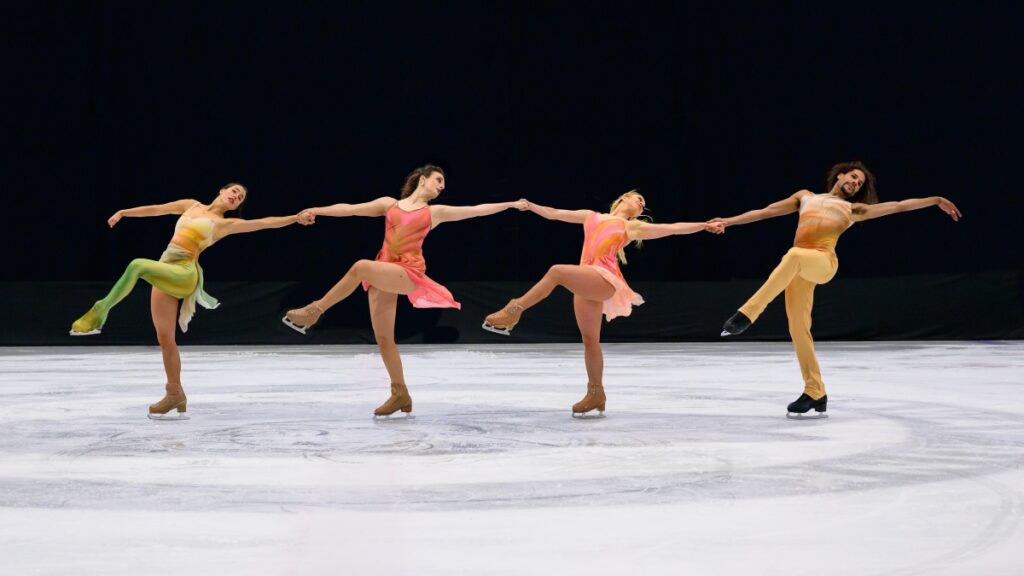
This year, IDI provides audiences with a new look at an old piece, “After the Rain.” In 2015, Webster choreographed the tango for two women and a man. Now, the piece is skated by three women—Czisny, Papadakis, and Kseniya Ponomaryova. Papadakis has used her post-Olympic skating career to advocate for open-gender ice dance (currently, only male/female pairings are allowed in international competition). But ice shows and artistic skating—where skating is set free as art—provide a testing ground for other possibilities. In “After the Rain,” Papadakis alternates between skating with two women—a love triangle reimagined.
Webster is acutely aware of how the development of skating got the art stuck where it is today. “Skating is regulated by compulsory dance that was built over ballroom,” he says. “Ballroom already had its structure, and then you’re putting more structure on top of structure without any sense of creative energy.” He challenges that by bringing in non-skating choreographers to set pieces on ice.
Garrett Smith, renowned ballet choreographer, developed “Swam,” the sweeping piece that closes out Act I. At one point, all eight skaters come together to join hands. The women on both ends have been lifted above the men, and the unit rotates as one.
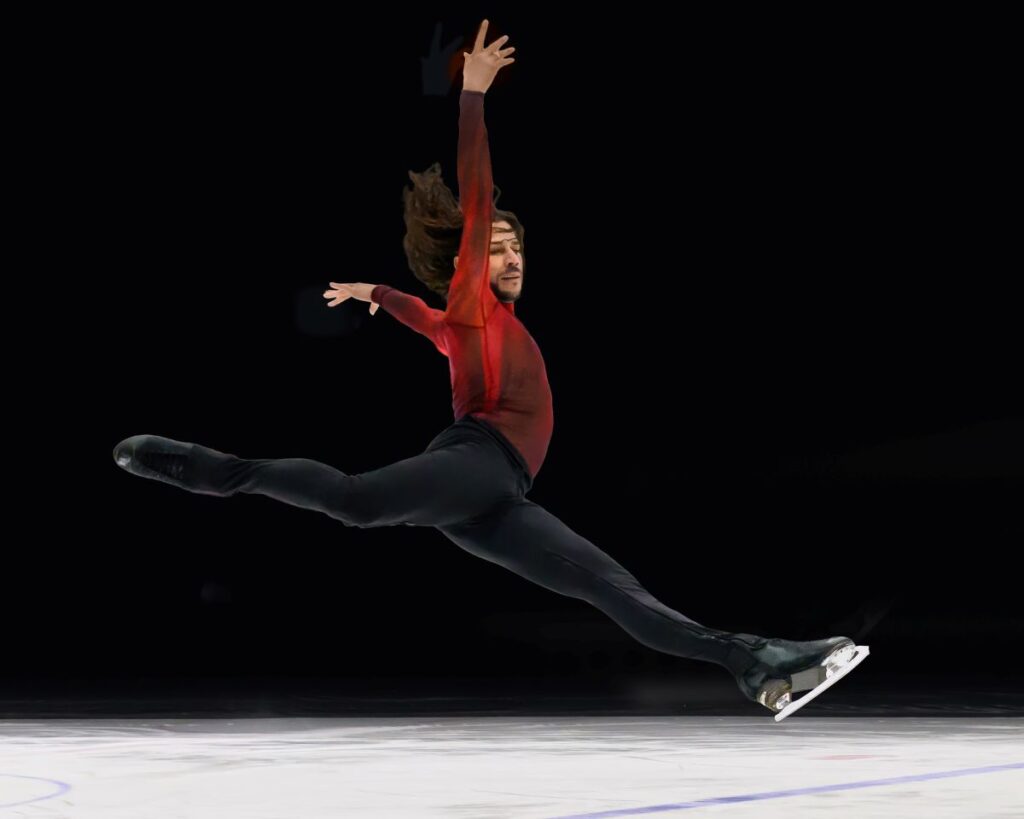
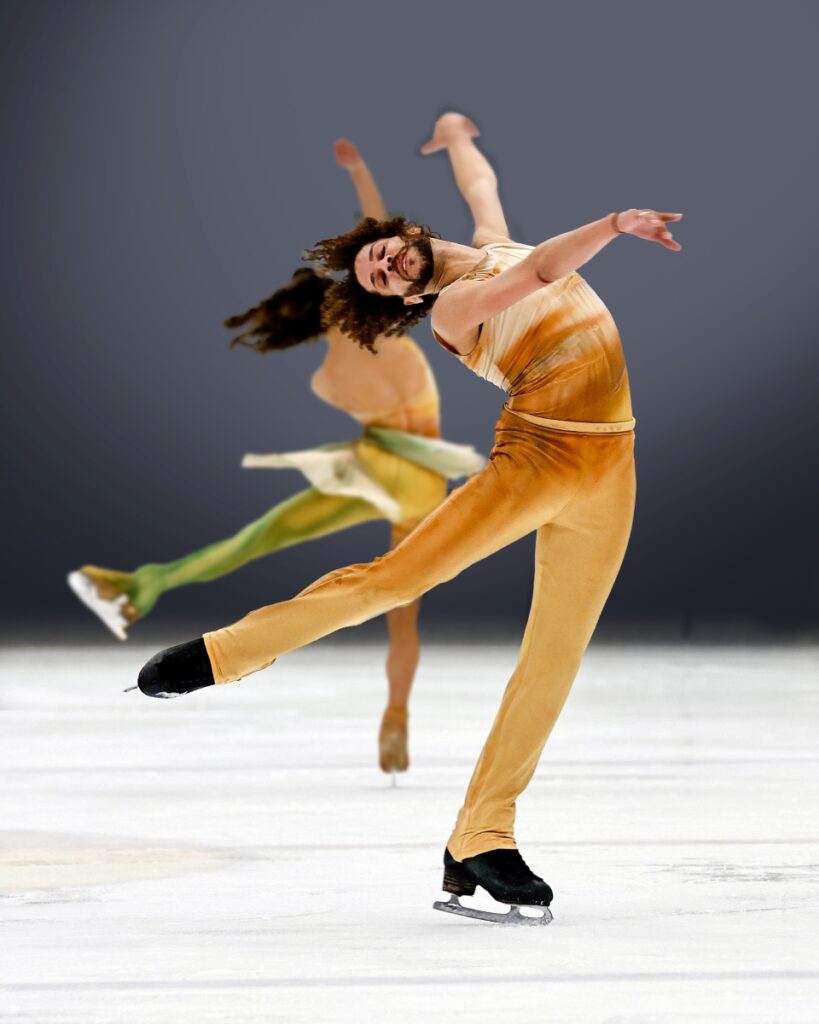
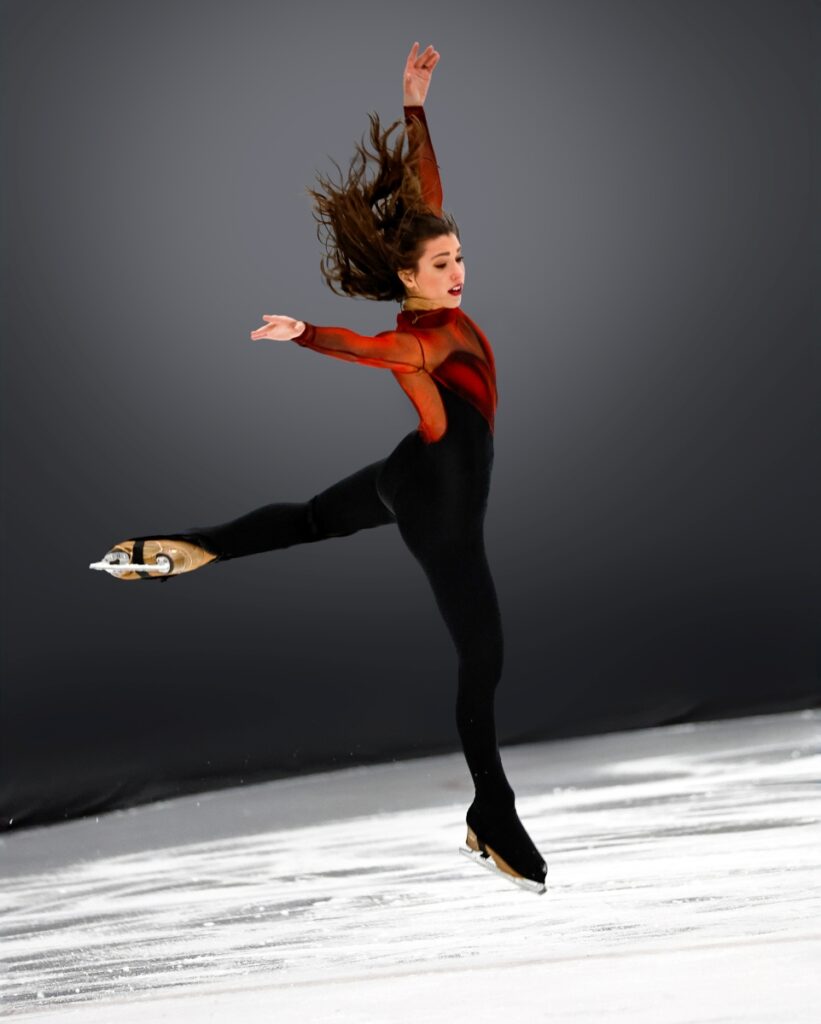
“It’s something that you rarely see in skating because we often get stuck in the same structure of thinking and skating. This is what we’ve always done. This is how we’ve done it,” Czisny says. But “Swarm” challenges all of that. “We create some shapes and lifts that are really unique—eight of us in one group, creating not so much a feeling as a visual picture,” she says.
Why isn’t there more of this? I ask Webster. Figure skating has long been the crown jewel of the Winter Olympics, the most watched sport of the winter games. Clips of Liu’s Olympic gala performance to “Stateside” by PinkPantheress and Zara Larsson are still flooding my (admittedly biased) timeline, and now, everyone from Broadway casts to Chinese grandmothers are sharing their own attempts at Liu’s choreography. Baltimore has its own viral skating sensation, Ryan Dunk, who performed with IDI last spring before joining a cruise ship’s skating show. We’re so entertained by skating, yet we have few opportunities to see it live.
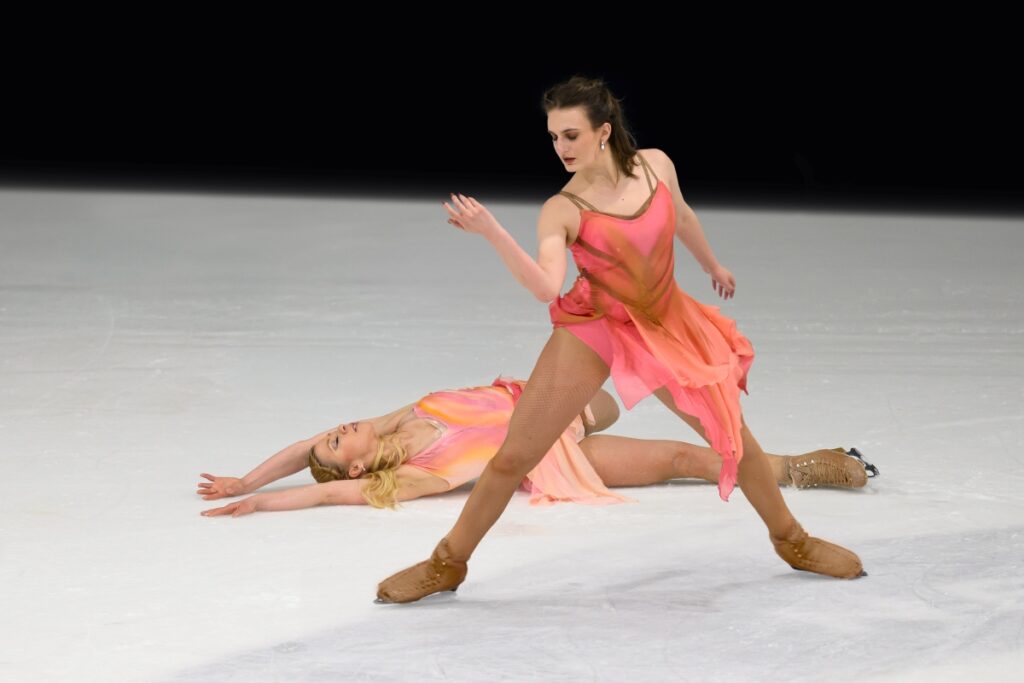
Ice itself is a major limiting factor. IDI depends on rinks that will open their doors to Webster’s show and lock up at the end of the night. Webster tells me that it was ice itself that led toward the undoing of John Curry’s show. During their residency at the Metropolitan Opera, a sold-out opening night was lost to a dispute about who could lay down the ice (the Met would not allow Curry’s person to do it, yet the Met staff did not know how to do it themselves), leaving Curry’s company responsible for the opening night loss.
The complexity of straddling the figure skating and dance worlds is another limiting factor. “I think a lot of people have the dream, but it’s daunting to think about how to fund it, how to build an audience, how to do all of that. You know, it took me almost twenty-five years of a career before founding IDI and the experience of working with Disney on Ice and understanding production,” Webster says.
Blending the theater and sport worlds presents another challenge. “A lot of university theaters have to then collaborate with the athletic department, and they don’t want to do that,” Webster says. And getting ticketed subscription series to include ice dance has been a challenge. “People don’t recognize the artistic potential of dance on ice as a performing art that aligns with established art forms. It is outside the box of what sells tickets,” he says. While IDI has participated in the occasional subscription series, Webster has found it more fruitful to present their own shows.
Two weeks before IDI’s Philadelphia show, I watched Alysa Liu win in Milan. I also watched gold medal favorite Ilia Malinin crumble in an uncharacteristically mistake-riddled free skate and Amber Glenn make a heartbreaking error in her short program. I left the Milan Ice Skating Arena distraught after Malinin’s skate and ebullient after Liu’s win. I’d watched dreams dashed and dreams realized at the pinnacle of competitive skating. What’s an ice show after the drama, the suspense, the stakes of the Olympics?
In 2022, I was swept by Papadakis’s win in Beijing, awe struck by her performance to Gabriel Fauré’s “Élégie.” But I’ve since learned of and reported on how the strictures of competitive skating kept Papadakis in an unhealthy skating partnership. What I watched on TV was the result of a system weighted by stacking structures on top of structures. I adore some of those structures, trekking to the ice rink twice weekly to practice pattern dances, relishing the thought that I’m the thousandth skater to fall on my three-turn in the Ten Fox. But we need a place to poke at those structures.
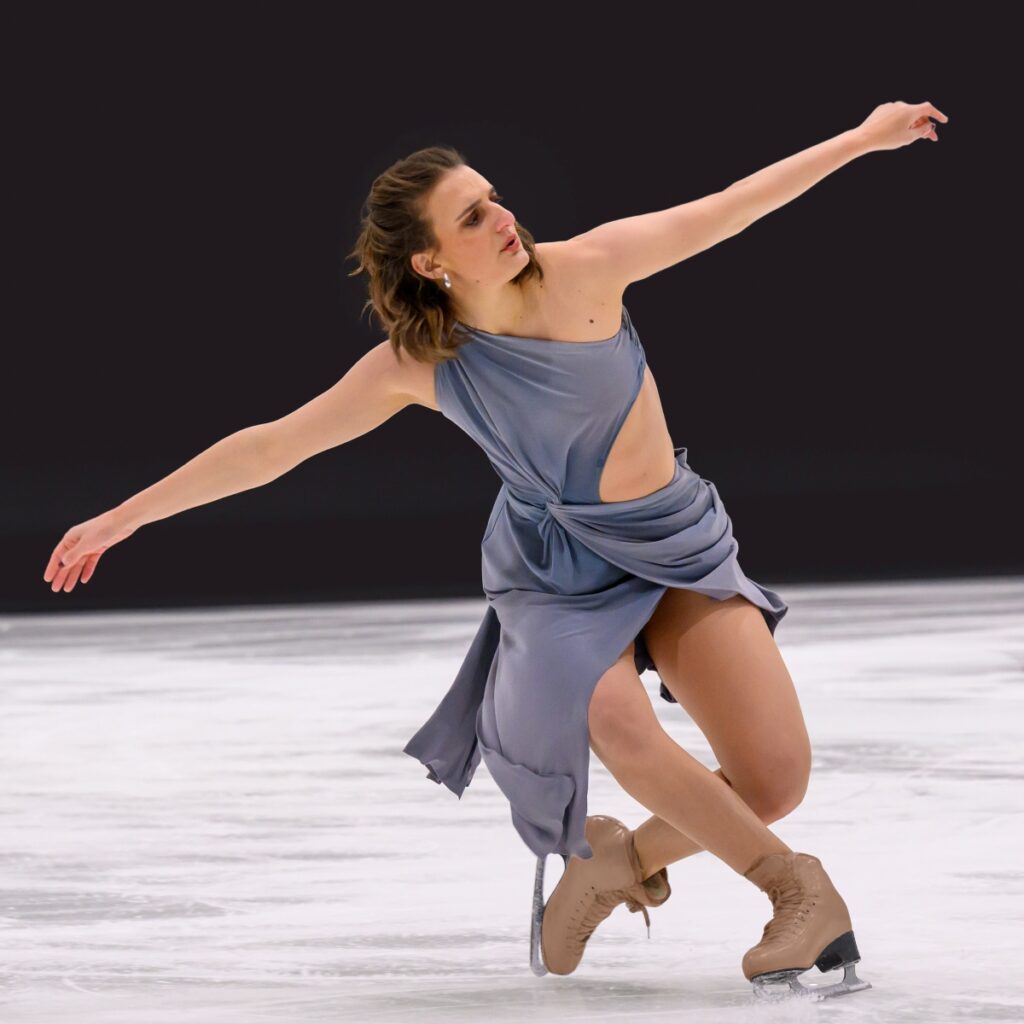
At the skylit rink in Ardmore, I finally see Papadakis skate in person. Four years ago, I couldn’t have fathomed seeing her sans partner. But today, watching her solo “Ephemeral Joy” and trio “After the Rain,” I understand that art is the testing grounds for the safe continuation of sport. That sounds like a comment made by someone still caught in the supremacy of competitive skating; perhaps. But art shows us possibilities. Helps us glimpse other worlds.
Competitive skating trained Webster’s cast. Now, his choreography pushes them deeper into the ice, toward one another, and into a world where figure skating lives beyond our television.
Ice Dance International will perform Wednesday, March 18th in Rochester, Minnesota; Thursday, March 19 in Mequon, Wisconsin; and Friday March 20 in Rosemont, Illinois.
Showtimes, tickets, and more information are available on their website.