In the world of anthropology, “reflexivity” is the critical consideration of how an observer’s own research practices might impact or influence a subject—or oneself. Imagine you’re an ethnographer or linguist, and you show members of a previously uncontacted tribe in the Andaman Islands a meme… say, 2007’s viral YouTube sensation “Kelly Shoes”. If you returned a year later they might be clomping around in improvised pumps and calling you a “betch”. And they’d be right.
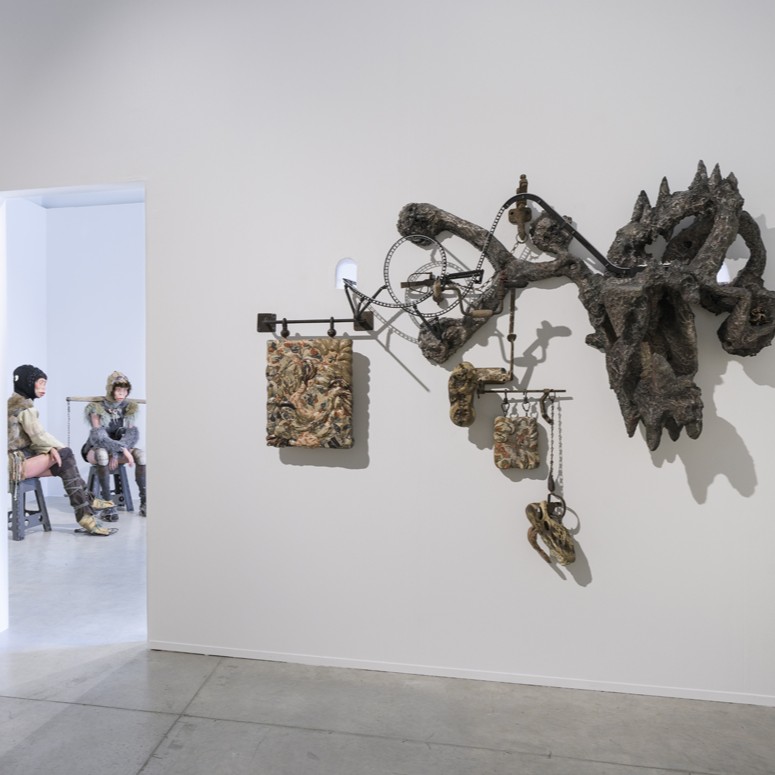
Thankfully, in the field of art criticism, we are allowed to unabashedly, ethically delight in our observer effects (and clompy footwear). Last year I travelled to Tallinn for Zody Burke’s archeologically-informed solo exhibition in her adopted city and asked the question Is a MICA Alumna in Cowboy Boots Emerging as the Unlikely Enfant Terrible of Estonia’s Art Scene? A month later, Burke was in New York showing at the Esther Art Fair. She accompanied me as my “plus-one” on a whirlwind tour of the other fairs around town. At The Independent, I snapped a photo of Burke posing with eerie mannequins that were dressed uncannily like her. They were part of an installation by the Swedish artist Klara Zetterholm, who happened to be standing just meters away—and whose practice fabricating imaginary natural history museum artifacts seemed almost destined to dialogue with Burke’s own. At the time I wrote “I obviously enjoyed being a fly, or, er… alien trilobite? on the wall during the great meeting of minds between two weirdo sculptors living and working just one ferry ride across the frigid Baltic Sea apart!”
Both artists gushed over their love of synthetic materials that can mimic the texture and patina of traditional media or natural phenomena—from stone to flesh. I predicted the beginning of a great friendship.
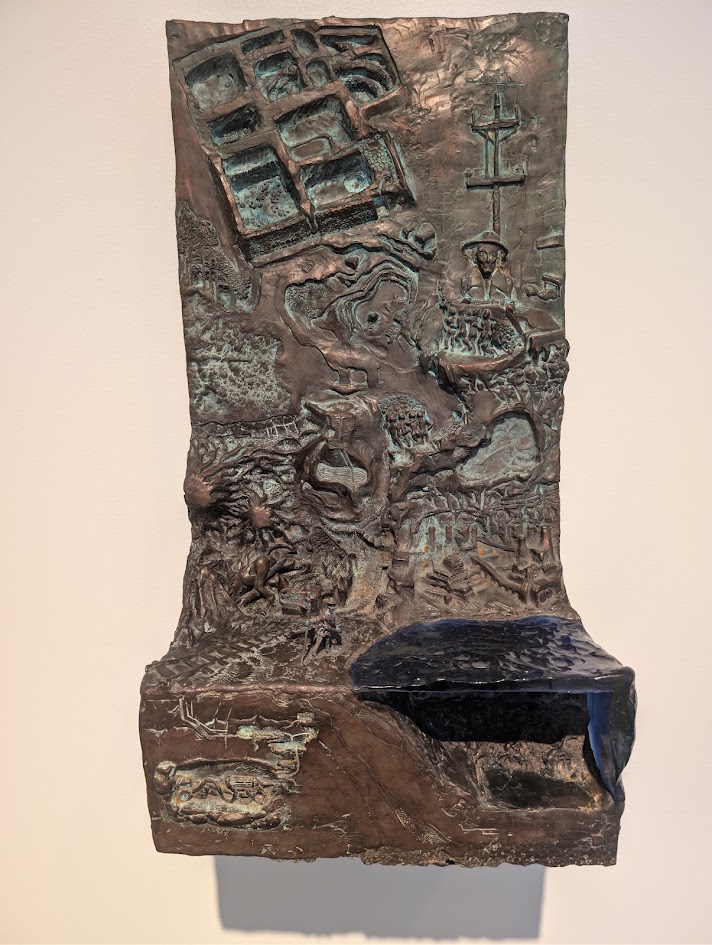
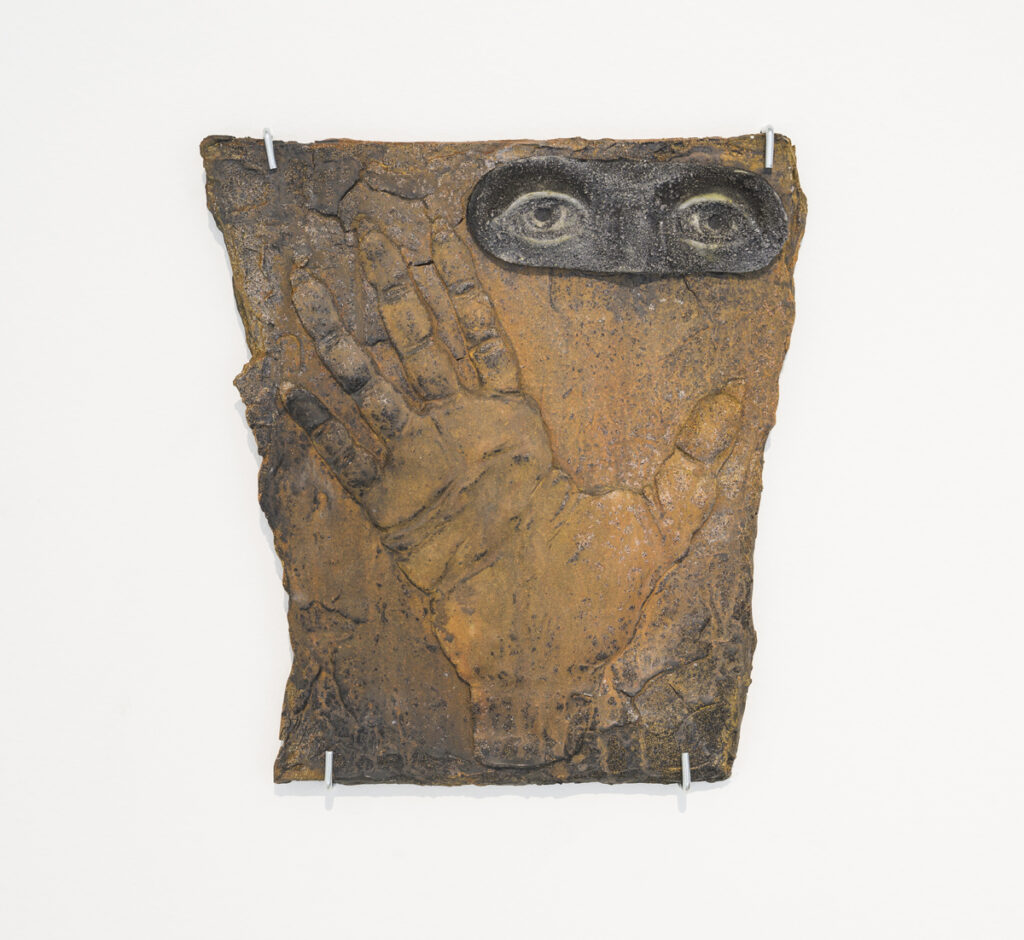
A year later, Zody Burke and Klara Zetterholm opened a show together at Temnikova & Kasela Gallery (run by Esther Art Fair Director Olga Temnikova). And so I found myself back in Tallinn, thinking quite a bit about reflexivity as I perused the artifacts on display, pleased some trace of our footprints from that fateful day in May of last year might be fossilized like some exotic centipede in so much synthetic clay sediment. This might seem like an awful lot of first-person backstory for a review, but I mention this because it’s a good explanation of why we do what we do as art writers. The act of observing the art and artists we care about makes connections—from our Artworld Global coverage to collaborations with international publications such as MOST Magazine—that sometimes, in some small way, can nudge the wonky arc of art history towards truly, remarkably great exhibitions.
And Ersatz Strata, Burke and Zetterholm’s triumphant two-person show (on view through August 15) is itself largely about parodying the myth of “objectivity” in the ways artefacts or artworks are presented, framed, and viewed in institutional contexts—and how they might be in the future. Indeed, in interviews with European press, Burke has cited Fred Wilson’s Mining the Museum as a formative influence. But in addition to rearranging and recontextualizing found objects, both artists mine their own experiences in careers as theatrical prop-makers to inject fantasies and farces into the culture of display. Here many objects return the viewer’s gaze with eyes that seem to ask: How much of archeology is conjecture? How much of ethnography is projection? How much of history—from the distant to the recent—is revisionist, written by the conquerors? Or at least survivors?
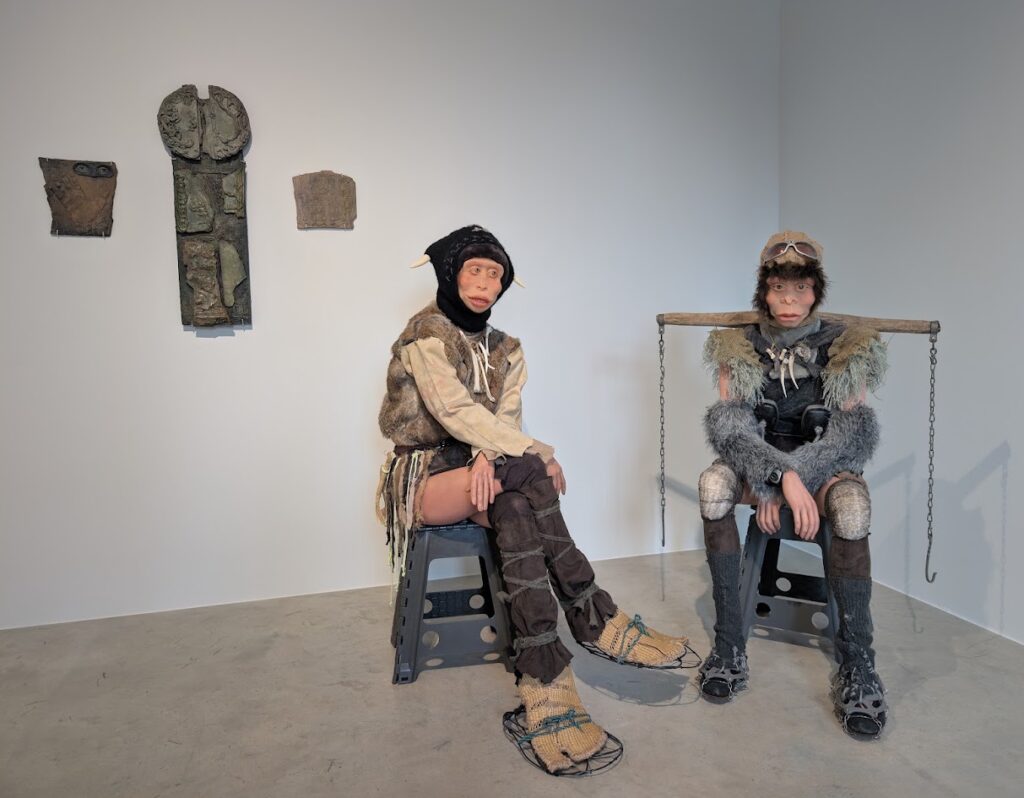
Klara Zetterholm’s life-sized “Ice Hiker” and “Snow Roamer” perch on plastic stools in the corner of the first gallery, startling nearly every visitor who enters with one eye on the exhibition text. Sculpted from synthetic clay, their faces are freakishly lifelike. At first glance, they appear to be a “missing link” of ancient protohumans, ripped from a natural history museum diorama. But look closer and the details don’t add up with any known timeline. Half of their garments are machine-stitched synthetic fibers. One figure is wearing plastic sunglasses on her head and an anachronistic digital wristwatch. Are they from a long-forgotten ancient civilization that exterminated itself? Or a potential future? Are these alien tourists or distant descendants of humanity who have time-travelled to witness the end days of our society? They seem to regard the viewer (or perhaps the objects in the gallery) with something akin to snobbish boredom or a healthy dose of exasperated skepticism. Maybe they are tourists from a future Scandinavia who are wearing snowshoes because they have trekked across a frozen sea—ironically enough an increasingly likely scenario as runaway global warming threatens to shut down the ocean currents that keep Northern Europe temperate. They have arrived to judge us—their primitive ancestors who somehow fucked the planet’s climate beyond repair—even as they themselves continue to use petroleum-based materials.
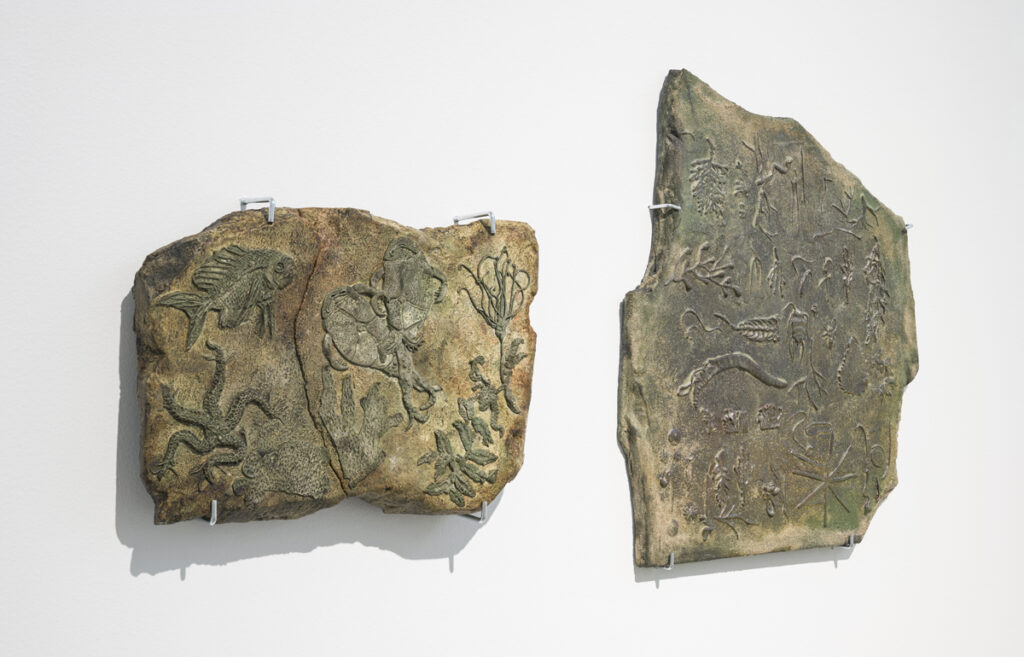
The pair are surrounded by Zetterholm’s Plate series of plaster, concrete, or synthetic clay faux-fossils of imaginary sea life or relics arranged as if they were fragments of looted architectural bas reliefs, wrenched from temple walls and whisked to museums in London or Berlin. But the detached gaze of one of the figures seems to linger closest to Zody Burke’s “Battle of Lyndanisse,” a monochrome intaglio print that similarly collapses “established” history and potential futures. The title references the 13th century Danish conquest of Tallinn and its subsequent forced conversion to Christianity—an event more firmly enshrined in Danish national identity than Estonian.
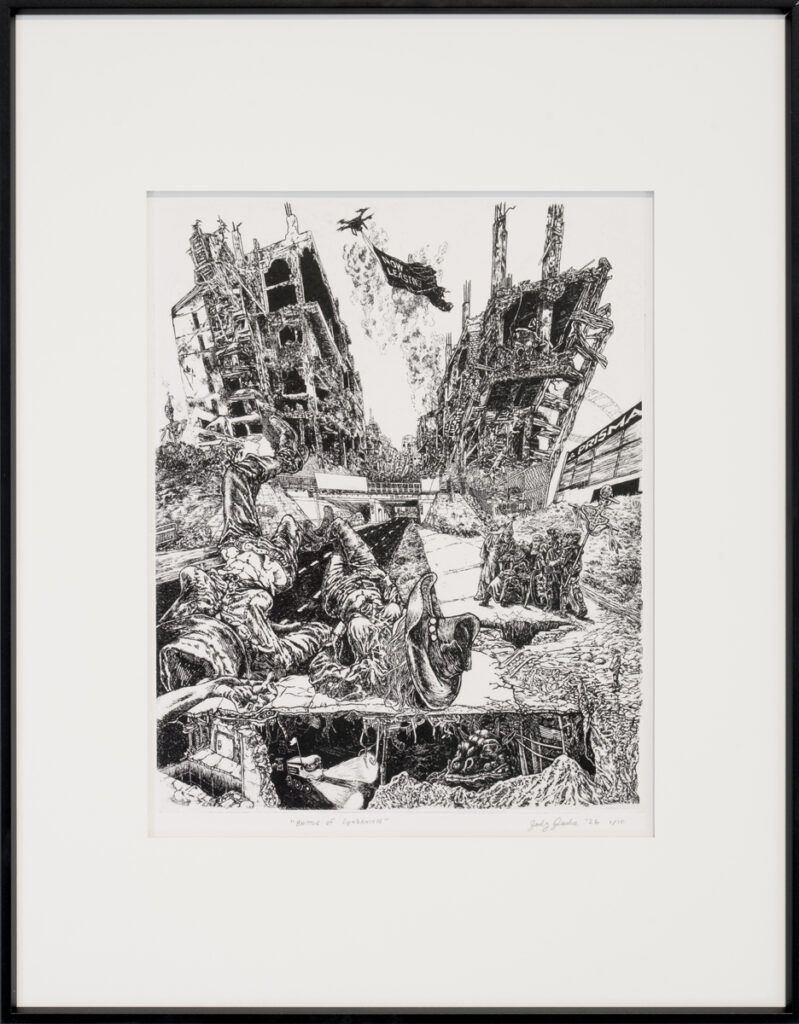
Burke’s intricately-detailed print, however, seems to depict a not-so-distant future or alternate present. Two cowgirls (it’s hard not to view them as a dual self-portrait of the artist and an alter ego) lay atop an abandoned, overbuilt highway, gazing up at a ruined cityscape while a quadcopter drone absurdly flies a ‘NOW LEASING” banner. Below, one of those goofy delivery robots trudges through some forgotten tunnel. Is this a reference to Estonia’s newfound status as a site of neoliberal tech industry investment and economic reintegration with the “Nordic Tiger” economies, and all the gentrification jitters that come with it? The only surface not treated with an horror-vacuii patina of rot and decay is the Prisma market, essentially the Finnish equivalent of Walmart. Aside: Burke was recently profiled by the lifestyle magazine SÄDE in a feature titled “Miks ma siin olen?” or “why am I here?” in Estonian. She shared photos of herself in her Tallinn-made wedding dress with the caption “If your favorite place on earth were determined by the sheer amount of time you spend there on a weekly basis, mine would obviously be the Prisma…”
As an American émigré and a Swedish “visitor”, respectively, the artists work with an acute awareness of their relationships to a complicated context. Estonia’s natural, built, and cultural environments have been endlessly made and remade by a revolving door of colonizers, ideologies, and iconoclasm by both violence and neglect. Tallinn’s cityscape is fraught with contradictions. It boasts one of Europe’s best-preserved medieval city centers, but it has been increasingly depopulated and museum-ified by the tourism sector. It’s ringed by strata of urbanism reflecting the aesthetics or values of various global interests over the years—from Scandinavian conquerors to the Soviet Union or post-90’s EU neoliberalism. Much of the country’s communist-era architecture is facing the end of its concrete’s lifespan—necessitating conversations about conservation, renovation, or replacement and what that should look like. Both young artists in the show are older than some of Estonia’s post-independence “pastoral” landscapes—restored by design or forested after centuries of brutal resource extraction that mostly benefitted foreign powers.
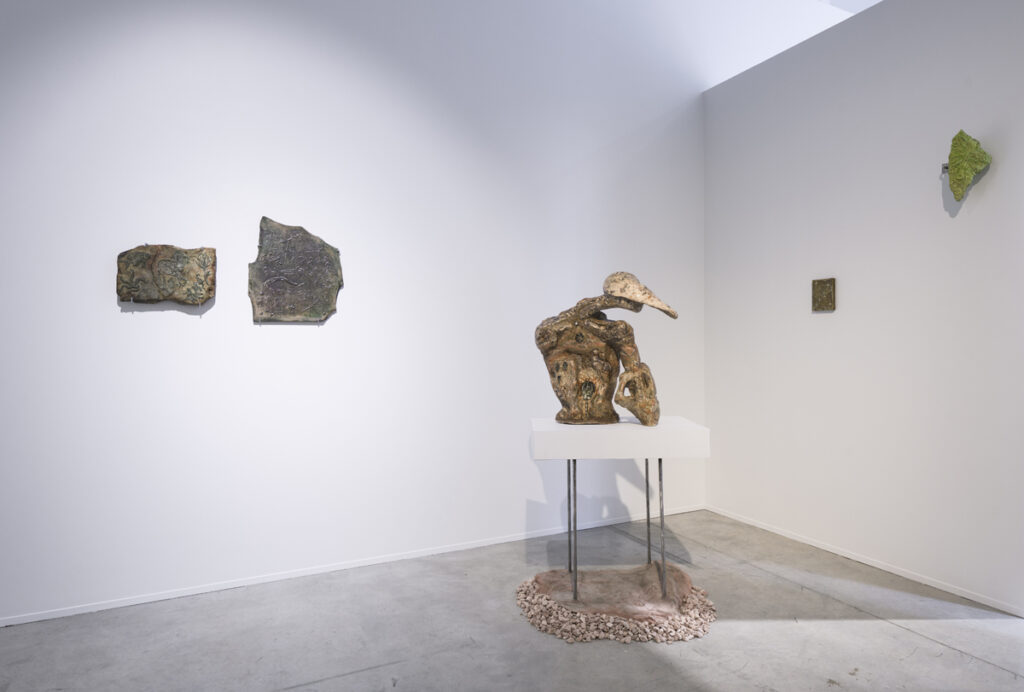
Zetterholm’s wall-hanging sculptures seem to conflate the artificiality of the natural and built environments. Some evoke the wildflowers used in bioremediation of polluted soil, here rendered as toxic fossils of slightly-too-staged floral arrangements in polymer clays—as if a tidal wave of petroleum-byproduct sludge had suddenly inundated a carefully landscaped garden. Others could be prehistoric carvings of imagined long-extinct animals, excised from their original contexts and transposed to a new architectural context for display.
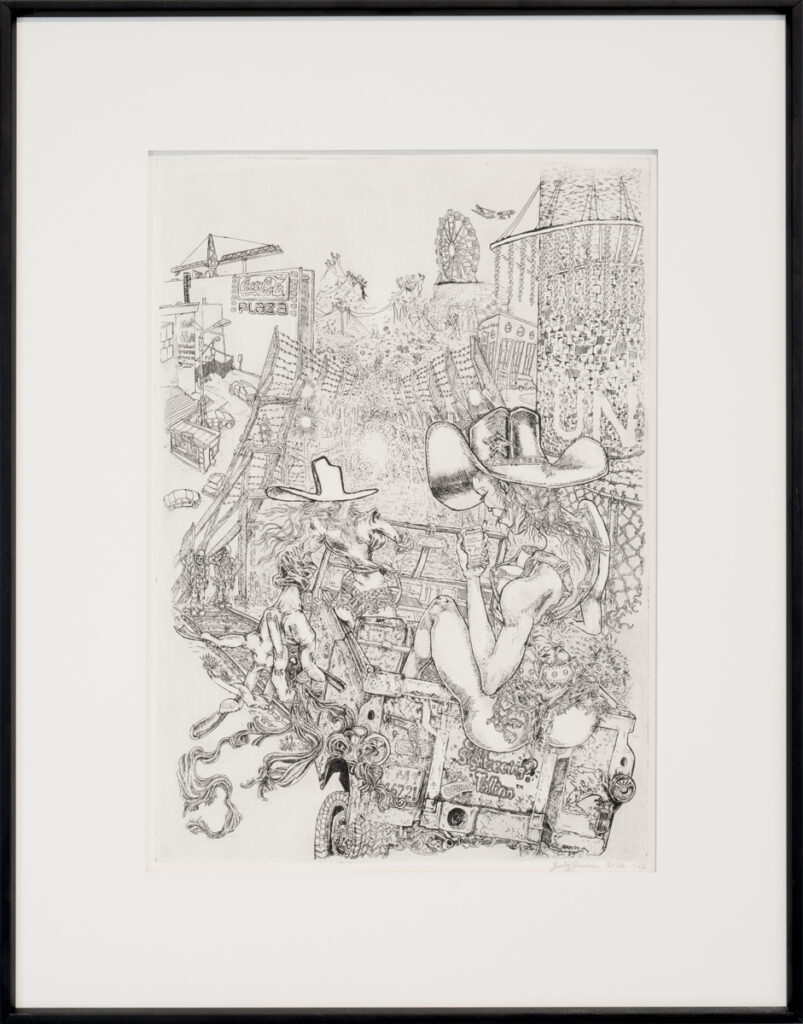
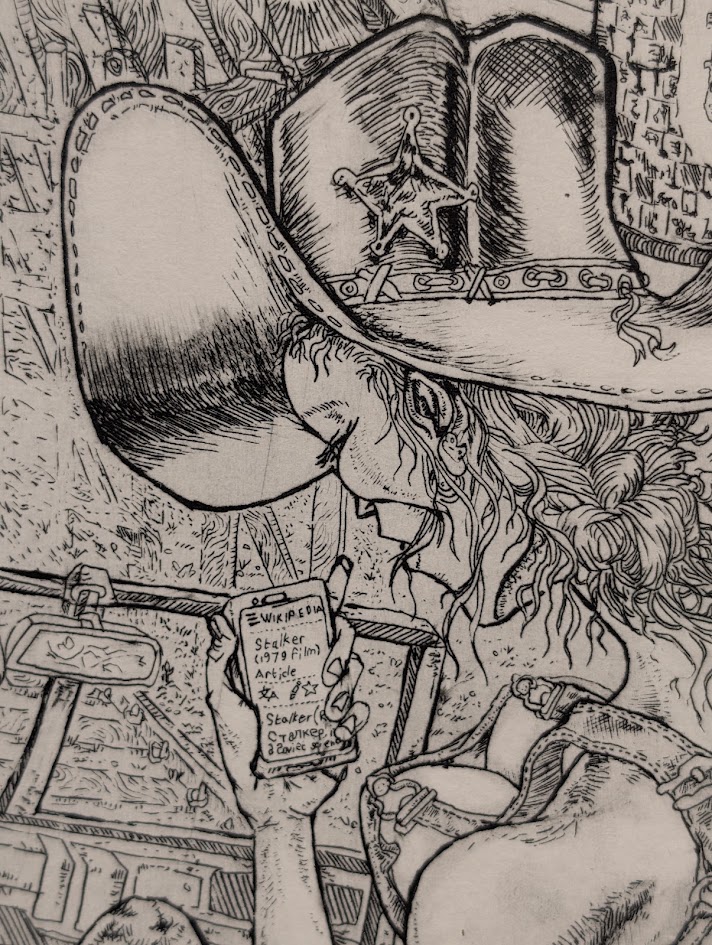
Displacement, ruin, and spectacle are recurring motifs in both Burke’s hyper-detailed sculptures and works on paper. A functioning model roller coaster penetrates the wall that bisects the gallery. It rumbles past the intaglio print “City Sightseeing Tallinn Official Zone Tour,” which sees one of the cowgirls driving a Jeep through a barbed wire corridor while American soldiers look on, saluting her. The landscape outside the “Official Zone” is divided between scenes of urban blight and “renewal”, such as a shopping mall with international chains. Her companion/twin—in one of those Zody Burke “blink-and-you’ll-miss-it” easter eggs—isn’t taking in the landscape, however. She’s reading the Wikipedia entry for Andrei Tarkovsky’s 1979 cinematic masterpiece Stalker. The dystopian sci-fi/fantasy film was shot in post-industrial areas around Tallinn, and exposure to toxic chemicals in those locations purportedly caused the premature deaths of multiple crew members, including the director himself.
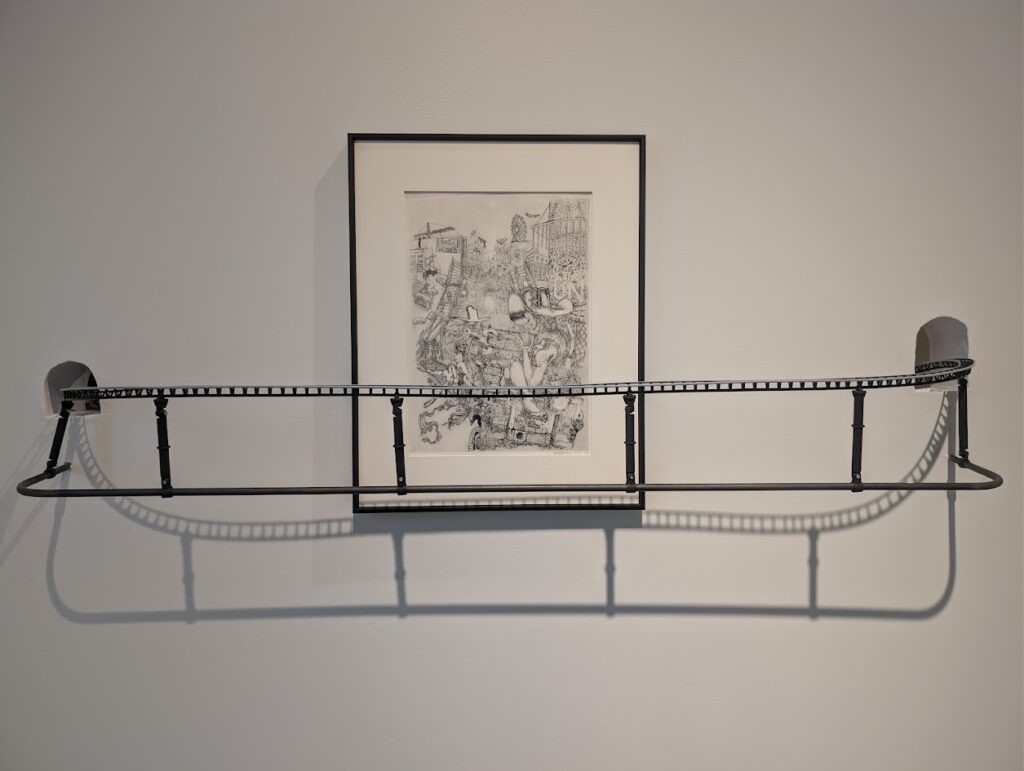
After passing the print, the model roller coaster traverses the wall and navigates a landscape comprising mysterious objects both fabricated and found at a dilapidated ranch in California owned by one of Burke’s family members. These assorted objects are treated as more “foreign” or “alien” by the East Coast native than the depictions of Tallinn. The piece reads as an autobiographical diptych straddling two identities, each inhabited as a sort of spectacle—a stranger in a strange land in either context. The artist-as-tour(ist/guide) must serve as a sort of ambassador for both unknowably vast America and underknown Estonia while remaining somewhat alienated from the mainstream of both.
The roller coaster emerges (figuratively) again in The Amusements, a short story by Jaakko Pallasvuo. The text was commissioned by the artists to accompany the exhibition and traces an imagined place through three vaguely defined eras—the first perhaps a neolithic past or post-collapse future. Generations after the death of the first story’s narrator the site becomes a factory, and later an amusement park built atop its ruins. History, its consumption, labor, leisure, and mortality are spun into a web of connections that spans time.
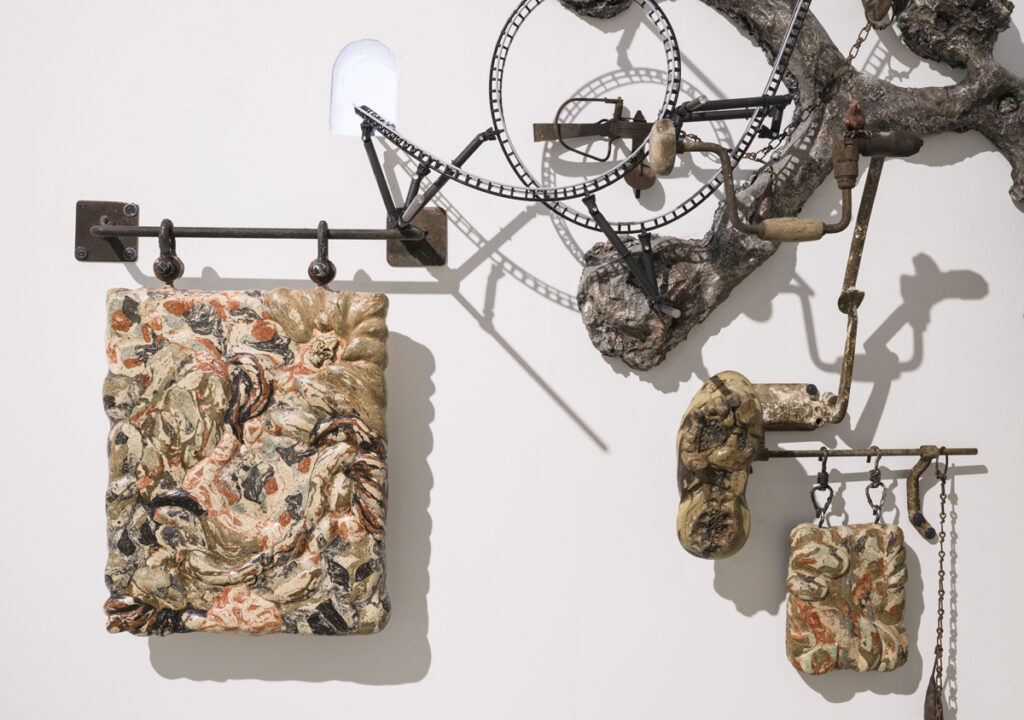
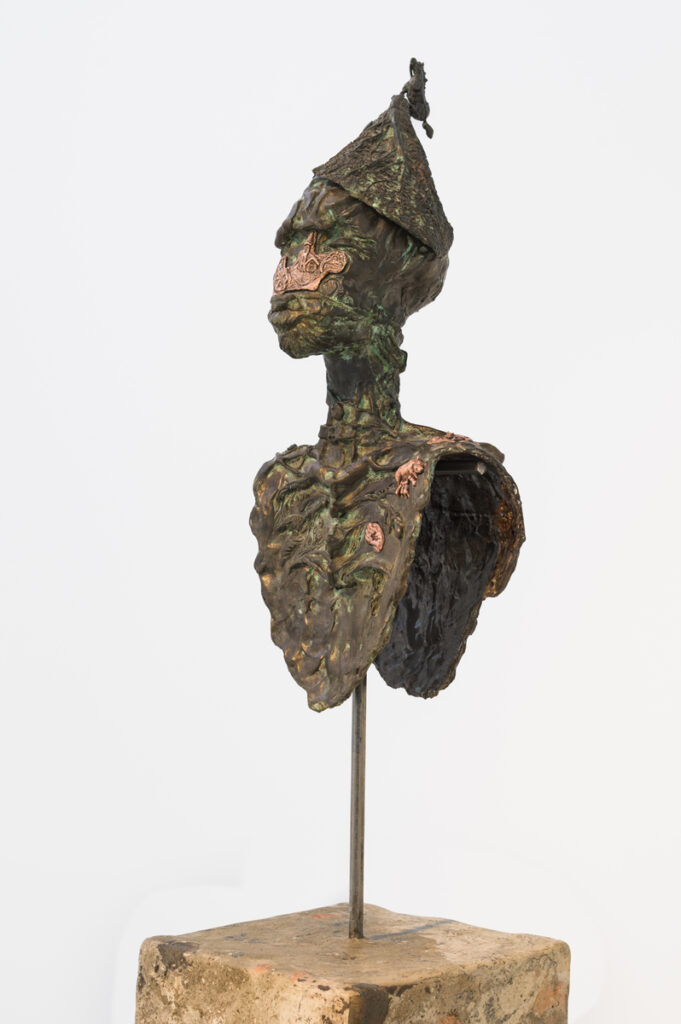
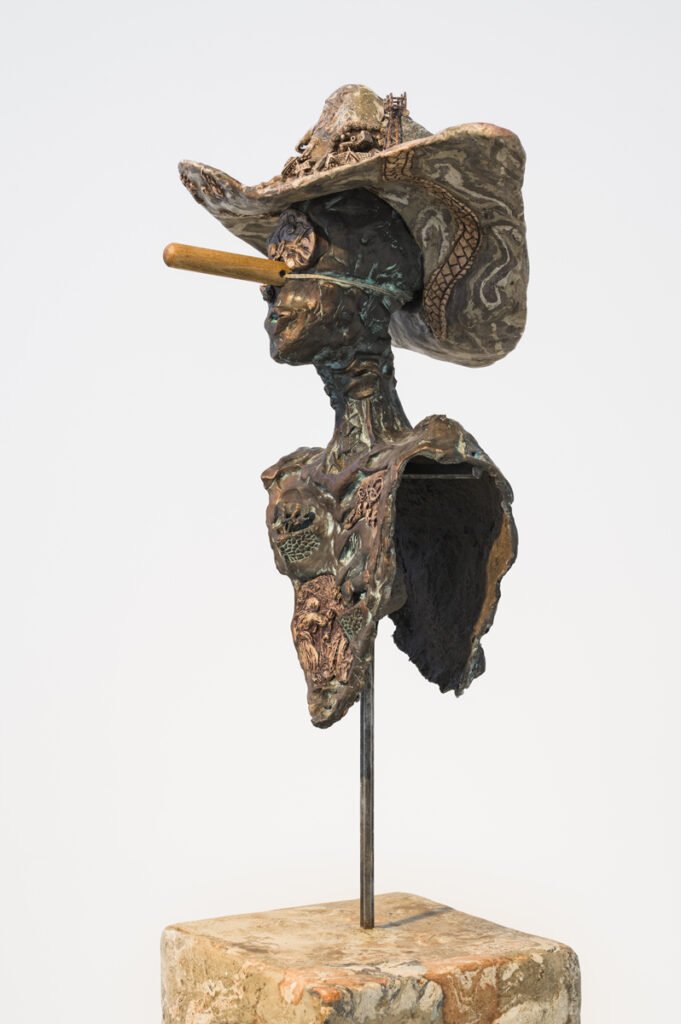
Nearly every labor-intensive piece in Ersatz Strata is packed with allusions to place, real or imagined histories or legends, red herrings, and non-sequitors. The cosmology Burke and Zetterholm have managed to assemble for their culture of two would take an anthropologist a hefty tome to outline. I spent the better part of the opening reception with my face hovering as close as possible to an impossibly-detailed carving or material list, searching for clues and taking copious notes I am no longer certain are relevant.
What sticks with me, though, is that many of the works here will likely outlast the “authentic” materials they mimic. Burke’s cold-cast resin and metal sculptures replicate the look of bronze or copper. When will they actually oxidize and degrade? The patinas on these and so many other polymer-based materials have been meticulously faked with acrylic paints—ironically adding one more layer of protection between the objects and the increasingly unpredictable chemicals and humidity in our atmosphere. The only consistent “apparent” material incorporated into many sculptures is oil shale, a type of rock containing fossil fuels that’s common in Estonia. With a relatively low density of burnable hydrocarbons, it was historically strip-mined and still generates roughly half of the country’s electricity. It’s a dirty and inefficient fuel source—but one Estonia has had to begrudgingly embrace again as a stopgap for energy independence from Russia until decarbonizing. In the meantime, its extraction consumes the landscape and converts it to crumbly rocks and the gasses slowly boiling the planet alive. Maybe after millenia, when both the synthetic bonds binding these sculptures together and empires have dissolved, these chunks of stone detritus will return to the earth and finally be at rest.
In an interview last year, Burke told me “I think we’re kind of at the end of archaeology right now, because as a species we’ve just generated so much shit. Whatever value modern archaeologists might imbue some Neolithic artifacts with, nobody will ever think anything that anthropocene humans generated has any value whatsoever. I’m talking aliens, future humans or otherwise. There’s just way too much shit and there’s no more archaeology. This is the line in the sand. That’s it.”
If we classify periods of distant human history by the materials that defined their technology—the Stone Age, Bronze Age, et al.—Zody Burke and Klara Zetterholm seem to beg the question: how might any potential future anthropologists define this moment in time, our Petroleum Age? A moment in which our contemporary synthetic media mimic the look, feel, and even patina of the materials that marked prior eras. Some trace of the majority of the 3D objects in Ersatz Strata will outlast the fibers comprising the Bayeux Tapestry or supporting humanity’s most treasured oil paintings. In this sense, they become 4D artworks—muddling the way scholars mark time.
This summer, the collapse of the world as we know it seems to have lurched out of slow-motion. Large chunks of Europe are broiling. I am honestly not sure if future generations will care about art criticism, anthropology, or archeology. But I hope they do. Because if my experience is any indication, they’re in for a wild ride with these two.
Zody Burke and Klara Zetterholm: Ersatz Strata is on view through August 15 at Temnikova & Kasela Gallery, Peetri 12, Tallinn, Estonia