Rob Pruitt has spent decades navigating the fraught space between provocation and crowd-pleasing spectacle. Following a controversial early-90s exile from the art world, he notoriously carved out his solo identity with his 1998 “Cocaine Buffet”——a piece where audiences mistakenly interpreted debasement as enjoyment. A sixteen-foot runway of plexiglass mirrors was installed on the gallery floor, bisected by a single, continuous line of cocaine. Visitors to The Fifth International, an artist-run space in NYC, were invited to partake in the work. The installation became infamous, functioning as both a public spectacle and a sharp commentary on consumerism within the art world.
Now, Pruitt channels that same fascination with consumption and audience complicity into the image of the giant panda. The artist has brought his iconic motif back to where his fascination first began: Washington, D.C..
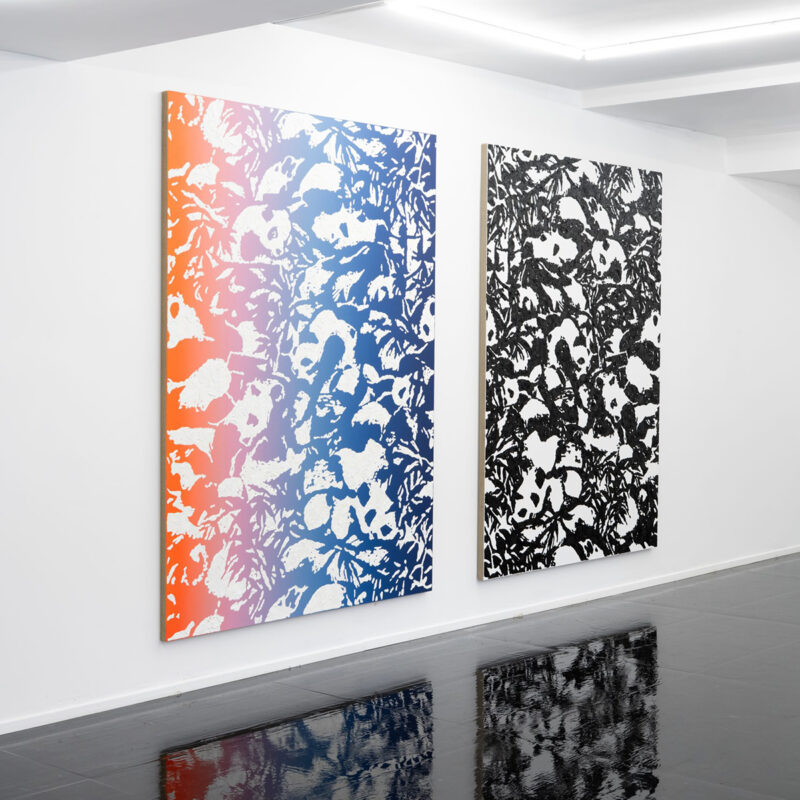
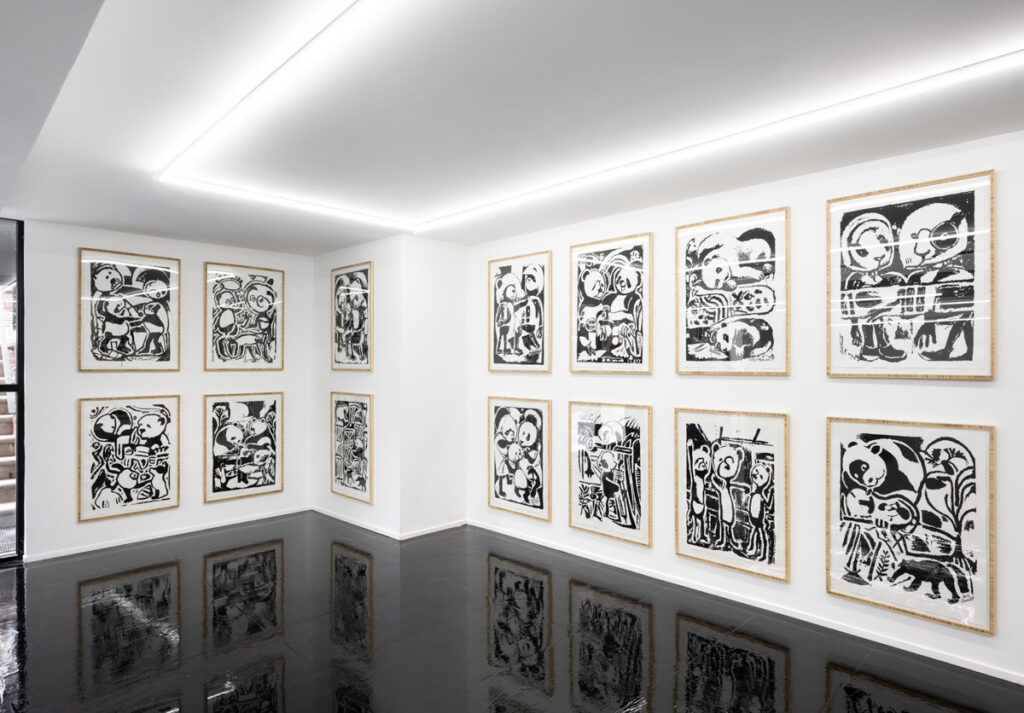
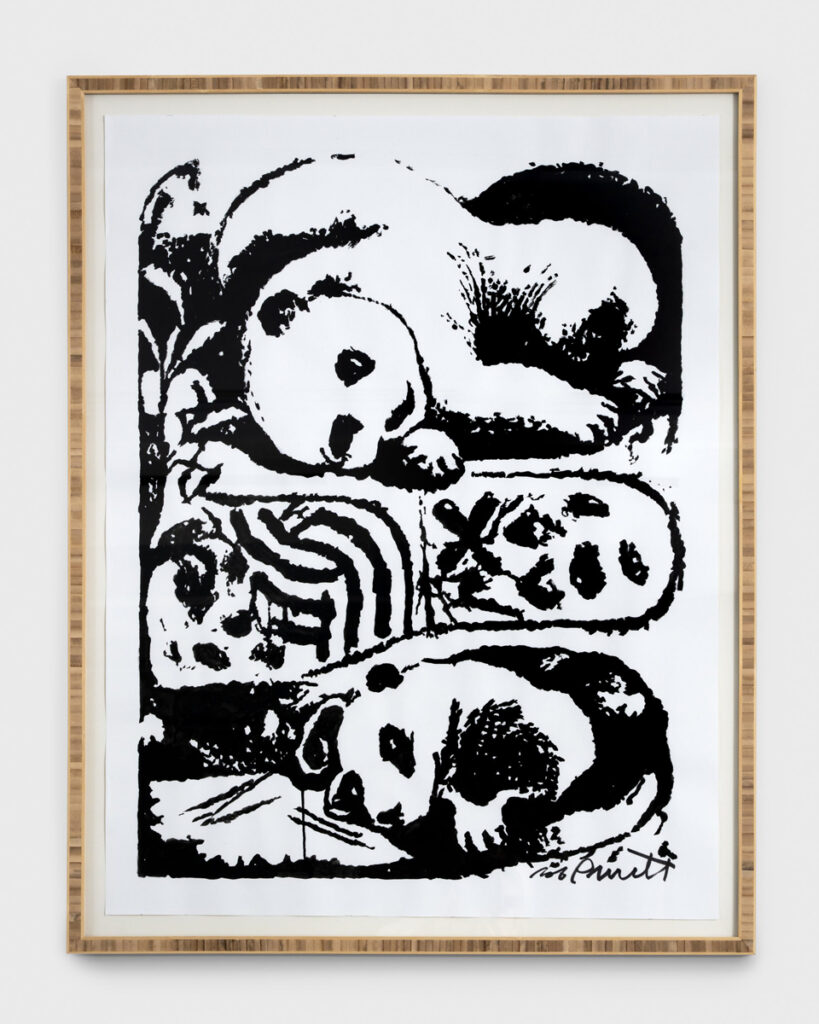
In Rob Wants to Make People Happy; He Aims to Please, his first solo exhibition in his hometown, on view from from February 7 to March 23, 2026 at von ammon co., Pruitt presents a new body of work comprising 30 drawings and two paintings. But rather than viewing them as simple, two-dimensional pets, the curatorial text frames the pandas through the lens of Lacanian jouissance. The pandas are presented as targets for an excessive and paradoxical mix of human emotions. They become a pure symbol for the things we simultaneously want to cuddle, smother, subjugate, smash, and annihilate. Those things that we seek to express but maybe can’t quite find the words for.
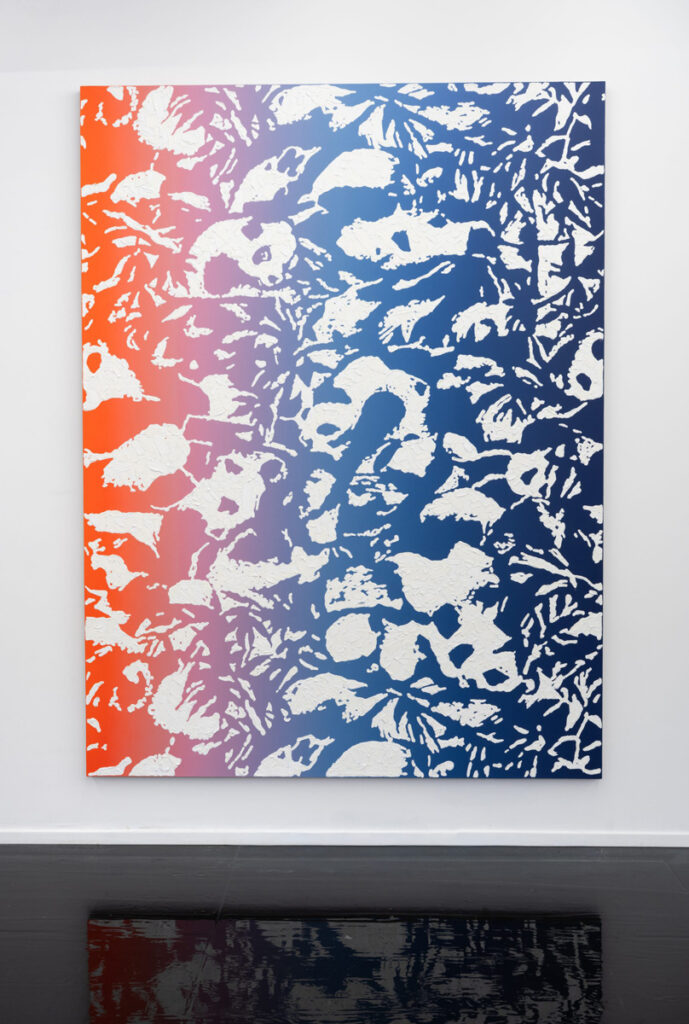
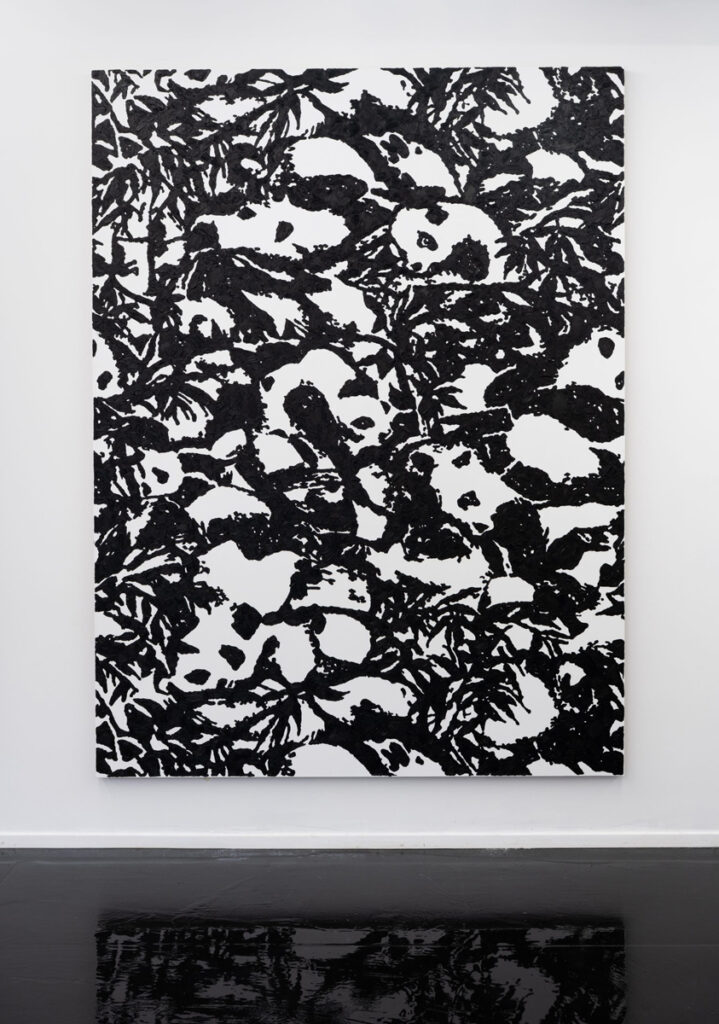
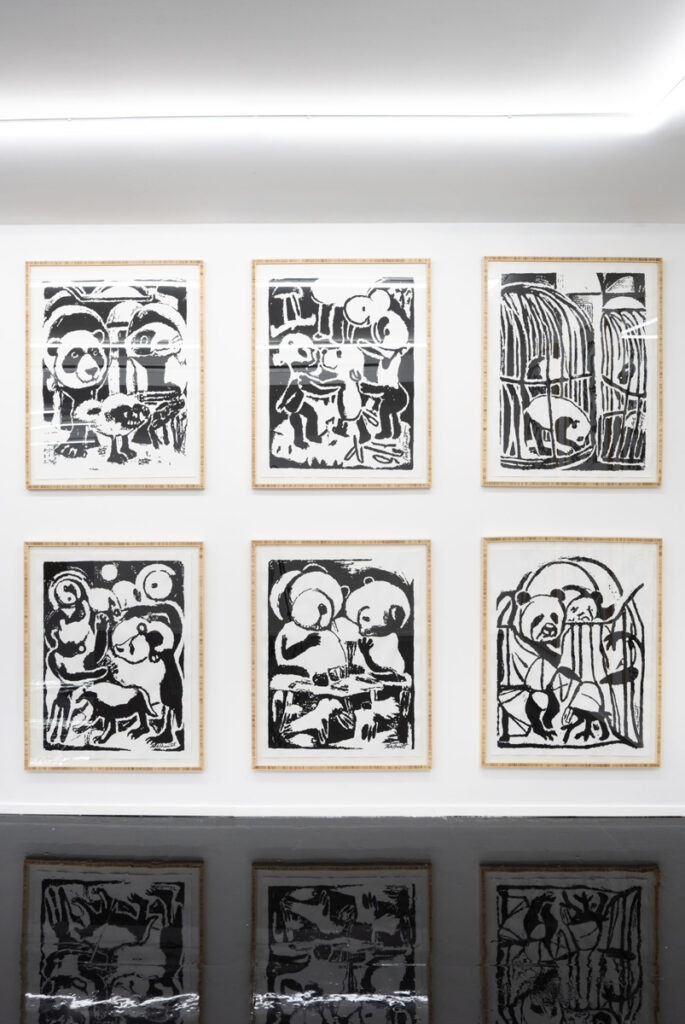
The show is made of all new works, made between 2025 and 2026. Two large-scale, woodblock print-like acrylic paintings anchor the show; both are massive millefleurs of pandas amidst bamboo—smushed together and graphically flattened into pattern. One is black-and-white, displayed next to its near-identical paramour, in which the dark values have been replaced with an orange-navy gradient.. Nearby hangs a menagerie of pandas in tan wooden frames rendered in acrylic on paper. The black lacquered floor of the gallery’s new location creates a mirror that adds a sense of motion to the exhibition. I half expected to turn and see that one of the pandas had moved from one frame to another.
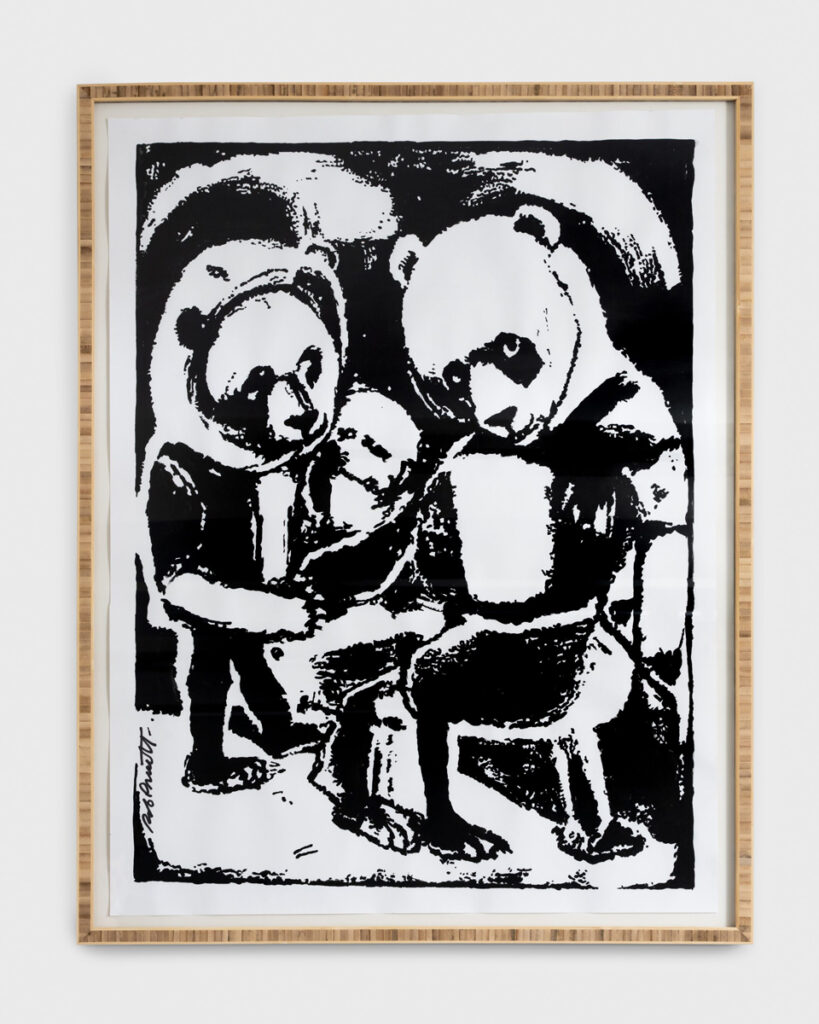
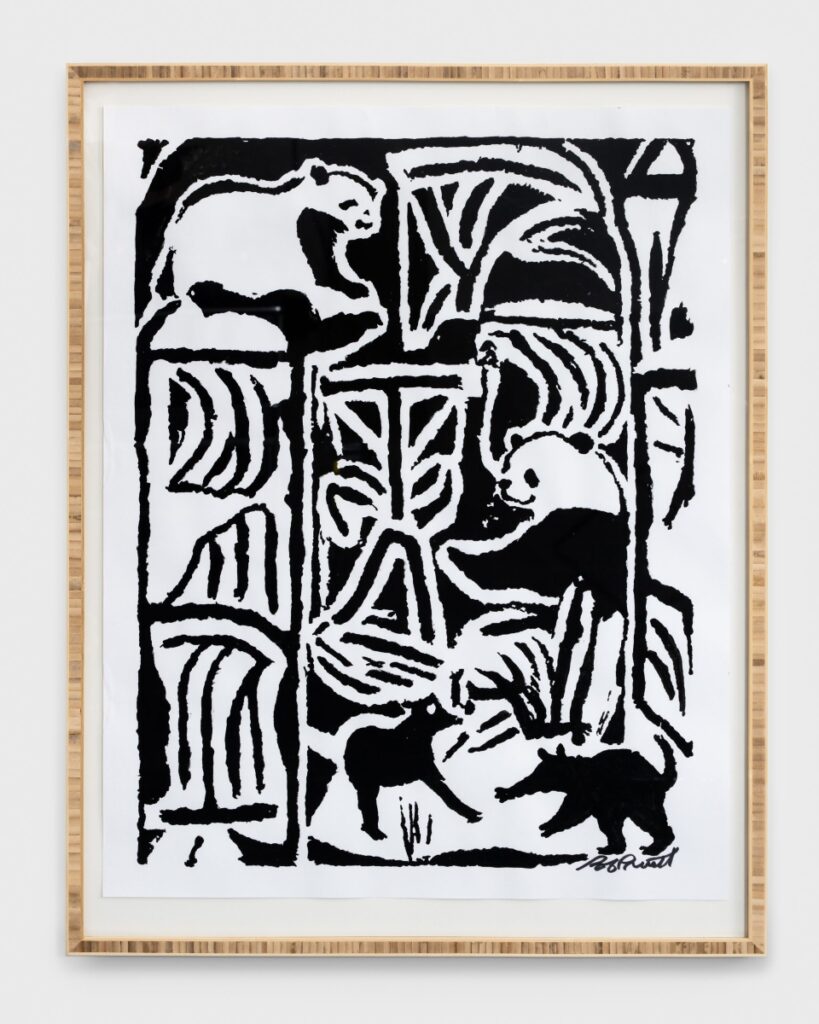
This exhibition also marks a timely evolution in Pruitt’s studio practice, utilizing AI image generators not just as a conversational collaborator, but as he refers to a “rapacious creditor”. By feeding narrative prompts and seminal art historical works into the software, the machine intelligence chews up our cultural inheritance and regurgitates it. Pruitt then physically reworks these outputs with black paint and a Japanese calligraphy brush.Pruitt’s painterly translations of the AI-generated imagery lend pathos to the machine—the human rhythm of his mark-making defibrillating otherwise “heartless” images.
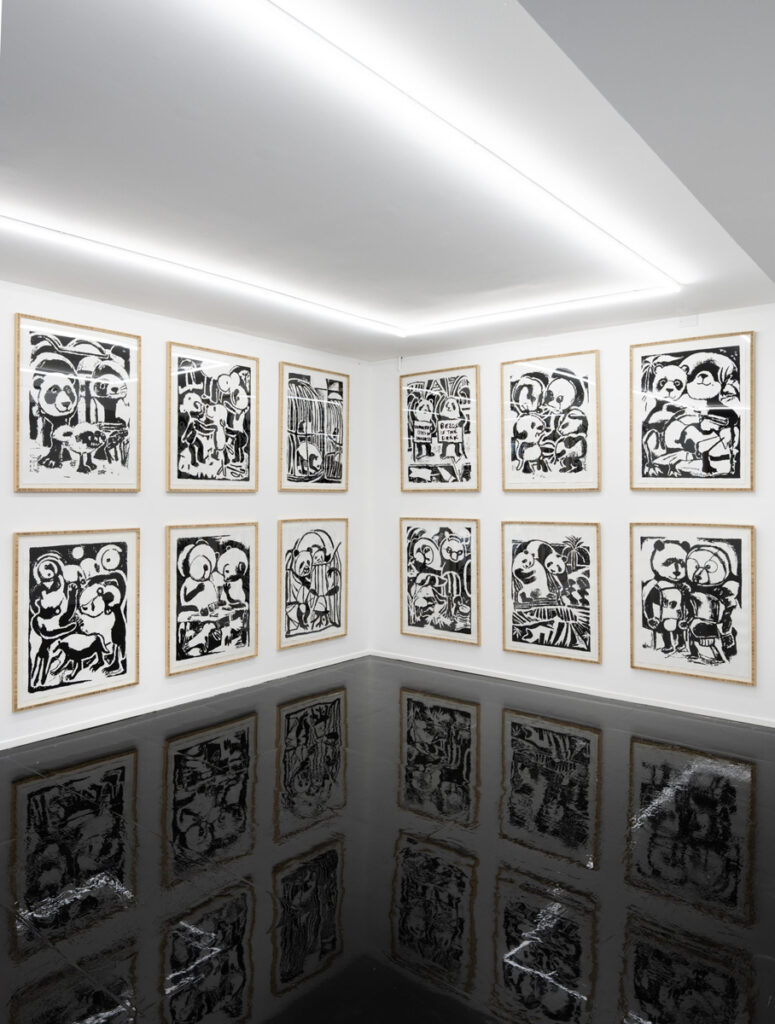
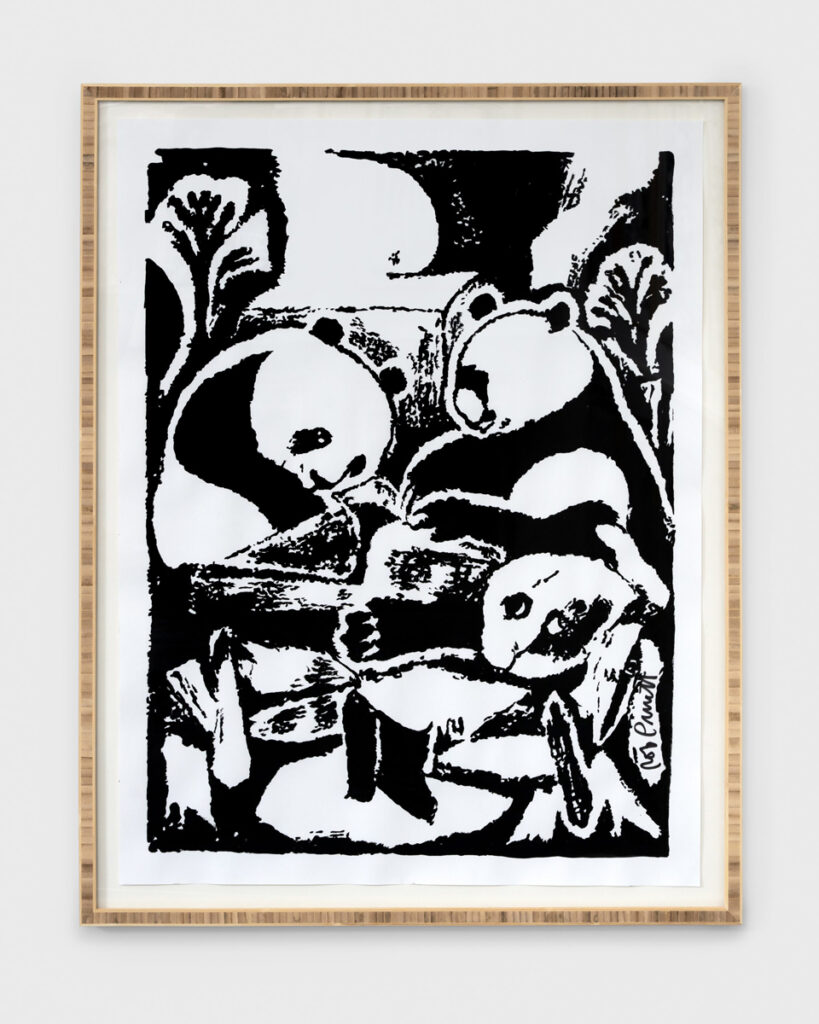
This search for a heartbeat extends beyond Pruitt’s brushstrokes. To counter the coldness of the machine, Pruitt invited gallerist Todd Von Ammon’s four-year-old daughter, Beatrice, to title the final, repainted works. Shielded from the initial AI outputs, her fresh perspective infuses the collection with a sentient moment of tenderness—making the pieces feel approachable, familiar, and profound.. It is a poignant act of human collaboration that grounds the exhibition in a warmth that AI—unable to conjure the totality of a Panda’s nuance/cuteness—simply cannot replicate. Set against the political backdrop of America’s 250th anniversary, as well as recent acts of war, the resulting works with titles like “ancient memorial” “apple” “baby” and “apple punched into a skeleton” are disorienting, both irresistibly cute and deeply allegorical, navigating themes of human-caused extinction and political resistance. Ultimately, Pruitt’s pandas also offer a bone-chilling memento mori. They are installed in grid pattern and beautifully framed, Each of the panda tiles are constructed from a false bamboo material called “ply boo” and were designed by Pruitt from scratch.
Pruitt’s pandas remain a cipher for our own cultural moment in these unprecedented times, reflecting our desires, anxieties, and need for connection. Even as he wrangles with these feeble approximations of artificial intelligence, his goal is to breathe a heartbeat into the flat lines of a digital prompt. By transforming the doom of AI and the tragedy of extinction into narratives we can’t help but consume, he creates a space for reflection.
Rob Wants to Make People Happy invites us to look past the cuteness and confront the allegories of good, evil, and resistance hiding in plain sight – but it also serves as a reminder, and offers a kernel of hope, that our sentience, that which makes art real, cannot actually be replicated by artificial intelligence.
In the following conversation, Pruitt discusses his origins at the National Zoo, his collaborative wrangling with AI, and why, despite everything, he still hopes to give his audience a sense of joy.
Teri Henderson: Where are your roots, and how did growing up near Washington, D.C., influence the genesis of this show?
Rob Pruitt: I think of myself as a mutt. On my mother’s side, I always thought I was 100% Italian because my mom’s parents escaped fascist Italy and moved to the US, but I’ve just recently learned through a cousin’s DNA testing that I’m at least 24% Greek. I’m from Rockville, Maryland, just outside D.C., having grown up there in the late 60s to early 80s.
When I was around nine, China gifted the National Zoo with two pandas, Ling Ling and Hsing Hsing. My dad would take me to the zoo, and with a Polaroid camera, I would take pictures of them and make drawings in a notebook. It was probably my first art experience that felt like a little bit of a project. So I knew that when I got the invitation from von ammon that I wanted to do something with pandas
The press release describes your use of AI as ‘imbricating a new layer of cruelty into the work.’ Do you see collaborating with AI as a hostile act against the art historical canon, or a surrender of control?
It would not have occurred to me to see the collaboration with AI as a hostile act against the canon of art history. I was just using it as a tool. I certainly understand that there is a long list of legitimate fears about the future of civilization and AI. It’s not hard to imagine a spiraling scenario of AI-powered androids taking down the human race. But I was drawn to it for much simpler reasons and didn’t think too much about its darker capabilities. I wanted to use it to have a collaborative conversation.
I began by suggesting a situation, like three pandas having lunch in a COVID shed in an urban environment; a few seconds later it would provide me with an image. Basically, I would redraw the whole thing with black paint and a Japanese calligraphy brush, then feed my drawing back into the AI program with a slightly different prompt. The process was a constant wrangling back and forth between what AI would spit out and my reworking it. None of the imagery is completely AI-generated.
When you take a flat image generated by AI and translate it into a physical painting, does the process feel like an act of resurrection?
Every act of art feels like a resurrection to me. In fact, I used to buy cheap art from Ikea and oil paint over it—an act of trying to bring it to life, like Frankenstein trying to breathe life into his monster. I only feel something is complete when it goes from a flat line to having some heartbeat.
I never saw the initial AI outputs as crude mutations, though I did see them sometimes as feeble approximations. It was a very worthwhile challenge to work with these feeble approximations and resolve them into something that I felt was vital. If there were any glitches, it had to do with stylistic issues, like badly drawn architecture or a 3-eyed panda, which was fun to work with and tinker with if I felt it was adding to the story. I felt a little like a filmmaker casting scenes, or a kid playing with dolls and a dollhouse.
There is a fascinating tension in this show between the joy collectors feel owning these works and the reality of the panda as a symbol of human-caused extinction. What do you see when you look at these compositions?
I came to pandas years ago as a subject matter because I thought they were interesting and good characters to act out any number of narrative situations. There is always that subtext for me that the panda is a symbol of human-caused extinction. They came so close to extinction because their environments were bulldozed, in some cases to create Nike factories. Visually, if you blur your eyes, a panda’s head even looks a bit like a skull head emoji.
There’s something that sticks with me from an interview where John Waters talks about stunt casting. Basically, he said if you cast an actor previously known for something, they bring those attributes to the role. Therefore, when I create a narrative of three pandas having a meal in a COVID shed, the fact that pandas are known to be near extinction becomes a trait brought into the narrative.
The show title, Rob Wants to Make People Happy, references your infamous 1998 Cocaine Buffet. Are audiences still being tested on what they are willing to consume?
I don’t really see a great point in making a parallel from the Cocaine Buffet to these new paintings. One way to look at the construct of Cocaine Buffet is to see it as a cynical invitation, but I was thinking about the physiological effects of engaging with art, and how endorphins could trigger euphoria. The pandas in these new paintings definitely have a level of cuteness that makes the viewer want to gobble them up, which is similar to Cocaine Buffet, I guess—consuming without being able to stop oneself.
About a decade ago, I made sculptures out of stacked, discarded truck tires, articulated with white paint to communicate the idea of a vicious cycle. At the top, I placed a bowl filled with candy. I thought it would be interesting to give viewers a sugar rush while they looked at the art, as well as the crash one feels after consuming candy. I was feeling disillusioned with how our culture had evolved to need constant stimulation—popping candy, vaping, or buying something on Amazon a couple of times a day—and I thought these “people feeders” might help move people away from this kind of self-medicating.
The press release frames the pandas through the lens of Lacanian jouissance—an excessive enjoyment that often involves suffering. Are collectors acquiring a psychic burden?
Todd Von Ammon’s writing addresses something I’ve been aware of and tried to harness: there is a global, undying, insatiable appetite for this creature. It’s hard to think that this overindulgence won’t trigger a backlash, but that never seems to happen. All of my panda work has included this, but it’s never just about that. There’s usually a personal message. The phenomenon of jouissance is an interesting reading, but if you personally don’t feel that saturation or shift from joy to revulsion, then you don’t. The work was not made as a defense of this phenomenon.
Considering the political context of exhibiting in the capital ahead of America’s 250th anniversary, what do you hope audiences take away, and how do you practice self-care right now?
I like to read the newspaper every day, watch Rachel Maddow on Mondays, participate in protests in my community, share what I believe in my art and on social media, and surround myself with people who care about human rights and the safety of others.
I hope people will look at these images as allegories. There’s a lot about protest and resistance, good and evil, and freedom and confinement in these pictures that will hopefully feel relevant to our troubled political moment.