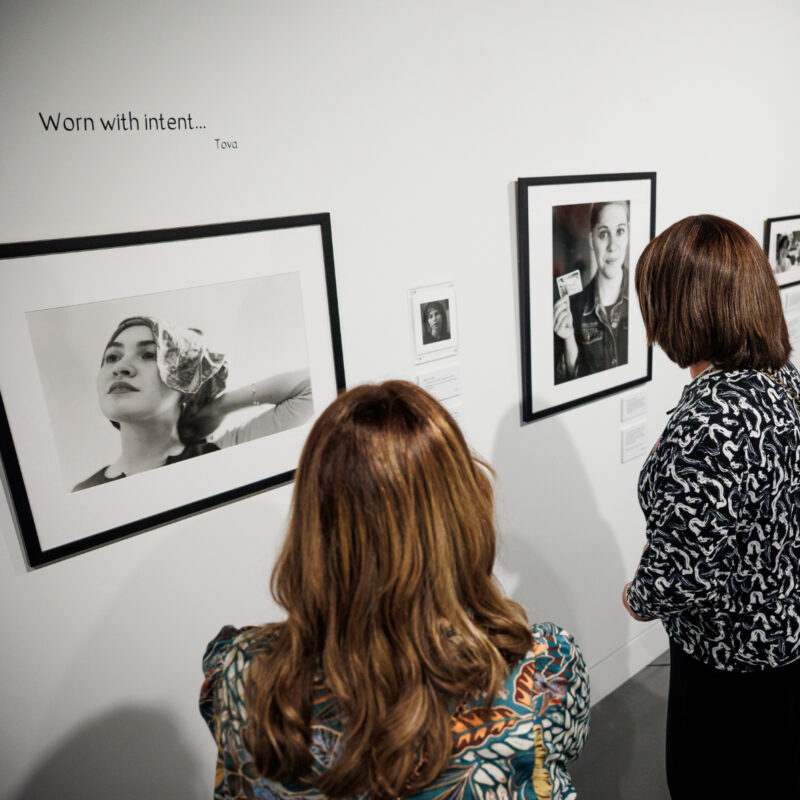
A swathe of skin emerges from the bottom left corner of the frame and meets an ear and a head of dark hair wrapped uncannily in sheer plastic. The photograph, printed at a minute scale (only 4 by 2.75 inches) and mounted in acrylic, is intimate. It is not quite a portrait, as the subject’s identifying features are withheld beyond the frame, but it still captures part of a person engaged in an unexpected act.
The accompanying label asks and explains: “What is revealed when something is concealed? An unmarried woman wears a hair covering made of transparent cellophane wrap. 2004.” This photograph marks the visitor’s entry point into Re: Intimacy. Image. Identity, on view through October 11, 2026 at the Jewish Museum of Maryland (JMM). The exhibition is a restaging of artist Zoë Reznick’s 2005 exhibition Intimacy. Image. Identity. Perspectives on Jewish Orthodox Women’s Haircovering and explores the evolving relationship observant Jewish women maintain to the practice of covering their hair.
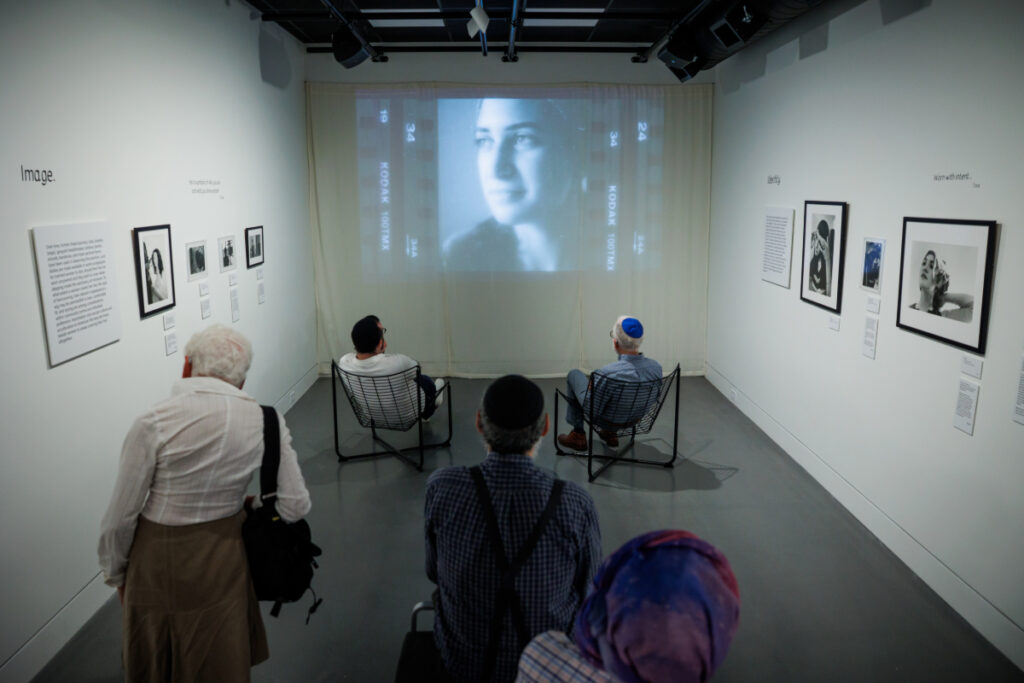
Featuring twenty black and white photographs, a selection of ephemera, and a documentary video by Reznick, who is also Director of Public Programs at the JMM, as the introductory text explains, the goal of re-presenting the two-decade-old photographs and reuniting the seven subjects is to “reimagine a body of work through an expanded lens.” The pairing of the 2005 photographs with the participants’ 2025 reflections is compelling, but it raises a larger question: how expansive really is the exhibition’s “expanded lens”?
Over the last two decades a lot has changed for Orthodox Jewish women. Social media has dramatically shifted their access to representation, and opportunities for self-imaging. Yet Re does not discuss these changes, opting instead to let the photographic subjects’ personal experiences take center stage. Hair covering is both deeply personal and profoundly public—shaped by community expectations, gender performance, and religious authority. The exhibition excels at documenting lived experiences, but it feels more hesitant to explore the broader politics surrounding those influences.
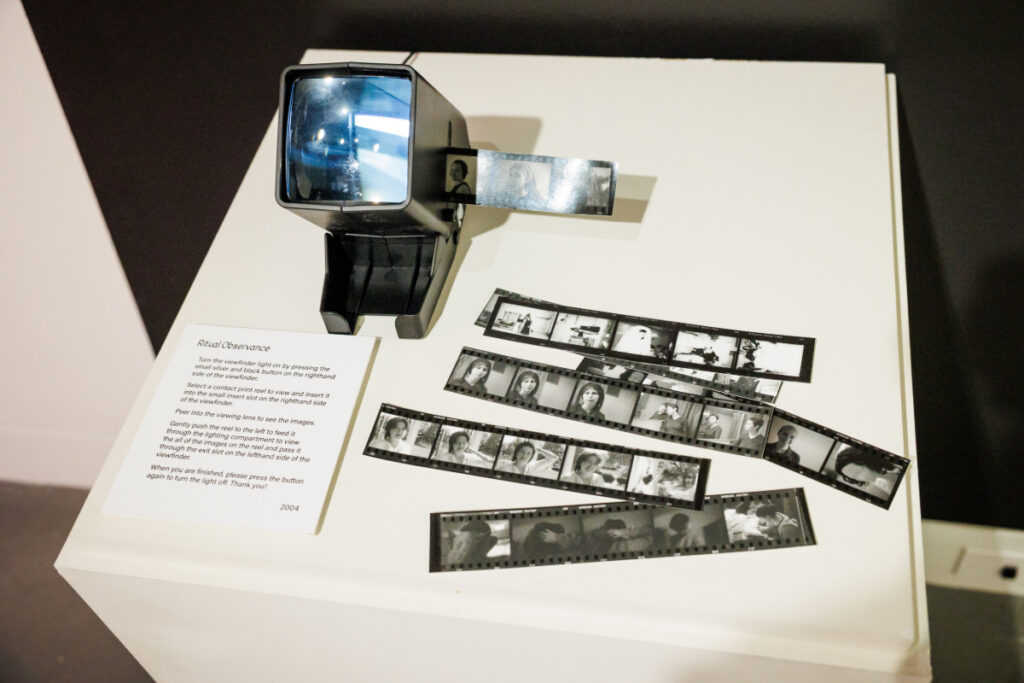
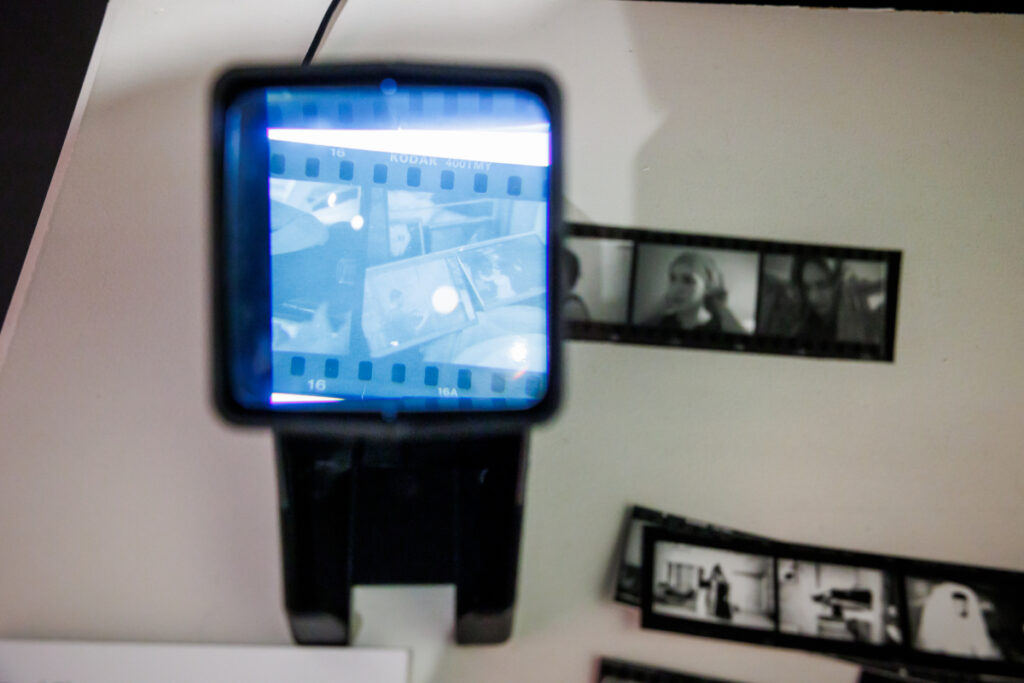
Playfully, after gazing upon the cellophane wrapped partial head, viewers encounter a pedestal upon which several items sit to provide them the rare opportunity to engage with photographic contact prints. By feeding Reznick’s contact sheets into a viewfinder, visitors get to see the images the artist chose not to exhibit. The contact sheets reveal subtle shifts in pose and gesture: Chana appears alternately wrapped in a scarf and with cropped hair, while Tova removes her wig between frames. The tactile experience draws viewers into both the subjects’ lives and Reznick’s photographic process, making it one of the exhibition’s strongest curatorial decisions.
Divided into three sections, Intimacy, Image, and Identity, with corresponding section texts, the exhibition succinctly outlines the contested history of hair covering, noting that some scholars trace the practice to the Bible while others argue it became binding through custom. The text for Intimacy offers this description: “covering one’s hair upon wedding has been practiced by Jewish women for millennia” as “a form of modest dress reserving the beauty of their hair for private married life.” Even the commentator Maimonides argued that the practice depended in part on local custom, underscoring how Jewish women’s hair covering has long been shaped by broad social expectations. The section text for Image lightly touches on this by explaining that: “Assimilation into secular culture and acculturation to American life have led many Jewish women to cease covering their hair altogether.”
This is a bit simplistic, but I cannot fault Reznick for being unable to cover the complexity of Jewish women’s hair covering in under 1,000 words. As researchers Valeria Seigelshifer and Tova Hartman explain, “Multicultural feminists claim that in order to understand a cultural practice and its impact on women’s lives, we should listen to the women themselves in order to learn how they negotiate the cultural practices that regulate their lives and through which they define themselves.” The beautiful photographs and thoughtful reflections in this exhibition offer us this opportunity.
“Sacred Dwelling” (2004) mimics the delicate and abstract qualities of the introductory cellophane portrait. It features the crinkled, gauzy layers of a hanging black fabric as light filters from the background. One of the few photographs that is not a portrait in the exhibition, this black and white image captures (as the label explains), a privacy curtain at a woman-owned salon that caters to Orthodox Jewish women’s hair and wig care needs. Reznick chose to mimic the partially opaque, partially sheer quality of the fabric in this photograph by hanging diaphanous white curtains on the exhibition’s back wall and projecting a film. Audible as the viewer peruses the photographs, the film’s soundtrack amplifies the voices of the photographic subjects as they convey their complex and multiple perspectives on hair covering.
“The Kallah (Bride, Hebrew)” (2003) features Tamara wearing a large veil and white dress preparing for her groom to greet her at their wedding. It is the first of five photographs included in “Intimacy.” Tamara recalls embracing hair covering as a welcome relief from the pressures of hair management, while Shaina describes it as a visible barrier that altered her friendships after her nuptials. Facing away from the viewer as she ties a patterned headscarf in her bedroom in “Hidden in Plain View” (2004), Shaina clenches her fists around the cotton fabric as if to convey the tension that this practice created in her relationships.
Tova by contrast, wears a wig and chats happily on the phone in the days leading up to her own wedding in “Tête-à-Tête” (2004) and continues to feel that hair covering is a critical reminder of her marital commitment. Together, these reflections reveal that the same religious practice can function as liberation, obligation, or mnemonic depending on the individual.
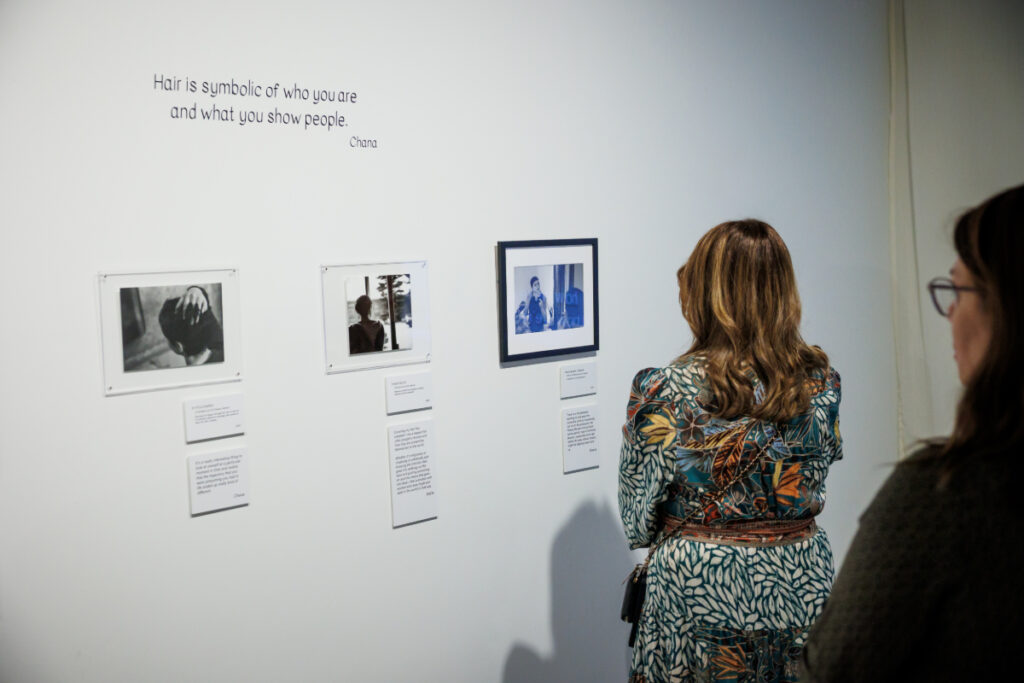
The four photographs in the following section, Image, explore the different sartorial opportunities that hair covering offers. Above the photographs, Reznick vinyl printed a quotation from one subject, Chana, who proclaims: “Hair is symbolic of who you are and what you show people.” Underneath “Hair Care” (2005), a photograph depicting someone beyond the frame styling a wig, Miriam expresses how she prefers to use a tichel because the colorful and patterned head scarves offer opportunities for creativity and personal expression. Shaina, captured beautifying in a tichel in the photograph “Mar’ot Nashim Tzidkaniot” (“Mirrors of righteous women” in Hebrew) (2004) explains that hair covering allows her to escape conventional beauty standards. DeDe, photographed outside her workplace looking out a window in a head scarf, explains that this practice allows her to “feel a kinship with women who wear hijab.” It is a pity that the exhibition never develops this compelling comparison beyond her reflection, missing an opportunity to situate Jewish women’s hair covering within a broader conversation around religious dress.
The final section, Identity, tackles the exhibition’s most compelling questions. While several portraits celebrate enduring marriages and personal agency, Chana’s experience is especially striking. In “Hester Panim” (“Concealment of Divine Countenance” in Hebrew) (2004), her hesitant visage occupies the frame, lips slightly parted as if she yearns to say something, her features enhanced by a black lace shawl over her head.
The small photograph is accompanied by a long reflection. No longer Orthodox and now married to a non-Jewish woman, Chana explains, she occasionally still covers her hair when attending synagogue. As she articulates, “I do this with a very clear intent of wanting to project the transcendence of my marriage over attempts to relegate it to the realms of the imaginary or a manifestation of mental illness.” Chana chooses to partially cover her hair to assert the legitimacy of her marriage in a space where her sexuality is at best marginalized and at worst unthinkable. Her comments, echoed in the film, reveal how hair continues to communicate identities and gestures of belonging beyond the context of Orthodox observance. In the film, Chana expresses noticing how many queer elders also use hair—length, cut, or coverage—to convey an identity within their own community’s codes.
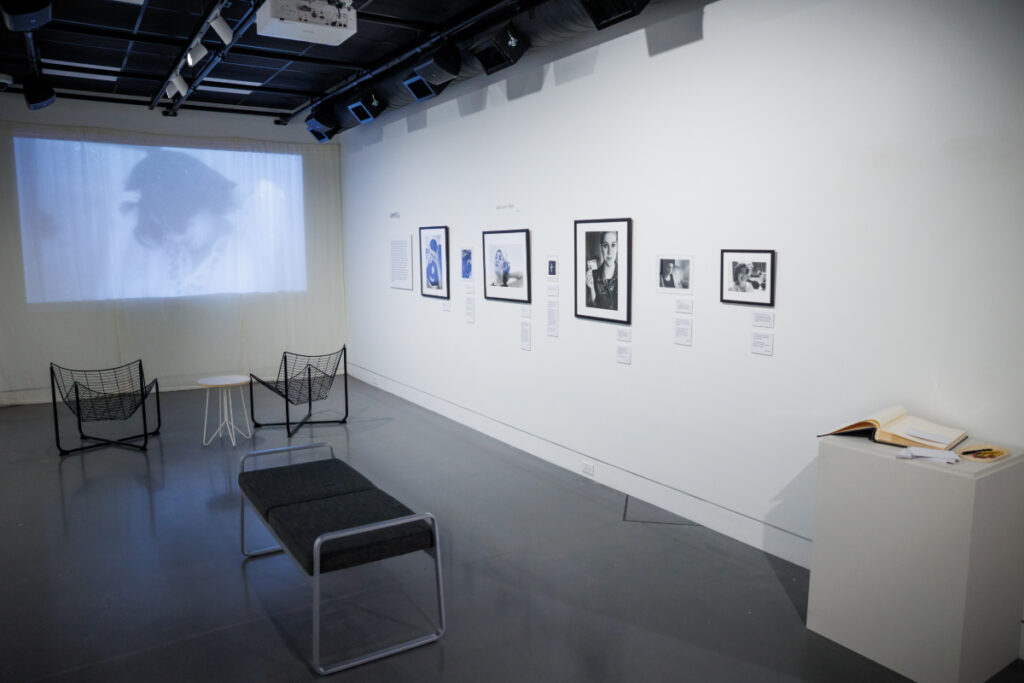
I appreciate how the exhibition leaves space for those participants, like Chana, who for different reasons no longer cover their hair. The last photograph in the exhibition, “I was her and am who she is now” (2005) is a bright portrait of Dee-Dee wearing a wig and the label beneath it explains that her work as a physician made this practice of hair covering challenging, contributing to her decision to stop. Her reflection beneath the image states, “Life and identity are a journey—I love that I had the freedom to explore.” This is a beautiful message to end on. However, it seems to evade the fact that many Orthodox women are not permitted the freedom to explore in their marriages.
Twenty years after the original exhibition, the politics surrounding Orthodox women’s self-representation have changed dramatically. Social media has provided an opportunity for observant women to publicly negotiate questions of modesty, divorce, communal authority, and visibility. Campaigns around the rights of women trying to obtain a divorce (known as an agunah), led in part by Orthodox influencers such as Adina Sash (aka Flatbush Girl), demonstrate how photography and self-imaging have become tools of activism as much as personal reflection.
Against this backdrop, Re remains deliberately inward-looking. The exhibition’s commitment to individual testimony is moving, but the exhibition ultimately stops short of situating those stories within the wider political transformations that shape Orthodox Jewish women’s lives.
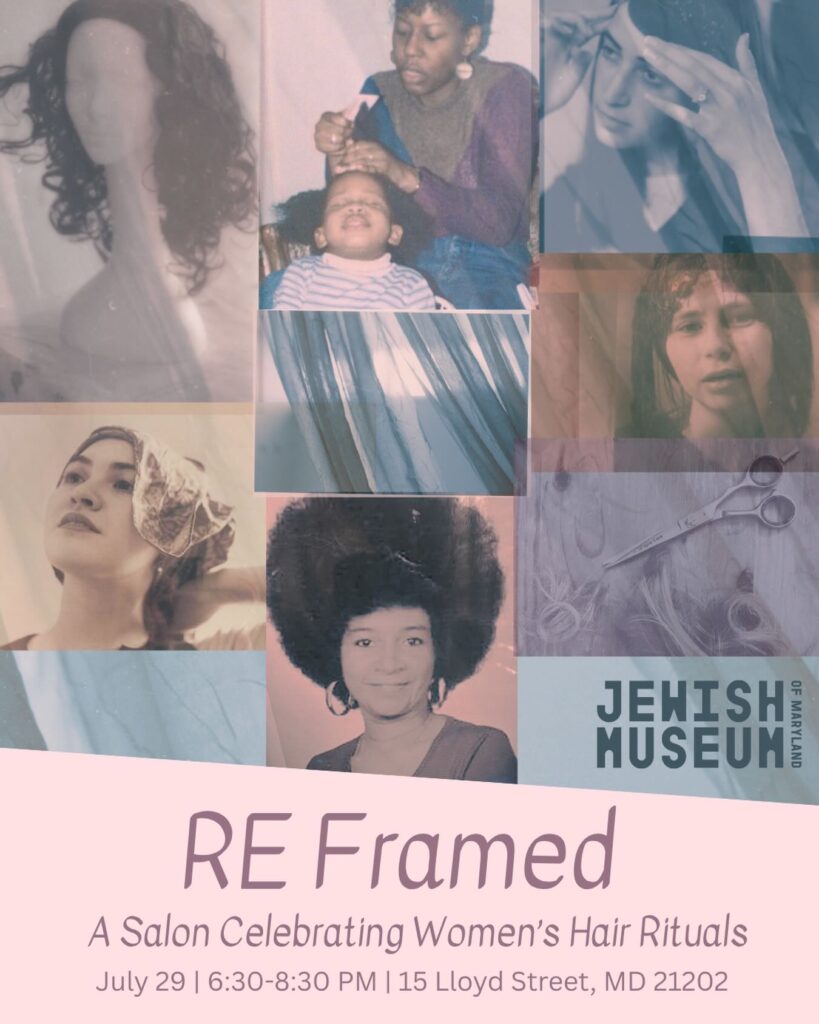
RE Framed: A Salon Celebrating Women’s Hair Rituals
July 29, 2026, 6:30 PM
Jewish Museum of Maryland
15 Lloyd Street, Baltimore
Join JMM for an evening celebrating women’s hair rituals, traditions, and culture in connection to the exhibition on view, RE: Intimacy. Image. Identity. This program invites attendees into an evening of reflection, conversation, and community as part of the Core Connections program series inspired by the Museum’s new core exhibition, Jews of Maryland at the Crossroads of Identity. The event highlights the exhibition theme “Agents of Change” which presents historical connections between Black and Jewish communities in Maryland.
The word “salon” holds two distinct meanings. A hair salon is a place of ritual, care, and beautification. A salon-style gathering brings people together for the exchange of ideas, stories, and perspectives. RE Framed draws on the shared meaning: salons as places of connection and community.
This event will feature an array of offerings for guests to immerse themselves in, including a reflection space in the audio/visual production studio, themed participatory activations, light refreshments including alcoholic beverages. Attendees will have the opportunity to explore the Museum, hear from gathering co-hosts Andria Washington Hanner and Zoë Reznick, experience an intimate salon conversation with special guests, and share their own responses within the space.
The Jewish Museum of Maryland’s 2005 exhibit Intimacy. Image. Identity. Perspectives on Orthodox Jewish Women’s Haircovering presented a traditional form of dress practiced upon marriage. Its series of black and white film photographs by Zoë Reznick traveled across five sites state-wide. Two decades following the development of this project, Museum staff resurfaced the exhibition materials.
Through RE: Intimacy. Image. Identity., the artist reunites the women she photographed and reimagines this body of work through an expanded lens. The exhibition features select framed prints from the original show, archival materials and photographs, and multi-media reflections shared by women participating in the project, illuminating regard for the personal significance of Jewish haircovering practice over time, together, in the present.
This project is an activation of the Museum’s transformed spaces, including the experimental Long Gallery and its neighboring audio/visual production studio.
6:30 PM | Open gallery, reflection space, + offerings
7:00 PM | Welcome + salon conversation
8:00 PM | Evening closes
Light kosher refreshments and alcoholic beverages will be served. Non-alcoholic options will be provided.
Program registration is available on a sliding scale and capacity is limited. You can learn more about the event and register here: