Every American born before 2001 has a 9/11 story. We all remember where we were that day — the sights, the feelings, the fear. I was a schoolteacher at the time, teaching art to high school students in Sykesville, Maryland. A number of our students’ parents commuted to DC; a few worked at the Pentagon. There was real fear that day. We had no way of knowing if those parents were okay, and everyone was sent home early.
I drove back to Baltimore, to a friend’s house in Charles Village, and the TV was on. I remember the footage of the planes hitting the towers, but what has stayed with me longest is the footage of people trapped on the highest floors, 100 stories up, who knew they weren’t going to survive. I can never unsee these two, tiny figures on the television screen: two men who hugged each other tightly, sharing deep emotion in their last moments. And then they jumped off the edge, together, still holding on. I never learned who they were. I just remember thinking I would have done the same thing.
The way we remember a traumatic event, especially long after, is not the same way it unfolds in real time. The chaotic details of the day and each person involved are smoothed out and viewed from a decisive and hazy distance. The reality is that thousands of people lost their lives, including firefighters and police officers while trying to save others. For America, September 11 was a wound — not just to the skyline of Manhattan, that symbol of American ambition, but to a national sense of safety that never fully returned.
This past year, I finally visited the 9/11 Memorial in Manhattan, and I was struck by how successful it is precisely because it’s understated — abstract, wordless, just two dark voids where the towers stood. It made me think about what a memorial can do, and how strange the whole enterprise is: something built after the fact, funded through effort and intention, to hold a grief that has nowhere else to go.
What I didn’t know until just last week is that Baltimore has one of its own.
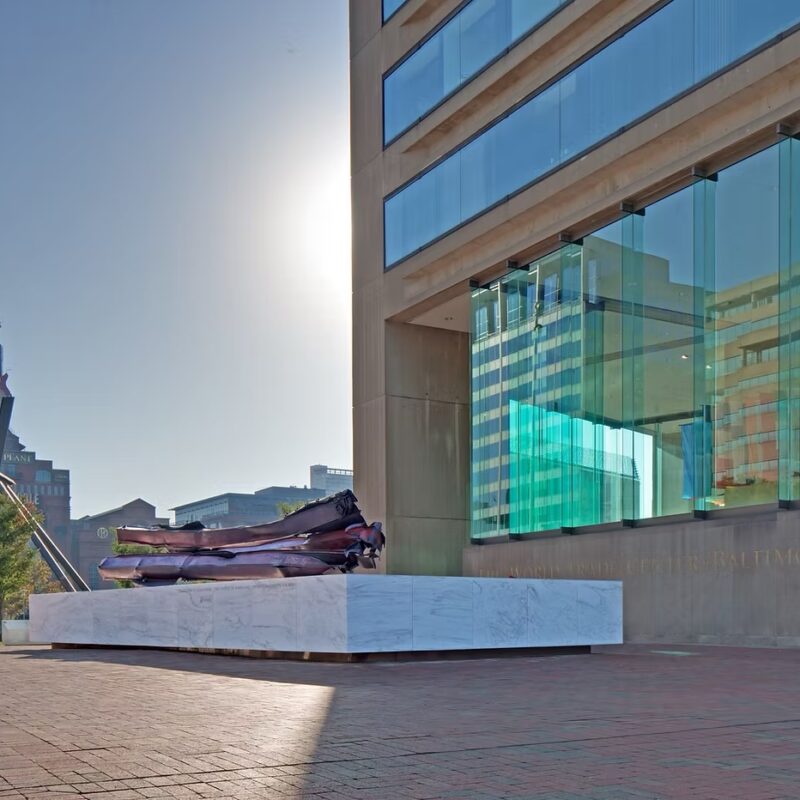
Maryland’s 9/11 Memorial sits in a plaza along the Inner Harbor, adjacent to Baltimore’s World Trade Center, a building most of us walk or drive past without much thought. I’ve seen the piece before, but I never quite registered what I was looking at.
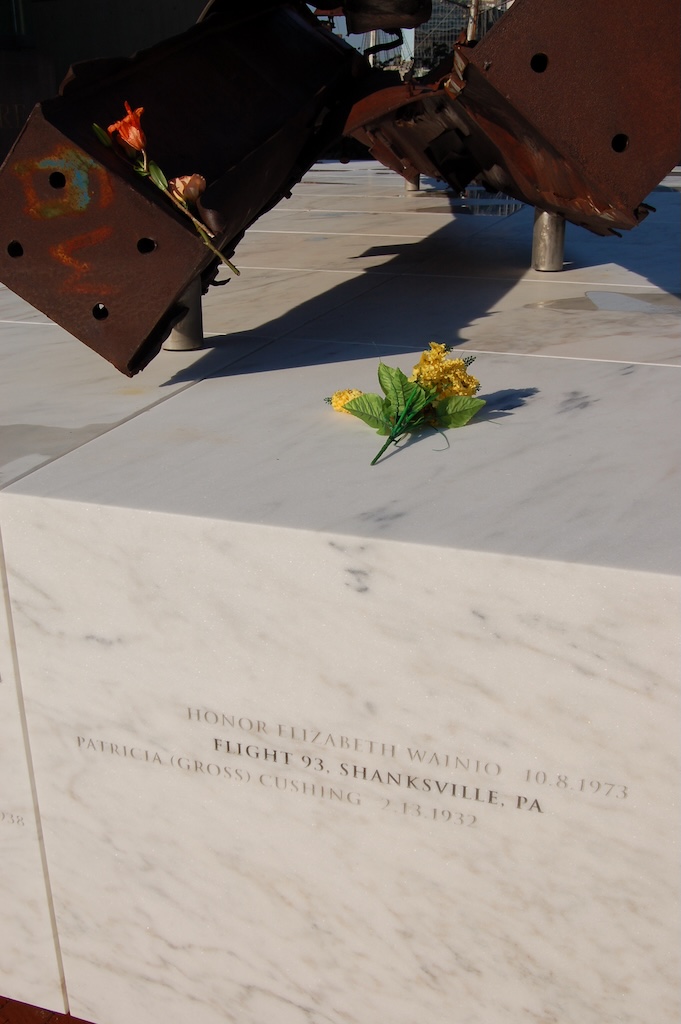
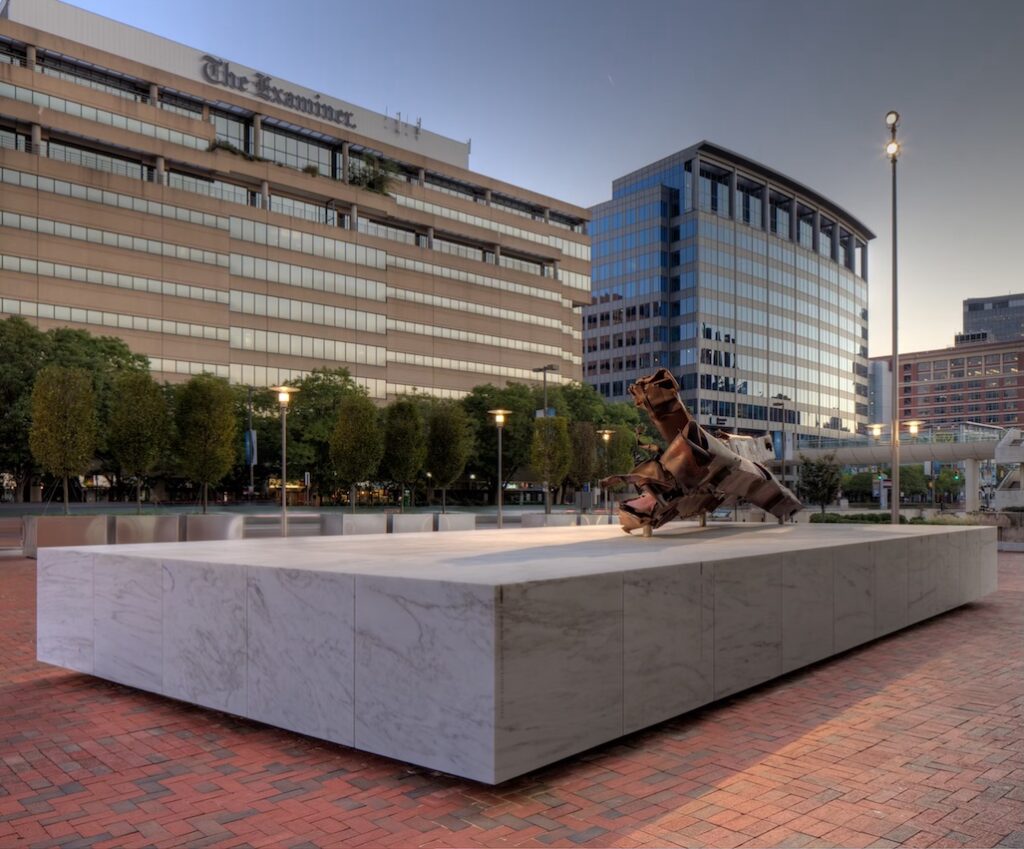
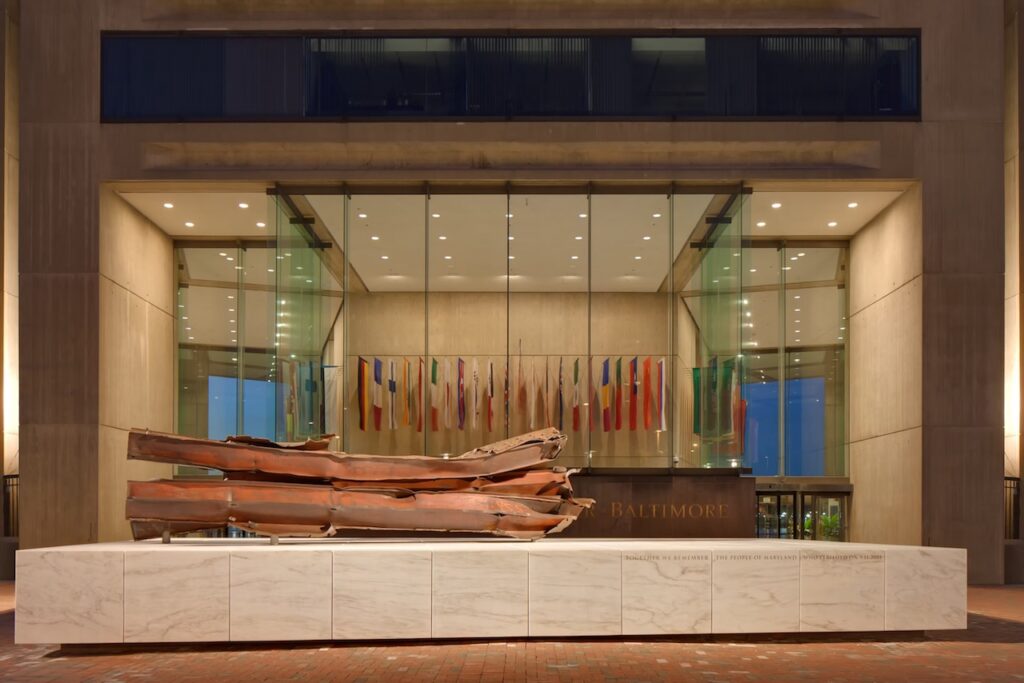
At the center of the memorial is an actual fragment of the North Tower: three steel columns, 22 feet long, recovered from the tower’s 94th floor. It’s real wreckage, twisted and torn, pulled from a New York warehouse where recovered World Trade Center artifacts were being stored.
The memorial was designed by two architects, Steve Ziger and Doug Bothner of the Baltimore-based firm Ziger|Snead. Bothner, the firm’s design partner, has spent more than two decades shaping its projects, work defined by clarity of concept and an honest use of materials; his residential designs have appeared in Dwell and Wallpaper.
“When we went to the warehouse to see the artifact for the first time,” Bothner recalled, “it was wrapped in a tarp, and when they opened it, it was like going to a viewing. It was still dirty, full of dust, plaster and potentially human remains. Everyone fell completely silent… It was such a powerful moment – to see this artifact and feel its impact – within the context of working on this project.” That instinct settled how the piece needed to be handled: not upright, not dramatized as falling, but laid on its side. A body at rest.
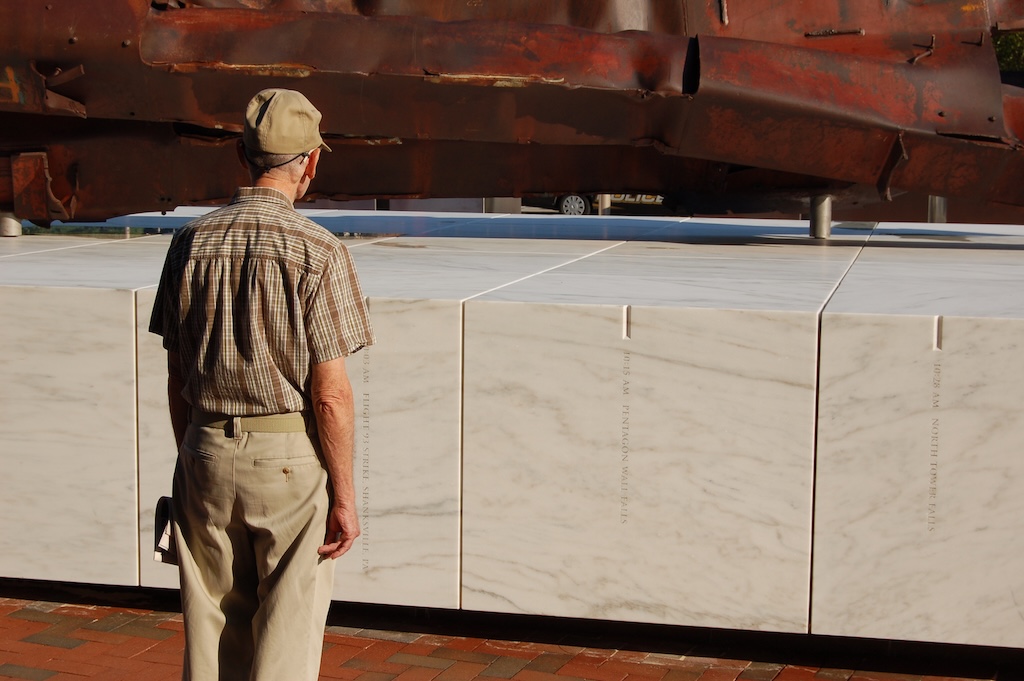
That steel relic lies on a bed of 50 white Danby marble blocks, quarried in Vermont from the same source that supplied half the Washington Monument. Each block weighs roughly 4,000 pounds, 200,000 pounds of stone in total. “Fifty massive blocks, fifty states, bringing the country together,” Bothner said. The marble bed is elevated just above the plaza floor, so the blocks appear to float rather than touch ground, a deliberate note of lightness beneath all that weight. Over time, rust from the steel will stain, or “patinate,” the stone beneath it, so the two materials will continue to change together for as long as the memorial stands.
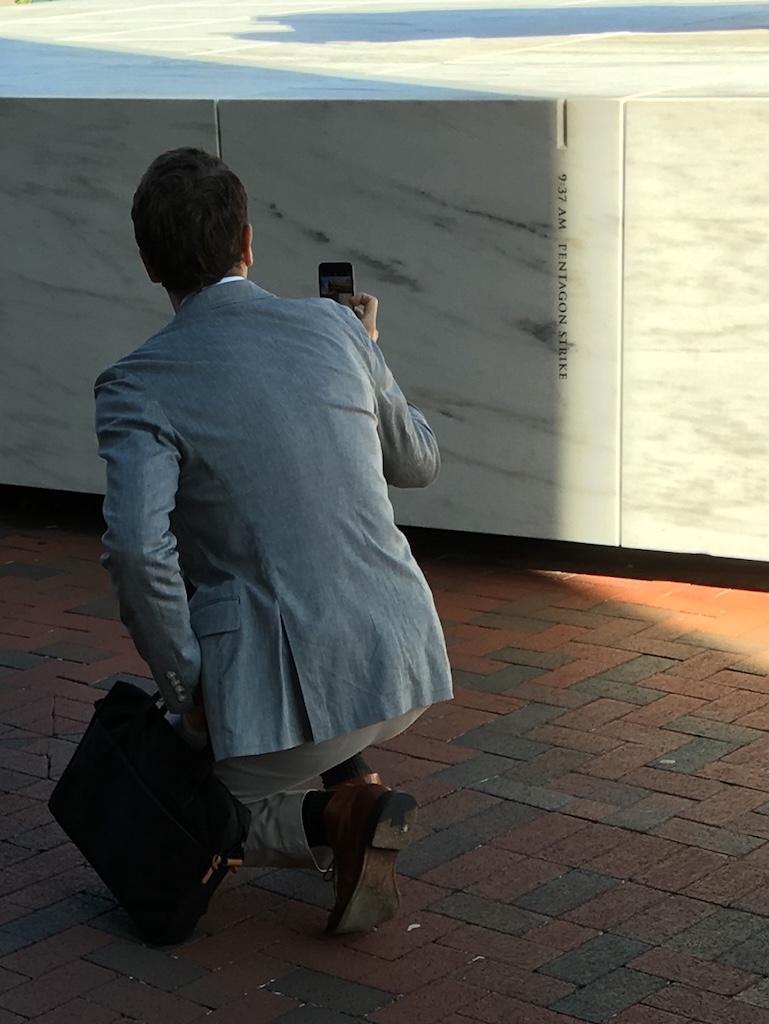
Striking as the steel and marble are, the memorial’s most affecting feature isn’t a material at all–it’s the shadow. Baltimore’s World Trade Center, the tall pentagon-shaped building beside the plaza, functions as the gnomon of a sundial. Every September 11, if the sky is clear, its shadow creeps across the memorial exactly as it did on the morning of the attacks.
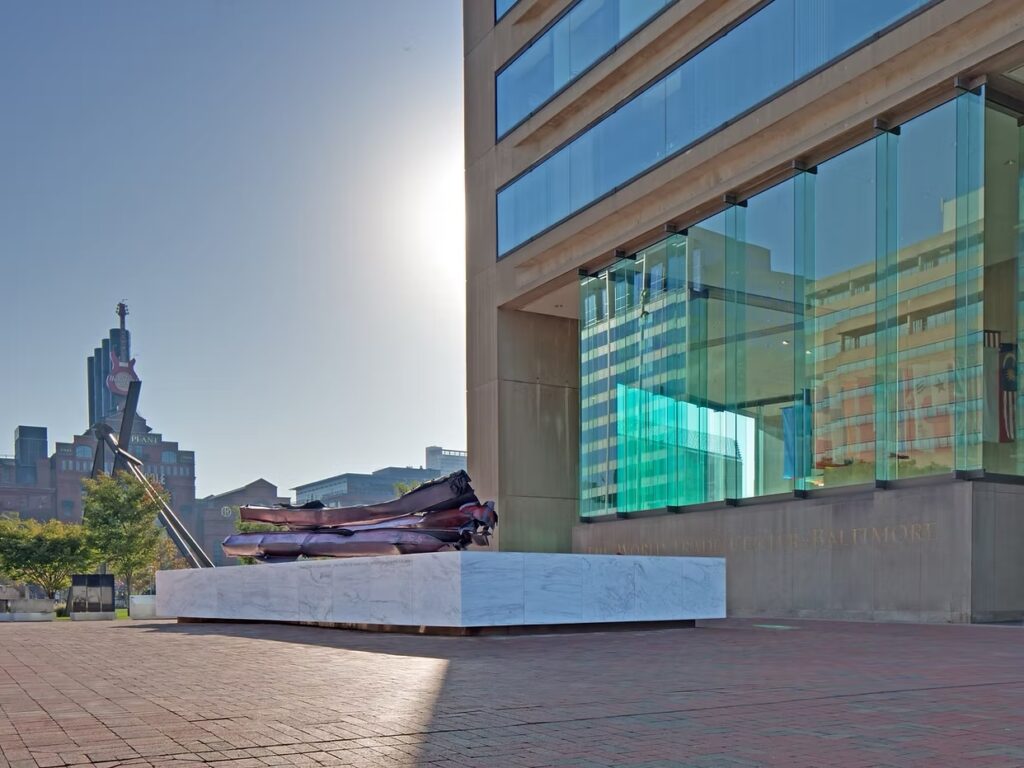
“We placed the memorial so the shadow of the World Trade Center would first touch the marble bed at 8:46 in the morning, the moment the first airplane struck the North Tower,” Bothner explained. From there, the shadow crosses a sequence of inscribed times marking the South Tower strike, the attack on the Pentagon, the crash in Shanksville, Pennsylvania, and the collapse of the North and South Tower. Each is one marked, during the annual commemoration, by the ringing of a bell as the shadow reaches it.
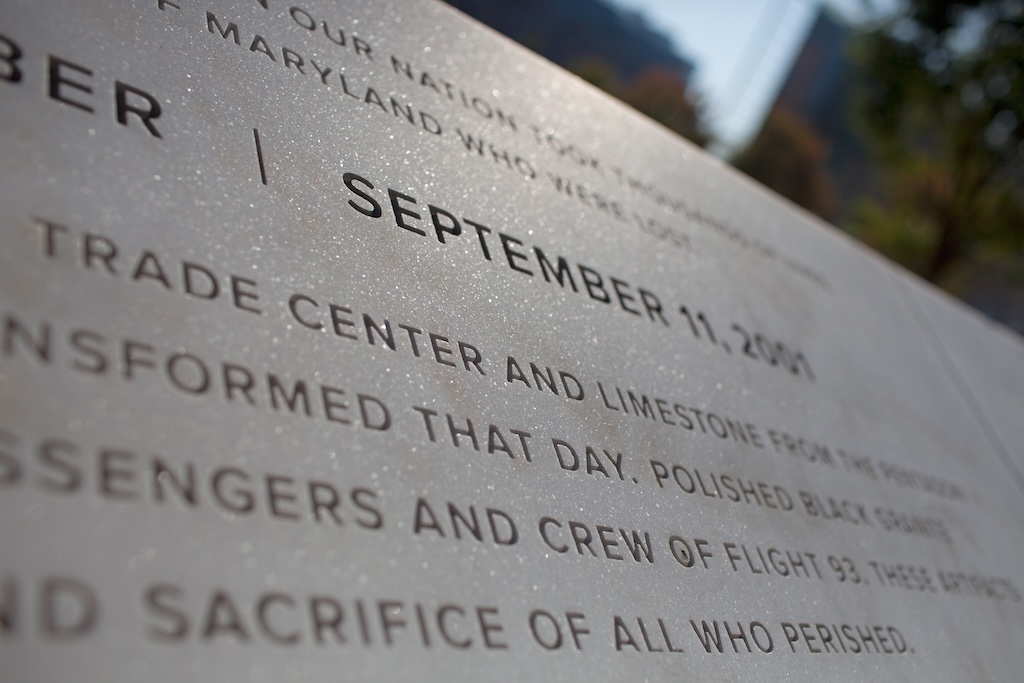
Crucially, the design doesn’t let the darkness win. By the time the shadow has finished its crossing, it still hasn’t covered the whole memorial. The east-facing surface stays in sunlight — and it’s there, on that lit face, that the names of the Marylanders lost that day are inscribed, scattered in a deliberately random cloud around the words “New York,” “Pentagon,” and “Shanksville,” rather than ordered by age or rank or hometown. It was an intentional choice, Bothner said: the names are “still in light, their memory bringing us back toward a hope for a brighter future,” a refusal to let the people who died be consumed by shadow.
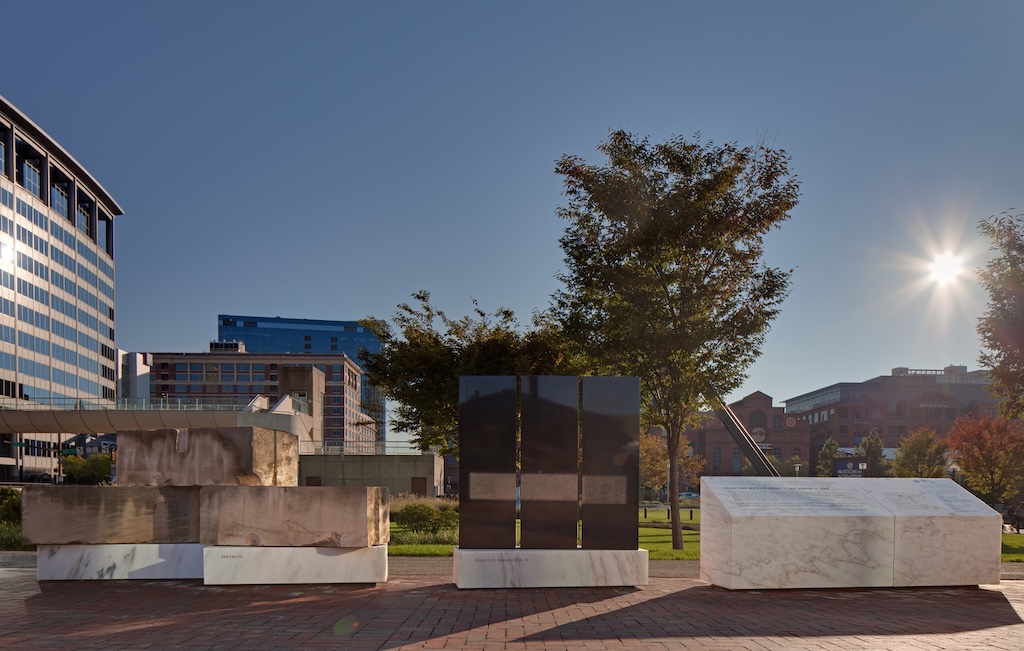
Two satellite pieces extend the story beyond New York: a Pentagon memorial of limestone blocks taken directly from the section of the building that was struck, arranged with a deliberate haphazardness that echoes the impact; and a Shanksville memorial of three upright, polished black granite columns meant to evoke the passengers of United Airlines Flight 93, who fought back and crashed the plane. The granite is reflective enough that visitors see themselves in it as they approach, the main memorial visible behind their own reflection.
The memorial exists because Governor Martin O’Malley commissioned it in December 2010, establishing a 9/11 Memorial Commission chaired by Rand Griffin that issued a call for design proposals. Ziger|Snead won the competition and began work immediately in January 2011, with a hard deadline of September 11, 2011, the tenth anniversary. Nine months, start to finish, coordinated through the Maryland State Arts Council alongside the Commission, the Port Authority, and the state’s economic development office.
For Bothner, the project turned out to be more than professional. His parents’ close friend, Robert LeBlanc of New Hampshire, was killed on the plane that struck the South Tower — a man whose children, Kjell and Nyssa, Bothner had grown up alongside. “When my parents called to tell me Bob was on that plane that day, I completely collapsed,” he said. Presenting the design to the commission, he walked the room slowly through the shadow’s path across the memorial, describing the morning minute by minute. “Everybody in the room was crying when I finished,” he said, “including myself.”
Twenty-five years on, that history is still close enough to touch. This Friday, September 11, marks the anniversary of the attacks, and the memorial will be the site of a small, annual commemoration ceremony organized by Create Baltimore, in conjunction with other city agencies. Most years, there is a modest crowd, somewhere between 10 and 30 people, but this year there may be more including a representative of Governor Wes Moore, a handful of dignitaries, a wreath, a flag raised by Baltimore firefighters, and remarks before the shadow reaches its first mark at 8:47 a.m.
If you’ve never stood at Maryland’s 9/11 Memorial at that hour, I encourage you to go. It is, as Bothner put it, “thoughtful design built to connect us to a collective and conscious story, to memorialize and honor the events of that day, the victims, first responders, and their families.”
It is a piece whose meaning reveals itself the longer you look, whether or not you know what you’re looking at. In a moment when so much competes for our attention, there’s something quietly powerful about a small group of strangers standing in silence, watching a shadow move, together.
Maryland’s 9/11 Memorial is located at the Baltimore World Trade Center plaza, 401 E. Pratt St., along the Inner Harbor.