In Drury Bynum’s most recent series, The Seraphic Veil, two female figures rendered in acrylic paint and collage wear flowing white gowns. Much of their faces are obscured. The folds of fabric in their dresses echo the backgrounds of rowhouses, stairs, and windowpanes. When I ask Bynum about these mysterious women, he has a ready answer: “One is a guardian angel. The other one is an archivist.”
Drawing from astronomer Carl Sagan’s idea that human beings are a way for the universe to know itself, Bynum has created a world in which that universe sends us “a being that’s responsible for putting us here, guiding us and making sure that we’re doing the things we were put here to do.” Along with this guardian angel is “the archivist who’s responsible for collecting all that data.”
When I look again at the figures, I see that in each painting they are leaning close together as if trading secrets, furtive and otherworldly. “I like that world-building,” Bynum explains. “Once I started seeing them and figuring them out, I was like, okay, that gives me a lot more to play with. I would like to continue building this world and finding other characters.”
Although these women emerged in the last few years, their origins can be traced to works Bynum painted when he was a grad student in Bowling Green, Ohio thirty years ago. “I found this book of bride photography from the 50s and it talked about how to photograph a bride to make them look amazing,” he says. “It was so specialized. There’s so much costumery and pageantry involved. A woman gets transformed into this angelic figure. So that was fascinating to me—like there is this one day, this one moment when someone is transformed into this almost deity.”
Soon, the figure of a bride began appearing in his paintings, and notably two of these were hanging in The Brewer’s Art until the restaurant suddenly closed in 2025.
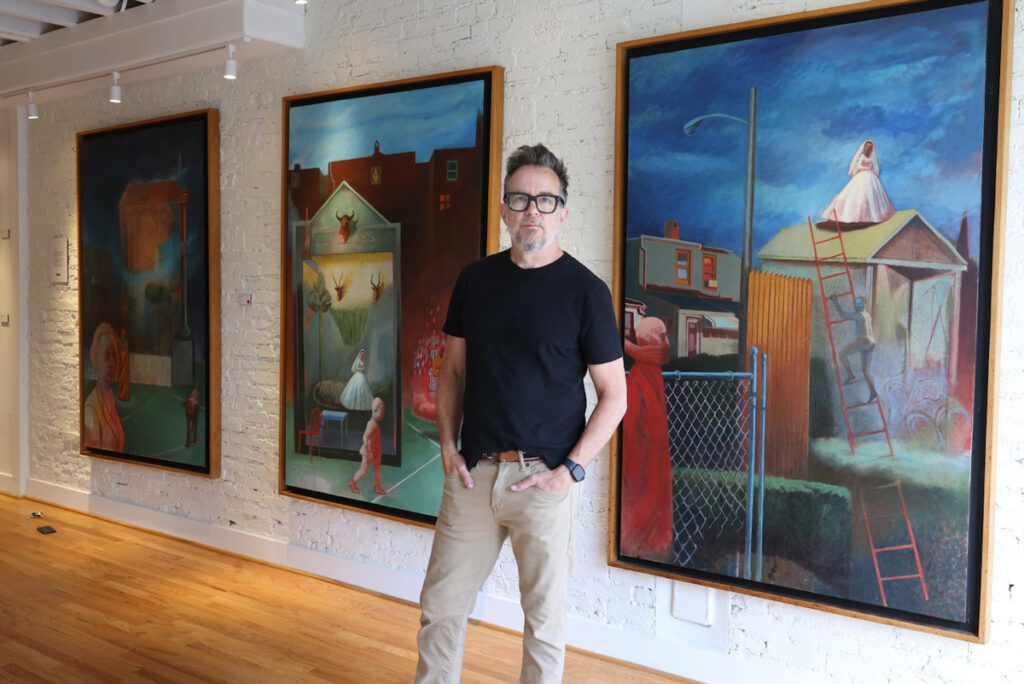
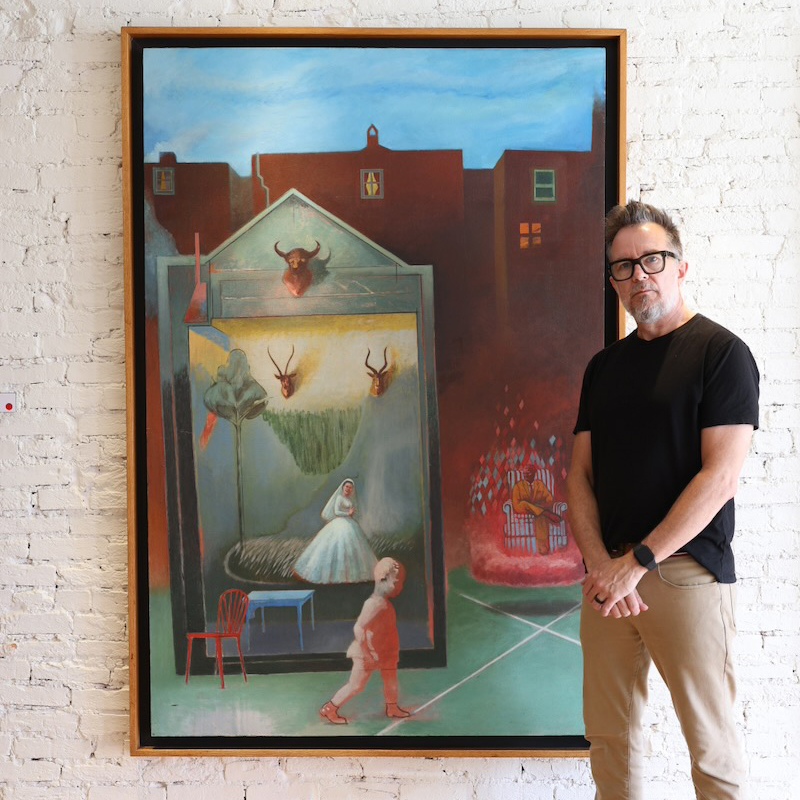
“In two of the three Brewer’s Art paintings, there’s this bride figure that’s standing on a roof in one and sort of floating in another,” Bynum says. “I had been in graduate school for a year already, and I was putzing around these small pieces and working with collage, but it wasn’t really jiving, coalescing.”
Then Johey Verfaille, the first chef at The Brewer’s Art, commissioned three large paintings. It was 1996, and she paid $600 per painting. According to Bynum she said, “‘I want you to make them architectural with a graphic punch.’ And I was like, I love that. I love those three words. It gave me enough runway to blast off, but enough limitations to not go too far.”
The resulting paintings are 4×6 feet and adorned the walls of the upstairs dining room of the popular brew pub for three decades, becoming a part of the cultural landscape of Baltimore. With bright swaths of color, surreal compositions, and ghostly blank-faced figures, these works seem clear predecessors to Bynum’s current projects, which may be more subtle in their palettes, but still have both the architectural component and the graphic punch.
But Bynum’s path from the Brewer’s Art paintings to his current work was not linear. After grad school, he moved back to Baltimore, a city he hadn’t planned on revisiting after he graduated from MICA in 1991. But an old friend—and the low rent—convinced him to come back. Even with a reasonable cost of living, though, the day-to-day as a working artist was more challenging than life as an art student had been.
“It just got too cumbersome. I needed to make more money. I was painting murals and doing faux finishing, and then I started making videos for small businesses.” Working in film proved more fulfilling—and lucrative—than the painting Bynum had been doing, so he and his wife, designer Jamie Campbell Bynum, started the video production business Shine Creative. “And then I got better at that sort of storytelling through video for businesses. And that had value to it.” So, Bynum turned his creative energy to video.
Drury BynumBeing in their presence was wild. It’s just like they had this power. They were mature works of art that I did at a very young age, and I was never able to get to that place again until now. I feel like I’m approaching that level of maturity again.
“15 years later, I decided that the creative outlet I had hoped video was going to be did not pan out. I thought, ‘I’m so much better at painting than I am than being a video director.’” Returning to painting felt natural to Bynum, though it took some experimentation for him to find his subject. “I didn’t know what to paint at first. And I was painting these little abstracts, just to get back into the practice and feel of it.”
Soon, though, Bynum began work on his series, Mythos Flux, which includes twelve 11×11 inch panels, each portraying “a woman caught mid-transformation, integrating with camera lenses, bird parts, disembodied eyeballs and collaged paper.” This led to other series—Arcana Obscura, The Oracle Engine, Construction of the Veil, Arcana Frontier, and most recently, The Seraphic Veil.
It was the latter group of paintings that he was working on when The Brewer’s Art suddenly closed its doors in February of 2026. Owner Volker Stewart reached out to Bynum about retrieving the canvases, and after a few months of back-and-forth with the trustee and lawyers, the works were released to Bynum. “I went in there and got them. I have video of pulling them off the walls.”
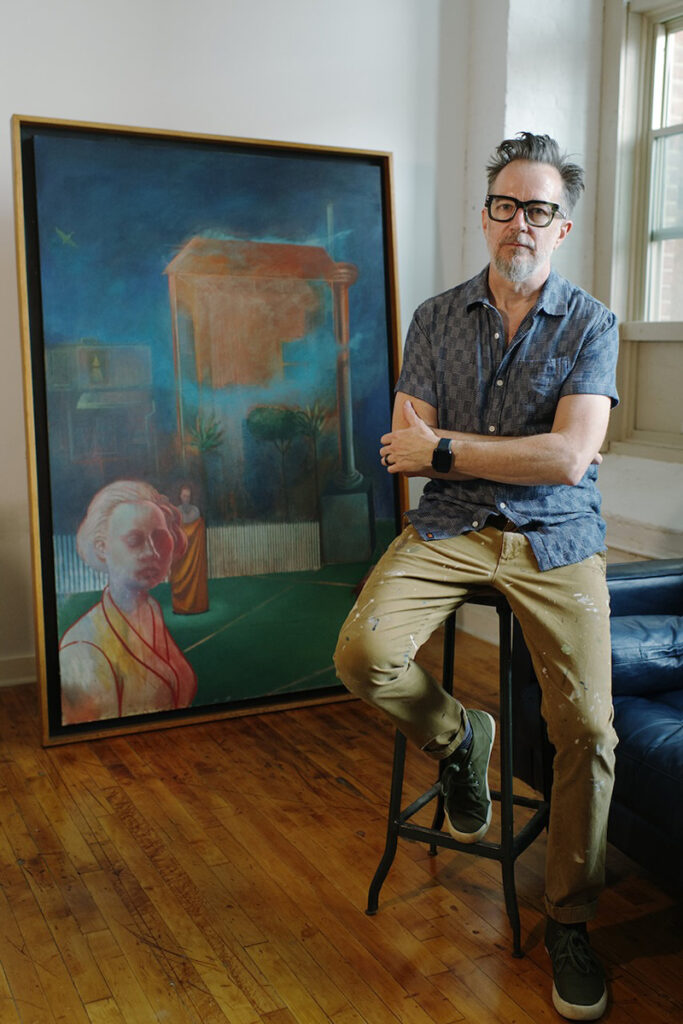
Back in his studio, the paintings from his grad school days had a profound effect on the artist. “Being in their presence was wild. It’s just like they had this power. They were mature works of art that I did at a very young age, and I was never able to get to that place again until now. I feel like I’m approaching that level of maturity again,” he says. Others clearly feel the same way, as all three paintings sold almost as soon as Bynum had them back in his possession.
Looking back on his career, Bynum sees the Brewer’s Art paintings as important to his development as an artist and to his own sense of legitimacy. “These aren’t just one-offs that I did on a whim or that I was just doing for schoolwork. These were the work of a very realized, mature artist.” Seeing the old work alongside his current projects bolstered Bynum’s confidence and spurred him to continue his exploration.
His process today echoes his earlier methods of layering multiple images. Before The Brewer’s Art commission, Bynum explains, “I was working with collage, and I was building a collection of slides of imagery that I would find in books or from other artists or other painters. And then I would build little collage drawings out of projecting slides.” For the large-scale commissions, “I went through the same process, this time of painting, rendering it more, and being far more concerned with color. And they took months to make, but they were by far the most ambitious work that I’d ever done. I quantum leaped from these crude little paintings to these monumental ones.”
Today, Bynum employs a similar process of layering images, but with a 21st century twist: he uses AI. I’ll admit to being wary of the new technology, particularly when it enters the creative process, but Bynum makes a convincing argument for its use. When Bynum came back to painting in 2020, he explains, “AI had started popping up, which was terrifying. And I thought it was going to be the worst thing that’s ever happened, you know? But I had a friend who showed me this program called Midjourney.”
With this program, Bynum started to take his older paintings and upload them, regenerating the images. “A lot of it was garbage at first,” he says, “but then I started inputting the bride image and transforming it. And it eventually became these characters over thousands of iterations.” The results of this process are powerful, inviting viewers to enter a space that is at once familiar and sacred.
Bynum doesn’t set out with a clear vision for what the paintings will be—he simply experiments with image and color and texture. “Typically,” he says, “I’ll paint something and then clues will start to emerge later as to what it’s about or what the themes are. I don’t really see them at first.” Nonetheless, when I take in Bynum’s work over the course of his career, I can clearly see a throughline: versions of that ghostly bride from grad school, themes of transformation, and the “architectural with a graphic punch” style of the paintings he made as a grad student all those years ago.
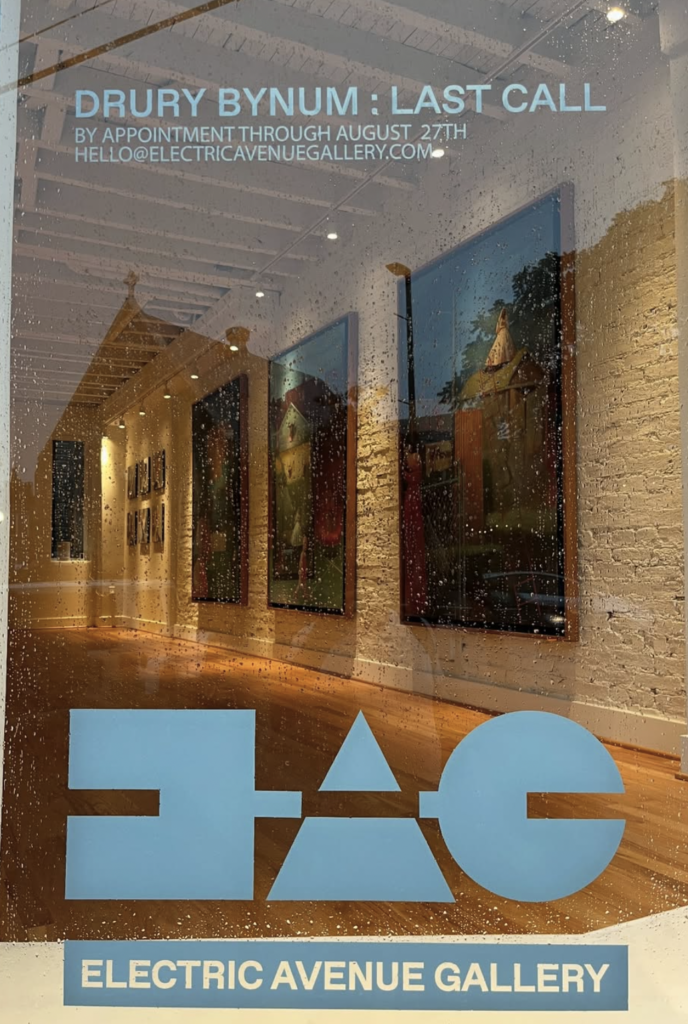
Bynum exhibited these iconic paintings alongside his new work at Electric Avenue, a new gallery in Hampdent from July 27 – August 27. We are please to report that all the paintings have now been acquired and exist in new homes.