Alex Da Corte is an artist unafraid to confront the present. And appropriately, the Venezuelan-American’s tense pop-surrealism is having a moment. In the past few years the New-Jersey-born, Philadelphia-based artist has had major institutional shows from France to Japan, and in a few months will co-curate The Whitney’s first Roy Lichtenstein retrospective in New York in more than 30 years.
Closer to home, Da Corte has several ambitious mixed-media installations presently on view at Glenstone—injecting an unexpected bit of kitschy neon suburban dystopia into the bucolic institution’s minimalist halls. It’s a show worth the pilgrimage.
Arriving at Glenstone is an exercise in subtraction. The private museum founded by Emily and Mitch Rales is set in a nature preserve characterised by stillness, silence, and deceleration. We vacate the reality of being glued to a phone, leaving the bustling and moving, multitasking world behind to enter a space of contemplation, full of natural hiking paths, wide open spaces, and pristine architecture.
Glenstone’s atmosphere of subtraction primes the viewer for quiet contemplation. A timed entry guarantees ample space in each gallery and a ban on indoor photography forces you to be completely present in the moment. Within Glenstone’s pristine, minimalist pavilions designed by Thomas Phifer, Room 6 is an extremely large and dramatic space that allows you to be immersed in the art. I had previously visited the space for Arthur Jafa’s akingdoncomethas—an expansive exhibition of video, music, and monumental sculpture, full of bold pop culture references, and deeply grounded in Black reality. But to enter Room 6 today is to see that space utterly transformed—a palimpsest of the previous installation, now ushered in by the hand of Alex Da Corte, who blends pop culture and art history into dreamlike, absurd, and often melancholy environments.

Stepping out of the natural light and into the darkness of the gallery, you notice the walls in Room 6 are wrapped in a nebulous, oleaginous array of dark hues—reds and deep purples—resembling blood or the viscous motion of a lava lamp. In this space, one first encounters “The Decorated Shed,” (2019), a miniature village and exercise in suburban surrealism. Presented on a mahogany table, Da Corte presents an exact replica of the mini village from the popular PBS children’s series Mister Rogers’ Neighborhood. However, one key change is obvious: towering high above the houses are an array of corporate neon chain restaurant signs, the absolute hallmark of American highway culture, including McDonald’s, Taco Bell, KFC, and Wendy’s. There is also a specific regional nod in the inclusion of Wawa and Checkers, referencing Alex Da Corte’s origins in the Philadelphia area, where he began his artistic career.
On the manicured tableaux, a trolley intermittently moves through the space, animating it as the viewer leans over. Da Corte makes us giants, peering down and surveilling this surreal and familiar scene. Blue lights flicker throughout the town, as if the invisible owners inside these model homes have set their TV trays down to watch the local news or, perhaps, Mister Rogers. Once a peaceful hamlet and setting for charming children’ s stories, the towering corporate signs change everything about this charming scene, illustrating an American fantasy overpowered by tacky corporate greed.

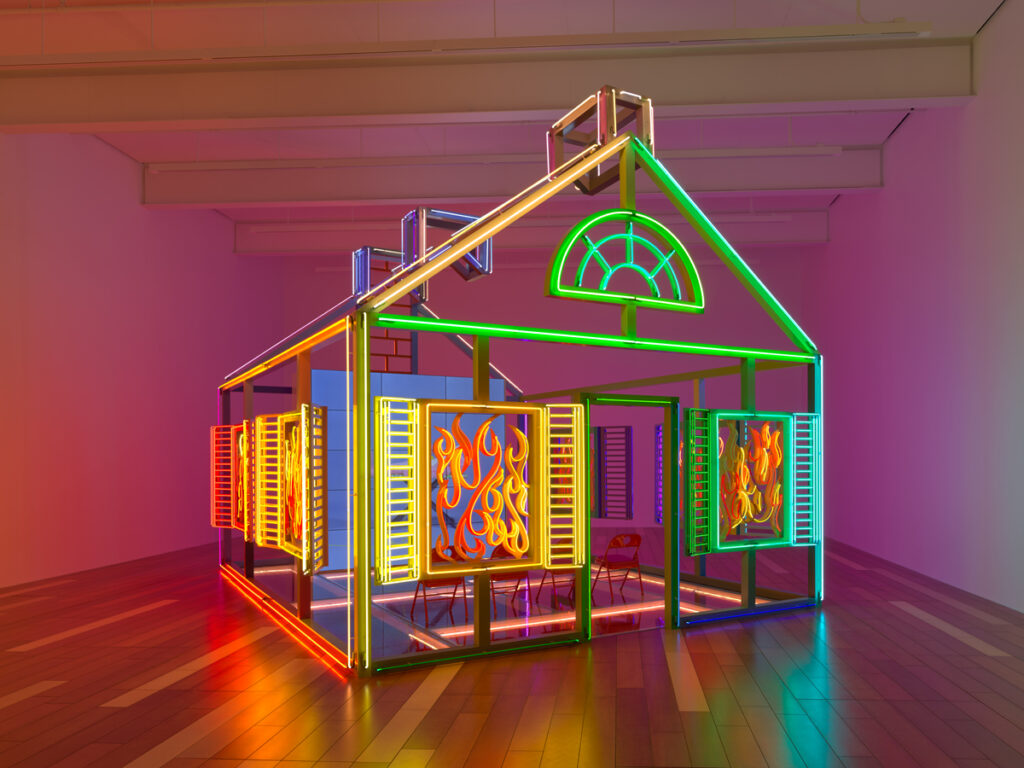
Compared to the miniature drama, “Hell House” is a life-sized one. It’s a neon house with no walls, a skeletal structure that feels less like a shelter and more of a hallucination. The structure was inspired by “Ghost House” (also known as the “frame house” or “ghost structure”) in Philadelphia, designed by architects Denise Scott Brown and Robert Venturi, a decorated shed that allows art to blend into surrounding spaces.
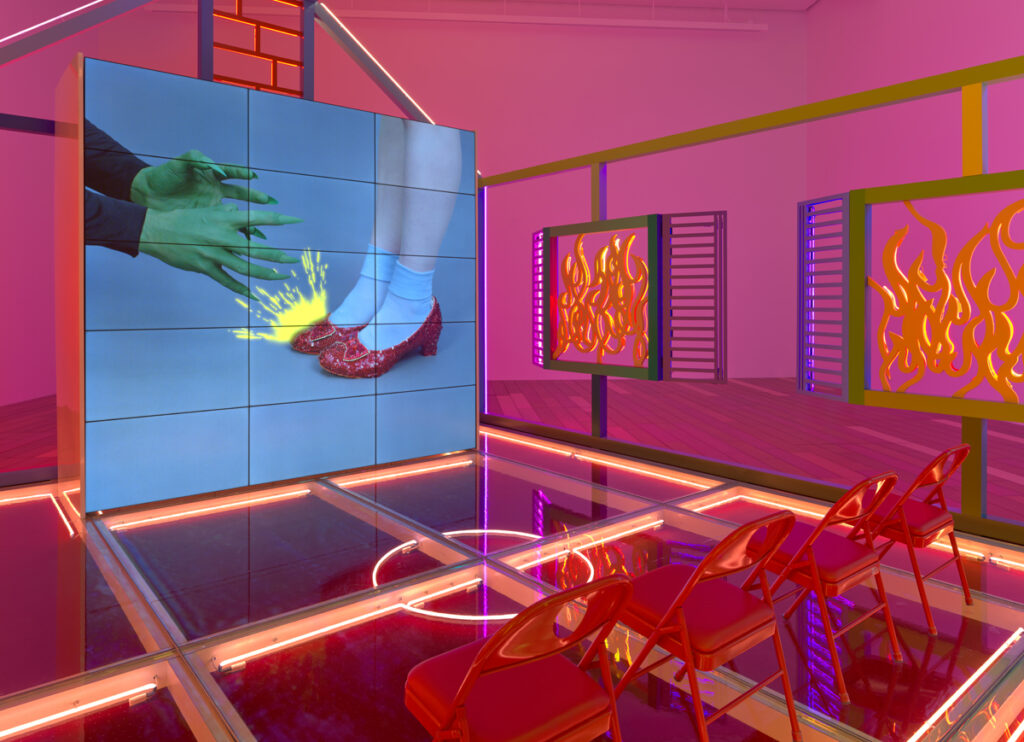
Once you enter through the open doorway, you realize it’s a platform for watching television on a big screen, or, for watching people watch television from the outside. At first glance, it resembles a church–a container, a sacred space, or perhaps some other shared third space. It offers an individual experience to each viewer who enters it, with small metal folding chairs lined up in front of the giant screen to encourage you to watch the video in its entirety. Combined with the video, it acts as a monument to the frenzy, disorientation, and deeply lonely feeling of existing on this planet.
Nora Severson Cafritz, Senior Director of Collections at GlenstoneTime slows down in that room… you’re sort of waiting for a crescendo… and there isn’t always. Sometimes that’s the point.
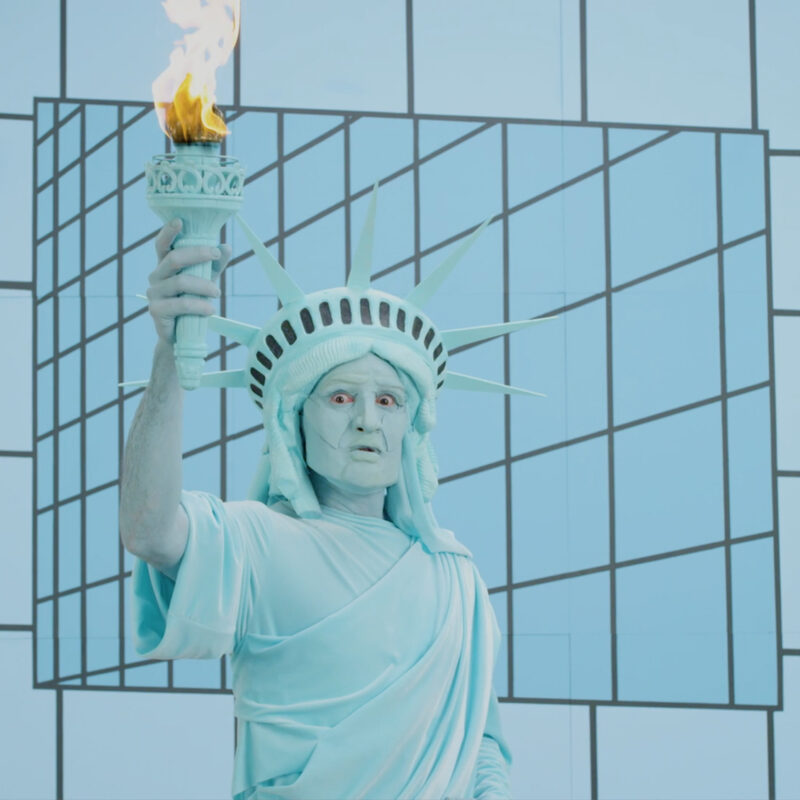
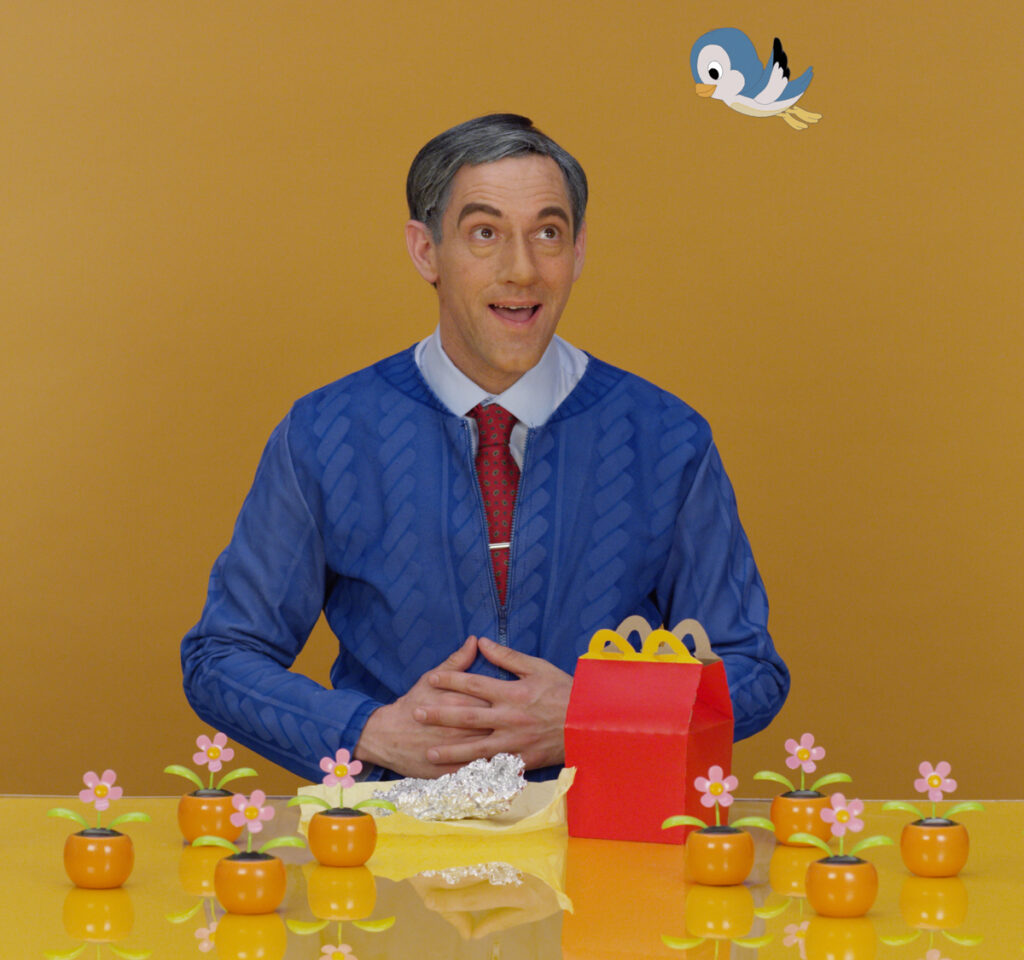
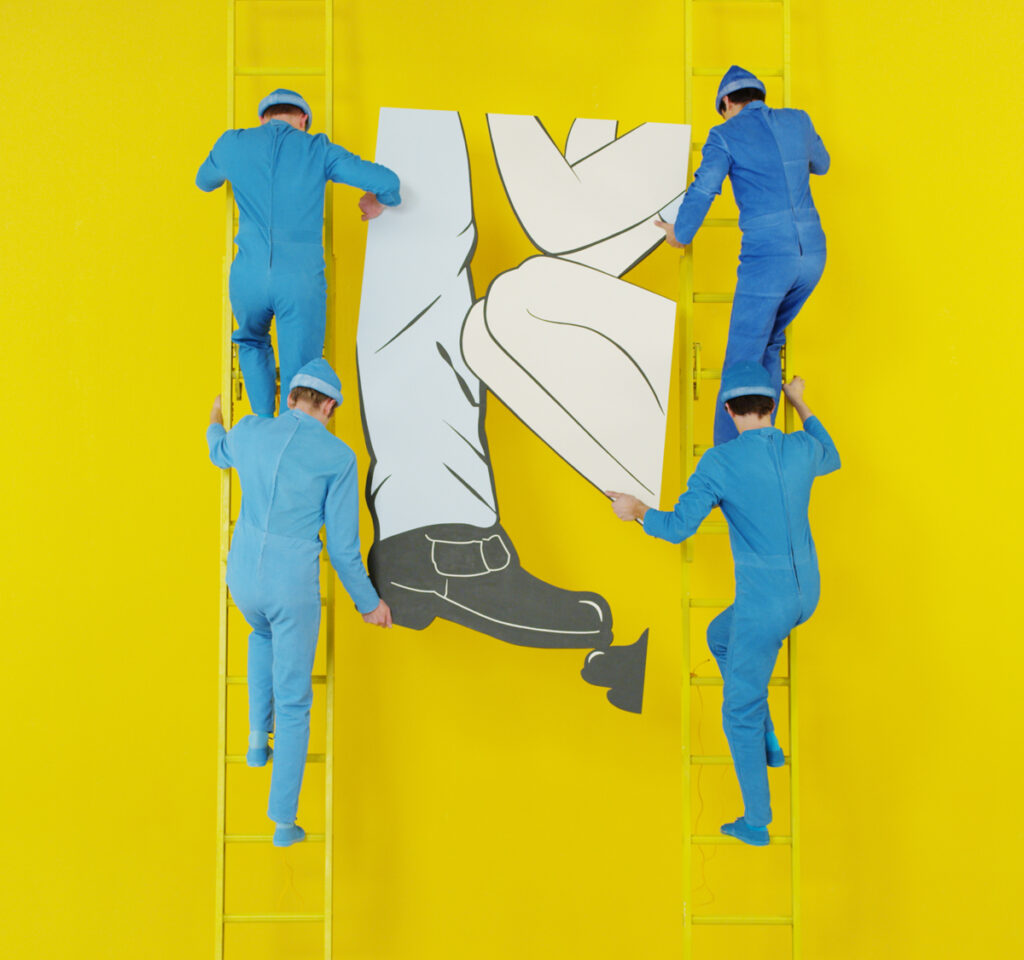
The structure was originally designed to house the video work, “Rubber Pencil Devil,” where the artist serves as the two main characters in prosthetic makeup and costume: Mister Rogers and the Devil. The artist includes 57 vignettes featuring himself in a variety of costumes, reimaging familiar Western television, cartoon, commercial, and movie moments, with familiar characters from Cinderella, The Simpsons, or Fruit of the Loom. The pacing of the video is distinct; it feels a bit like scrolling TikTok, but in slow motion.
Da Corte has said that ketchup was his first addiction. Ketchup plays a special role in the video, serving as a symbol for American obsessions and traditions, and it’s worth noting that Mr. Rogers was born in Pittsburgh, the original home of Heinz 57. The artist underwent four hours of prosthetic makeup and transformation to embody the character of Mister Rogers, someone he views as an uncomplicated hero, a good guy. Dressed in a bright cerulean sweater and sperry topsiders, Da Corte brings this hero to life, invoking him at a time when America is in need of his philosophy of empathy more than ever. Da Corte’s Rogers is a direct contrast to his characterization as the devil, painted bright red and dancing around with a rubbery life-sized pencil.
For Da Corte, the manipulation of space and time is deliberate. Nora Severson Cafritz, Senior Director of Collections at Glenstone, noted that this is one of the only spaces at the museum without natural light, allowing the team to control the environment differently. “Time slows down in that room… you’re sort of waiting for a crescendo… and there isn’t always,” Cafritz explains. “Sometimes that’s the point.” Inside Room 6, there is a shift—a transformation. It is disorienting, not unlike the built environments at Disney or a shopping mall. Yet, Da Corte offers a portal for contemplation and a hierophany, combining the sacred with the profane, for reflection..I heard Frank Ocean’s “Moon River” stirring above the hum of electricity animating the structure, and I felt a family tug of melancholy at the lyrics, the song that Ocean recasts as a queer longing lullaby.
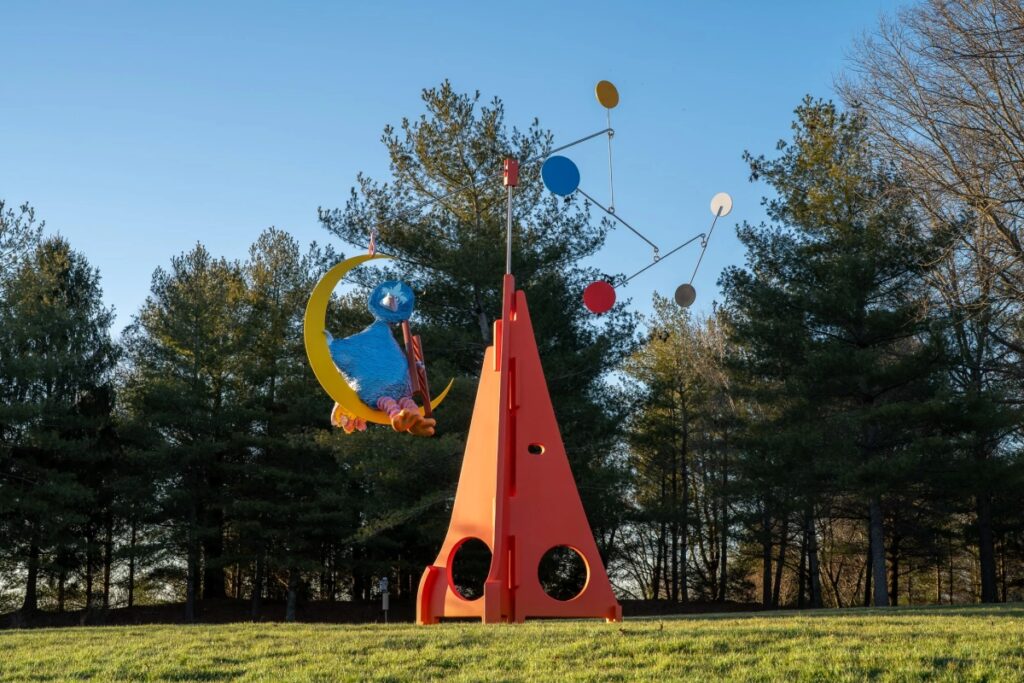
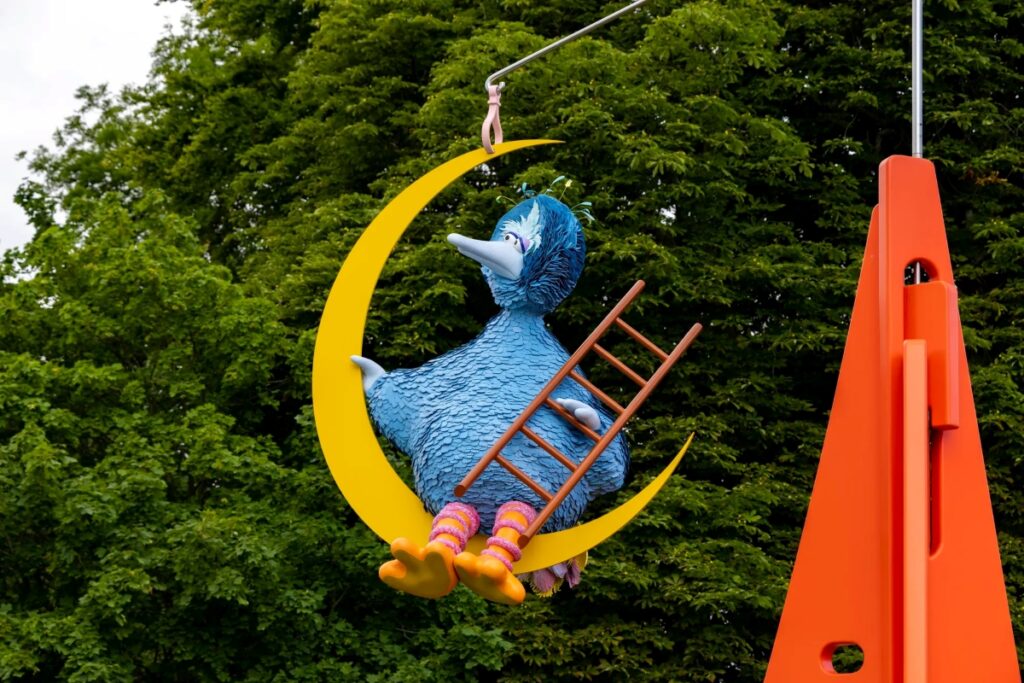
Leaving Da Corte’s fantastical microcosm of our world that is on display inside of the Pavilions, the experience shifts again. Stepping outside into the broad Glenstone landscape, you encounter “As Long as the Sun Lasts” (2021), a massive, 20-foot-tall kinetic mobile, inspired by fellow Philadelphian Alexander Calder, and designed to interact equally with earth and sky. In true Da Corte fashion, he used Little Tikes play sets as source material, and perches a replica of Big Bird, but he is painted blue, referencing the movie Follow That Bird, in which Big Bird is captured and painted blue. Originally commissioned and on display for the rooftop at the Metropolitan Museum of Art,
This figure is also a reference to Garibaldo, the character Da Corte grew up watching on TV in Caracas, Venezuela—the Brazilian version of Sesame Street. Da Corte’s use of color is never random, with the color blue referencing fact and feeling.
For American audiences, it might trigger memories of Follow that Bird, where the blue paint signifies a story about homesickness, loss, and change. As mainstream popular culture is flattened and commercialized, Big Bird as Garibaldo, in his vibrant blue, with manufactured feathers that move with the wind, carries a ladder to heaven and the cosmos for those who are too vibrant for the masses. His pose on the mobile is a reference to Donna Summer’s disco album Four Seasons of Love, in which the artist beautifully sits on a crescent moon on the cover. This is a response to the call of disco, a genre that allowed queer folks to find themselves and others like them on dance floors.
By finding Garibaldo and engaging with him, I imagine others who feel othered feel similarly seen. Da Corte creates pop art that is at once an exposition and commentary on our present 21st-century lives. Because of his deep repository of cultural, personal, and artistic references, the worlds he creates offer the viewer moments where they can find themselves—regardless of whether they are feeling happy or sad, lonely or loved, queer or marginalized.
Viewed all together at Glenstone, both inside and outside, Da Corte’s work offers a boundless psychological flytrap for audiences who will find connection with familiar characters and brands from pop culture, but also a critique at the absurdity and sadness of modern life. Through sculpture, video, and multisensory immersive spaces, Da Corte offers an arresting monument to loneliness and isolation, served up for this exact moment. This sense of unbroken scale and immersion is often when Glenstone does best, removing barriers and distractions so that a visitor can connect with multiple works by one artist without feeling rushed or overwhelmed.
Cafritz shared that Glenstone’s ethos is to support these ambitious visions. “If an artist proposes a wild idea, eight times out of ten we can say, awesome, let’s do it. That support allows for works like Da Corte’s that validate our modern, messy, hybrid existences. The works change as we change. As time passes, our ability to interact with and engage with the work shifts. I’ve gone into that space and had different reactions to it based on what I’m going through in my life,” Cafritz admits.
Alex Da Corte treats American television icons like Mr. Rogers and standard-bearers like Alexander Calder as equal sources of inspiration. His ability to blur the lines of high versus low culture—that syncretism—is a spirit that resonates with anyone who has ever found kinship in a warehouse party. Da Corte’s exposition of consumerism and loneliness is an exacting extension of Glenstone’s founders’ ethos, illustrating the power of communal experiences in these unprecedented times.