Just how do you structure your day, and give it meaning? Two cups of coffee in the morning and a cocktail at sundown? Walks with the dog, or an evening workout class? Listening to a podcast on your way to work, or a scheduled FaceTime with your mom?
From the mid-1200s to the 1500s, thousands of Europeans routinely punctuated their days by reciting a standard series of prayers and penitential psalms that were spelled out in volumes known as Books of Hours. Ranging from opulent, hand-painted manuscripts to modest, printed versions, these books were stunningly popular; over the course of three centuries, more of them were produced than any other type of book. And now an appealing, tidy show at the Walters Art Museum (Medieval Mindscapes, through August 23) offers a chance to consider some of the habits of their users—and to compare them to our own behaviors.
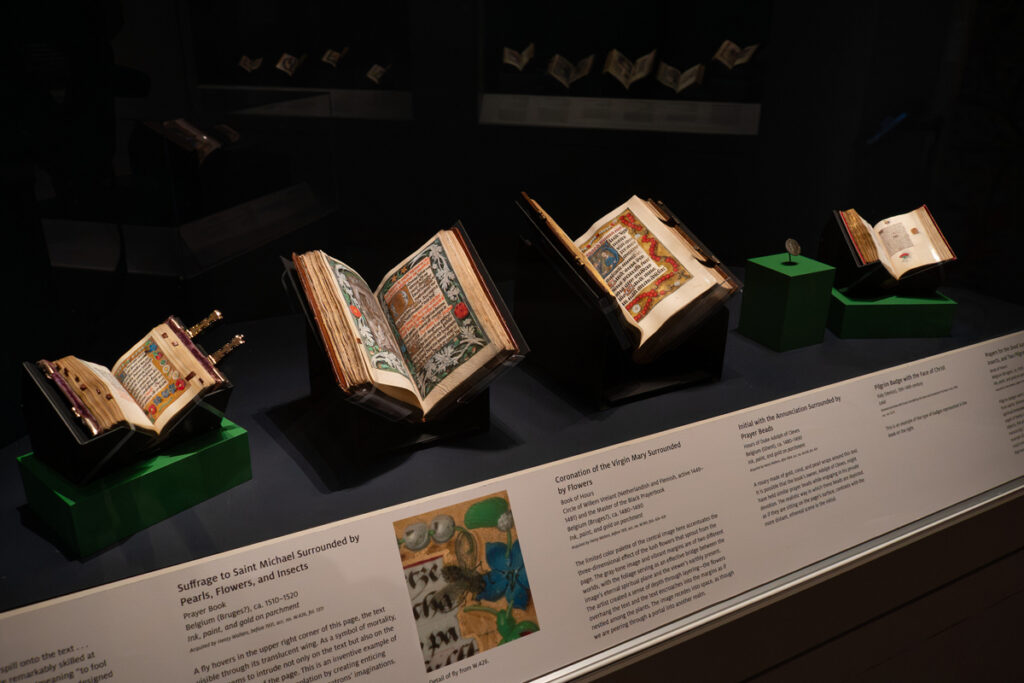
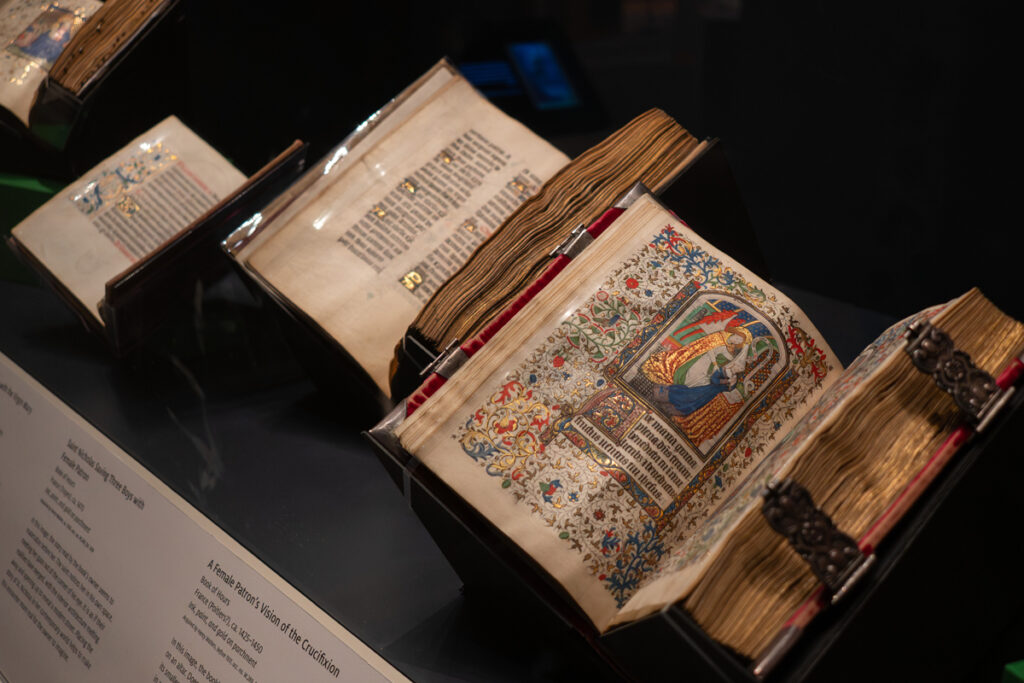
The exhibition, which fills a single room on the museum’s third floor, features nineteen illustrated manuscripts and several related objects. Notably, all but one of the objects are drawn from the Walters’ permanent collection, which includes one of the largest groupings of Books of Hours in the world. You can almost sense the pleasure that the curator, Lauren Maceross, took in choosing her examples. Juxtaposed with tidy bands of text, the images on display range from playful to grisly and from conventional to conceptually complex. Cumulatively, though, they offer considerable rewards.
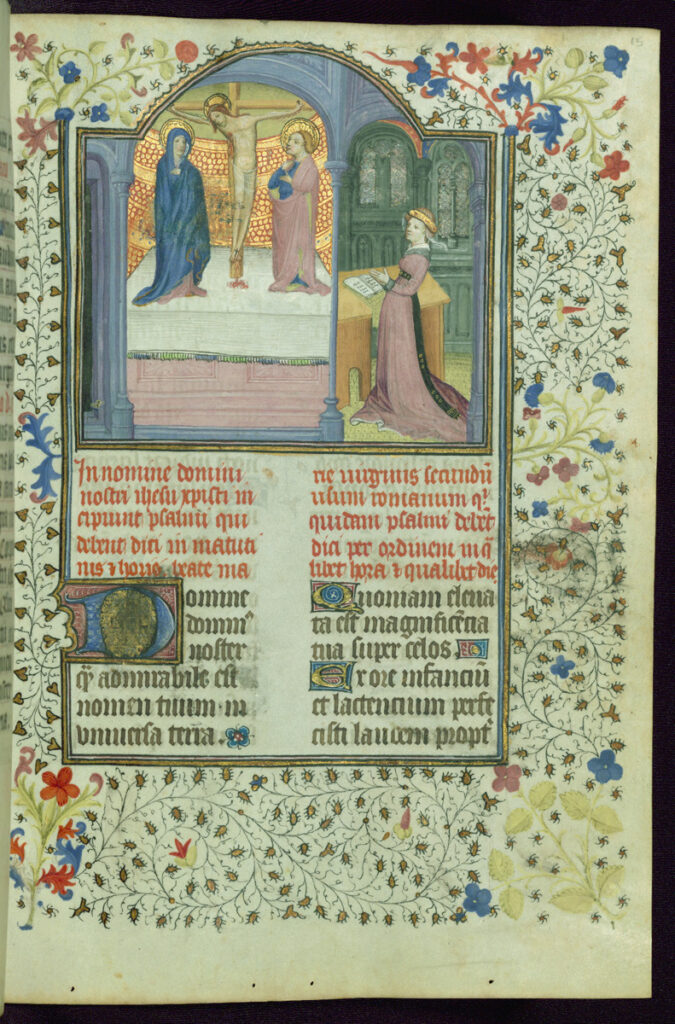
You might start with a 15th-century French example, in which a richly dressed woman, her hands folded in prayer and a book open before her, looks towards an image of the Crucifixion. But while the space might initially seem continuous, a slender colonette hints at the distance between her medieval world and the Biblical episode that she envisions. Is this, then, a vision? Or is she an example of focused devotion for the book’s owner, who may well have been female? The image doesn’t quite commit to an answer as it hovers between realities, hinting at the mystical potential of fervent prayer.
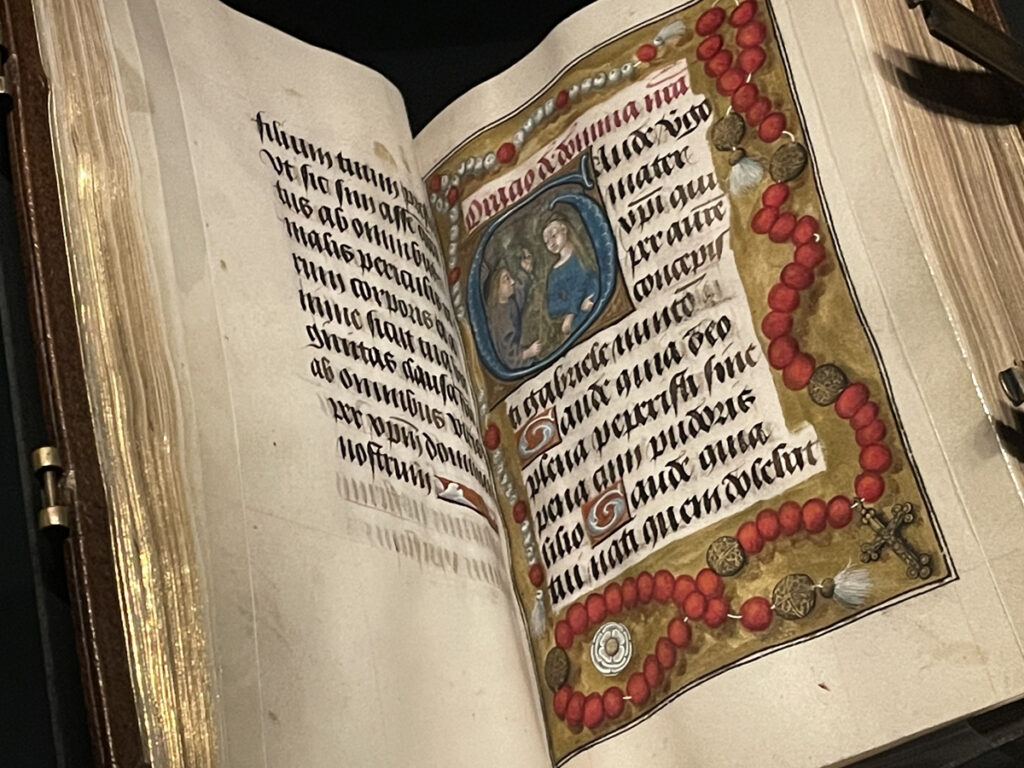
Across the room, a slightly later example made for Adolph of Cleves, in Belgium, offers further evidence of the forms that prayer could take—and another conceptual wrinkle. A modest image of the Annunciation, in which the archangel Gabriel tells the Virgin Mary that she will bear a son, is encircled by a painting of a rosary apparently made of gold, coral and pearl. As an accompanying text notes, Adolph may have held a similar rosary as he prayed, and the painted beads cast fictive shadows, as if to convince us that they could be picked up. Much as the story of the Annunciation hinges on the enigmatic relationship between word and flesh, then, this page delights in the tension between text, image and physical substance.
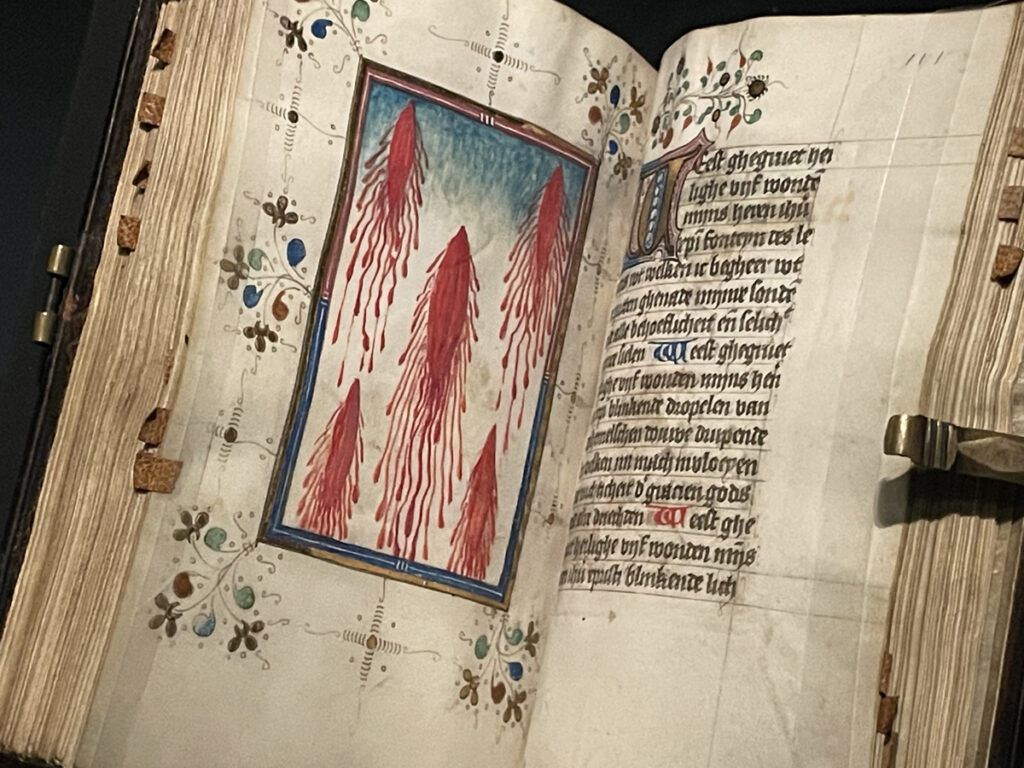
But Books of Hours didn’t simply toy with the idea of touch; at times, they could also solicit it. In a remarkable Dutch example called the Loftie Hours, we see the five wounds that Christ sustained while on the cross, rendered in lurid, effusive detail. Placed after a series of images in restrained gray, these images almost shock in their intensity; painted on vellum, or animal skin, they suggest a piercing violence. But in an era in which the blood of Christ was widely considered sacred, they were also inviting. Indeed, signs of wear imply that users stroked or kissed these images, making contact with their savior across a vast temporal gulf.
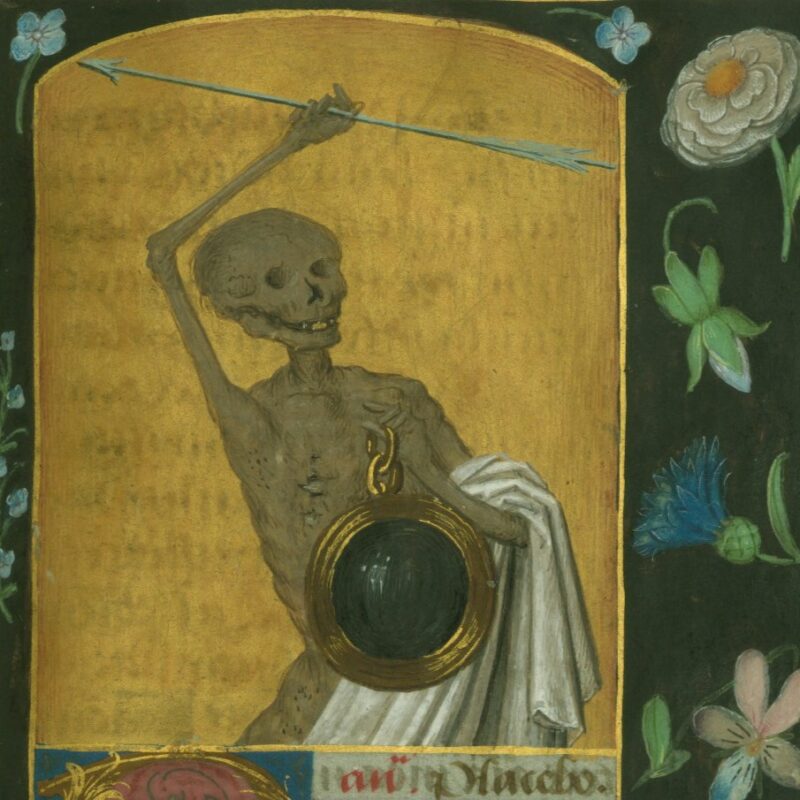
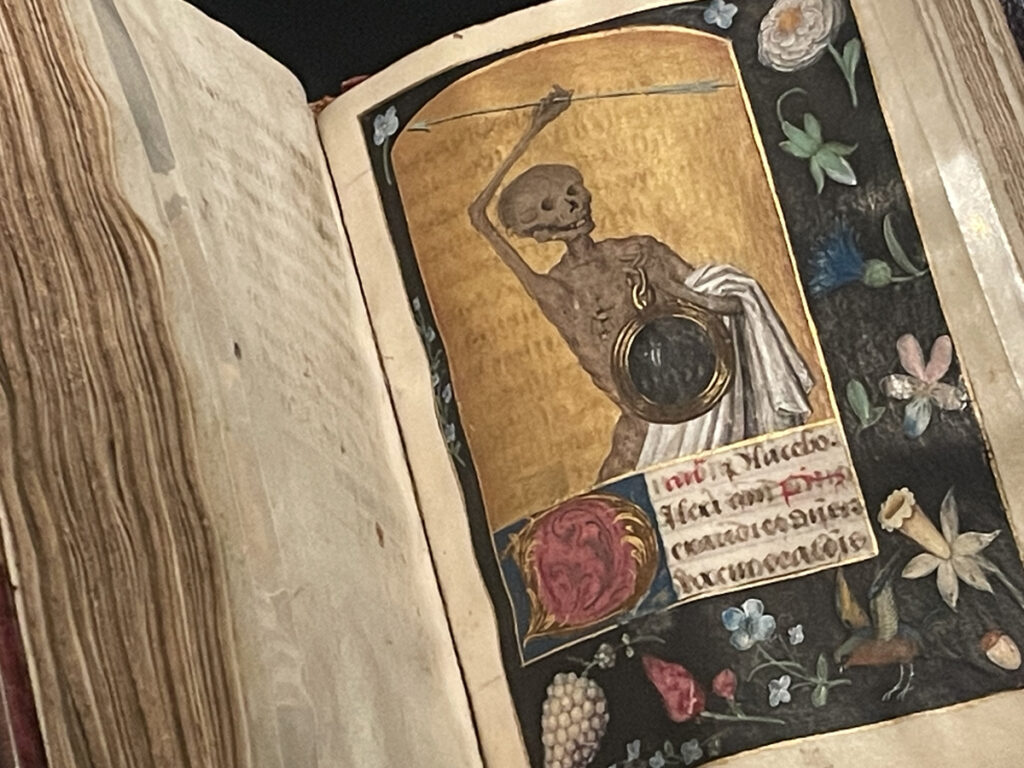
Not every image on display depicts a holy subject, though. Books of Hours also included prayers for the dead, and a Flemish manuscript made in around 1500 pairs that text with a ghoulish painting of a skeletal figure. Brandishing an arrow and seemingly grinning, he is chained to a large mirror: a reminder, perhaps, of our own mortality? Nearby, in the margins, flowers and a bunch of grapes suddenly acquire a morbid aspect; they, too, will rot. An early ancestor of later, more famous vanitas paintings, this is a lively rumination on the fragility of life.
In that work, the image seems to offer a moral lesson. In a striking illustration in a petit, oval-shaped manuscript made in the mid-1500s, however, we are expected to do most of the thinking. In an empty room, an open book on a lectern is illuminated by several brilliant rays of light that pass through a window. It looks like the setting for another Annunciation, but the scene is devoid of figures. Evidently, we’re meant to fill it, in a process of active meditation. As the art historian John Shearman once observed, Renaissance art often asked viewers to participate in the creation of artistic meaning. Here, a user saying their prayers could bring the scene to life.
Crisply installed and conveniently lit in a museum setting, these images meet and support our close gaze. It’s worth remembering, though, that Books of Hours were meant to be portable, and must have been used in a wide variety of contexts. In fact, holes in the pages of one of the examples in this show imply that it was attached to a belt, and worn by its user. Drawing on the Walters’ astoundingly deep collection, Maceross shows it next to a surviving belt, and a book binding with a belt attached. It’s a compelling installation that clearly establishes the place of these books in everyday lived experience.
There are several other curatorial gambits that are also worth noting. The show is divided into four main sections, each of which is organized around a theme: in one case, all of the images on display involve forms of illusionistic, trompe l’oeil painting, while in another the body of Christ is a recurring subject. I was most interested, though, in a placard’s suggestion that portraits of books’ owners can be usefully compared to avatars in contemporary video games. Much as a gamer navigates, in other words, a virtual world, a user of a Book of Hours could feel immersed in a painted scene, or landscape.
That analogy is fair and it’s pursued at some length in this exhibition. The unpeopled scene in the oval book, we read, is “not unlike a role-playing game” in which we’re confronted by an inert landscape, and must decide our own course of action. And that parallel is even more obvious in a display that pairs digital photographs of further images from the same oval manuscript with open-ended dilemmas: “A red being approaches on a dark cloud. Do you pick up the harp and play for them or venture into the city?” It’s a pleasing thought: late medieval manuscripts as the close cousins of Zork, or The Oregon Trail.
Or, perhaps, as the antecedents of cell phones? That parallel is also considered here, if only briefly. As another placard points out, Books of Hours were mobile devices that offered their users information, entertainment, and the possibility of connection. That’s true, and I’m actually tempted to go even further. For as much as we touch and swipe our screens, the owners of these texts evidently rubbed, nuzzled, and caressed the images that decorated their pages. Viewed in such terms, the age of manuscripts and the digital era can feel surprisingly close in spirit.
But maybe, in the end, none of this is very surprising. After all, Henry Walters, the founder of the museum, reportedly liked to carry a Book of Hours in his pocket. The appeal of these books has always been strong, and it’s not hard to see why. The next time you’re in a crowded waiting room, look around. Note the fellow who pulls out his phone to play a daily game of Wordle, and the young woman who’s editing an tweet. Rather like Books of Hours, our devices facilitate private meditation, linking us to unseen realities by a means that we barely understand. And in the process, they lend form and significance to our days and structure our experience—thus linking us to readers who lived centuries before us.