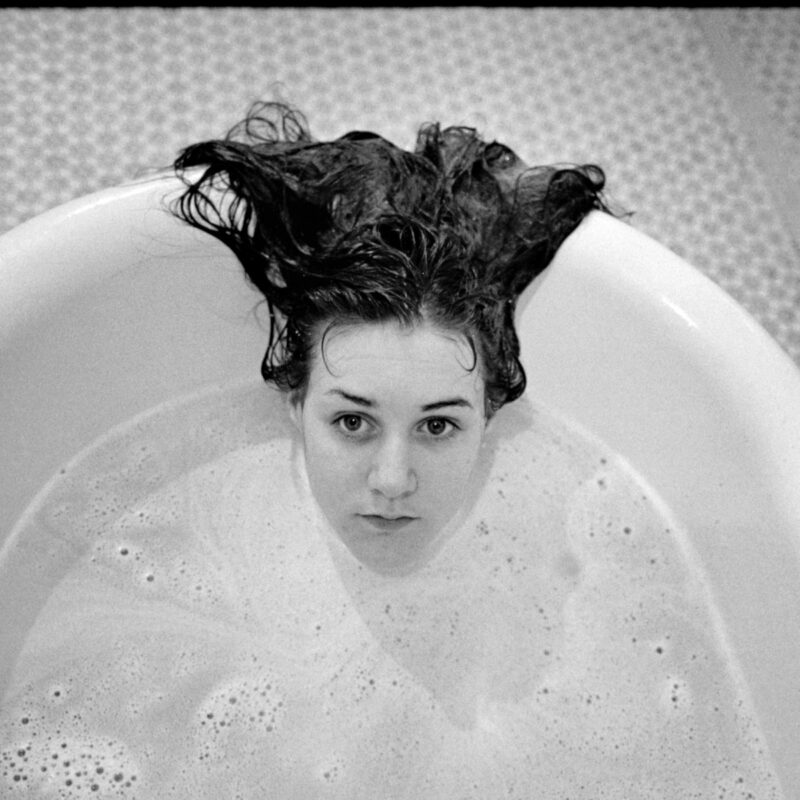
In the iconic photograph, a young woman lies in a deep white ceramic bathtub, only her face visible above the soapy water. She is framed like a saint. Wet, dark hair fans out behind her, flowing over the back of the tub. She gazes at the viewer with wide eyes, her oval girlish face pensive yet stark. The photograph’s title, Laurie in the Bathtub, indicates the girl’s plain first name only (maintaining a degree of anonymity).
This portrait is one of Mary Ellen Mark‘s most recognizable images from an all-women’s maximum-security ward at an infamous psychiatric hospital.
Mark is a major documentary photographer of the latter part of the twentieth century. The photograph of Laurie was used as the cover of the influential book, Ward 81, by Mark and her collaborator, Karen Folger Jacobs, published in 1978. It is a lasting document that helped the outside world reconsider those deemed “mentally ill.”
The Albin O. Kuhn Library Gallery at the University of Maryland in Baltimore County is currently showcasing Mary Ellen Mark: Ward 81. The important traveling exhibition was originally curated by Gaëlle Morel and Kaitlin Booher for The Image Centre at Toronto Metropolitan University in collaboration with the Mary Ellen Mark Foundation, New York (established after her death). Now at UMBC, the show was organized by Beth Saunders, Curator and Head of Special Collections, along with Emily Hauver, Curator of Exhibitions, Albin O. Kuhn Library and Gallery. The library and gallery are known for their extensive collection dedicated to the history and cultural significance of photography. It is an extraordinary display of Mark’s groundbreaking works.
The formal qualities of Mark’s photographs are, as always, exquisite, but the content of her work makes it even more compelling. Throughout her career, the photographer sought out subjects she called “the unfamous,” people deemed outcasts—marginalized, forgotten, victimized, and misunderstood by society. They included the homeless, street kids, sex workers, addicts, circus performers, people with autism, the poor, and many more. Mark worked globally, with several well-known series produced in India and Mexico. She depicted her subjects without judgment and was especially drawn to young women. She’d befriend her subjects honestly, always with a camera in hand, so as not to deceive as she immersed herself in their lives to document them. She often followed up with key participants decades later.
Ward 81 was her first large-scale thematic endeavor. Since the advent of photography, there has been a long history of men documenting women with mental disorders. These were often done in the name of science. Albert Londe is a famed example. He created images of women afflicted with “hysteria”, a catch-all name for psychiatric illness that women were branded with for centuries. These images captured female patients experiencing extreme mental duress. The photos were widely disseminated, and others followed suit.
Mark’s images compel viewers to reconsider her predecessors’ work through a feminist lens. She is not diagnosing; she is connecting. While Mark is often linked to other great photographers of her era, such as Robert Frank and Dianne Arbus, who also chronicled those then considered outside the norm, Mark depicted them more empathetically, more human. Her approach was radical compassion.
Between documentary-style photo shoots for major magazines of the era (Mark’s work appeared in Life, Rolling Stone, The New Yorker, New York Times, Vanity Fair, and more), she also served as an on-set film photographer for over 100 major motion pictures, working with some of the greatest directors of her time. She hustled for money on commercial jobs to fund her own projects. Sometimes they overlapped.
In 1975, she was hired to take still photos on the set of One Flew Over the Cuckoo’s Nest, which was filmed on location at Oregon State Hospital. It was there Mark first met the women who lived on Ward 81, the only psychiatric ward of its kind for women in the state. She developed a strong bond with them.
After filming ended, Mark enlisted her friend, sociologist Karen Folger Jacobs, as a collaborator. With the approval of Dr. Dean Brooks, then the hospital’s superintendent, they spent 36 days living among the residents. Immersing herself in the lives of the women there, Mark shot over 4800 images. She recorded over 50 audio tapes. These included recordings made by residents, and conversations between Mark and Jacobs.
Their resulting book, Ward 81, was groundbreaking. It contained 97 black-and-white images along with text featuring the residents’ quotes and Jacobs’ written commentary. An expanded hardback edition, Ward 81: Voices, edited by Martin Bell, Julia Bezgin, and Meredith Lue, was released in 2023, eight years after Mary Ellen’s death. This new volume includes 141 images and additional text from previously unreleased audio recordings between Mark and Jacobs. It also offers further commentary from interviews with the subjects, along with extra documentation, essays, and contextual analyses.

Jack LivingstonIn 1975, she was hired to take still photos on the set of One Flew Over the Cuckoo’s Nest, which was filmed on location at Oregon State Hospital. It was there Mark first met the women who lived on Ward 81.
This version of the book is the basis for the current exhibition, which features approximately 100 large-format framed silver gelatin prints, along with additional audio, video, contact sheets, and a wide array of ephemera.
The era in which these photos were taken was one of rapid change in mental health treatment. Large, oppressive, prison-like psychiatric hospitals like the one shown in the film One Flew Over the Cuckoo’s Nest, were still common but beginning to be questioned. Many, such as the Oregon Hospital, had been built in the early 1900s; others were much older. These were large, menacing compounds originally built away from cities, on grounds surrounded by high chain-link fences. They were meant to hide the “afflicted” away.
The treatment provided was harsh and ineffective at best, and torture-like at worst. Patients’ therapy programs depended on a constantly changing and questionable medical model. Residents had few rights; often, they were locked away and isolated from their families—sometimes from birth—based on doctors’ recommendations. Overcrowding and widespread abuse often led to antisocial behavior that resulted in more confinement and further mental deterioration.
In the nineteen-fifties, the first round of reform-minded documentary journalism was published, revealing these brutal conditions, and a wave of de-institutionalization was initiated. However, it was not sufficient. By the nineteen-seventies, new groups advocating for patients’ rights emerged. Family advocates became vocal, lawyers got involved, and the system was reevaluated, influenced by broader movements for civil rights, gay rights, and feminism. Ward 81 was established during that transitional period, bridging the old and new eras.
I am familiar with this world because around that same time, I was hired at age 18 to work with residents as a “tech” (a low-level care worker, trained by the organization) at a new mental health facility in Aurora, Illinois, outside Chicago. I continued to be employed in mental health in various roles with different populations for the next ten years. The women depicted here feel very familiar to me, as do the circumstances.
During that period, there was a strong backlash against the Freudian-based psychiatric movement that had come before, and it was being replaced by more effective behavioral and cognitive approaches. Some residents, like those depicted in Ward 81, were eventually released into community centers similar to the ones where I worked. Many people improved in smaller, more normalized settings—thanks to updated methods, new medications, staff interactions, and better living conditions. Others remained in large state psychiatric hospitals, which still housed the most difficult “patients,” including those with severe self-harm issues and those who were considered a threat to the community. The dehumanizing nature of these large, prison-like facilities cannot be overlooked and is evident in these images.
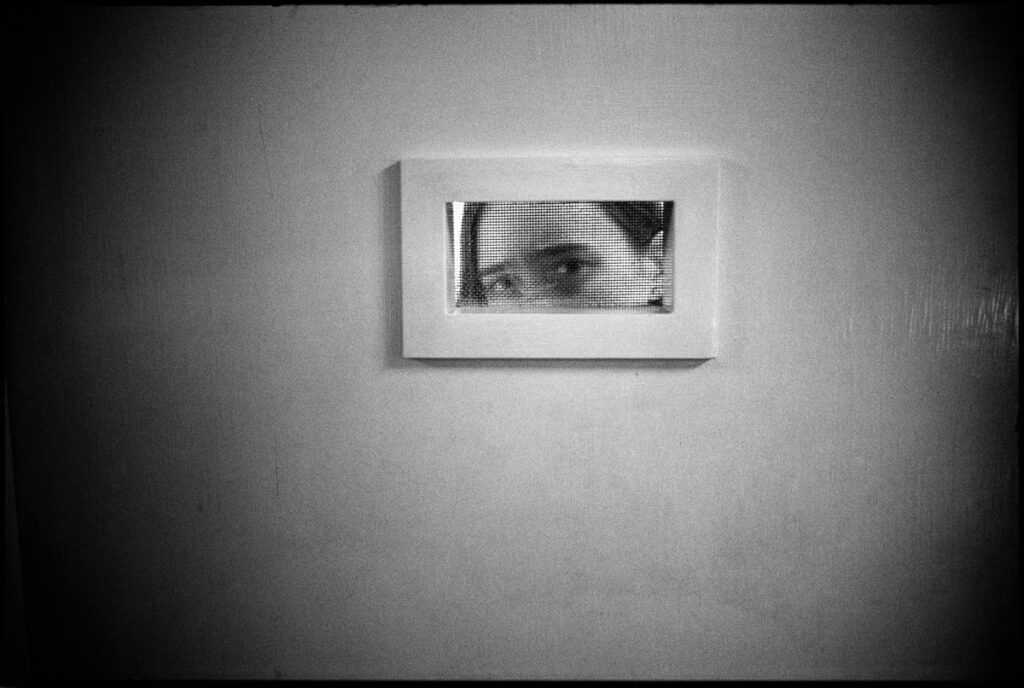
The exhibition starts with a dark-painted wall displaying photos taken on the set of Cuckoo’s Nest, featuring actors like Jack Nicholson and Louise Fletcher in their film roles, along with other now well-known actors, all inside the hospital. During these scenes, some residents were involved and asked to offer feedback on authenticity. Then Mark was able to shoot her first tentative photos of a few of the women. She frames them full-body and maintains a respectful distance. Her subjects stare at the camera, not yet knowing the photographer. One hides behind a poignant self-portrait drawing. These photos are more about the place than the people. During this time, Mary Ellen began to conceive her future project. These early images are different from the work she would later create with the women.
The Cuckoo’s Nest film was based on a famous 1960s novel by Ken Kesey, a counterculture LSD advocate who had, when he was a writing student, worked in California as a night aide on a psychiatric ward at Menlo Park Veterans Administration Hospital. While there, he took part in notorious government-operated drug experiments where they administered acid and other hallucinogens to participants in controlled environments. Kesey found the hallucinogens enlightening, noting they mimicked states of untethered psychosis.
In the film (as in the book), the anti-hero Randall McMurphy, an unsavory yet charismatic borderline criminal played by Jack Nicholson, chooses to “act crazy” to secure a short stay in a mental institution to avoid prison, believing it will be easier. There, he clashes with the power structure and tries to rally other patients to resist the system, which is represented by the oppressive head nurse (played by Fletcher). After numerous confrontations, the nurse retaliates by administering shock treatments and ultimately a lobotomy to McMurphy.
Like many portrayals of psychiatric hospitals in fiction and Hollywood, Cuckoo’s Nest is exaggerated, presenting a cartoonish, operatic view of life inside. However, the now-classic film was so popular that its images became deeply ingrained in the public consciousness, especially the scenes depicting electroconvulsive therapy. The film sparked renewed interest in mental health. This provided Mark the needed connections to gain entry to the hospital for her proposed project. Her subsequent work there, after the film’s release, provided a much more realistic, nuanced view of the same hospital. She chose to focus on the women, (the film focused on men).
The rest of the exhibition quickly moves beyond Hollywood clichés to showcase numerous images of about ten women who lived on Ward 81. Only those who gave their consent (along with their family and the administration) were documented by Mark. She didn’t read anyone’s case files before working with them, so she had no preconceptions. This allowed her relationship with them to develop organically. In the exhibition, each woman is portrayed through a series of grouped photographs, often accompanied by their personal quotes displayed as wall text. This has a cinematic power. They appear alone and together in the black-and-white photographs.
This format gives them a timeless, formal beauty associated with renowned photographers and filmmakers of the twentieth century. Most are close-up or medium shot portraits cropped to emphasize emotional expression. The camera angles twist and rotate in surprising intimate ways.
These depictions are far from the bizarre world of Cuckoo’s Nest. During this era, as a nod to “normalization” (the then-new term for the goal in helping residents return to community living), residents were encouraged to express their individuality by wearing their own clothes, jewelry, and makeup, and to care for themselves as much as possible. This was very progressive at the time. The old hospital-patient relationship was being phased out, though the long, narrow ward remained locked and looked the same. Most of the women are young, though a few are older. They often seem hopeful, sometimes humorous, even in these difficult circumstances.
There is also a deep sense of pathos throughout. The women were being held against their will for the most part. They were often confined to their rooms, with nearly every aspect of their lives controlled. All were experiencing intense internal turmoil that was poorly understood at the time. Self harm was a daily concern, residents tearing and biting at their flesh or cutting themselves, sometimes to the bone. Suicide was a shadow forever present, the ultimate destruction. Mark did not shy away from these truths, nor did she exploit them. The questions here are complicated. Some procedures and equipment may seem cruel, even gruesome, but they are a reality in a world where the desire to self-harm and do violence is a constant concern for those who, in good faith, are trying to help those in their care.
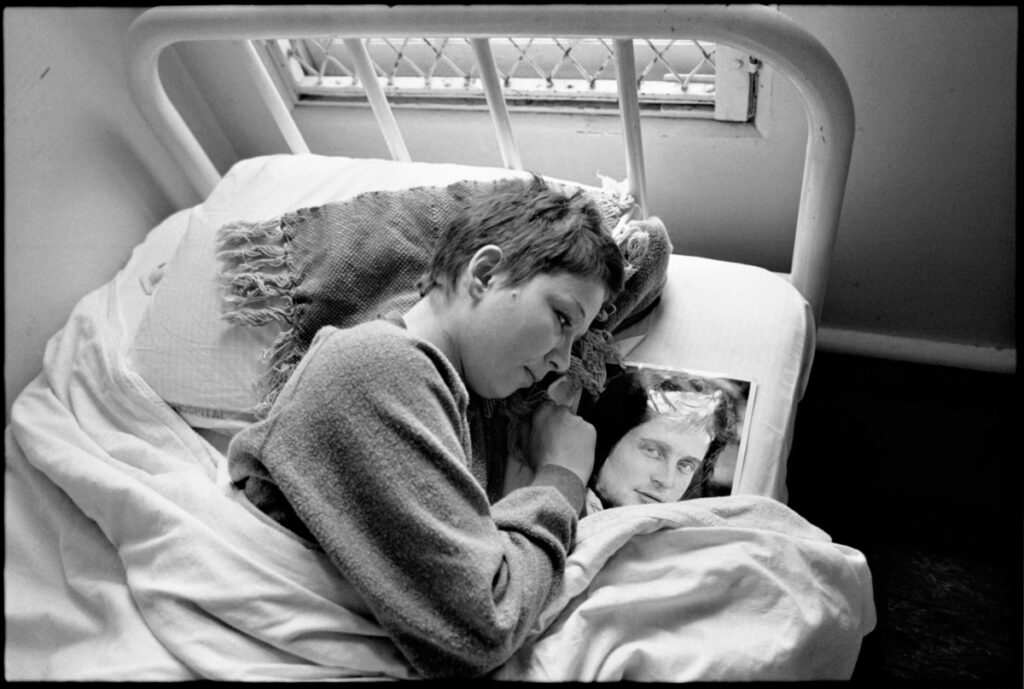
One wall in the show presents tender, sometimes fierce images of a woman named Mona. In the first photograph, she lies in bed and cradles an apparent gift—a picture of a handsome young Michael Douglas, who had produced One Flew Over the Cuckoo’s Nest and been on set. In the accompanying text, the women often discuss their annoyance at a lack of access to men. They joke about running off with them. Who wouldn’t want to escape?
A new essay from Ward 81: Voices reveals how much the women residents also discussed the violence they had endured at the hands of men on the outside, and hints at the role such abuse may have contributed to their illnesses. Mona’s hair is close-cropped. She has piercing, dark-lined, sultry eyes and a taste for cigarettes.
In a series of images, Mona poses with a woman named Beth, who is taller and has longer hair. The two appear as a couple, sometimes embracing lovingly. One moving photo shows the two in a shower in swimwear, apparently taken before or after a visit to a pool. Mona strikes a cool, defiant pose here, wearing a life saver flotation vest while water flows down her face as she stands side by side with Beth.
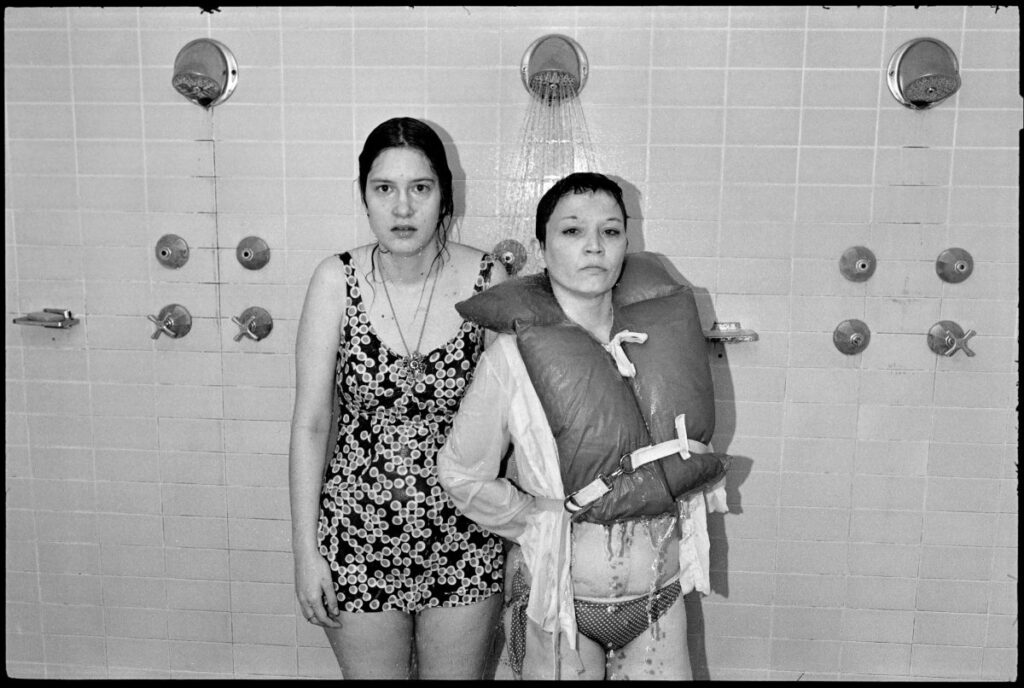
Genders were separated in these hospitals, making the fluid nature of bonding, desire, and sex even more apparent. In my experience, queerness was more accepted in such places than it was in the outside world at the time. Homosexuality of any kind was considered a disorder by the mental health establishment from 1952 through 1973. By the time of this project, most staff were more accepting, while some families and doctors may still have tried to discourage it. Mark presents Mona and Beth’s relationship as tender and positive, an island of love and connection in a sea of isolation. It is one of the most touching highlights of the show.
Many of the women in Mark’s images appear playful, very aware of the camera, and enjoying the attention. In one photograph, another woman brandishes a camera, prompting the question: What if Mark had empowered all the women there to use cameras, to become the chroniclers of their own lives, if even for a short while? What if they taught them photography, gave them the gift of making art? No such inverted work is included. I wish it did.
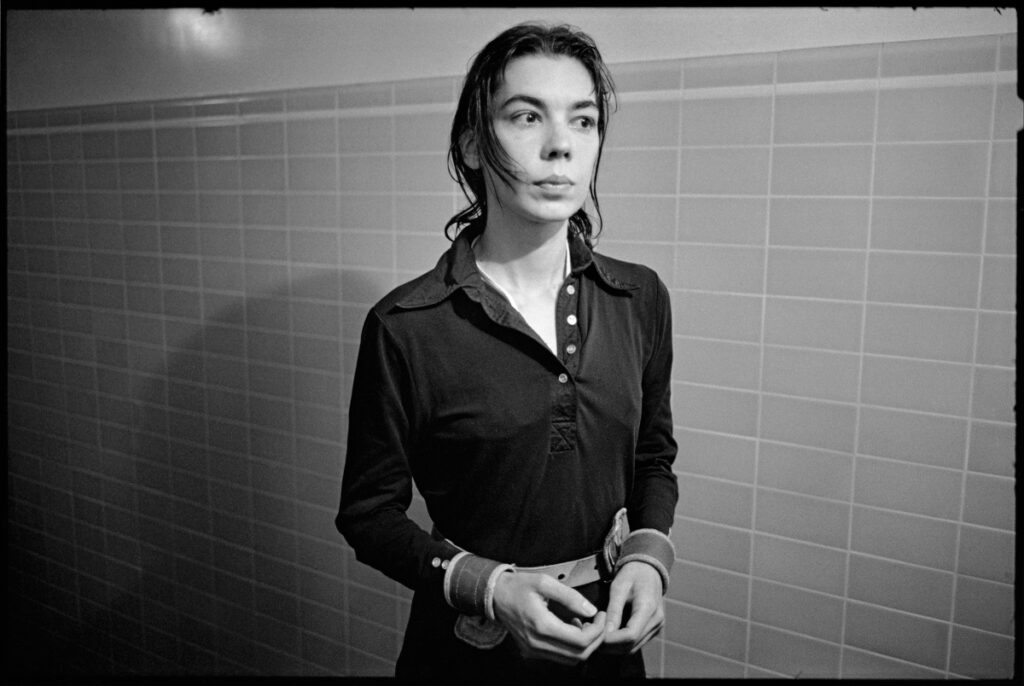
Carol T., a slender young woman dressed in a dark dress, with a long, elegant neck and sharp lips, looks as if she stepped out of a lead role in a college play, except that she is wearing a restraint belt that keeps her hands pressed to her sides, locked at her waist. This portrait exposes the darker side of psychiatric hospital care. Restraints, a common feature in these wards, were used to prevent people from hurting themselves or others; a normal part of life in Ward 81. Another striking image of Carol T. finds her examining herself in a large mirror, hands free.
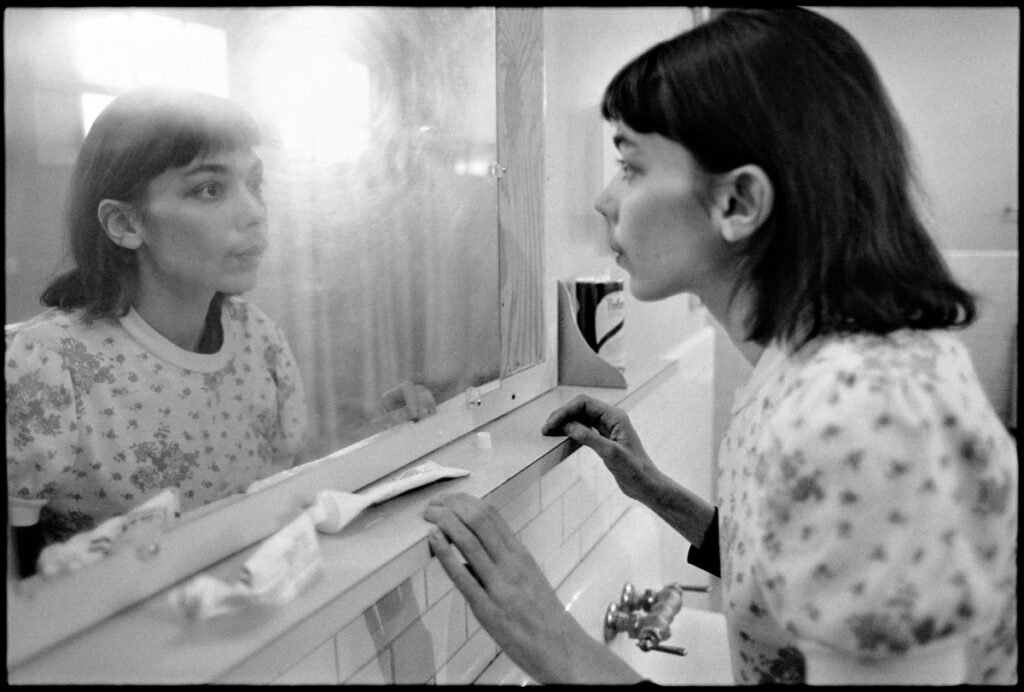
Mary Ellen MarkI wanted to help these women make contact with the outside world by letting them reach out and present themselves. I didn’t want to use them. I wanted them to use me.
In a 1978 interview with Mark published in Time Magazine, she describes, “Looking back now, I feel that the pictures are almost like a scrapbook, a memory of a certain time in my life and in theirs. I wanted to help these women make contact with the outside world by letting them reach out and present themselves. I didn’t want to use them. I wanted them to use me.”
Mark also managed to photograph electroconvulsive therapy (ECT) being administered to an older resident named Mary Iris. ECT was used especially with patients who had a tendency to inflict severe self-harm. It causes seizures, calming the patient but leading to stupor and memory loss. It was believed to help make them manageable afterward. It also served as a punishment, even if unintentional.
Mark insisted on capturing the procedure while maintaining the patient’s dignity. Still, the resulting images are difficult to view, illustrating one of the dilemmas contemporary curators face when showcasing her most challenging work. These photographs, along with others that bear witness to self-harm, are essential to providing context. They reveal the truth of the residents’ lives. The book notes that none of the residents on Ward 81 agreed with ECT for any reason; they all feared it and were confined to their rooms during its administration to others. The audio tapes document that this made Mark even more determined to capture it.
ECT is still used today for major depression, bipolar disorder, and catatonia, but cautiously, and only after other treatments have failed. Also it is at much lower levels.
One photograph shows an orderly at a table surrounded by pills to be taken by the women. The front of the desk is covered in handwritten facts, dates, rules, and some humorous advice. It depicts the human day-to-day side of working on Ward 81. But this is one of very few images of the staff—none approaching the intimacy of the portraits of the women. Perhaps while the administration agreed to the project, those working there did not want to be portrayed.
In another image, the superintendent Dr. Brooks chats with a resident at her door. It is taken from a distance, and we get no sense of him as a person. He was considered a progressive in the field at the time and led many reforms. Without him, the Ward 81 project would not exist. Still, as with the staff, Mark’s photos do not offer much glimpse into his relationship with the residents.
Born in 1940, Mary Ellen Mark grew up in a Pittsburgh suburb, where she was, by her own account, popular. There are photos of her as a lively cheerleader, her signature long black hair flowing. Her talent for attracting and connecting with others emerged early and became a key part of her success. She loved art and studied painting at the University of Pennsylvania, earning a BFA in 1962. She found her passion when she switched to photography. She received a Master’s Degree in photojournalism from the Annenberg School for Communication in 1964. She met her collaborator and husband, Martin Bell, in 1980 on the set of Ragtime, another of Milos Forman’s films. They lived together in a large Soho studio for the rest of their lives. Over the years, he made fifteen films based on her work.
In a 2005 interview with Spectrum magazine, Mark revealed she came from a “troubled home.” Her father suffered several nervous breakdowns and was hospitalized when she was young. Maybe this is the seed of what drove her, especially on the Ward 81 project. Such a difficult personal experience at a young age gave her greater insight into the plight of those cast out and in need of help.
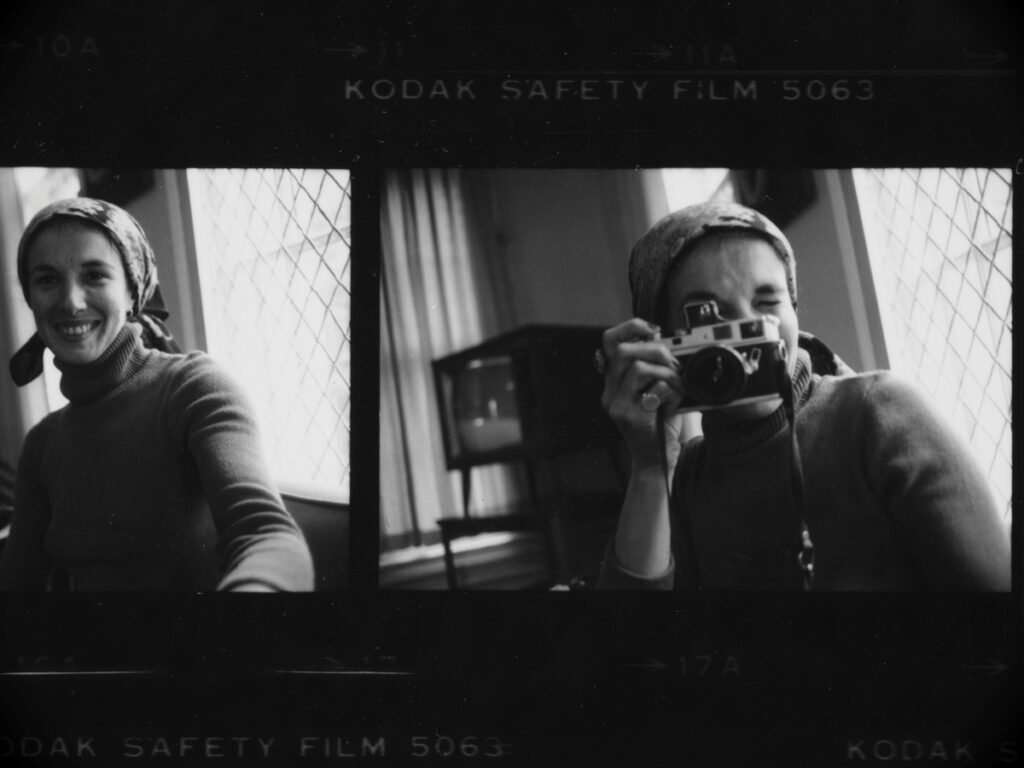
In addition to photographs, the exhibition showcases ephemera, such as small cards with images and notes from the time. It includes contact sheets, release forms, letters, and personal snapshots. There are small Polaroids like those she took on the ward and shared with project participants. A short video by Martin Bell pairs images of the Ward 81 women with audio recordings of their commentary. There’s also later audio of three women from the original project that Bell managed to find. It’s quite moving and leaves one wishing they had done more of this much earlier.
It’s impossible to view this show without questioning the ethics of the work. When someone is in a severe mental crisis, are they fully able to consider what they are agreeing to? Few have less power than the incarcerated. Did the attention, friendships formed, and positive portrayals make it all acceptable? Is the series simply documentary journalism? Are we, as viewers, voyeurs? How much money has the artist and others earned from this project over the years? What, if any, obligations are there to those depicted as time passes? These issues are central to much of Mark’s work. Interviews with her over the years offer a variety of thoughtful answers, she obviously wrestled with the issues.
In an interview with The Pennsylvania Gazette in 1978, Mark explained, “I don’t want to exploit people’s misery. What this project means to me is, in a way, reaching inward and reaching outward… It’s me reaching inward just to try and feel and touch these women. And them reaching outwards to try and tell the people that are going to see the pictures: ‘Here I am.’ And that’s what I think a lot about when I photograph. It’s not only me reaching inwards, but I think about the effect that that person is going to have.”
Creating this series today would be difficult, probably impossible, due to strict HIPAA laws, enacted in 1996 to protect patients’ right to privacy, and the changing nature of treatment. A few recent films explore similar themes, including 2019’s Bedlam, a four-part documentary series about patients at a well-known mental hospital in South London, and HBO’s moving 2024 documentary One South: Portrait of a Psych Unit, which follows a group of teenagers through treatment. Both are sensitive portrayals and clear successors of Ward 81. While neither matches the immersive quality of Mark’s works, they expand the conversation to include family and treatment staff and show how much progress has been made in treating debilitating illnesses like anxiety, OCD, anorexia, bipolar, and borderline disorder.
After Ward 81, Mark created many more series that gave visibility to other marginalized groups. My favorite series of hers is Streetwise. It focuses on a group of very young street kids in Seattle, Oregon. At its center is a feisty fourteen-year-old named Tiny who turns to prostitution for money (a running theme in Mark’s work). This became a controversial Oscar-nominated documentary that Mark made with her husband.
It is fitting that this exhibition is on display at UMBC, a university that continues to emphasize social responsibility and promote difficult conversations. In an ironic turn, during my research for this article, I learned that in May 2022, UMBC acquired the 175-acre campus of Spring Grove Hospital Center in Catonsville, Maryland—a 225-year-old psychiatric hospital not far from the university. The state transferred the grounds for $1 to support the university’s long-term growth. The site is slated for repurposing, but the hospital will remain operational there for at least a decade. While Spring Grove Hospital Center is currently considered a modern psychiatric facility, it has a checkered past that includes many issues depicted in Ward 81 and discussed in this article. A panel with current providers from Spring Grove (which includes the Johns Hopkins Bloomberg School of Public Health) commenting on Ward 81 would be of interest.
Since Mark’s death in 2015 at age 75, the Mary Ellen Mark Foundation, with a board led by her husband and two of her long-time assistants, has continued to preserve her work and ensure it is properly exhibited worldwide. The foundation also offers grants to emerging photographers.
Mark deserves a major retrospective of all her work. Karen Folger Jacobs later served on the 1978 President’s Commission on Mental Health during the Jimmy Carter administration. She has taught around the world, won numerous awards, and currently lives in Berkley, California
The Ward 81 project offers a compelling look into a community that few understood or depicted at the time. Mary Ellen Mark and her team were courageous explorers, delving into a once-taboo subject and shedding light on a small group of women they hoped to better understand and assist. Whether they achieved their original goals remains open to debate, but the quality of the photographs is undeniable, and their effort was both brave and exhilarating.
There is still a lot of work to be done in mental health treatment. It is a rapidly changing field. Today, many women like those who lived on Ward 81 could end up homeless or incarcerated in for-profit prisons, where their victimization is worse. The homeless crisis, which is closely linked to psychiatric disorders, has grown so large that the public seems numb. Many people facing mental health challenges today lack access to any treatment, especially in rural communities.
One positive—mental illness is now much less stigmatized. It is discussed more openly, and many books on the subject are available. The more we talk about it and share our experiences, the better. This exhibit helps push that conversation forward. As the current generation of artists once again takes up political and social issues as important subjects, and many groups are pushed further to the margins and need representation, Mary Ellen Mark becomes an increasingly vital artist elder.
Mary Ellen Mark: Ward 81 is exhibiting at The Albin O. Kuhn Library Gallery at the University of Baltimore in Baltimore County: January 16 – May 22. Admission is free.
Library Gallery hours:
Monday, Tuesday, Wednesday, Friday: 10 a.m. – 5 p.m.
Thursday: 10 a.m. – 7 p.m.
Saturday and Sunday: 12 p.m. – 5 p.m.
Dr. Kaitlin Booher (Associate Curator of Photography, Columbus Museum of Art) will be in conversation with Dr. Holly Avella (Assistant Professor, Media & Communication Studies, UMBC) at the Library Gallery on Thursday, April 2 at 5:00 pm. A reception will follow. The event is free and open to the public.