“Iconic” and “librarian” are two words that rarely go hand in hand. This is true even though there have been a number of well-known librarians: Audre Lorde, Jorge Luis Borges, Benjamin Franklin, and Lewis Carroll, to name a few. However, I would classify these historic figures as “secret librarians” because their fame came from prowess in other professions.
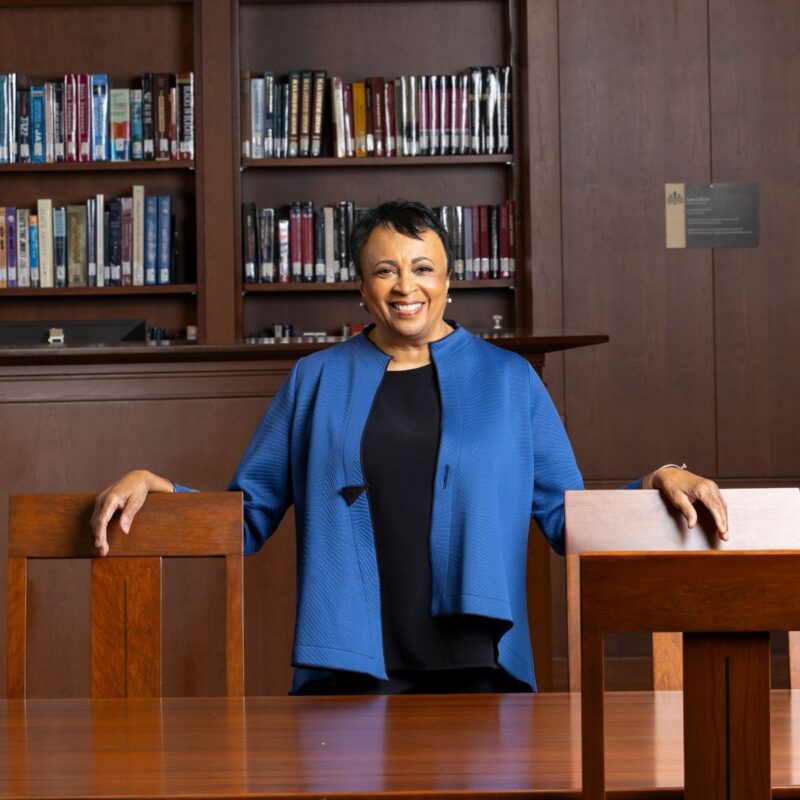
Dr. Carla Hayden, however, is an iconic librarian in the truest sense. Hayden spent most of her career here in Baltimore, as the CEO of the Enoch Pratt Free Library. She left that role to serve as the 14th Librarian of Congress (LOC) until she was abruptly removed from her post by the current administration, along with over 100,000 other civil servants during the first half of 2025.
She was the first woman and the first Black person to be appointed to the position. There, she sat at the helm of the largest library in the world, which houses more than 180 million items in 470 languages, and boasts the largest rare book collection in North America. Founded in 1800, the LOC is massive in scope. Its roughly 3,000 staff not only support members of Congress with legislative research reference, but also serve the American public in acquiring and making available an unparalleled collection of books, periodicals, photographs, legal materials, films, maps, sheet music, and sound recordings.
While we typically think of libraries first and foremost as places to seek and find information, Dr. Hayden is quick to point out that they are also sites of inspiration. Not only do library holdings help patrons conduct academic research, complete their taxes or submit housing vouchers, but they are also a tool for artists.
At the LOC, for example, Hayden helped facilitate the joint purchase (along with the Smithsonian) of the earliest known photograph of Harriet Tubman. It’s a rare glimpse of Tubman closest to the era in which she helped shepherd over 300 enslaved people to safety via the Underground Railroad. In the previously unknown work found in an abolitionist’s photo album, Tubman appears young, strong, defiant. Hayden remarks that a key reason for LOC’s role in the purchase was to aid with the digitization of the photograph which—because it is in the public domain—can be used by all of us. And, as Hayden reports with glee, it has been widely used. Like many of the collection’s photographs, an image like this is essential for documentary films and other creative works that rely on public domain and open access works to illustrate historical moments. They can help bring long buried stories to life.
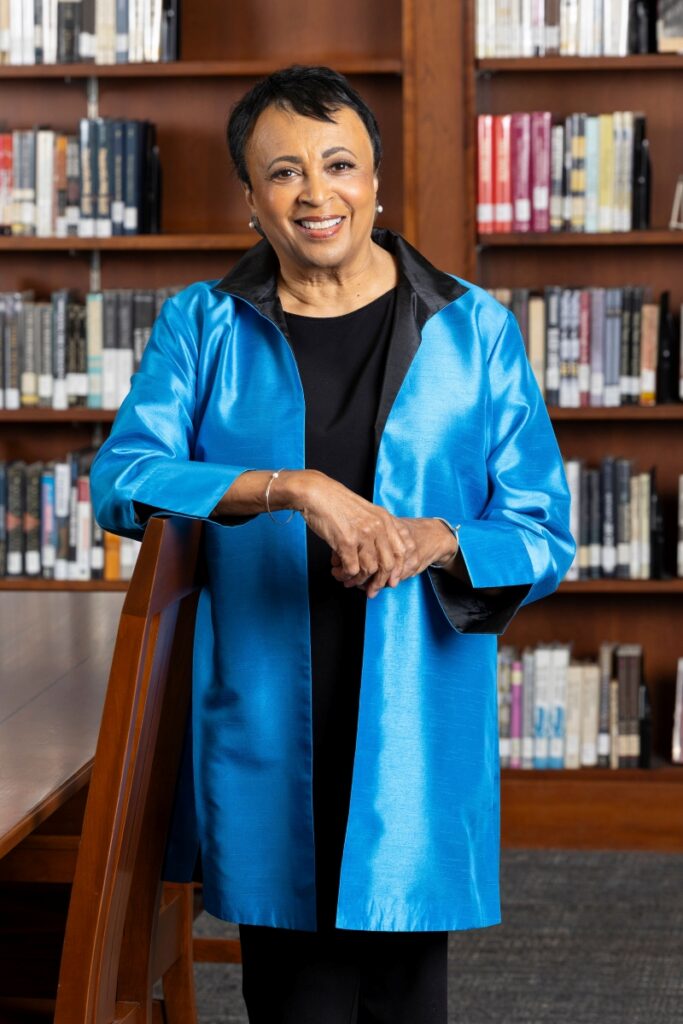
Siân EvansWhile we typically think of libraries first and foremost as places to seek and find information, Dr. Hayden is quick to point out that they are also sites of inspiration.
For librarians and Baltimoreans alike, Dr. Hayden was iconic long before she arrived at the Library of Congress. Her commitments to the city of Baltimore, which she still calls home, and to her chosen profession run deep. A Florida native who grew up in New York and Chicago, Hayden began her career in libraries at the University of Chicago, where she got her MLS and her PhD in the late 1970s and 1980s. She started her career as a children’s librarian, which she contends instilled in her a lifelong love of art. Illustrated books “make stories come alive” for children, in much the same way that art “opens up mental space and stimulates thought for all learners,” Hayden explains.
Indeed, it was children’s librarianship that in 1993 brought Hayden to Baltimore. Part of her reasoning for taking the position of CEO of the Enoch Pratt Free Library was that it was the “birthplace of services to young adults.” In 1932, Margaret Edwards was hired at the Pratt and transformed library access by bringing books to the people: introducing “book talks” at local schools and even implementing a horse-drawn book wagon. This wagon served as a precursor to today’s Bookmobile, which provides free WiFi, materials lending, and library card services to residents unable to visit an official branch. Edwards also authored The Fair Garden and the Swarm of Beasts: The Library and the Young Adult, a foundational book on adolescent library services, which was originally published in 1969 and continues to be used today.
During her tenure at Enoch Pratt, Dr. Hayden also served as the president of the American Library Association (ALA) from 2003-2004 and was the first Black person to be awarded Library Journal’s Librarian of the Year Award, in a field that is still roughly 85% white. While she was ALA President, she came to prominence for her public debates with then Attorney General John Ashcroft about the federal government’s attempts to gain unwarranted access to library records through the Patriot Act. This was a fierce defense on behalf of legions of librarians who were incensed by what they saw as government overreach. After 9/11, law enforcement sought to mine public library user data to identify potential terrorists Hayden sees her role then as supporting her constituency of librarians who were deeply invested in patron privacy. “The need for balance between public safety and personal privacy in looking at information became a major focus of my tenure as the ALA president,” she says. At the time, Hayden balanced this public, national role with her local work at the Pratt.
Hayden’s care for the City of Baltimore and the patrons of the library is palpable in all that she did here, including a $115 million renovation of the central library in Mount Vernon which saw the creation of the library’s African American reading room. This room is deeply personal to Hayden who shares, “My first interviews after my termination [from the LOC] were in this room, and it was so comforting.” The wood paneling with built-in book shelves has a home-like feel to it: bright, warm and inviting.
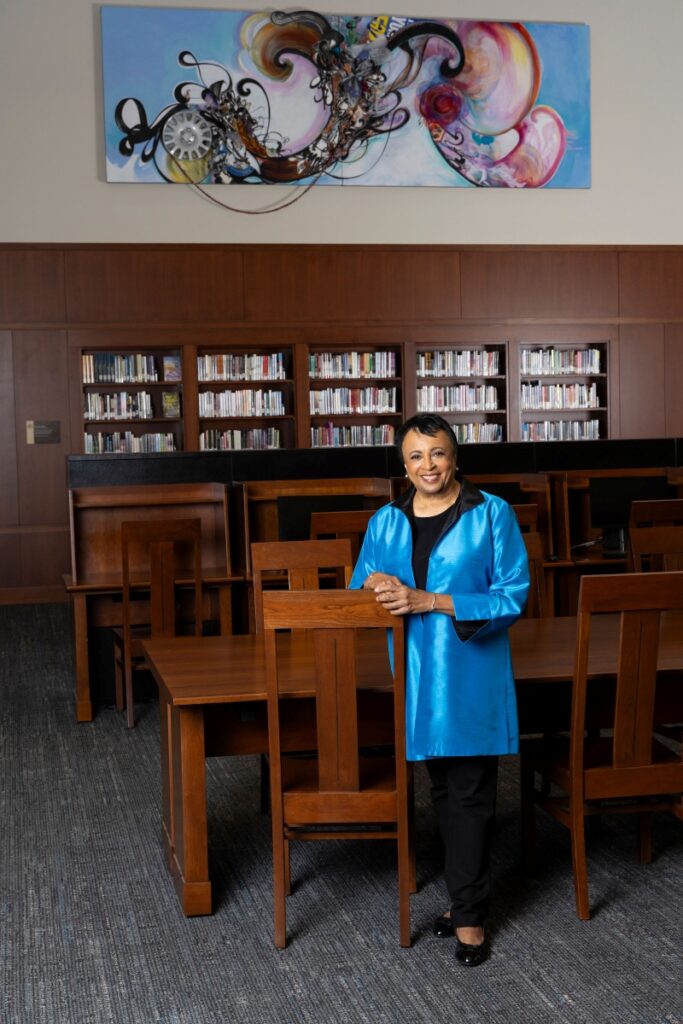
When I visit the room on a sunny Saturday, I find patrons reading and watching films on the public computers, while a small group of folks hold an impassioned whispered discussion at one of the long wooden tables. All this lively activity is flanked by two colorful works of art selected by Hayden and her team: Shinique Smith’s First Born of the Child’s Sunrise (2012-2016) and Sam Gilliam’s Listening (2012-2014) which hang on each end of the room.
Hayden says she wanted “place-based work” that was globally relevant for the newly created space. She didn’t want the decoration to feel like a stereotypical parade of “great African Americans” from history. So, like a good librarian, she did her research. It didn’t take long to come across the art of Baltimore-born Shinique Smith who was, as she puts it, “blowing up at the time.” Smith’s sculptural painting combines found objects like ribbon, fairy wings, summer church hats, and a hubcap with collage, calligraphy, and bright pastel acrylic paint on a wood panel, bringing the hubbub of the Mount Vernon streets outside into the quiet contemplative space of the reading room.
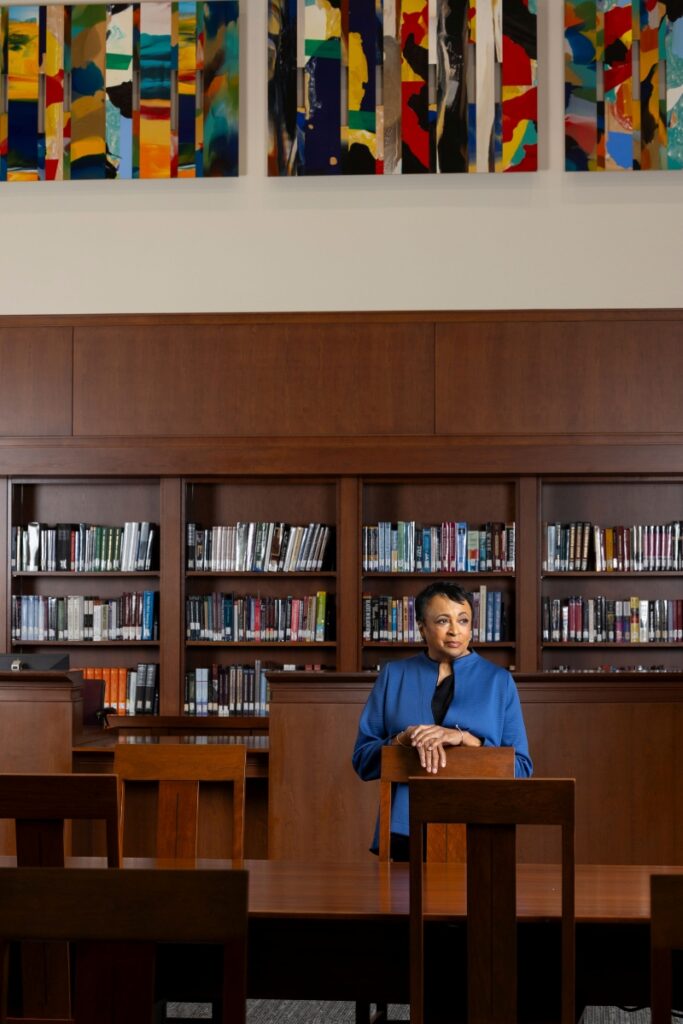
Directly across, Gilliam’s Listening also plays with the line between painting and sculpture. A series of colorful acrylic panels on birch, the work hangs directly above the reference desk, contributing to the air of brightness in the room. Gilliam was an internationally renowned DC-based Black abstract artist famous primarily for his drape paintings from the 1960s and 70s, which consisted of vibrantly stained unstretched canvases draped in space. When I ask how the Pratt acquired this piece, Hayden laughs, “I knew Sam but didn’t think he would go for it. Then the donors stepped up.”
There’s always the question of money when commissioning—or even accepting—gifts of artwork in a public library. Patrons and politicians alike might ask: why not use that money for an after-school program, for example? But Hayden knows that having art in libraries democratizes it. She argues that, because libraries are typically visited more frequently than other cultural institutions, commissioning art brings it to the people. You can, of course, go to the Baltimore Museum of Art to see Smith’s work, but its placement in this room makes space for an “informal exposure to art” that, Hayden says, is not unlike the serendipity of browsing the library stacks. You might go to the library looking for one thing, but leave with an entirely different book, idea, or a new favorite artist.
But not all patrons visit the central library. Baltimore is, in Hayden’s words, “a city of neighborhoods.” And for Hayden, all those places can and should be graced by art. Artworks scattered across the Pratt’s libraries include the bust of Baltimore-born guitarist and satirist Frank Zappa outside the Southeast Anchor branch in Highlandtown and the two-story Pennsylvania Avenue branch mural that survived the unrest of 2015 in response to the killing of Freddie Gray in police custody.
The unrest was another pivotal moment in Hayden’s career. She garnered national attention by making the bold decision to keep the branch open, despite it being the epicenter of the activity. Tellingly, the Pennsylvania Avenue branch remained untouched. When I ask her about the long tail of that experience, she says that she felt that moment “reinforced the relationship of the Enoch Pratt Free Library with the people of the city. It was, and remains, a place of refuge and access to what people need in their daily lives.” Libraries exist, first and foremost, for their patrons, even and perhaps especially those who are in distress.
I’m a librarian myself and as we’re wrapping up, I tell Dr. Hayden that I plan to begin this piece with a joke about “iconic librarians.” She laughs wholeheartedly and asks me if she’s told me about where she lives. It turns out that Hayden lives in a rather non-descript apartment building designed by a very young Frank Gehry. It isn’t showy or stylized like the work he’s famous for. It’s like a little, obscure secret that you might only discover through deep research or, in my case, a casual conversation. With a youthful giggle, she proclaims that it is “the most boring Frank Gehry building, which is a source of pride. I thought it appropriate for a librarian.”