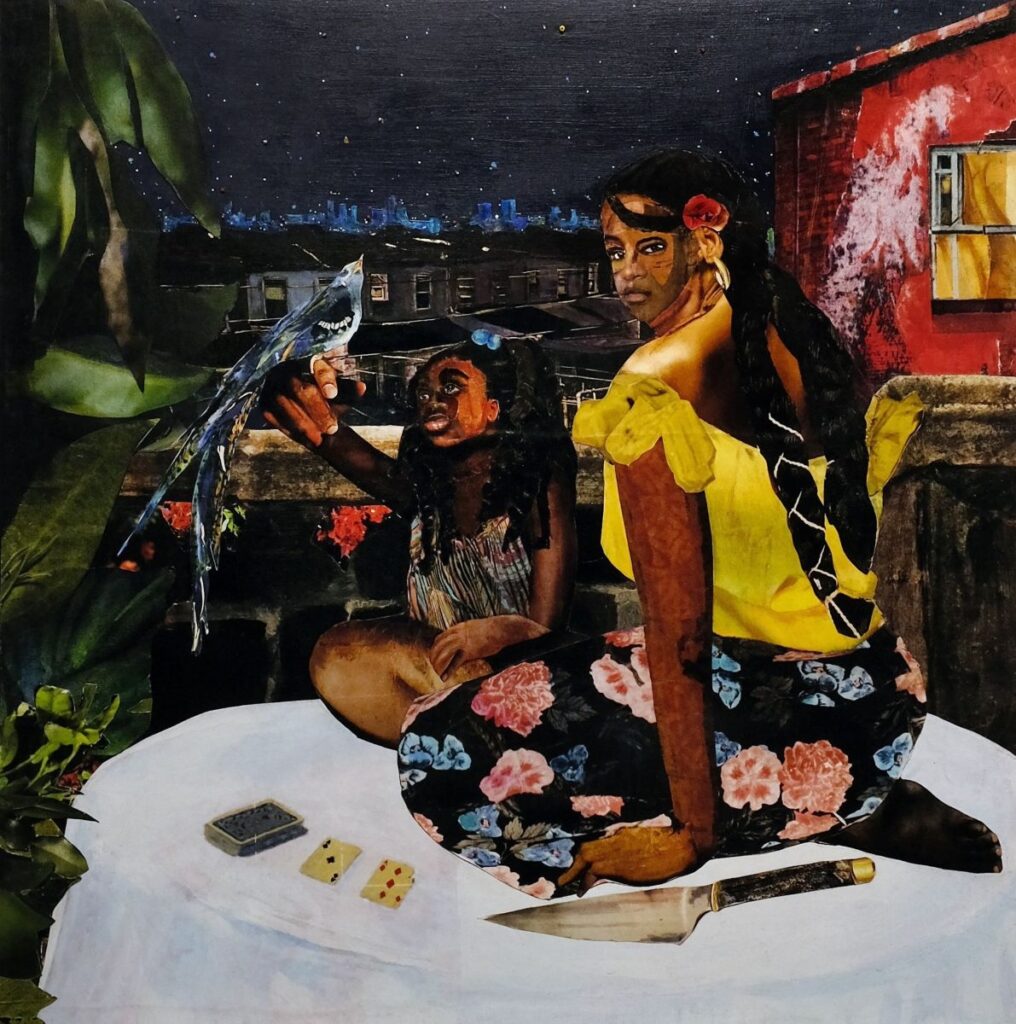
A young Black girl sits in the center of Brianna Faulkner’s collaged work “Solitaire.” Her hair is in big twists and her eyes are full of wonder as she looks up at a blue bird with a brilliant plume of feathers, delicately perched on her outstretched hand. A wall of luscious palm trees stands just behind the bird. On the other side of the girl, her mother sits with a gaze fiercely fixed on the viewer. The mother sits between the viewer and her daughter and makes it clear that she will stop at nothing to protect the little girl and her paradise. A sharp kitchen knife rests right by her hand, for anyone who wants to call her bluff.
The little girl looks up at the bird, who in turn looks up to the sky. A row of rowhomes and cityscape glow in the midnight light behind them, but the girl and the bird are completely unaware, for their dream shines in the night sky with a lunar serenity. Theirs is a dream of flight.
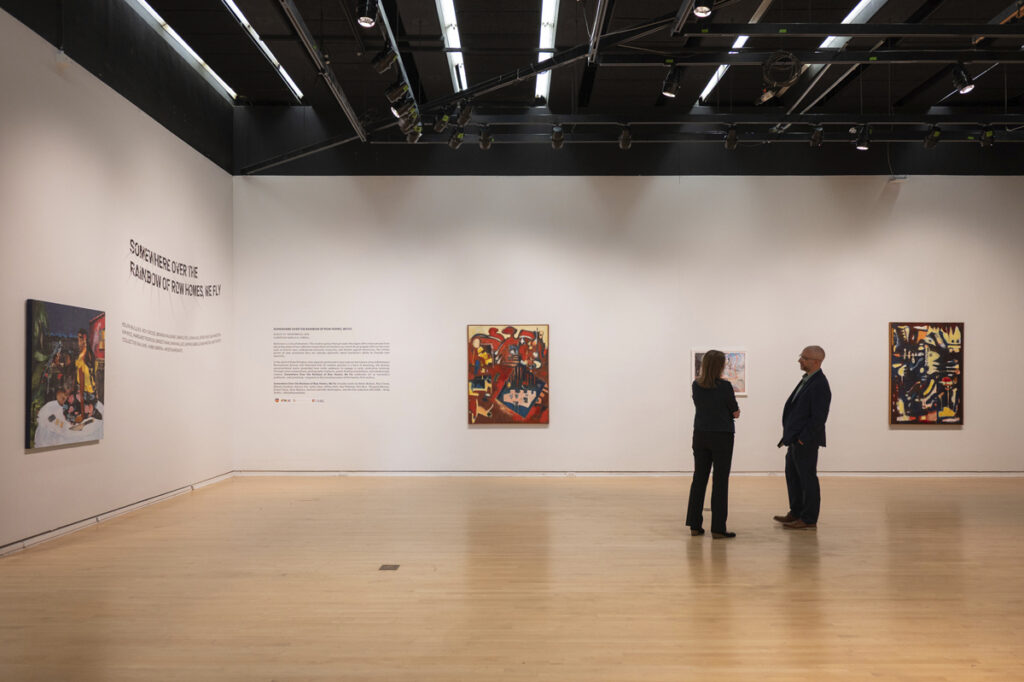
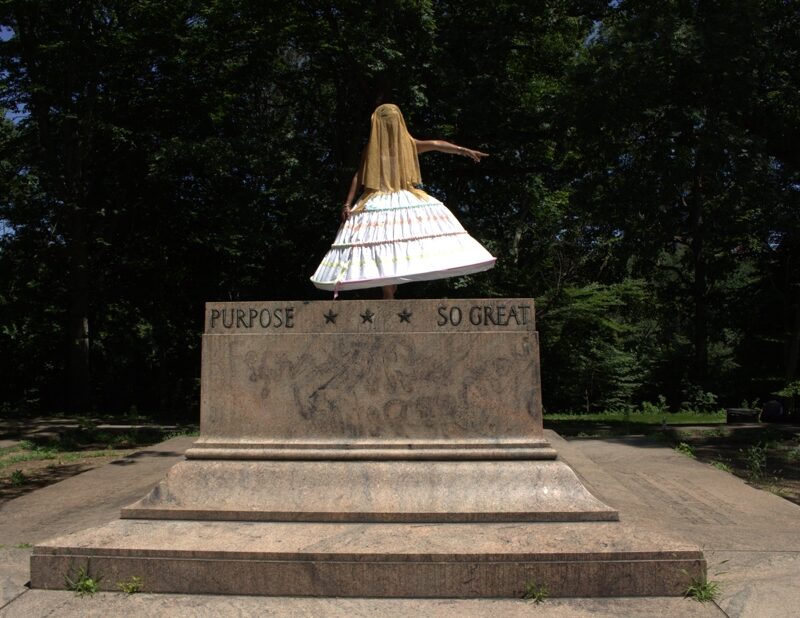
Somewhere Over the Rainbow of Row Homes, We Fly is the latest show composed by writer, curator and art historian Angela N. Carroll at UMBC’s Center for Art, Design, and Visual Culture. Across a diverse presentation of 5 films, 5 photographic installations, two paintings, two sculptural pieces, and a large collaged piece, Carroll brings together thirteen artists from and deeply connected to Baltimore to tell a story—not just of the city—but about its people, its ideas, its failures, and its glories.
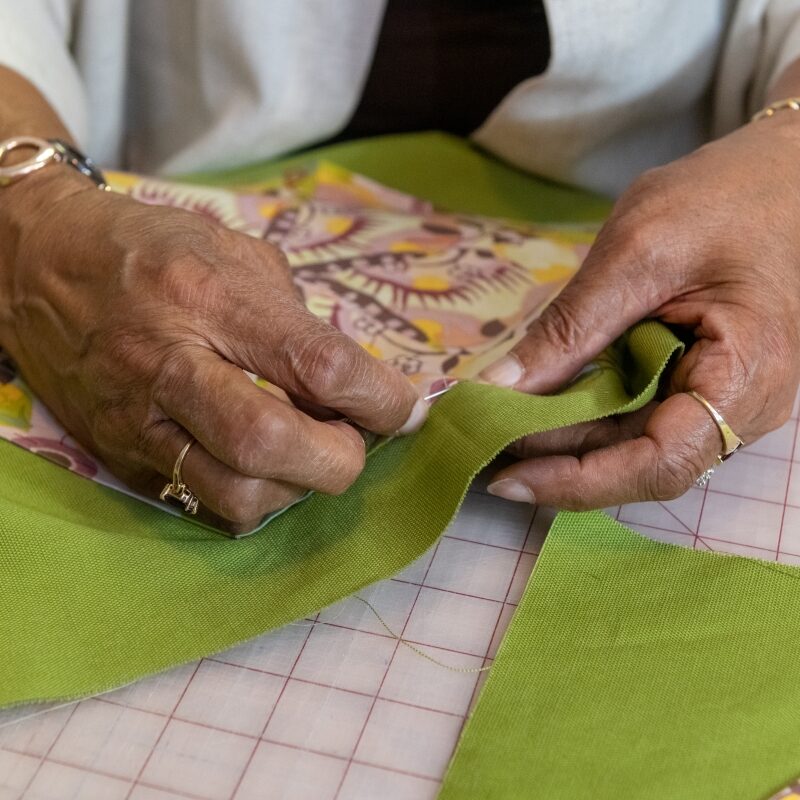
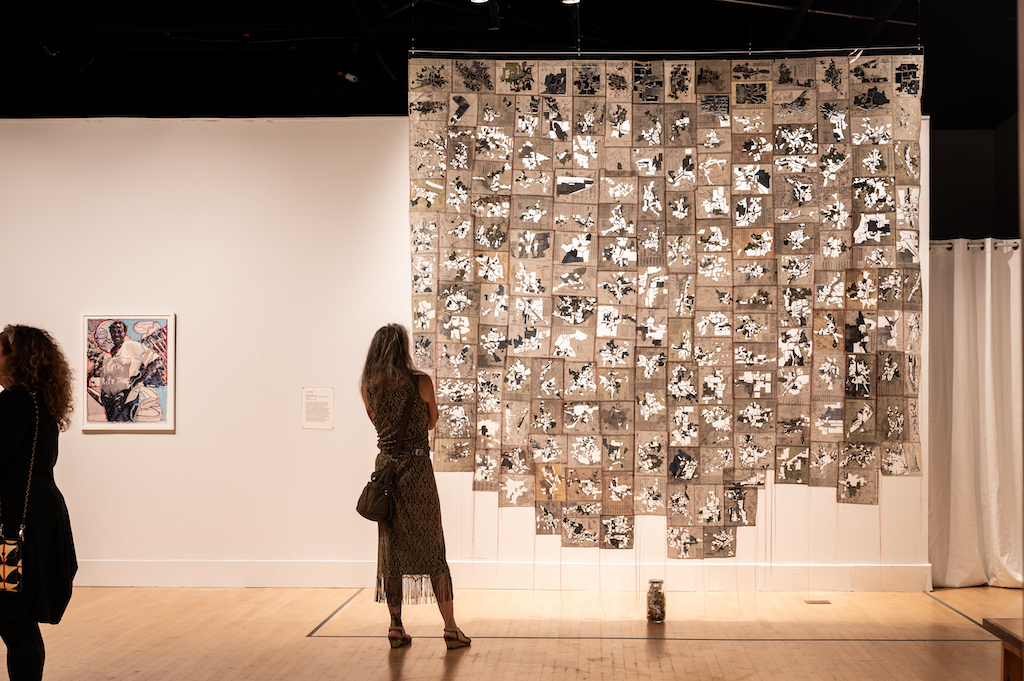
Baltimore is a complex city with a complex history. While Baltimore was once the US city with the highest population of free Black folk decades before the Emancipation Proclamation, it was also the nation’s first city to pass a racial zoning ordinance in 1910, specifically segregating blocks by race. This set a precedent for “redlining,” a practice of grading and color-coding neighborhoods by race and prohibiting people of color in “hazardous” neighborhoods, marked in red, from taking out mortgages to buy property. Artist Kim Rice confronts this history of housing discrimination in her work “American Quilt.”
Suspended from the ceiling, “American Quilt” is a massive composite of various American city maps where this practice was implemented. In each map, the neighborhoods which the Home Owners’ Loan Corporation (HOLC) deemed “hazardous” because of a predominantly ethnic or lower income demographic are cut out—literally wiped off the map—and relegated to a glass jar on the ground. The remaining skeletal maps are hand stitched together with lines of red thread in the shape of Baltimore. Loose red lines drip from the bottom of the quilt like the blood of a city whose scars never fully healed.
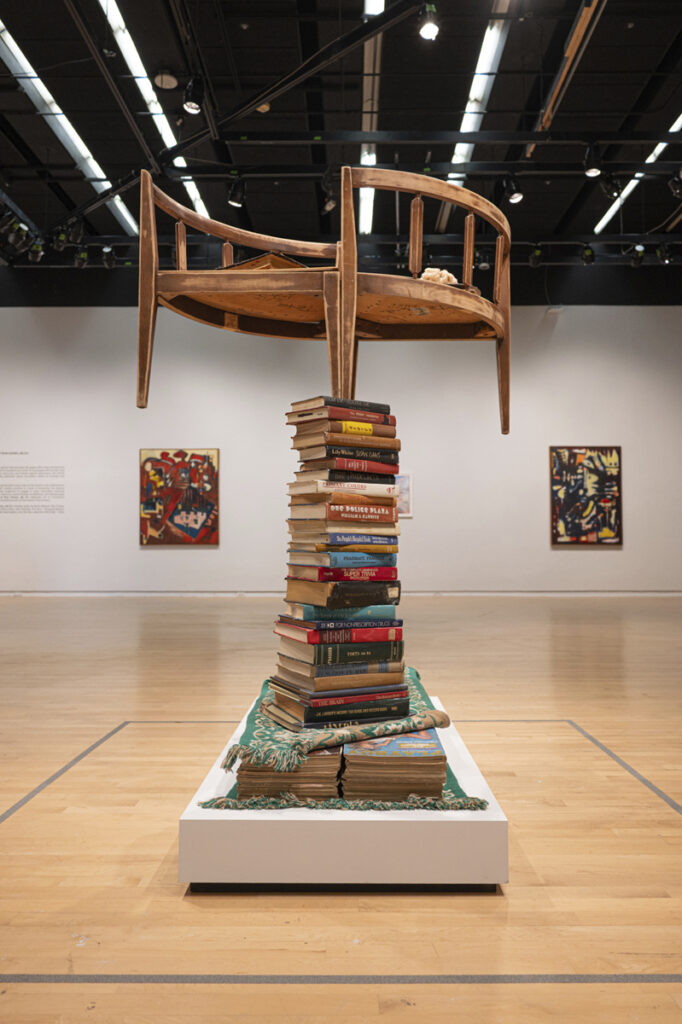
The city’s wounds trace back further, to those of an ailed country. Jeffrey Kent’s “Justice, Peace and Genuine Respect for All People,” offers a critique on a country that was built and maintained off of the objectification of people. Two Victorian benches are balanced precariously on two stacks of books, which are themselves stacked on countless Playboy and Playgirl magazines hidden under a rug. In one of the chairs, a gilded gavel sits on a weathered bible. In the other, a silver collection bowl with an offering of “ancestral picked” cotton lies on a special issue of EBONY Magazine called “The Black Soldier.” These two collections are given equal weight, but they raise the question: how can this be reconciled?
Two stacks of 26 books—ranging in topics from the physical body to the mind to social study and commentary—can be read both as feet of a body. Each stack of 26 books mirrors the 26 bones in each human foot. The 52 books can also collectively read as a house of cards. Either way, the structure is built on unsteady footing and bound to crumble under scrutiny. The tension between the promise of “peace, love, and genuine respect for all people,” and the reality of precarity, lust, and forced labor is palpable and can only stand for so long before toppling under the weight of its inconsistencies.
A semi toppled house stands central in Jasmine Gabrielle Washington’s photograph “Remembering Forward.” The house has been her family’s home for generations. Through the title, Washington bridges the elusive past with an approaching future. She considers what it meant for a Black family to own land in the south in the 1900s—an act of resistance against a system designed to exclude. There’s a compelling disparity between the agency of a Black family owning and maintaining their home for generations and the state of disrepair the house takes in Washington’s photos. It underscores that care is a continuous effort. Preservation is constantly battling the forces of entropy. Love is a verb.
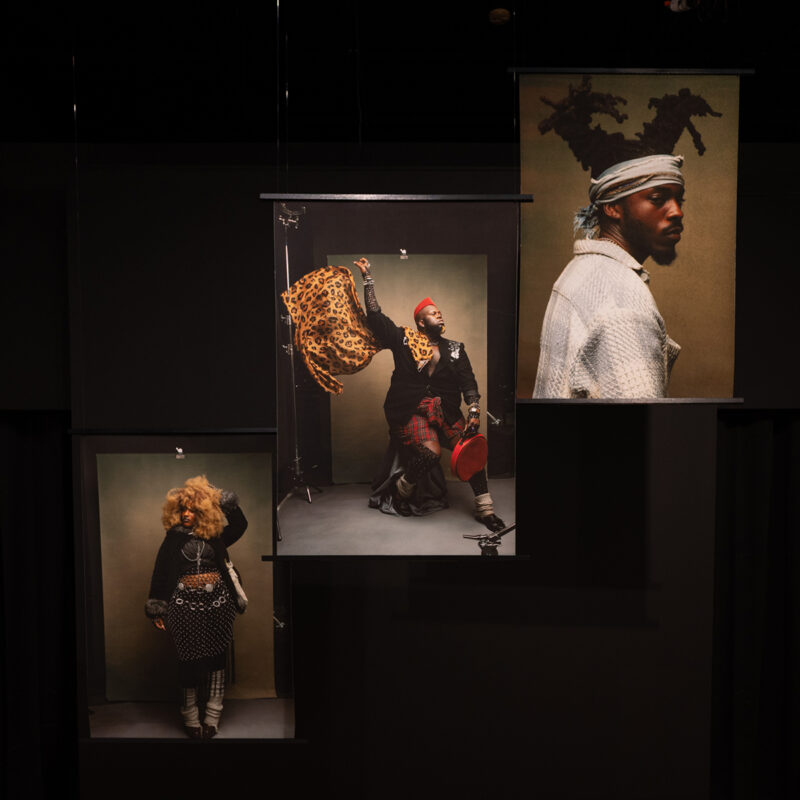
Love can be as quiet as acknowledgement. In Ernest Shaw’s photographic triptych, he shows love to Ms. Pat, an unhoused woman who lives on North Avenue, by taking her photo, embellishing it with his signature drawings of West African masks, and displaying her image in an institutional show. Ms. Pat—a woman who undoubtedly spends most of her days invisible—is seen.
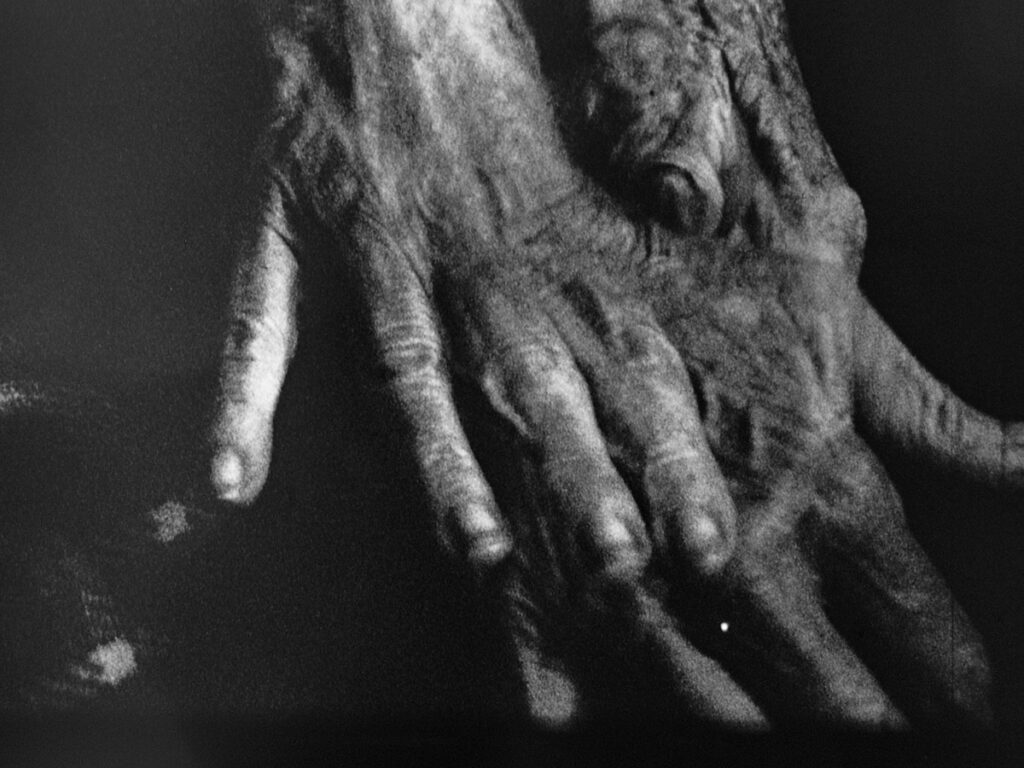
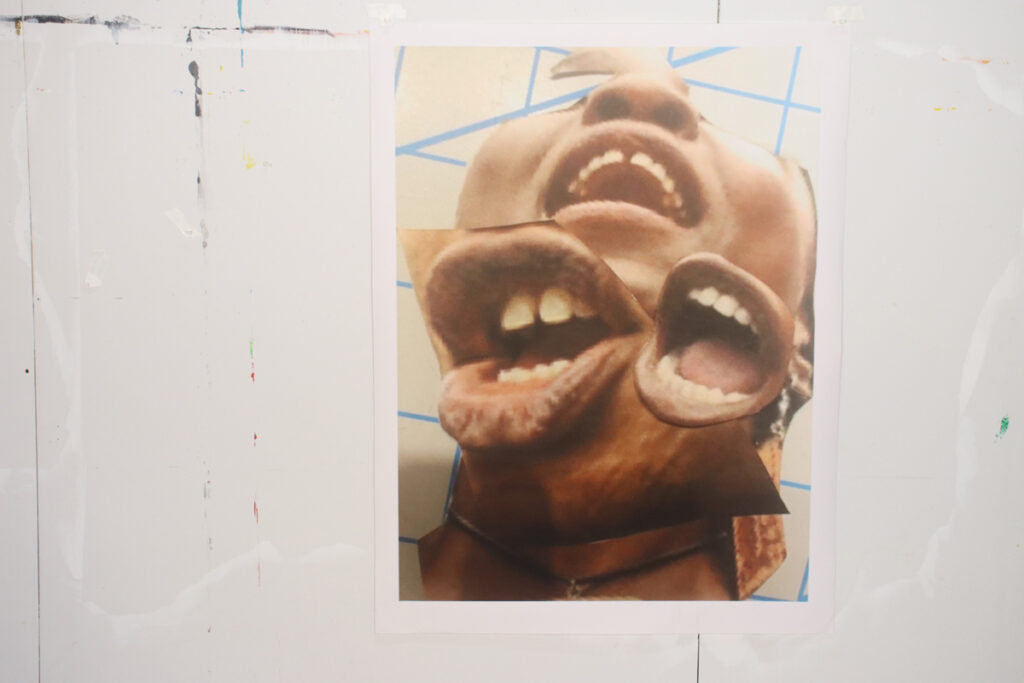
Love can be as bold as the ultimate sacrifice. In Ada Pinkston’s video “A Mise en Black Abyss,” she appears in a window, nested against shifting footage of corn fields, the cosmos and a forest, and recounts a Native American Penobscot story of creation. In the story, the First Mother, seeing her children starving, sacrifices her flesh and becomes corn for her children to eat. She instructs them not to eat all of her corn, however, and to plant the kernels so they may eat again tomorrow.
The mise en abyme appears in Ada’s title, in the multi-window structure of her video layered with images of cornfields, and in the story of cultivation itself; together, they show that Love is legacy and sustainability.
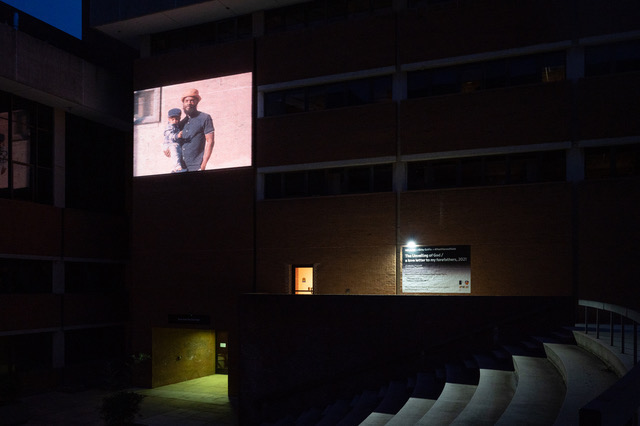
Triumphant horns from the collective NIA JUNE + Kirby Griffin + APoetNamedNate’s film “The Unveiling of God/ a love letter to my forefathers” resonate through the space and signal a beginning. “Your birth is not new. You have always been here,” proclaims JUNE. “There is a sanctuary inside of you, like a seed in soil…” She says, “Loving God is as easy as touching earth. Unveiling God is witnessing your birth.”
The award winning film, shown both inside the gallery and projected outside every evening as an outdoor installation, is a tribute to Black men and Black boys. Through an eclectic and infectious musical score, breathtaking cinematography and powerful poetry, the collective deconstructs stereotypes about Baltimore and exalts Black joy, Black love and Black family, while anointing the Black baby—the future—as God.
Love is acknowledgement. Love is sacrifice. Love is legacy. The film closes with a shot of two parents, just off screen, holding a baby up in the center of the frame. A draped curtain behind the baby can be read as wings. Wings destined to carry the child to new heights over the rainbow of rowhomes.
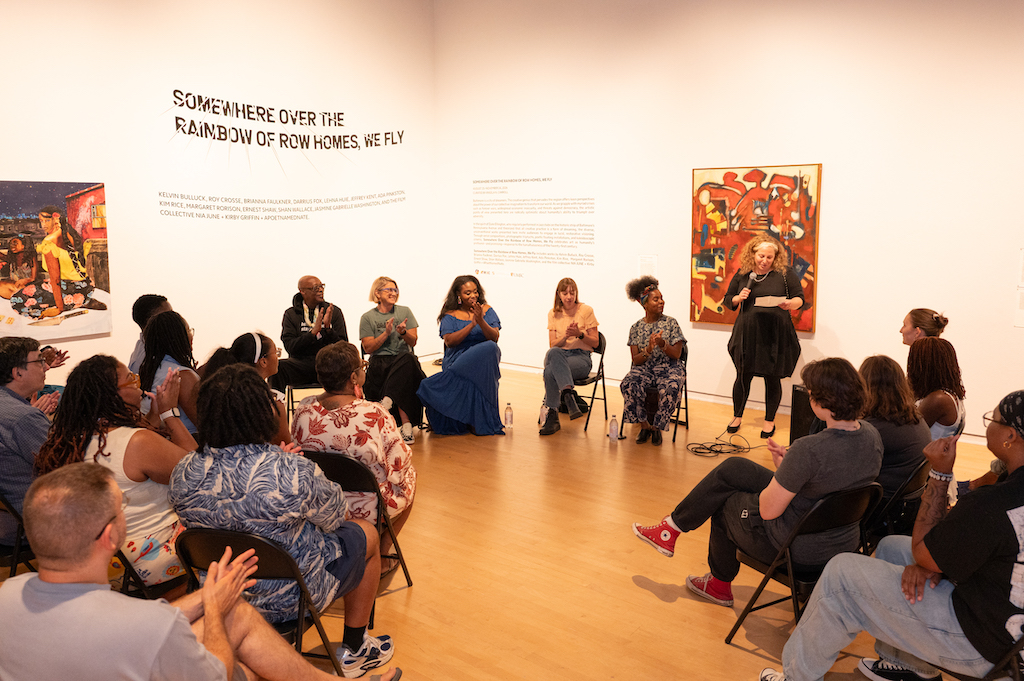
Somewhere Over the Rainbow of Row Homes, We Fly is on view through November 24, 2026. The exhibition features works by Kelvin Bulluck, Roy Crosse, Brianna Faulkner, Darrius Fox, Lehna Huie, Jeffrey Kent, Ada Pinkston, Kim Rice, Margaret Rorison, Ernest Shaw, Shan Wallace, and Jasmine Gabrielle Washington, and a public presentation of a filmic work produced by the collective NIA JUNE + Kirby Griffin + APoetNamedNate.
OCTOBER 15, 6–8 PM
Brandon Woody in Concert + Outdoor Film Projection
A free outdoor concert by Baltimore trumpeter and composer Brandon Woody, alongside a public projection of The Unveiling of God / a love letter to my forefathers by NIA JUNE + Kirby Griffin + APoetNamedNate.
Learn more
NOVEMBER 5, 6–8 PM
Artist Roundtable on Experimental Praxis
Learn more
NOVEMBER 19, 6–8 PM
Artist Talk: Memory, Archives, and Land Sovereignty
Learn more
Somewhere Over the Rainbow of Row Homes, We Fly is supported by the UMBC Arts+ Initiative and other sponsors, including the Maryland State Arts Council and the Baltimore County Commission on Arts and Sciences. On view through November 24, 2026.
All CADVC exhibitions and public programs are free and open to the public. More information: cadvc.umbc.edu