The exhibition begins with bodies: abstract, soft, and etched in salt. Walking through that initial entrance on the third floor of the The Phillips Collection from the stairwell, visitors are met with the show title, arches drenched in the colors of a dark sun-blooming horizon.
From now until September 20th, The Phillips Collection is presenting an exhibition exclusively featuring artists from Washington, DC, Maryland, and Virginia. The last regional invitational show in 2021 reflected the effects of the pandemic. This one required art made post November 2024 in the wake of Trump’s reelection. Artworks by 48 artists span video, fiber, photography, drawing, painting, mixed media, and installation. Plucked from over 1,500 submissions, organizing, grouping, and conceptualizing throughlines is an engulfing task and yet, curators Tie Jojima and Tsedaye Makonnen rigorously channeled into creation Tomorrow the Sun Will Rise.
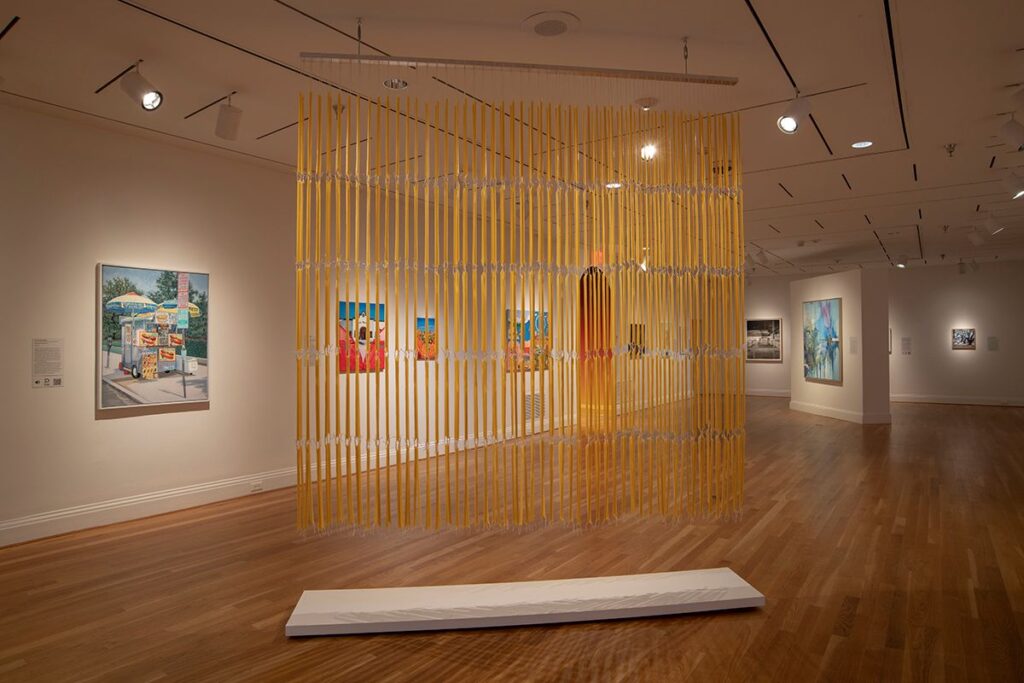
Shelby HubbardThe works vary in political directness, but each were undeniably made under continuing oppressive forces. Evident in the exhibition is endurance, resilience, or a slower trudge of motion, sometimes forward.
Jojima explained that when installing the show they privileged form and visual connections, rather than a narrative, and still, many of the exhibition spaces form webs of connection. Each room is loosely grouped by large wall texts that offer a framework for viewing. These are not to be confused with the groupings mentioned in the introductory wall text (gazing, archiving, challenging, processing, and experimenting) which are instead examined in the exhibition catalogue. Walking through the galleries means finding traces of connection between artworks not explicitly defined by wall text, catalogue, or proximity.
The resulting show is a portrait of a region. The works vary in political directness, but each were undeniably made under continuing oppressive forces. Evident in the exhibition is endurance, resilience, or a slower trudge of motion, sometimes forward. The artists here speak as witnesses, not in the passive way the word is often employed, but the active way, the way a person is forced to take the stand and swear to tell the truth. The results show what has been broken isn’t a sudden snap of normalcy, but a crack so deep in the foundation that what can be restored, perhaps shouldn’t be. As the images and materials build, in their varied forms, an undercurrent of understanding moves between them, from room to room, showing the deeply, uniquely human place that exists between experiencing harm and marvel.
Shelby HubbardAs the images and materials build, in their varied forms, an undercurrent of understanding moves between them, from room to room, showing the deeply, uniquely human place that exists between experiencing harm and marvel.
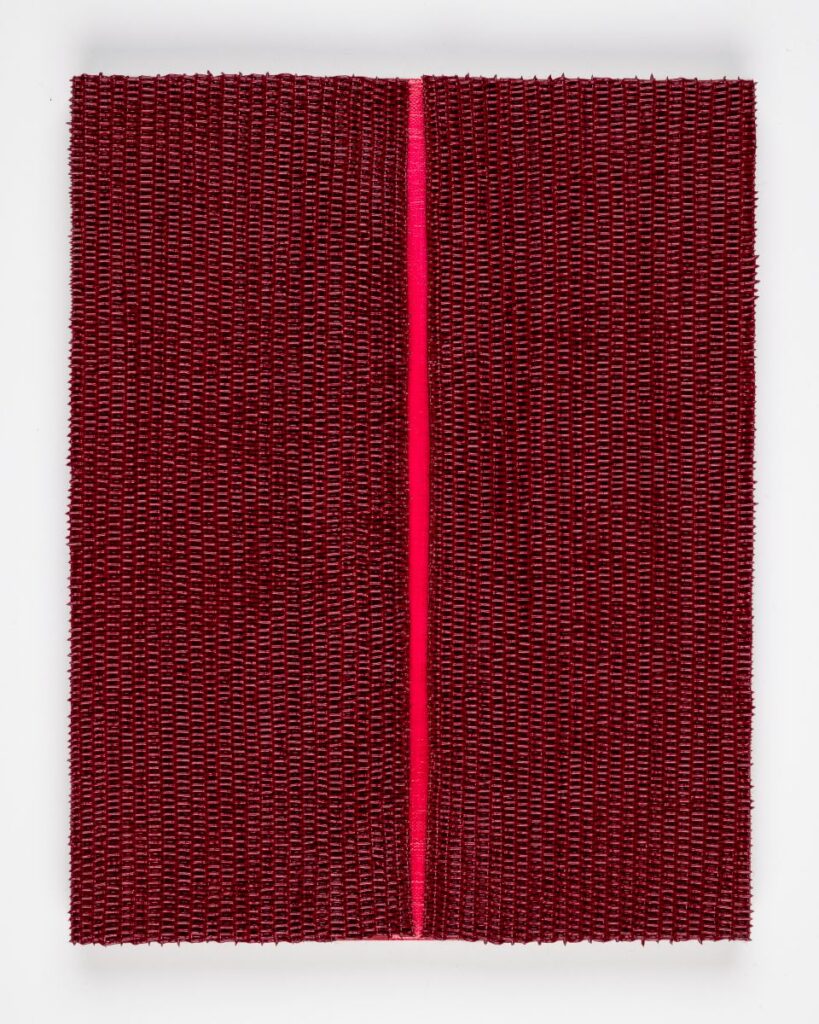
Visitors are first confronted by a wall of artworks implying or directly depicting vulvas. Danielle Mysliwiec’s two works, “Slit and Cover,” both the color of gore, show a thin column between meticulously placed extruded paint mimicking a hard weave, and a raised linen pointed column intersecting a diamond of that same extruded paint.
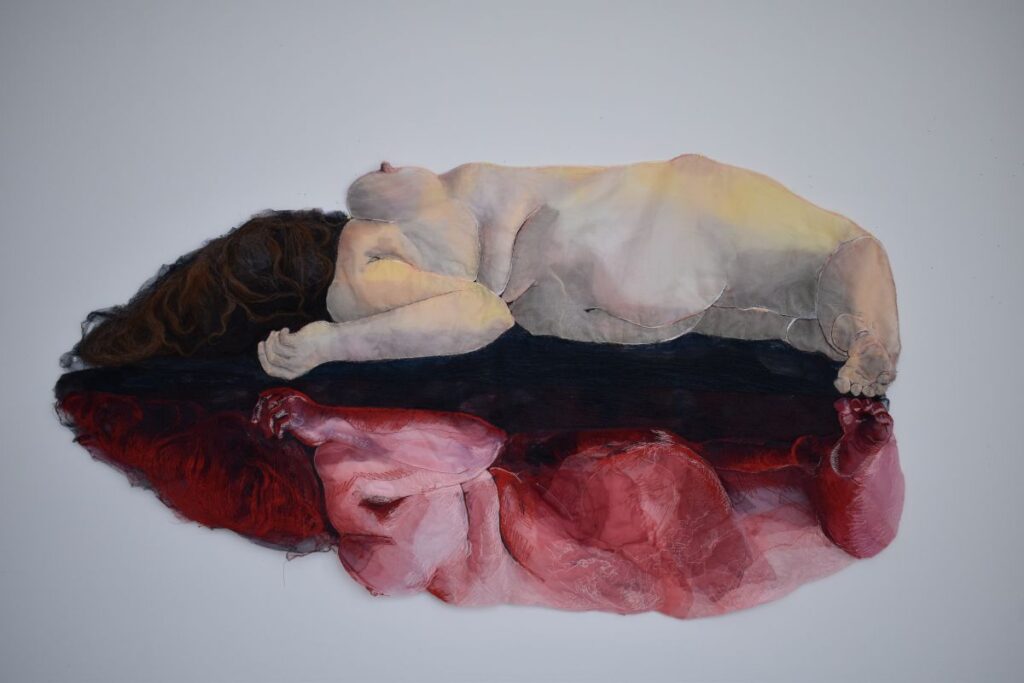
Katie O’Keefe’s nude parallel figures are turned away from viewers leaving a mess of fraught, tangled hair and a writhing body experiencing chronic illness. The top figure is rendered in pale cream flesh and the other, separated by a dense shadow, is an exact mimic rendered in deep reds and pinks. Their symmetry is vulvar, perhaps an interpretation influenced by the works surrounding it.
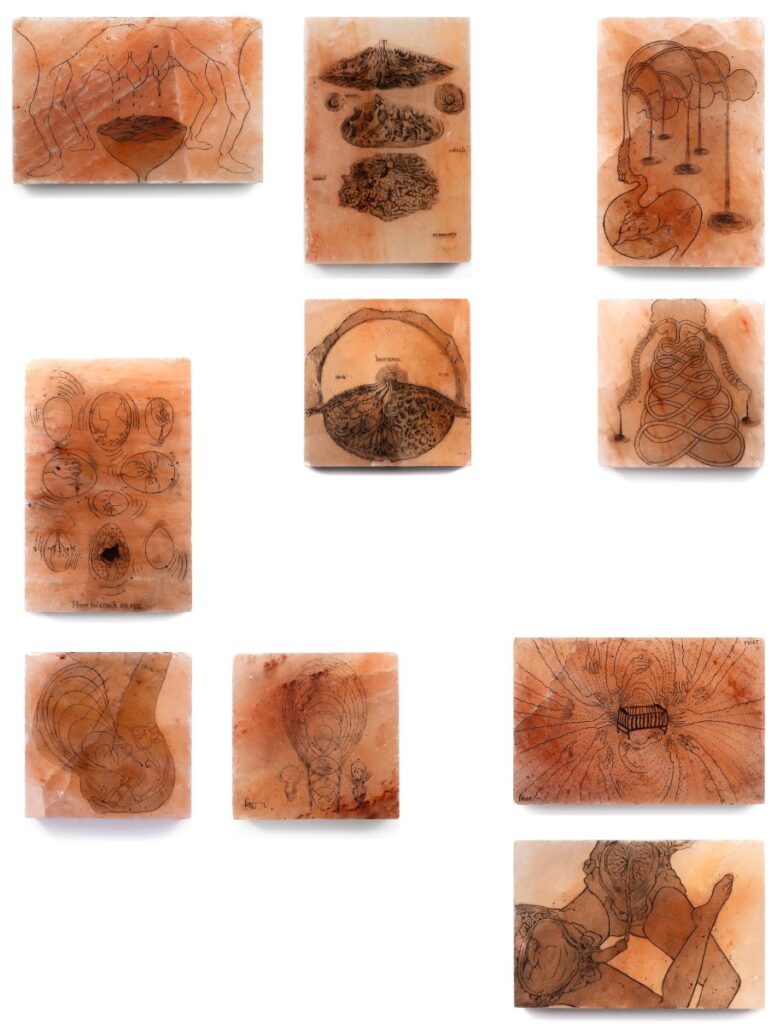
On the other side is Madyha Leghari’s “sick, stroke, sea, swell,” an arrangement of 10 etchings in rock salt. They depict scenes like gestation, instructions on how to crack an egg, an empty crib surrounded by reaching, quaking arms, and an umbilical cord pulled by an in-utero baby’s arm to a splayed open body. Bodily realities are unignorable from the start.
Around the room, works trace the spaces traditionally shaped by and delegated to women. In “Afterimage: Borrowed Flora,” by Sharon Cheuk Wun Lee, an aluminum sheet is engraved with a floral interior scene missing its central figure. Lee works from Colonial-era postcards featuring Asian women which depicted them, like the elegant furniture and broad leafy plants surrounding them, as beautiful objects. The centerpiece, that is, the figure, is removed. The scene’s anticipatory void catches light. Its cold, carved rendering strips the original creating a new interior world.
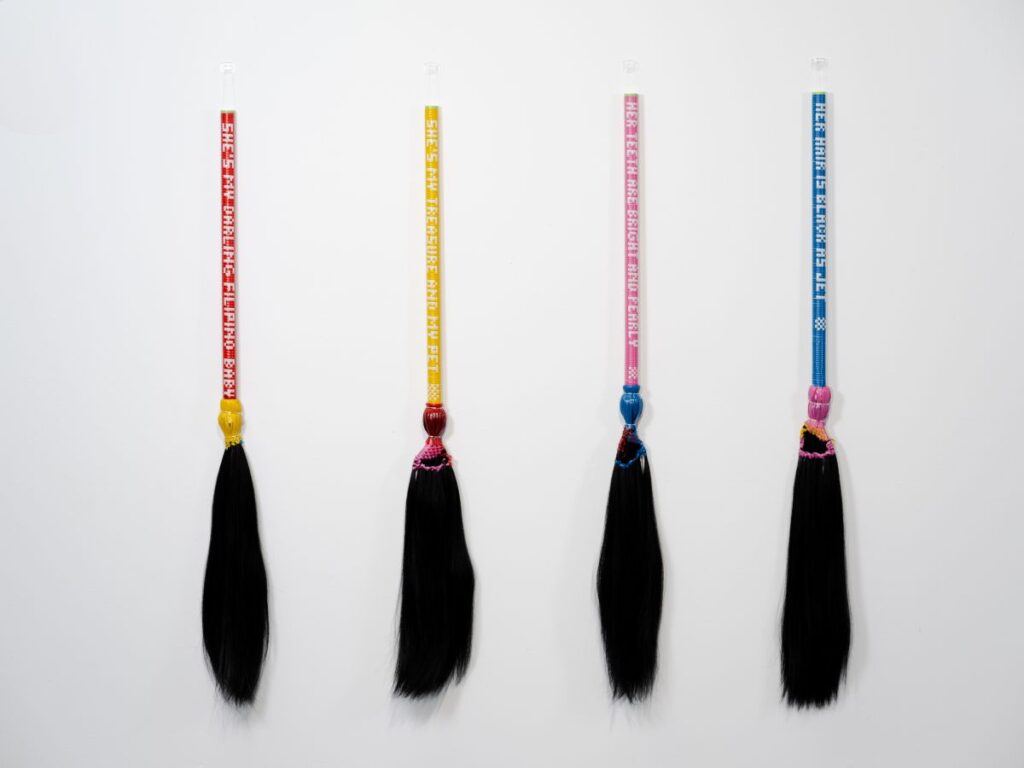
Thea Canlas’, “My Filipino Baby #2,” is a row of four brooms, with plastic rattan woven handles and long black hair replacing bristles. In the handles lyrics are woven in from the country song “Filipino Baby” the last broom reads: “She’s my treasure and my pet.” The hair suggests women and the brooms are inextricable, a horror story anathematizing colonist perspectives of Filipino women.
Between them is Mojdeh Rezaeipour’s video projection and installation “Classroom Solidarities: Jin Jiyan Azadi.” Three classroom desks sit in the center of the room, a chalkboard framed in a wooden stand and on wheels bears an assignment. A video projection fills the entire wall beyond the desks. It plays a combination of videos: the artist in their studio making the work visitors see, animated collages, and more. The collages are made using “digital protest images and videos produced by womxn and young girls in classrooms across Iran.” We hear young people chant and sing and declare. On the back walls are the collages with annotations written in pencil. Visitors are invited to sit at one of the desks and answer a question from a booklet. Black wax drips over the edges of silhouettes of young people. A voice speaks and the caption reads: “Freedom is to be sowed and we have the seeds.”
Leading from Rezaeipour’s installation is a smaller, cornered exhibition room, and perhaps the most discordant. Featuring portraits, drawings, abstract and mixed media works, they are grouped as work about matter, referring to both physical matter and “what matters—what holds significance and emotional weight,” according to the wall text.
The artworks seem more logically aligned as individual walls rather than a room which does align with the approach to consider sight lines first. This isn’t a reflection of the quality of the work. Around the room are material and visual delights.
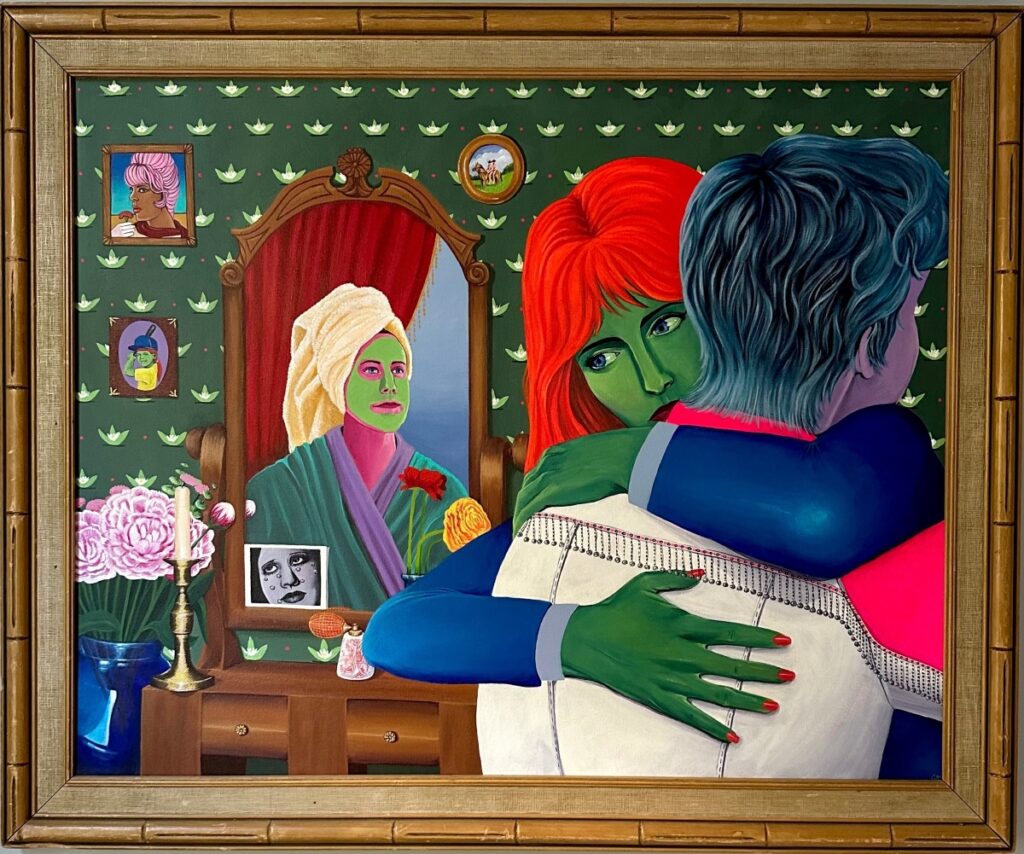
C.S. Corbin’s “Room” is a voyeuristic peek into a bedroom with three figures, one reflected in a dresser’s mirror, and two embracing. Staged like a surreal drama, the label reveals that the three figures are three selves representing the past, present, and future. An embrace between the past and future selves is an act of compassionate understanding of the journey of being trans. The present self, comfortably wrapped in a robe and hair towel, donning a green spa mask on fuchsia skin, watches, or remembers, from the mirror.
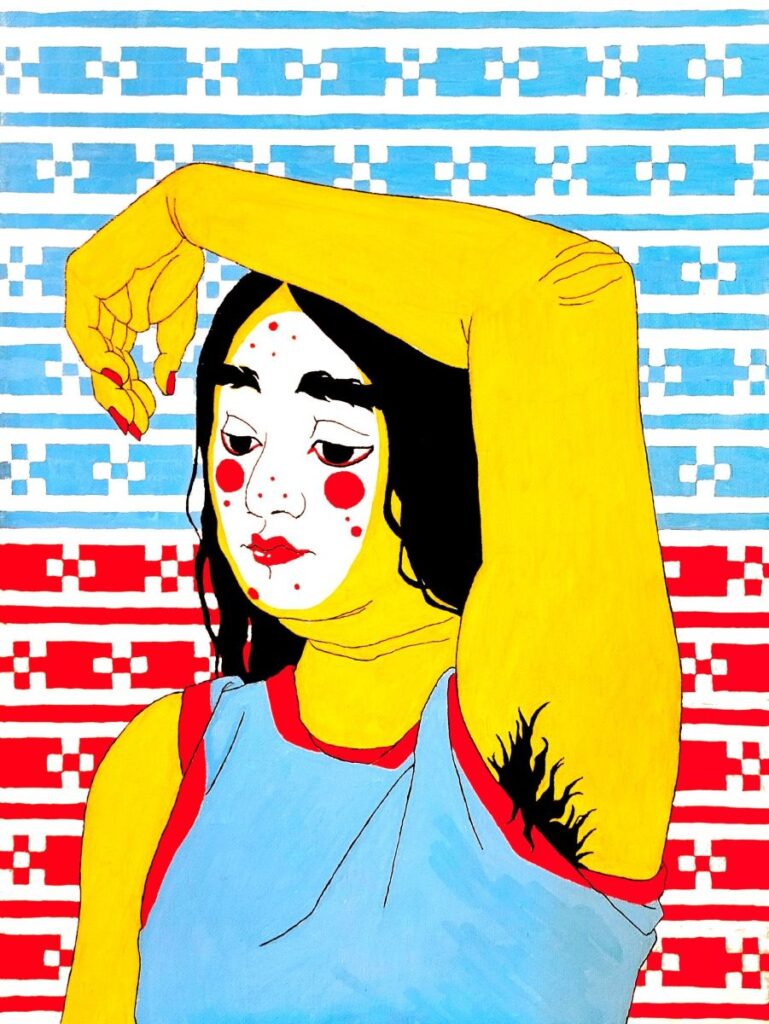
The figure in “The Love Clown” by Nami Oshiro is electric yellow with clown makeup and one exposed tuft of armpit hair. She’s wearing a light blue tank with red binding. The background is a light blue and red stripes with a minsa pattern, which represents shared love in Okinawan textiles. The figure is alone and her eyes are downcast. It’s a humorous and earnest depiction of someone wanting to be, or scared of, love.
David Joo’s fragile-looking pale mint column made of handmade kozo (mulberry) paper titled “Wormweb.” Its assumed softness contrasts the surface terrain that suddenly erupts in a dark swath of green, both alluring and unsettling. Alexandra Chiou’s “Becoming Light” ink and hand-cut paper undulates as a tree-like form, a site of transformation where deep purple and blue organic forms spill from layered brown, red, and green roots. From the upturned branches thin, light peach leafy forms are layered loosely on top of each other casting gray shadows.
Upon leaving the room, visitors will pass Khin’s “Reminisce / Indigo Resilience” a similarly motion rich mixed media work where a geometric, blocky photograph tinted in a deep yellow shows a young sister on one of her daily visits to the site where her brother was violently murdered by military forces in Myanmar in 2024. Behind the image is a deep royal blue and a flame of coral orange from the top right. Over it are small petal-like brush strokes together forming waves or swarms over the edges of the image, as if the swarm brought the image and memory here, to be sure we saw.
Past the hallway, before entering the next room, is a grouping of five paintings by Adam Chamy which also offer a new mythology. Arranged in a cross, they each are painted on the Victorian-era book “The Lance of Kanana.” The gouache and watercolor obscure the text and cast new imaginings on a story told from a colonist perspective: a many-legged mountain, a person’s body covered in blue edged eyeballs, a cracked open geode reveals an impossible night sky and mountain vista, and a heron, like Icarus, flies too close to the sun. The top painting, the only one over two pages, shows a circular window into a peaceful, ocean side scene.
“A Mediterranean shore is rendered as a portal,” Chamy wrote. “Gaza’s coast appears not as war zone, but as hope. Today, that sea is blocked. It’s fish unreachable. Its horizon denied. People in Gaza are starving—cut off from land and from the water that once gave life.”
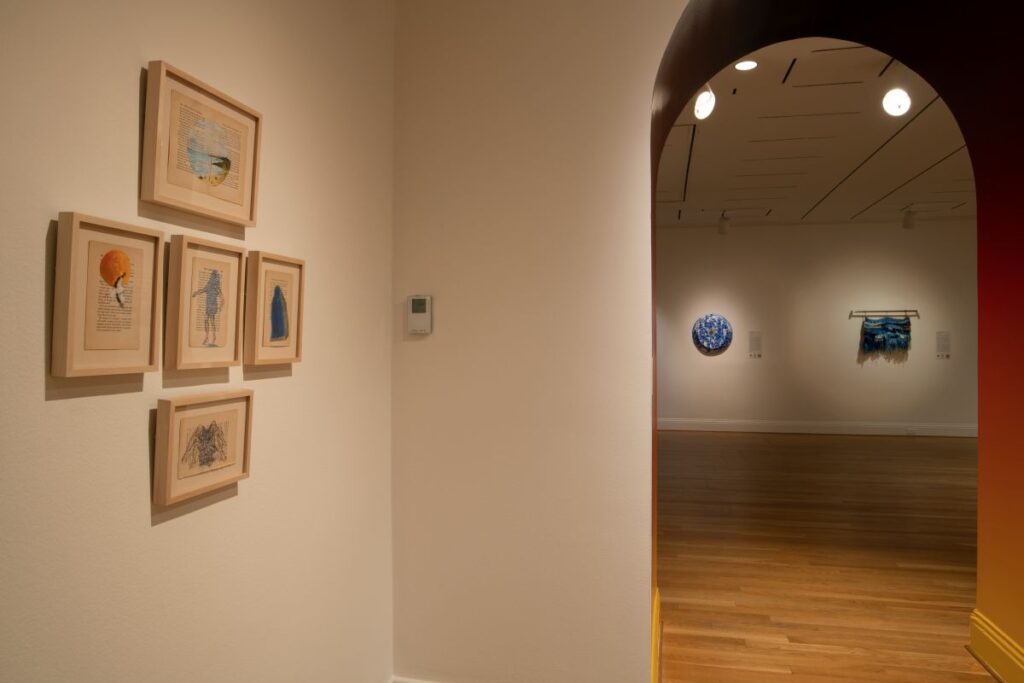
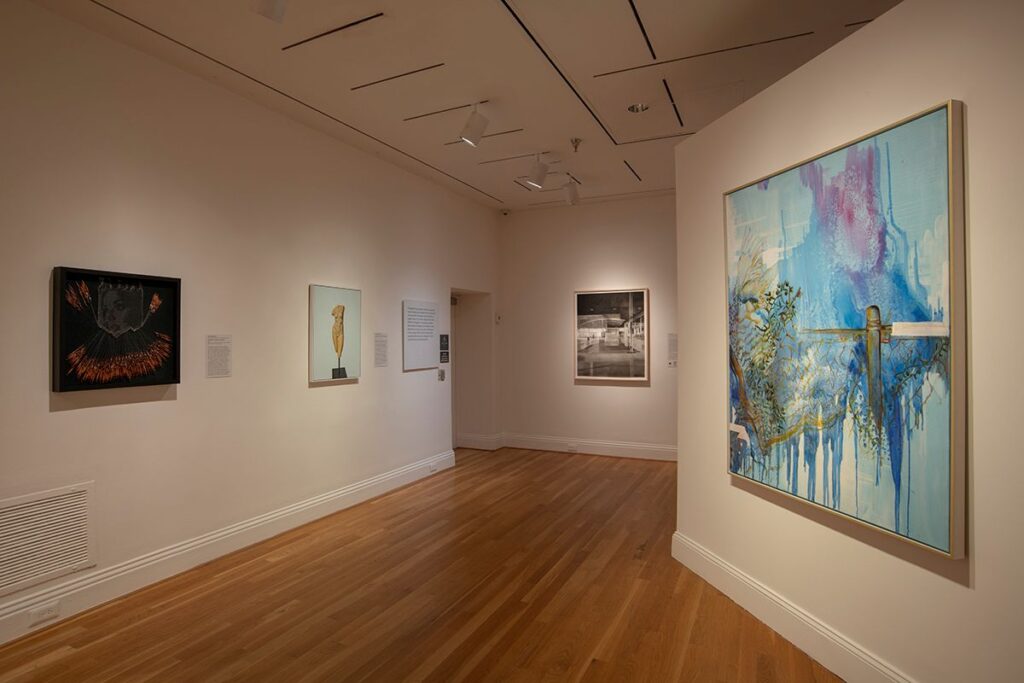
Moving into the next space, the archway opens to an angled half wall bearing another of Chamy’s works titled, “A Myth of Resistance Told in Blue.” It has dripping cool toned hues in gossamer layers containing symbols like a draped keffiyeh, a dove’s wing, and an olive branch. The symbols fade in and out of the background, caught in and destroying a chainlink fence. The myth here is true to its definition: an ancient story. It depicts resistance being embedded in infrastructure, seeping through despite, and sometimes, undetectably, to those unwilling to look.
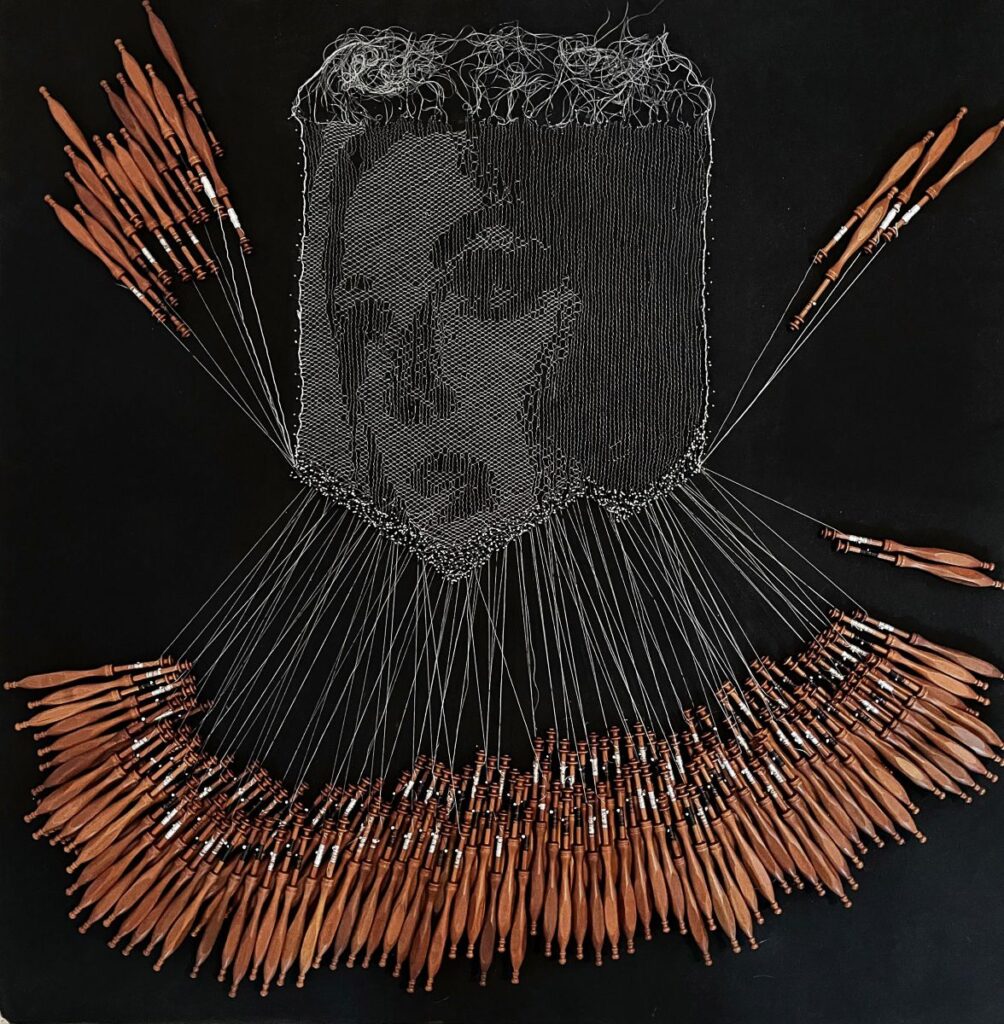
On the wall opposite Chamy is Sasha Baskin’s “Persephone II (Reece Unravels).” The bobbin lace portrait shows Reece Weaver, of Dallas Cowboy Cheerleaders and America’s Sweethearts fame. Calling her Persephone casts her in a new role: a goddess in contemporary mythology, in other words, a reality television celebrity. Rendered in bobbin lace, an endangered craft, “Persephone II” contrasts the speed of popular media consumption and the intensive work of lace making. The intricate textile, still attached to its many bobbins, is evidence of labor. Using this tedious form to depict Weaver doesn’t further glorify her but renders her in an ancient, tortured role that investigates the dehumanizing process in the creation of a celebrity.
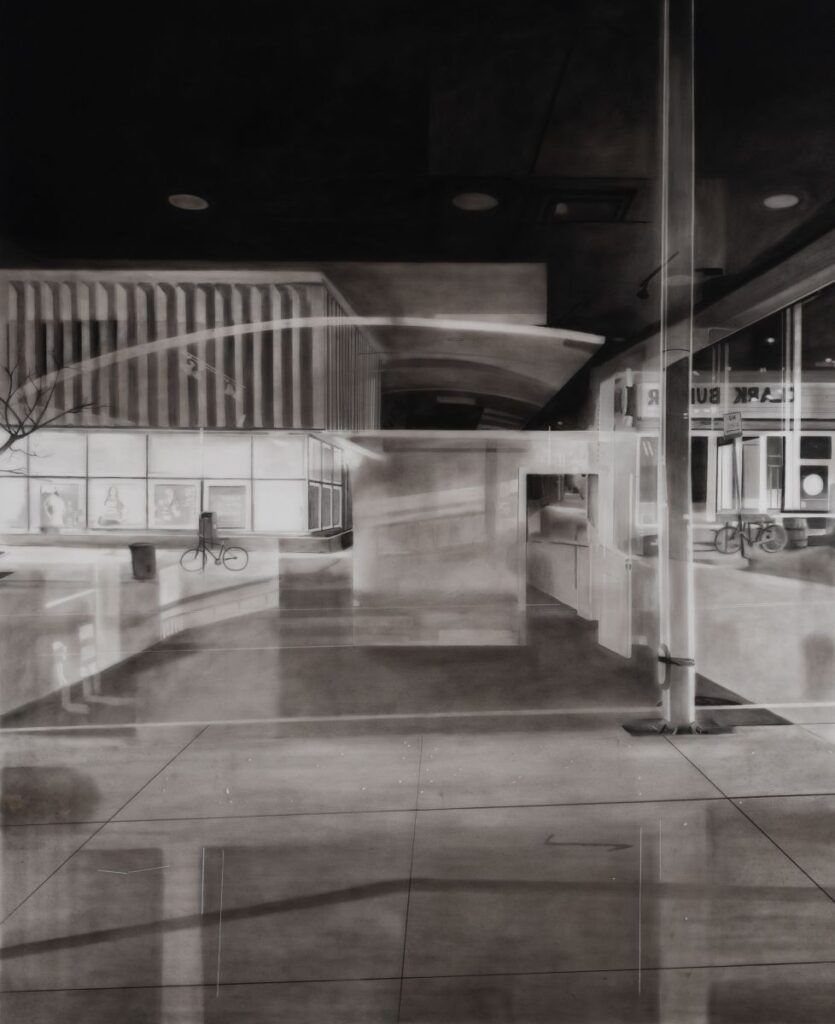
Along the next wall is Erin Fostel’s “Untitled Window Series 21.” This large graphite, charcoal, and pastel drawing captures rippling window reflections. The black, white, and gray image places the viewer in Fostel’s exact perspective standing in front of a window where a darkened store interior and multiple exteriors are rendered interstitially. In the center, where a reflected figure is expected, is a rectangular inner wall. The image is unsettling, offering a ubiquitous scene but stripping it of any people who it was built for, making the viewer a ghost.
Continuing around the angled wall where Chamy’s work hangs leads to a bodily and environmentally themed corner. Pamela Crockett’s “Sub-Cortical 2” looks like a cross between tree bark and microscopic bone. Using Ink, gouache, saffron, and coffee, the webbed, breaking texture was made in the wake of losing her best friend to dementia. The warped starbursts of amyloid plaques and spikes of tau tangles in Crockett’s work reference the microscopic evidence of Alzheimer’s disease. Crockett traces the intertwined bark patterns and the microscopic eruptions, observing their similarities without absolution.
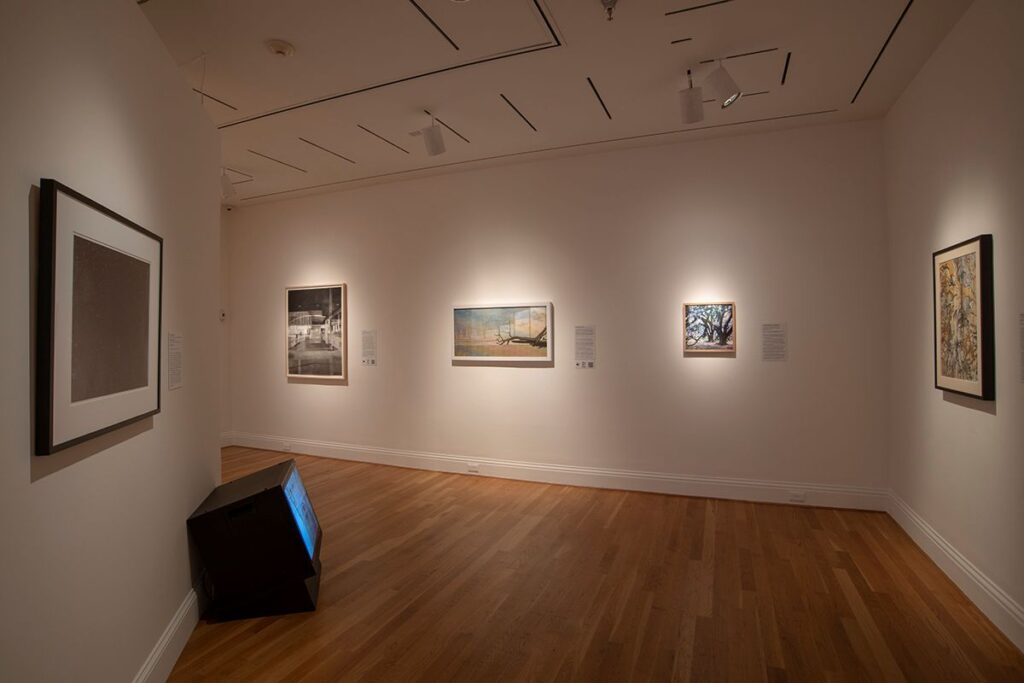
A shushing static emits from a TV on the floor. Sobia Ahmad’s “One Big Eye” is an 18-minute 18mm film made, like Crockett’s work, with coffee. The coffee she used as developer creates aberrations: splotches, thick grain over scenes shot at Pando, a prehistoric aspen grove in Central Utah. Its 106 acres and interconnected root system is “believed to be the largest organism ever found.” The video shows close shots of roots, shadows, eye shaped tree knots, and wide shots of the densely packed grove. The shushing of the leaves attempts to regulate the massive organism. The ancient beast is shrinking unsustainably.
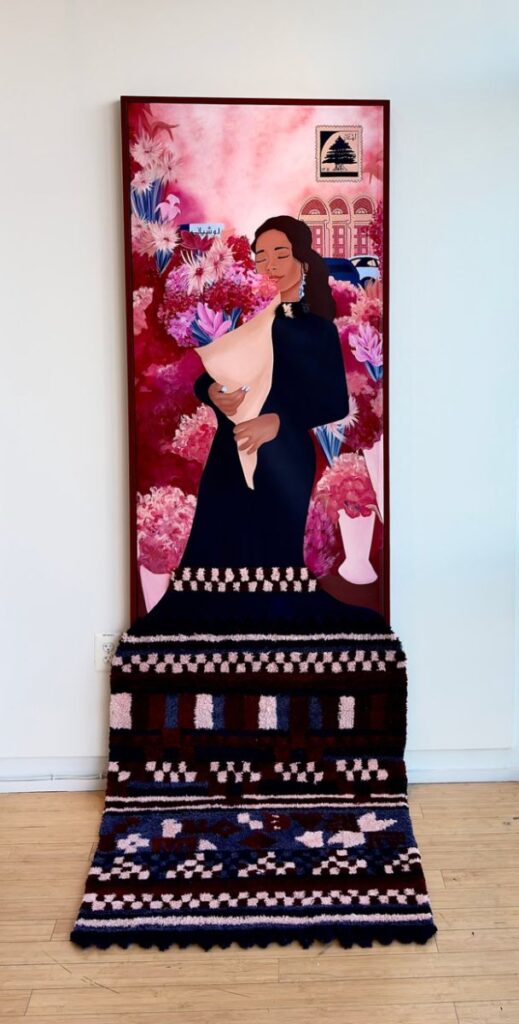
Out of the corner of the gallery, the space opens wide to a vibrant array of paintings, some textile infused like Hannah Atallah’s “how stunningly beautiful that our sacred respect for earth, for life is deeper than our rage (Portrait of Salua Moussawel)” which combines painting and rug tufting, and Paloma Vianey’s “Chamarra no. 30: Viva México” and “Chamarra no. 25: Parque Central (Cempasúchil)” that are painted on a combination of canvas and unzipped jackets revealing exteriors and marigolds cherishing how place is shaped and carried.
A luscious woven tapestry made of thick roving wool of blue hues, using Andean weaving techniques, is suspended with copper wires, and embedded with clay pigs, chanchitos. The work by Diego Borgsdorf, titled “Rewe Tapestry,” pushes the warp to hold Chilean histories. Two pieces by Aishwariya Chandrasekar, “observations of / from a pale blue dot” and “waves can’t be contained” are petite embroideries packed with fine thread and short stitches. The first is a white wavy grid of stars like space-time diagrams on black cotton. The second is a loose parallelogram composed of intersecting waves created with shiny thread. Both conjure the infinite through hypnotic motion, and are small, effective reflections on smallness in the expanding universe. The room smells sweet and sticky. Mary Early’s Línea XV beeswax and cotton installation is a massive veil of dipped cotton in two layers, mirroring the angle of the independent wall on the opposite side of the room.
Across the top of the gallery wall in the next room is Ringo Lisko’s “Sorrow, or Frustration”, a site-specific installation made using dirt Lisko swept up off The Phillips Collection’s floors. The dust was adhered to the wall to write, in thick text, “or simply longing to stand next to something beautiful.”
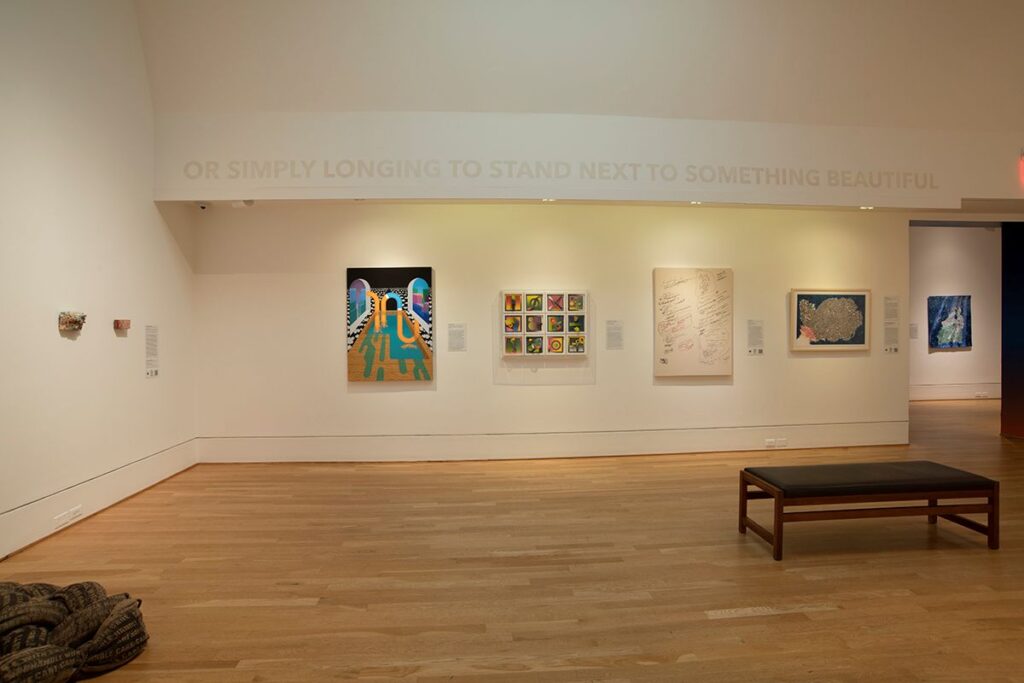
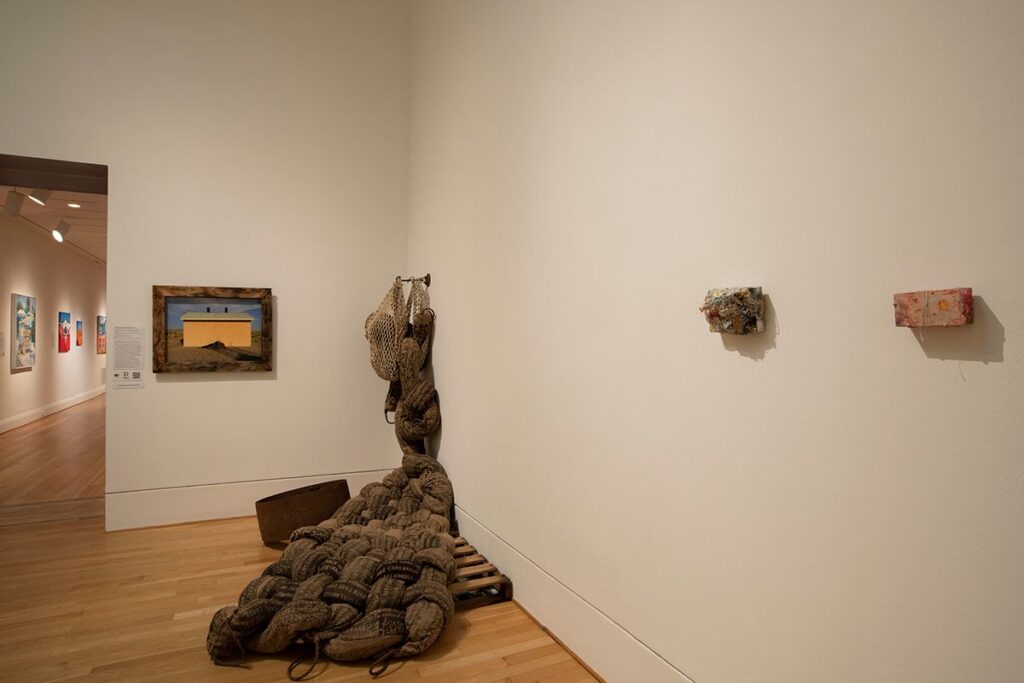
Those beautiful somethings might be Cianne Fragione’s “Meriggi e Ombre / waves chatter / tangles” and “Non chiederci la parola”, two dense, crusty, pastel mixed media works that have a disturbing attraction. Enveloping the corner of the room is Melissa Sutherland Moss’ “Carry What Carries You.” Thick woven burlap snags and drags from the wall, cascading over wooden shipping pallets. Between their slats are photographs laid across the floor beneath it. Peeking through wood and shadows reveals wedding photos and familial scenes.
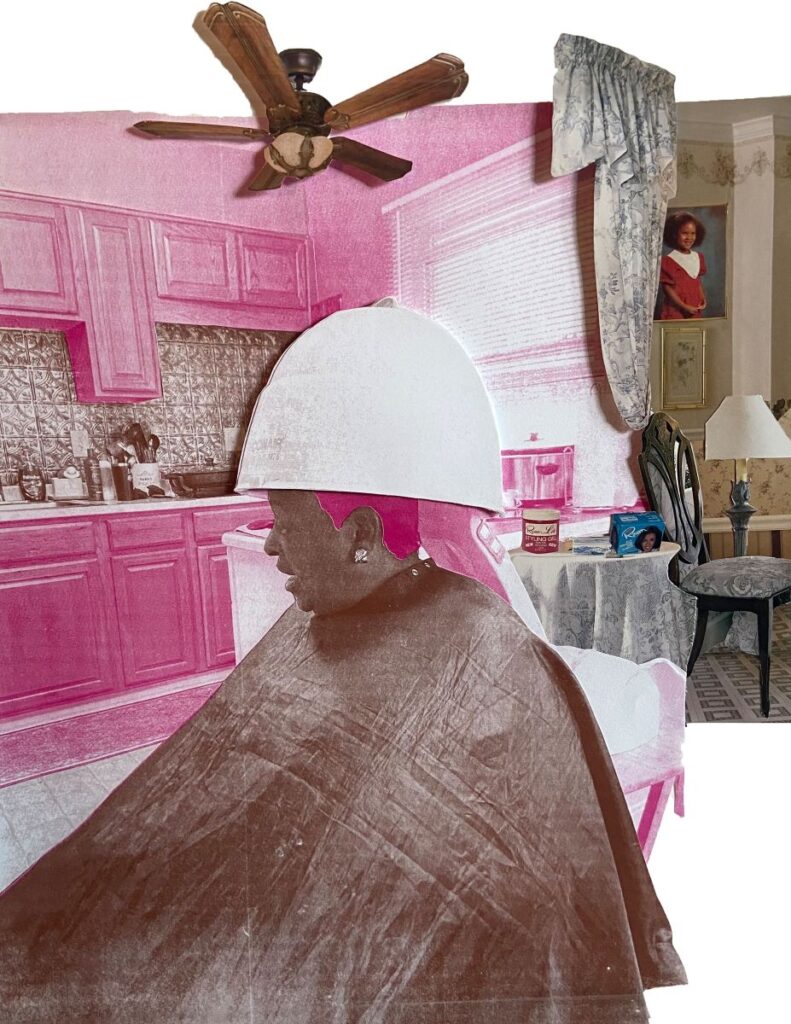
Omari Jesse’s “Good Hair, Good God” allows viewers to peer into a domestic scene where an older Black woman sits at the center, frozen mid sentence looking to the side while sitting underneath a hair dryer and cloak from neck to the edge of the frame. Behind her is a kitchen rendered through pink silkscreen print. Curtains suspend jutting past the edge of the image. A full color portrait of a child hangs on the wall behind her. The edges of the collage are cut around the fan and curtains making the entire work resistant to square containment. The edges of the image lift in suspension.
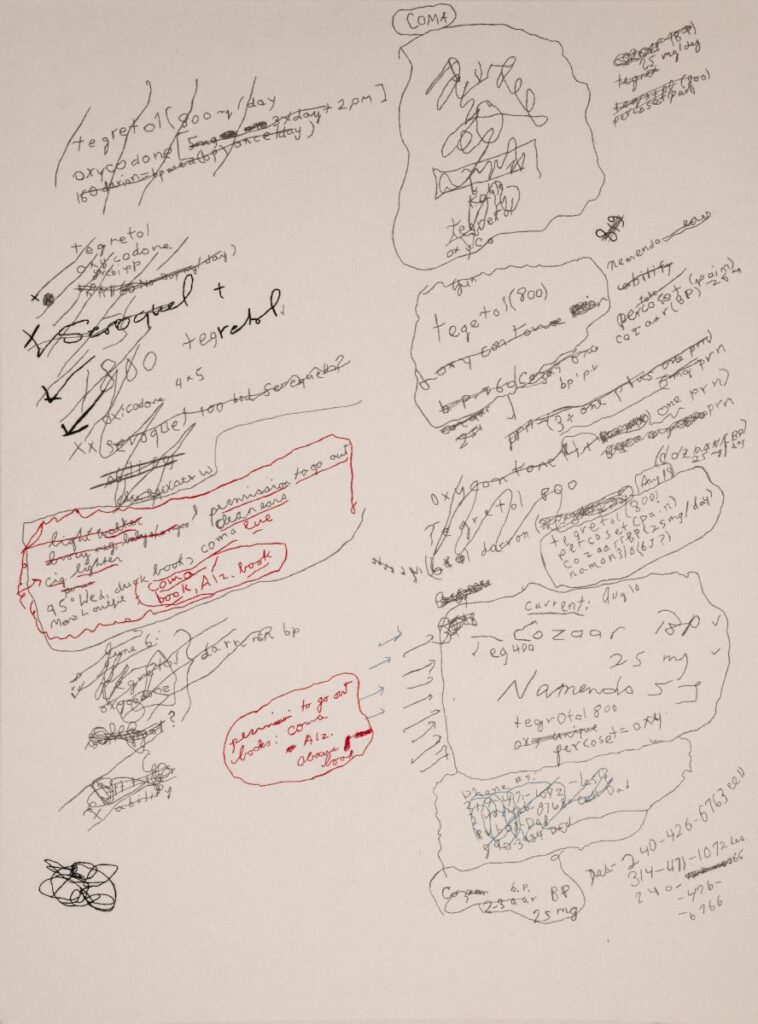
Similarly rooted in the familial is Leslie Holt’s “World Book III (coma),” large scale embroidered recreation notes her mother, a theoretical physicist, kept in a 1976 world book encyclopedia during her last hospitalization before dying. The piece shows scribbles, struck-through redactions, dates, and temperatures. Holt wrote that her mother loved the encyclopedia and rendering the notes on such scale, in a meticulous format, recognizes these notes as important and worthy of recording.
Also using handwriting is Abdulrahman Naanseh’s “They are Compelled.” The ink illustration looks like a churning landmass or satellite imagery of storms on other planets. Black lines swoop in repeated patterns made using Arabic calligraphy and specifically phrases from a poem by Salim Barkat, embedding new lands in poetry.
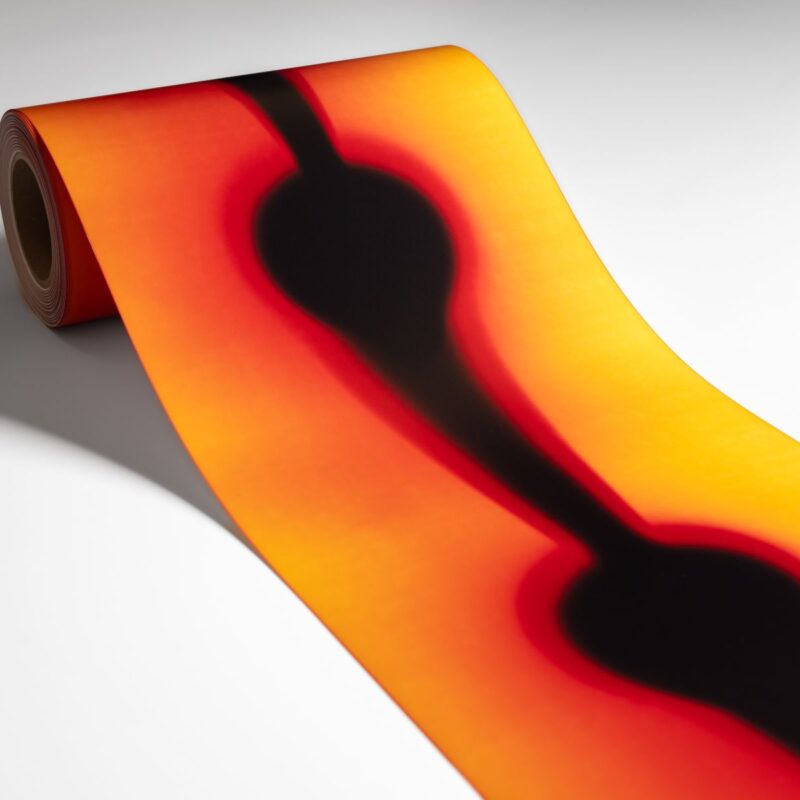
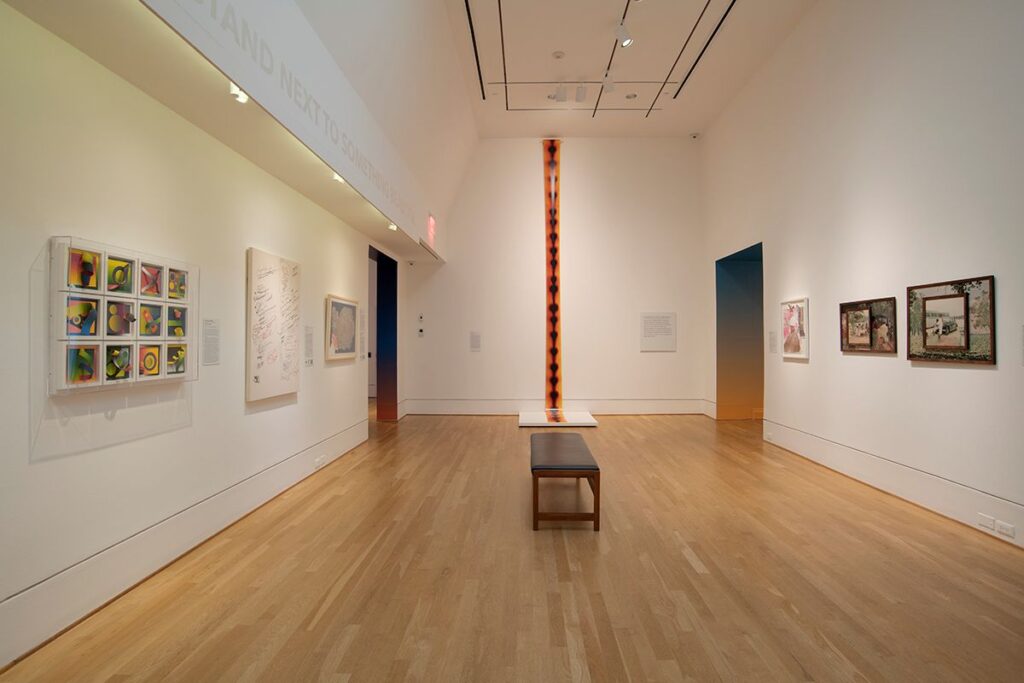
Towering on the next wall is Kei Ito’s “Sungazing Scroll.” Made using photographic paper, light, and the pace of his own breath, only exposing the scroll to light while inhaling 108 times, a number culturally associated with purification. Ito’s grandfather witnessed the bombing of Hiroshima and fought against nuclear weaponry before dying of cancer. “I remember him saying that day in Hiroshima was like hundreds of suns lighting up the sky,” Ito wrote. Here his body and breath shape the sun forming connected voids outlined in deep red and orange gradients.
The central gallery spaces are buttressed by three artworks made in relation to water from below and above. In one room is Aynex Mercado’s “Drowning Liberty” and Savannah Faith Jackson’s “Middle Passage / Ocean Flag.” In the far opposite room is Emily Francisco’s “2025 July 9: A Thunderstorm // When Systems Collide.”
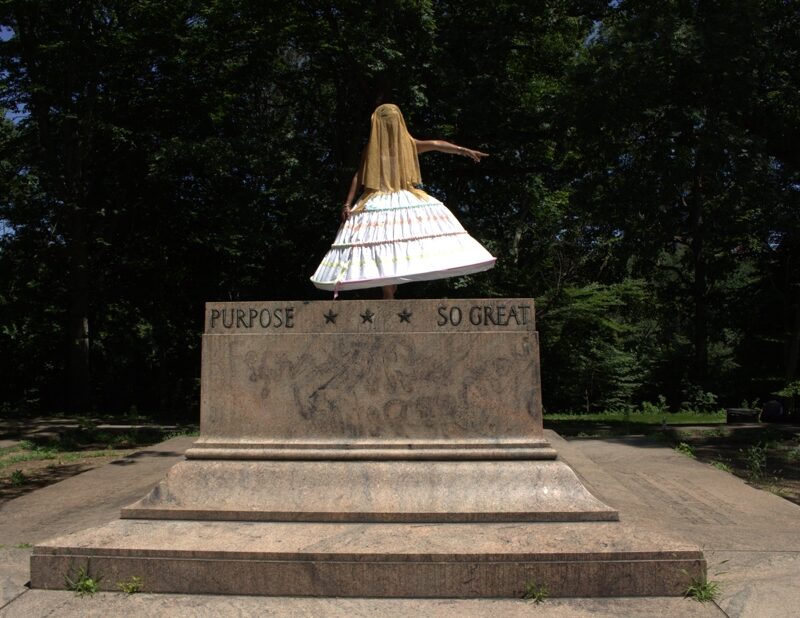
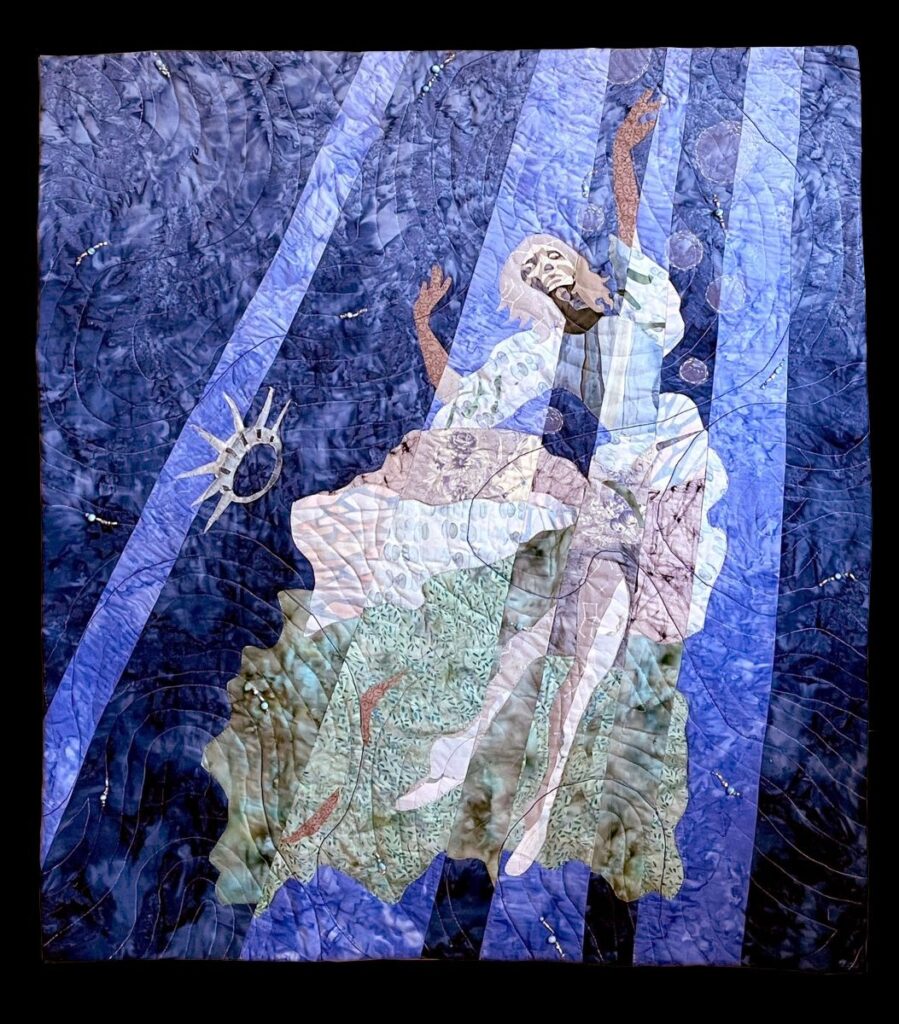
Mercado’s liberty, rendered in quilted fabric, is suspended in water. Her crown floats away and her arms are elegantly outstretched in rays of water filtered light. Her expression is content as her dress billows around her. Mercado writes, “Can we restore harmony before liberty is swept away?”
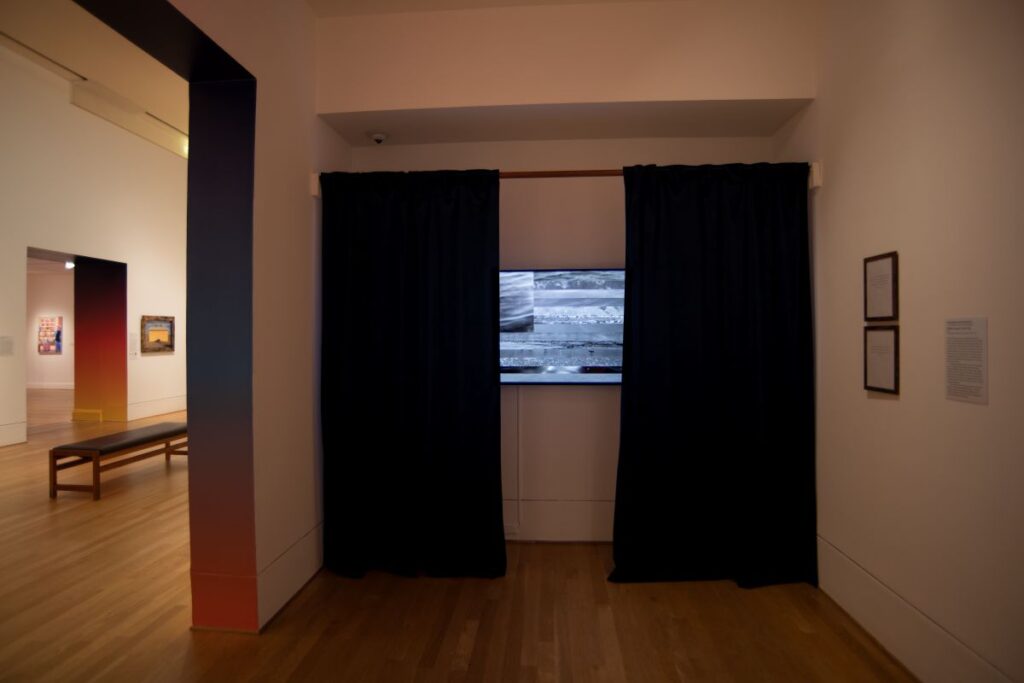
Jackson’s “Middle Passage / Ocean Flag” is a video collage shown on screen behind two indigo dyed curtains. Adjacent to the curtains are two framed texts. The video shows a flag made of strips of the Atlantic Ocean in varying tones of gray, moving in sometimes soft, conflicting motion. The framed texts tell a story about perceptions of the ocean and its meaning; a woman tells her that the ocean is “confirmation that God exists.” The next passage ends by describing the sound of the waves as “a howl turned hum for liberation.” Mercado and Jackson’s work consider the ocean as a multifaceted charged site: a space where liberty can drown, or has drowned, and a space for spiritual rejuvenation.
Emily Francisco’s “2025 July 9: A Thunderstorm // When Systems Collide” is a sound installation. It captures rushes of rain and rolling thunder. Bright LED lights on the floor in the room project blues and purples on the ceiling. The audio is a field recording of an active tornado warning. The label assures that “the work invites visitors to feel the storm rather than simply hear it.” While the technological infrastructure does not support such an immersive experience, the concept reaches toward the universal. Rain and ocean waters are recognized as fearsome and rejuvenating.
Tomorrow the Sun Will Rise presents work that occupies and unfurls, some softly, bodily and materially and some collaboratively through observation, chance, and repetitive labor.
If you follow the threads from every artist and artwork through their experiences, you would create a web crossing continents. Here, border crossings are vital to understanding. Like the ancient root system of Pando, the view of the pale blue dot, or specs of dust carefully collected to form thick words: each small piece matters, each is part of a collective whole.
These works aren’t only emotive reactions to politics, but intellectual investigation. They are demonstrations of a daring willingness to marvel. Crockett’s microscopic investigations into dementia, Holt’s dying mother’s embroidered notes, Chamy’s embrace of new mythologies amidst deliberate erasure, and Ito’s capturing of the sun through the use of his own body, all navigate uncharted space between atrocity and wonder. What this work shows is the power of collective being. It shows us our neighbors and what they can create despite, because of, and in resistance to harm. It shows us that there is still alchemy, unbelievably, to be channeled.
Tomorrow the Sun Will Rise: The Phillips Collection Juried Exhibition is on view August 1–September 20, 2026. Plan your visit here.
Featured artists from Washington, DC, Maryland, and Virginia include: Negar Ahkami, Sobia Ahmad, Mark Armbruster, Hannah Atallah, Aliana Grace Bailey, Sasha Baskin, Diego Borgsdorf, Kara Braciale, Danyela June Brown, Thea Canlas, Adam Chamy, Christina Chan, Aishwariya Chandrasekar, Alexandra Chiou, Se Jong Cho, C.S. Corbin, Pamela Crockett, Mary Early, Erin Fostel, Cianne Fragione, Emily Francisco, Kyle Hackett, Leslie Holt, Kei Ito, Savannah Faith Jackson, Omari Jesse, David Joo, Khin, Don Kimes, Sharon Cheuk Wun Lee, Madyha Leghari, Ringo Lisko, Joey Mánlapaz, Aynex Mercado, Margaret Murphy, Danielle Mysliwiec, Abdulrahman Naanseh, Javaid Nayyar, Jhon Ochoa, Katie O’Keefe, Nami Oshiro, Mojdeh Rezaeipour, Gail Shaw-Clemons, Alexandra Silverthorne, Anne C. Smith, Bria Sterling-Wilson, Melissa Sutherland Moss, and Paloma Vianey.
September 3, 2026, 5–8:30 pm: Celebrate the iconic works of The Phillips Collection during a special edition of Phillips After 5. Enjoy music from DJ Stylus and Justin Trawick, get a flash tattoo from Cry Baby Studios, and more. $20, free for members, reservation required.
September 12, 2026, 10 am–1 pm: Kids and caregivers are invited to learn more about the artists on view in Tomorrow the Sun Will Rise: The Phillips Collection Juried Exhibition and make their own artworks using similar materials.
September 17, 2026, 6:30–7:30 pm: Soundscape artists Rita Burns and Ronya-Lee Anderson will compose and perform a live in-gallery soundscape that weaves together songs chosen by the artists featured in Tomorrow the Sun Will Rise.