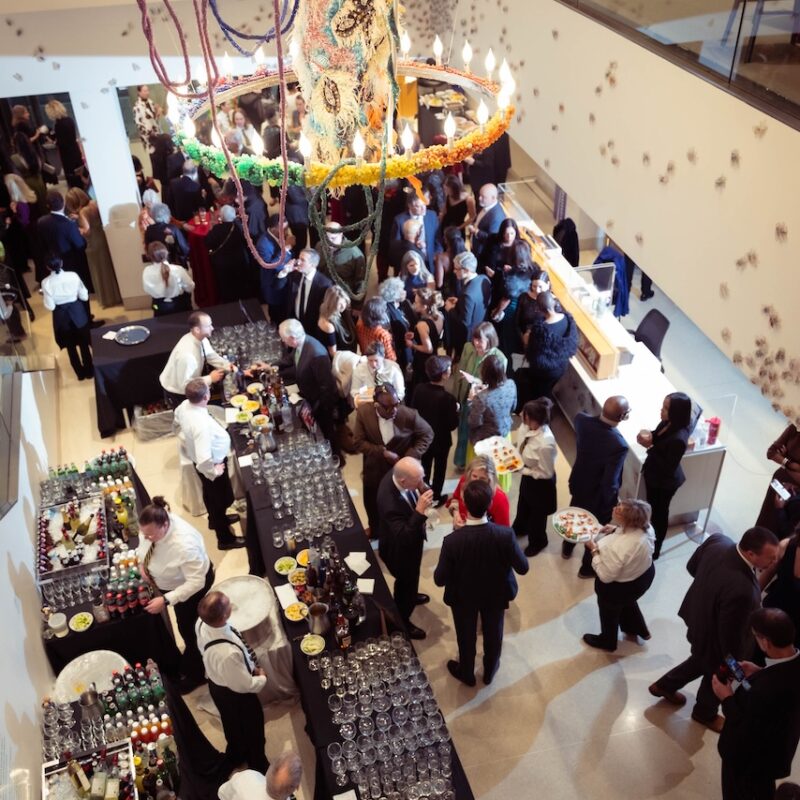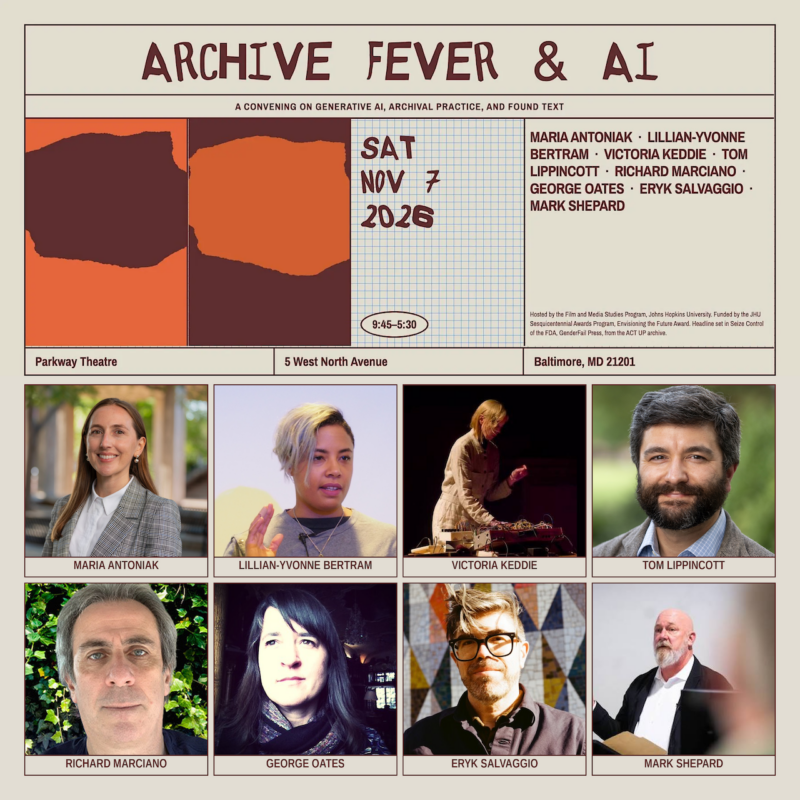
During a recent daylong convening on art, archives and artificial intelligence, a computer scientist challenged the room to explain why archivists are still necessary. Ironically, none of the people on stage were archivists.
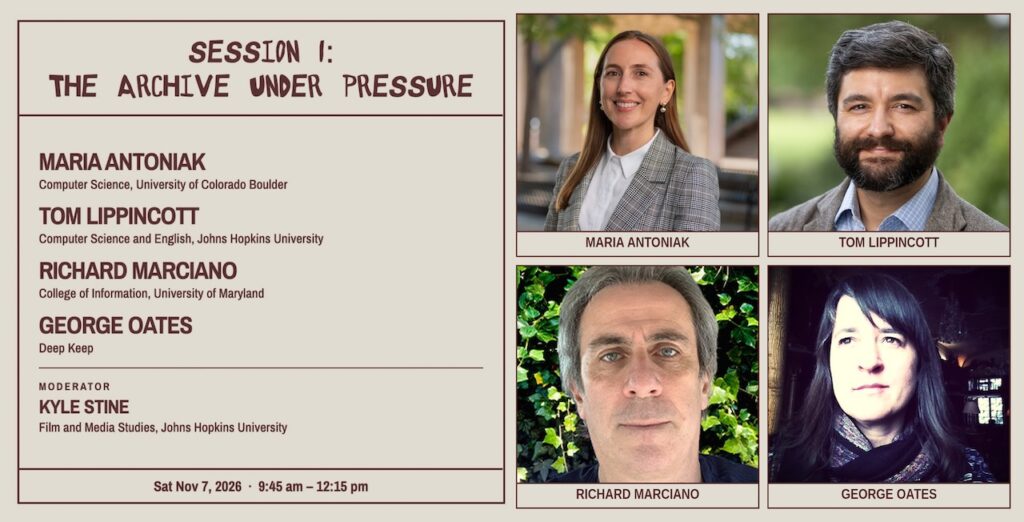
“That was like watching Jerry Springer,” the attendee next to me said as the first panel wrapped. We were at the Parkway Theater for “Archive Fever & AI: Found Text and Creative Practice in the Age of Generative AI,” a daylong convening organized by designer, writer, and curator Liz Flyntz, and the discussion had just reached a crescendo. Tom Lippincott, a computer scientist and director of the Center for Digital Humanities at Johns Hopkins University, had asked his fellow panelists to make an argument for archivists’ continued usefulness. “Because I have yet to hear a convincing one,” he said.
George Oates, a designer and the founder of Deep Keep, countered that much archival material has never been digitized and so isn’t available for computational analysis at all. Richard Marciano, a computer scientist in the University of Maryland’s College of Information who describes himself as “an accidental archivist,” defended the expertise of archivists in building and preserving record collections.
Lippincott was not convinced, claiming that archival work was likely to suffer the same fate as computer science, where he argued there was almost no need to code anymore. At one point, he interrupted his fellow panelists to ask, “When was the last time any of you wrote code?” The tension was palpable, with one of the other computer scientists responding that she had, indeed, written code recently.
I had arrived that breezy November morning brimming with questions. I’m a librarian who has worked at the intersection of art and organizing for more than a decade, but I’m a relative novice when it comes to AI, a subject that lately seems to slip into nearly every conversation I have, personal or professional. But, I did not expect to spend the morning watching a panel of non-archivists debate whether the archival profession should exist. I kept wishing one of my archivist colleagues had been on that stage to offer their own perspective on the work of preserving historical records.
In hindsight, the friction had been building all morning. Earlier in that first panel, “The Archive Under Pressure,” Maria Antoniak, a computer scientist at the University of Colorado Boulder, pointed out that white space is meaningful in poetry, yet AI tends to flatten text into a single string with no regard for it. Lippincott opened his own talk by rebutting her, arguing that some AI platforms can in fact reproduce the spacing of, say, an e.e. cummings poem, and went on to claim that, among other things, machines can produce better metadata than humans. Oates, who works on personal digital archiving, began her talk with a line from Rick Prelinger: “We’re capturing more information than ever, and archiving less than ever.” Marciano spoke about the importance of building relationships between technologists, archivists, and librarians.
Yet across more than two hours, none of the panelists defined what they meant by “archive.” When I asked exactly that during the Q&A, Oates was the only one to answer. Archives are collections of historical records, she said, though she acknowledged that definitions, especially among humanists, are slippery.
That slipperiness was built into the day’s premise. The convening took its name from Jacques Derrida’s 1995 text Archive Fever, a central work of what’s been called “the archival turn,” in which theorists including Derrida, Michel Foucault, and Pierre Nora stretched “archive” far beyond its traditional meaning, a collection of records relating to a place, institution, or family, and recast it as a question of power. “There is no political power without control of the archive, if not of memory,” Derrida wrote.
Working archivists such as Verne Harris, Joan M. Schwartz, and Terry Cook have contended with this loosening of the term since the 1990s. Cook proposed a useful distinction: “the archive” for the theoretical construct, and “archives” for the actual institutions and the practical discipline often called archival science. Keeping that distinction in view might have grounded the morning’s debate. When Lippincott asked what archivists are for, he wasn’t asking about a metaphor. He was asking about a job: a body of skilled labor, done mostly behind the scenes, by people who weren’t in the room to describe it.
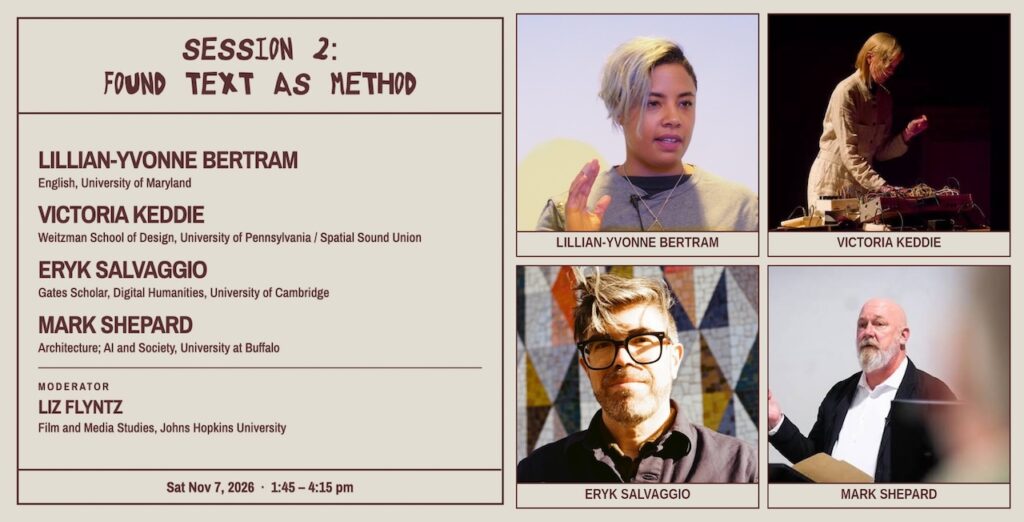
The afternoon panel, “Found Text as Method,” offered a reframing. Poet Lillian-Yvonne Bertram began by reminding us that machines themselves aren’t coming for our jobs; those decisions are made by leadership in our workplaces. They then shared an archive of camera footage of the critters in their backyard, paired with sometimes hilariously inaccurate AI captions and oddly poetic Nextdoor summaries from the same days.
Artists Victoria Keddie and Eryk Salvaggio presented work with learning algorithms and AI-generated images, and Mark Shepard gave one of the best artist talks I’ve heard in a while, on Hedgework, an urban landscape that uses an AI chatbot to engage visitors in, among other things, building an archive of the birds that visit the hedge. The project was inspired by 18th-century Irish hedgerows, which served as sites of social gathering and political resistance.
Those hedgerows brought to mind the Luddites, who began organizing at night on the moors of Nottinghamshire in the early 19th century. I find myself thinking about the Luddites a lot these days. We now use the term to disparage people who don’t understand technology, but the actual history is far more radical. The Luddites were textile workers and artisans protesting abhorrent labor practices, including child labor, by breaking machines, a tactic the historian Eric Hobsbawm famously called “collective bargaining by riot.” They weren’t necessarily opposed to the technology itself, but to how it was being used to exploit workers.
Which brings us back to Bertram: it isn’t the technology but the managerial class that decides what happens to our jobs. Seen that way, Lippincott’s provocation, abrasive as it was, may have been the most useful question of the day. If archivists, librarians, and artists can’t articulate the value of their own labor, someone else will decide it for them. Perhaps smashing machines is the answer. Or perhaps we need to get much better at advocating for human labor in the face of increasingly capable AI. Either way, we can’t assume this fever will simply break, leaving creative and archival work unchanged.
At the very least, I thoroughly enjoyed spending a day immersed in the kind of tense, discursive arguments we usually only see online, except here they were happening on a stage, between real people, in front of an audience of actual human beings. I sincerely hope the video footage will be archived somewhere, even if the metadata ends up being AI-generated.