Just outside my window, I see shimmering green forest and frenetic birds spiraling upward, guiding my line of sight toward bright blue winking through the foliage. The sky is forever shifting as days tick by and weather passes through. I look outward and upward often, not only seeking relief from the atrocities I scroll through on my computer, but also in search of something greater than myself to give me some perspective.
I know I am not alone in this turning of my attention; artists and writers have turned to nature for inspiration and solace for centuries, and the works in CPM Gallery’s current exhibition Brighter Skies follow in this tradition. The show includes seven Baltimore-based artists whose works “express the power of slowly and attentively engaging with earth and sky.” This engagement rewards viewers with a sense of connection not only to nature, but also to the artists themselves, each of whom has a unique and striking interpretation of the show’s theme.
According to gallery owner Vlad Smolkin, the show “gestures both towards hope for renewal and ironic hopelessness when considering environmental degradation, social turmoil, or performative politics.” Indeed, it is reasonable to wonder how we can find any hope when the world is literally burning. But this show left me heartened that art continues to provide a sense of meaning and purpose, even in a moment largely defined by human destruction, materialism and greed, and the disasters brought about by climate change.

Taken alone, each of these works speaks about the power of nature and invites viewers to consider their place in relation to the natural world; taken together, the conversation becomes more dynamic and complex.Elizabeth Hazen
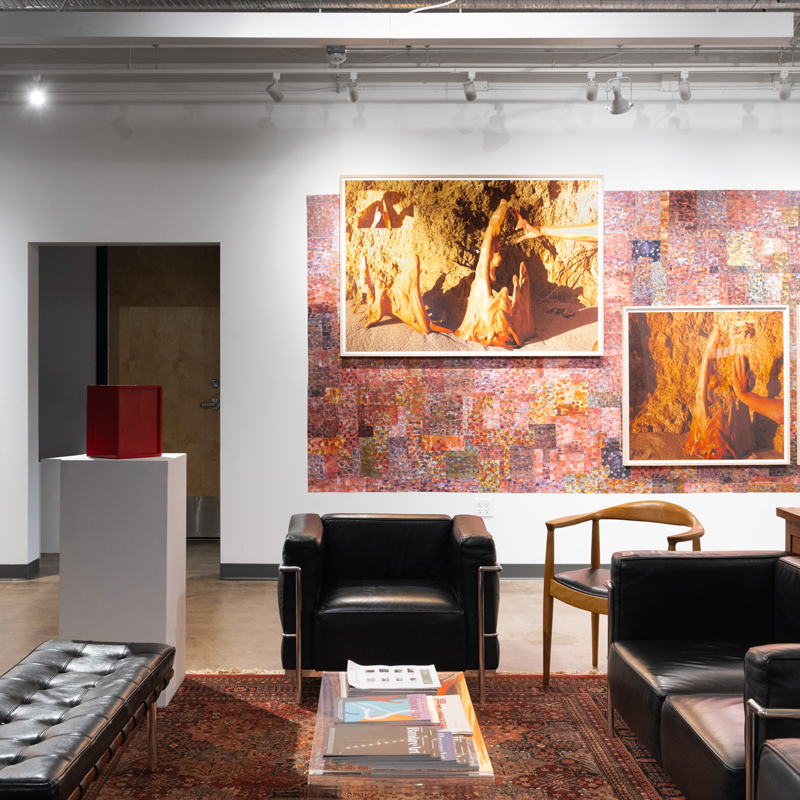
One aspect of Brighter Skies that gives the show power is the arrangement of the pieces. The artists’ works here intermingle, large bright collages beside subtle charcoal drawings, imposing sculptures alongside diminutive oil paintings. This curation creates a sense of collaboration and conversation. Smolkin says, “One thing I’m happy about is that the show is a kind of melting pot. Baltimore can sometimes feel like people are in their groups, like there are these little separate rooms, and I try to put everyone in the same room.”
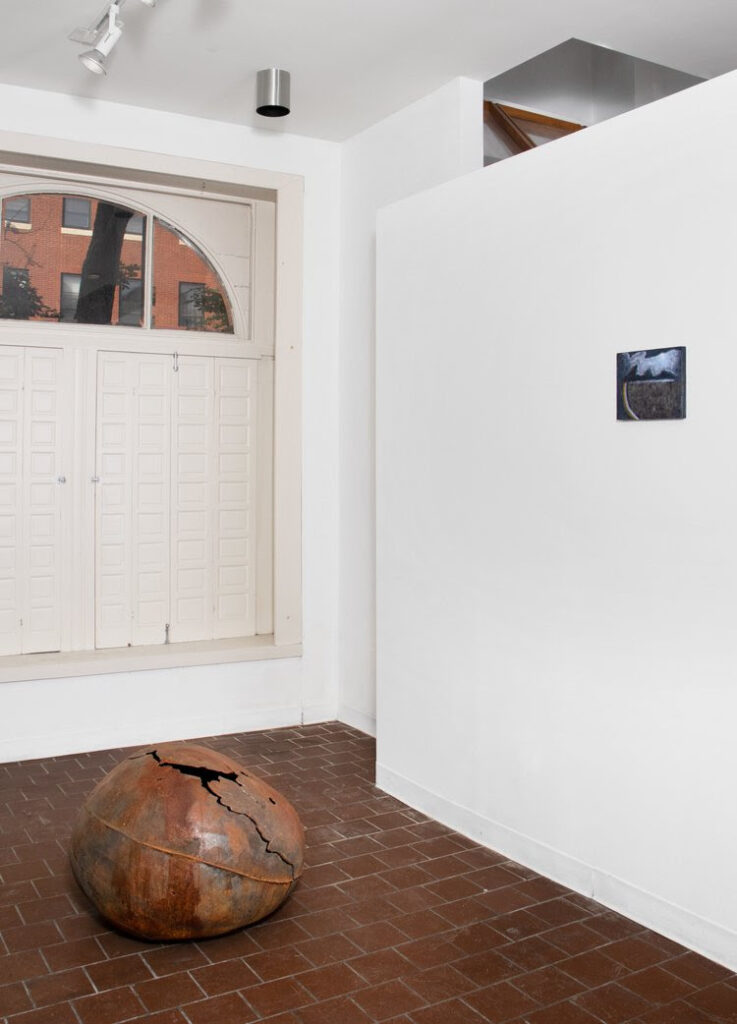
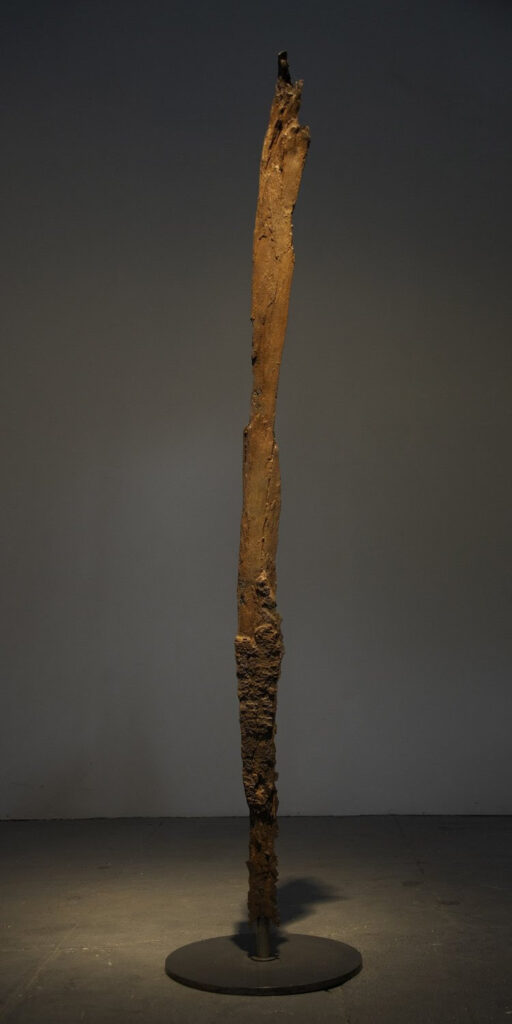
In this room, seven artists’ works come together, creating a series of contrasts and harmonies. Ruppert’s sculptures are cast in iron and bronze, man-made objects that imitate natural ones. They impose on the gallery space with their size and weight. His nearly nine-foot-tall cast iron monolith, “West Cliff Strike,” which Smolkin calls a “kind of memorial to a tree struck by lightning,” is intentionally situated under a skylight and across from a meditative charcoal drawing of Herring Run Park at night by Erin Fostel.
Fostel’s drawings are gorgeous, almost photographic, forest nightscapes—trees silhouetted in misty light– that evoke a sense of solitude and calm and maybe a little sadness. On the other side of Ruppert’s sculpture are four large pieces by Charles Mason III of large, expressive flowers. Charles Mason III’s oil stick and pastel drawings are bold and bright and playful, one inscribed with the whimsical message, “Would you help me if the wind decided to blow me away.”
Taken alone, each of these works speaks about the power of nature and invites viewers to consider their place in relation to the natural world; taken together, the conversation becomes more dynamic and complex. Smolkin describes some of the logic of his curation: “I actually like when things are simple in a way, like a drawing using wood [paper] to make a depiction of a forest next to a cast iron sculpture of a piece of wood that was burned . . .”
Despite the seeming simplicity of the connections, their proximities create a much more nuanced examination of what it is like to be a human being living in the natural world. The exuberant joy of Mason’s flowers, the implicit violence of Ruppert’s sculpture, and the quiet melancholy of Fostel’s drawings interact, offering visual representations of the states nature can create in and around us.


Four other artists round out the show. Taj Poscé and Zoë Charlton both work in mixed media. The former uses burned industrial plastic in his works which involve geometric designs, the materials themselves becoming a commentary on the ways in which human production has hurt the environment. His work feels explosive with its strong lines, bold textures, and bright colors. Two pieces feature a shape like a shooting star, its trajectory downward, as if capturing the moment before a crash.
In Poscé’s piece, “Somewhere Between Joy and Pain,” created from acrylic paint, burned newspaper, canvas, tissue paper, and industrial plastic, a rainbow is in the background. In front of it is a purple star that seems to be exploding. The layered materials give depth to the work—both literally and figuratively, as the viewer must look past clouds, stars, diamonds, and burnt newspaper to focus on the rainbow. And isn’t that true in life? We must endure storms to see rainbows, must take the cruelty and violence of the natural world along with its beauty.
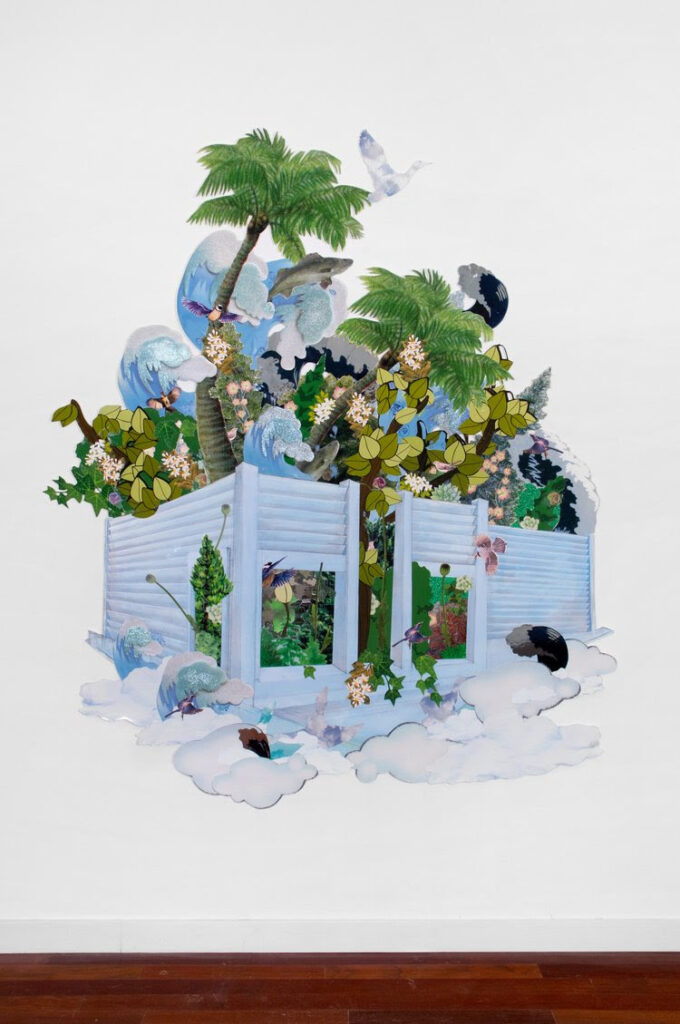
Charlton’s collage is the only work in the exhibit that explicitly acknowledges human presence in the natural world. This presence takes the form of a vinyl-sided house from which lush palm trees and leaves, pink flowers, ocean waves, and clouds burst forth, the natural world literally exploding from the walls of the house.


Thiang Uk’s and Dolores Zinny, like Fostel, create quieter, more atmospheric works, and their juxtaposition to the bolder works of Poscé and Charlton force the viewer to move around in order to see all of the pieces clearly. Uk’s paintings are relatively small in scale—about 8 x 10 inches—but they are rich with energy and movement. The compositions are abstract landscapes that represent the sky in a range of moods, and the softness of these images has a powerful effect beside the harder lines of Poscé and Charlton and the heaviness of Ruppert.
To fully appreciate the movement in Uk’s work, you need to get up close. Similarly, Zinny’s diminutive pencil drawings—the fine lines and gradations of color—draw the viewer right up to the frame. Her pieces are about the size of a postcard, but they have a big impact. There is so much texture and movement, it seems impossible that the small format can contain it. In “Sun,” the image of the sun is just blank space on the paper, an absence representing the most powerful thing in the sky.


Nature itself can be both quiet and meditative, violent and extreme, as the works in “Brighter Skies” demonstrate. Smolkin came up with the idea for the exhibit about six months ago, and he admits that he was not the only one thinking about themes of nature and destruction: “I started noticing other shows that had a similar energy—there’s the Black Earth Rising show at the BMA, then there’s some shows in New York galleries. There seems to be something in the air. I think we’re all trying to find equilibrium, trying to connect to something that doesn’t feel like it’s falling apart as you’re trying to connect to it.”
The show succeeds in this. These seven artists’ works take the viewer on a journey through the natural world—its quiet beauty, its energetic power, its potential to destroy—and after spending time with the exhibit, I felt the thing that both art and nature are uniquely capable of eliciting: hope.
Brighter Skies is on view June 28- August 9 2025 at CPM Gallery. Open By Appointment: Tuesday – Saturday, 10am – 6pm
1512 Bolton St, Baltimore, MD 21217
Header Image: Erin Fostel, “Rustle,” 2023, charcoal and graphite on Grafix drafting film, 27 x 24 inches (Framed: 29 x 26 x 2 inches)