The first piece you see when you enter the recently opened exhibit Strong, Bright, Useful & True is a collage layering images of a brick wall, the American flag, and a banged-up front door that together form an ambiguous backdrop to two young people embracing. Is the couple in Bria Sterling-Wilson’s “What Do You Have to Lose?” clinging to each other as castaways in a hostile world, or simply finding comfort in the shelter of familiar surroundings, or a little of both?
Walk to the farthest end of the gallery and you will find the masterwork of assemblage “Ancestry Doll 1” by Joyce J. Scott. With African sculptures for legs and Japanese porcelain figurines of eighteenth-century English gentlemen for arms, the small figure in an elaborately beaded dress embodies how identity and self-presentation are an amalgam of historical influences stitched together in a sometimes ungainly manner.
Sterling-Wilson is an emerging artist in her early thirties who earned her BFA from Towson University in just 2021. Scott is the MacArthur genius prize-winning almost octogenarian who garners laudatory profiles in The New York Times. Artists at opposite ends of their careers sharing the same gallery space like this is a rare but welcome happening. They have been brought together, along with a dozen others in this impressive showcase at the Irene and Richard Frary Gallery at the Hopkins Bloomberg Center in Washington, as living artists who have a common connection to Baltimore. Altogether, the show displays recent acquisitions by Johns Hopkins University from ten artists, several works from its permanent collection, and a loan from the Baltimore Museum of Art.


Baltimore is a city overflowing with talent, and it deserves to be recognized and celebrated. Exhibitions like this shift the spotlight to where it truly belongs.Bria Sterling-Wilson
The Frary Gallery, though only 1,000 square feet, nevertheless offers in Strong, Bright, Useful & True a satisfying cross-section of Baltimore’s contemporary art-makers: intergenerational, as diverse in makeup as the city’s population, and demonstrating accomplishment across mediums of painting, drawing, sculpture, assemblage, and video installation.
“Baltimore is a city overflowing with talent, and it deserves to be recognized and celebrated,” Sterling-Wilson told BmoreArt recently by email. “Exhibitions like this shift the spotlight to where it truly belongs.”
The idea for organizing a Baltimore-centric exhibit at the Frary Gallery began last fall. “It became pretty clear that there was an interesting moment occurring at Hopkins [around] taking a look at the arts,” said the gallery’s director Caitlin Berry in an interview, which could help “weave an interesting story around Johns Hopkins and its relationship to the community and the creative community of Baltimore.”
Sparked initially by JHU President Ron Daniels attending a Connect + Collect event in BmoreArt’s gallery space in 2022, the university had launched an initiative to collect the work of Baltimore-based artists, according to BmoreArt Executive Director and Publisher Cara Ober. Its focus on public art collection and display was an outgrowth of a project that sought to elevate diverse and underrepresented accomplishments and experiences reflective of JHU’s campuses and communities. Moreover, this effort dovetails with a campus-wide Taskforce on the Arts introduced last year “to elevate and advance the arts at Johns Hopkins.”
An Art Collecting Committee was formed of students, faculty, staff, alumni, and trustee representatives to guide an initial investment of $500,000 over two years. They selected works for acquisition from an artists’ portfolio curated by Ober and Inés Sanchez de Lozada, Manager of the BmoreArt’s Connect+Collect gallery space, that told a diverse Baltimore story and spoke to the social, environmental, scientific, and cultural issues that JHU communities wanted to prioritize, Ober explained.
First-year acquisitions included a number of works by established or mid-career Baltimore-based artists, including photos by SHAN Wallace and portraits by Ernest Shaw and LaToya Hobbs. In the second year, the Committee tapped even more up-and-coming and emerging artists.
“Most colleges don’t see the value in collecting art, especially from living and local artists,” Ober pointed out. “Unlike most other institutions, JHU was willing to take a risk on these living artists poised for much greater national acclaim, to invest early and with confidence, and to give the decision-making power to their students, faculty, and staff.”
Baltimore Museum of Art Curator and Department Head of Contemporary Art Cecilia Wichmann echoed support for the Committee’s approach. “As institutions embedded in the social fabric of Baltimore, we have an unparalleled opportunity and an ethical imperative to seek out and support the artists in our midst,” she wrote in an email. “Their work creates and perpetually renews the culture of the city that we cherish.”

Strong, Bright, Useful & True doesn’t strain too hard to find commonalities amongst the array of Charm City artists featured. “Thematically, it’s not that these artists are exploring one thing,” Berry noted. Still, the exhibit’s thoughtful curation suggests several strands linking the works.
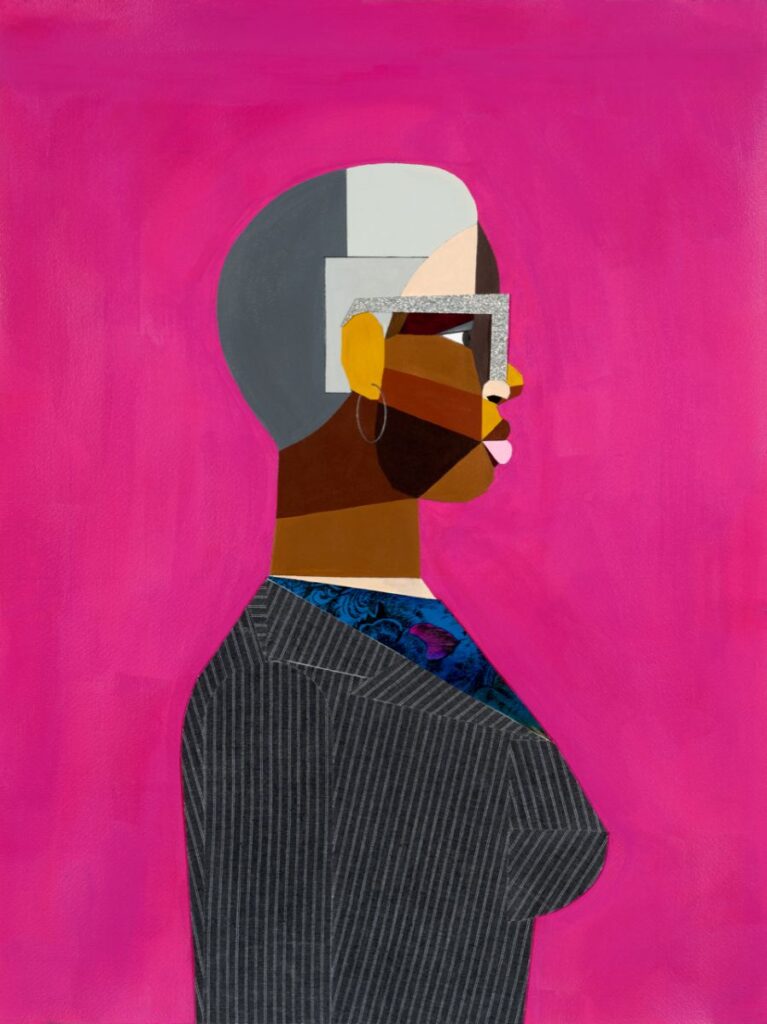
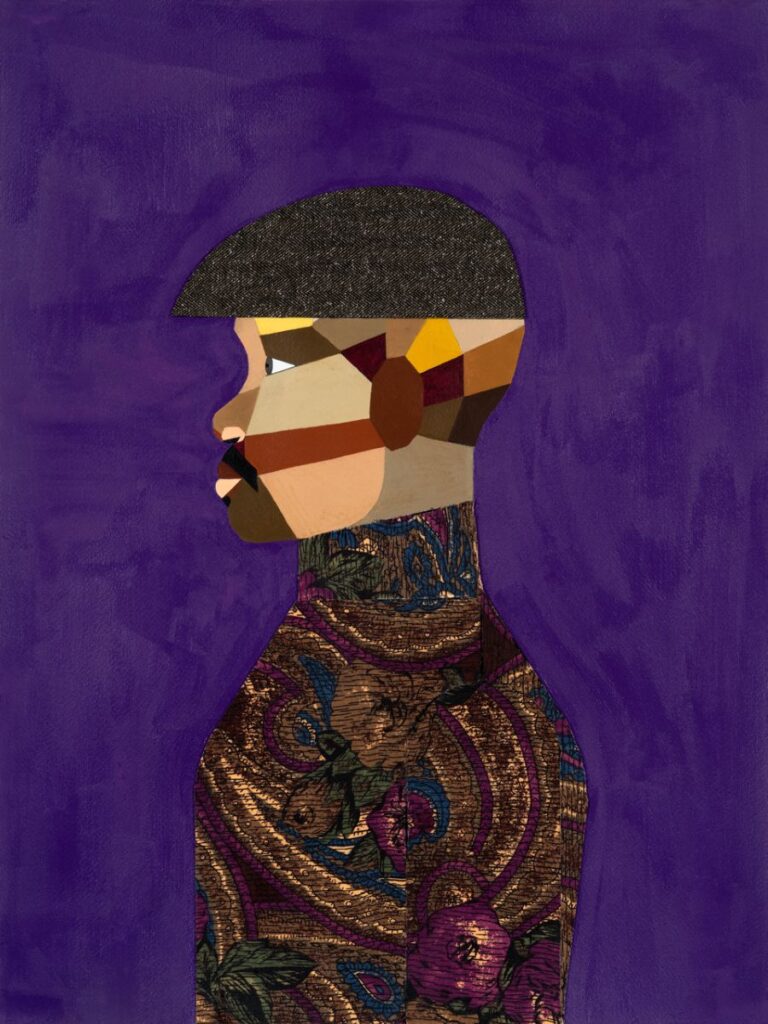
Experimentation in portraiture, for instance. Derrick Adams’ paired “Interior Life (Woman)” and “Interior Life (Man)” evoke both the venerable tradition of cameo portraits and the disorienting fragmentation of Cubism. Now in his mid-fifties, Adams is enjoying a well-earned burst of attention, scoring his own feature in the New York Times’ “The Art Issue 2025” and sharing real estate with other local standout Amy Sherald in the stunning touring exhibit Giants: Art from the Dean Collection of Swizz Beatz and Alicia Keys.
Younger artists take the genre further by concealing faces and expressions, an absence that nonetheless reveals the subject’s character and emotional state. The visage of a Black man is almost totally obscured by shower water as it pours down over his head in Jerrell Gibbs’ oil painting “Can’t let’em see me cry.” Even so, all of us can recognize (and relate to) the moment of solitary breakdown and release in the pose. “For me, being in the shower, sometimes it kind of gives you the freedom to just let go, and sometimes crying is a part of that process,” Gibbs explained elsewhere of the image.
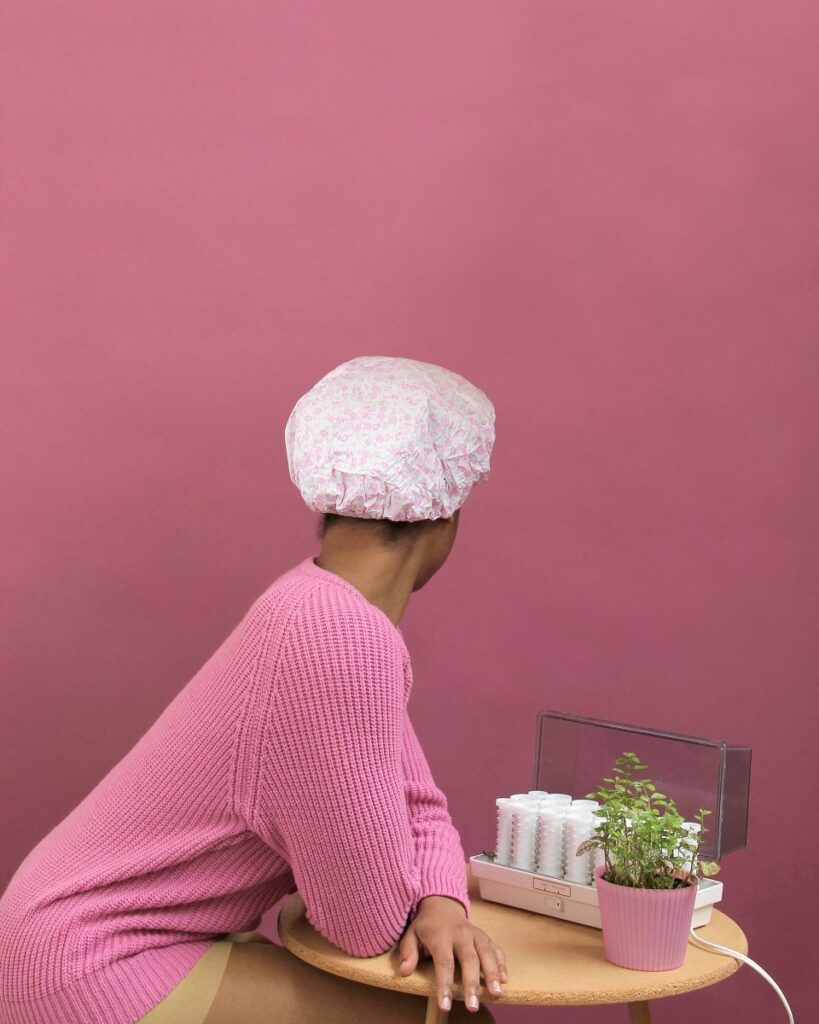
Similarly, Nakeya Brown presents only her back to the camera in her “Self Portrait” photograph. With attention drawn to the hair bonnet she is wearing and the open case of hot rollers at her side, the viewer intuits the effort that goes into fashioning a persona that could turn around and face the world.


His aim is simply to channel the materiality of this man-made-turned-organic object... not impose interpretations.Coley Gray
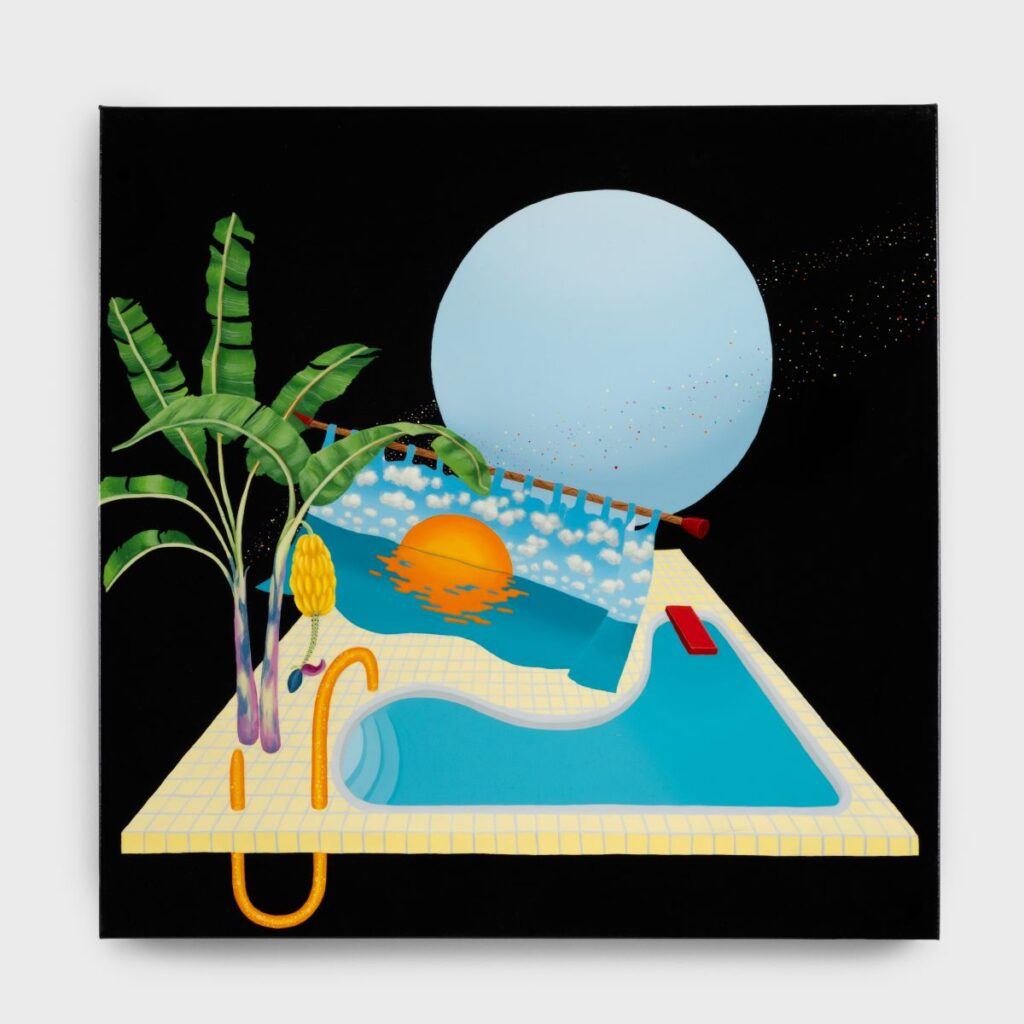
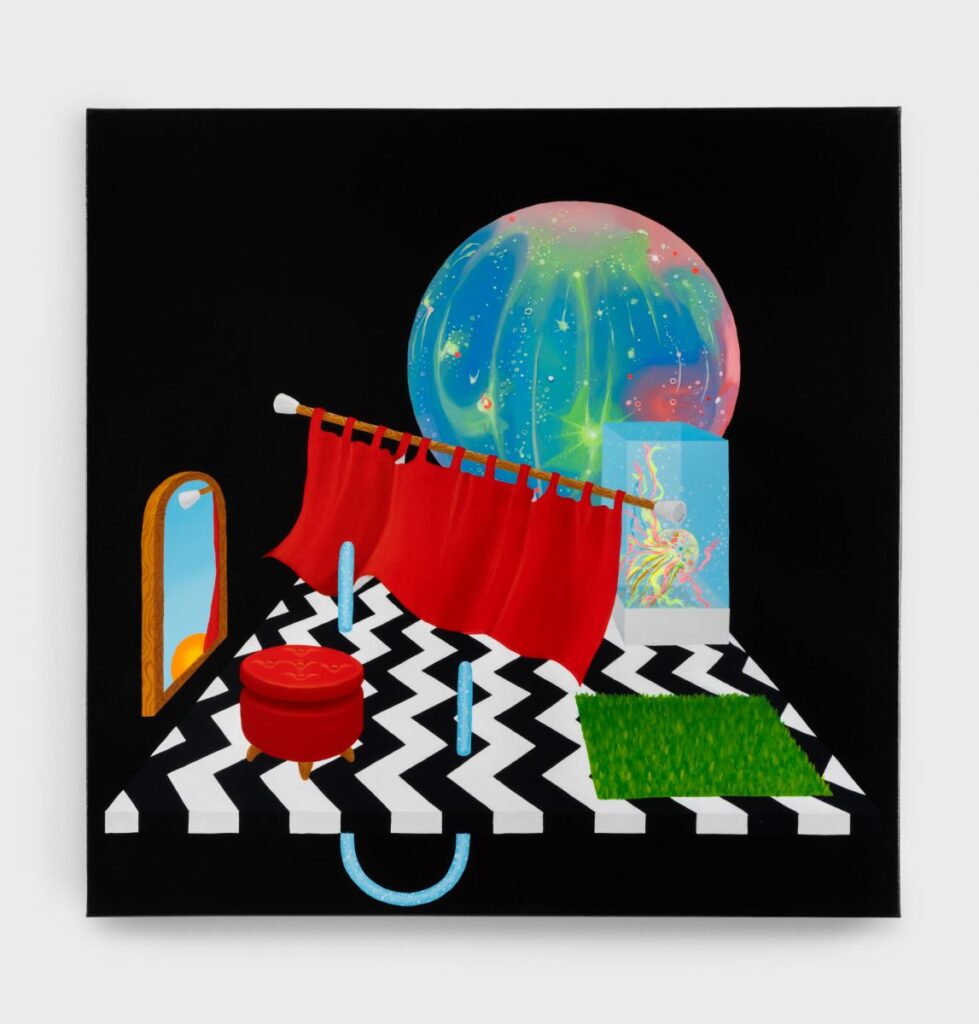
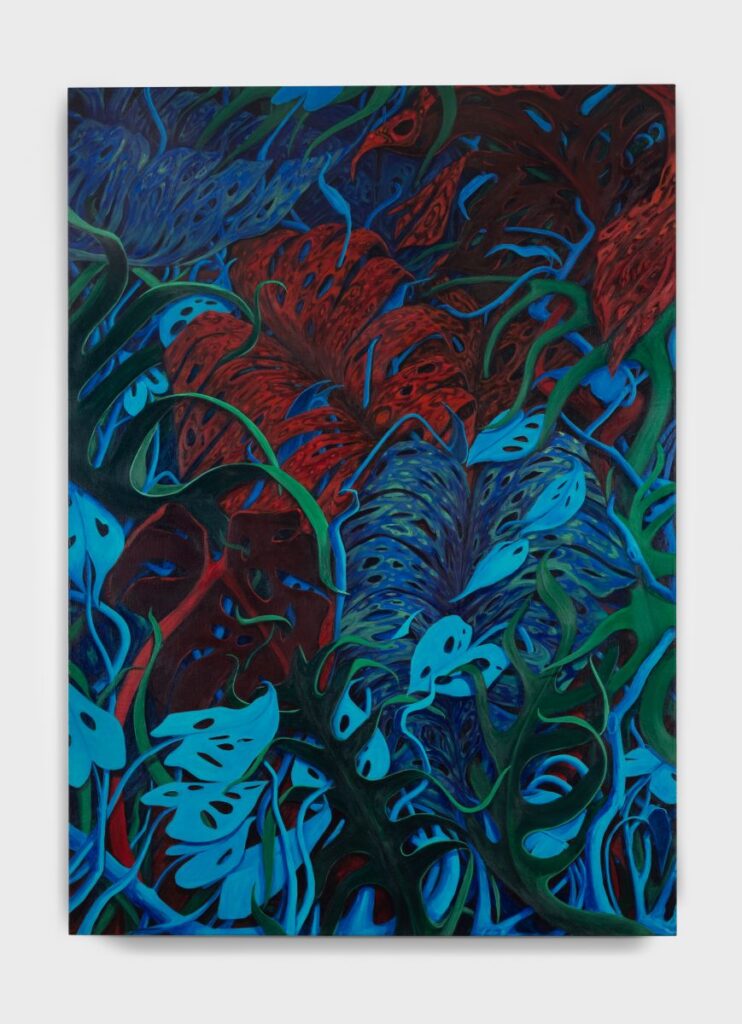
Other artworks present us with thoroughly different but equally disturbing takes on the natural world gone awry. In Se Jong Cho’s two surreal acrylics, astral planes are literally set atilt by mash-ups of Miami Vice-colored solar objects with human-scaled furniture and swimming pools. “Monstera Mash” is Phaan Howng’s close inspection of plant leaves and tendrils without beginning or end, which insidiously and voraciously could be overtaking a gothic garden of the Victorian age.
Artistic practices that engage unconventional mediums are highlighted, too. Brandon Donahue-Shipp’s “Basketball Bloom (Spectrum)” transforms dissected and deconstructed basketballs bound together with shoelaces into a chrysanthemum blossom shape. “I really like to think about, when I’m making my work, how many people have touched these basketballs, the stories that have been built around the game of basketball, and how I’m tying them all together,” Donahue-Shipp said in a video interview.
His aim is simply to channel the materiality of this man-made-turned-organic object, though, not impose interpretations. “I’m just kind of the in-between person that’s making it,” he claimed. “I don’t control the meaning.”

A geometric pattern inspired by historical Mexican textiles is overlaid on a 1980s-era family photo of a Catholic religious ceremony from rural Guadalajara.Coley Gray

A geometric pattern inspired by historical Mexican textiles is overlaid on a 1980s-era family photo of a Catholic religious ceremony from rural Guadalajara in “Procession.” “A lot of my work is about the hybrid, the mixture of both indigenous and European beliefs,” its creator Edgar Reyes said in a video interview. He recognized that a digital print was not “a traditional type of piece,” he continued, and hence appreciated the Art Collecting Committee’s openness to this form that conveyed his vision of hybridization as both assimilation and resistance.
Frary director Berry uses as well the placement of pieces to cohere such a variegated collection. The two large-scale plays in color and abstraction, “Circle Dance” by Linling Lu and “Walls of Yucatán” by René Treviño, are set into dialogue by being mounted on opposing walls. Lu’s trademark ten circles of cleanly separated concentric hues create a force field of darting energy around its wide oval shape arrangement. Photos from Treviño’s travels through Mexico and the Yucatán peninsula are distilled into basic elements of irregularly repeating patterns of shapes and progressions of mottled hues of striking colors like Carmine Red and Veronese Green.


Ten circles of cleanly separated concentric hues create a force field of darting energy.Coley Gray
About half the works line the gallery’s perimeter walls while niches built around the central video installation generate a sense of discovery as the visitor turns corners. The darkened viewing alcove runs on a loop the single-channel video Annexation Tango by Kandis Williams. This space manages to be both enclosed and porous—the sound of tango music suffuses the entire gallery.
The inclusion of the 10-minute piece, the exhibit’s only time-based work, is the result, according to BMA’s Wichmann, of Berry reaching out to explore its loan from the museum “as a way to extend the range of Baltimore perspectives represented in the exhibition.” (She noted this also built on a previous collaboration when JHU loaned “Ancestry Doll 1” to the museum’s for Scott 2024 retrospective.)
In Annexation Tango, a bare-chested man moves through a series of dance steps and poses, sometimes focused inward and sometimes staring straight at the viewer. His mostly solo tango is superimposed over aerial footage of suburban housing developments that give way to rural fields attached to former correctional facilities in Virginia. As the percussive music peaks and the landscape of raging, red-tinged flames intensifies, the dancer carries on in spite of seemingly impending extinguishment. The video is a fine example of Williams’ practice of collage techniques and her conceptual themes linking the Black body to land, sites where self-expression and exploitation of labor meet.
“With its searing interplay of movement and sound,” opined Wichmann, Annexation Tango “offers an immersive experience at the heart of the Frary Gallery’s beautifully conceived installation.”
Certainly, the opportunity to experience in DC this arresting piece by Williams (whose survey at the Walker Art Museum shows an artist truly in top form), or to study Derrick Adams’ reworking of the Black figurative tradition, is one reason to visit Strong, Bright, Useful & True. However, the greater draw comes from the collective story told of a rich urban ecosystem of artists and the city that uniquely nurtures it—a narrative to which the show’s artists readily attest.


“What I like about Baltimore is that people are open to seeing the multifaceted humanity and intersections that we have,” Reyes said, which he sees reflected in how the exhibit “showcases and uplifts multiple different experiences and perspectives and mediums.”
Howng credits the success of her career to Baltimore, she wrote in an email to BmoreArt, “thanks to its supportive community that encourages experimentation, taking risks, and more.”
Collagist Sterling-Wilson echoed the kudos to its “vibrant, supportive, and constantly evolving” artistic community. She added, “What I value most is that I don’t have to ‘leave’ Baltimore to become an artist.”
Donahue-Shipp, who moved to Charm City several years ago, suggested another enabling factor he has noticed: a sense of pride residents have in the city’s creative sector. “They’re championing their local artists,” he said.
Chief among these cheerleaders it seems to me is JHU through its commitment to acquiring and displaying locally-produced works, especially by emerging artists. Strong, Bright, Useful & True testifies to an admirable investment in not only cultural resources that benefit the campus and beyond (thanks, Frary Gallery) but also the livelihoods and career trajectories of the artists who define Baltimore’s creative vitality. Other educational institutions would do well to emulate such a fresh angle on town-gown relations. As for JHU, this exhibit surely demonstrates a successful proof of concept that merits continuing the initiative.
The depth of Baltimore’s creative pool is more than enough reason to keep acquiring pieces from working local artists, offered Donahue-Shipp.
“For every person that’s discovered or recognized, there’s always twice as many, or triple as many, that have not been discovered yet,” he said. “I know a handful that are itching to have their work shown. There’s great talent here, right?”
***
Strong, Bright, Useful & True: Recent Acquisitions and Contemporary Art from Baltimore is on display at the Irene and Richard Frary Gallery until September 6. Free and open to the public Tuesday-Saturday; timed tickets are recommended but not required.
Header image: Bria Sterling-Wilson, What Do You Have to Lose? (2020) 24 x 18 inches. Collage and found imagery. Image courtesy of the artist.