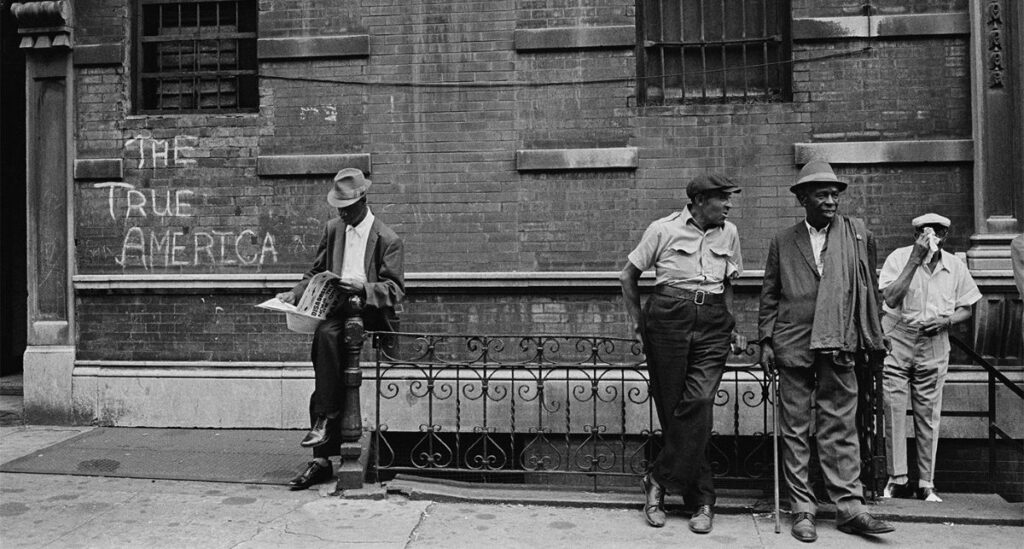
The recent re-opening of the Studio Museum in Harlem has offered a chance to celebrate Black visual makers and reminisce about Manhattan’s 125th Street as it looked in 1968, when the museum first opened. But if you can’t get to Harlem right now, no worries—MICA’s Meyerhoff Gallery offers a compelling related opportunity. The True America: Photographs by Ernest Cole, on view through December 15, reveals nearly a hundred photographs by the artist and former Harlem resident. A lively exercise in street photography and a tentative love letter to the neighborhood at the center of New York’s Black Arts and Civil Rights Movements, Cole’s works grant us a look, through the lens of an observant foreigner, at Black American expressiveness in the late 1960s and early 70s.
And it’s the product of some remarkable historical circumstances. In 1966, Cole, a 26-year-old Black man, fled his native South Africa, where he had taken a searing body of photographs that documented the brutal conditions of life under apartheid. These images formed the core of a remarkable book, House of Bondage. After settling on 142nd Street in Harlem, Cole proceeded to take thousands of pictures over the course of several years. Most of them focused on urban life in New York City, but he also traveled, documenting street scenes in Cleveland and Los Angeles, residues of racial violence in Atlanta and Washington, and the stark interiors of Black homes in rural Alabama.
By 1972, however, Cole had begun to lose interest in photography, and he drifted between the United States and Sweden. He eventually died in 1990, at the age of 49, and the full scope of his photographic work was unknown until 2017, when more than 60,000 of his negatives resurfaced in three Swedish safe-deposit boxes.
Magnum and the Ernest Cole Family Trust has begun to process and catalog the material, and the art historian Leslie M. Wilson curated a number of exhibition prints. Aperture, a nonprofit publisher, organized the exhibition and published the accompanying texts on the artist’s work. Initially staged in Minneapolis, The True America recently landed in Baltimore, where it’s on view for a little over a month.
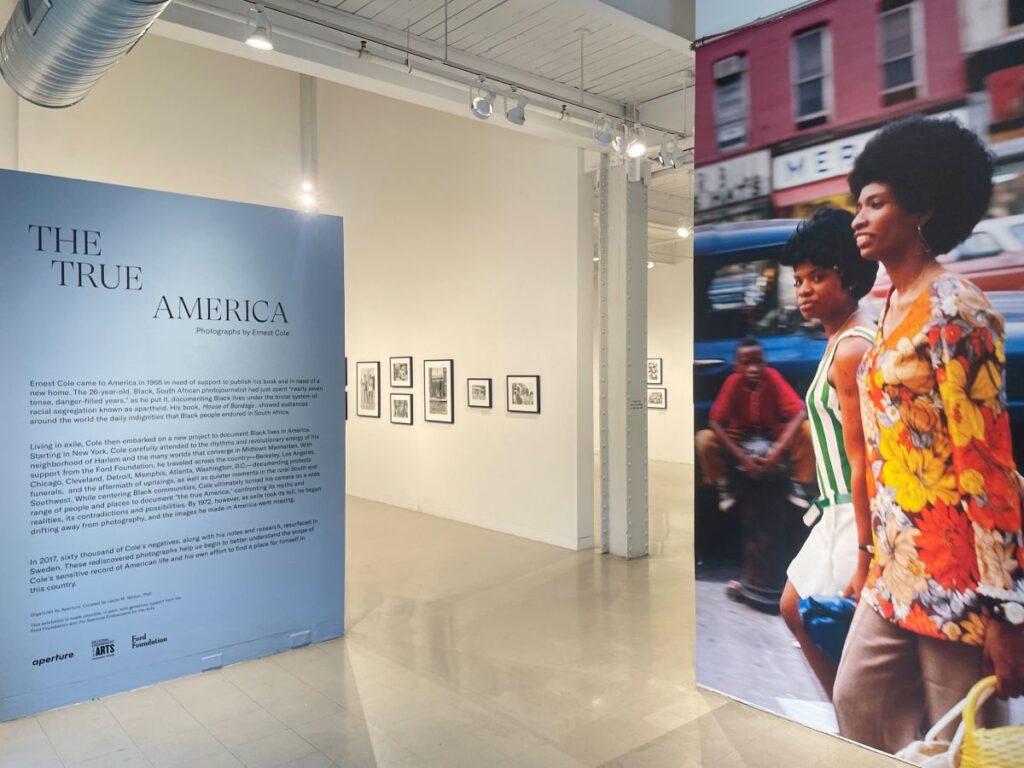
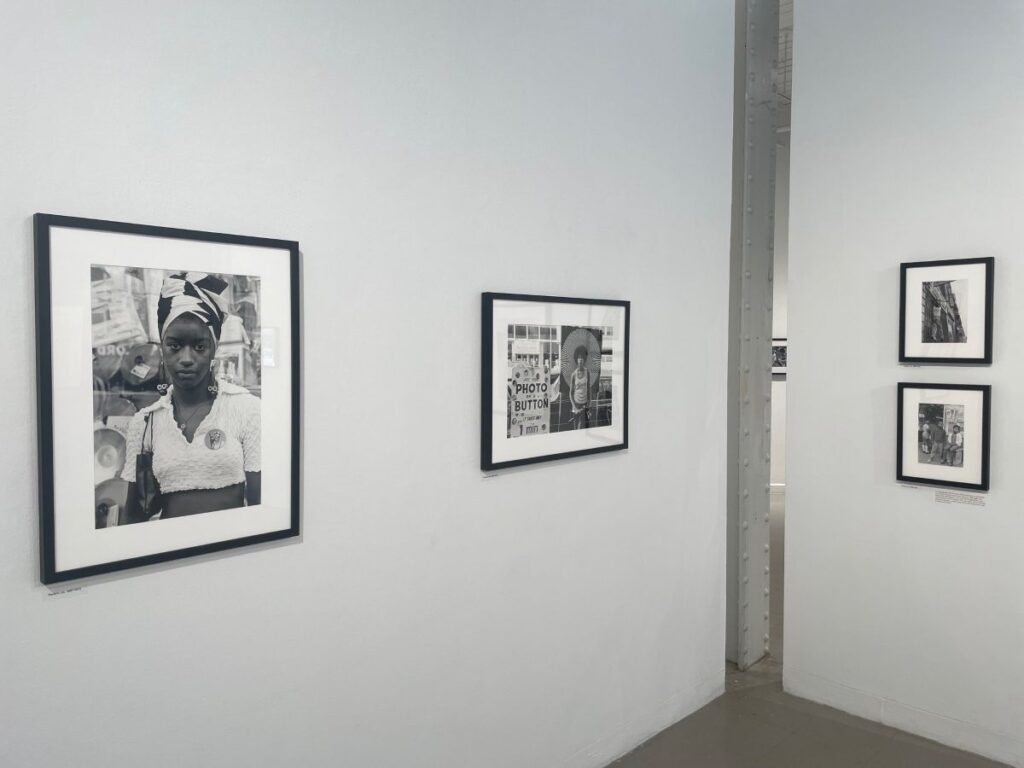
Crisply installed, the show opens strongly: in the opening gallery, sixteen photographs hum with creative, improvisational energy. A boy swings from a pole that juts from a towering façade; an intertwined couple embraces, uninterested in the severe metal and stone forms that surround them. A young woman tries out an aggressive pose against a dazzling backdrop at a sidewalk photo stand. The gritty streets of Harlem are converted, in such images, into a theater that supports kinetic experimentation, romantic exploration, and radical self-expression.
Was Cole drawn to such subjects precisely because the freedom that they implied contrasted with the oppressive conditions in South Africa? Perhaps—but as several historical artifacts displayed in the second room clearly indicate, he was also fully attuned to the presence of racism in America. In a 1967 article in the New York Times, for example, Cole reported witnessing “racial attitudes that were very much like those I know from South Africa.” New York City was not Johannesburg. But the insidious culture of white supremacy in both cities evidently made moments of individual Black joy worth recording.
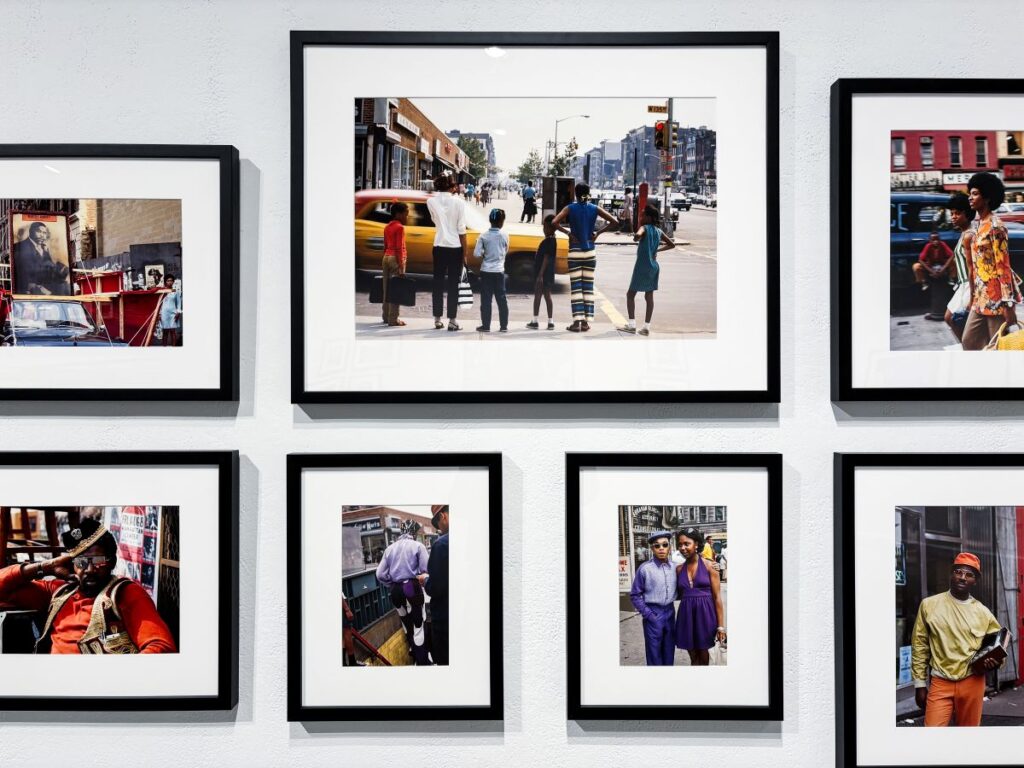
Kerr HoustonCole’s interest in political potential is paired with a delicate attention to composition and pattern.
Also relevant here is Cole’s fascination with blocks of text: storefront signs, hand-lettered religious verses, protest posters, book covers and graffiti regularly populate his photographs. As a wall text in the show notes, Cole’s interest in words may have been personally significant, for they offered him a means of gauging “how Black Americans viewed their political possibilities and where he might fit into that context.” These texts, then, were revealing elements in a polyvocal landscape that Cole was slowly deciphering.
Clearly, though, he also delighted in their varied graphic forms, and in his most arresting photographs, Cole’s interest in political potential is paired with a delicate attention to composition and pattern. I’m thinking, for instance, of an image of an elegant young Black woman in a subway car, absorbed in her copy of the 1968 book Black Rage. The contrast between the book’s fiery title and her calm immersion is memorable, but the image also rewards in more nuanced ways. Its diverse vocabulary of disparate patterns (the stripes on her dress; the gridded subway wall; the ovals on the envelope that she holds) somehow coheres. And the presence of a gentle parallel between the angle formed by her open book and the crook of the arm of a second figure in the middle ground is flatly disarming: rage giving way to a fortuitous beauty.
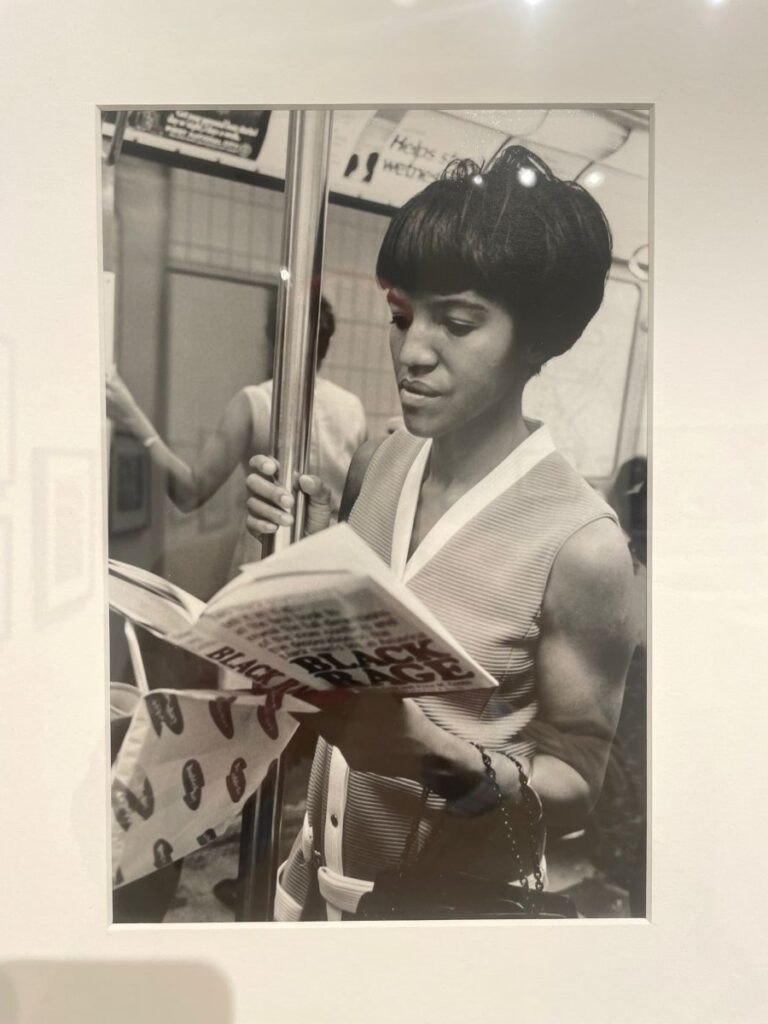
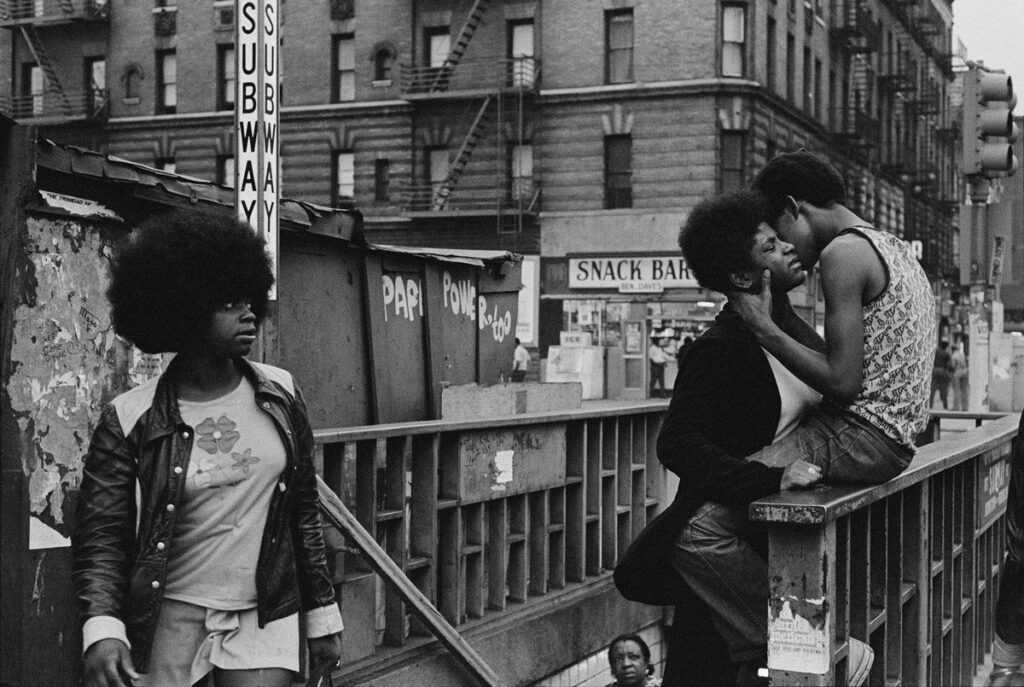
Admittedly, Cole was hardly the first photographer to take candid shots on New York City subway cars; in the 1930s, for instance, Walker Evans had taken a series of unposed photographs of metro riders. But Evans’ images feel inky, forlorn, and listless—commuters as cadavers—when we compare them to Cole’s livelier, more complex work. More useful, here as a frame of reference, is Henri Cartier-Bresson’s notion of the “decisive moment,” that fugitive instant in which the elements of a composition suddenly cohere. This woman belongs, you might say, in her surroundings.
But she doesn’t acknowledge us. Even though we are near to her, an emotional distance is maintained. Indeed, as Wilson points out, in most of his photographs, “Cole is a stranger, observing closely and critically, but not intimately.” This is apparent in the next gallery, which features fourteen photographs taken throughout Manhattan. At times, the pictured subjects are obviously aware of Cole’s camera, and respond variously: some seem wary, some appraise him in an amicable manner, and some seem to strut for the lens. But the relationship never feels quite personal. These are works by an outsider, tinged with the slight pathos of the flâneur.
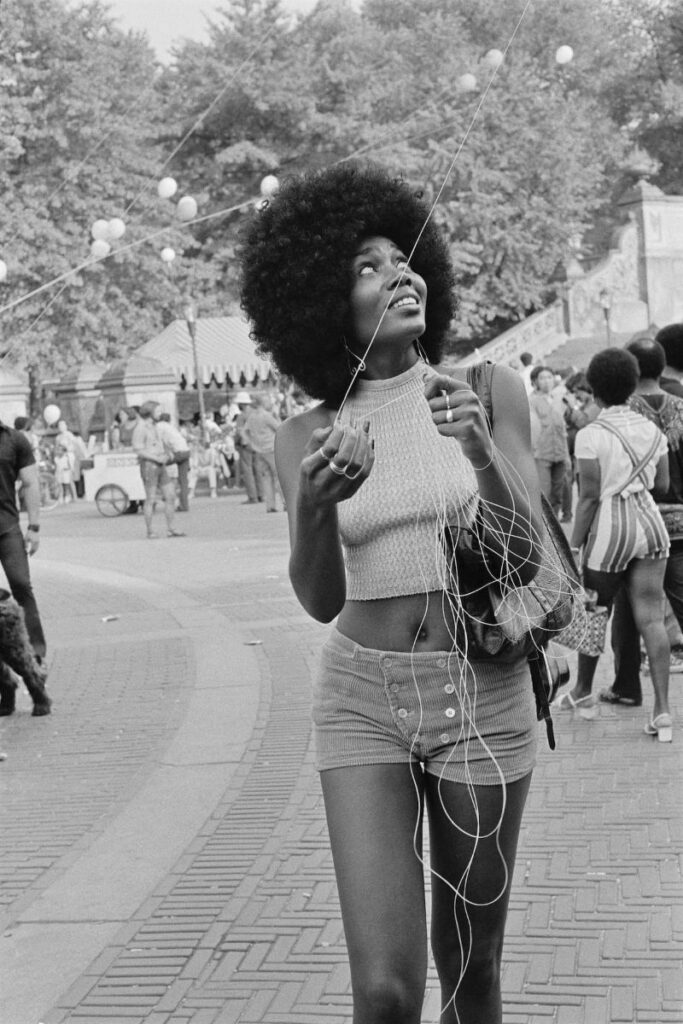
Even so, Cole’s photographs generally suggest an underlying sympathy, or a desire to believe in the nobility of his subjects. While he usually shot in black and white, he did occasionally use color film, and a wall of images in this show testifies to his love of bold patterns, bright colors, and people who were unafraid to stand out on the city’s sidewalks. Even his black-and-white photographs could convey this: in one of my favorite prints, a smiling woman strolling through a park looks upwards at a balloon. It’s a buoyant, summery image, in which her evident pleasure and self-confidence suggest the lightness and bright coloration of the unseen balloon.
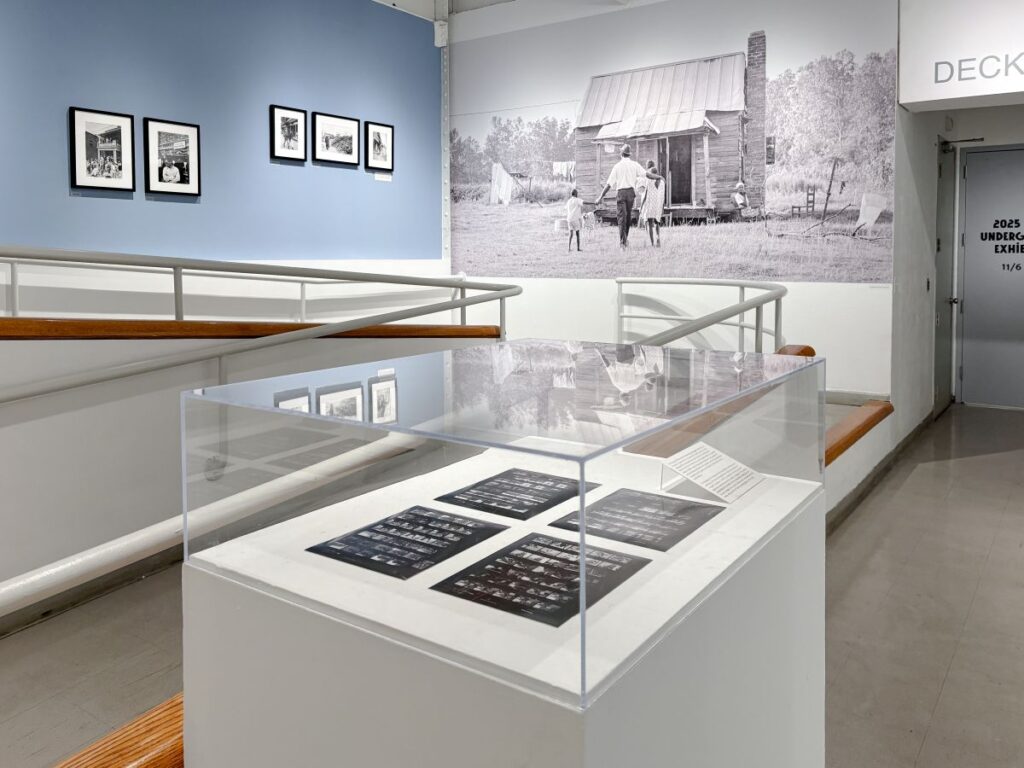
Kerr HoustonIn a vitrine, we can see some of Cole’s contact sheets: a hint of the mass of images that still need to be studied.
Of course, the years around 1970 were also a turbulent period marked by a grinding war, political assassinations, and civil unrest, and this show includes several photographs related to social agitation. In one, a National Guardsman and a woman in a regal coat pass each other in front of a burned, shattered Washington storefront: the weird aftermath of the violent uprising that followed the murder of Martin Luther King Jr. And when Cole traveled to Chicago, Memphis, and Atlanta, he maintained his interest in how Black residents responded to repressive conditions and events.
Interestingly, he also spent some time in rural Lowndes County, Alabama, where he took a number of sensitive pictures of Black families and their modest circumstances. Here, too, it’s hard to avoid thinking of Evans, whose stoic photographs of white Alabama sharecroppers had appeared in the 1941 book Let Us Now Praise Famous Men. Cole’s images, though, are less iconic and denser with information. In one interior scene, a family watches television in a room decorated with cardboard, images of slain leaders, and humble calendars. And in a majestic photograph reproduced on a wall, a family walks towards a modest, tin-rooted house: simple togetherness, monumentalized.
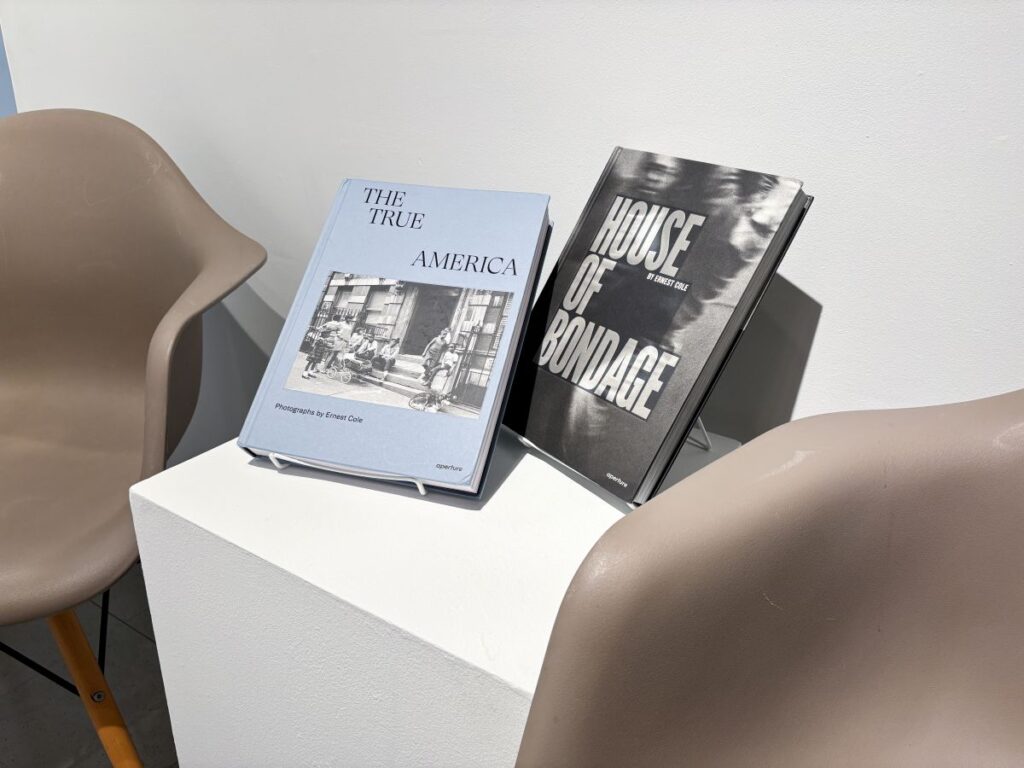
That final gallery is also notable for its thoughtful curatorial touches. In a vitrine, we can see some of Cole’s contact sheets: a hint of the mass of images that still need to be studied. And at the very end of the show, beneath two photographs of seated Alabamans, two chairs flank copies of Cole’s two books: House of Bondage and the catalogue for this show. Here’s some advice: take a seat, echoing the Black subjects above you, pick up the catalogue, turn to page 150, and enjoy an image of rapt concentration and blurry energy: three girls, immersed in skipping rope on a crowded sidewalk.
How to sum this show up, then? Two important foils can help. Early in his career, Cole was struck by Cartier-Bresson’s 1955 book The People of Moscow, a record of the photographer’s trip to the Soviet capital. Cole seems to have admired Cartier-Bresson’s ability to treat groups in abstract terms, and he appreciated the idea of a book that combined images and text. But when he turned his lens on America, Cole had little interest in the pallid routines and regimented order of Moscow. Instead, he sought out dancers, sharps, church ladies, proselytizers, and quirky signage—creating an active, multi-faceted portrait of Black American individualism.
And, in the process, he crafted an implicit corrective to one of the most infamous missteps in the history of photography. In 1969, the Met mounted Harlem on My Mind, a show that nominally sought to celebrate Black creativity—but that failed to include any paintings or sculptures, and used photographs of Harlem leaders and residents as design elements. The show was excoriated by critics such as A.D. Coleman and sparked protests by Black artists. There’s no evidence that Cole took part in those protests, but in a sense he hardly needed to. For, as this show makes clear, he was already at work producing a rich and varied vision of his surroundings: Harlem, that is, in the flesh.
The True America: Photographs by Ernest Cole exhibits November 8-December 15, 2025 at MICA’s Meyerhoff Gallery, 1303 W Mount Royal Ave
Curator Leslie Wilson will be giving a gallery talk in the Meyerhoff Gallery at 4 p.m. on December 3, 2025.