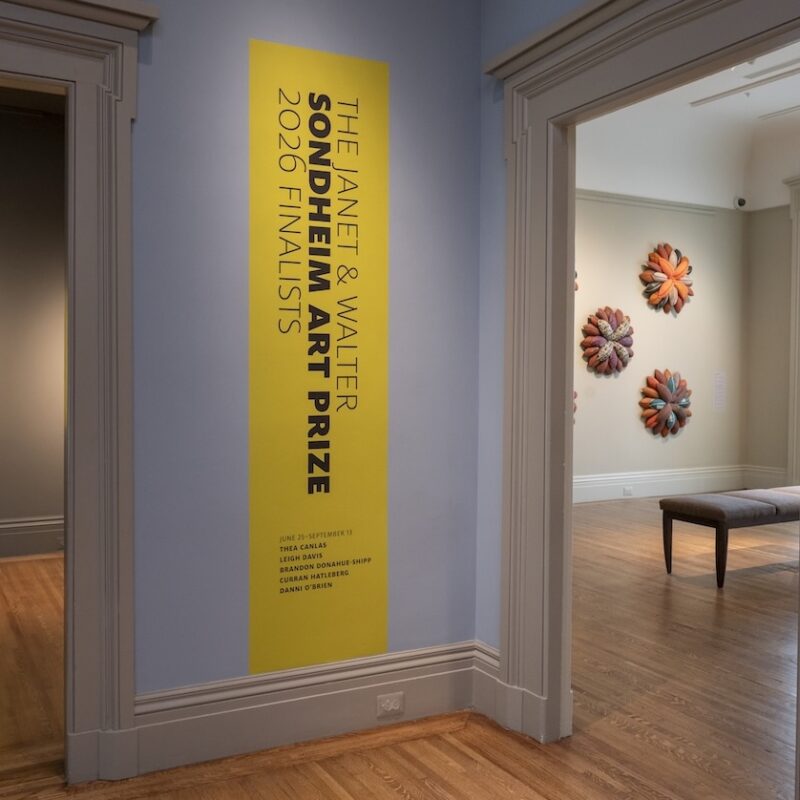
Every summer, the Janet & Walter Sondheim Art Prize offers a useful, if imperfect, barometer of Baltimore’s contemporary art scene. This year’s exhibition at the of 2026 finalists at the Walters Art Museum’s Hackerman House feels less like a competition than a conversation. Organized by Create Baltimore and curated by the Walters’ Lisa Anderson-Zhu, the exhibition asks jurors to compare artists working in vastly different media, addressing entirely different concerns, and then select a single winner. Yet the real value of the exhibition has never been the prize itself. It is the rare opportunity to experience the ideas, materials, and processes driving the region’s most accomplished contemporary artists.
This year’s finalists—Thea Canlas, Leigh Davis, Brandon Donahue-Shipp, Curran Hatleberg, and Danni O’Brien—share no obvious aesthetic common ground. Their work ranges from photography and installation to assemblage and sculpture. Yet each artist investigates what remains hidden beneath everyday life: the labor that supports global economies, the emotional residue of grief, the histories embedded in familiar objects, the fragility of the body, and the connections forged between strangers.
Collectively, the exhibition feels less concerned with making statements than with asking viewers to look more carefully at the systems and relationships that shape contemporary experience. This isn’t an obvious blockbuster exhibition, although it is gorgeous, especially within the context of the historic Mount Vernon mansion. However, it is an exhibition that rewards patience and in-person looking.
Cara OberAlthough the $30,000 Sondheim Prize will be awarded on August 27, for me the winner is the exhibition itself.
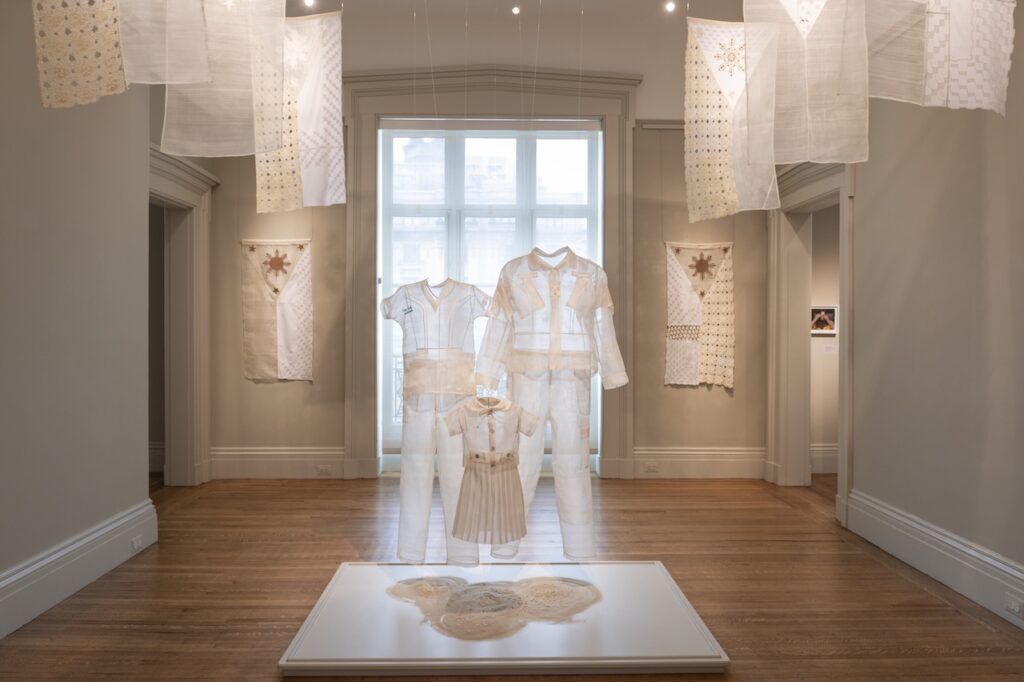
Thea Canlas presents some of the exhibition’s most intellectually rigorous work. “Value Studies: Uniforms” transform translucent piña-cloth garments into spectral stand-ins for the millions of overseas Filipino workers whose labor supports economies across the globe while rendering them largely invisible. Delicate embroidery and luxury materials create an uneasy tension between beauty and exploitation.
Canlas asks viewers to consider how migration becomes normalized within global capitalism and what happens when cultural identity is shaped by the expectation of departure. Who benefits from these systems of exchange, and who disappears within them? Suspended above piles of sand, pearls, sugar, and human teeth, the uniforms become haunting reminders that labor itself is one of the Philippines’ greatest exports. The work asks an uncomfortable question: What does it mean when a nation’s most valuable commodity is its people?
In Flag Studies Installation #5 (2026), Canlas reimagines the national flag as an unstable, evolving symbol rather than a fixed emblem of nationhood. Combining digitally embroidered Philippine textiles, lace, and printed satin, she layers materials whose histories reflect colonization, commerce, and cultural adaptation. The installation foregrounds the diversity of Indigenous textile traditions while questioning how they have been absorbed into nationalist narratives and global markets. Rather than proposing a singular vision of Filipino identity, Canlas presents a constellation of shifting forms that acknowledges the ongoing influence of colonialism, migration, and diaspora in shaping what a nation—and its symbols—can mean.
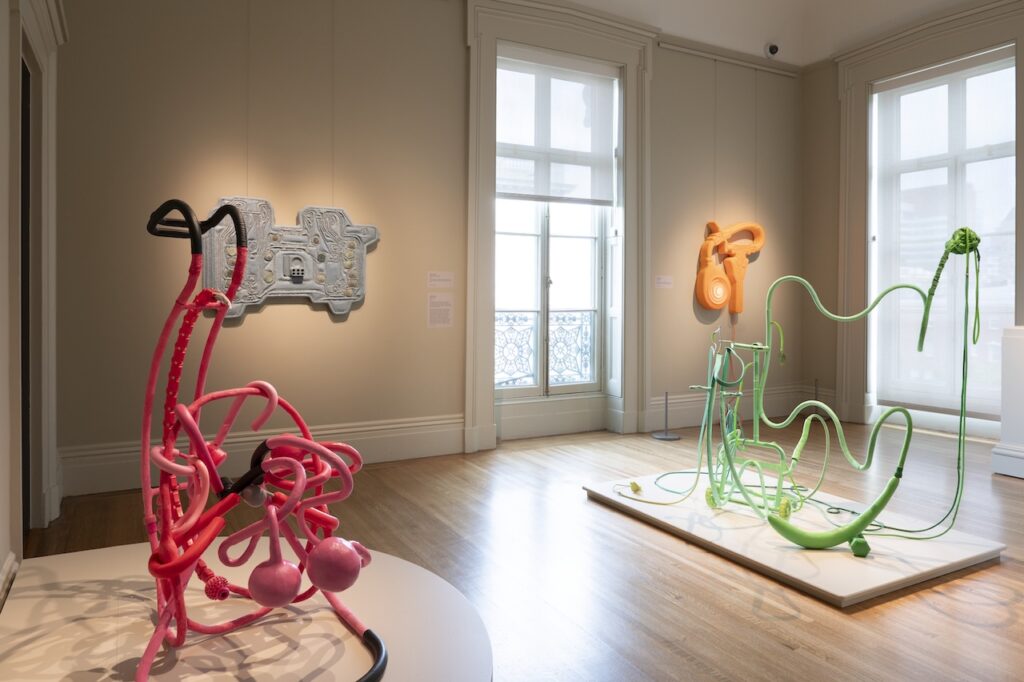
Danni O’Brien’s sculptures offer the exhibition’s wild card. “The Thighmaster Cycle” assembles discarded exercise equipment, wax casts, dried gourds, and household detritus into a gloriously dysfunctional organism that seems simultaneously ridiculous and strangely alive. Whether it is a deliberate reference to Matthew Barney’s “Cremaster Cycle,” its absurdity is its strength, the sculpture delights in malfunction. It refuses optimization. In a culture obsessed with self-improvement and bodily control, O’Brien proposes a different possibility: what if instability is not a flaw but a condition of being alive? Why are our bodies expected to function like efficient machines when they’re so often awkward, vulnerable, and unpredictable?
That vulnerability becomes more pointed in “Humidify Her,” which layers a 1938 contraceptive patent drawing with recycled domestic objects and glowing lights. The piece feels part shrine, part warning signal, part archaeological fragment. O’Brien draws connections between personal health, reproductive autonomy, and the material remnants of past technologies without becoming didactic. Rather than making an overt political statement, the artist asks whether the history of reproductive control is ever really behind us.
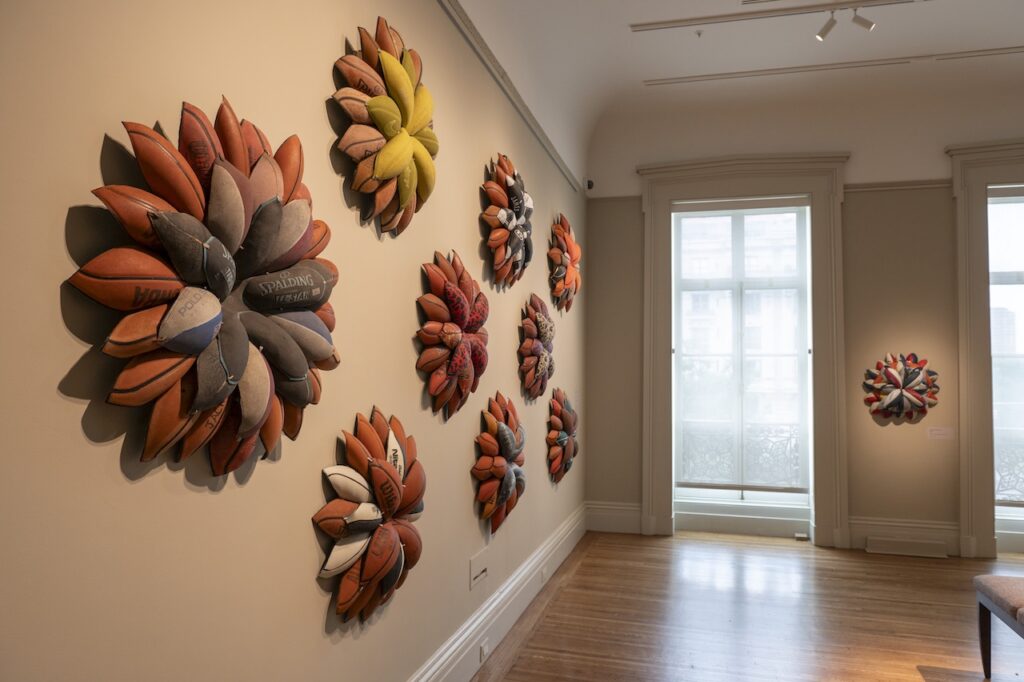
Brandon Donahue-Shipp transforms familiar materials into unexpectedly tender monuments. His Basketball Bloom sculpture series, including “Glow City,” unfold worn basketballs into floral forms, preserving every scuff and abrasion. The objects remain unmistakably athletic equipment, yet they also become portraits of collective use, memory, and touch. Relying on nostalgia and the history embedded in creative reuse, they allege that an object can become more precious because it has been used and worn.
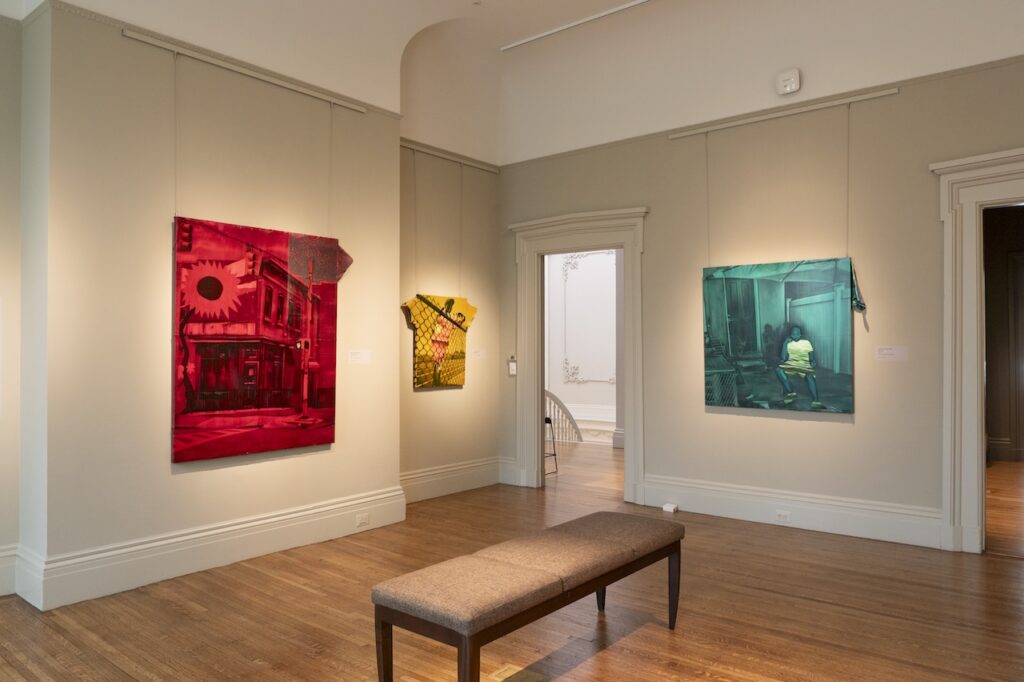
His T-shirt painting “1051 Greenmount Ave” operates with similar sensitivity. Airbrushed memorial shirts are ubiquitous within Black communities but rarely enter museum spaces. By painting directly onto the garment itself, Donahue-Shipp preserves both its physical form and emotional weight. The shirt is no longer simply clothing or canvas—it becomes an archive of labor, memory, and everyday devotion.The work recalls Baltimore’s long tradition of memorial airbrushing while expanding it into a meditation on place, memory, and care. What stories remain embedded in the objects we wear long after they have outlived their original function?
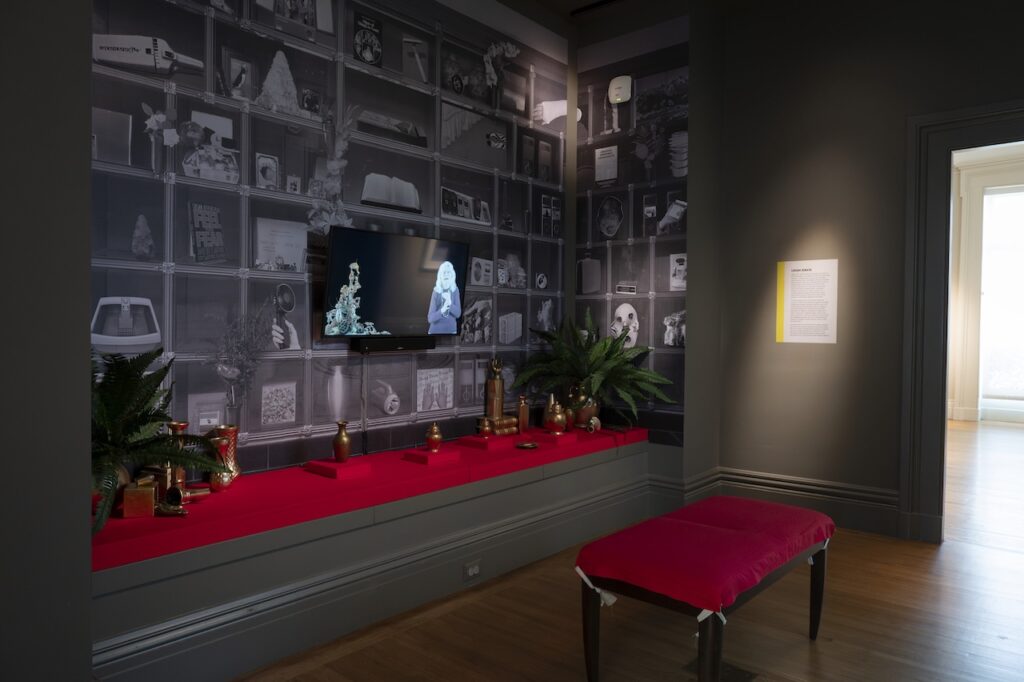
Leigh Davis approaches mortality through participation rather than representation. The immersive installation, “Elegies for the uncertain inevitable,” resembles a contemporary viewing chapel, complete with video, seating, collected objects, and spaces for reflection. Rather than focusing on a single loss, Davis explores the anticipatory grief that accompanies contemporary life—the awareness of futures that may never arrive, relationships that will inevitably change, and worlds that are constantly slipping away. Can art provide a rehearsal space for uncertainty? It’s a subtle but profound shift.
Davis’ ongoing practice includes all kinds of collective rituals for mourning, including “Karaoke in the Cemetary” and “Reunions,” a psychomanteum, as well as the film, “Inquiry into the ELE,” which presents accounts of end-of-life experiences gathered through collaborative research. At the Walters, this particular installation, a columbarium designed to commemorate all kinds of bereavement, complete with a collection of urns, recognizes that collective grief increasingly unfolds through screens, social media feeds, and mediated experiences. “Elegies” insists on the continuing importance of physical presence, while acknowledging the absurdity of living and the irrationality of our responses to grief and loss. In an era saturated with mediated tragedy, Davis posits that grief itself has become something we need to practice together rather than experience alone.
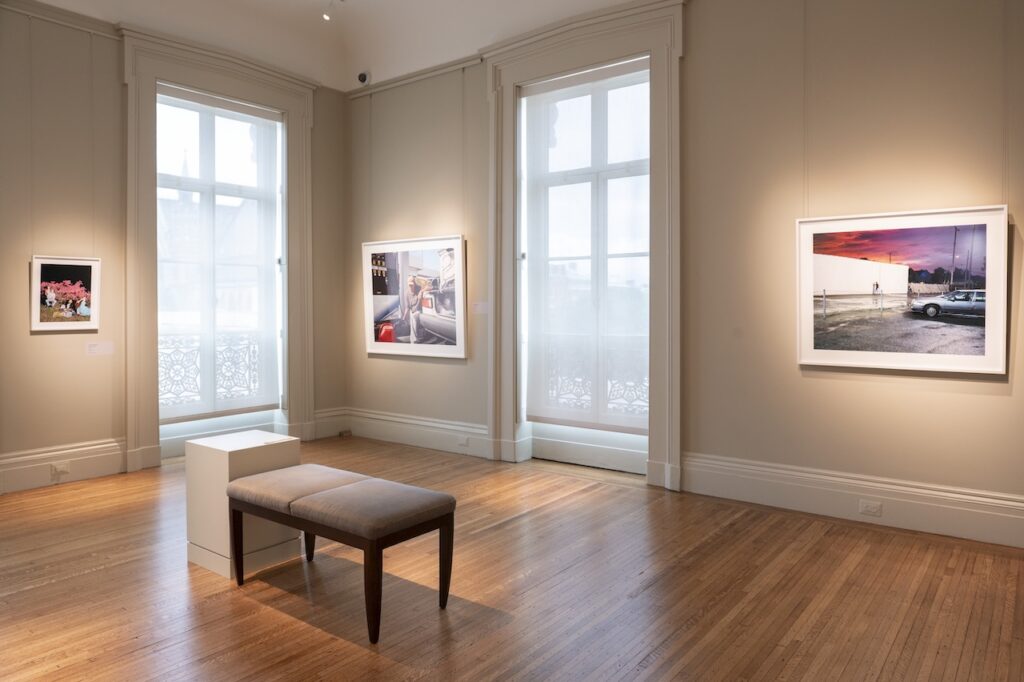
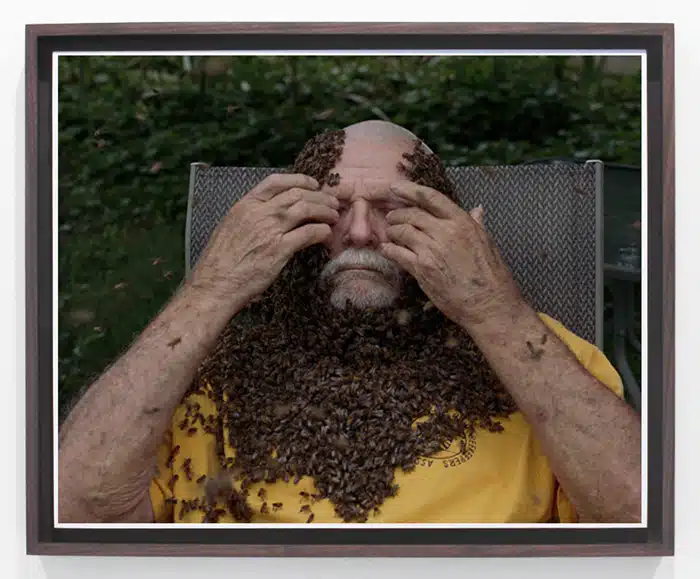
Curran Hatleberg’s color photographs of white Southern Americans initially appear quieter than the rest of the exhibition, but their emotional complexity emerges gradually. In “Untitled (Man with Bees),” a small color portrait of a man almost completely covered in bees, the image resists easy symbolism; he may be a shaman or religious leader, or possibly an eccentric beekeeper, showing off his relationship with this particular hive. Either way, your curiosity is rewarded, as you become aware of the deep trust that must exist between subject and photographer. Untitled (Rainbow) similarly hovers between documentary and dream, suggesting that coincidence can carry emotional truth without becoming metaphor.
Hatleberg’s practice is rooted in long-term relationships with the people he photographs, and that commitment is evident throughout the work. At a moment when images are produced and consumed at unprecedented speed, his photographs insist that understanding another person requires time. Can photography still create meaningful connection, or have we become too accustomed to looking without truly seeing?
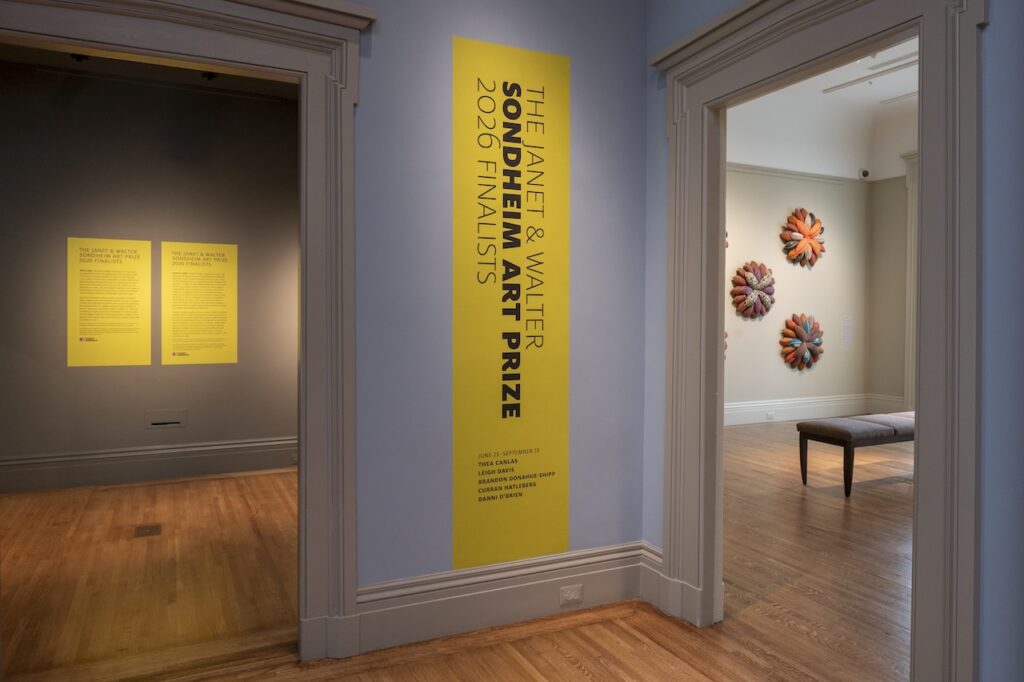
Perhaps the most surprising aspect of this year’s Sondheim exhibition is its collective refusal of certainty. None of these artists offer simple conclusions. Instead, they invite sustained engagement with labor, memory, identity, community, history, and mortality—subjects that resist easy resolution and reward close attention. Although the $30,000 Sondheim Prize will be awarded on August 27, the highest achievement is the exhibition itself, a collaboration between artists, international jurors, Create Baltimore, the Walters, and the Sondheim family whose original gift has continued to fund this project for twenty-one years.
Rather than presenting five artists competing for a single accolade, the exhibit has assembled five rigorous, deeply accomplished practices whose concerns extend well beyond Baltimore. Together, these artists demonstrate the intellectual ambition, technical sophistication, and conceptual range that define contemporary art at its highest level, while remaining rooted in the particularities of place and lived experience. Set within the historic Hackerman House, their work enters into an unexpected dialogue with the museum’s architecture and collections, lending each installation additional resonance and complexity.
In a cultural moment that prizes speed, certainty, and spectacle, that slower proposition feels quietly radical. These artists are not simply producing objects or illustrating ideas; they are expanding the terms of contemporary discourse, asking viewers to reconsider how we inherit history, inhabit our bodies, construct identity, and imagine collective futures. If the Sondheim Prize is intended to identify artists whose work will shape the future of contemporary art, this year’s finalists make a compelling case that Baltimore continues to produce voices worthy of national—and increasingly international—attention.
More information:
The Janet & Walter Sondheim Art Prize is one of the Baltimore region’s most prestigious awards for contemporary visual artists, recognizing artists and artist collaborators who live and work in the greater Baltimore area. Produced by Create Baltimore, the annual competition awards a $30,000 fellowship to one winner, while finalists each receive an exhibition at the Walters Art Museum and a finalist award. Artists working in any visual medium may apply during the annual open call, after which jurors select semifinalists and finalists through a competitive review process.
The 2026 finalists’ exhibition is on view in the Walters’ Hackerman House through September 13, 2026. Upcoming public programs include a Curator Tour on July 12, Sketching Sessions in the galleries on July 16, and Finalist Artist Talks on August 1, all free with registration.
The $30,000 Janet & Walter Sondheim Art Prize will be awarded at the Walters Art Museum on Thursday, August 27, 2026. The award ceremony begins at 7:00 PM, with the galleries opening to the public at 6:00 PM.
Sondheim Jurors, 2026
Lauren Haynes is a curator and arts worker who currently serves as the Executive Director of Atlanta Contemporary. For two decades, Haynes has worked to build a more inclusive future for contemporary art through a curatorial practice rooted in community engagement and equity. Her work spans exhibitions, public programs, residencies, and outdoor installations that amplify the voices of Black artists and others often overlooked by mainstream institutions. She found her path to curatorial work through a college work study job at Oberlin’s Allen Memorial Art Museum. That formative experience, along with nearly a decade at the Studio Museum in Harlem shaped her commitment to representation at every level of the art world. Recent projects include Rest/Play (Governors Island, 2025); Jordan Casteel: field of view (Hill Art Foundation, 2024) and Lyle Ashton Harris: Our first and last love (Queens Museum, 2024). Haynes serves on the board of the Association of Art Museum Curators and AAMC Foundation and on the visiting committee for the Allen Memorial Art Museum at Oberlin College. Haynes was a 2018 Center for Curatorial Leadership fellow and a recipient of a 2020 ArtTable New Leadership Award.
Jinny Khanduja is the executive director of the Cue Art Foundation in New York. Khanduja is a cultural producer, facilitator, writer, editor, administrator, and curatorial caretaker of artists’ work and ideas. She has worked across nonprofit and arts sectors for over 15 years, holding a wide range of roles that bridge programs, development, communications, and leadership. Her practice is grounded in a commitment to new forms of organizational stewardship—ones that challenge conventional models and bring programmatic and operational work into closer alignment. She is especially passionate about creating intentional spaces that can support artists conceptually and materially, while also questioning the systems they operate within. She values depth over scale and believes in the lasting impact of focused, relational work.
Shellyne Rodriguez is an artist, educator, writer, and community organizer based in the Bronx. Her practice utilizes text, drawing, painting, collage, and sculpture to depict spaces and subjects engaged in strategies of survival against erasure and subjugation. She earned her MFA from Hunter College in 2014, and a BFA from the School of Visual Arts in 2011. Rodriguez has shown work at PPOW Gallery, Smack Mellon, MoCada Museum, the Cue Art Foundation, and El Museo Del Barrio and has had residencies at the Robert Rauschenberg Foundation, the Robert Blackburn Printmaking Workshop, and the Latinx Project.