To enter Ernest Shaw’s studio is to wade into the rhythms and hues of a masquerade procession down an imaginary African Diasporic street. Faces and visages call up the living and the dead across the Transatlantic’s seas. When I visit the artist here on a hot July day last summer, soft jazz music plays in the background whilst silently, the sonic visuals of hip hop, Senegalese drumming, and Santéria chants resonate from the oversized canvases against the wall, with African masks playing the role of leitmotif.
Shaw is an artist with a deep sense of lineage. Born into a family of artists and scholars in West Baltimore, one of his earliest memories as an infant is of his mother carrying him and his brother to her college art classes where he first soaked up the sensuality of paint and charcoal. His pedigree includes a great-uncle, Dr. Luke Shaw, who received a PhD in art before the MFA became a terminal degree.
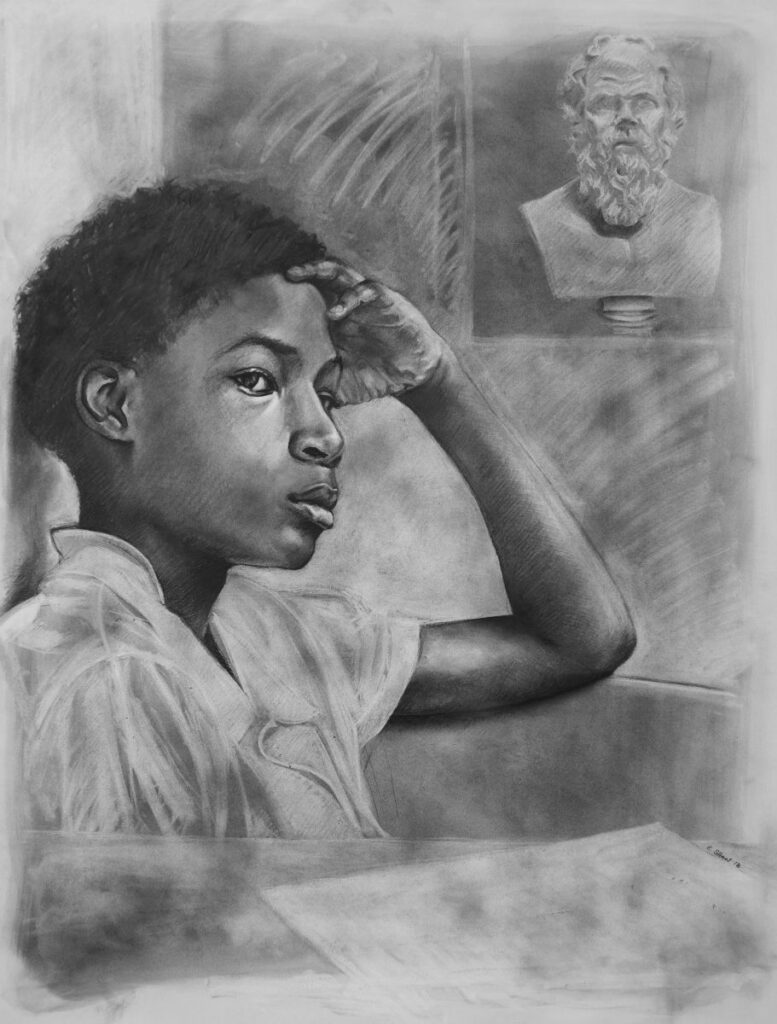
Family is just one facet of his profile that makes Shaw the quintessential ‘artist as scholar.’ Take Academia, an early work in charcoal. Though not a self portrait, the young boy in the frame has a serious mien, head in hand with a question in his eyes, as he looks askance at the world. These thoughtful, interrogative figures appear repeatedly in his portraits.
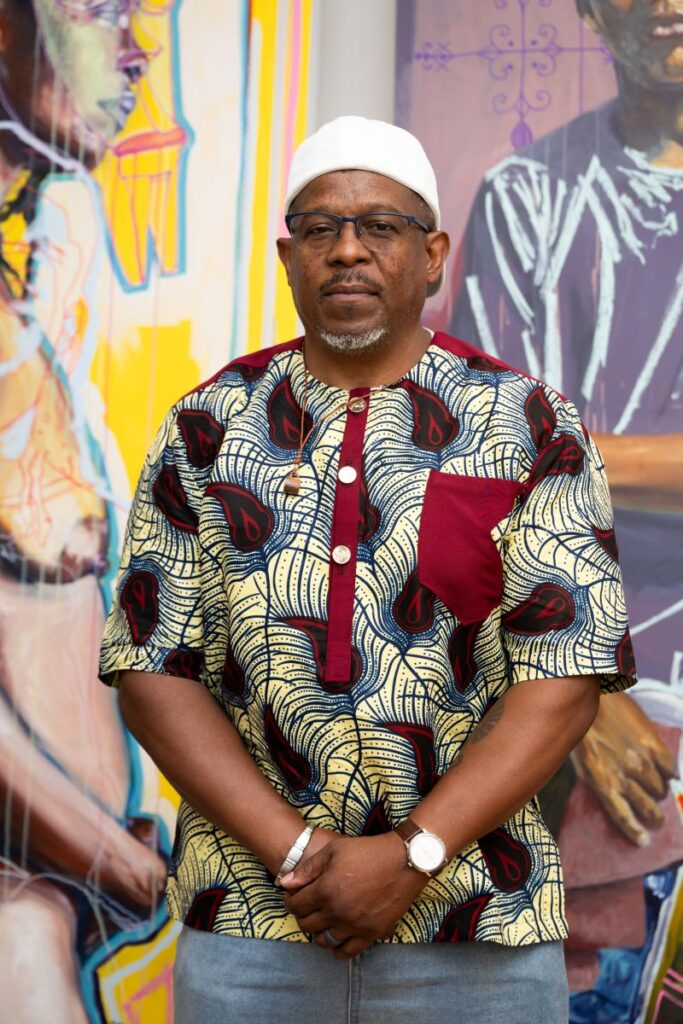
This questioning spirit has defined Shaw’s trajectory. With a BFA from Morgan State University and an MFA from Howard University, he is now a PhD candidate at the Institute for Doctoral Studies in the Visual Arts, a nonresidential program for artists in aesthetics, art theory, and philosophy. Shaw’s motivations here are not merely accumulative, but personal. As a new grandfather he not only wants to be an example for his granddaughter—the PhD is something he would like to achieve while his father is still alive.
More importantly, ideas motivate and animate his art. Take Nkisi, an epitome of his painting style with its repetitions and allusions, its layers and investments in the humanity of the Black subject. The work is dense with varying modes of figuration, from line drawings to broad brushwork. Painted in 2021, blue, pink, and white lines on the saffron yellow painting’s surface trace overlapping profiles of three perceptible yet underdefined women, who take shape as contour and color against the broad strokes of a brown Janus-faced, voluminous, ghostly, presence. The 8’ x 3’ wash of sunny yellow edges and shards of blue alludes to the power of the ineffable in the vicinity of the visceral—indestructible, irreducible humanity as collective survival beyond race or time and space.
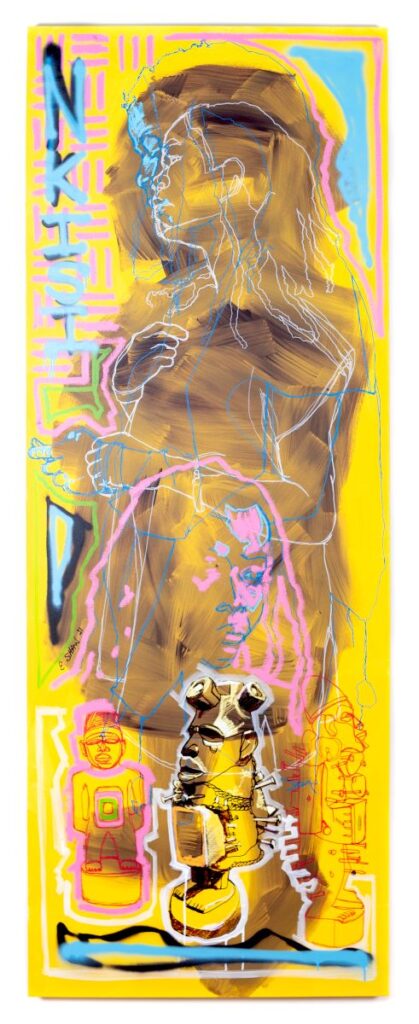
Ernest ShawNkisi is an homage to Black women and their capacity to hold and carry power.
The nkisi (pl: minkisi) is rendered at the bottom of the canvas as outline and realist apparition. Minkisi are objects carved with cavities for medicine, concatenated with ritual power, and used for healing and binding agreements. Originating from The Congo, they are now used globally in African inspired practices including Candomblé and Santéria.
This is the artist making forays into abstraction and away from figurative realism, even as he steers close to the longstanding vocabulary of his practice—representing the Black African Diasporic body in various states of redress by enlisting in almost every painting the mediating presence of African masks or sacred objects and symbols.
According to the artist, Nkisi “is an homage to Black women and their capacity to hold and carry power.” Paired with Gon II, it is one of two painterly versions of a series of graphite drawings the artist produced in 2015.
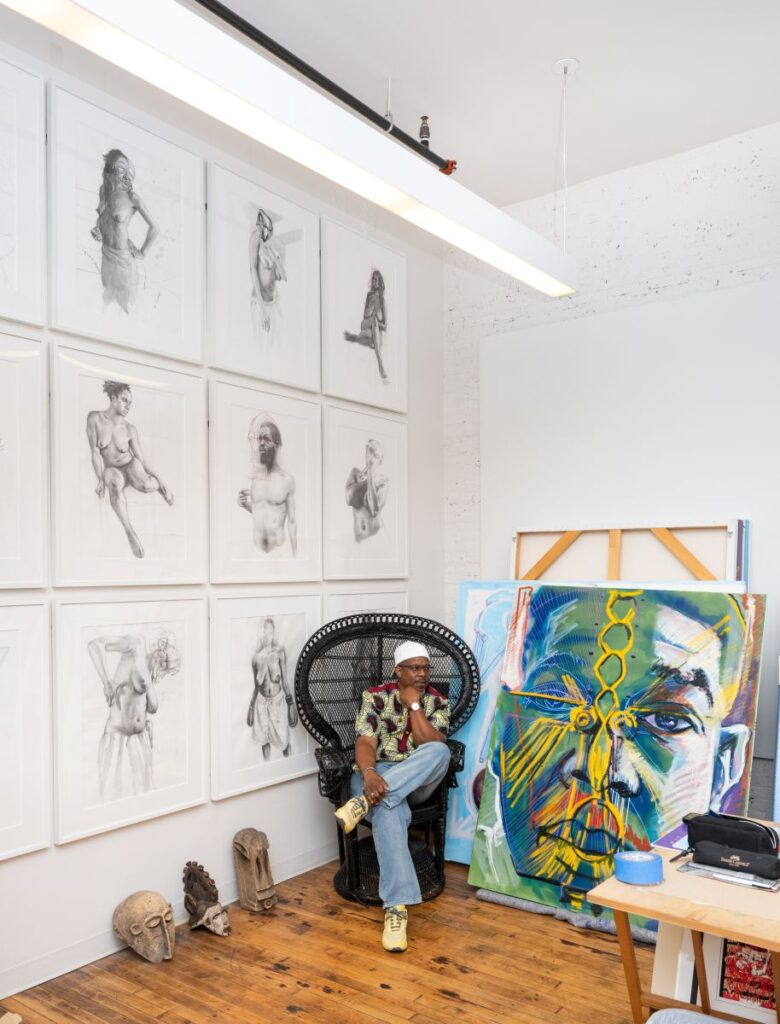
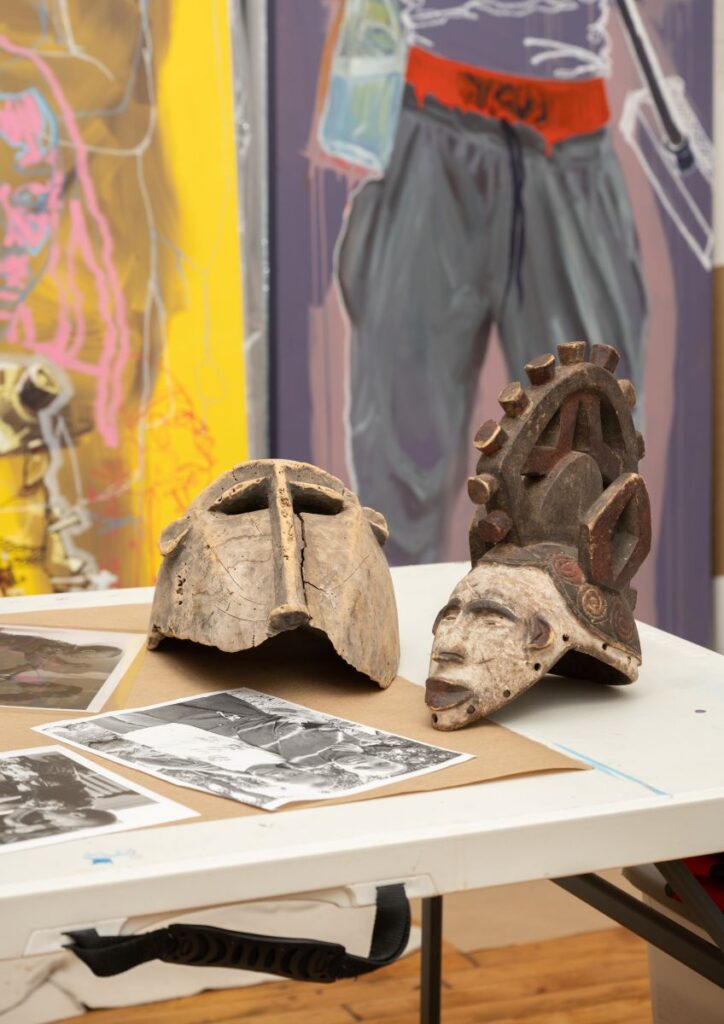
These works were inspired by conversations with female friends and family members, who shared their experience of abuse with Shaw. His shock led to a series of graphite sketches cataloging the lean and athletic, the undulating and voluptuous, the pensive and the graceful bodies of Black women that fill the north wall of his studio. The portraits are an acknowledgement of his subjects’ expressed humanity. Yet, masks appearing with the figures muzzle and disguise, weigh down, and silence. This is the masking of self-protection behind which many women hide their pain and traumas. As the poet Paul Laurence Dunbar wrote, “We wear the mask that grins and lies / It hides our cheeks and shades our eyes…”
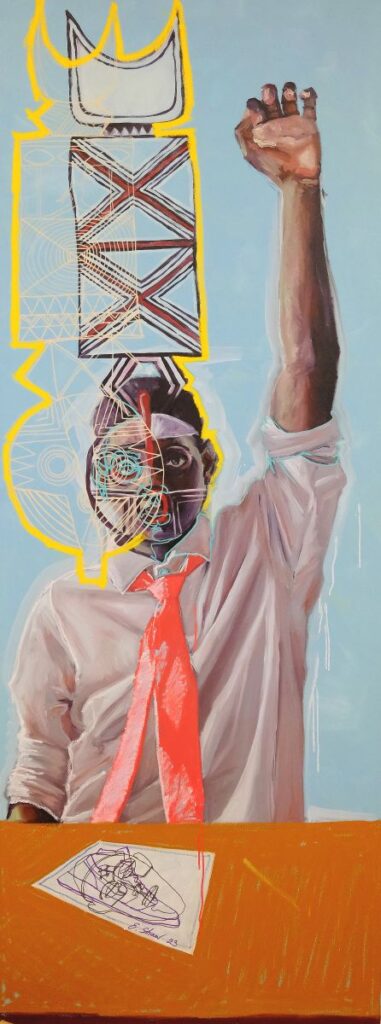
Other modes of masking found in Shaw’s work perform a richer and more liberating mediation. In Bwa, a plank mask from Burkina Faso is superimposed on the portrait of a male figure in professional attire. Here, Shaw is enlisting the mask as a mediator of identity in images of Black masculinity. A neon orange tie bleeds onto a drawing of a sneaker, which is overlaid with a sketch of a Punu mask from Gabon, as if to replace consumer objects of desire associated with urban masculine culture with African inspired symbols of maturity and adult subjectivity.
Shaw often titles paintings with the proper names of ethnic groups, which also identify the type of masks that replace or float around the visages of the subjects, as if to precipitate a consciousness located in African identity: Bwa, Dan, Chokwe, Fang, Senufo. It is a move that cites a particular people whilst reinscribing ontogeny both in the past and in the now time of self-recognition, transcending the particularity of indigeneity.
Dora MarkeA neon orange tie bleeds onto a drawing of a sneaker, which is overlaid with a sketch of a Punu mask from Gabon, as if to replace consumer objects of desire associated with urban masculine culture with African inspired symbols of maturity and adult subjectivity.
A former teacher in the Baltimore City Public School system for 22 years, the artist makes it clear that his pedagogy is not distinct from his artistic philosophy. Black iconic scholars and creatives provide a conceptual armature for his practice: W.E.B. Dubois’ ideas on double consciousness; Fanon’s critiques of Western humanism in Black Skin, White Masks; the Jamaican American playwright and social theorist Susan Wynter’s reworlding of the human as a verb, not a noun, a praxis. Add Toni Morrison, James Baldwin, John Coltrane, and Alvin Ailey—the creative icons he calls his Mount Rushmore.
“Why the masks?” I ask, curious about his transposition of the traditional African art form into contemporary art.
“It is about identity,” Shaw says. “I drop different sculptures, symbols, masks as a [vernacular] of who we are as a global people with a culture that’s tens of thousands of years old. We have a history that did not begin with slavery. We are African.”
Shaw’s practice is a redemptive, reparative project of identity formation, specifically African Diasporic identity, as it dismantles the dehumanizing reduction of Blackness to the underside of its putative opposite. As he puts it, “We are conditioned to think dichotomously, and that dichotomous thinking—good/evil, white/black—does not account for the nuance and the layers that exist in the in-between spaces. And this is a term I’m going to focus on in my dissertation: The Unembodied In-between of Blackness: that is where our humanity rests. That is where anyone from any ethnicity, any culture, that is where they connect with the work.”
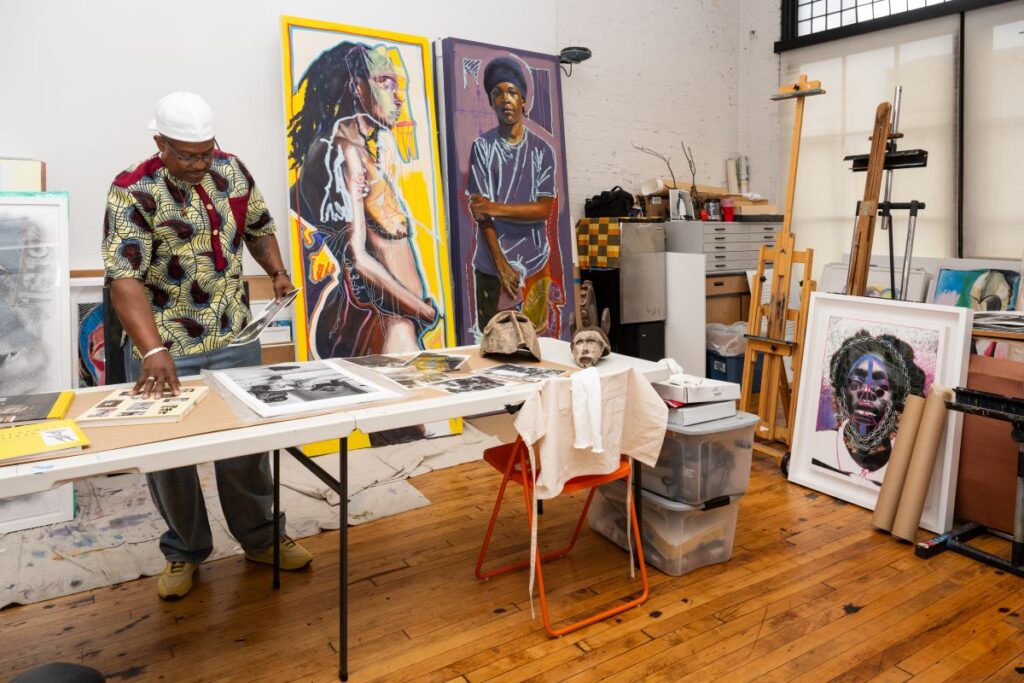
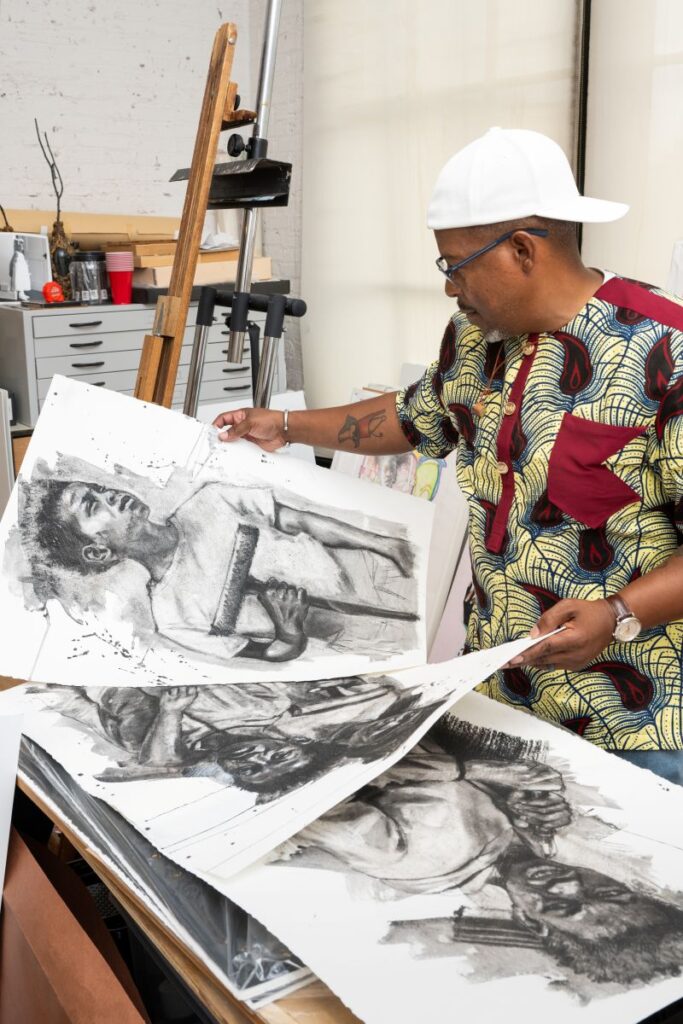
Ernest ShawThe Unembodied In-between of Blackness: that is where our humanity rests. That is where anyone from any ethnicity, any culture, that is where they connect with the work.
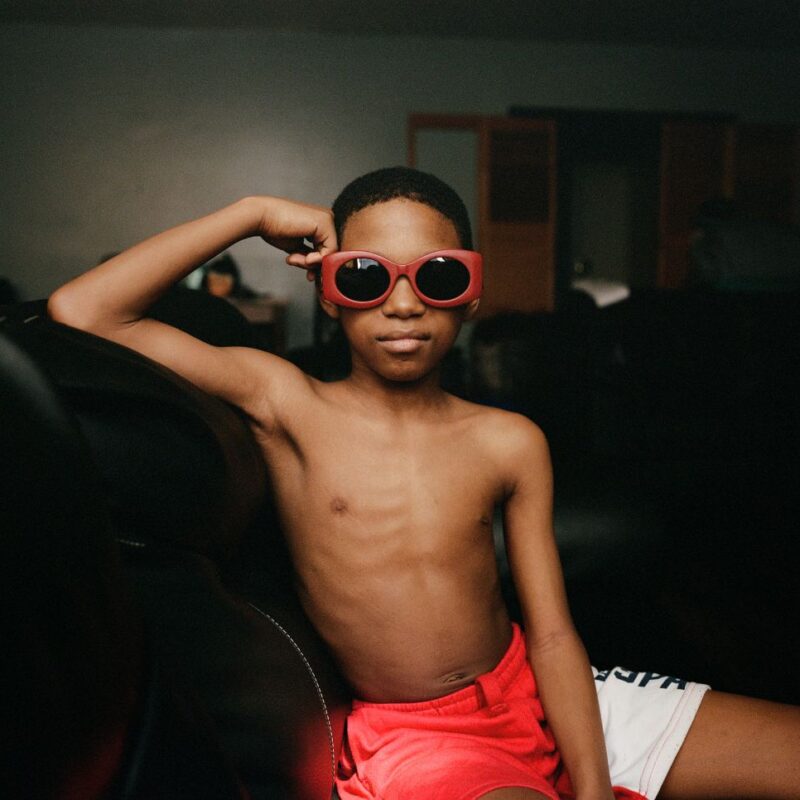
In the Crossing Godz series, a new body of work featuring squeegee boys, the artist begins with photographs, layered with acrylic, oils, and water soluble pastels. Modeled on crossing guards, the Godz are figures who stand at crossroads. Like tricksters, they are harbingers of chaos but can also remove obstacles and offer options and openings in navigating the challenges of life. Similarly, squeegee boys offer people the opportunity to reveal their humanity—based on how they choose to relate to them. This is the praxis of humanization, where recognition engenders the indestructibly human, impervious to violation and violence.
At play here is a theory of reception that does not recognize art as an object, but as a process of co-creation between the maker of images and the audience. According to Shaw, his professor at Howard, Michael B. Platt, “instilled in his students the importance of words and language… The work becomes ‘art’ when it has an audience and that audience communicates a response to the work/image maker.” In apprehending and meditating on Shaw’s work, the viewer is called upon not only to engage with art as co-creation, but to consider the active role one plays in receiving his subjects’ complex and indelible humanity.
In parallel, the West African masking tradition which Shaw iterates and reiterates visually is a living, pulsing, rhythmic event of music, dance, and collective co-creation. This for me is the beating heart of his work, a call for all of us to engage with art as an ongoing antidote to the fictions of slavery, colonialism, and dehumanization that we as Africans of the Diaspora have survived for 500 years.